Overview

A growing SaaS company wanted to modernize its cloud deployment process for a full-stack application. They required a cloud native platform that could handle rapid feature delivery with stronger security and faster deployment cycles. They chose AWS as the foundation with Terraform for infrastructure automation and GitHub Actions for CI/CD orchestration.

Our aim was to make their vision a reality. To do so, we built a fully automated Infrastructure as Code (IaC) and deployment pipeline. It brought together infrastructure provisioning and application deployment along with security under one workflow. With automated compliance practices and infrastructure as code, the company cut deployment time from 2 hours to less than 10 minutes. They now release updates multiple times a day with zero downtime and full confidence in production quality.


Achievements


  • 90% reduction in deployment time
  • 98% reduction in manual deployment errors
  • Multiple deployments per day with zero downtime
  • 35% cost reduction through optimized resource utilization
  • 100% infrastructure audit trail and compliance

Key Challenges


  • Manual Infrastructure Provisioning

    The team created cloud resources manually. This led to inconsistent environments and configuration drift. Development, staging, and production ended up with different setups, which often caused deployment failures.

  • Slow and Error-Prone Deployments

    Manual deployment processes requiring multiple steps across the frontend and backend increased error rates and deployment time. Each release took 2+ hours with frequent rollbacks.

  • Security Vulnerabilities from Manual Credential Management

    Long-lived AWS credentials stored in various locations created security risks. No centralized secret management led to credential leaks and compliance issues.

  • Limited Deployment Visibility

    Lack of deployment history and rollback capabilities made troubleshooting difficult. Teams had no clear audit trail of infrastructure or application changes.

  • Environment Configuration Drift

    Without version control for infrastructure, environments diverged over time. This resulted in "works on my machine" problems and production incidents.

  • Compliance and Audit Complexity

    Manual tracking of infrastructure changes made it difficult to maintain audit trails and demonstrate compliance with security standards.

Our Solution with Infrastructure as Code

The company implemented a comprehensive automation framework that unified infrastructure provisioning and application deployment. This created a single, automated workflow built entirely on GitHub Actions and AWS.

Core Technology Stack

Layer Technology Purpose

Frontend

React SPA

Single-page application with modern UI

Backend

Node.js
Express

RESTful API with microservices architecture

Infrastructure

Terraform

Automated AWS resource provisioning

Container Registry

Amazon ECR

Docker image storage and versioning

Compute

Amazon ECS Fargate

Serverless container hosting for backend

Database

Amazon RDS PostgreSQL

Managed relational database with Multi-AZ

Storage & CDN

Amazon S3 + CloudFront

Static asset hosting and global distribution

CI/CD

GitHub Actions

Automated build, test, and deployment

Security

AWS Secrets Manager, IAM

Secure credential storage and authentication

Monitoring

CloudWatch

Application and infrastructure observability

Complete CI/CD Pipeline Implementation

Every code commit triggered a multistage automated deployment pipeline. It ensured quality and security before production.
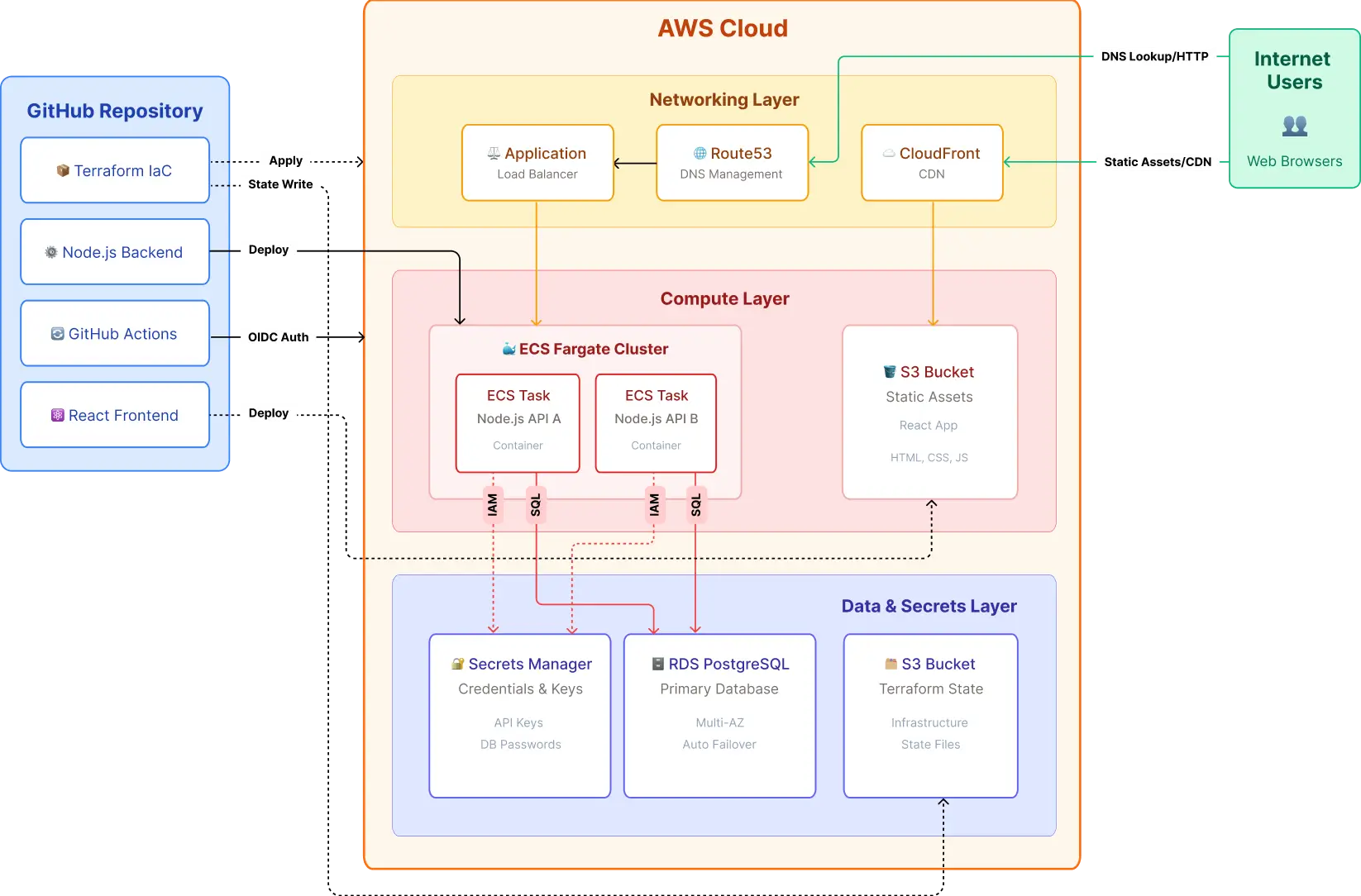

Complete CI/CD Pipeline


Stage 1: Infrastructure Validation with Terraform

  • Validates Terraform syntax and configuration files
  • Runs terraform plan to preview infrastructure changes
  • Scans infrastructure code with tfsec and Checkov for security issues
  • Posts plan output as a PR comment for team review
  • Blocks merge if validation or security checks fail

Stage 2: Application Build and Testing

  • Executes unit tests for React frontend (Jest) and Node.js backend
  • Runs integration tests against test database
  • Generates code coverage reports
  • Builds production-optimized React bundle

Stage 3: Container Security Scanning

  • Builds Docker images using multi-stage builds
  • Scans container images for vulnerabilities with Trivy
  • Checks for outdated dependencies with Dependabot
  • Validates image signatures
  • Pushes signed images to Amazon ECR

Stage 4: Infrastructure Provisioning

  • Authenticates to AWS using IAM user credentials with a configured profile
  • Applies Terraform changes with state locking
  • Creates or updates VPC, ECS clusters, RDS, S3, CloudFront
  • Validates resource creation through health checks
  • Maintains complete state history in S3

Stage 5: Application Deployment

  • Deploys React app to S3 with versioning
  • Invalidates CloudFront cache for immediate updates
  • Updates ECS task definitions with new container images
  • Performs blue-green deployment with health checks
  • Automatically rolls back on failed health checks

Integrated Security and Compliance


  • Secrets Management

    AWS Secrets Manager and Parameter Store kept credentials out of the code. The system rotated database passwords every thirty days.

  • Authentication

    IAM user credentials with configured profiles ensure secure access to AWS resources. Credentials managed securely through GitHub Secrets.

  • Network Security

    VPC with public and private subnets. Security groups restricted access based on least privilege. Database isolated in private subnet.

  • Data Protection

    RDS encryption at rest with KMS. TLS/SSL for all data in transit. S3 bucket versioning and encryption enabled.

  • Continuous Compliance

    Infrastructure scanned for compliance violations before deployment. Automated alerts for configuration drift. Complete audit trail in CloudTrail.

  • Container Security

    Vulnerability scanning before deployment. Non-root containers with read-only filesystems. Resource limits enforced on all containers.

Results & Impact


Operational Efficiency

  • Deployment frequency increased from weekly to multiple times per day (500% improvement)
  • Lead time for changes reduced from 2 hours to 10 minutes (92% faster)
  • Mean time to recovery reduced to under 15 minutes
  • Infrastructure provisioning for new environments reduced from 3 days to 30 minutes

Enhanced Security

  • Centralized credential management with GitHub Secrets
  • Zero unresolved critical vulnerabilities in production
  • Automated security scanning catching issues before deployment
  • Complete infrastructure audit trail for compliance

Improved Developer Productivity

  • Developers can deploy with confidence without manual steps
  • Reduced time spent on environment setup and troubleshooting
  • Increased developer satisfaction through automated quality gates
  • Self-service infrastructure through pull requests

Implementation Timeline


Month Milestone

1

Discovery, toolchain selection, and AWS architecture design

2

Terraform infrastructure modules and state backend setup

3

GitHub Actions pipeline design and configuration

4

Application containerization and ECS deployment

5

Security scanning integration and compliance validation

6

Production cutover, monitoring setup, and team handover

Key Engineering Insights


  • Infrastructure as Code Reduces Errors

    Treating infrastructure and application deployments as code with Git version control reduced deployment errors by 98%.


  • Secure Credential Management

    IAM user credentials stored securely in GitHub Secrets with profile-based configuration simplified access management.


  • Terraform State Locking Prevents Conflicts

    DynamoDB-backed state locking prevented concurrent modifications and state corruption, ensuring infrastructure consistency.


  • Blue-Green Deployments Enable Zero Downtime

    ECS blue-green deployments with automated health checks allowed production updates without service interruption.


  • Shift-Left Security Catches Issues Early

    Integrating security scanning in CI/CD caught vulnerabilities before deployment.


  • Observability Accelerates Troubleshooting

    CloudWatch dashboards and X-Ray tracing reduced the mean time to recovery from 4 hours to 15 minutes.

Long-Term Value


Operational Gains

  • Full-stack application deployed across multiple AWS services
  • Fully automated infrastructure provisioning and application deployment
  • Complete disaster recovery capability through infrastructure as code
  • Multi-environment support (dev, staging, production) with consistent configuration

Security and Compliance

  • Continuous vulnerability scanning and policy enforcement
  • Zero critical vulnerabilities in production deployments
  • Complete audit trail for all infrastructure and application changes
  • Compliance with security best practices and industry standards

Business Outcomes

  • Accelerated innovation with faster time-to-market
  • Higher developer morale and productivity through automation
  • Reduced operational costs through optimized resource utilization
  • Strong foundation for future microservices migration and scaling

Key Metrics Dashboard


DORA Metrics


  • Deployment frequency: Multiple deployments per day
  • Lead time for changes: < 30 minutes
  • Change failure rate: < 3%
  • Mean time to recovery: < 15 minutes

Infrastructure Metrics


  • Infrastructure as Code coverage: 100%
  • Terraform state consistency: 100%
  • Automated deployment success rate: 97%

Application Metrics


  • API response time (p95): < 200ms
  • Frontend load time (p95): < 2 seconds
  • Uptime: 99.95%
  • Error rate: < 0.1%

Cost Metrics


  • Monthly AWS cost reduction: 35%
  • Cost per deployment: Tracked and optimized
  • Resource utilization: 70-80% (optimal range)

Technical Best Practices Adopted


  • Infrastructure as Code with a modular Terraform design for reusability
  • Git-based workflow for complete version control and audit trail
  • IAM user authentication with secure credential storage
  • Multi-stage Docker builds to minimize container attack surface
  • Automated security scanning at every pipeline stage
  • Blue-green deployments with automated rollback capabilities
  • Secrets managed centrally in AWS Secrets Manager
  • Complete observability with CloudWatch, X-Ray, and custom metrics
  • Cost tagging and tracking for all AWS resources
  • Database migration as a separate pre-deployment step
  • CloudFront cache invalidation automation
  • Terraform workspace separation for environment isolation

Conclusion

The SaaS company successfully transformed its cloud deployment process. This helped them build a fully automated software delivery ecosystem. They brought together infrastructure automation, continuous deployment, and security monitoring. This completely changed the way their platform operates in the cloud.

The combination of Terraform for infrastructure management and GitHub Actions for CI/CD automation delivered measurable business value. Teams can now deploy with confidence multiple times per day, maintain complete security compliance, and respond to customer needs faster than ever before.

Ready to accelerate your cloud infrastructure with automated DevOps?