-
 India, USA
-
 Entertainment
-
 OTT Platform
India, USA
Entertainment
OTT Platform
Maahoul was created around an ambitious product vision: rethink how concerts are distributed, monetised, managed, and experienced digitally. Rather than building another video library, the platform connects the different parties involved in the concert ecosystem and gives each one a purpose-built experience.
Audiences can discover and stream performances. Artists and their representatives can publish and monetise concerts. Administrators manage approvals and commercial operations. And Performing Rights Organisations (PROs) can review approved concerts, submitted setlists, royalty records, and payment workflows.
Mobisoft partnered with Maahoul to design and build this platform from the ground up. The result is a custom-built OTT platform combining VOD streaming, adaptive bitrate delivery, DRM, subscriptions, concert purchases, artist monetisation, rights workflows, analytics and multi-role content operations in one connected product.
The outcome is a single OTT ecosystem that connects six stakeholder groups around one concert record, spanning content creation, approval, monetisation and rights administration.
Traditional OTT products focus on the relationship between a content catalogue and a viewer. Concerts introduce a longer chain of participants and decisions. A single performance can involve an artist, a manager or label, a venue, an agreement, a setlist, content rights, a subscription tier, a purchase, a streaming royalty, and an administrative approval before anyone watches it.
Maahoul needed to work as both a video streaming platform and a concert operations platform. A generic white-label product would have forced these concert-specific processes into a template built for something else. A custom build let the architecture follow the operating model of the business instead. Three challenges shaped most of the engineering decisions.
A concert could be created by an artist or a representative, reviewed by an administrator, exposed to a rights organisation and finally consumed by an audience member. Duplicating that record across separate systems would have created drift and confusion.
We designed role-specific workflows around a single shared lifecycle instead. Each stakeholder receives the controls relevant to their responsibility, while the platform keeps one consistent record underneath. This lets every party act on the same concert without ever touching another party's workflow.
A simple subscribed or not-subscribed model could not support free Tier 1 concerts, premium Tier 2 concerts, a trial period, fixed-term subscriptions, artist-specific subscriptions and individual purchases all at once.
Our team centralised entitlement logic so payment and subscription states translate directly into playback permissions and quality rules. Multiple commercial strategies now coexist without separate delivery systems for each one, and new pricing models can be added without touching the streaming layer itself.
Setlists, agreements, royalties, and PRO visibility needed to enter the platform without adding operational weight to the audience experience.
We separated consumer playback from administrative and rights workflows while keeping the data relationships between them intact. Admin approval acts as the gate that determines when a concert becomes visible inside the PRO workflow, so rights processes stay connected to streaming without ever surfacing inside it.
Together, these decisions let Maahoul function as both a streaming destination and an operational system for concert content, rights and payments.
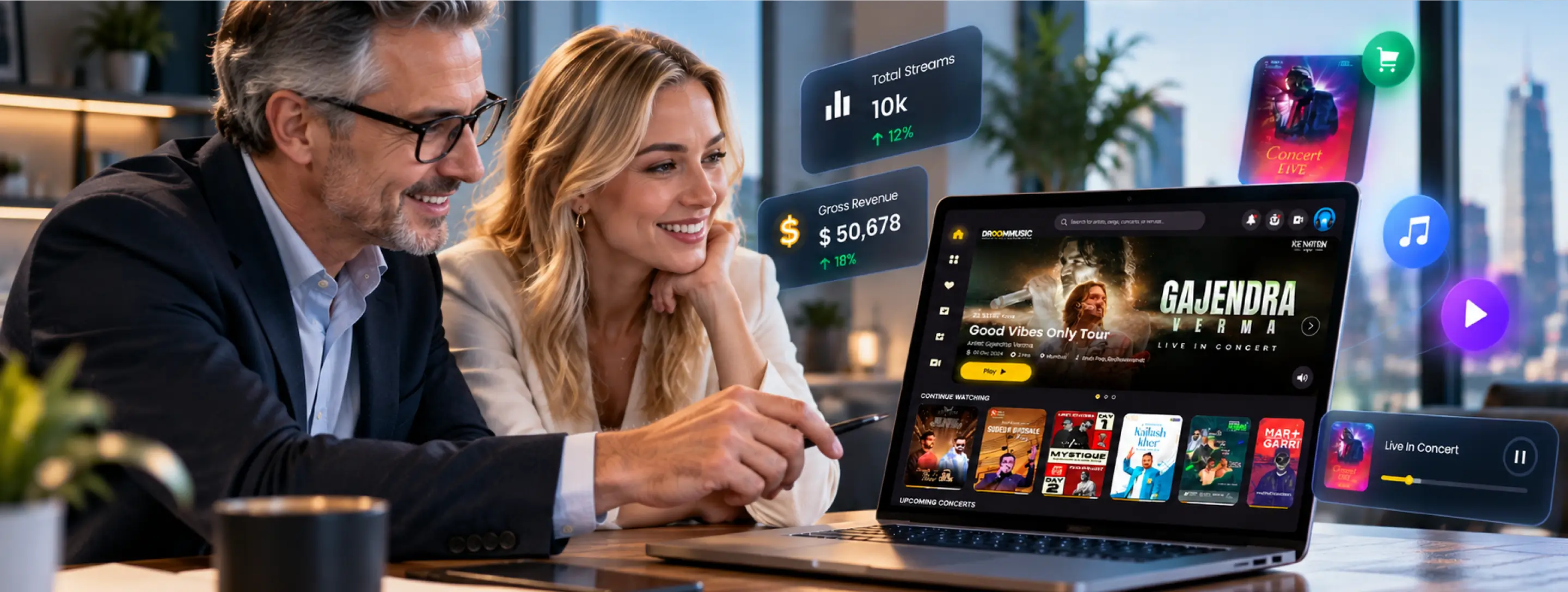
The discovery phase began by mapping every participant in the concert lifecycle and what each one needed to control. The team defined six connected experiences: Audience, Artist, Talent Manager / Record Label, Venue / Organiser, PRO and Super Admin. Role-based permissions kept each group's responsibilities clear while preserving one underlying concert record shared across the platform.
Streaming workloads behave differently from ordinary application traffic, so the team designed media handling as its own dedicated layer. AWS MediaConvert processes video and generates playback renditions, CloudFront distributes media at scale, and VideoCrypt supports protected playback. This separation let the application layer stay focused on users, subscriptions, content, permissions, payments, and business rules.
Payments were not treated as a checkout feature bolted on at the end. Zoho Billing manages subscription operations, and Razorpay handles payment processing. Entitlement rules then determine what a viewer can access based on free or premium status, subscription state, artist subscription, or individual concert purchase.
Audience members register using OTP authentication, choose preferences around genres and artists, search the catalogue, receive preference-based recommendations, build playlists, save favourites, and resume viewing through a continue-watching experience. A concert platform needs reasons for a viewer to return beyond one performance, and this layer turns a catalogue into an ongoing relationship.
The platform offers a 7-day trial and subscription terms of 1, 3, and 12 months. Tier 1 concerts remain available to any registered viewer, while Tier 2 concerts require either a concert purchase or an active subscription to the relevant artist. Different artists and performances can now support different commercial strategies without separate streaming systems.
Artists work inside a dedicated Studio experience for creating and managing concerts. They upload concert details, video, and supporting documents. They can save incomplete submissions as drafts, manage upcoming concerts, and distinguish premium content from standard releases. Artist analytics cover views, watch time, subscriber counts, unique viewers, estimated revenue, age demographics and geographic insight, along with earnings and balance history. Artists become active participants in monetisation rather than simply supplying files to a central team.
Representatives who manage more than one artist can work across relevant profiles, create concerts on an artist's behalf, maintain supporting documents and manage content with role-specific access. This mirrors how the concert industry actually works, where artists frequently operate through management companies, labels, venues and event organisations.
Rights administration sits at the core of the platform rather than at its edge. A concert first moves through administrative review. Once approved, its details and submitted setlist become visible inside the PRO experience, where reviewers can examine approved records, artists, agreements, setlists, song-level information, royalty records and payment workflows.
The Super Admin experience gives central visibility across audiences, artists, PROs, talent managers, organisers, concerts, playlists, subscriptions, royalties, payments, contracts, notifications, reported issues, policies and audit activity. Launching a product is only part of the work. The business also needed a structured operating system for content, commercial administration, and governance after launch.
Completed within the four-month engagement, Maahoul established a working foundation for managing a concert from creation through approval, monetisation, streaming, rights administration, analytics, and payment.
Audiences now have a dedicated destination for discovering and watching concert content. Artists and industry stakeholders have structured tools to publish, manage, monetise, and analyse their own performances. Platform operators can view content, subscriptions, stakeholders, contracts, royalties, payments, and audit activity from one administrative environment.
One platform now connects content creation, approval, rights administration, monetisation, protected VOD playback, analytics, royalties and payments across six stakeholder experiences. That is the core achievement, not a single feature but a working system that holds these processes together without forcing any one stakeholder into another's workflow.
"Maahoul required much more than a traditional streaming application. The platform needed to connect audiences, artists, representatives, organisers and rights stakeholders while supporting the commercial and operational workflows behind every concert. The result is one connected product that gives each stakeholder the tools they need."
A concert OTT platform needs more than a video player. Rights, artists, organisers, subscriptions, contracts, royalties, and content operations all shape the product architecture from the start. Custom OTT development lets Maahoul model concert-specific workflows instead of adapting the business to fit a generic white-label platform.
Free access, trials, subscriptions, artist subscriptions, and premium concert purchases can coexist inside one entitlement model when that logic sits at the centre of the architecture. Role-based design makes a complex ecosystem manageable. Giving six stakeholder groups the right visibility and controls at each stage keeps the platform usable as it scales.
A concert never stops at the screen. It carries an entire operational history with it, from the artist who submitted it to the rights organisation that reviews its royalties. Building for that reality, rather than around it, is what separates a streaming app from a streaming business.
Mobisoft brings product strategy, engineering, and content operations together to help you build it right.
Let’s Talk