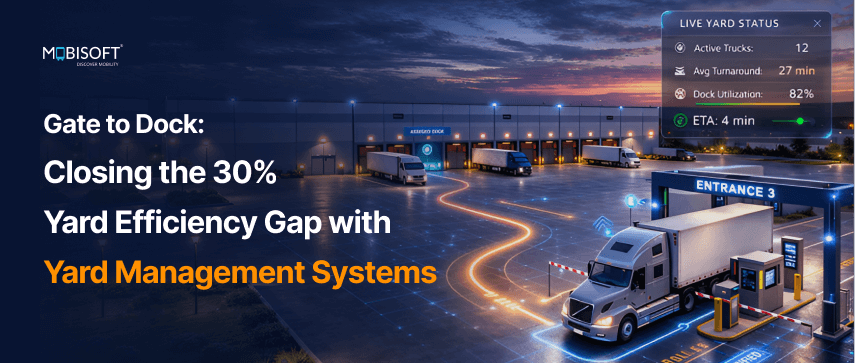
Here is a question that rarely gets asked in reviews focused on supply chain optimization. We pour resources into route optimization and warehouse automation, yet the space connecting them remains largely unexamined within the overall warehouse yard management strategy. It is curious when you consider that this overlooked zone, those few acres between the gate and the dock, directly influences transport costs, warehouse productivity, and service reliability all at once.
Dock schedules slip because arrivals cluster unpredictably without structured dock scheduling software. Warehouse teams stand waiting while carriers hunt for parking spots. The cumulative effect runs to millions annually, though few organizations trace the leakage back to its source inside fragmented yard operations management.
We tend to think of the yard as a passive space, a neutral zone where trucks simply wait their turn. But space is never really neutral in the supply chain. It either enables flow or constrains it. And in most facilities, the yard has become a constraint dressed up as a parking lot, often due to the absence of a structured yard management system.
Organizations exploring how to improve yard efficiency and reduce gate-to-dock delays often start by evaluating scalable yard management software built for high-volume warehouse environments.
The Real Problem: Operational Blind Spots
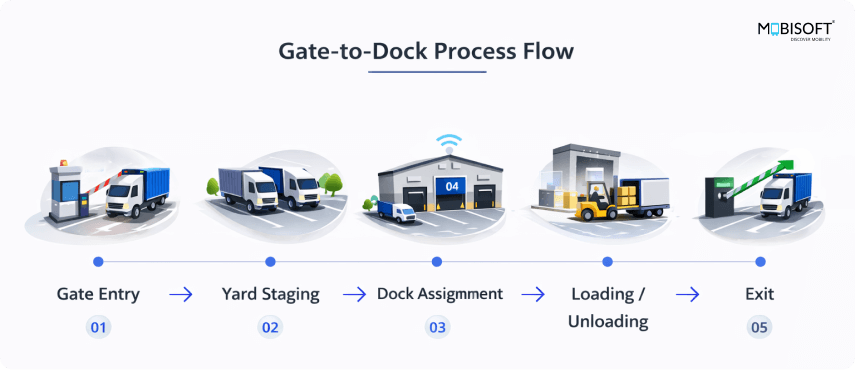
The yard creates blind spots because responsibility fragments the moment a truck passes through the gate. Transportation teams focus on getting vehicles to the facility on time. Warehouse teams focus on moving freight once it reaches a door. The space in between, where trucks queue, park, and wait, belongs to no single function, which means problems there belong to everyone and no one at once.
Blind Spot 1: No Real-Time Visibility
Knowing what sits in the yard at any given moment should be simple, yet most facilities cannot answer this basic question without physical verification or real-time yard tracking. The gate log shows arrivals from hours ago. The appointment system shows what was scheduled. But loaded trailers drift into corners of the lot, spotted trucks wait for doors that are not actually free, and no single screen shows the current state of play. Dispatchers assign arrivals based on assumptions. Dock managers release labor based on incomplete information. The entire operation reacts to yesterday's problems while today's congestion builds, directly affecting warehouse efficiency.
Blind Spot 2: No Ownership of Dwell Time
When a truck sits for three hours, the cost accumulates silently, but responsibility disperses instantly. Transportation points to unloading delays. Warehouse points to late arrivals. Security points to paperwork errors. Each explanation contains enough truth to stick, which means no single function ever owns the full cycle from gate to departure. Without ownership, dwell time becomes a topic for monthly reviews rather than a metric for daily improvement. The underlying pattern, perhaps that one carrier consistently arrives early or that afternoon shifts lack dock labor, never surfaces because nobody is paid to find it, making it harder to reduce truck turnaround time.
Blind Spot 3: Dock Capacity Is Underutilized
Consider a facility running thirty-five docks across two shifts, which represents 560 potential operating hours each day. Industry benchmarks suggest many yards achieve around seventy percent utilization, leaving more than 160 dock-hours unused daily. Those hours represent real capacity, already staffed and lit and heated, simply wasted because trucks cannot reach doors efficiently. The interesting part is that most organizations blame insufficient dock capacity when the real constraint sits fifty yards away, hidden in plain sight among queuing trucks and unclear yard layouts that lack an integrated yard management system.
These coordination gaps highlight why the future of freight logistics technology is increasingly focused on reducing gate-to-dock delays and eliminating common bottlenecks in yard operations through connected digital platforms.
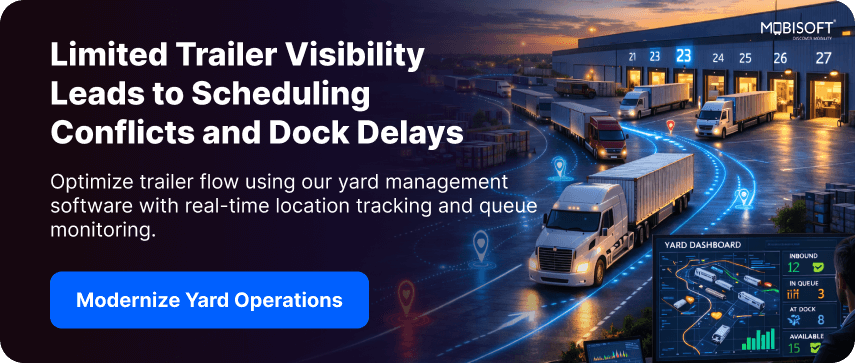
Yard Maturity Model: Where Does Your Facility Stand?
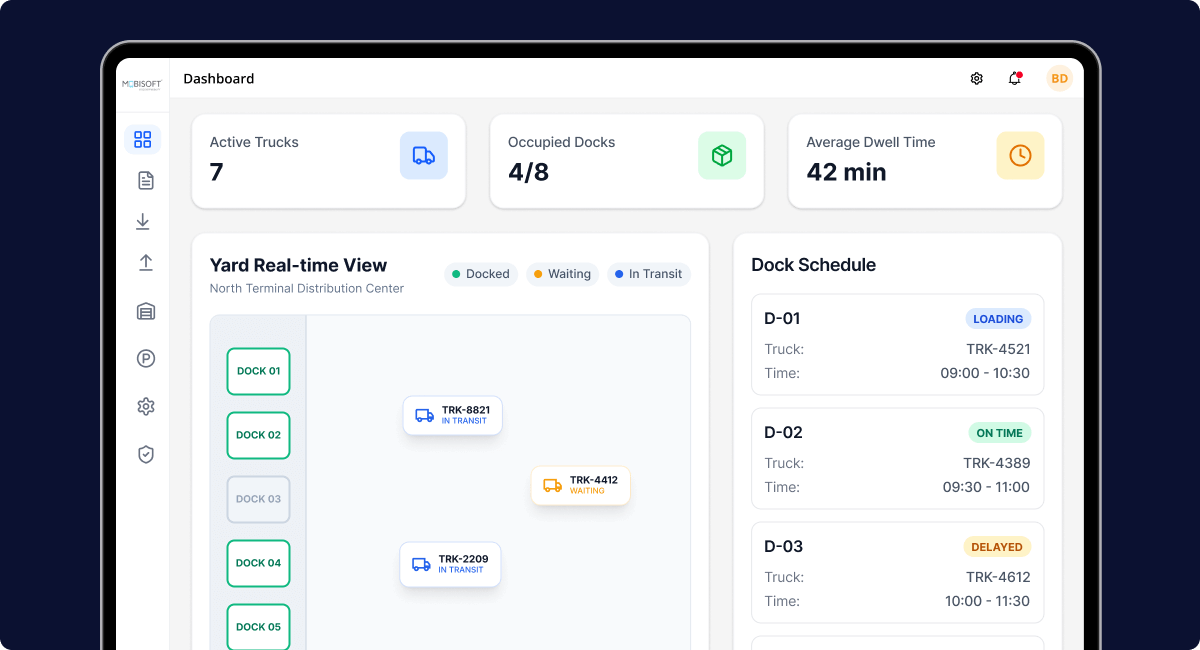
How yards evolve tends to follow a pattern in overall warehouse yard management. The question is not which technology a facility uses but how its operating model handles variability.
Level 1: Manual & Reactive
- Paper gate registers capture arrivals but provide no visibility once trucks leave the booth.
- Walkie-talkie coordination creates constant noise without building any useful picture of the yard's status.
- No dock planning means assignments happen reactively as trucks arrive throughout the day.
- No dwell time tracking leaves management blind to how long trucks actually sit.
Impact:
- Two to three-hour truck turnaround becomes normalized as standard operating practice.
- High detention costs accumulate silently and are only discovered during invoice reconciliation.
- No visibility means leadership cannot identify where delays originate or who owns them in overall yard operations management.
Level 2: Spreadsheet-Controlled
- Basic appointment sheets spread arrivals across windows but require manual updates throughout the day.
- Manual dock planning relies on one person's knowledge of which doors work best for which freight.
- Email coordination creates delays as information moves more slowly than trucks through the gate.
Impact:
- Slight improvement in turnaround, but nothing that fundamentally changes the operating rhythm.
- Still no real-time insight into what sits in the lot or which trucks are actually ready.
- High operational dependency on specific individuals who hold the process knowledge.
Level 3: Digitally Scheduled
- The appointment system structures arrivals to prevent the morning rush and afternoon gaps.
- Basic dock allocation follows the schedule rather than reacting to whatever shows up first.
- Timestamp recording creates data that reveals how long each stage of the process takes.
Impact:
- Fifteen to twenty percent turnaround improvement as arrivals spread more evenly.
- Partial visibility into performance, though gaps remain between scheduled and actual activity.
- Data exists, but often sits unused in reports rather than driving daily decisions.
Level 4: Integrated Yard Control
- Gate automation logs arrivals instantly through license plate or driver credential recognition.
- Dock optimization matches trailers to doors based on real-time status and scheduled appointments using a yard management system.
- Yard zoning organizes the lot intelligently, separating live loads from drop-and-hook traffic.
- Asset tracking shows exactly where every trailer sits without anyone walking to check through real-time yard tracking.
- ERP and TMS integration eliminates duplicate data entry and keeps systems aligned.
Impact:
- Twenty-five to forty percent turnaround reduction as coordination replaces reaction.
- Twenty to thirty percent dock efficiency improvement from continuous door utilization.
- Data-backed decisions replace guesses about why congestion forms and where.
Level 5: Performance-Driven Yardmpact:
- Predictive congestion alerts warn of problems before trucks stack up at the gate.
- Carrier performance analytics reveal which partners consistently drive delays or inefficiency.
- SLA-based dock prioritization rewards reliable carriers with faster turns through the facility.
- Continuous KPI benchmarking compares performance against internal targets and external standards for sustained supply chain optimization.
Impact:
- Sub-ninety-minute turnaround becomes the standard that operations build around.
- Minimal detention cost as dwell time shrinks and accountability clarifies.
- High carrier reliability as partners recognize the facility as easy to work with.
- Operational predictability means warehouse and transportation finally coordinate rather than blame.
Most facilities operate between Level 1 and Level 2. For organizations evaluating transportation management systems for visibility, understanding core TMS features for logistics is essential to fully integrate yard and dock performance data.
The Financial Drain: Breaking Down Hidden Costs
Scenario:
The financial drain from yard inefficiency is easier to model than most leaders expect. Take a facility handling 250 trucks daily with an average avoidable delay of one hour. At a detention rate of forty dollars per hour, that is ten thousand dollars daily or roughly three point six million annually. But detention charges are only the visible portion of weak Logistics Optimization.
Result:
- Dock labor stands idle while trucks queue outside.
- Warehouse workers run overtime because afternoon arrivals backed up past the shift change.
- Production lines are slow because components arrive late or sit in trailers waiting to be spotted.
- Safety incidents become more likely as congestion forces drivers into tight maneuvers.
These costs compound, and because they never trigger a separate line item, they escape the scrutiny applied to freight rates or warehouse leases. The yard leaks millions, but the leaks remain invisible until someone maps the full cycle with structured yard management software.
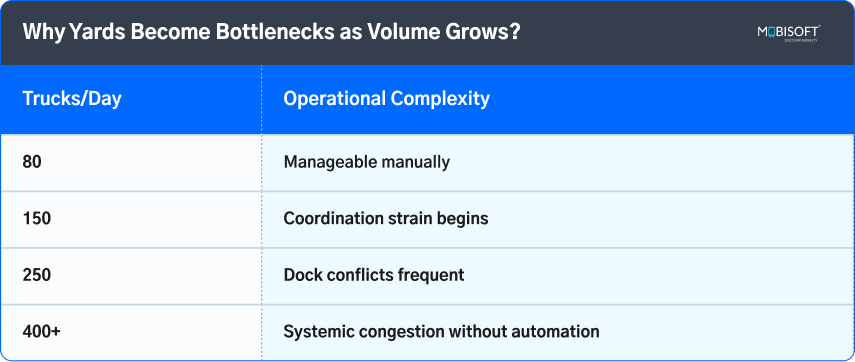
Beyond 150 trucks/day, manual control collapses under variability.
Strategic Benefits Beyond Cost Reduction
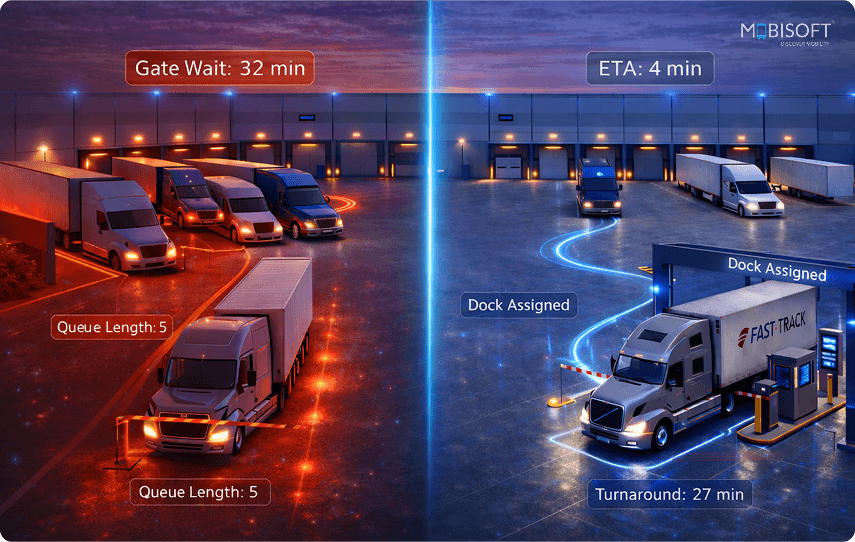
The yard tends to be framed as a cost center, something to minimize rather than leverage within broader supply chain optimization efforts. But organizations that treat it strategically through structured yard management systems discover benefits that have nothing to do with cutting expenses.
Predictable Throughput
When workflow is smooth under disciplined yard operations management, the facility gains something unexpected: breathing room. A predictable flow of trucks means the warehouse can absorb minor disruptions without panic. A carrier running thirty minutes late no longer triggers missed appointments, improving overall warehouse efficiency.
Stronger Carrier Relationships
Carrier networks communicate constantly about which facilities create headaches and which make life easy. A yard known for ninety-minute turns through structured yard management software becomes prime real estate in the minds of dispatchers. During capacity crunches, when everyone fights for truck availability, that reputation translates into preferential treatment. Carriers choose the easy yards first, especially those supported by effective logistics optimization practices.
Improved Compliance
Regulatory scrutiny and customer audits increasingly demand proof of chain of custody, wait time documentation, and security checkpoints. Facilities with structured yard data powered by digital yard management answer these requests in minutes rather than days. The information exists already, captured as a byproduct of normal operations rather than extracted through manual records.
Data-Driven Continuous Improvement
Dwell time data reveals more than just yard performance. Consistent delays from specific carriers signal broader issues worth addressing across the supply chain optimization cycle. Recurring congestion during certain windows points to shift scheduling problems. The yard acts as a sensor, supported by real-time yard tracking, detecting failures elsewhere in the supply chain that would otherwise remain invisible until they cause real damage.
Sustainability Gains
Every minute shaved from idle time reduces fuel burn without requiring anyone to think about sustainability. The emissions reduction happens automatically, as a direct consequence of better flow enabled by structured yard automation solutions. For organizations with corporate carbon targets, yard improvements offer a rare overlap between operational and environmental goals.
Many of these operational gains align with broader supply chain digital transformation initiatives focused on reducing truck waiting time in warehouses and eliminating common bottlenecks in yard operations.
Executive-Level KPIs That Matter
The yard produces data constantly within any structured warehouse yard management framework. The question is which numbers deserve leadership attention. These metrics reveal whether the yard drives performance or drains it.
- Average Truck Turnaround Time measures total minutes from gate-in to gate-out, the single best indicator of yard fluidity and coordination effectiveness within a yard management system.
- Dock Utilization Percentage reveals how much of the available door capacity actually moves freight rather than sitting empty between trucks, directly impacting warehouse dock efficiency.
- Yard Dwell Time tracks how long trailers sit after spotting, exposing delays between arrival and unloading that warehouse teams own and highlighting opportunities to reduce truck turnaround time.
- Detention Cost per Load quantifies the financial penalty of slow turns, converting operational friction into margin impact within the overall logistics optimization strategy.
- Gate Processing Time captures how quickly trucks move through check-in, often the first bottleneck visitors encounter in the gate-to-dock process optimization cycle.
- Trailer Idle Ratio shows what percentage of yard inventory sits inactive, tying up space that could otherwise turn and affecting broader warehouse yard management performance.
Turning these metrics into real-time yard analytics and actionable reporting typically requires structured data engineering services that unify operational data platforms across systems.
The Turning Point: When to Invest in Yard Digitization
The transition from reactive to structured yard control through a Yard Management System usually starts with recognition. Here are the moments when leaders realize manual approaches no longer suffice.
- Daily truck volume crosses 150, the point where coordination strain exceeds human capacity to manage it smoothly.
- Detention charges consistently exceed five percent of total freight spend, indicating the yard leaks margin daily.
- Dock conflicts become routine rather than exceptional, with trucks fighting over doors that should be scheduled through structured dock management system capabilities.
- Production delays trace back to inbound materials sitting in trailers rather than arriving late, revealing a yard bottleneck that affects broader supply chain optimization.
- Compliance audits grow more frequent and expose gaps in gate logs or security records.
- Expansion plans risk scaling inefficiency rather than solving it, adding square footage without adding intelligence through an integrated transportation management system alignment.
Organizations planning custom yard management application rollouts often rely on scalable enterprise application development to ensure long-term yard operations optimization.
The Yard Is a Performance Lever, Not a Parking Lot
The yard was never designed to be a buffer, though most facilities operate as if it were without structured yard management systems in place. Treating those five acres as a passive parking space worked when volumes stayed low and expectations remained loose.
When trucks queue for hours, the capital sits idle. When loaded trailers wait fifty yards from empty docks, the margin evaporates. When carriers route around a facility because drivers dread the delays, the competitive position is affected due to poor yard operations management. The cost is the throughput never realized, the labor hours lost to coordination, and the carrier's goodwill that drains until only desperate trucks accept the wait.
Facilities that pull ahead will treat the yard as infrastructure worth managing with modern yard management software. The technology exists, and the metrics are clear. The only variable is whether leadership decides those five acres deserve the same attention as every other part of the operation. Companies making that decision early will find their advantage compounding across the broader supply chain management ecosystem. Facilities that modernize yard control as part of broader smart supply chain technology investments are better positioned to improve dock scheduling efficiency and scale without adding operational friction.
Key Takeaways
- The yard directly influences transport cost, warehouse productivity, and service reliability, yet most facilities lack visibility into it within their overall warehouse yard management strategy.
- One in three shipment delays originates between the gate and dock, not on the road or inside the warehouse.
- Avoidable dwell time costs mid-sized facilities millions annually, most of which never appear as a separate line item in traditional logistics optimization analysis.
- Manual coordination collapses beyond 150 trucks daily, making structured yard control through a yard management system a necessity rather than an option.
- Dock utilization often hovers around seventy percent, meaning hundreds of paid hours vanish weekly to coordination failures.
- Maturity progression from reactive to performance-driven yards typically delivers twenty-five to forty percent faster truck turnaround.
- The yard serves as an early warning system, revealing carrier reliability issues and scheduling problems before they cause broader disruption across the supply chain optimization process.
- Facilities treating the yard as strategic infrastructure gain carrier preference, labor stability, and throughput predictability that competitors cannot match.

Frequently Asked Questions
What is the single fastest way to reduce dwell time without buying software?
Implement scheduled appointment windows with clear cutoff times. This simple step spreads arrivals across the day rather than clustering them unpredictably. Many facilities see a fifteen percent improvement within weeks simply by controlling when trucks show up, no technology required.
How should we handle unscheduled carriers that bypass our appointment system?
Build a hard rule enforced at the gate. Unscheduled trucks wait until scheduled arrivals clear, regardless of what the driver claims about urgency. This protects the carriers who followed rules and gradually trains the ones who did not that the system has teeth.
Do we need a yard management system if we already have a TMS and WMS in place?
A TMS optimizes freight movement between facilities, while a WMS manages inventory inside four walls. Neither was designed to track trailers between the gate and the dock. Yard management fills that gap, connecting the two systems with real-time visibility into assets neither one sees.
What happens to yard performance during peak season when volume spikes by fifty percent?
Manual processes break predictably while structured systems flex. Facilities operating at Level 1 or 2 see turnaround times double and detention costs triple. Those at Level 4 or above absorb the spike with minor degradation because automation handles variability better than humans managing disorder.
How do we calculate the true ROI of yard digitization beyond detention savings?
Map the full cycle from gate to departure and quantify every idle minute. Then add labor productivity recovered, dock capacity unlocked, and carrier rate increases avoided because drivers now prefer the facility. Most organizations find that the soft savings exceed hard detention costs by two to one.

Nitin Lahoti
Read more
Nitin Lahoti is the Co-Founder and Director at Mobisoft Infotech. He has 15 years of experience in Design, Business Development and Startups. His expertise is in Product Ideation, UX/UI design, Startup consulting and mentoring. He prefers business readings and loves traveling.
 Nitin Lahoti
 March 3, 2026