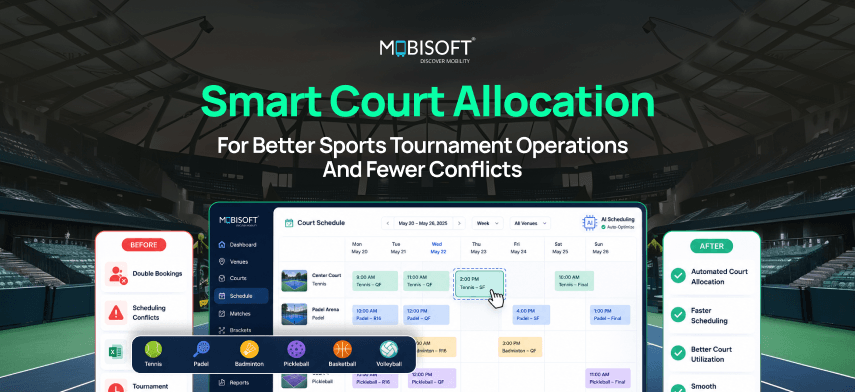
Consider a morning of day 3 at Wimbledon. Court 12 has just been cleared after a two-hour match that ended earlier than expected. Court 18 is soaked after a ten-minute rain shower. Centre Court's roof is closed. Three scheduled matches are waiting for reassignment. The Referee's office has four match supervisors, a weather monitor, a broadcast liaison, and a court manager, all coordinating by radio and phone to redeploy players, line officials, ball boys, and spectator stewards to the correct courts in the correct sequence.
Manual scheduling at this level functions clearly. What it costs the people doing it is a different question entirely. Four supervisors, a weather monitor, a broadcast liaison, and a court manager, all carrying the full picture in their heads simultaneously, all making calls on two-minute windows where a wrong decision does not just inconvenience someone. It delays a global broadcast and activates clauses in sponsorship contracts. The margin for error is effectively zero, and the humans absorbing that pressure are doing so without any system built to help them carry it. Thanks to digital transformation in sports in recent years, smart court scheduling automation is replacing it, efficiently managing resources.
This guide covers the technology, the algorithms, the sport-specific allocation requirements for fifteen sports, the real-world platforms, and the operational improvements that automated court allocation delivers for tournament operators ranging from club-level coordinators to Grand Slam referees.
The Court Scheduling Problem: Why Manual Assignment Fails
Sports tournament scheduling software exists because court allocation is a combinatorial optimisation problem. A 32-player, 6-court, two-day tournament sounds manageable until you account for what the schedule actually has to hold together. Player rest windows, surface compatibility, match duration estimates, referee availability, lighting cutoffs, and broadcast obligations do not exist in isolation. They interact constantly, and the number of valid scheduling combinations runs into the tens of thousands before the first match is even assigned. A human scheduler navigates that and produces something workable in two to four hours. A constraint-based scheduling system produces an optimal or near-optimal result in seconds. When a match overruns, a player withdraws, or weather forces a court change, it re-optimises the entire schedule in under a minute. The table below covers the most common failure modes in manual court scheduling, how they occur, their operational consequences, and how smart systems resolve each one:

Common Manual Scheduling Failure Modes
| Failure Mode | How It Occurs | Consequence | System Resolution |
| Doublebooking | Separate admins assign the same court without a shared calendar, or a bracket template ignores variable match durations. | Players arrive to find another match running. All subsequent matches were disrupted. | Real-time availability database. Conflict detection fires before any assignment is confirmed. |
| Player rest violation | Players scheduled for a second match before the minimum rest period has elapsed. Common in singles-plus-doubles events. | Health risk. Governing body violation. Possible withdrawal from second match. | Player profile linked to match schedule. Rest period rules encoded per sport. Assignment blocked within the minimum rest window. |
| Surface mismatch | Match assigned to a court whose surface does not meet competition category requirements. | Rules violation. Player unfairness. Risk of protest or governing body inquiry. | Court surface stored in database. Match requirements filter available courts to compatible surfaces only. |
| Referee doubleassignment | Referee allocation is managed separately from court allocation, resulting in concurrent assignments. | The match runs without a qualified official. Rules violations may go unenforced. | Referee schedule linked to court assignment engine. Concurrent assignment blocked in real time. |
| Broadcast conflict | Broadcast match assigned to a non-capable court, or two broadcast matches scheduled simultaneously with one crew. | Contracted coverage fails. Rights holder claim triggered. Sponsor visibility unmet. | Broadcast capability flag on each court. Broadcast matches filtered to capable courts. Crew availability is treated as a resource constraint. |
| Weather cascade failure | The outdoor court goes down. Affected match not reassigned. Downstream matches not adjusted. | Court sits idle while the ops team manually coordinates reassignment across players, officials, and spectators. | IoT or weather API triggers automatic court status update. Cascade reassignment redistributes all affected matches. Push notification sent to stakeholders. |
| Idle court time | Fixed start times used instead of as-soon-as-ready sequencing. Match duration estimates not updated live. | Courts sit empty. The tournament runs late. Venue costs accumulate on unused assets. | Dynamic sequencing assigns the next match the moment the court is clear. Live match pace updates duration estimates. Schedule compresses automatically. |
The Algorithm: How Court Scheduling Automation Actually Works
Automated court allocation is formally a Constraint Satisfaction Problem, CSP for short. The system works with a defined set of variables, courts, time slots, matches, players, and officials. It assigns a value to each of these variables so that a specific court is reserved for a specific time. The system ensures hard constraints, such as referee availability, minimum rest periods, no double-booking, and surface compatibility. The goal of this optimisation process is maximum court utilisation, minimum tournament duration, and spectator satisfaction. In its general form, the problem is NP-complete. As variables and constraints multiply, the solution space grows exponentially. So, an exhaustive search becomes computationally impractical. Sports tournament scheduling software combines several techniques to find optimal or near-optimal answers without brute-forcing every possibility. Here are the five most effective algorithmic approaches used in smart court allocation systems.
Approach 1: Constraint Propagation (the Foundation)
Before a single match gets placed, the system runs constraint propagation across every possible court-time combination for that match, cutting out infeasible options immediately. Court 4 reserved for maintenance until 11 am? Every match needing availability before that has Court 4 removed from consideration before the optimisation algorithm even starts. Constraint-based scheduling propagation works precisely because it shrinks the search space aggressively upfront, rather than discovering conflicts mid-assignment. This is the approach that academic sports scheduling literature (Constraints journal, Springer) has identified as computationally most efficient for tournament scheduling.
Approach 2: Integer Linear Programming (ILP) for Small-Medium Tournaments
For tournaments with up to a few hundred matches and tens of courts, Integer Linear Programming finds provably optimal solutions within acceptable computation time. In ILP, the scheduling problem is encoded as a linear objective function to maximise utilisation and minimise gaps. It is governed by linear inequality constraints:
- No court holds two concurrent matches
- Player rest minimums are respected
- Each referee covers one match at a time
Solvers like CPLEX, Gurobi, and Google's open-source OR-Tools do not just find a good schedule. They produce a certificate of optimality, a mathematical guarantee that no better arrangement exists. The NBA scheduling system historically used ILP variants for season schedule construction.
Approach 3: Constraint Logic Programming (CLP) for Complex Rule Sets
When the constraints are qualitative rather than purely numerical, such as seeded players not being scheduled opposite each other in early rounds on outside courts, Constraint Logic Programming represents these rules declaratively and uses backtracking search with forward-checking to find solutions. Fastbreak AI explicitly references constraint-based scheduling as its engine, used by 60+ professional leagues, including NBA and NHL-level organisations.
Approach 4: Metaheuristics for Large Tournaments
For large multi-day multi-venue tournaments where ILP computation time becomes impractical, metaheuristic approaches generate good solutions without guaranteeing optimality. Simulated annealing begins with a random valid schedule and improves it through successive small changes. Although it does accept a worse solution occasionally. The reason is the trap of a local optimum, with that tolerance reducing over time as the algorithm converges. Genetic algorithms, on the other hand, maintain a population of candidate schedules. In fact, it produces better versions through mutations and crossovers across generations. Both approaches are standard tools in multi-sport event scheduling platforms managing hundreds of teams across multiple venues simultaneously.
Approach 5: Real-Time Dynamic Rescheduling
Real-time rescheduling is the response layer that handles live events: a match ending early, a player injury, a rain delay. Static ILP solutions cannot be re-solved in seconds. Dynamic rescheduling uses greedy heuristics (assign the waiting match to the first available court that satisfies all constraints) combined with local search (check whether swapping two upcoming matches improves the overall schedule) to produce an updated schedule in under a minute. Modern platforms like Anolla explicitly describe their AI as updating in real time to fill freed slots. This is the dynamic rescheduling layer operating continuously during the event.
Constraint Taxonomy: What Every Tournament Management System Must Model
The table below lists the full constraint taxonomy covering constraint categories, examples, whether each is hard or soft, and the software data model requirement for a complete tournament management system.
| Constraint | Examples | Data Model Requirement |
| Court physical availability (Hard) | Maintenance window, weather closure, lighting off-hours, post-match cleaning, safety hold. | - Status enum: available, occupied, maintenance, weather_hold, cleaning - Status_valid_until timestamp - Automated transitions via IoT or manual override |
| Surface and environment compatibility (Hard) | - Match requires outdoor clay; court is indoor synthetic - Match requires minimum 20m x 10m; court dimensions smaller | - Court: surface_type, dimensions, indoor_outdoor - Match: required_surface (null = any) - Constraint: surface must match or be null |
| Player rest period (Hard for safety, Soft for scheduling) | - ATP/WTA: 20-minute minimum post-match - Juniors: 30-45 minutes | - PlayerSchedule: match_id, court_id, scheduled_start, actual_end - Constraint: next scheduled_start >= previous actual_end + rest_period_minutes |
| Referee and official assignment (Hard) | - One match per official at a time - Line officials qualified for assigned court - No supervisor double-assignment | - OfficialSchedule mirrors PlayerSchedule - No concurrent assignments permitted - Qualification level must meet the court requirement |
| Broadcast and show court priority (While Broadcasting - Hard, Home nation - Soft) | - Top seed on Centre Court - Broadcast match at fixed time - Home nation player on the show court, where possible | - Match: broadcast_required, broadcast_start_time - Court: broadcast_capable - Hard: broadcast match on a capable court at a fixed time - Soft: home nation preference applied where available |
| Match duration uncertainty (Soft) | - Tennis best-of-3: 60-120 min - Best-of-5: 90-240 min - High variance across all racket sports | - Match: estimated_duration_minutes with confidence interval - Actual duration tracked live - Fed back into ML model for future estimates |
| Bracket and competition order (Hard) | Round 2 cannot begin until all Round 1 matches in the same half are complete. | - Bracket: tournament tree with match dependencies - Prerequisites checked before any dependent match is scheduled |
| Venue capacity and spectator allocation (Soft) | - Centre Court: 14,979 - No.1 Court: 12,345 - Match importance should roughly match court size | - Match: expected_spectator_interest (high/medium/low) - Court: capacity - Soft constraint: high-interest matches prefer higher-capacity courts |
| Player equity (Soft) | No player receives significantly more or fewer show-court appearances than similarly seeded peers. | - Player: show_court_count tracked across the tournament - Soft constraint penalises high variance among similar seedings |
| Weather and environmental conditions (Hard for safety, Soft for comfort) | - No outdoor use during rain or within drying period - Australian Open Heat Stress Scale applies | - WeatherCondition: current and forecast values - Hard: blocks outdoor assignment above safety threshold - Soft: prefers indoor above comfort threshold |
Fifteen Sports: Court Allocation Requirements Across Every Court-Based Competition
Each court-based sport has distinct allocation requirements shaped by its court geometry, match duration variability, surface sensitivity, multi-event complexity, and operational constraints. The following profiles specify exactly what sports facility scheduling software must know about each sport to manage scheduling effectively.
Tennis: Grand Slams, ATP/WTA Tour, ITF, Junior, Club
Court and surface types: Grass (Wimbledon: 18 courts), clay (Roland Garros: 20 courts), hard (US Open: 22 courts, including Armstrong and Louis Armstrong; Australian Open: outdoor and indoor Show Courts). Dimensions: 23.77m x 8.23m singles, 10.97m doubles. Indoor/outdoor distinction critical for weather management.
Allocation Challenges
- Highly variable match duration (45 minutes to 5+ hours).
- Singles and doubles share the same courts.
- Seeding-based show court priority.
- Rain delay cascades across all outdoor courts simultaneously.
- Player rest management between singles and doubles.
- Broadcast obligations for specific matches.
- Junior, qualifying, and main draw phases share courts across different tournament stages.
Smart System Features Required
- Surface-aware scheduling and broadcast-required match lock (specified court, specified time).
- Show court priority queue: seeded players preferred for Centre and No.1 courts.
- Rain cover mode: activates roof court priority and queues outdoor matches.
- Multi-event matrix: player appearing in singles, doubles, and mixed, tracked as a single schedule entity.
- Real-time match clock feed to update estimated finish time.
- Hawk-Eye/ELC court status integration (2025 onwards, all Wimbledon 18 courts have electronic line calling).
Real-World Benchmark
Wimbledon 2025: Hawk-Eye Live installed on all 18 courts with 450+ cameras. Video Review added on 6 courts in 2026. Final order of play confirmed the evening before. The entire court scheduling automation system is live from morning until play concludes. Wimbledon 2026: 29 June to 12 July.
Conflict Types to Resolve
- Double-booking (most common).
- Player rest violation in singles-plus-doubles combination.
- Outdoor court weather cascade.
- Broadcast slot collision.
- Referee qualification mismatch for show courts.
- Show court equity imbalance across seedings.
Padel: International Padel Federation, World Padel Tour
Court and surface types: 20m x 10m enclosed glass-and-metal court. Smaller than tennis, typically grouped in banks of 4-8 courts in padel-specific venues. Indoor and outdoor courts are both in use.
Allocation Challenges
- Padel is played exclusively as doubles (2v2), so bracket management always involves teams of two.
- Mixed doubles and same-gender doubles require separate scheduling streams.
- Condensation on glass walls is a safety issue distinct from outdoor court wetness.
- Growing tournament volume has outpaced manual scheduling capacity at many padel clubs.
Smart System Features Required
- Team-of-two entity tracking: players travel together, rest together. Automated court allocation must prevent scheduling player A of pair AB when player B is simultaneously on a different court.
- Glass wall condition sensor integration: condensation detection triggers a court hold.
- 90-minute slot optimisation for club use versus variable-duration tournament play.
- Context-aware court booking management for padel-specific venue layouts.
Real-World Benchmark
The World Padel Tour grew from 4 to 25+ countries between 2019 and 2025. Padel booking represents one of the fastest-growing court sport scheduling challenges in Europe.
Conflict Types to Resolve
- Team partner availability conflict: both players in the same pair must be available simultaneously.
- Glass court condensation safety hold.
- Acoustic management: schedule spacing between adjacent enclosed courts.
- Cross-bracket scheduling in mixed-doubles plus same-gender doubles on the same day.
Badminton: BWF World Championships, Thomas/Uber Cup, Club
Court and surface types: BWF standard: 13.4m x 6.1m (singles), 13.4m x 6.71m (doubles). Courts are marked in both configurations on the same floor area. Indoor only. Multi-court halls (8-24 courts in major venues).
Allocation Challenges
- Court width reconfiguration is required between singles and doubles matches.
- Shuttle speed selection depends on venue temperature and altitude. Different shuttle speeds may be required as temperature changes through the day.
- Court numbering and assignment in multi-court halls affect spectator flow.
- Shuttlecock consumption tracking: courts need fresh shuttles at match start.
Smart System Features Required
- Net width configuration tracking per court assignment (singles mode versus doubles mode).
- Shuttle speed schedule triggered by temperature readings.
- Show court assignment for seeded matches with broadcast support.
- Simultaneous multi-court tracking: 8+ courts running concurrently in major championships.
- HVAC management integration to maintain a consistent hall temperature.
Real-World Benchmark
BWF World Championships halls typically run 6-10 courts simultaneously. Major badminton nations host tournaments with 24-court facilities requiring industrial-scale sports facility scheduling.
Conflict Types to Resolve
- Net configuration mismatch.
- Shuttle speed inconsistency across courts.
- HVAC draft interference from adjacent court doors left open during a match.
- Spectator over-concentration on the centre courts leaves the outer courts inaccessible.
Squash: PSA World Tour, British Open, Club Championships
Court and surface types: Standard squash court: 9.75m x 6.4m. All-glass courts for major tournaments. Traditional non-glass courts at the club level. All-glass courts are broadcast-capable; traditional courts are not.
Allocation Challenges
- Most PSA World Series events use a single all-glass portable court installed in a non-squash venue.
- Match duration variability is very high (25 minutes to 90 minutes for best-of-5).
- Warm-up allocation on a separate court is standard at professional events.
- The glass court requires assembly and disassembly time that must be scheduled.
Smart System Features Required
- Single-show court event management: any overrun cascades the entire day schedule. This is the most demanding case for real-time rescheduling.
- Warm-up court tracking: 5-10 minute warm-up slots per player required before the match.
- Glass court assembly status monitoring.
- Match duration model calibration: Squash has the highest per-set duration variance of any racket sport.
Real-World Benchmark
PSA World Tour Finals and World Championships are typically held on a single glass court. This single-court constraint means scheduling conflict resolution must manage cascades with zero fallback. The PSA uses a tournament management system that displays live match status and estimated completion time to operations teams.
Conflict Types to Resolve
- Cascade overrun with no fallback capacity.
- Warm-up court collision: two players from different matches competing for the same warm-up slot.
- Glass court assembly is delayed at the scheduled start time.
- Audience congestion at the single viewing angle during schedule transitions.
Pickleball: APP Tour, Major League Pickleball, Club
Court and surface types: Pickleball court: 13.4m x 6.1m (same dimensions as badminton; can be marked on a tennis court). One tennis court can contain two pickleball courts. Net height: 91.4cm at centre. Both indoor and outdoor. Pickleball is the fastest-growing court sport in North America and represents one of the most acute sports facility scheduling challenges in North America.
Allocation Challenges
- Multiple pickleball courts on a single tennis court: scheduling must track which sub-court is being used, not just the parent tennis court.
- Temporary netting placement and removal between sub-courts.
- Wind sensitivity: wiffle ball flight is affected by wind similarly to shuttlecocks in badminton.
- Growing volume of tournaments with limited dedicated pickleball facility availability.
Smart System Features Required
- Sub-court mapping: track Court 1A and Court 1B separately within the space of one tennis court. This requirement is unique to pickleball and not handled by tennis-specific court scheduling automation.
- Temporary netting status tracking.
- Wind speed monitoring for outdoor play.
- Multi-format management: singles, doubles, mixed in the same session.
Real-World Benchmark
Major League Pickleball grew from 12 to 24 teams between 2022 and 2025. APP Tour events run 20-40 courts simultaneously. The US Open Pickleball Championship uses a purpose-built multi-court facility.
Conflict Types to Resolve
- Sub-court mapping error: both pickleball courts on a single tennis court were assigned simultaneously without tracking the sub-court level.
- Temporary net placement conflict.
- Wind holds for outdoor courts, affecting different sub-courts of the same parent court differently.
- Surface conversion tracking when a venue switches between tennis and pickleball use.
Basketball: NBA, FIBA World Cup, EuroLeague, Youth Tournaments
Court and surface types: NBA standard: 28.65m x 15.24m hardwood. FIBA standard: 28m x 15m. Most multi-purpose arena floors serve basketball, indoor volleyball, and other court sports. Court conversion time (from basketball configuration to another sport) is typically 30-45 minutes and must be scheduled.
Allocation Challenges
- Multi-court youth tournaments are the primary scheduling challenge.
- Gym availability constraints are severe at multi-sport recreation centres.
- Referee assignment is the most common conflict in youth basketball.
- Shared gymnasium space with non-basketball users creates complex availability windows.
Smart System Features Required
- Gym availability matrix for shared facilities across multiple sports.
- Referee qualification per age category.
- Team travel time between venues in multi-gymnasium youth tournaments.
- Court conversion time tracking between sports uses.
- Bracket dependency enforcement for elimination rounds is a core requirement of any sports tournament scheduling software.
Real-World Benchmark
Fastbreak AI uses the same constraint-based scheduling engine that schedules NBA and NHL seasons, trusted by over 60 professional leagues worldwide. A single FIBA 3x3 World Tour event runs 20+ courts simultaneously with mixed-gender competitions.
Conflict Types to Resolve
- Referee double-assignment (most common in youth basketball).
- Team travel time between dispersed gymnasium venues is not accounted for.
- Gym conversion time is not scheduled between uses.
- Bracket dependency violation: scheduling Round 2 before all Round 1 games are complete.
Volleyball: Indoor, Beach, Sitting Volleyball
Court and surface types: Indoor volleyball: 18m x 9m. Beach volleyball: 16m x 8m sand court. Sitting volleyball: 10m x 6m. All three disciplines have different court dimensions and surface requirements. Outdoor beach volleyball requires specific site conditions, including sand depth and drainage.
Allocation Challenges
- Indoor and beach volleyball require entirely separate venues and scheduling systems.
- Beach volleyball courts may be temporary installations with assembly and deassembly time.
- Sand court conditions are affected by rain, temperature, and humidity.
- FIVB Beach Pro Tour runs up to 24-court tournaments requiring industrial-scale allocation.
- Sitting volleyball court configuration requires different floor markings from the standing game.
Smart System Features Required
- Surface type segregation: Indoor and beach volleyball are managed as completely separate sport instances.
- Sand condition monitoring via moisture sensor integration.
- Temporary court assembly status tracking.
- Broadcast camera angle constraint: Beach volleyball broadcast requires a specific sun orientation. Sports venue management must account for morning versus afternoon session assignment relative to the sun's position.
Real-World Benchmark
FIVB Beach Pro Tour runs events in 24 countries with 24-court outdoor venues. The 2024 Paris Olympics beach volleyball at Champ-de-Mars used 3 temporary courts with full broadcast infrastructure.
Conflict Types to Resolve
- Surface type mismatch: indoor player assigned to beach court or vice versa.
- The sand condition is unsafe and not cascaded to the affected match schedule.
- Sun orientation violation for beach courts.
- The temporary court assembly was incomplete at the scheduled match time.
- Sitting volleyball court markings were not converted before the match.
Table Tennis: ITTF World Championships, Team Events, Club
Court and surface types: Standard table: 2.74m x 1.525m x 0.76m height. Playing area per table: approximately 7m x 4m minimum. Large arenas accommodate 24-32 tables simultaneously (ITTF World Championships). Setup and teardown time per table is approximately 30 minutes. Playing area lighting must be consistent across all tables (450-750 lux minimum).
Allocation Challenges
- Table density in a small space creates spectator management challenges and acoustic interference.
- Match pace is very fast (15-45 minutes per match), creating high scheduling throughput demand.
- Show table selection for a TV broadcast within a multi-table hall.
- Team events require coordinating multiple singles and doubles matches at specified intervals.
Smart System Features Required
- Table-in-hall grid mapping for spectator navigation.
- Set up and teardown status per table.
- Lighting uniformity check linked to the venue management system.
- High-throughput automated court allocation: many short matches requiring rapid sequential assignment.
- Team match sequencing: ITTF and ETTU formats mandate a specific singles and doubles order that cannot be violated.
Real-World Benchmark
ITTF World Championships run 32 tables simultaneously in the group phase. The World Team Championships may run up to 6 team matches concurrently, each requiring 3-5 individual match slots in sequence.
Conflict Types to Resolve
- Table position confusion in large halls.
- Lighting inconsistency between tables.
- Team matches order violation.
- High-throughput cascade: fast matches complete quickly, and the next match is not yet ready, creating unnecessary idle table time.
Racquetball and Racketball: USA Racquetball, International Racquetball Federation
Court and surface types: USA Racquetball standard: 12.2m x 6.1m x 6.1m four-wall indoor court. All-glass back wall for spectator viewing in major venues. Courts are four-walled enclosures with hardwood or synthetic surfaces.
Allocation Challenges
- Warm-up protocols and equipment checks must be scheduled before the match starts.
- Most national championship events run 2-4 courts simultaneously.
- Multi-division scheduling: pro, collegiate, age group, and gender divisions running simultaneously.
Smart System Features Required
- Glass court status monitoring.
- Warm-up court allocation: pre-match warm-up in racquetball is standardised at 5 minutes.
- Equipment check scheduling: ball specification varies by event level.
- Shared facility management with squash.
- Multi-division scheduling conflict resolution in a single scheduling interface.
Real-World Benchmark
The US Open Racquetball Championship runs on 4-6 courts simultaneously across multiple days. The sport is growing in Latin America with new multi-court facilities requiring allocation software.
Conflict Types to Resolve
- Warm-up court collision: two players from concurrent matches competing for pre-match warm-up time.
- Ball specification error: pro match ball used in an age-group division or vice versa.
- Glass court cleaning delay between matches.
- Multi-division bracket confusion in a shared scheduling interface.
Handball: EHF Champions League, IHF World Championship, Bundesliga
Court and surface types: Court: 40m x 20m indoor. Goal area circles at a 6m radius. A large court relative to other indoor sports. The surface must be suitable for sliding, with resilient synthetic flooring preferred for injury prevention.
Allocation Challenges
- Goal posts must be installed and certified before play begins.
- Team warm-up requires half-court access for 15-20 minutes before the match.
- Broadcast setup requires camera positions at both ends of the court with specific seating clearance.
Smart System Features Required
- Goal post installation status tracking.
- Pre-match half-court warm-up allocation.
- Court surface condition assessment (resilience check for synthetic surface).
- Referee assignment with IHF licence verification for international matches.
- Broadcast position clearance verification as part of sports venue management.
Real-World Benchmark
The IHF World Championship runs at 4 venues simultaneously, with 2 matches per day per venue. EHF Champions League Final4 uses a single arena across 2 days with 4 matches total.
Conflict Types to Resolve
- Goal post installation delay at the scheduled match start time.
- Warm-up court allocation conflict: two teams requiring opposite ends of the same court simultaneously.
- Referee qualification mismatch for international matches.
- Court surface certification lapses before the tournament.
Futsal: FIFA Futsal World Cup, National Leagues, School
Court and surface types: FIFA futsal court: 38-42m x 18-22m indoor, hard smooth surface. Goals: 3m wide x 2m high. Significantly smaller than a handball court. Court marking includes penalty spot and futsal-specific lines.
Allocation Challenges
- Futsal and handball courts both require indoor hard surfaces, but with different dimensions and markings.
- Youth futsal tournaments may use gymnasium space with multiple courts side by side.
- Goalkeeper-specific substitution rules require team management area tracking.
Smart System Features Required
- Court marking version control: futsal, handball, and basketball markings on the same gymnasium floor require tracking which marking set is active.
- Surface abrasiveness assessment: football boots are prohibited in futsal, and a footwear check must be scheduled before court access.
- Fixed duration scheduling: match windows are predictable, unlike racket sports, which benefits sports tournament scheduling software efficiency.
- Substitution zone overlap prevention when two futsal courts are placed adjacent in a gymnasium.
Real-World Benchmark
The FIFA Futsal World Cup is held quadrennially with 24 teams across 2 venues. National futsal leagues in Brazil, Portugal, Spain, and Russia have the highest professional scheduling demands.
Conflict Types to Resolve
- Court marking confusion: wrong sport markings active when a futsal match begins.
- Surface damage from prohibited footwear.
- Substitution zone overlap on adjacent courts.
- Fixed-duration scheduling advantage is lost when a match is delayed by a referee or team issue.
Netball: International Netball Federation, Superleague, School
Court and surface types: Standard court: 30.5m x 15.25m. Playing circles at each end (4.9m radius). Indoor or outdoor hard surface. Dimensions are standardised internationally with no variation between competition levels.
Allocation Challenges
- Officiating requires two umpires who must both be available simultaneously.
- Outdoor courts are vulnerable to the weather.
- Match duration is relatively predictable (60 minutes, including two breaks).
Smart System Features Required
- Dual umpire simultaneous availability constraint: both umpires must be assigned to the same court at the same time.
- Outdoor court weather management.
- Goal post stability check before match (portable goal posts must be secured).
- Pitch condition monitoring: outdoor netball is highly weather-sensitive.
Real-World Benchmark
The England Netball National League runs 4-6 courts per round. The Netball World Cup runs 4 courts simultaneously, with broadcast on two show courts. Australia and New Zealand domestic competitions are the most advanced in terms of scheduling software adoption.
Conflict Types to Resolve
- Dual umpire availability conflict: the match cannot proceed with only one official.
- Outdoor court weather hold does not cascade to the match sequence.
- Team warm-up area conflict on adjacent courts.
Gymnastics (Artistic, Rhythmic, Trampoline): FIG World Championships
Court and surface types: Artistic gymnastics floor exercise: 12m x 12m. Rhythmic gymnastics floor: 13m x 13m. Trampoline equipment: 5m x 3m frame plus crash mat areas. All apparatus must be certified before competition and must be checked before each session.
Allocation Challenges
- Gymnastics is an apparatus-allocated sport, not a court-allocated one. The scheduling challenge is assigning gymnasts to apparatus in the correct rotation order.
- Equipment preparation and safety inspection before each rotation is mandatory.
- Rotation timing must allow sufficient transition between apparatus for scoring completion.
Smart System Features Required
- Apparatus rather than the court as the allocation unit.
- Apparatus safety certification status tracking.
- Warm-up apparatus scheduling: FIG mandates warm-up time on a competition or dedicated warm-up apparatus.
- Rotation sequence compliance: FIG event order is prescribed and cannot be reordered.
- Scoring completion timer: scores must display before the next gymnast begins.
- Broadcaster apparatus assignment as part of the overall sports venue management.
Real-World Benchmark
The FIG World Championships run 6 apparatus simultaneously in artistic gymnastics, with 24+ gymnasts competing in each apparatus final. Olympic Games artistic gymnastics requires the most complex apparatus scheduling of any gymnastics format.
Conflict Types to Resolve
- Apparatus certification lapses before a rotation begins.
- Warm-up apparatus double-booking.
- Rotation sequence violation.
- Broadcaster timing miss: camera crew not positioned at the assigned apparatus before the competition begins.
Swimming (Pool Events): World Aquatics, National Championships
Court and surface types:
Olympic standard pool: 50m x 25m with 8-10 lanes.
Short course: 25m x 25m with 6-10 lanes.
Each lane is a separate competing unit analogous to a court in court sports. Water temperature must be maintained between 25 and 28 degrees Celsius.
Allocation Challenges
- Lane seeding for finals is a governing body rule: World Aquatics mandates centre-lane seeding for finalists based on heat times.
- Multiple events running in the same session across different strokes and distances require lane rotation between heats.
- Warm-up pool lane allocation is separate from the competition pool.
- The timing system (Omega) must be confirmed operational on each lane before the event begins.
Smart System Features Required
- Lane seeding engine: World Aquatics rule requires the fastest 8 qualifiers seeded lanes 4, 5, 3, 6, 2, 7, 1, 8. This seeding must be applied automatically at heat completion.
- Warm-up pool lane scheduling as a separate resource.
- Timing system lane confirmation.
- Multi-event session management: stroke and distance rotation within a session.
- Water temperature logging for compliance.
Real-World Benchmark
World Aquatics Championships run all events in a single 50m pool over 8 days. Omega Timing provides the official timing system at all major championships. Olympic Games swimming uses 10-lane pools for heats and 8-lane seeded finals.
Conflict Types to Resolve
- Lane seeding error: incorrect seed order applied at finals draw.
- Warm-up pool lane double-booking.
- The timing system malfunction on a specific lane is not detected before the start of the event.
- Relay exchange zone violation due to an incorrect relay order submitted late.
Multi-Sport Events: Olympic Games, Commonwealth Games, Asian Games
Multi-sport event scheduling is the most complex form of sports tournament scheduling software deployment. Multi-sport events manage all of the above court and venue types simultaneously across 20-50 venues in a single city over 10-17 days. The 2028 Los Angeles Olympics covers 32 sports across 40+ venues with 10,500 athletes in play. Venues do not sit idle between sports either. Each handover requires a surface conversion, an equipment deployment, or a full facility-mode change. Sometimes all three.
Allocation Challenges
- Venue sharing across sports: one arena may host basketball, volleyball, handball, and gymnastics in sequence. Each use requires a different floor configuration, equipment installation, and spectator layout.
- Equipment logistics: moving apparatus, nets, and goals between venues on a tight schedule.
- Athlete village transport to the venue adds a travel time constraint.
Broadcast rights holders for each sport have separate schedule requirements.
- Weather-sensitive outdoor venues (archery, tennis, rowing, sailing) can affect indoor venue availability when outdoor cancellations force schedule changes.
- Governing body technical officials (FIG, BWF, World Aquatics) have jurisdiction over their specific sport, and their technical rules take precedence over the master event schedule.
Smart System Features Required
- Master scheduling engine coordinating all venue-sport combinations as a unified constraint-based scheduling problem.
- Venue configuration state management: track which surface or equipment configuration each venue is currently in and when conversion to the next configuration is scheduled.
- sports event transportation systems to ensure athletes' smooth transport from the Olympic Village to each venue.
- Broadcast rights partition: IBC allocates broadcast capacity per sport, not per venue.
- Governing body veto: a sport's technical body can override the master schedule for safety or rules reasons.
- Medal ceremony scheduling on the same court or venue as the competition without disrupting the event flow.
Real-World Benchmark
Paris 2024 Olympic Games used La Défense Arena for swimming and water polo (different pool configurations) and Bercy Arena for gymnastics and boxing (complete floor changeover between sports). The IOC master scheduling system coordinates 32 sports across 40+ venues, the most complex multi-sport event scheduling operation on the planet.
Conflict Types to Resolve
- Venue conversion delay: basketball arena floor not ready for gymnastics apparatus installation on schedule.
- The athlete arrived late due to an underestimated travel time from the Village.
- Broadcast schedule collision: two high-value medal events in different sports scheduled simultaneously when the broadcast partner has only one primary channel.
- Governing body rule override requiring a last-minute session reschedule.
- Outdoor venue weather disruption cascading to indoor venue availability through athlete reassignment.
Platform Options: Sports Tournament Scheduling Software in 2026
The table below covers the leading sports tournament scheduling software and sports facility scheduling platforms available in 2026, including their court type coverage, AI and optimisation capability, key differentiators, and limitations. Large tournaments are also increasingly relying on automated concierge services to prevent double bookings and last-minute operational disruptions.
| Platform and Courts Supported | AI Capability | Key Differentiator | Limitation |
| Anolla For: Tennis, padel, badminton, basketball, football courts, swimming lanes | - Resolves 79.3% of booking queries in real time - 68% conflict reduction - 8-10 hrs/week admin saving - 25-language support | - Hybrid model support: membership, pay-per-play, coaching, tournaments in one system - Weather integration - Smart lock and lighting control | - Less suited to large single-event tournament operations- Stronger as a continuous club management platform |
| Fastbreak AIFor: Multi-sport via sport-agnostic architecture | - Same constraint-based engine as NBA/NHL scheduling - Used by 60+ professional leagues - Handles team drops and additions dynamically | - Single database connecting scheduling, housing, ticketing, and communication - No CSV exports between functions | - Not designed for daily recurring court booking at a single venue |
| MatchcourtFor: Tennis courts primarily | - Intelligent assignment by player preference - Automated conflict resolution - Real-time availability tracking | - Mobile-first design - Member priority management - Clean club management integration | - Tennis-only - Not suited to large-scale or multi-sport tournament scheduling |
| CourtReserveFor: Tennis, pickleball, racquetball, squash, padel | - Booking automation and conflict prevention- Waitlist and cancellation management - Member tier priority | - Strong pickleball-specific features - Mobile court status display - Automated waitlist filling | - Booking platform, not a tournament scheduling engine - Better for club management than complex multi-day events |
| Sportlomo / LeagueAppsFor: Soccer, basketball, volleyball, hockey, others | - Schedule generation with conflict detection - Referee assignment- Multi-division management | - Strong registration-to-schedule workflow - Good for associations managing high team volumes | - Less AI sophistication - Better for structured league formats than variable-duration tournament scheduling |
| Custom Build (Mobisoft)For: All 15 sports in this guide, including gymnastics apparatus and swimming lanes | - Full constraint programming: hard and soft constraints per sport- Broadcast, weather API, and IoT integration - Real-time dynamic rescheduling - Predictive duration models | - Sport-specific rule configuration - NGB results system and broadcast partner integration - Custom governing body compliance reporting | - Build cost: depending on specific requirements - Justified only when commercial platforms cannot meet sport-specific requirements |
Implementation Framework: Deploying Automated Court Allocation
Phase 1: Constraint Audit (2-4 Weeks)
Most deployments of court scheduling automation fail due to issues that surface after the launch. By then, reconfiguring the system costs significantly more than getting it right up front. Before selecting any software, document everything that governs your scheduling environment. Governing body rules include rest periods, surface requirements, and officiating standards. But the Facility has to check availability windows, maintenance schedules, and lighting cutoffs. Note down the broadcast obligations, commercial requirements, etc. Every constraint you miss in this phase becomes a problem you solve under pressure later.
Phase 2: Court and Facility Data Model (1-2 Weeks)
Map every court into the system database: dimensions, surface type, indoor/outdoor status, broadcast capability, lighting system, seating capacity, and IoT sensor connections. This data model is the foundation of all automated court allocation decisions. Errors in the court data model, such as a court listed as outdoor that is actually indoor, or an incorrect capacity figure, produce incorrect allocations that undermine trust in the system.
Phase 3: Integration with Source Systems (3-8 Weeks)
A tournament management system does not operate in isolation. It depends entirely on the accuracy of what feeds into it.
- Connect it to your bracket and draw engine.
- Link player management for rest period tracking and scheduling history.
- Pull referee availability and qualification data directly.
- Integrate a weather API or IoT sensors for live court conditions.
- Add the broadcast partner schedule with its fixed start times and court requirements.
- Finally, connect access control and facility management systems for real-time court status updates.
Phase 4: Schedule Configuration and Algorithm Testing (2-4 Weeks)
Feed historical tournament data through the configured constraint-based scheduling algorithm. Then compare its output against the schedule your team actually ran. Look for the gaps. Where results differ, ask a specific question: is the algorithm wrong, or did the human scheduler know something that never got documented? That distinction matters more than the gap itself. Resolving it is what converts a technically correct system into one your operations team will actually trust.
Phase 5: Live Event Operations Training (1-2 Weeks)
Operations staff need to understand how to use the real-time rescheduling interface, how to override the algorithm for exceptional circumstances, and how to interpret the conflict alerts the system generates. The most common failure mode in court scheduling automation deployment is operations staff reverting to manual processes because they do not trust the system. This typically happens when staff have not been trained on how to handle the scenarios they are most worried about.
Phase 6: Post-Event Review and Algorithm Improvement (Ongoing)
After each event, review how many conflicts occurred versus how many the manual system would have produced; where the algorithm's match duration estimates were wrong, and how historical data should update the model; whether any new constraints were discovered during the event that should be added to the constraint set. Sports tournament scheduling software improves with every event if this feedback loop is maintained.
From Manual Juggling to Intelligent Orchestration
Court allocation is not a glamorous function. Spectators never know when it works well. They see their match start on time, in the right place, with the right official, and think nothing of it. They notice only when it fails: when two players show up at the same court at the same time, when a broadcast-scheduled match starts 40 minutes late, when a player is forced to play back-to-back matches because nobody checked the rest period. The invisibility of good scheduling is its most important characteristic. It is also the reason that manual scheduling, which tolerates a higher failure rate, produces a visible degradation in tournament quality that organisers learn to normalise.
Smart court allocation systems make the invisible visible in one direction only. They surface potential conflicts before they occur, resolve them algorithmically, and present the operations team with a schedule they can trust rather than one they must continuously firefight. The 85% reduction in planning time, the 68% reduction in double-bookings, the 8-10 hours saved per administrator per week: these are not abstract efficiency metrics. They are the hours redirected from spreadsheet management to athlete welfare, venue quality, and spectator experience. They are the conflicts that did not require emergency radio calls. They are the broadcast segments that started on time.
For tournament directors, venue operators, and national governing bodies evaluating court utilization optimization investment, the question is not whether to automate court allocation. It is which system matches the sport, the scale, and the constraint complexity of their specific competition, and whether a commercial platform can serve it, or whether the governing body's specific rules and integrations require a custom build.
Build Smart Court Allocation for Your Sport with Mobisoft Infotech
Mobisoft Infotech, a sports app development company, designs and delivers custom court scheduling automation systems and configured commercial platform implementations for sports operators across all fifteen sports in this guide:
- Constraint modelling: documenting and encoding the specific governing body rules, surface requirements, official qualification standards, and broadcast obligations for your sport into a formal constraint set.
- Algorithm selection: matching the scheduling algorithm (ILP, CLP, metaheuristic, or hybrid) to your tournament scale and constraint complexity.
- Integration development: connecting the automated court allocation system to your tournament management system, player database, referee management system, weather API, IoT court sensors, and broadcast partner schedule.
- Sport-specific features: sub-court tracking for pickleball, apparatus allocation for gymnastics, lane seeding for swimming, glass court status for squash, and net configuration for badminton. These are features that commercial platforms do not provide for non-mainstream court sports.
- Real-time dynamic rescheduling: live reallocation when a match runs long, a court becomes unavailable, or a player withdraws, with stakeholder push notification and cascade management.
- Multi-sport event scheduling: unified scheduling across multiple sports sharing venues, with venue configuration state management, athlete transport time constraints, and broadcast rights partition.

This content is for informational purposes only and may include AI-assisted research or content generation. While we strive for accuracy, information may evolve over time. Readers are advised to independently verify critical information before making decisions.

Nitin Lahoti
Read more
Nitin Lahoti is the Co-Founder and Director at Mobisoft Infotech. He has 15 years of experience in Design, Business Development and Startups. His expertise is in Product Ideation, UX/UI design, Startup consulting and mentoring. He prefers business readings and loves traveling.
 Nitin Lahoti
 May 14, 2026