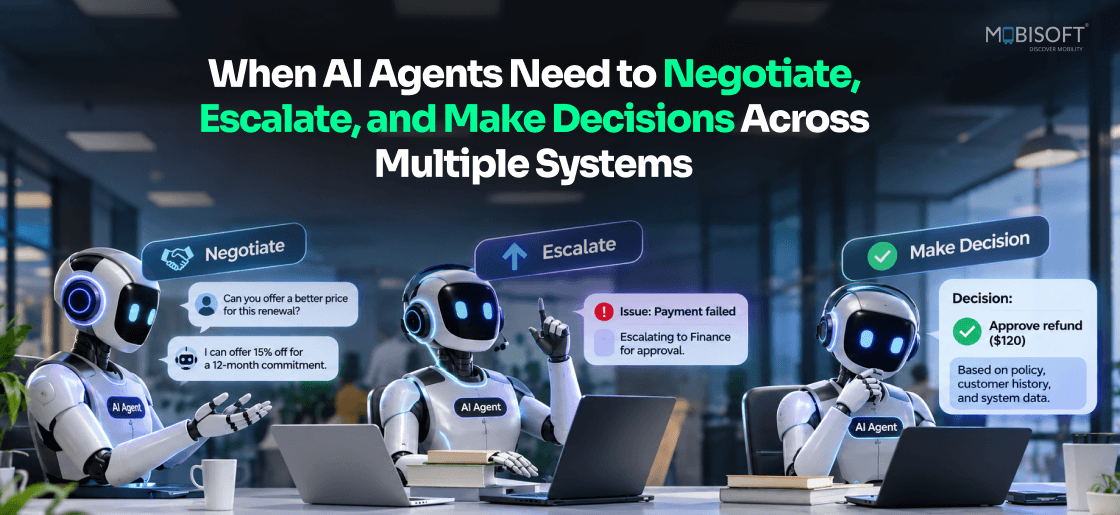
Suggested Post Title: When AI Agents Need to Negotiate, Escalate, and Make Decisions Across Multiple Systems
Who owns the file when an AI agent hands it to the next system? Most teams can’t answer that quickly. Say a credit agent finishes its check at 2 am. Does the compliance agent know what it found? Real processes rarely stop at one task. A commercial loan can pass through nine systems before anyone signs.
Context can get lost in each handoff. AI agent orchestration keeps those handoffs in order. It decides who acts next and when a person steps in.
A 2025 study of seven multi-agent frameworks found 14 distinct failure modes. Inter-agent misalignment was one of three main groups. So a good share of the risk sits in coordination. Our approach to custom AI agent development settles state and authority first. Prompts come later. By the end, you’ll have a pattern choice and an escalation map. A worked cost model with illustrative numbers comes along too.
What Are Complex Agentic Workflows?
Early enterprise AI handled one job at a time. A model summarized a document or tagged a ticket. That work still delivers value. But the processes that matter most are chains of linked decisions. They cross systems and involve outside parties. They also trigger more work downstream. Complex agentic workflows cover that whole chain.
Quick Answer: Complex Agentic Workflows
A complex agentic workflow chains agent actions across several systems. It includes conditional logic and outside parties. There's a path to a human built in. It's the control layer between agents. It routes work and tracks state. Rules decide when each agent may act. Three traits set these workflows apart.
- The workflow keeps one state across systems that don't talk.
- Each step depends on the last result, even a silent counterparty.
- Negotiation follows set limits. Escalation sends context to the right person.
Who Gets Value First
Enterprise AI agents are ideal where a process crosses several systems. Chief AI officers and engineering VPs usually own that call. Operations heads and architects share it. Lending and insurance teams often start here. Legal and supply chain teams follow. We'd rank candidate workflows by volume and cost of error. Our AI strategy consulting services begin with that ranking.
The biggest gain sits in the gaps between steps. Someone emails a file. Someone else rekeys a number. A third person waits for a system to finish. AI workflow orchestration removes those pauses. Agents handle the work around them. An operations head might ask, "Why does a six-step approval take three weeks?"
The Three Core Capabilities That Define Complex Agentic Workflows
Three capabilities set these workflows apart. Agents negotiate and escalate. They also decide with shared context. Each one needs its own design.
Negotiation Within Set Parameters
In AI agent workflow automation, negotiation rarely means a commercial back-and-forth. The agent reads the input and checks it against its limits. Say a supplier quotes £42.50 per unit against a £38 target. That's 11.8 percent above target. The quote lands in the escalation band. "Counter at £39.90, supplier hit target twice before" is the manager's note. Quotes up to £39.90 pass straight through. Anything above £45.60 gets a standard decline. A person only sees what falls outside the limits. The same logic fits contract clauses and credit limits. SLA response times and settlement offers work too.
Escalation to the Right Human at the Right Moment
Escalation differs from error handling. A failed API call is an error. A valid decision above the agent's authority is an escalation. Good escalation has three properties.
- It's precise. A credit exception goes to a credit officer. A clause deviation goes to legal.
- It's rich in context. The human sees the workflow state and the agent's analysis.
- It's aware of time. A decision with a four-hour SLA arrives with that deadline.
- A generic manager queue can't do that. Human-in-the-loop approval only works when context travels with the request. A good alert reads "File 4471, credit exception. Offer expires in four hours."
Decisions That Hold Context Across Systems
The hardest capability is keeping one view of the workflow. AI agent system integration depends on that view. Say a KYC check flags a possible sanctions match at step five. At step eight, a credit agent approves the file anyway. It never saw the flag. Each decision was locally correct and globally wrong. The relevant window here is the workflow's full current state. Better to expose each core system through an MCP server. That way agents read and write the same way. Our MCP server integration service covers the design.
| Capability | What It Means in Practice | Without It | Architectural Requirement |
| Negotiation | Agent answers outside inputs within defined limits. Humans see only what falls outside. | Every outside input goes to a person. Agents only relay messages. | Parameter layer, response templates, escalation thresholds |
| Escalation | Decisions above agent authority reach a named human with full context and urgency. | Generic queues. People spend 30 minutes rebuilding context. | Escalation taxonomy, context packaging, urgency classes, role-based routing |
| Cross-system decisions | Agent keeps one coherent workflow state across all systems. | Context breaks at system boundaries. Later steps ignore earlier findings. | Workflow state store, integration layer, context aggregation per decision |
Four Architecture Patterns for Multi-System Agentic Workflows
Your AI agent architecture decides how agents talk to each other. It also decides where state lives. How do multiple AI agents work together? They follow a pattern that fixes who coordinates and where state sits. Four patterns cover most enterprise needs.
Orchestrator-Worker
One orchestrator owns the workflow state and picks the next worker. Each worker does one job well. It takes a task and reports back. Workers hold no state. Multi-agent orchestration suits flows of five to 15 steps. Claims handling and client onboarding are typical. In June 2025, Anthropic tested a lead agent with parallel subagents on research tasks. It beat a single agent by 90.2 percent on an internal test. It also used about 15 times the tokens of a chat. Coordination has a price. Growth is the catch. Every new exception adds logic to the orchestrator. Move to a nested design once testing gets hard. Retries and timeouts matter from day one. Our AI agent development production guide covers them.
Hierarchical Multi-Agent
A primary orchestrator runs the stages. Sub-orchestrators run the steps inside each stage. A document-processing sub-orchestrator might manage the extraction and validation workers. Hierarchical multi-agent systems mirror how large firms already assign ownership. Say the credit team owns the decision stage. If an approval looks wrong, the audit trail names one owner. Each team answers for its own phase.
Event-Driven Peer Mesh
Agents run as independent services on a shared event bus. No single agent manages the flow. Intake finishes and publishes a "document-processed" event. The credit agent reacts and publishes a "credit-assessed" event. The compliance agent listens for both. Steps without dependencies run in parallel. It suits systems that already publish events, like ERP updates. Debugging gets harder as there is no single owner. Log every event with the agent's identity and a timestamp. That log lets you replay any chain.
Human-AI Collaborative Workflow
Here, a person coordinates. Agents gather facts and draft replies. Human-in-the-loop AI agents suit M&A diligence and complex litigation. They suit any process where rules require a person at each step. An autonomous error costs too much in those cases. Many teams start here before granting more autonomy. A deal lead might say, "Show me everything before I decide."
Pattern Selection Guide
Start with the question "Who owns this flow end to end?"
- Pick orchestrator-worker for high-volume, standard flows such as claims.
- Choose the hierarchical pattern when different teams own different phases.
- Go with the peer mesh when systems already publish events.
- The collaborative pattern works well when regulation requires a person.
Your AI agent orchestration architecture won't stay fixed. Many teams begin collaborative and move toward orchestrator-worker as trust grows.
Designing a Negotiation Engine Where AI Agents Operate Within Parameters
The negotiation engine handles every outside party. That includes suppliers and customers. Regulators and other agents count too. How do AI agents negotiate within business rules? They compare each input to set zones. They then pick a response from an approved list.
The Parameter Model With Four Zones
Every negotiable variable splits into four zones. The agent accepts in Zone 1 and counters in Zone 2. It escalates in Zone 3 and declines in Zone 4. Say a claimant counters above the claims authority. The agent tells the senior adjuster "Counter is £4200 over my limit, recommend £12000."
| Workflow | Negotiation Variable | Zone 1 (Accept) | Zone 2 (Counter) | Zone 3 (Escalate) | Zone 4 (Decline) |
| Procurement | Unit price vs target | Within 5% of target | 5% to 10% above: counter at target | 10% to 20% above: escalate to procurement manager | More than 20% above |
| Credit and lending | Loan amount vs policy | Within standard LTV and DSC | Borderline: request added security | Policy exception: escalate to credit committee | Outside policy maximum |
| Contract terms | Payment days | Standard 30 days | 31 to 45 days: counter at 30 | 46 to 60 days: escalate with commercial context | More than 60 days |
| Insurance claims | Settlement vs authority | Within claims authority | Counter within authority range | Above authority: escalate to senior adjuster | Fraud indicator: stop and route to the SIU |
| SLA negotiation | Response time vs contract | Within contracted SLA | Request extension with reason | Breach risk: escalate to account manager | Repeated breaches: escalate to legal |
Response Templating and Tone Calibration
Outside messages should sound like your organization. Generic AI text doesn't. A decline to a long-term supplier might open "Thanks for the quick turnaround."
- Approved templates hold the structure. The agent fills only the variable fields.
- A tone library sets formality for each counterparty type.
- Account history and open disputes feed every draft.
- Legal reviews every template before launch and after policy changes.
- The system stores every sent message with its template version.
Agent-to-Agent Negotiation in Multi-Agent Architectures
As multi-agent AI systems spread, agents will negotiate with other agents. One firm's procurement agent may meet another firm's sales agent. Both need a shared message format and a round limit. They also need an escalation path for deadlock. Agents without those loop forever or escalate too soon. Google released A2A in April 2025. It donated the protocol to the Linux Foundation that June. MCP connects an agent to tools. A2A connects agents to each other. Our breakdown of A2A vs MCP protocols explains when each fits.
Negotiation Engine Anti-Patterns
Four mistakes cause most of the trouble. A procurement lead will ask, "What happens if the supplier never replies?"
- Parameter-free autonomy gives the agent no limits. It chases the lowest price and ignores precedent.
- A one-round assumption fails because real talks run longer. We'd allow three rounds before escalation. Every round stays on record.
- Free-form model replies add legal and brand risk. Templates are the control. The model fills only the variable fields.
- Without impasse handling, a silent counterparty stalls the workflow.
When and How AI Agents Hand Off to Humans
Escalation keeps value at the edge of the agent's authority. Escalate too often and humans become the bottleneck. Escalate too rarely and errors reach customers. When should an AI agent escalate a decision to a human? It should escalate when one of five defined triggers fires.
The Five Escalation Triggers
Each trigger answers the question "Why is a human needed now?"
- The decision exceeds the agent's authority limit.
- The agent's confidence falls below its threshold. The case looks unusual or ambiguous.
- The workflow hits a known exception pattern, like a fraud flag.
- An outside party behaves oddly. Facts conflict, or a reply never comes.
- A required input is unavailable, so the workflow can't move on.
What the Human Needs to See in Escalation Context Packaging
The package decides the quality of the escalation. Thirty minutes of context-gathering means the escalation failed. We'd design for a decision in five to ten minutes. Human-in-the-loop approval works best from a phone. A mobile alert might read "Approve or counter at £41.90? The SLA breaches in four hours."
| Context Element | What to Include | Why It Matters |
| Workflow status summary | Where the escalation occurred, what is done and what is pending | The human sees the full picture |
| Escalation trigger | Which of the five triggers fired and the exact value | The human focuses on one decision |
| Agent analysis | What the agent found, its confidence and the key factors | The human skips work the agent already did |
| Decision options | Accept, counter at X or decline | The human makes a structured choice |
| Recommendation | The agent's preferred option and its reasoning | The human has a starting point |
| Consequence and urgency | What happens if nobody decides within X hours | The human can prioritize |
| One-click response | A mobile interface with approve, counter or decline and a comment field | The human resolves it in minutes |
Escalation Routing Logic That Gets the Case to the Right Human
Different decisions go to different people. The routing map changes whenever the organization does. Say the credit officer is on leave when a case arrives. A backup role should receive it within minutes.
- Map each trigger type to one named role, like a credit officer.
- Keep the map in configuration. A reorganization then needs no code change.
- Give every role a backup. Add a timer that escalates silent cases.
- Log each routing decision with the rule that fired.
Tool calls need the same discipline. Our guide to MCP for enterprise AI covers permissions and audit logs.
Why Cross-System State Management Is the Technical Heart of Complex Agentic Workflows
These systems were never built to talk. They still have to act as one. How do AI agents coordinate across enterprise systems? They share a state store and an integration layer. Each decision also gets a freshly built context.
The Workflow State Store
Every workflow needs its own state store. It's the live record of where one instance stands right now. The audit trail is different, since it records history. How do you maintain state across multiple AI agents? You keep it in one store that every agent reads before it acts. The store answers questions like "Where is file 4471 right now?"
- The orchestrator can rebuild full context before any decision.
- An interrupted workflow resumes at the exact step.
- Operations teams see live status on a dashboard.
- Auditors get an operational record to pair with the audit trail.
Writes are append-only. Each record carries a workflow ID and a timestamp. It also names the actor and the action. Fast reads matter. The orchestrator queries the store at every decision.
System Integration Layer
A workflow that spans nine systems needs an API integration layer. It hides each native API behind one interface. Good AI agent system integration protects the flow when systems misbehave. Say the ledger API times out at 2 am. The layer retries twice. Then a circuit breaker trips and the case escalates.
- Retry logic handles transient failures such as timeouts.
- Circuit breakers stop calls to a system that keeps failing.
- Data quality checks validate every response before an agent uses it.
Build this layer first. Our Artificial intelligence development services can help you get started.
Context Aggregation at Decision Points
The orchestrator gathers the relevant state before each decision. It packs that state into one context object. Say a credit step needs three inputs. They are the KYC result, the policy output and the valuation. For an LLM-based orchestrator, this means building the prompt. Context engineering here is a high-value design investment. Better context means better decisions and fewer escalations.
Context Aggregation Best Practices
For high-stakes credit steps, add a short line to the prompt that tells the model what to watch for, such as a sanctions match or a missing guarantor.
- Include only the fields each decision needs. Too much history makes the model weigh early facts wrongly.
- Pass system data as structured JSON so parsing stays deterministic.
- Add known failure patterns at high-stakes steps. The model then reasons with risk in mind.
- Version every decision prompt. Test changes on past cases first.
Complex Agentic Workflow Use Cases
Our guide on Multi-agent AI in revenue operations shows one such case. The five profiles below show how patterns, negotiation and escalation combine in real functions. Each describes a typical flow. None reports a client result.
Loan Origination Across Nine Systems
A mid-market lender's origination flow runs through nine steps. It pulls data from outside sources and branches on what comes back. The orchestrator might log "Waiting on valuation, day three" while other steps move on.
- Intake reads the application and extracts the key financial figures.
- Bureau enrichment queries Experian and Dun & Bradstreet.
- Financial analysis runs eligibility checks against the credit policy.
- A valuation instruction goes to the approved panel of surveyors.
- KYC and AML checks cover the applicant and every related party.
- Compliance review checks regulatory and affordability rules.
- The agent packages the credit file and routes it to the right authority.
- After approval, the agent generates the term sheet.
- The agent manages signing, then updates the CRM, the loan system and the ledger.
Use the hierarchical pattern here. Intake and analysis form one stage, checks form another, and approval and execution form a third. Policy exceptions go to the credit committee with a full context package.
Procurement and Supplier Management
A procurement flow starts with supplier selection by specification match. The agent then sends an RFQ with the specification packaged. Quotes come back and get compared on technical and commercial criteria. Negotiation covers price, lead time and payment terms. Certification and financial health checks run alongside. Purchase orders flow to the ERP, and delivery tracking follows. A three-way match of order, receipt and invoice approves payment.
The negotiation agent reads each supplier's delivery history. A supplier with a weak record gets less room on lead time. The agent also drafts the finance justification for any deviation, such as "Accepted 4% above target for a two-week shorter lead time."
Contract Negotiation and Execution
Clause-level logic works well here. The agent triages each contract by type, value, and risk. It then reviews every clause against the playbook and drafts redlines for nonstandard ones. Say a counterparty marks up a liability cap. The agent offers the approved fallback. Anything past that fallback goes to legal counsel. Each clause carries a playbook position, a fallback and a sign-off trigger. After signing, the agent updates the CRM and the obligations system. The team can review every round later.
Insurance Claims Processing
Claims flows start with first notice of loss and a coverage check. Liability, loss amount, and fraud screening follow. The agent then checks settlement authority and negotiates with the claimant. Payment and closure come last. This flow carries the richest escalation map. A claims agent can route to six different people, and each one needs a different context package.
- Liability complexity goes to a senior adjuster.
- Coverage disputes go to legal.
- Fraud indicators go to the special investigations unit.
- Settlements above authority go to the claims manager.
- Large losses go to a specialist.
- Legal proceedings go to litigation management.
The orchestrator keeps this map and applies the right rule to each trigger.
Revenue Operations Orchestration
A sales agent handles the admin around a deal. It qualifies leads and researches accounts. It updates the CRM from meeting notes and drafts proposals from approved templates. Contract terms get negotiated within approved parameters. Multi-agent orchestration keeps those tasks in sequence. The rep keeps the relationship and the judgment calls. Discounts above delegated authority go to pricing approval.
| Workflow | Typical Systems | What Agents Negotiate | Main Escalation Path |
| Commercial lending | 9 | Credit limits and security within policy | Policy exceptions to the credit committee |
| Procurement | 6 | Price, lead time and payment terms | Quotes above the escalation band to the procurement manager |
| Contract negotiation | 5 | Clauses within playbook fallbacks | Clauses beyond fallback to legal counsel |
| Insurance claims | 7 | Settlements within authority | Fraud indicators to the SIU, large losses to specialists |
| Enterprise sales | 6 | Discounts and terms within delegation | Discounts above authority to pricing approval |
Governing Complex Agentic Workflows Beyond Individual Agent Oversight
Oversight of one agent asks whether it made the right call. Workflow governance asks whether the final outcome was right. A workflow can still fail when each decision looks fine. Wrong context, a bad value from an integration or a missed trigger can all cause it. So how do you govern AI agents that make business decisions? You govern the whole workflow and every agent inside it. Strong AI agent orchestration builds these checks in from the start.
Regulation adds another layer. The EU’s AI Omnibus took effect on 27 July 2026. Law-firm summaries say it pushes the deadline for stand-alone high-risk systems, such as credit assessment, to 2 December 2027. Article 14 of the AI Act still requires human oversight for those systems. Ask your legal team to confirm the dates that apply to you.
Performance Metrics On Workflow Level
An ops lead will ask, "Are we escalating too much?" Agent accuracy can't answer that. These five workflow numbers can.
- End-to-end cycle time shows whether the redesign delivered.
- Straight-through processing rate shows how often no human was needed.
- Escalation rate by trigger shows where limits sit too tight or too loose.
- Outcome quality rate compares results with reviewed cases.
- Exception pattern frequency flags new failure types early.
Watch the escalation system itself too. Triggers should fire at the right rate. Routes should reach the right people, and SLAs should hold. We'd run Human-in-the-loop AI agents with a monthly override review. That review shows where people keep reversing the agent.
Cross-Agent Accountability
Say a claim settles at the wrong amount. The audit trail shows the settlement agent used a coverage figure from step two. Accountability has to point at a specific agent and step. The cause may sit in an integration value, in model reasoning, in a routing rule or in a trigger that never fired. Every action needs an agent identity. Every step should log which earlier outputs it used. We'd also replay past cases with known outcomes after each configuration change. That test catches drift before customers do.
Integration Reliability Governance
Your workflow is only as reliable as its weakest connection. A strong orchestrator can’t fix a flaky legacy system. What happens when an AI agent fails during a workflow? The state store remembers where it stopped. Once the cause clears, the agent picks up at the failed step. A status note might read “Bureau API down, retrying in five minutes.”
- Track each integration against its own SLA.
- Plan for systems that go offline by queueing the work or sending it to a person.
- Check data quality on every integration, because one wrong value can pass through several agents unnoticed.
Review overrides every month and escalation tiers every quarter. Audit the full setup once a year. Regulated teams also need audit evidence that meets their rules, such as the EU AI Act or HIPAA.
ROI Model for a Complex Agentic Workflow in Commercial Loan Origination
This model uses an illustrative commercial lender. Every figure is an assumption you can replace with your own. It gives you a structure to test and doesn't forecast results. Speed wins deals in competitive lending, so cycle time anchors the whole case.
Platform Profile of an Illustrative Commercial Lender
- The lender receives 480 applications a year and completes 42 percent, about 202 loans.
- The average loan is £1.2M, with a 1.2 percent arrangement fee and 0.4 percent first-year margin.
- Origination work equals about 12 full-time roles at £52K each, fully loaded.
- Current cycle time is 24 business days, and rivals average 14 to 16.
- Rework hits 28 percent of applications, and each case costs about six hours of team time.
- The flow spans Salesforce CRM, SharePoint, Experian, Dun & Bradstreet, DocuSign, a valuer portal, a KYC platform, a policy engine and the core loan system.
Value Source 1: Cycle Time Reduction and Conversion Rate Improvement
Say exit surveys show 8 percent of applicants chose a rival for speed. Cutting the cycle to about 14 days would match those rivals. Assume completion rises three points, to 45 percent. That's 14 extra loans on 480 applications. Each earns £14400 in fees and £4800 in first-year margin. The gain comes to £268800 in year one.
Value Source 2: Origination Team Efficiency
Assume agents absorb 35 percent of the 12 roles. That frees 4.2 roles worth £218,400 a year. The saving arrives through redeployment and natural attrition. We'd point the freed time at relationship work and complex cases. Capacity counts as savings only when someone uses it.
Value Source 3: Rework Reduction
Say intake now checks every file for missing documents before submission. Rework falls to 12 percent of applications. That's 77 fewer second rounds. At six hours and £30 an hour each, the saving is £13860. It's small, but it also shortens the cycle.
ROI Summary
| Metric | Value |
| Conversion gain (14 extra loans) | £268800 per year |
| Team capacity freed (4.2 roles) | £218400 per year |
| Rework reduction (77 cases) | £13860 per year |
| Total annual benefit | £501060 |
| Build cost (nine-system integration, orchestration, interface) | £185000 one time |
| Run cost (infrastructure, LLM API, maintenance) | £42000 per year |
| Year 1 net benefit | £274060 |
| Three-year benefit | £1503180 |
| Three-year cost | £311000 |
| Three-year ROI | 383 percent |
| Payback period | About five months |
Conversion supplies just over half of the benefit. That makes the speed assumption the one to test first. The team saving looks large in headcount terms. It turns into cash only when you redeploy people or hold hiring.
ROI Modelling Cautions
How sure are you that speed was the reason applicants left?
- Validate the speed assumption with exit surveys. Rate, terms and relationships also decide where applicants go.
- The £185K build cost assumes modern APIs on all nine systems. Legacy core banking can raise cost and timelines, so run an integration assessment first.
- Valuers, KYC providers and bureaus set their own response times. Agents compress internal steps only, so map the outside critical path before you set a target.
Building a Complex Agentic Workflow in 16 Weeks
A 16-week plan covers integration, orchestration, governance and operations in order. Integration is the main variable. A documented REST API takes days. A legacy system with a proprietary format can take weeks. AI workflow orchestration only works once those connections hold. Plan for 16 to 20 weeks if several legacy systems are involved.
Workflow Architecture (Weeks 1 to 3)
Ask the owner of each system, "Does this API have documentation and a sandbox?" The answers set the real timeline.
- Map the full workflow and choose the architecture pattern.
- Run an integration feasibility assessment. It's the highest-value risk reduction in the plan.
- Design the negotiation parameters and the escalation taxonomy.
- Agree who approves each parameter, since those owners will sign off on the limits.
Core Build (Weeks 4 to 10)
Work in two-week sprints. Say the first sprint ends with a demo of the state store reading and writing one real record. That demo proves the foundation early.
- Build the state store, integration layer, orchestrator logic and worker agents.
- Add the approval gateway and the audit trail.
- Demo working steps at the end of every sprint.
Integration Testing and Parallel Run (Weeks 11 to 14)
The parallel run is where thresholds get honest. A reviewer might note "Agent escalated 40 cases we would have approved."
- Test end to end, including exceptions and edge cases.
- Run the new workflow beside the existing one and compare outcomes.
- Calibrate escalation thresholds against the comparison.
Cutover and Optimization (Weeks 15 to 16 and Beyond)
We'd cut over in stages, starting with the lowest-risk case types. An AI agent orchestration architecture with a rollback path makes that safe.
- Move traffic in stages and keep a rollback path.
- Commission the monitoring dashboard.
- Start the model improvement cycle from real overrides.
Teams that already run an integration platform often start the build faster. MuleSoft, Boomi and Azure Integration Services are common examples.
How Mobisoft Infotech Builds Complex Agentic Workflows
We design and build complex agentic workflows for enterprises whose processes span many systems. Our work covers negotiation, escalation and cross-system decisions. Enterprise AI agents earn trust through those controls. The engagement runs in four steps.
- A workflow architecture phase maps the process and selects the pattern.
- A build phase delivers the state store, integration layer, agents and approval gateway.
- A governance setup adds the audit trail, metrics and review cadence.
- A parallel run and staged cutover happen alongside your operations team.
Where To Start This Month
Handoffs carry most of the risk, so start there. Pick one workflow and list every handoff between a system and a person. Write four-zone limits for its most negotiable variable. Name the person behind each escalation trigger.
Then pull last quarter's exception emails and sort them by trigger type. You'll see which limits sit too tight and which routes lack an owner. Those two lists become your first design brief. That data keeps AI agent orchestration projects honest.

Frequently Asked Questions
Can Mobisoft Infotech connect agents to our systems without APIs?
Usually yes, though it takes more design. Say your loan system only exports a CSV file each night. We'd wrap that export in an adapter inside the API integration layer. The adapter tags its data as a day old, so the agent escalates when freshness matters.
How do we test agents before customers see them?
Start in shadow mode. For the first few weeks, a person signs off each draft through human-in-the-loop approval. Log every edit the reviewer makes along the way. A note like "wrong clause" becomes a test case you'll reuse.
What affects the running cost of our agent workflow?
Token use is usually the first line item. Anthropic reported in 2025 that multi-agent setups used about 15 times the tokens of a chat. Tight context engineering trims that bill, since each step sends only the fields it needs. Cheaper models can handle simple steps like classification.
How do we limit what each agent can access?
Give each agent its own scoped credentials. A shared admin key across multi-agent AI systems lets a drafting agent write to the ledger. We'd start read-only and add writes step by step. Logging every tool call answers "who changed this record?" fast.
When can we let agents decide more on their own?
Watch the override rate for each trigger type. Say reviewers reverse under one in twenty counter-offers for eight straight weeks. That's the moment to widen the Zone 2 limit slightly. Keep Zone 3 unchanged until the audit trail shows no misses.
This content is for informational purposes only and may include AI-assisted research or content generation. While we strive for accuracy, information may evolve over time. Readers are advised to independently verify critical information before making decisions.

Nitin Lahoti
Read more
Nitin Lahoti is the Co-Founder and Director at Mobisoft Infotech. He has 15 years of experience in Design, Business Development and Startups. His expertise is in Product Ideation, UX/UI design, Startup consulting and mentoring. He prefers business readings and loves traveling.
 Nitin Lahoti
 November 3, 2026