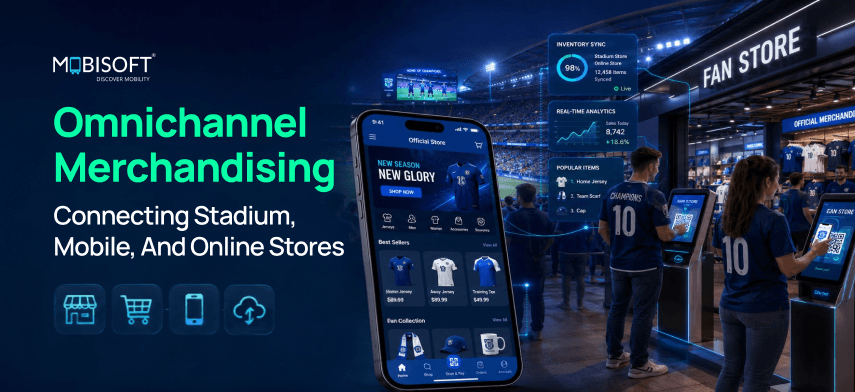
A fan walks past the stadium merchandise store on match day. They spot a shirt they want. The queue is fifteen minutes long. They think, "I'll just grab it online later." But, they never do.
That is not a technology failure, it's a revenue failure. And it happens at clubs across every league, every weekend, because the stadium store, the online shop, and the sports mobile app are treated as three separate retail businesses that happen to share a badge.
The fan does not see three channels. They see one club.
Omnichannel retail is the practice of connecting those channels so the fan's experience is coherent regardless of where they choose to buy. Not identical across channels, but coherent. Same inventory, same identity, and same loyalty balance. The gap between what fans expect and what most clubs actually deliver is where purchase intent quietly dies.
Manhattan Associates' 2026 Global Unified Commerce Benchmark assessed over 400 specialty retailers and found that only 7% qualify as unified commerce leaders. The majority, 33%, remain at basic maturity. Leaders report 27% lower fulfilment costs and 18% less cart abandonment compared to fragmented operators.
For sports organisations, where every match day is a compressed, high-emotion retail window happening across three channels at once, that gap is paid for in abandoned intent every single week.
This guide covers what genuine omnichannel merchandising looks like in practice. It maps each channel's role, the data architecture that connects them, a phased implementation roadmap, and the metrics that tell you whether it is actually working.
Why Most Sports Merchandise Operations Are Not Actually Omnichannel Retail
Most clubs that describe their merchandise operation as omnichannel are operating multichannel at best. The distinction matters operationally and commercially.
Here is a distinction worth making clearly before anything else.
Multichannel retail means having multiple channels that each work independently. You have a stadium store that processes transactions on match day. You have a website that handles online orders throughout the week. You also have a mobile app that fans can browse and occasionally purchase from. Each channel functions on its own terms and reports its own revenue numbers. From a distance, this looks like an omnichannel because the channels coexist.
Omnichannel commerce means those channels share inventory data, customer identity, and transaction history in real time. A sale at the stadium POS immediately updates the stock count visible on the website. A fan who bought it online three months ago is recognised at the stadium. Points earned during a Saturday match-day purchase appear in the fan's app before they reach the car park exit.
The difference is invisible until it fails, and when it fails, it fails in front of a fan who is already emotionally invested in the club.
Most clubs are on the wrong side of both experiences more often than they realise.
The commercial consequences of staying fragmented are measurable and consistent. Fans who encounter false availability claims, see an item listed as in stock, and then receive a cancellation email, lose confidence in the online store as a reliable place to buy. Research into repeat purchase behaviour shows that fans who do not receive immediate loyalty recognition after a stadium purchase are considerably less likely to return within ninety days. Fans who experience a broken click-and-collect process often avoid using the service again entirely, even after the operational issues are fixed.
Retail digital transformation in sports merchandising is not about layering new features on top of disconnected systems. It starts with fixing the foundational infrastructure. Inventory, customer identity, and order management should all be in one place. The clubs that have made this investment report outcomes that their fragmented competitors cannot replicate. Not because they sell different products, but because they convert a higher proportion of existing fan intent into completed purchases.
Consider what the omnichannel retail maturity gap looks like in practical terms across four levels.
| Maturity Level | What it looks like | Commercial consequence |
| Siloed | The stadium store, online shop, and app operate on separate systems with no shared data | High cart abandonment, no cross-channel personalisation, no click-and-collect |
| Cross-channel | Online and stadium POS share inventory, but customer identity is still separate | Fewer false out-of-stock errors, but personalisation limited to within-channel history |
| Omnichannel | Inventory and customer identity unified, personalisation references full purchase history | Higher repeat purchase rate, lower cart abandonment, and effective lifecycle marketing |
| Unified commerce | All channels share inventory, customer data, order management, and payment data in real time | 2x revenue growth versus basic-tier operators, 27% lower fulfilment costs |
Most clubs reading this will recognise themselves somewhere in the first two rows. The question is not whether unified commerce is worth building. The question is where to start and what to build in what sequence.
Five Commerce Channels and How They Connect
A fully connected sports merchandising operation runs across five channels. Each one serves a different fan context. Each one has a distinct role in the purchase journey. What has to be consistent across all five is:
- Inventory data
- Customer identity
- Pricing
- Loyalty programme running underneath.
The goal is not to make every channel look or feel the same. It is to make them coherent.
Stadium Store
Every club selling sports team merchandise faces the same foundational challenge: converting match-day intent into completed purchases before that emotional window closes. The stadium store is the highest-intent merchandise touchpoint in sports retail. A fan walking in on match day is at the peak of their emotional connection to the club. They have already committed significant time, money, and energy to being there. The barrier to a merchandise purchase is lower at this moment than at any other point in the calendar.
That is what makes it so commercially painful when the experience fails.
Queue length is the most common failure point. Research consistently shows that a significant portion of fans abandon the purchase when they face a five-minute or longer queue. The stadium retail experience is not just about having good products on display. It is about converting intent that already exists.
The stadium store also serves as the physical fulfilment point for click-and-collect orders. When it functions well, it captures impulse purchase, enables fans to try before they buy, and provides the immediacy that no delivery option can match. No fulfilment cost to the club either, since the fan collects in person.
What the stadium store needs to function as a part of omnichannel retail:
- Contactless payment terminals (average transaction time drops from 45 seconds to 8 seconds)
- Real-time inventory visible to staff on mobile devices
- A dedicated click-and-collect collection point with QR scanning
- Loyalty point awards are displayed on the receipt and in the app at the point of sale
- A customer identification mechanism so the fan can link their purchase to their digital profile
The most common integration failure at the stadium store is the POS operating as a standalone system. When stadium POS transactions do not update the central inventory immediately, the online store shows items as available that have already sold. Staff cannot check whether a size exists in the online catalogue. Cross-channel returns get declined because the online and POS systems hold separate order records.
This is the first thing to fix. Everything else depends on it.
Online Store
The online store is the always-open channel. It serves fans who cannot attend in person, international supporters who never will, fans browsing at midnight after a title win, and the considerable volume of fans who research online before buying at the stadium.
It is the channel with the longest consideration window and the broadest reach. It is also the channel where ecommerce merchandising and personalisation have the highest leverage. A logged-in fan arriving from a post-match push notification should see match-relevant products, not a generic homepage featuring whatever sold well last week.
The online store has some structural weaknesses worth acknowledging. It operates without the emotional context of match attendance. A fan browsing from their sofa has considerably lower purchase intent than the same fan standing outside the stadium store. That gap in intent has to be closed through relevance, personalisation, and the kind of contextual product surface that reminds the fan why they care.
Peak traffic events for sports online stores include kit launch days (which can generate a month's worth of standard traffic in twenty-four hours), title wins, major transfer announcements, and the two-hour window after the final whistle of a high-profile match. The online store has to be architected to handle these spikes without slowing down, and the inventory displayed during those moments has to be accurate.
What the online store needs to function as a part of omnichannel commerce:
- Real-time inventory reading from the same central system as the stadium POS and mobile app
- One-click checkout with Apple Pay, Google Pay, and Shop Pay as primary options
- A personalised homepage for logged-in fans featuring favourite player products and purchase history
- Match-contextual product surface on match days, updated dynamically as events unfold
- Click-and-collect as a fulfilment option at checkout, with live availability confirmation
The single most destructive failure mode for the online store is showing products as available when they have already sold at the stadium. A fan completes checkout, receives a confirmation email, then gets a cancellation two days later. That sequence destroys the trust that every other piece of the commerce experience is trying to build.
Mobile App
The mobile app is the most intimate commerce channel. It is in the fan's pocket during the match, on the sofa after the final whistle, and on the commute the morning after. It is the only channel that combines real-time match context with purchase capability and loyalty tracking in one interface.
Mobile commerce is where the sports-specific advantage over generic retail becomes most visible. A fan watching a goal celebration receives a push notification within sixty seconds featuring that player's merchandise. They tap through. They buy in two taps. They never leave the app. That sequence is not achievable by any other retail category in quite the same way, because no other retail category has live emotional events happening in real time that directly map to purchasable products.
The app is also the bridge between the stadium and online environments. A fan presents their app QR code at the stadium POS to link their in-venue purchase to their digital identity. They check their loyalty balance between halves. They place a click-and-collect order from their seat. They track collection readiness without leaving the app.
What the mobile app needs to function as part of omnichannel retail:
- Real-time match score and event feed to contextualise merchandise push notifications
- Push notification management with player-based segmentation
- In-app commerce with full checkout capability, not just browse and redirect
- Loyalty points balance is visible on the app home screen
- QR code for in-store identification at the stadium POS
- Click-and-collect status tracker showing when an order is ready and where to collect
The most damaging failure mode for the mobile app in a merchandise context is sending push notifications promoting products that are out of stock when the fan clicks through. A notification sent within sixty seconds of a goal, featuring the scorer's shirt, is the highest-intent moment in mobile commerce. If the fan taps through and the shirt is sold out, the notification has done more damage than if it had never been sent. Inventory checking before notification dispatch is not optional.
Social Commerce
Social commerce is the discovery and impulse channel for fans who do not proactively open the club website or app but spend significant time on TikTok and Instagram consuming sports content.
A fan watches a goal celebration reel on Instagram. The club has tagged the kit the player is wearing. The fan taps the tag, sees the product, and purchases without leaving the app. That is a completed transaction that would not have existed without social commerce integration. The fan was not in purchase mode. They were in content mode. The product appeared in their context rather than requiring them to seek it out.
Social commerce is projected to grow from $2 trillion in 2025 to $8.5 trillion by 2030, making it the fastest-growing commerce channel in retail overall. For sports organisations, it is also one of the most underdeveloped.
The common failure with social commerce in sports retail is the product catalogue being maintained manually and falling weeks out of date. A new kit launches on the website. The Instagram Shopping catalogue still shows last season's product. A player transfer creates a surge of demand for a shirt. TikTok Shop still shows the previous squad member's product. Automated catalogue sync from the central product information system to all social commerce channels eliminates this.
What social commerce needs to function as part of unified commerce:
- Automated product feed published to Instagram Shopping and TikTok Shop in real time
- Real-time inventory sync to social channels to prevent fans from ordering unavailable items
- Social orders flow into the same central order management system as website and POS orders
- Customer data from social purchases is linked to CRM, where the fan has an existing account
Click-and-Collect
Click-and-collect is the bridge between online selection and physical collection. It is the highest-converting fulfilment option for fans attending a match, and it consistently underdelivers because it is built poorly.
The value proposition is simple. A fan reserves an item online, confirms their size, pays at checkout, and collects at a dedicated point at the stadium without waiting in the standard retail queue. The fan gets online convenience and immediate physical collection. The club gets a committed, pre-paid purchase before the fan even arrives.
When click-and-collect is working, it converts fans who would have abandoned the purchase due to queue length into completed transactions. Fans given click-and-collect as a fulfillment option convert at 20 to 30% higher rates than fans presented with delivery only.
When click-and-collect is failing, which is most of the time, the collection queue is as long as the standard retail queue. The collection system and the POS are separate. Staff cannot find the order quickly. The fan who pre-ordered to save time ends up waiting longer than someone who walked in without ordering. That experience is worse than not offering click-and-collect at all, because the fan made a deliberate choice to pre-order and was still made to wait.
What click-and-collect needs to function properly:
- Unified inventory so that an online reservation actually holds physical stadium stock
- A collection point physically separate from the main store queue
- QR code redemption takes under ninety seconds from arrival to collection
- Real-time order status notifications are sent when the order is ready
- Dedicated staffing at the collection point, not shared staffing with the main store
The Unified Data Architecture: What Has to Connect to Everything Else
Five channels creating five separate data streams is not omnichannel. It is five separate businesses sharing a logo. The architecture that makes unified commerce possible requires five data systems operating as one.
Central Inventory Management
One inventory database. One source of truth.
Every stadium POS transaction, online order, click-and-collect reservation, and mobile app product display reads from and writes to the same record in real time.
When a shirt in size large sells at the stadium POS, the online store reflects the reduced quantity within seconds. Not in an overnight batch or in the next morning's sync. Within seconds.
This is the foundational integration of the omnichannel retail ecosystem. Without it, click-and-collect is impossible. Real-time stock accuracy is impossible. Cross-channel returns are impossible. Every other element of omnichannel commerce assumes this exists and breaks without it.
The false availability problem, showing a product as in stock when it has sold, is the single fastest trust-destroyer in sports retail. A fan who encounters it once will not trust the website's stock information again without calling ahead. Fixing this one integration eliminates that problem.
Unified Customer Identity
A single fan record that aggregates every purchase across every channel, loyalty points earned and redeemed, communication preference, registered favourite player, and match attendance record, where ticketing data is available.
This is the commercial foundation of personalisation in unified commerce. Without it, the post-match email cannot know that a fan attended today's game, bought their player's shirt at the stadium two seasons ago, and has not made a purchase since. The recommendation engine cannot reference stadium purchase history when surfacing products on the website. The push notification cannot distinguish between a fan who has bought that player's shirt before and one who has not.
When matchday transactions become part of the same customer record as online behaviour, clubs can personalise with meaningfully greater accuracy and build lifecycle journeys that are actually relevant.
Order Management System
A single system that tracks every order regardless of where it was placed and manages its fulfilment pathway. Online order, POS transaction, mobile purchase, and social commerce sale. All of them visible in one place, routed to the correct fulfilment method from the same system.
The OMS is the routing intelligence of the omnichannel commerce. When an online order is placed for a product that sits in the stadium store but not at the central warehouse, the OMS routes it to ship-from-store. When a click-and-collect order arrives, the OMS holds the physical stock and triggers the collection notification. When a return is processed at the stadium store for an online purchase, the OMS handles the reconciliation.
CRM and Fan Data Platform
The layer that activates all the unified customer identity data. The CRM holds the fan profile. The fan data platform pushes it across channels, sending the match-day push notification, triggering the abandoned cart email, populating the personalised homepage, and informing the product recommendation engine.
Without CRM integration, the channels have data but cannot use it. The fan profile exists but sits idle. The birthday email goes out without referencing a single purchase because stadium purchases never made it into the email marketing system. The homepage serves the same generic content to a fan who has bought the home kit, the away kit, and two player shirts in the past twelve months as it does to someone who has never bought anything.
A well-integrated CRM with a fan data platform is what closes the gap between having customer data and actually using it to sell more effectively.
Loyalty Platform
The points economy operates across all five channels simultaneously. Every purchase earns points. Points are visible in the mobile app within seconds of the earning transaction. Points can be redeemed against any purchase on any channel.
This is the commercial mechanism that makes fans want to identify themselves at the stadium POS. The QR code they present at the till links their in-venue purchase to their digital profile and earns points they can spend online. Without that incentive, fans have no reason to connect their stadium purchases to their digital identity. And without that connection, the club loses the data that would enable every other personalisation capability.
The loyalty platform is also the metric by which fans measure whether the club recognises them. A fan who earns points at the stadium and sees them appear in the app before they reach the exit understands, at a visceral level, that the club knows who they are and values the relationship.
Implementation Roadmap: Connecting Stadium, Mobile, and Online in Three Phases
The question clubs most commonly ask is not whether to build omnichannel merchandising. It is where to start without spending money on things that depend on other things that do not exist yet.
The answer is to build in dependency order. Each phase creates the infrastructure that the next phase requires.
Before any investment, run a quick audit across five questions:
- Does a sale at the stadium POS update the online store's stock count in real time?
- Does the online store know what a fan bought at the stadium store last month?
- Can a fan order online and collect at the stadium without joining the regular queue?
- Does a goal by the fan's favourite player trigger a product push across all channels within sixty seconds?
- Does a point earned at the stadium store appear in the fan's online account?
Most clubs fail at the first question. Start there.
Phase 1: Inventory Unification and POS Integration (Weeks 1 to 12)
This is the foundational build. A single inventory source shared by the stadium POS and the online store, with real-time stock sync across both.
Technology options:
- Shopify Plus, with native POS and online inventory sync, is the recommended starting point for clubs migrating to a unified platform
- Integration of an existing POS to a Shopify backend via API if a full POS replacement is not desirable
- Omnium OMS as the inventory source of truth above existing POS and ecommerce systems, the approach Stadium Nordic took when selecting Omnium in March 2025, specifically for cross-channel inventory coherence
The non-negotiable requirement here is that inventory updates propagate across all channels within ten seconds of any transaction. Not minutes. Not hours.
Cost range: £15,000 to £45,000, depending on existing system complexity and whether a POS replacement is required.
What you can measure when this phase is complete:
- Zero false out-of-stock messages on match day
- Stadium sales reflected on the website within sixty seconds of the transaction
- Cross-channel returns accepted at the stadium store for online purchases
- Staff can check online inventory from a mobile device on the shop floor
This one phase eliminates the most common and most damaging fan experience failure in sports retail. Everything that follows builds on it.
Phase 2: Fan Identity and Loyalty Connection (Weeks 8 to 20)
Connect the fans' in-stadium purchase to their digital identity. This phase introduces the CRM integration, the loyalty platform connection to the POS, and the post-match communication automation.
What gets built:
- Mobile app QR code at the POS for fan self-identification
- CRM receives transaction data from the POS and links it to the fan's online account
- Loyalty platform API connected to the POS for real-time point award at the moment of sale
- Match attendance data from the ticketing system, feeding into the CRM fan profile
- Post-match email automation triggered by match attendance records
Technology options:
- CRM: HubSpot, Salesforce, or Microsoft Dynamics, receiving POS transaction events
- Loyalty platform: LoyaltyLion or Smile.io with an API connected to the POS
- Email automation: Klaviyo or Braze with match attendance trigger logic
The key performance requirement here is that a stadium purchase translates into a loyalty point award visible in the mobile app within sixty seconds.
Cost range: £20,000 to £60,000 depending on CRM complexity and data migration requirements.
What you can measure when this phase is complete:
- Fan identity connection rate at the stadium POS, targeting 30% of transactions linked to a digital profile within six months of launch
- Post-match email open rates against pre-implementation benchmarks, targeting a 40% uplift
- Repeat purchase rate among fans who have connected their stadium and digital identities compared to those who have not
Phase 3: Personalisation and Social Commerce Activation (Weeks 16 to 30)
The third phase adds the sports-specific capability that no generic retail operation can replicate: real-time match context connected to the commerce layer.
What gets built:
- Match event webhook from an official data provider to the personalisation engine and push notification platform
- Goal notification push pipeline, player scores, notification dispatched within sixty seconds, featuring that player's merchandise
- Match-day homepage personalisation for logged-in fans
- TikTok Shop and Instagram Shopping product catalogue sync from the central product information management system
- Post-match merchandise email automation drawing from CRM attendance and purchase data
Technology options:
- Match data: Opta, StatsBomb, or the tournament management system's native webhook
- Push notification: Braze or Firebase
- Personalisation engine: Nosto or Klevu connected to the CRM fan profile
- Social commerce: TikTok Shop and Instagram Shopping integration with automated catalogue sync
Cost range: £25,000 to £70,000 for match data integration, push notification pipeline, and social commerce activation.
What you can measure when this phase is complete:
- Conversion rate on the match-day personalised homepage versus the standard homepage, targeting a 25 to 40% lift
- Click-through rate on goal-triggered push notifications, targeting 3 to 8% against less than 1% for non-contextual notifications
- Social commerce revenue as a percentage of total merchandise revenue, with 5 to 15% achievable within twelve months of activation
Measuring Omnichannel Performance: The Metrics That Matter
Running omnichannel retail without a measurement framework is the equivalent of building five roads and never checking whether any traffic actually flows between them. The metrics below are not vanity numbers. Each one tells you something specific about whether the integration is working or where it is breaking down.
Cross-Channel Purchase Rate
The percentage of fans who have purchased on more than one channel, stadium plus online, or online plus mobile app, within a defined period.
This is the primary indicator of omnichannel depth. A high cross-channel purchase rate tells you that fans are experiencing the channels as parts of one operation rather than unrelated storefronts. A low rate tells you that channels are not reinforcing each other, regardless of how well each one performs individually.
Target: 20 to 35% of active purchasers should be cross-channel buyers within twelve months of a unified commerce launch.
How to calculate: Count of customer profiles with at least two transactions across different channels, divided by total profiles with at least one transaction.
Fan Identity Connection Rate at POS
The percentage of in-stadium transactions linked to a digital fan profile via app QR, loyalty card, or email at the point of sale.
This metric is the data pipeline into personalisation. Every unlinked transaction is a purchase that happened without the club knowing who made it. The fan earned nothing. The club learned nothing.
Target: 30% in the first six months, 50% or above by twelve months, 70% or above by twenty-four months.
Click-and-Collect Completion Rate
The percentage of click-and-collect orders that are successfully collected rather than uncollected and eventually refunded.
A completion rate below 70% indicates a broken experience, either poor communication so the fan did not know their order was ready, or a collection experience bad enough that the fan decided not to bother. Both are operational failures that are straightforward to fix once the data surfaces them.
Target: 85% or above.
Channel Revenue Attribution
Revenue by channel as a percentage of total merchandise revenue, tracked over time.
This metric does not have a single right answer. It tells you whether your investment in specific channels is producing proportional returns and where growth is happening. Online typically accounts for 30 to 45% of total merchandise revenue. Stadium POS typically accounts for 40 to 55%. Mobile and social are growing, with 5 to 15% achievable for each within twelve months of activation.
The value of tracking this over time is noticing when a channel's share shifts meaningfully and understanding whether that is a result of investment, a change in fan behaviour, or a deterioration in another channel's performance.
Personalisation Conversion Lift
The difference in conversion rate between personalised page experiences for logged-in fans with CRM profile data and anonymous browsing sessions.
If personalisation is working, logged-in fans should convert at 1.5 to 2.5 times the rate of anonymous visitors. If the lift is not significant, the personalisation engine is either not receiving sufficient data or not surfacing products that are genuinely relevant to the individual fan.
This metric is particularly useful for diagnosing whether Phase 2 fan identity work is translating into measurable commerce outcomes.
Post-Match Email Conversion Rate
The percentage of fans who open a post-match merchandise email and complete a purchase.
The sports industry average for e-commerce email conversion sits around 1.59%. Match-contextual post-match emails, sent within two hours of the final whistle and referencing the specific match, the fan's attendance, and products relevant to the result, should achieve 3 to 6% conversion. If they are not, the segmentation, personalisation, or timing of the automation needs attention.
Target: 3 to 6% conversion rate on contextualised post-match emails.
Inventory Accuracy Rate
The percentage of online product availability accurately reflects the actual available inventory.
Target: 99.5% or above.
Below 99% means a meaningful volume of fans are encountering false availability, placing orders for items that cannot be fulfilled, or visiting the stadium store for items that are actually sold out. Every one of those interactions has a negative follow-on effect on purchase confidence.
One Club, One Fan, One Commerce Experience
The fan does not think in channels. They think about their club. They want to buy wherever they are. They want to collect wherever it is convenient. They want the club to remember who they are at every single touchpoint.
The technology to deliver that experience exists. It is deployable within six to twelve months for most clubs. Shopify Plus, Omnium, and Brightpearl have demonstrated it at scale. Toby's Sports unified 67 outlets and achieved 13.5x sales growth. Fanatics managed custom sports ecommerce operations across twelve simultaneous venues at the FIFA Club World Cup in 2025. Intersport runs click-and-collect and ship-from-store across 42 countries from a unified inventory.
The barrier is not technology. It is the organisational assumption that the stadium store, the online shop, and the mobile app are naturally separate operations, that this is just how things work, and that fixing it is a long and expensive project for some future roadmap.
It is not as long or as expensive as the alternative. Every match day where inventory is fragmented, every notification that promotes a sold-out shirt, every fan who pre-orders for click-and-collect and stands in a queue anyway, is a compounding revenue loss with a compounding trust cost attached.
The clubs investing in retail digital transformation services through unified inventory and customer identity right now will have a measurable commercial advantage over the clubs that continue to manage three separate retail businesses under one crest. Not because they will have better kits or more famous players. Because they will convert a higher percentage of their fans' existing purchase intent into completed transactions.
The connected retail experience is not a future state. It is a current competitive reality being built by the organisations that have understood what the fan already assumed was in place.
Omnichannel commerce starts with one integration: the stadium POS and the online store reading from the same inventory. Everything else follows from that.
Build Your Omnichannel Sports Merchandise Platform with Mobisoft Infotech
Mobisoft Infotech can help you design and build unified sports merchandise commerce systems across stadium, mobile, online, social, and click-and-collect channels.
Talk to Our Experts

Frequently Asked Questions
How long does it take to build a unified sports merchandise platform?
Most builds follow a phased approach. Inventory unification and POS integration typically takes 8 to 12 weeks. A full omnichannel retail setup covering fan identity, loyalty, and social commerce runs between 20 and 32 weeks, depending on your existing systems.
Do we need to replace our existing stadium POS to get started?
Not necessarily. We can integrate your current POS with a central inventory system via API. A full POS replacement is only recommended when your existing hardware is creating significant retail technology bottlenecks.
What if we already have an online store and a mobile app?
That is actually the most common starting point. We assess what you already have and build the integration layer that connects your existing channels into a unified commerce system rather than rebuilding from scratch.
How much does it cost to get started?
Entry-level inventory unification and POS integration start at £10,000. Full omnichannel merchandising with personalisation and social commerce sits between £50,000 and £120,000, depending on scope and complexity.
Can this work for a smaller club, not just large enterprises?
Yes. The phased roadmap is specifically designed so that smaller clubs can start with sports ecommerce basics and scale up as the operation grows. You do not need to build everything at once.
This content is for informational purposes only and may include AI-assisted research or content generation. While we strive for accuracy, information may evolve over time. Readers are advised to independently verify critical information before making decisions.

Nitin Lahoti
Read more
Nitin Lahoti is the Co-Founder and Director at Mobisoft Infotech. He has 15 years of experience in Design, Business Development and Startups. His expertise is in Product Ideation, UX/UI design, Startup consulting and mentoring. He prefers business readings and loves traveling.
 Nitin Lahoti
 May 12, 2026