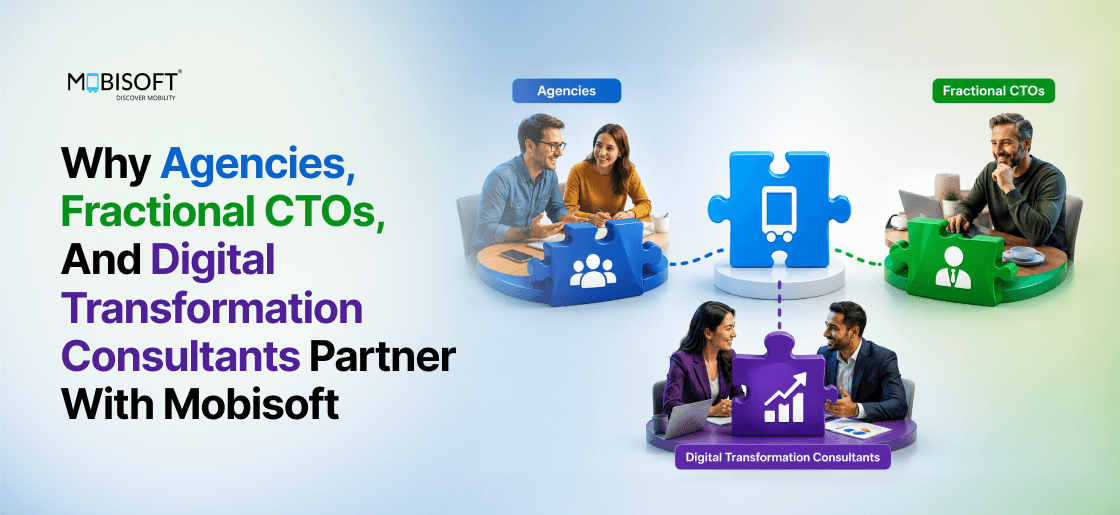
This guide is for decision-makers who want to choose an engineering partner that fits their business goals and long-term vision. Agencies, fractional CTOs, and digital transformation consulting firms that arrive at Mobisoft's partner programme typically do so after evaluating alternatives: generic outsourcing firms that offer low rates and variable quality, specialist boutiques that excel in one domain but cannot serve the next client, and freelance networks that cannot scale effectively with growing demands. What they find in Mobisoft is a specific combination of capabilities that is difficult to replicate: engineering teams with credible domain expertise in regulated industries, a production platform that proves the engineering quality claim, and a partnership structure that preserves their client relationships and their brand. This guide describes, for each of the three partner types, the specific reasons that combination is compelling.
The Common Thread: Three Different Businesses, One Engineering Partner Challenge
Digital agencies, fractional CTOs, and digital transformation consultants are, in most observable ways, very different businesses. An agency has a creative team, a studio culture, and a brand built around design and marketing deliverables. A fractional CTO is typically a solo practitioner or small firm built around technical expertise and advisory influence. A transformation consultant builds their reputation on industry knowledge, change management capability, and the ability to navigate complex organisational dynamics. They compete in different markets, serve different clients, and deliver different primary services.
What they share is a single engineering challenge: they regularly encounter clients whose technology needs exceed what the consultant, agency, or CTO can deliver independently. The quality of the software development partner they recommend or deploy reflects their professional credibility. A bad engineering partner recommendation damages an agency's client relationship, undermines a fractional CTO's advisory standing, and breaks a transformation consultant's most valuable claim: that their recommendations lead to outcomes, not just strategies.
What All Three Partner Types Require Before Choosing a Software Development Partner
Before committing to any engineering relationship, all three partner types share a core set of requirements. Understanding these requirements explains why a generic outsourcing option is rarely sufficient.
| Requirement | Why It Matters |
|---|---|
| Verifiable production evidence | Partners need a live, testable product, not just portfolios or case studies. Agencies, boards, and consultants validate technical capability through real-world proof, not screenshots. |
| Domain expertise in the partner's primary client industries | Technical skills alone are insufficient. Clients often require industry-specific compliance, regulations, and operational knowledge. Gaps here can lead to costly remediation. |
| Partnership structure that preserves the partner's client relationship | Agencies, fractional CTOs, and consultants must retain their client relationships and leadership roles. The engineering partner should support, not compete with, them. |
| Honest scope clarity | Recommending the wrong partner creates professional risk. Clear visibility into strengths and limitations helps avoid failed engagements. |
| No equity requirement | Most agencies, consultants, enterprise clients, and founders will not offer equity to engineering vendors. Equity demands are often an immediate disqualifier. |
Why Digital Agencies Choose Mobisoft as Their Software Development Partner
Digital agencies that join Mobisoft's agency partner program have almost always evaluated alternatives before choosing. Those alternatives include in-house engineering teams, specialist freelance networks, a generic offshore development partner, and boutique development studios. What agencies find in Mobisoft that alternatives do not consistently offer is a specific combination of engineering quality, domain expertise, white label software development structure, and verifiable production evidence that makes the agency's own brand stronger rather than weaker for the partnership.
Four Reasons Agencies Choose Mobisoft
White-Label Delivery That Strengthens the Agency Brand
Mobisoft's dedicated developers deliver comprehensive services. All deliverables, including code, design assets, architecture documents, and sprint review outputs, are managed by the experts. However, they do not appear in client-facing communications. The agency's PM is the client's sole contact. The working software is deployed and maintained under the agency's client contract. Generic offshore firms nominally offer white-label delivery but frequently introduce their own branding in deliverable documents, email signatures, or code repository names. That exposure damages the agency's credibility at the worst possible moment.
Domain Expertise That Makes Regulated-Industry Proposals Credible
When an agency's client is a hospital, a commercial carrier, or a financial services company, the proposal must demonstrate HIPAA or PCI-DSS technical depth to survive procurement review. Mobisoft's domain expertise provides the specific regulatory language, including HIPAA §164.312(b) audit logging, FMCSA 395.3 HOS enforcement, and PCI-DSS CDE scoping, that makes the proposal credible without requiring the agency to have that knowledge in-house. Generic development firms describe compliance as a general capability. Proposals that say they take HIPAA compliance seriously do not survive review by a healthcare IT procurement team looking for specific Technical Safeguard implementation descriptions.
Delivery Standards That Do Not Require the Agency to Become a Development Manager
Mobisoft's delivery model provides sprint reviews with working software demos on target devices, test coverage reporting, OWASP security results, technical debt quantification, and Architecture Decision Records. This gives the agency the quality evidence it needs to satisfy its client without requiring the agency to develop engineering management expertise. Offshore development firms with low rates typically require active engineering management from the client side. The agency becomes a de facto engineering project manager, fielding technical escalations they are not qualified to resolve, while the margin that made the offshore rate attractive disappears into management overhead. Hire dedicated developers directly for a client engagement to eliminate the problem.
Honest Scope Limitations That Protect the Agency from Bad Recommendations
Mobisoft's explicit scope boundaries cover game development, blockchain and smart contracts, embedded firmware, consumer social at 100M+ DAU, mainframe modernisation, and ITAR aerospace software. This list means agencies know which client requirements to introduce to Mobisoft and which to route elsewhere. It prevents the agency from making a recommendation that Mobisoft then declines or underdelivers on. Generic development firms claim capability in everything. The agency discovers the actual limitations mid-engagement, when the client's trust in the agency's recommendation is already damaged.
Why Fractional CTOs Choose Mobisoft: The Advisory Credibility Case
The fractional CTO's engineering partner choice is the highest-stakes partner selection in Mobisoft's programme. A CTO as a service practice that recommends an engineering partner to a Series A founder is not just recommending a vendor. They are staking their technical credibility, the reputation on which their entire advisory practice depends, on the quality of that recommendation. In a market where fractional CTOs are evaluated on their track record of recommendations that worked, one visible failure carries disproportionate weight.
Six Reasons Fractional CTOs Find the Mobisoft Partnership Valuable
Engineering Depth Behind the Advisory
A fractional CTO who advises on architecture, technology selection, and team scaling needs their recommendations to be backed by implementable engineering capability. Mobisoft's 150+ person engineering team sits behind the advisory relationship. When the CTO makes an architecture recommendation, Mobisoft can build the validation prototype. When the CTO recommends a technology approach, Mobisoft can review the implementation. The advisory recommendation is backed by engineering execution capability that most fractional CTOs cannot access independently. As a dedicated development team working under the CTO's direction, Mobisoft converts advisory recommendations into actionable plans.
Domain Compliance Knowledge for Regulated-Industry Clients
Fractional CTOs who advise healthcare, logistics, and fintech companies need to know the specific compliance implications of their architecture recommendations. A CTO who recommends a data model that does not accommodate HIPAA audit logging requirements creates an expensive remediation problem for their client. Mobisoft's six domain practice areas in healthcare, logistics, fintech, enterprise SaaS, corporate mobility, and on-demand have accumulated compliance architecture knowledge that informs the fractional CTO's recommendations. The CTO does not need to be a HIPAA Technical Safeguard expert to advise a healthcare startup correctly when they have a technology partner who is.
A 90-Day Foundation That Survives CTO Transitions
Fractional CTOs know their engagement will eventually transition to either a full-time CTO or ongoing advisory. The architecture, team structure, and delivery standards established in the first 90 days must be sound enough to survive that transition without a rebuild. Mobisoft's 90-day foundation deliverables, covering architecture assessment, team structure design, delivery standards, board communication framework, and a technical debt register, are designed to be handed to an incoming full-time CTO without remediation. The fractional CTO's reputation for setting up a company correctly is supported by documentation that the next CTO can evaluate and build on.
Production Evidence for Board-Level Conversations
Fractional CTOs who represent technology in board meetings and investor conversations need to demonstrate engineering quality credibly to non-technical stakeholders. A board approving a $300,000 engineering investment expects the CTO to have evaluated the engineering partner's work quality, not just their rate card. The SAML and SCIM architecture overview is presentable to the board's CISO. The CTO's recommendation is evidence-based rather than reputation-based.
An Engineering Team That Supports the CTO's Authority
The fractional CTO's greatest risk in an engineering partnership is a firm that gradually positions itself as the client's primary technology decision-maker, reducing the CTO to a scheduling and communication layer. This happens when engineering firms develop direct client relationships, attend client meetings without the CTO present, or communicate architectural opinions directly to the client's founders. Mobisoft's engagement model is structured to prevent this. Engineers work under the CTO's direction. All client-facing technical communications are mediated through the CTO. Architectural decisions are documented and presented by the CTO. The CTO's authority is strengthened by the dedicated development team's competence, not threatened by it.
Flexible Engagement Scaling Without HR Overhead
Fractional CTOs serve multiple companies simultaneously. Scaling engineering capacity up or down as different portfolio companies enter different development phases is an operational complexity that most solo practitioners cannot manage through direct employment relationships. Mobisoft's engagement model accommodates variable team sizes without requiring the fractional CTO to manage HR, benefits, or employment contracts. Scaling from two engineers to eight engineers to support a product launch and back to three engineers for steady-state maintenance is a commercial agreement change, not an employment action. This is the core operational advantage of an outsourced development team structured around the advisor's needs.
How Fractional CTOs Should Evaluate Mobisoft Before the First Recommendation
Fractional CTOs who are evaluating Mobisoft as an engineering partner before making their first client recommendation typically follow this sequence. It consistently converts practitioners from evaluation to partnership.
- Request a 45-minute technical architecture walkthrough with the AI matching engine and enterprise security architecture through your Mobisoft channel partner manager. Assess whether engineers describe architectural decisions with the same depth and confidence you would expect from a senior hire.
- Request the CSRD ESRS E1 methodology documentation, the HIPAA compliance architecture overview, and the FMCSA HOS enforcement architecture description, available under NDA. Check whether the compliance documentation is specific enough to satisfy a domain-expert review.
- Ask the wrong project question. In your initial conversation with a Mobisoft senior engineering leader, ask what they would tell a client building a blockchain-based supply chain application. A firm that names its scope limitations clearly is a firm whose claimed capabilities can be trusted.
- Request a sample Architecture Decision Record and a sample 90-day architecture assessment, anonymised, through your channel partner manager. Review them as you would evaluate the work of an engineering team you were considering for a CTO-level hire.
Fractional CTOs who want to understand how the CTO as a service model integrates with Mobisoft's engineering capability can explore the full overview of the technology consulting partnership structure.
Why Digital Transformation Consultants Choose Mobisoft: The Strategy-to-Execution Bridge
The most persistent frustration in digital transformation consulting is the gap between the strategy the consultant recommends and the execution that follows. Transformation consultants build business cases for technology investments, define the architecture of the to-be state, and secure board approval for programmes that will change how the organisation operates. In most cases, execution is then handed to a different team: an internal IT department that cannot build what was specified, or an external development firm that lacks the domain knowledge to build it correctly. The consultant's strategy recommendation becomes separated from the outcome it was supposed to produce.
Five Transformation Consulting Challenges Mobisoft Addresses
The Specification That Gets Built Incorrectly
Transformation consultants write detailed specifications of the to-be state. The development team builds what the specification says. The built product is technically correct but operationally wrong because the specification did not capture the operational constraints, edge cases, or integration requirements that the business domain contains. Mobisoft's co-delivery structure puts the transformation consultant's domain knowledge alongside Mobisoft's engineering knowledge from sprint one. When the consultant knows that a logistics workflow has a specific FMCSA compliance constraint that the specification does not capture, the co-delivery structure allows that knowledge to be incorporated in sprint planning before it becomes an expensive late-stage discovery. This is one of the core advantages of digital transformation consulting delivered through a co-delivery model rather than a pure handoff.
The Compliance Requirement Discovered After the Product Is Built
Transformation consultants who are strategy experts rather than technology compliance experts regularly miss the specific technical compliance requirements of the markets their clients are entering. HIPAA Technical Safeguards, FMCSA HOS enforcement logic, PCI-DSS CDE scoping, and CSRD emission calculation methodology are technical requirements that general-purpose transformation consultants are not expected to know. But when the consultant recommends a development partner without this knowledge, the compliance gap becomes the consultant's accountability problem when it emerges at enterprise procurement. Mobisoft's domain compliance knowledge is pre-loaded into every engagement in the relevant domain. The compliance requirements are surfaced at the architecture stage, not post-launch, which prevents cost revisions of $80,000 to $200,000 that would otherwise arrive after the board has already approved the original business case. Working with a dedicated software development partner with pre-loaded compliance knowledge changes that risk profile entirely.
The Technology Roadmap That Is Obsolete at Launch
Transformation programmes typically take 12 to 24 months from strategy approval to product launch. The technology landscape changes during this period. Specifications written at the beginning of the programme are based on technology capabilities and market conditions that may not be current at launch. Mobisoft's quarterly technology briefings for partners cover new engineering capabilities, regulatory changes, and market signals, keeping the transformation consultant's technology recommendations current throughout the programme. Architecture Decision Records created at the beginning of the programme are revisited when new capabilities, such as React Native New Architecture, new LLM APIs, or new compliance tools, become available. The product at launch reflects the current technology landscape. This is a meaningful advantage of technology consulting services delivered through an active, ongoing partnership rather than a one-time engagement.
The Board Presentation, the Consultant Cannot Defend Under Technical Questioning
Transformation consultants who present technology strategy to technically sophisticated boards, those with CTOs, engineering advisors, or PE sponsors running their own technical due diligence, are sometimes challenged on architectural decisions, technology choices, or compliance postures they do not have the technical depth to defend with specificity. Mobisoft's technical leadership is available to participate in board-level presentations and due diligence sessions for significant transformation engagements. The transformation consultant presents the strategy. Mobisoft's CTO-level representative presents the technology architecture. The board's technical scrutiny is met by the engineering partner's depth, not by the consultant's general technology knowledge.
The Engagement That Ends at the Strategy Phase
Transformation consultants positioned as pure strategy advisors are structurally excluded from the execution phase. The board that approves the strategy naturally looks for a firm that can execute, and a strategy-only firm is not that firm. Co-delivery with Mobisoft allows the transformation consultant to credibly propose remaining as the strategic lead through the execution phase. The consultant brings the domain knowledge, the business case, and the stakeholder relationships. Mobisoft brings engineering delivery through its custom software development services. The combined proposition is more compelling than either party alone.
The Transformation Consultant's Co-Delivery Engagement Model in Practice
Transformation consultants who work with Mobisoft in a co-delivery structure consistently find the engagement model more effective than either a pure strategy advisory or a pure project management role. The operating rhythm that works best:
- Strategy-to-build translation: the transformation consultant's strategy document and business case are translated into a product requirements document by Mobisoft's engineering team in the Discovery Sprint. The consultant participates in the Discovery Sprint workshops and verifies that the PRD reflects the strategic intent correctly. This translation is the most critical stage. It is where strategy becomes engineering and where gaps between the strategy's assumptions and the engineering reality are discovered at the lowest cost.
- Sprint review as transformation governance: transformation consultants who attend sprint reviews and see working software every two weeks maintain the connection between strategic intent and engineering execution that pure strategy engagements lack. When a sprint delivers a feature that works technically but does not serve the strategic workflow correctly, the transformation consultant identifies the gap before it accumulates into a structural product problem.
- Stakeholder communication from working software: Transformation consultants who can demonstrate working software in stakeholder progress meetings maintain board and executive confidence more effectively than consultants who can only show slides. The sprint review cadence provides a steady stream of working software throughout the programme.
- Escalation pathway for strategic decisions requiring engineering input: when a business event, such as a market change, regulatory change, or acquisition, requires a change to the technology programme, the transformation consultant's Mobisoft engineering partner can assess the engineering impact in 48 hours. The consultant who can present the strategic options and their engineering implications simultaneously is a more valuable board advisor than one who can only present the strategic options.
Why Partners Choose Mobisoft Over the Alternatives: The Honest Comparison
Agencies, fractional CTOs, and transformation consultants who choose Mobisoft have evaluated alternatives. The comparison below is honest about both Mobisoft's advantages and its limitations as an engineering partner.
| Alternative | What It Offers | Where Mobisoft Is Better | Where the Alternative May Be Better |
|---|---|---|---|
| Generic offshore development firm |
|
|
|
| Solo developer or small freelance team |
|
|
|
| Large IT services company (Infosys, Wipro, TCS equivalents) |
|
|
|
| Another niche specialist development firm |
|
|
|
What Mobisoft Is Not the Right Answer For: Honest Scope Boundaries
Knowing what an engineering partner does not do is as important as knowing what they do. Mobisoft is not the right engineering partner for:
- Game development using Unity or Unreal Engine. Agencies with gaming clients, fractional CTOs at gaming startups, and transformation consultants at gaming or entertainment companies should use a gaming-specialist firm.
- Blockchain and smart contracts. Web3 projects, NFT platforms, and DeFi applications require specialist blockchain engineering that Mobisoft does not provide.
- Embedded firmware and hardware-integrated software. Automotive ECU software running AUTOSAR or CAN, IoT device firmware, and RTOS-based industrial software are outside Mobisoft's scope. Mobisoft builds the mobile and cloud layer that connects to hardware, but does not build the firmware itself.
- Consumer social media at 100M+ DAU scale. Mobisoft's engineering practice is built for enterprise-scale products with hundreds to tens of thousands of users. Consumer social at that scale requires different infrastructure engineering.
- Mainframe modernisation. COBOL and legacy mainframe migration to modern platforms is a specialist practice that Mobisoft does not offer.
- Aerospace ITAR-controlled software. ITAR restrictions require a U.S. person engineer clearance. Mobisoft's India-based engineering team is not eligible for ITAR clearance.
- Petrochemical SCADA or DCS mobile integration is the core product. Mobisoft can build the mobile layer for industrial operations, but does not build the SCADA or DCS system itself.
- Engagements shorter than six weeks. The onboarding investment required for a Mobisoft engagement cannot be recovered in the sprint output within that timeframe.
What Partners Discover in the First 30 Days
Partners who join the Mobisoft programme with a specific client opportunity in mind report a consistent discovery pattern in the first 30 days. What they expected, a competent engineering team and a working commission arrangement, is present. What they did not expect, the domain compliance depth that makes their proposals win, the 48-hour scoping support that makes them credible before the introduction, and the demo that transforms their client conversations, is what drives the partnership's value. This is a reliable pattern across agencies, fractional CTOs, and digital transformation consulting firms.
The First 30-Day Discovery Pattern
| Days | What Partners Do | What Partners Discover |
|---|---|---|
| 1-7 |
|
|
| 7-14 |
|
|
| 14-21 |
|
|
| 21-30 |
|
|
Specific Things Partners Say They Did Not Expect
- The domain proposal sections were immediately usable without modification. Partners who expected generic capability descriptions found specific regulatory language that they could insert directly into their next client proposal without editing.
- The 48-hour scoping was faster and more specific than expected. Partners who expected a high-level feasibility response received a preliminary architecture assessment that named specific technologies, identified compliance requirements they had not considered, and provided a high-level estimate with a confidence interval.
- Partners who had been relying on case studies and reference calls reported that demonstrating a live production application shifted the client's confidence from hoping it works to seeing that it works.
- The honest scope boundary accelerated the qualification process. Partners who discovered what Mobisoft does not do were initially uncertain whether this was a limitation. They discovered it was the opposite: an engineering partner who says not in scope for a specific requirement is a partner whose claimed capabilities can be trusted.
- The channel partner manager was a named person who responded quickly. Partners who expected a support desk relationship found a named individual who answered direct questions, tracked pipeline status actively, and proactively surfaced opportunities from the partner's brief that the partner had not identified.
How to Evaluate Whether the Mobisoft Partnership Is Right for Your Business
The Mobisoft global partner program generates the most commercial value for partners with specific characteristics. The three self-assessment questions below are the most reliable predictors of whether the partnership will create value for a specific agency, fractional CTO practice, or transformation consulting firm.
Three Self-Assessment Questions
Is there a client in your current base or pipeline who has asked for something you cannot currently deliver?
This is the foundational question. The Mobisoft partner programme generates the most immediate value for partners who have a specific, current, qualified opportunity, not an anticipated future pipeline.
Examples of qualifying situations:
- An existing agency client who has asked for a mobile app alongside a brand campaign.
- A fractional CTO client who needs a HIPAA-compliant patient engagement app.
- A transformation consulting client who has board approval for a digital platform build.
- A fractional CTO portfolio company that has just raised Series A and needs an engineering team.
Startups that need an engineering team can also explore a startup partner program to access ongoing technology support and collaboration as they scale.
If you can name a specific client or prospect, this is a strong fit signal. If you are building a pipeline specifically to feed the referral partner program, that is a weak fit. The pipeline that makes a partner relationship valuable already exists in your client base. The programme activates it.
Is your client's requirement in one of Mobisoft's six domain practice areas?
Healthcare (HIPAA, FHIR), logistics (FMCSA, ELD), corporate mobility (CSRD ESG), fintech (PCI-DSS), enterprise SaaS (SAML, SCIM), and on-demand platforms are the six areas where the domain expertise advantage is direct and proposal-winning.
If the requirement falls outside these areas, such as game development, blockchain, embedded firmware, mainframe, or ITAR, review the scope boundary section before investing in an application. If the requirement is partly within scope, submit the brief to your channel partner manager for a fit assessment. The assessment is free and takes 24 hours.
Is the engineering partner's quality a reflection on your professional credibility?
- For agencies: if a poor-quality build would damage your client relationship, the quality verification allows for a direct professional benefit.
- For fractional CTOs: if a bad recommendation would damage your advisory reputation, the ability to conduct technical due diligence before making the recommendation is a direct professional protection.
- For transformation consultants: if an implementation failure would undercut your transformation business case, co-delivery with Mobisoft maintains your involvement in the implementation quality in a way that pure referral does not. If the answer to all three is yes, the partnership application is worth making. If yes to two, apply and let the qualification conversation confirm fit. If yes to one, explore the fit in a conversation before applying.
The Starting Point: One Client, One Introduction, One 90-Second Test
The decision to partner with Mobisoft does not require a programme commitment, a minimum revenue guarantee, or an exclusivity agreement. It requires one thing: a current client or prospect whose technology development needs fall within Mobisoft's domain areas and who trusts your recommendation enough to take a meeting. The right offshore software development company does not ask you to take their word for it. Mobisoft lets you test it yourself.
For agencies, the free demo is your answer to whether you can show something you have actually built. For fractional CTOs, it is your board-ready evidence of engineering quality. For transformation consultants, it is the moment the strategy-execution gap closes: when you can show a client not just what you recommend building, but what the team that will build it has already built. The right offshore software development company does not ask you to take their word for it. Mobisoft lets you test it yourself.

Frequently Asked Questions
Why do digital agencies choose Mobisoft as their software development partner?
There are five compelling reasons:
- Comprehensive white-label software development with all deliverables branded to the agency, and Mobisoft engineers absent from client communications.
- Engineering quality verifiable through a demo before any commercial commitment.
- Domain expertise for regulated-industry proposals with specific regulatory citations ready to use.
- Delivery standards that do not require the agency to become an engineering manager.
- Honest scope limitations that prevent bad recommendations.
Why do fractional CTOs choose Mobisoft?
There are six primary reasons:
- 150+ person engineering team backing the advisory relationship.
- Domain compliance knowledge in healthcare, logistics, and fintech, extending the CTO's effective advisory range.
- A 90-day foundation designed to survive CTO transitions without remediation.
- Free demo as board-ready production evidence.
- A partnership structure where Mobisoft engineers work under the CTO's direction.
- Team scaling from two to eight engineers on demand without HR overhead. This is the core value of a structured CTO-as-a-Service partnership.
Why do digital transformation consultants choose Mobisoft?
We offer five distinct advantages:
- Strategy-to-build translation through the Discovery Sprint.
- Domain compliance surfaced at the architecture stage rather than post-launch, preventing cost revisions of $80,000 to $200,000.
- Current technology is kept in the roadmap through quarterly partner briefings.
- Mobisoft's engineering leadership is available for board-level technology presentations.
- Co-delivery that allows the digital transformation consulting firm to remain the strategic lead through implementation rather than exiting at strategy approval.
What is the difference between the Mobisoft partnership and hiring a generic offshore development firm?
Four substantive differences:
- Domain expertise in six specific industries versus generic capability claims.
- Verifiable quality via a live downloadable application versus curated case studies.
- Contractually enforced white-label integrity versus a nominal white-label approach that unravels in practice.
- A partner relationship model that preserves the referring partner's client position versus one that allows the engineering firm to develop direct client relationships.
These differences define what it means to outsource software development in a model structured around partner success rather than headcount.
What requirements are outside Mobisoft's scope?
Eight clear boundaries:
- Game development (Unity, Unreal Engine).
- Blockchain and smart contracts.
- Embedded firmware and hardware-integrated software (AUTOSAR, CAN, RTOS).
- Consumer social media at 100M+ DAU scale; mainframe modernisation (COBOL migration).
- Aerospace ITAR-controlled software; petrochemical SCADA or DCS mobile integration as the core product.
- Engagements shorter than six weeks.
When the scope is unclear, submit a three-sentence brief to the Mobisoft channel partner manager for a free fit assessment within 24 hours.
How does Mobisoft preserve the agency's or consultant's client relationship?
Five structural protections:
- Mobisoft engineers do not communicate directly with the client in white-label engagements.
- All deliverables are branded to the partner.
- IP is assigned to the client at the partner's contract signing, removing any leverage point Mobisoft could use to create a direct client relationship.
- In co-delivery engagements, Mobisoft engineers attend client meetings only at the partner's invitation.
- A non-solicitation clause prevents Mobisoft from directly pursuing the partner's clients after the partnership ends.
What should an agency or fractional CTO look for when evaluating Mobisoft before the first partner application?
Four due diligence steps:
- Request a 45-minute technical architecture walkthrough.
- Request the compliance documentation most relevant to your client base.
- Ask what Mobisoft would tell a client building a blockchain application. This is to test whether they are honest about their scope limitations.
- Review the partner agreement's non-solicitation and IP assignment terms before signing. Both should be protective of the partner's client relationship position.
This content is for informational purposes only and may include AI-assisted research or content generation. While we strive for accuracy, information may evolve over time. Readers are advised to independently verify critical information before making decisions.

Nitin Lahoti
Read more
Nitin Lahoti is the Co-Founder and Director at Mobisoft Infotech. He has 15 years of experience in Design, Business Development and Startups. His expertise is in Product Ideation, UX/UI design, Startup consulting and mentoring. He prefers business readings and loves traveling.
 Nitin Lahoti
 June 5, 2026