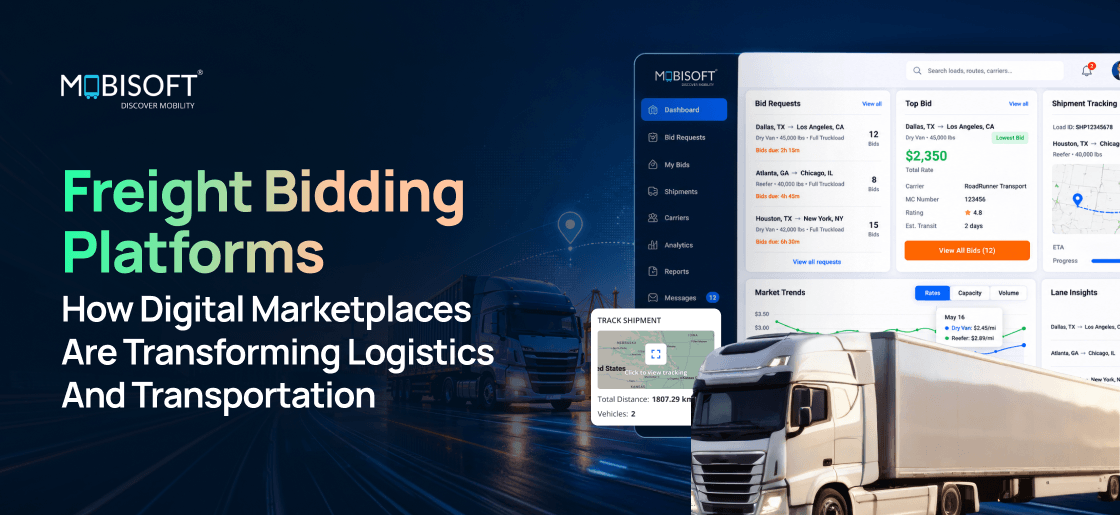
Freight procurement has historically been one of the most opaque pricing markets in global commerce. A shipper negotiating rates with a carrier operates without a general idea of value in the market, what the carrier's cost structure looks like, or verification checks before the purchase. Digital freight marketplace platforms are changing this fundamental information asymmetry. They aggregate demand, allow for competitive carrier bidding, and have implemented AI to rate discovery and carrier selection. The resultant upgrades are measurable improvements in freight cost, carrier quality, and procurement efficiency for shippers of all sizes. This guide explains the mechanics, the market models, the AI layer, and what it means for how freight gets priced and moved in 2026.
The Freight Pricing Problem: Why Freight Bidding Platforms Emerged
To understand why freight bidding platforms have grown rapidly, it is necessary to understand what freight procurement looked like before them. Freight pricing in the pre-digital era was a relationship-driven, information-asymmetric negotiation between shippers and carriers, with most of the information advantage sitting with carriers who knew their own cost structures while shippers negotiated from ignorance.
Problems With Traditional Freight Procurement
The table below maps the five core problems that made manual freight procurement unsustainable at scale, how each manifested in practice, and how digital platforms address them.
| Problem | How It Manifested | Scale | How Platforms Address It |
| Rate information asymmetry | Shippers negotiated without knowing what others paid on the same lane; carriers exploited the gap | Medium to large shippers with hundreds of lanes | Platform aggregates historical and live market rates; shippers see real benchmarks before every negotiation |
| Manual annual RFP cycles | Months of prep; rates locked 12 months regardless of market; process cost often exceeded savings | Enterprise shippers with 50+ lanes | Continuous rate discovery; mini-bids on specific lanes; spot market access alongside contract rates |
| No carrier performance data | Carriers chosen on price and relationships only; no visibility into on-time, claim, or service quality metrics | Any shipper managing more than 5-10 carrier relationships | Platform tracks and scores carriers on every load; selection driven by real data, not reputation |
| Limited carrier market access | Shippers worked with only 5-20 carriers; missed competitive pricing from carriers outside their network | Shippers on lanes where relationship carriers were not cost-competitive | Platform exposes freight to hundreds or thousands of carriers; competitive bids surface lower-cost options |
| Routing guide compliance failure | Overloaded primary carriers triggered frequent unplanned cascades to the spot market | Shippers with complex routing guides and high tender rejection rates | Digital routing guide management; automatic tender cascade; built-in spot market access on rejection |
Market Forces That Accelerated Platform Adoption
Several converging forces drove shippers and carriers toward digital platforms over the past five years.
- 2020-2022 freight market volatility exposed the risk of annual contracts. Spot market rates diverged dramatically from contract rates, pushing shippers toward platforms that enabled more frequent repricing and spot market access.
- Supply chain resilience prioritisation elevated freight reliability from a logistics function to a C-suite strategic priority. Shippers invested in freight management platform technology that delivered visibility, carrier redundancy, and procurement agility that manual processes could not.
- Digital native shipper expectations changed demand. New shippers with no existing carrier relationships or manual process habits expected end-to-end digital workflows covering rate discovery, carrier selection, booking, tracking, and billing.
- Carrier digitalisation accelerated. Carriers became increasingly capable of engaging digitally through ELD data, API connectivity, digital BoL, and digital acceptance and rejection, making carrier-side platform participation practical at scale.
- AI maturation for logistics delivered measurable results. ML-based rate prediction, carrier scoring, and demand forecasting reached commercial quality. AI-native platforms began producing demonstrably better shipper outcomes than rule-based competitors.
Freight Bidding Platform Models: The Taxonomy of Digital Freight Marketplaces
The term freight bidding platform covers several distinct business models with different mechanics, value propositions, and revenue structures. Understanding the differences is essential for shippers and carriers evaluating platform options, and for technology builders deciding which model to build.
The Six Platform Models
The table below outlines the six primary online freight marketplace models, how each works, who benefits most, and where each falls short.
| Model | How It Works | Best For | Revenue Model | Key Limitation |
| Reverse auction | Shipper posts load; carriers bid openly; lowest qualifying bid wins before deadline | High-volume shippers on competitive lanes with many capable carriers | Flat fee or % of load value per auction; subscription for high-volume shippers | Lowest-bid mechanics may attract carriers who underperform on service; it needs genuine carrier competition |
| Sealed-bid tender | Shipper sends load to selected carrier list; each carrier submits one blind bid | Shippers wanting competitive pricing without open auction dynamics | Platform fee or subscription; carriers pay to access tender network | Fewer bids on average than open auction; carrier list must be curated upfront |
| Dynamic spot marketplace | Open marketplace: shippers post loads, carriers post capacity, platform facilitates real-time matching | Shippers with spot freight needs; carriers with immediate available capacity | Carrier pays 12-20% per accepted load or subscription | Broker model captures margin; spot price volatility; carrier relationships less deep than direct negotiation |
| Contract rate RFQ | Shipper runs digital annual or semi-annual RFQ; sends to large carrier list; awards by lane | Large shippers running complex multi-lane procurement | Shipper subscription; carrier access free or subscription | Annual lock-in still applies; AI value limited to process efficiency vs manual |
| Instant rate engine | Shipper enters load details; platform returns instant platform-generated rate; book immediately | Time-sensitive freight needing instant booking without bid-wait period | Carrier margin or transaction fee | Rate is a market estimate; may be above spot in loose markets; shipper cannot see competing rates |
| Hybrid contract + spot | Platform manages both contract routing guide and spot market in one workflow; automatic cascade on rejection | Shippers with mixed routing guide and spot freight needs | Contract RFQ subscription plus spot market transaction fees | Higher implementation complexity; requires depth on both contract and spot carrier networks |
The Shipper vs Carrier Platform Experience
Every platform must balance competing interests between shippers and carriers across five key dimensions.
- Rate outcome: shippers want the lowest qualified rate. Carriers want the highest rate for available capacity. Platforms that drive rates too low lose carrier participation.
- Speed of rate discovery: Shippers want instant availability. Carriers want time to evaluate load fit and profitability. Instant-book platforms may not surface the best-fit carrier.
- Carrier selection control: shippers want to choose from multiple qualified carriers. Carriers want to be selected on capability, not just price. Lowest-price-wins mechanics punish service-oriented carriers.
- Relationship transparency: shippers benefit from market rate transparency. Carriers prefer rate opacity to protect their negotiating position. Platforms that reveal market rates fully shift bargaining power to shippers.
- Data ownership: Shippers want their freight data to improve their negotiating position. Carriers want pricing data to remain private. Carrier platform participation depends on an acceptable data policy.
Technology Architecture of Modern Freight Bidding Platforms
Understanding how freight bidding platforms work at the technology level is necessary for both buyers evaluating platforms and builders designing them. The technology differentiators that separate leading platforms from commoditised load boards are not primarily in the user interface. They live in the rate intelligence, carrier scoring, and matching quality that sits beneath it.
The Rate Intelligence Layer
Rate intelligence is the foundation of any credible freight procurement software. Four components define its quality.
- Market rate benchmarking establishes the current market rate for a specific lane, load type, and date by aggregating available market signals, including DAT load board spot rates, SONAR by FreightWaves contract and spot indices, Cass Freight Index, internal transaction history, and carrier cost models. Platforms with real-time market data feeds price more accurately than those relying on lagged indices.
- Dynamic rate prediction uses ML models to predict the rate that will clear the market for a specific load on a specific day, given current supply and demand conditions on the lane. Platforms with more transaction history have better-trained models. Newer platforms may lag established players in lane-specific prediction accuracy.
- Cost floor calculation estimates the minimum rate at which a carrier can profitably execute a specific load, factoring in deadhead, fuel, driver pay, and time constraints. Platforms that drive pricing below the cost floor will experience carrier attrition and service quality problems.
- Accessorial charge management calculates fuel surcharge, detention, layover, hazmat, liftgate, inside delivery, and re-delivery charges accurately into the quoted rate. Accessorial accuracy is a significant source of billing disputes; automated calculation reduces dispute frequency.
The Carrier Matching and Scoring Engine
The carrier matching engine determines which carriers see a specific freight opportunity and in what order. A platform with 10,000 registered carriers but poor matching produces the same outcome as a platform with 100 carriers. Five matching criteria separate quality platforms from commoditised load boards.
- Geographic proximity matches based on the carrier's last known position via ELD or self-reported location within a practical deadhead threshold, not their registered address. Irrelevant outreach trains carriers to ignore platform notifications.
- Equipment compatibility requires an exact type match across dry van, reefer, flatbed, step-deck, oversized, and hazmat-permitted equipment. Generic matching wastes time and reduces carrier platform engagement.
- HOS feasibility verifies the carrier's available driving hours via ELD integration to confirm they can complete pickup and delivery on schedule. Load failures from HOS violations cost shippers and damage platform credibility.
- Historical lane performance tracks the carrier's on-time rate, cargo claim rate, and response time specifically on lanes similar to the load. Matching by overall score without lane specificity misses performance variation that matters at execution.
- Carrier financial health screening includes credit score, payment history with the platform, fuel card usage, and days in operation. Financially distressed carriers represent service reliability risk.
The Auction and Bidding Mechanics
The specific mechanics of how an auction is run significantly affect outcomes for both shippers and carriers.
- Open (visible) auctions make all current bids visible to all bidders, creating a downward price spiral. This produces the lowest rates for shippers in competitive lanes but risks carrier disengagement when rates feel unsustainably low. Best for commodity freight where service differentiation is low, and carrier options are abundant.
- Sealed-bid auctions have carriers submit one bid without seeing others. This prevents price spirals and produces rates closer to carriers' true market assessment. Better carrier experience, slightly higher average rates for shippers than open auctions. Best for specialised freight where carrier relationships matter.
- Dutch auction (descending price) starts at a high price and decrements until a carrier accepts. It is the fastest to first acceptance, but does not produce competitive rate discovery. Appropriate when the speed of carrier commitment matters more than rate optimisation.
- Best-and-final with negotiation has carriers submit initial bids, after which the shipper can counteroffer before awarding. This adds a negotiation layer that produces better relationship dynamics and information exchange. Best for high-value, long-term contract lanes.
- Auto-award with performance weighting automatically awards the load to the best carrier based on a weighted score combining rate, performance history, and capacity fit. Most appropriate for commodity freight where the shipper's routing guide is already defined and the platform is executing it efficiently.
AI and Machine Learning in Freight Bidding Platforms
AI in freight bidding platforms is not one technology but a collection of specific applications at specific decision points in the freight procurement platform workflow. The platforms producing the most measurable outcomes are those applying AI to the highest-impact decisions: rate prediction, carrier selection, and demand forecasting.
AI Applications with Documented Impact
The table below maps the six AI applications that have produced verifiable results in production freight environments.
| AI Application | Mechanism | Documented Impact | Data Requirement |
| Lane-level demand forecasting | ML model trained on historical bookings, seasonal factors, economic indicators, and regional industrial activity; predicts volume by lane up to 8 weeks ahead | Carriers pre-position capacity 1-2 weeks before demand peaks; 15-25% reduction in last-minute spot rate premiums for shippers who book in advance | 12-18 months of transaction data per lane; economic and weather feeds |
| Carrier bid prediction | ML predicts which carriers will bid and at what range before auction opens | Notifies highest-probability bidders first; reduces time to first bid by 40-60%; improves auction participation | Historical carrier bidding data; carrier position and ELD data |
| Rate anomaly detection | ML identifies anomalously low bids (carrier underpriced, likely to fail) or anomalously high (shipper overpaying vs market) | Protects shippers from load failures caused by unsustainable bids; alerts platform operators to outlier pricing | Sufficient transaction history to establish normal rate distribution by lane and load type |
| Carrier performance prediction | ML trained on OTP, claim rate, communication responsiveness, and compliance history predicts performance before award | Load awards to high-predicted-performance carriers improve OTP by 5-10 percentage points vs random selection from qualified pool | At least 10-15 loads per carrier for meaningful prediction; lane and freight type context |
| Dynamic routing guide management | AI analyses routing guide performance and recommends carrier tier and tender sequence adjustments | Routing guide compliance improves from 72-78% to 85-92% with AI optimisation; reduces cascade to unplanned spot market | Minimum 6 months of routing guide tender and acceptance data per carrier and lane |
| Natural language load creation | LLM interface: shipper describes load in natural language; platform extracts structured booking requirements automatically | Reduces booking data entry time by 60-80% for shippers without TMS integration; reduces entry errors | High-quality freight-domain NLP training data; validation against booking rules |
The AI Advantage: Why Data Network Effects Matter
The most important thing to understand about AI in freight management software is that the AI improves with the volume and quality of transaction data the platform accumulates. This creates a compounding competitive advantage for established platforms.
- Rate prediction accuracy: a model trained on 1 million loads on the Chicago-to-Atlanta lane predicts rates more accurately than one trained on 10,000 loads. Higher accuracy drives more platform usage, which drives more data, which improves the model further.
- Carrier performance database: a platform that has scored 5,000 carriers on 500 loads each has dramatically better carrier performance data than one that has scored 500 carriers on 50 loads each. Better carrier data produces better matching and selection, which attracts more shippers, which drives more transactions.
- Demand forecasting by lane: lane-level forecasting requires sufficient historical data per lane. A platform with broad geographic coverage and high transaction density per lane provides accurate forecasts. Geographic and transaction density are prerequisites for forecasting value.
- The implication for new entrants: a new freight bidding platform cannot immediately replicate the AI performance of an established platform with years of transaction data. New platforms must either specialise in a lane set or freight type where they can quickly build sufficient data density, or compete on user experience and operational features while building toward competitive AI performance.
The Shipper's Guide: Using Freight Bidding Platforms Effectively
Shippers who use freight bidding platforms without a coherent strategy often experience disappointment: rates that do not reflect the full competitive market, carrier quality that varies widely, and operational friction from the platform not integrating with existing processes. The shippers who consistently achieve the best outcomes apply systematic strategies across carrier network development, bid specification, and platform selection. Mobisoft's freight marketplace software provides the infrastructure to support this kind of structured procurement approach.
Carrier Network Strategy for Maximum Bid Competition
The quality of bids depends entirely on the quality and quantity of carriers participating in the auction. An auction with fifteen qualified bidders produces genuine market discovery. Building a carrier network on a bidding platform is not a passive activity.
- Breadth vs depth balance: register more carriers than you award to; target 5-10 qualified bidders per lane. Avoid concentration where one carrier wins all loads on a lane, which reduces competitive pressure. Allow 3-6 months to build and activate a diverse carrier network.
- Performance-based tier management: actively promote high-performing carriers to the primary tender position and demote poor performers. Plan 6-12 months to see measurable OTP improvement from systematic tier management.
- Regional carrier inclusion: deliberately include regional carriers who are strong on specific lanes alongside national carriers. Regional carriers frequently undercut national carrier pricing on home lanes while delivering better service.
- Owner-operator access: include owner-operators in the carrier mix via digital platforms that aggregate capacity. Owner-operators frequently produce the best rates on specific lanes where they have planned positioning and the lowest cost structure.
Bid Specification Best Practices
The quality of bids a shipper receives is directly correlated with the quality and completeness of the load specification they post. Incomplete specifications produce non-comparable bids, post-award disputes, and carrier failures.
- Specify all accessorial requirements upfront. If the load requires liftgate service, inside delivery, appointment scheduling, extended dwell, or hazmat handling, these must be in the bid specification. Carriers who discover accessorial requirements after award either charge detention or walk away.
- Include freight characteristics that affect carrier operations: weight, piece count, dimensions, stackability, freight class, commodity type, temperature requirements, fragility, and handling instructions.
- Specify time constraints with precision: ready-for-pickup time, latest pickup time, and delivery appointment or window. Carriers need to know whether they can make the pickup with their HOS and current location.
- Define documentation requirements upfront. If C-TPAT certification, RFID-tagged trailers, or specific insurance limits are required, state these in the specification before award.
- Post accurately and consistently. Shippers who post loads with misleading characteristics damage their carrier relationships and platform reputation. Carriers who experience consistently inaccurate specifications stop bidding.
Routing Guide Integration: When to Bid vs When to Tender
The right procurement approach depends on the nature of the freight and the state of the carrier relationship.
- Contract lanes with reliable volume and preferred carriers: tender to contract carrier at agreed rate; reserve bidding for tender rejection cascade. Bidding on every load unnecessarily disrupts a reliable carrier relationship.
- New lanes without established carrier relationships: open bid on the platform before signing a contract. Use bid data to inform contract negotiations; the winning bidder often becomes the contract carrier.
- Seasonal volume spikes beyond contract capacity: supplement contract tendering with open bids for incremental volume. Contract capacity may not cover peak demand.
- Tender rejection: cascade to secondary contract carrier or open bid, depending on time urgency. Having a pre-configured digital cascade prevents manual spot market scrambling.
- Spot loads (one-time or irregular freight): open bid or instant rate platform, depending on speed requirement. No contract carrier to tender to.
- Underperforming lanes: run a competitive bid on the lane even if a contract exists. Real bid results are the most credible leverage in a contract renegotiation conversation.
The Carrier's Guide: Competing Effectively on Freight Bidding Platforms
Carriers approach freight bidding platforms from a fundamentally different position than shippers. The carriers who consistently win the best loads are not the ones who bid lowest. They are the ones who bid most precisely: the right rate for loads where they have a genuine cost advantage.
The Carrier's Platform Strategy
- Bid where you have a cost advantage. Submit competitive bids only on loads that fit your truck's current position, equipment type, and planned route. Avoid loads that require significant deadhead or are in lanes where you have no planned positioning. Bidding broadly and then discovering deadhead cost eliminates margin is a common and costly mistake.
- Price to your actual cost structure. Calculate the full cost of each load before bidding: deadhead to pickup, loaded miles, driver cost, fuel, and overhead contribution. Bid at a price that covers cost plus an acceptable margin. Carriers who bid at the market average without calculating deadhead win unprofitable loads.
- Build a performance reputation systematically. Treat every platform load as a performance data point. Consistent on-time performance and low claim rates produce a platform score that improves future load access and rate competitiveness. Carriers who treat platform loads as lower priority than direct shipper loads see their scores decline.
- Use the platform for backhaul completion. Use the platform specifically to find loads that turn empty repositioning into revenue. Accept rates that are above deadhead cost, even if below loaded-mile rates. Running empty instead of accepting a platform rate at a lower-than-preferred level is a direct revenue loss.
- Maintain platform data quality. Keep truck position current via ELD integration where possible. Keep equipment specifications accurate. Respond promptly to load notifications; slow response lowers notification priority and win rate on appropriate loads.
Freight Procurement Strategy: Integrating Bidding Into Your Logistics Operation
Freight bidding platforms are most effective when integrated into a coherent freight procurement strategy. The shippers who achieve sustained cost and service improvements use bidding platforms as one element of a multi-tier procurement strategy that includes contract freight, managed volume, and spot market access. Integrating bidding with an Enterprise Transport Management System significantly amplifies the efficiency gains.
The Three-Tier Freight Procurement Strategy
The table below outlines a proven three-tier structure for freight procurement across contract, committed spot, and open spot categories.
| Tier | Volume | Rate Structure | Platform Role | Carrier Relationship |
| Tier 1: Preferred contract | 50-60% of freight; high-volume, predictable lanes | Annual contract rate with quarterly fuel surcharge adjustment | Tender management and compliance tracking; no competitive bidding except annual RFQ | Deep relationship; dedicated capacity commitment; performance SLA; priority in tight markets |
| Tier 2: Committed spot | 25-35% of freight; variable lanes | Short-term committed rates (30-90 days) or mini-bids on lane bundles | Mini-bid platform: competitive bids on lane bundles quarterly; award for 90 days | Regular but not exclusive; performance tracked; renewed or replaced quarterly on bid performance |
| Tier 3: Open spot | 10-15% of freight; overflow and irregular loads | Full spot market rate via open bid; highest rate volatility | Full reverse auction: open bid to all qualified carriers; lowest qualified bid wins | Transactional; selected purely on price and qualification; no ongoing relationship obligation |
The Mini-Bid: The Strategic Tool Most Shippers Underuse
The annual freight RFP is a blunt instrument. It produces one rate for one year on every lane, requires months of preparation, and locks shippers into rates that may become wildly off-market within six months of the award. The mini-bid is a competitive bid on a specific lane or lane bundle for a 60-90 day commitment. It provides the rate discovery of competitive bidding with less administrative burden and more market responsiveness. Pairing mini-bids with capable transportation procurement software makes the process significantly faster to execute.
When to use mini-bids:
- New lanes without established carrier relationships: bid before contracting; use results to inform the contract.
- Lanes where carrier performance has deteriorated: competitive pressure as an alternative to renegotiation.
- Lanes where significant market rate changes suggest your contract rate may be off-market.
- Seasonal lanes where carrier capacity and rate availability change significantly by season.
Mini-bid format: post a lane bundle of 3-5 related lanes to a selected carrier list of 10-15 carriers. Specify the volume commitment, equipment requirements, service standards, and bid period of 60-90 days. Allow 48-72 hours for carrier bids and award to the 2-3 best-performing bidders to maintain competition.
Shippers who run mini-bids on their top 20 lanes annually consistently report 8-15% rate improvement compared to renewing annual contracts without a competitive process. The savings come from two sources: rate realignment with market conditions (annual rates drift from market over time) and renewed carrier competition on lanes where the carrier had become comfortably margin-fat.
Integration with Transportation Management Systems
Freight bidding platforms deliver maximum value when integrated with the shipper's transportation management software. The integration enables seamless flow from order creation through tender, carrier acceptance, tracking, and invoice without manual data transfer between systems.
- Order to load creation: order data flows from ERP or WMS to bidding platform automatically via EDI 204 or REST API. Saves 5-15 minutes of manual data entry per load.
- Carrier acceptance to TMS: When the carrier accepts a bid, acceptance and rate information flow back to the TMS automatically via webhook or EDI 990. Saves 5-10 minutes of manual rate confirmation entry per load.
- Tracking status to TMS: GPS tracking and milestone updates push to the shipper's TMS in real time via EDI 214 or REST API, eliminating manual status check calls throughout transit.
- Invoice reconciliation: the platform generates a freight invoice automatically on delivery and matches it to the TMS booking and rate confirmation via EDI 210 or REST API, reducing 2-5 hours of manual reconciliation per invoice.
- Performance data to reporting: carrier OTP, claim rate, and transit time data push to shipper analytics systems automatically, eliminating dedicated analyst time for manual performance tracking.
Building a Freight Bidding Platform: Architecture and Technology Considerations
For technology companies and logistics operators considering freight marketplace development, the architecture decisions and feature prioritisation are fundamentally different from building a single-carrier TMS. A marketplace platform has network effects at its core: value grows with the number of participants on each side, and the sequence in which supply and demand sides are built determines whether the marketplace achieves critical mass or dies in the cold start problem. Mobisoft's FastMovers freight matching platform demonstrates how these architecture decisions play out in a production environment.
The Core Technical Architecture
A production-grade freight bidding platform requires seven distinct technology layers.
- Shipper-facing application: React/TypeScript web application for load creation, bid management, carrier performance dashboard, and analytics. Load creation UX must balance completeness (all required fields) with simplicity (progressive disclosure). WebSocket handles real-time bid updates without page refresh.
- Carrier-facing application: web application plus React Native mobile app. Mobile-first for carriers since dispatchers and owner-operators use smartphones. Push notification infrastructure via FCM is critical; carriers who do not see a load within the bid window cannot bid.
- Auction engine: real-time bid management service with configurable auction types (open, sealed, Dutch, auto-award), bid validation, auto-award logic, and bid history. Sealed bids must be genuinely sealed until the auction closes. This is a high-reliability service; an outage during an active auction creates business and legal problems requiring dual-region deployment and circuit breakers.
- Rate intelligence service: external market data integration from DAT and SONAR APIs, historical rate database, ML model for rate prediction, and rate recommendation engine. Model performance monitoring and alerting on rate prediction quality degradation is essential.
- Carrier network service: carrier profile management, ELD integration for position and HOS, FMCSA authority verification, performance scoring engine, and matching and notification engine. Matching must be precise enough that a notification equals a relevant opportunity. At 1,000 loads per day, notified to 5,000 relevant carriers, the notification infrastructure must handle 5 million notifications per day.
- Real-time tracking: GPS position from ELD integration or driver app, geofence-based milestone detection, ETA calculation, and exception detection. TimescaleDB handles GPS position time-series at scale. Shippers expect position updates within 5 minutes.
- Payment and settlement: carrier payment processing, factoring integration, shipper invoice generation, and fuel advance management. Payment speed differentiates platforms; carriers prioritise platforms that pay quickly. PCI-DSS compliance and factoring partner API integration are required.
The Cold Start Problem and Network Effect Strategy
The hardest problem in freight bidding software development is the cold start: shippers will not post freight to a platform with no carrier network, and carriers will not register on a platform with no freight. Solving this requires a deliberate sequencing strategy.
- Build supply first in a specific geography: recruit 50-100 carriers in a specific metropolitan area or freight corridor before recruiting shippers in that area. Going national immediately dilutes carrier density everywhere. Building density in a specific region first creates a real marketplace before expanding.
- Use a managed service model during early growth: the platform team acts as a broker for the first 500-1,000 loads, manually matching and booking while the technology is validated. This keeps early carrier registrants engaged while the automated marketplace builds toward liquidity.
- Anchor shippers provide the demand foundation: signing 2-3 anchor shippers with 50-100 loads per month before launch ensures real load volume from day one. Anchor shippers typically receive pricing benefits in exchange for committing volume; this is the cost of solving the cold start problem on the demand side.
- Carrier acquisition through load board presence: posting anchor shipper loads on DAT and Truckstop.com initially attracts carriers to the platform. Carriers who respond to load board posts are channelled through the platform registration workflow, building the carrier network from live loads rather than cold outreach.
The Competitive Landscape: Freight Bidding Platform Vendors in 2026
The freight bidding platform market is more competitive and technically capable than it was three years ago. Established load boards have added matching intelligence. Digital freight brokerages have added carrier performance scoring. Enterprise procurement platforms have added AI rate guidance. Understanding the landscape is essential for shippers selecting platforms and investors evaluating opportunities. Mobisoft's transportation management solutions serve clients navigating this evolving vendor landscape.
Market Segment Map
Six distinct market segments compete for freight platform spend in 2026.
- Traditional load boards (DAT, Truckstop.com): the highest carrier network density in North America, established over 25 years, trusted spot rate benchmarks. Limitation: limited AI in matching and rate guidance; UX is dated compared to newer entrants; primarily a listing service, not a managed marketplace.
- Digital freight brokerage platforms (Transfix, Echo Global, Coyote, Worldwide Express): managed marketplace where the platform takes a margin between shipper and carrier. Strong carrier network and improving AI features. Limitation: Broker's margin reduces the effective rate to the carrier; the shipper does not directly negotiate with the carrier.
- Enterprise freight procurement platforms (Emerge, Transplace/Uber Freight, project44): enterprise shipper focus with deep TMS integration, contract management, and carrier performance tracking. Limitation: less carrier network depth for spot market; high implementation complexity.
- Instant rate booking platforms (Loadsmart, Uber Freight, Convoy pre-acquisition): click-to-book without bid wait; algorithm-generated rate. Limitation: rate is algorithm-generated, not market-discovered; may be above market in loose conditions.
- AI-native new entrants: ML-first platforms built around better carrier matching and rate prediction, targeting specific verticals or lanes. Limitation: newer, smaller carrier networks; lack transaction history for best ML performance initially.
- 3PL-operated digital platforms (XPO, Werner, J.B. Hunt 360): asset carrier building a digital marketplace alongside owned fleet. Limitation: marketplace dynamics are limited by asset carrier interest in protecting owned fleet margin.
The Consolidation Dynamics
The freight platform market is experiencing active consolidation. The acquisition of Convoy by Amazon in 2023, the merger of Transplace into Uber Freight, and the acquisition of XPO's brokerage operations are all examples of a market moving toward fewer, better-capitalised platforms. Four dynamics drive this consolidation.
- Network effects reward scale: carrier network density is the primary determinant of platform quality for shippers. The platforms with the largest carrier networks attract the most shipper freight, which attracts more carriers, creating a reinforcing cycle that advantages large incumbents.
- AI requires data at scale: the ML models that produce the most accurate rate predictions require millions of load transactions. Smaller platforms with lower transaction volume cannot replicate the AI performance of larger competitors.
- Strategic acquirers: Amazon, Uber Freight, and large 3PLs have a strong strategic rationale for acquiring freight platforms. They bring customer relationships, engineering resources, and balance sheets that pure-play freight platforms cannot match.
- Platform durability risk for buyers: platforms that are likely to be acquired or to go out of business create switching cost risk for shippers who have deeply integrated with them. Financial health, strategic investor support, and customer lock-in should all be evaluation criteria alongside rate performance.
The Future of Freight Bidding Platforms: Trends Shaping 2027 and Beyond
The freight bidding platform market is in the middle of a technology transition that will produce a generation of platforms significantly more capable than what exists today. The trends below are active development priorities at leading platforms and freight technology investors.
Next-Generation Platform Capabilities
- Fully automated freight procurement: AI-assisted today, requiring human review. By 2028-2030, a fully automated award for commodity lanes meeting defined criteria. Already 30-50% of loads are auto-awarded on some leading enterprise platforms.
- Predictive capacity availability: carriers currently self-report available capacity. Platforms will predict specific carrier capacity availability by location and date 2-4 weeks ahead based on ELD data and current load assignments. Broad commercial availability is 2-3 years out.
- Embedded freight finance: separate factoring and payment products today. Platform-native instant payment to carriers at a small discount is expanding and becoming a standard differentiator, with shippers paying on normal terms and the platform managing the timing gap.
- Autonomous carrier qualification: manual vetting today. Fully automated qualification via API-driven FMCSA verification, automated insurance certificate validation, and AI review of carrier safety data is already available at some platforms and becoming a standard feature requirement.
- Cross-border automated customs: manual customs documentation today. Platforms generating and transmitting customs documentation for cross-border loads and integrating with CBSA and CBP automated systems are in limited deployment with active development for US-Canada and US-Mexico corridors.
- Carbon and sustainability reporting: manual carbon calculation from distance and fuel data today. Automated per-load carbon accounting, shipper sustainability dashboards, and carbon-optimised carrier selection mode are in active development, driven by corporate sustainability reporting requirements.
The Autonomous Freight Question
Autonomous trucking is on a longer timeline than many 2020 predictions suggested. But the autonomous freight question for digital logistics platforms is not just about driverless trucks. It is also about autonomous freight management: the combination of automated procurement (AI awards freight without human approval), automated dispatch (AI assigns loads without dispatcher review), automated documentation (digital BoL and POD without human handling), and automated payment (settlement triggered by digital delivery confirmation), creating an end-to-end autonomous freight pipeline.
The components of this autonomous pipeline are available today for commodity freight with established carrier relationships. The platforms that will lead the next phase of market development are those that string these components together into a seamless workflow, making the movement of routine freight as friction-free as an e-commerce purchase confirmation. Human oversight is preserved for exceptions, complex freight, and relationship management. Automation handles the routine execution.
Conclusion
Freight bidding platforms have moved from a niche alternative to manual procurement to a mainstream component of enterprise freight management in six years. The $2.1 trillion addressable freight market represents an enormous opportunity for platforms that can produce reliable rate discovery, carrier quality, and operational efficiency at scale.
For shippers, the strategic opportunity is clear. Replacing annual bilateral negotiations with continuous, data-informed competitive procurement produces rate improvements of 12-18% on comparable loads, better carrier quality through performance-based selection, and procurement agility that manual processes cannot provide. The implementation requires investment in platform integration, carrier network development, and bid specification discipline, but the returns are documented and repeatable. Whether you are evaluating freight technology solutions for the first time or optimising an existing stack, the case for digital competitive procurement is strong.
For carriers, the platform opportunity is selective. Bidding platforms provide access to freight outside existing customer networks, backhaul revenue improvement, and market rate data for better pricing decisions. The risk is participating in platforms that drive rates below sustainable levels. Carriers who participate strategically, bidding where they have a genuine cost advantage and building a performance reputation for access to premium loads, consistently outperform those who bid broadly and reactively.
For technology builders, the market is large, and the problems are technically interesting. Real-time auction mechanics, AI rate prediction, carrier matching at scale, and the cold start problem of building a two-sided marketplace all produce durable competitive advantages for those who solve them well. A qualified logistics software solutions partner can accelerate the path from architecture to production. The data network effects that accrue to leading platforms with high transaction volume make early market position increasingly valuable over time.
The transformation of freight procurement from phone-and-spreadsheet negotiation to an AI-powered digital freight marketplace is not complete, but the direction and pace of change are both clear.
About Mobisoft Infotech
Mobisoft Infotech builds custom logistics software development solutions including freight bidding marketplaces, carrier matching engines, rate intelligence systems, and transportation management system for freight brokers, 3PLs, carriers, and logistics technology investors. Our logistics engineering practice has designed and delivered platforms serving freight markets across North America, Europe, and Asia-Pacific.

Frequently Asked Questions
How do freight bidding platforms reduce logistics costs?
Platforms reduce costs through four mechanisms. Market rate discovery produces rates that reflect actual market conditions rather than bilateral negotiation with an information advantage. Shippers consistently report 12-18% rate reductions vs manual negotiation on comparable lanes. Carrier network expansion exposes shipper freight to regional carriers and owner-operators with lower cost structures on specific lanes. Performance-based selection reduces the cost of exceptions by selecting carriers with consistently strong OTP. Routing guide optimisation with automated tender cascade reduces rate premiums from reactive spot procurement.
What is the difference between spot freight and contract freight on bidding platforms?
Understanding spot freight vs contract freight is central to platform strategy. Contract freight locks in a rate and capacity commitment for a defined period, typically 12 months. The platform manages tendering to the contracted carrier at the agreed rate. Spot freight has no prior rate agreement; the shipper posts the load, carriers bid competitively, and the shipper awards to the best bid at current market rates. Most shippers use a combination: contract for predictable high-volume lanes, spot for overflow and seasonal freight. The best platforms manage both contract tendering and spot bidding in a single workflow, with automatic cascade from rejection to spot.
How does AI improve freight bidding platform performance?
AI improves platform performance at five decision points. Lane-level demand forecasting reduces spot rate premiums by 15-25% for shippers who book in advance of demand peaks. Carrier bid prediction reduces time to first bid by 40-60% by notifying the most likely bidders first. Rate anomaly detection protects load execution integrity by flagging unsustainable bids. Carrier performance prediction improves on-time delivery by 5-10 percentage points by selecting carriers with the best predicted performance for each load. Dynamic routing guide management improves compliance from 72-78% to 85-92%, reducing unplanned spot market cascades.
What should shippers look for when evaluating freight procurement software?
Shippers evaluating freight procurement software should assess five dimensions. Carrier network quality: Request bid density data for your top 10 specific lanes, not total registered carriers.
- Rate intelligence depth: Does the platform use real-time DAT and SONAR data, or lagged indices?
- Integration capability: Does it integrate with your TMS via EDI 204, 214, and 210 or REST API?
- Carrier performance tracking: Does the platform track and score carriers from its own transaction history, not self-reported metrics?
- Platform durability: What is the financial health and investor backing? Platform-dependent processes create switching costs, so choose platforms likely to be operational in 3–5 years.
What are the benefits of freight bidding platforms for carriers?
Carriers gain three primary benefits:
- Access to freight outside their existing customer network: carriers access shipper freight they would not otherwise know about, which is particularly valuable for filling backhaul lanes or covering seasonal capacity surpluses.
- Backhaul revenue improvement: platforms aggregate available loads near delivery destinations, enabling drivers to find revenue-generating return loads and directly reducing empty miles.
- Transparent rate discovery: market rate data informs carrier pricing decisions, helping them price more confidently and avoid systematic under-pricing.
The primary risk, however, is platforms that drive rates below sustainable levels. Carriers should participate selectively in platforms where winning rates consistently cover their cost floor.
What technology is required to build a freight bidding platform?
Building a logistics platform development project of this kind requires seven technology layers: a React/TypeScript shipper web application; a React Native mobile carrier application with push notification infrastructure; a high-reliability real-time auction engine with WebSocket for live bid updates; a rate intelligence service integrating DAT and SONAR APIs with ML-based rate prediction; a carrier matching service with ELD integration and FMCSA verification; real-time GPS tracking with TimescaleDB for time-series data; and a payment and settlement layer with PCI-DSS compliance and factoring partner integration. The most critical architectural decisions are auction engine reliability, carrier notification matching precision, and rate intelligence data quality.
This content is for informational purposes only and may include AI-assisted research or content generation. While we strive for accuracy, information may evolve over time. Readers are advised to independently verify critical information before making decisions.

Nitin Lahoti
Read more
Nitin Lahoti is the Co-Founder and Director at Mobisoft Infotech. He has 15 years of experience in Design, Business Development and Startups. His expertise is in Product Ideation, UX/UI design, Startup consulting and mentoring. He prefers business readings and loves traveling.
 Nitin Lahoti
 June 16, 2026