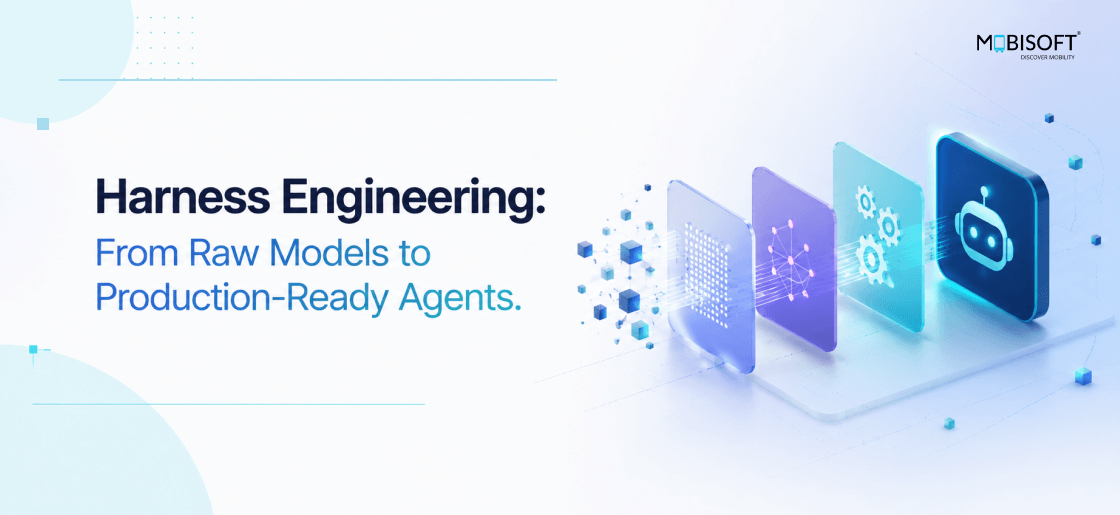
A capable model can still fail a simple real task. The reason rarely sits inside the model itself. It sits in the thin scaffolding wrapped around it. Picture a strong model asked to process a refund. It reasons well, yet it cannot read the order. It cannot call the payment API or check a policy. The intelligence is there, but the hands are missing.
This gap explains a simple equation that frames everything ahead. An agent equals a model plus a harness. The model supplies reasoning, and the harness supplies everything else. Harness engineering is the discipline of building everything else. Most production failures trace back to harness design, not model intelligence.
Here is the question worth holding onto. If two teams use the same model, why does one succeed? One ships a reliable agent, the other a fragile demo. The answer lives in the harness, and this guide maps it.
Why This Topic Matters Now
The center of gravity in agentic AI has moved. The year 2025 belonged to agents as a proof of concept. The year 2026 belongs to the agent harness as real infrastructure. Builders now compete on engineering, not on model access alone.
Several forces make this the right moment to focus here.
- Model gains are slowing in the ways builders feel most.
- Open source and frontier models keep converging on quality.
- The edge moves toward engineering choices teams actually control.
- Reliability, cost, and safety now decide which agents reach customers.
When models look alike, the harness becomes the true differentiator. Teams that treat harness engineering as core work pull ahead. Early AI strategy consulting services help frame these priorities before any code starts.
What Harness Engineering Actually Means
The cleanest definition is also the most useful one. Harness engineering is the discipline of designing the systems, constraints, and feedback loops that wrap around autonomous AI agents to make them reliable, production-ready AI agents. While the AI model provides the raw intelligence, the harness provides the operating system, tools, guardrails, and memory to turn that intelligence into useful, repeatable work,
The Model Is Not the Bottleneck
A surprising pattern shows up across real deployments. A strong harness can lift a mid-tier model above expectations. That same model can stumble inside a weak harness. The wrapper often matters more than the raw weights.
The reason is practical rather than mysterious.
- The harness controls the quality of context the model sees.
- It decides how reliable each tool call turns out to be.
- It handles error recovery when an action fails midway.
Treat the harness as the main performance lever you control. You cannot retrain the model, but you can improve its surroundings. That work pays off week after week.
Harness Engineering Versus MLOps and Software Engineering
Harness engineering is a new layer, not a replacement. Familiar practices carry over with very little change. Version control, testing, and observability still apply here. Continuous integration wraps every change as before.
Other concerns are genuinely new to this kind of system. Behavior is nondeterministic so that the same input can yield different outputs. Context windows impose a strict budget on what fits. A modern AI software development company treats these concerns as first-class engineering.
The Anatomy of an Agent Harness
A sound AI agent architecture rests on predictable building blocks. Small projects lean on only a few of them. Enterprise platforms eventually use almost all of them together. Knowing each block helps you spot what your system lacks.
System Prompts and Configuration
The system prompt sets standing instructions for the agent. It defines the role, the constraints, and the output format. Good prompt engineering here removes ambiguity before work begins. Configuration also routes each request to the right model. Send hard reasoning to a costly model. Route routine steps to a cheaper, faster one.
Tools and Execution
Tools let the model act beyond plain conversation. They include APIs, databases, and code runners it can call. Teams now move from many narrow tools toward general execution. Giving the model a shell and a filesystem often wins. Tool calling then becomes flexible rather than rigidly predefined.
Sandboxes and Safe Execution
Model generated code must run somewhere contained. A sandbox provides an isolated space for that execution. It protects the host machine and the user from damage. Preinstalled runtimes let the agent verify its own work right away.
Persistent Storage and the Filesystem
Context windows forget everything once a session ends. A filesystem gives the agent durable memory across sessions. Work saved to disk survives restarts and long pauses. This durability underpins serious LLM application development at scale. Offloading large outputs to disk also relieves the context window.
Feedback Loops and Self Verification
An agent that never checks itself drifts into errors. Feedback loops let it confirm results before moving on. The agent runs tests, reads logs, and inspects output. A required check forces real proof before the agent claims success.
Guardrails and Permissions
Guardrails decide what the agent may and may not do. They include approvals, allow lists, and deny by default limits. Structured permissions beat trust based purely on prompts. Human approval belongs at any high-stakes or costly step.
Observability
Observability captures logging, tracing, and audit trails throughout. Every decision and action leaves a readable record. Strong AI orchestration depends on knowing what each agent did. A fuller treatment of tracing appears later in this guide.
The Agent Loop: The Engine Inside the Harness
Every agent runs on one core cycle underneath. It reasons, acts, observes, and then repeats the cycle. This loop is the engine that the harness wraps around. Strong GenAI consulting services can help teams design this core loop.
The pattern behind this loop has a familiar name. ReAct means the model alternates between thinking and tool calls. A refund agent shows the idea in action.
- It reads the order and checks the policy.
- It calls the payment tool with the right arguments.
- It reads the result and issues the refund.
- It writes a clear final answer for the user.
Turn Structure and Stopping Conditions
A turn is one pass through reason, act, and observe. Turn limits matter because loops can run away quietly. A capped count stops the agent from spinning forever. Stopping rules end the run at a goal, a spent budget, or an approval. A stuck agent then resets or escalates to a person.
Planning and Task Decomposition
Some tasks need a plan before any action starts. Plan then execute suits complex, multi-step goals well. React on the fly suits short, exploratory tasks instead. Decomposition breaks a large goal into checkable milestones. A saved plan survives a context reset without losing direction.
Context Engineering: The Hardest Part of the Harness
Context windows are finite, and attention degrades as they fill. A crowded window makes the model slower and less accurate. So context engineering becomes the hardest craft in the harness. The goal is to deliver the right information at the right moment.
Compaction and Offloading
A window near its limit needs a careful handoff. Compaction summarizes the full window into a compact form. It keeps decisions and open tasks, and drops raw noise. Offloading writes large results to disk and passes a reference. The window then stays free for reasoning rather than storage.
Progressive Disclosure and Skills
Loading every capability at once wastes the window badly. Progressive disclosure loads tools only when the task needs them. Skills package this idea and connect through the Model Context Protocol. Retrieval augmented generation complements this by fetching facts on demand. A solid RAG architecture keeps that retrieval fast and relevant.
Prompt Caching and Cost Control
Repeated prompts waste money and add needless latency. Prompt caching reuses stable prefixes across many calls. Savings then show up in both speed and spend.
- Set a token budget for each task type.
- Route cheap work to cheaper, faster models.
- Reserve costly models for genuinely hard reasoning.
Tool Design, Skills, and MCP
Tools are the hands of any agent. Their design sets the ceiling on overall reliability. A clumsy tool makes even a smart model stumble. A clean tool lets the same model shine.
Designing Tools Agents Can Use Well
A tool the agent misuses is worse than none. Function calling works best when the contract is obvious. The model should never wonder what an argument means.
- Name each tool by the intent it serves.
- Return structured, predictable output every time.
- Fail loudly with errors the agent can act on.
Teams offering AI agent development services treat tool quality as a core deliverable.
The Model Context Protocol and Agent Standards
The Model Context Protocol gives tools a common interface. MCP standardizes how an agent exposes tools and data. A shared standard removes piles of custom glue code. By 2026, the protocol runs under the Linux Foundation. Thousands of community servers now expose tools through it. Agent-to-agent standards let specialized agents cooperate cleanly.
Memory and State Across Long Tasks
Memory spans from seconds for one turn to months across jobs. A single store cannot serve such different time scales. Strong AI memory design separates concerns by duration. Without it, agents forget, repeat, and waste effort.
The Three-Tier Memory Model
Three tiers cover the full range of memory needs.
- Working memory is the live context window itself.
- Session memory holds progress files for the current job.
- Long-term memory keeps the knowledge the agent reuses later.
Each tier has a different cost and access pattern. Working memory is fast but small and temporary. Long-term memory is durable but needs deliberate retrieval. Matching data to the right tier keeps systems efficient.
Long-Running Agents: Working Across Many Context Windows
Long jobs extend beyond a single context window. Each new session starts with no memory of the last. It resembles a crew working with no written handoff. A deliberate process passes state forward between windows.
The Initializer and Worker Pattern
Two specialized roles split this work cleanly. An initializer agent builds the scaffold once at the start. A worker agent then carries the project forward each session.
- The initializer writes a setup script and a progress log.
- It creates a feature list and the first commit.
- It leaves a handoff document for the next session.
The worker reads those notes before touching anything. It verifies the build, ships one feature, and commits. Storing progress as JSON resists accidental overwrites during edits.
The Restart Loop for Fresh Context
A bloated window hurts long-horizon work over time. The restart loop solves this with a clean slate. It restarts the agent with a fresh context window. The filesystem, meanwhile, holds all the durable state. Each session then proves the basics before adding more.
Verification and Evaluation
Agents behave nondeterministically, so the same input can vary. You must measure behavior, not only inspect the code. Control comes in two complementary forms here. Guides steer the agent before it acts, and sensors like tests catch problems after. Mature harness engineering blends both into one loop.
Building an Eval Suite
A good eval suite blends two kinds of checks. Deterministic checks confirm exact, known outcomes. Rubric based checks score judgment where answers vary. Running both gives a fuller picture of quality.
- Run many trials to handle natural variation.
- Track regression across model and prompt changes.
- Compare new versions against a stable baseline.
Computational Versus Inferential Checks
Checks fall into two broad categories by nature. Computational checks are deterministic and run in milliseconds. Inferential checks use a model and take longer. Run fast deterministic checks first on every change. Save slower semantic checks for harder judgment calls.
Observability, Tracing, and Debugging
You cannot operate an agent you cannot observe. Tracing turns a black box into a readable record. Every step becomes visible, repeatable, and explainable. That visibility is the foundation of safe operation.
What to Capture
Useful traces record the full path of execution.
- Capture every tool call with inputs and outputs.
- Record the decisions the model made at each turn.
- Correlate events across a multi-step run.
An OpenTelemetry-style approach captures the call graph cleanly. Portable traces plug into tools your team already trusts.
Debugging Nondeterministic Failures
Nondeterministic bugs resist the usual debugging habits. A trace lets you reproduce the failing run faithfully. You find the turn where reasoning first went wrong. Trajectory review then shows where the agent lost the thread. Each finding becomes a new guide or sensor.
Permissions, Security, and Excessive Agency
An agent with tools can cause real harm unbounded. Security here is a core requirement for any deployment. Sound AI deployment treats permissions as a primary design concern. The stakes rise with every capability you grant.
Deny by Default and Structured Permissions
The safest default grants nothing until justified. Deny by default forces every capability to earn its place. You then expand permissions only with a clear reason. On behalf of credentials act as the specific user. Fixed credentials act as one shared service identity.
Excessive Agency and Defense in Depth
Excessive agency means an agent doing more than intended. A single weak control rarely stops serious harm. Defense in depth layers several controls together instead.
- Sandbox the execution so damage stays contained.
- Use allow lists to bound reachable actions.
- Require approvals and keep full audit trails.
Some actions should always pause for a person. Human review belongs on any irreversible or costly move.
Orchestration and Multi-Agent Systems
One agent eventually meets tasks too large to hold. Coordinated teams of agents can handle that scale. Thoughtful AI orchestration balances capability against added overhead. Knowing when to scale up matters as much as how.
Single Agent Versus Multi Agent
A single capable agent often beats a crowd. Fewer moving parts mean fewer ways to fail. Reach for one agent until it clearly struggles. Specialization helps only once a task grows complex enough. A planner, a coder, and a reviewer then split roles.
Topologies and the Cost of Coordination
Multi agent systems arrange roles in several shapes. A supervisor and worker layout suits clear delegation. Subagents also serve as context firewalls that keep windows focused. Yet more agents add tokens, latency, and failure surface. Start with one agent and add others only when needed.
A Practical Starting Checklist
Theory only helps once it becomes action. A junior engineer can follow this path in a week. Good harness engineering starts small, then adds layers as needed.
Minimum Viable Harness
A first harness needs only a handful of parts.
- A clear system prompt and a few reliable tools.
- A sandbox for any code the agent runs.
- A filesystem for state and one verification test.
Add basic tracing from the very first day. This lean setup already handles real, useful tasks.
What to Add as You Scale
Growth should follow need, not novelty for its own sake.
- Add memory tiers when sessions outgrow one window.
- Add evals, permission layers, and observability dashboards next.
- Add orchestration only when one agent stops being enough.
Conclusion: Engineering the Space Around the Model
The harness, not the model, decides production reliability. Context, tools, memory, verification, and control do the heavy lifting. Mastering them is the real work of harness engineering.
A model reasons, but the surroundings make it useful. Each block you strengthen improves the overall AI agent architecture. Reliable agentic AI depends on the harness around the model.
When the model becomes a commodity, the harness decides your edge. So pick one weak block in your harness this week. Strengthen it, measure the result, and move to the next. That steady practice is how reliable agents get built.

Frequently Asked Questions
What Is Harness Engineering In Simple Terms?
It covers everything around the model that makes an agent work. Harness engineering turns raw reasoning into reliable, repeatable actions. Tools, memory, and guardrails all sit inside it.
How Is It Different From Prompt Engineering?
Prompt engineering writes the instructions a model reads each turn. Harness work wraps those prompts inside tools, state, and controls. One crafts words, the other builds the whole system.
Why Does Harness Matter More Than The Model?
A strong harness can lift a mid tier model above expectations. Sharp context engineering controls what the model sees each turn. The wrapper often decides reliability more than raw weights.
What Is MCP And Why Does It Matter?
MCP is the Model Context Protocol for connecting tools and data. It gives agents one common interface instead of custom glue code. Standard interfaces make integrations faster and easier to maintain.
How Should A Small Team Start With Agents?
Begin with a clear prompt, a few reliable tools, and a sandbox. Add AI memory tiers only once sessions outgrow one window. Grow the harness as real needs appear, not before.
This content is for informational purposes only and may include AI-assisted research or content generation. While we strive for accuracy, information may evolve over time. Readers are advised to independently verify critical information before making decisions.

Mobisoft Team
Read more
Get the latest insights, industry trends, and expert perspectives from the Mobisoft Infotech team. Stay updated with our teams collective knowledge, discoveries, and innovations in the dynamic realm of technology.
 Mobisoft Team
 July 6, 2026