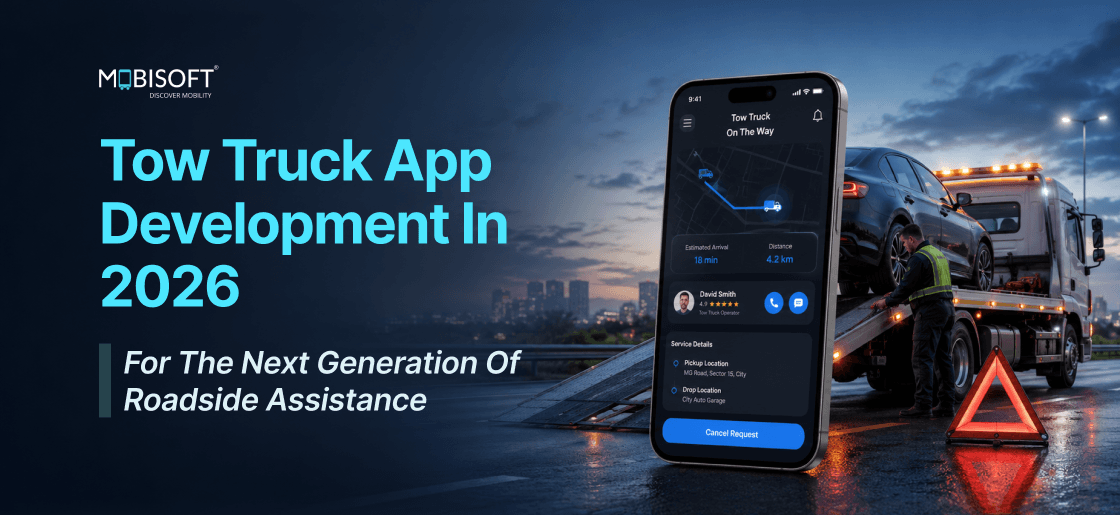
A car breakdown never arrives at a convenient moment.
One minute you are heading somewhere, the next minute your car has stalled on the roadside. Your first instinct is to search for help. That search used to mean scrolling through directory listings or calling operators one by one. Pricing was rarely clear during those calls. Negotiating power was almost nonexistent for a stranded driver.
That old process explains why tow truck app development has grown so active. A well built roadside assistance app replaces the guesswork with a few taps. You select the service you need and share your location. A verified professional gets dispatched within minutes.
This blog walks through what a modern on-demand roadside assistance app needs in 2026. It covers why the market has grown so fast and what founders and towing businesses should know before building one.
Why Roadside Assistance Is Having A Moment In 2026
The global vehicle roadside assistance market reached 28.9 billion dollars in 2026. That is up from 27.7 billion dollars in 2025. Analysts project the market will climb to 41.6 billion dollars by 2033. That growth reflects a compound annual rate of 5.3 percent.
This growth is not accidental. Three forces are pushing the category forward together.
Insurance Bundling Is Changing Distribution
Motor insurance providers are folding roadside assistance directly into their policies. This has made insurers the fastest growing distribution channel in the market.
For a customer, this means help often arrives through an existing policy. For a towing software solution provider, insurance partnerships now matter more. They are no longer a minor side deal.
Regional Demand Tells Its Own Story
Europe holds the largest regional share of this market. It accounted for 35.2 percent of global revenue in 2025. Germany leads within that region by a wide margin.
Dense urban markets tend to adopt on-demand assistance earlier than rural ones. Higher vehicle density makes fast dispatch easier and more profitable for operators.
The Service Mix Is Moving Toward Quick Fixes
Towing still leads the category with 32.2 percent of total market share. Tire replacement is growing faster than any other service type.
This tells us something useful about rider behavior. People want quick fixes whenever a small repair can help. Towing remains the fallback for more serious breakdowns.
Battery Support Is Also Climbing Fast
Battery related requests have grown alongside tire replacement in recent years. Cold weather regions see particularly high demand for this service. A dead battery often strikes without warning during winter mornings.
Providers now stock portable jump start units on nearly every truck. This lets a technician resolve many battery issues within minutes. No towing becomes necessary for a large share of these calls.
Roadside assistance is no longer a niche convenience feature. It has become real infrastructure that many industries want to own.
Auto manufacturers still hold the largest share of the provider market. Many now bundle a few free years of roadside coverage into new sales. This creates a strong incentive for independent operators to differentiate. Speed, transparency, and specialized services offer that path forward. Manufacturer plans often skip these details entirely. Many towing businesses already work alongside logistics service providers, which makes this differentiation easier to act on quickly.
What Changed Since The Last Wave Of Towing Apps
Early roadside assistance apps solved one basic problem well. They connected a stranded driver to a nearby truck. A phone call alone could never move that fast. That was a genuine improvement at the time. The category has matured considerably since then.
AI Dispatching Has Become The Baseline
AI powered dispatch used to be a rare premium feature. Today, real-time dispatch backed by AI matching is close to standard.
Modern tow truck dispatch software uses live location data and technician availability together. It also factors in historical job duration to find the right match. This approach reduces wasted trips and shortens customer wait times.
Smaller towing businesses once found this technology financially out of reach. Cloud based platforms now offer these same capabilities at lower monthly cost. This has leveled the playing field between large chains and independent operators considerably. Many of these platforms pair naturally with a broader delivery management system for operators running more than one service line.
Diagnostics Now Happen Before The Truck Arrives
Telematics and connected vehicle data allow many issues to get triaged remotely. A technician can review basic diagnostic details before leaving the garage. This step alone saves a trip when towing is not required.
Rural Coverage Remains A Real Gap
Most major roadside assistance platforms still struggle outside dense metro areas. Provider density in rural regions simply is not there yet. This gap has not closed much in recent years.
A driver stranded on a rural highway often waits far longer. Fewer technicians cover much larger territories in these areas. This makes every dispatch decision more costly for the operator. Larger towing businesses often close this gap with dedicated enterprise fleet management software built for exactly this kind of coordination.
Vehicle Type Exclusions Still Exist
Most on-demand apps still exclude motorcycles and recreational vehicles entirely. Only a small number of platforms have started closing this gap. Real opportunity still exists for operators willing to serve these riders.
Motorcycle towing requires different equipment than a standard car job. RV assistance often needs larger flatbeds and more experienced technicians. Few platforms have invested in this equipment so far. That leaves demand largely unmet across most regions today.
Electric Vehicles Have Created A New Category
A stranded electric vehicle cannot get help from a jump start. A fuel can offers no solution either in this case. It typically needs a mobile charging unit instead. A flatbed ride to a charging station works as well. This single change has pulled roadside assistance into new territory.
Pricing Transparency Has Improved But Not Fully Arrived
Older platforms often surprised customers with fees after a job was done. Many current apps now show estimated pricing before confirmation. This change in expectation came directly from customer complaints. Review platforms and social media amplified those complaints quickly.
Membership Models Face New Competition
Traditional membership plans once dominated the roadside assistance conversation entirely. Pay per use apps now challenge that model directly with lower upfront cost. Infrequent drivers increasingly prefer paying only when they actually need help.
Frequent drivers, however, still find annual membership plans more economical overall. A driver who calls twice a year often saves money with membership. This creates room for platforms that support both pricing models side by side.
Leading Roadside Assistance Apps In 2026
A few platforms illustrate how this category actually operates today.
Honk
Honk runs a large network of over 75,000 service providers across the United States. Pricing typically falls between 55 and 125 dollars per job. The platform has added AI features to improve transparency. This helps both insurance carriers and everyday customers.
Urgently
Urgently connects drivers to a network of more than 60,000 providers nationwide. Pricing generally ranges from 65 to 150 dollars depending on the service. The app covers a wider 10 mile tow radius than many competitors.
Jerry
Jerry pairs roadside assistance with insurance comparison shopping inside one app. This bundling gives customers a reason to open the app outside emergencies too. Pricing sits between 55 and 110 dollars for most standard requests.
Agero Through AARP
Agero powers roadside assistance for AARP members through a dedicated membership model. The network includes more than 70,000 service providers across the country. Pricing runs from 60 to 130 dollars, and access requires an active membership.
Strand-D
Strand-D operates across roughly 1,500 towns and cities throughout India. The platform works with more than 17,000 certified professionals. Everything runs on a pay per use basis. No membership requirement makes this roadside assistance app model accessible to occasional users.
Each of these platforms shows a different angle on the same core problem. Some focus on scale, others focus on bundling, and others focus on accessibility. Studying these differences helps clarify where a new entrant might fit best.
How An On-Demand Roadside Assistance App Works In 2026
The customer journey inside a modern roadside assistance platform has become noticeably faster. Here is the flow most on-demand roadside assistance app platforms follow today.
Quick Onboarding With Saved Vehicle Profiles
Customers register using a phone number, email, or social login. Vehicle details often get saved after the first request. Repeat requests then take just a few seconds.
AI Guided Service Selection
Many apps now ask a few diagnostic questions instead of a plain list. Some also accept photo uploads from customers. This helps route the right technician on the first attempt.
Live Location Sharing
The customer shares an exact location, much like hailing a ride. Some platforms can now pull this data directly from the vehicle.
Vehicle And Battery Type Detection
EV support requires different equipment and specially trained technicians. Apps now capture battery type early in the request. This single detail changes which technician gets sent.
Fulfillment With Live Tracking
The assigned technician reaches the customer while the app shows live tracking. This mirrors the experience of food delivery apps. Transparency here has become a basic expectation now.
What once required several manual steps now takes under a minute.
Post Service Follow Up
Once the job wraps up, the app should prompt a quick review. Customers can rate the technician and leave detailed feedback. This closes the loop and supports better quality control.
Data Flowing Back Into The Business
Every completed request generates useful data for the operator behind the app. Response times, service types, and common breakdown causes all get logged. Over time, this data helps refine staffing and equipment decisions considerably.
A business that tracks this information closely can spot patterns others miss. Certain neighborhoods might show higher battery failure rates during summer heat. Certain highways might show more tire related calls during winter months.
Core Features For The Customer App
A strong customer facing app balances simplicity with useful detail. Here are the features that matter most in a modern roadside assistance app today.
Simple Onboarding And Profile Management
Onboarding is quite simple. Customers can register in just a few taps. They can also manage multiple vehicles under one shared account. This matters for households with more than one car.
AI Guided Service Selection
Customers can answer a short set of diagnostic questions. It will help in matching the right technician. A photo upload option adds even more useful context. This single feature can reduce repeat dispatches meaningfully.
Live GPS Sharing With Dynamic Arrival Windows
Precision location sharing works alongside a constantly updating estimate. This keeps the customer informed without needing to call anyone. The features helps reduce anxiety and builts trust.
Vehicle And EV Profile Management
This feature allows customers to save vehicle data. It helps route requests to the right technician. Battery health information, where available, supports better routing for EV owners.
Transparent Upfront Pricing
Transparency plays a key role here. Customers should see estimated costs before confirming any request. This directly addresses a long standing complaint about pricing.
Real Time Status Notifications
Push notifications and SMS alerts are extremely useful. They keep customers updated at every stage. In-app chat with the assigned technician adds a useful layer.
Integrated Digital Payments
People have preferences about how they want to pay for a certain service. Multiple payment methods should be available inside the app. Insurance linked billing matters for customers whose policy already covers this.
Ratings And Support Access
A simple ratings system lets customers share honest feedback. An in-app support channel gives them a direct way to flag issues. Reliability in this features also increases trust factor. Customers will start opting for the service comfortably knowing that they can reachout in case of any issue.
Safety Features
An SOS button has become an expected safety layer for many riders. Live trip sharing with a trusted contact adds real peace of mind. This matters most for drivers stranded alone at night.
Multilingual And Accessibility Support
A stranded driver may not speak the app's default language fluently. Multilingual support removes one more barrier during an already stressful moment. Voice guided navigation within the app helps drivers with visual impairments too.
Accessibility features rarely get prioritized during early product planning stages. Building them in from the start avoids costly rework down the line. It also expands the customer base a platform can genuinely serve well.
All these features can easily be implemented with an on demand app development.
Core Features For The Driver Or Technician App
The technician side of a towing app development project deserves equal attention. Dispatch speed and job quality depend on this app working well.
Verified Onboarding With Certification Tracking
Background checks matter more than ever in this industry. Certification verification also matters, especially for EV capable technicians. That group has become a distinct workforce category.
Real Time Job Requests With Smart Matching
Real-time dispatch should weigh technician skill and equipment together. Proximity alone no longer produces the best possible match. This approach means better matches and fewer wasted trips.
Availability And Earnings Dashboard
Technicians need a clear view of upcoming and completed jobs. A transparent earnings breakdown should sit on the same screen.
Built In Navigation With Route Optimization
Static shortest path routing no longer meets rider expectations. Modern dispatch automation software adjusts routes dynamically instead. Live traffic conditions now guide every recommended route.
Access To Pre Arrival Diagnostics
Technicians should view vehicle data or photos the customer submitted. This helps them bring the right tools on the first trip.
Digital Payment Collection
Automated invoicing removes friction at the end of every job. In-app payment collection replaces manual paperwork entirely.
Performance And Feedback Dashboard
A clear feedback loop should connect to long term earnings potential. This gives technicians a real reason to maintain quality.
Training And Onboarding Materials
New technicians benefit from short in-app training modules before their first job. These modules can cover EV safety protocols and customer communication basics. A well trained technician resolves more calls without needing backup support.
Ongoing training also matters as vehicle technology keeps changing quickly. Quarterly refresher content keeps the entire technician network current on new equipment. This investment pays off through fewer failed jobs and better ratings.
Core Features For The Admin And Business Panel
Every towing business needs a strong backend to manage operations. Here is what a capable roadside assistance software platform should include.
Centralized Live Dashboard
A single view of the operation should show live fleet location. This gives business owners immediate visibility into daily activity.
Driver And Technician Network Management
This includes certification tracking for services like EV charging support. Scheduling and payment management for the full roster belong here too.
Customer Relationship Management
A complete service history for every customer supports faster resolution. It also helps teams deliver more personalized service over time.
Dynamic Pricing And Rate Management
Rates should adjust based on demand, distance, and complexity together. This gives owners more control over margins during peak periods.
Promotions And Retention Tools
SMS, push, and email campaigns help retain occasional customers. These tools matter most for customers who need help rarely.
Predictive Analytics And Reporting
Historical dispatch data can now forecast demand spikes by region. This kind of forecasting is becoming standard within serious fleet management operations.
Insurance Partner Integration
Insurance linked distribution is the fastest growing channel in this market. A strong integration layer for partners has become a real advantage.
Compliance And Documentation Tools
Towing businesses face regional regulations covering licensing, insurance, and vehicle storage rules. An admin panel should track compliance status for every technician automatically. This reduces legal risk and keeps the business operating smoothly.
Digital documentation also matters when disputes arise between customers and technicians. Photo timestamps and service logs provide clear evidence when questions come up. This protects both the business and the technician involved fairly.
Businesses running larger fleets often pair this panel with something more specialized, built for that exact scale of coordination.
The AI Layer From Predictive Maintenance To Predictive Dispatch
Artificial intelligence marks the biggest change in this category so far.
What Predictive Maintenance Already Proves
The commercial fleet world offers a useful preview here. The American Transportation Research Institute tracks breakdown costs closely across the industry. Its estimate puts the annual toll above 25 billion dollars. A single commercial breakdown can cost several hundred dollars in direct repairs. That figure typically ranges between 450 and 760 dollars alone.
McKinsey research suggests predictive maintenance can cut costs by 10 to 40 percent. It can also reduce downtime by up to 50 percent. Volvo Trucks North America already applies this through its Blue Service Contract. This program adjusts maintenance intervals based on real usage data.
Volvo's Uptime Center currently monitors close to 85,000 connected trucks. Volvo and Mack Trucks have reduced diagnostic time by 70 percent. Connected systems made that improvement possible across their fleets.
How This Trickles Into Consumer Roadside Assistance
A similar approach is starting to appear in consumer facing towing dispatch software. AI dispatching can pre-diagnose an issue through a few symptom questions. An uploaded photo adds even more useful detail before dispatch.
This alone prevents a meaningful number of wasted trips monthly. Dynamic arrival time prediction offers another clear example of this progress. Modern systems factor in live traffic conditions instead of static distance. Technician skill match and historical job duration both improve accuracy.
As more vehicles arrive connected from the factory, a real question emerges. Will roadside apps eventually flag a likely failure early? That change would move the category toward genuine prevention.
The EV Charging Wrinkle
Electric vehicles break several assumptions that earlier towing apps relied on.
Why A Dead EV Cannot Be Treated Like A Dead Engine
A combustion engine that runs out of fuel has a simple fix. A dead electric vehicle battery has no true equivalent solution. It typically needs a mobile charging unit brought to the vehicle. A flatbed ride to the nearest charging station works too.
Mobile Charging Is Becoming Its Own Category
Dedicated mobile EV charging operators have started appearing as a distinct service. Several expanded regionally through 2025 and into 2026. This signals real demand building steadily beneath the surface.
The Operational Complexity Is Real
Supporting EV roadside assistance well requires specialized technician training upfront. Different equipment on the truck adds further complexity too. Route planning must also account for charging infrastructure nearby.
Battery Diagnostics Add Another Layer
An EV battery problem is rarely a simple binary situation. It might need a full charge, a partial charge, or deeper diagnostics. Technicians need training to tell these situations apart quickly and accurately.
Some manufacturers now share limited diagnostic data through partner integrations. This data can tell a technician the battery's actual state before arrival. That information saves time and avoids sending the wrong equipment entirely.
Charging Infrastructure Still Varies By Region
Urban areas generally offer dense charging networks that support quick mobile response. Rural regions often lack charging stations within a reasonable distance. This gap makes EV roadside assistance considerably harder to deliver consistently everywhere.
Operators expanding into EV support should map charging infrastructure carefully first. This mapping informs where to station mobile charging units most effectively. It also helps set realistic response time expectations for customers in each area.
This Is Also A Genuine Opportunity
EV specific roadside assistance remains underserved compared to adoption growth rates. For a new entrant willing to invest early, this gap offers real upside. Existing towing businesses can capture this opportunity too. Careful planning and early equipment purchases make that possible.
The Persistent Gaps Nobody Has Solved Yet
This category is not fully solved despite years of steady progress. Several gaps remain wide open across nearly every major platform today.
- Rural and remote coverage stays thin because provider density cannot support fast dispatch outside major cities.
- Motorcycle and RV owners remain underserved by most apps, since equipment and training needs differ from standard passenger cars.
- Pricing transparency has genuinely improved, yet it still varies between platforms during an actual emergency.
- Multilingual support remains inconsistent, which creates friction for non-native speakers during a stressful moment.
These gaps do not signal a failed category in any way. They represent the clearest opportunities for any business willing to build for them.
Why These Gaps Persist
Most established platforms focus on dense urban markets first. Growth there comes faster and infrastructure costs stay lower overall. Expanding into harder markets requires patience and upfront investment few companies want to make.
Rural expansion in particular demands a different operating model entirely. Fewer requests per technician mean higher costs per completed job. Businesses willing to accept thinner margins early can build lasting loyalty in these markets.
The Data Behind The Opportunity
Rural vehicle ownership rates remain high across most countries, including well developed ones. Yet roadside coverage in these areas trails urban coverage significantly. This mismatch between vehicle ownership and available service creates a clear opening.
A regional operator committed to rural coverage builds strong word of mouth. Trust matters enormously in smaller communities where reputation travels fast. This trust can become a durable competitive advantage over time.
What This Means For Towing Businesses And Startups Building In 2026
A few practical points stand out for anyone entering this space now.
Insurance Partnerships Deserve Early Attention
Insurance bundling is the fastest growing distribution channel in this market. Building integration capability early can speed up customer acquisition meaningfully.
AI Features Are No Longer Optional Extras
AI powered dispatching has quickly moved from a premium add-on to a baseline expectation. Predictive diagnostics belong in that same category today. A platform without these capabilities will feel outdated soon.
Budget conscious operators can start with a lighter version of these features. Even basic symptom based triage delivers meaningful improvement over a static service list. Scaling up to deeper AI capability can happen gradually as revenue grows.
EV Readiness Is Worth Planning For Now
Even a partial approach can position a business well ahead of demand. Partnering with an existing mobile charging operator works well here. Scrambling to catch up later tends to cost far more. This single decision can save significant cost down the road.
Underserved Segments Represent Real Differentiation
Rural coverage, motorcycle support, and RV assistance are not distractions. They remain some of the few paths left toward genuine differentiation. Most competitors currently look fairly similar to one another.
Technology Partnerships Can Speed Up Launch
Building every piece of technology from scratch rarely makes sense today. Established platforms for real-time dispatch and payments already exist and work well. Partnering with the right technology provider can cut launch time considerably.
This approach also reduces long term maintenance burden for smaller operators. A team can focus energy on service quality and market expansion instead. Technical debt from a rushed in-house build often costs more later.
Customer Trust Takes Time To Build
A new roadside assistance brand faces real skepticism from first time users. Trust builds slowly through consistent response times and fair pricing. Early reviews matter enormously since most customers check ratings before their first request.
Operators should resist the urge to overpromise during early growth phases. A slightly slower rollout with strong service quality beats rapid expansion with weak execution. Reputation, once damaged in this industry, proves difficult to repair quickly.
Businesses already working alongside established transportation partners are often well positioned to expand here. Much of the underlying dispatch and routing infrastructure overlaps between both categories. This overlap shortens the learning curve considerably for teams making this move.
Is the real opportunity in 2026 a better version of an existing app? Or does it lie in building for regions nobody has served properly yet?
Conclusion
Picture that same stranded driver from the start of this blog. This time, the app does far more than simply dispatch a truck. It diagnoses the issue and predicts arrival times accurately. It also adapts to whatever vehicle sits on the roadside.
Roadside assistance has moved well past being a simple convenience feature. A market projected to pass 41 billion dollars by 2033 backs that claim. Insurers, manufacturers, and independent operators are all competing for this space.
Building a serious tow truck app in 2026 means combining several pieces well. AI dispatching, EV readiness, and thoughtful fleet management all need to work together. A modern platform should also plug cleanly into broader delivery operations. Operators running multiple service lines benefit most from that kind of integration.
If you are exploring roadside assistance app development for your business, we can help. Our team at Mobisoft brings deep experience building on-demand platforms. We work across transportation and logistics daily. Get in touch with us to discuss your project. We would love to show you what modern tow truck dispatch software can offer.

Frequently Asked Questions
How much does tow truck app development cost?
Cost depends heavily on feature scope and platform complexity. A basic three sided platform costs less than one with AI diagnostics and EV support. Insurance integrations and predictive analytics add further cost. Most serious tow truck app builds fall into a mid range budget rather than a bare minimum one.
Do small towing businesses need AI features from day one?
No. Small operators can start with basic symptom based triage. This alone improves match quality over a static service list. Deeper AI dispatching capability can get added later as revenue grows. Waiting for stronger cash flow reduces financial risk during launch.
Can an existing towing business add an app without rebuilding everything?
Yes, most towing businesses can layer an app onto their current operations. Existing trucks, technicians, and processes stay largely the same. The app mainly changes how customers request help and how jobs get assigned. This makes a roadside assistance platform an addition rather than a replacement.
Why does insurance integration matter for a roadside assistance app?
Insurance bundling has become the fastest growing distribution channel in this market. A platform with insurance integration can receive requests directly from policyholders. This removes the burden of separate customer acquisition efforts. Strong insurance partnerships often bring more stable request volume than paid marketing alone.
This content is for informational purposes only and may include AI-assisted research or content generation. While we strive for accuracy, information may evolve over time. Readers are advised to independently verify critical information before making decisions.

Nitin Lahoti
Read more
Nitin Lahoti is the Co-Founder and Director at Mobisoft Infotech. He has 15 years of experience in Design, Business Development and Startups. His expertise is in Product Ideation, UX/UI design, Startup consulting and mentoring. He prefers business readings and loves traveling.
 Nitin Lahoti
 July 23, 2026