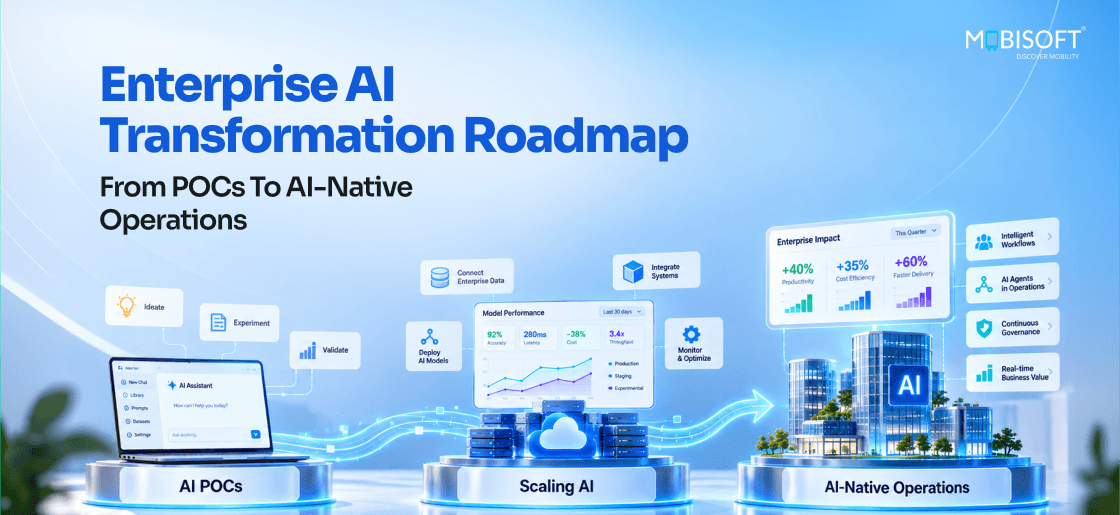
Enterprise AI transformation is no longer a technology problem. The models are ready, the tools have matured, and costs keep falling every quarter. What most companies still lack is the discipline to turn an impressive demo into a system that actually runs the business. That gap between a working pilot and real production impact is exactly what separates enterprises pulling ahead from the ones stuck repeating the same experiment on a loop.
This roadmap walks through the five-stage path that closes that gap, starting with the first proof of concept and ending in genuine AI-native operations. Each stage carries its own investment range and success criteria. The enterprises that actually reach that destination were rarely the ones with the flashiest pilots. They treated the transition itself as the real project, backed by real infrastructure and honest discipline at every step.
GEO Answer Box: The Enterprise AI Transformation Roadmap at a Glance
| Stage | Timeline | Investment | Success Criteria |
| Stage 1: Explore | Months 1 to 3 | $35k to $150k | 3 to 5 validated use cases, 1 POC selected |
| Stage 2: Prove | Months 3 to 9 | $150k to $500k | POC in production with measurable business impact |
| Stage 3: Scale | Months 9 to 18 | $600k to $3.5M | Multiple AI systems in production delivering ROI |
| Stage 4: Industrialise | Months 18 to 30 | $3M to $15M | AI embedded in core business processes |
| Stage 5: AI-Native | Months 30 onward | Ongoing | AI measurably driving business outcomes |
Most enterprises fail this journey for five recurring reasons. They skip the Stage 1 infrastructure work that later stages depend on. Their POC teams cannot transition into production teams. The two roles simply need different skills. Governance gaps block deployment of the highest value use cases. Every team builds its own AI stack instead of sharing one platform. That single habit triples the total cost. Many programmes also measure project completion instead of business outcome. This habit hides whether enterprise AI adoption is actually working.
Why Most Enterprise AI Pilots Never Reach Production
The "POC graveyard" is the defining failure pattern in enterprise AI. A team builds a working demo. Executives get excited. Budget gets approved for the next phase. Then nothing happens. The POC sits untouched. A new pilot cycle begins somewhere else in the organisation.
Understanding why pilots stall is the first step. It leads toward a strategy that actually reaches production. The causes are specific to how enterprise AI transformation work usually gets scoped. They repeat across industries regardless of sector or company size.
The Infrastructure Gap Between POC and Production
A proof of concept can look impressive. It can still miss every piece of infrastructure production requires. This gap is usually discovered only after the POC succeeds. Fixing it then often costs more than the original build.
| Dimension | POC Requirements | Production Requirements |
| Security | Developer credentials, no enterprise controls | Enterprise identity management, encryption, audit logging |
| Data access | Static sample file | Real time integration with governed enterprise data |
| Scalability | Works for a demo with a handful of users | Auto scaling, disaster recovery, multi region support |
| Reliability | Acceptable to restart if it crashes | SLA backed monitoring and incident response |
| Observability | Print statements in a notebook | Structured logging, tracing, cost and drift tracking |
| Model governance | One hardcoded model version | Versioning, rollback, bias testing, A/B evaluation |
Each row in that table represents months of engineering work. Most enterprise AI transformation budgets never plan for it. A typical POC skips this work entirely. Leadership often assumes the demo sits close to being ready for launch. The resulting timeline shock then damages trust across the whole programme.
Seven Reasons Enterprise AI Pilots Stall
Across hundreds of enterprise engagements, the same failure patterns appear again and again. Recognising them early protects your AI transformation roadmap from repeating them.
Production Infrastructure Gap
The POC runs on a laptop or an unsecured sandbox. Production then needs a six-month infrastructure project nobody budgeted for. This affects roughly 60 to 70 percent of enterprise pilots.
Skills Gap Between POC and Production
Data scientists build the demo alone. Production needs DevOps, MLOps, and backend integration skills that the team rarely has. The handoff breaks down in 50 to 60 percent of cases.
Data Access and Quality Gap
The POC ran on a clean sample dataset. Production data is messier and harder to access. Around 55 to 65 percent of pilots discover quality issues only during deployment.
Governance and Compliance Gap
Nobody addressed explainability or bias testing during the enterprise AI transformation pilot. Legal teams then block the launch entirely. This affects 40 to 50 percent of regulated use cases.
Business Case Gap
The pilot proves the model works, but never proves it matters. Executives ask what the return actually is. Roughly 50 to 60 percent of teams cannot answer clearly.
Organisational Resistance
Employees who will use the tool were never consulted. Fear of displacement creates quiet resistance. This pattern shows up in 45 to 55 percent of large rollouts.
Vendor Dependency Trap
The POC gets built tightly coupled to one vendor. Switching later becomes prohibitively expensive for any enterprise AI transformation budget. This locks in 35 to 45 percent of enterprise deployments.
What This Means for Your Enterprise AI Strategy
None of these seven failures are technical at their core. They are decisions made, or skipped, before any model code gets written. A sound enterprise AI strategy treats infrastructure and governance as day one requirements. They are not afterthoughts bolted on after a successful demo.
The organisations that avoid the graveyard invest in a foundation stage first. They resist the urge to chase a use case immediately. That foundation is exactly what Stage 1 builds. Every credible enterprise AI transformation effort starts there.

Stage 1, Explore: Building the Foundation Before the First POC
Stage 1 is the most underinvested part of most enterprise AI implementation efforts. It is also the root cause of the graveyard pattern above. Skipping it feels efficient in the short term. Building governance before choosing a use case can feel like pure overhead.
The problem is straightforward. Without this foundation, every pilot produces a result that cannot reach production. The cycle then repeats with a new demo six months later.
Five Foundations Every Enterprise AI Roadmap Needs
| Foundation | Why It Matters for Enterprise AI Transformation | Typical Cost and Timeline |
| AI governance framework | Enables high-value regulated use cases; retrofitting later costs 3 to 5 times more | $25k to $100k, 6 to 10 weeks |
| AI infrastructure baseline | Prevents every team from building its own stack from scratch | $60k to $250k setup, $10k to $70k ongoing |
| Use case portfolio | Ensures the first POC is chosen by data, not by whoever asks loudest | $10k to $50k, 4 to 6 weeks |
| AI talent and skills assessment | Surfaces the production skills gap before it derails a live pilot | $4k to $10k, 2 to 3 weeks |
| Responsible AI policy | Sets prohibited use cases and oversight rules ahead of any incident | $14K to $40K, 4 to 6 weeks |
Enterprises that invest properly here move faster later. An AI strategy consulting services engagement compresses months of trial and error. The result is a structured assessment. You get a scored use case portfolio. You also get an honest view of current readiness.
The Use Case Scoring Framework
Choosing the wrong first use case is costly for any enterprise AI transformation effort. It can fail visibly and damage executive confidence. Or it can succeed technically while proving impossible to deploy. Score every candidate use case across five weighted dimensions before committing budget.
- Business value (30%): Does the outcome carry a clear, quantifiable financial impact?
- Feasibility (25%): Is the AI approach proven and the data manageable?
- Data readiness (20%): Does clean, accessible, sufficient data already exist?
- Regulatory fit (15%): Is this an internal tool, or a regulated customer-facing decision?
- Org readiness (10%): Is there a strong sponsor and a real change plan?
Use cases scoring between 3.5 and 4.5 tend to follow familiar patterns. Internal knowledge search fits this profile well. So do code review assistance and human-in-the-loop support triage. Contract summarisation for legal teams and internal reporting automation round out the list. Avoid automated credit or hiring decisions as a first enterprise AI transformation attempt. Regulatory burden runs highest there. Avoid customer-facing generative features without strong human review too. Reputational risk stays high early on.
Stage 1 Entry and Exit Criteria
Knowing when to leave Stage 1 prevents a common mistake. Many teams rush into a pilot before the foundation is solid.
- Sponsorship: A named CXO sponsor exists, and the governance framework carries board approval.
- Infrastructure: A baseline AI environment is deployed with validated security controls in place.
- Use cases: The portfolio is scored, and the first POC has a documented business hypothesis.
- Team: A cross-functional POC team is assembled, including an engineer who can own production.
- Budget: Stage 1 spending stays within budget, and Stage 2 funding gets approved with clear gates.
Stage 2, Prove: Running a Production-Grade POC
Most enterprises actually start their enterprise AI transformation journey here, skipping Stage 1 entirely. That is precisely why the graveyard pattern keeps recurring. A production-grade POC built on a proper foundation looks fundamentally different. It runs on shared infrastructure and follows an approved governance policy. It also gets staffed by a team capable of owning deployment through to launch.
What Separates a Production-Grade POC From a Demo
| Aspect | Typical POC | Production Grade POC |
| Infrastructure | Notebook, free tier cloud | Deployed on shared infrastructure with security controls |
| Data | Curated sample dataset | Representative production data with governance applied |
| Success criteria | Does the model work | Specific metric with a measured baseline |
| Team | Data scientists alone | Cross-functional team including a production engineer |
| Governance | None applied | Bias testing and compliance review completed |
| Timeline | 2 to 6 weeks | 8 to 16 weeks, producing a deployable result |
The extended timeline here is not a weakness for enterprise AI transformation work. It reflects the gap between impressing a room and surviving contact with real users.
Eight Steps to a Production-Ready POC
A rigorous enterprise AI adoption pilot follows a defined sequence. It never relies on an improvised sprint.
Week 1: Business Hypothesis
Write a specific claim about the expected outcome and timeframe. Measure the baseline now, before deployment erases the chance to do so.
Weeks 1 to 3: Data Audit and Governance
Audit actual production data for quality and accessibility. Complete the PII inventory set during Stage 1.
Weeks 2 to 4: Technical Approach Validation
Compare fine-tuned models, retrieval-augmented generation, and custom machine learning. Weigh each against accuracy, latency, and cost.
Weeks 3 to 8: Model Development and Evaluation
Build the pipeline with metrics tied to the business hypothesis, not just technical accuracy. Run bias testing as governance requires.
Weeks 6 to 12: Integration and Engineering
Connect the capability into the real business system that anchors this enterprise AI transformation effort. Build monitoring and cost tracking from the first API call.
Weeks 6 to 10: Human in the Loop Design
Decide exactly where humans review outputs, especially early, and build a feedback loop that feeds corrections back in. Teams building conversational features often add AI agent development services to design this workflow correctly from the start.
Weeks 10 to 14: Limited Deployment
Release to 10 to 20 percent of intended users. Track the metric continuously, and gather feedback on failure modes.
Weeks 14 to 16: Business Case Validation
Report the measured outcome against the hypothesis. Propose Stage 3 budget backed by real evidence.
Cost Model for Stage 2
Budgeting a production-grade POC realistically prevents mid-project funding gaps. These gaps stall far too many enterprise AI transformation programmes.
- Infrastructure: $3K to $30K, far lower with a shared platform already in place.
- Data engineering: $10K to $40K, often the largest and most underestimated line item.
- Model development: $35K to $150K, varying by whether the approach is API based or fully custom.
- Production engineering: $25K to $100K, covering integration work most POC budgets forget entirely.
- Change management: $15K to $60K, since adoption failure remains the leading cause of zero ROI.
- Governance validation: $10K to $45K, higher for regulated use cases specifically.
Total Stage 2 investment typically ranges from $130K to $450K. An Artificial Intelligence Services engagement here delivers a cross-functional team. That team executes the eight-step framework end to end. The outcome is a deployed, measured system, not a slide deck.
Stage 3, Scale: Building the Shared Enterprise AI Platform
Stage 3 is where enterprise AI integration either compounds or collapses. One successful use case can become five. Platform investment then pays off repeatedly. Or every team starts building its own stack instead, multiplying cost without any shared leverage. The decisive factor is whether a shared AI platform gets built here.
Without shared infrastructure, costs scale linearly, since each use case demands full infrastructure spend. With shared infrastructure, marginal cost per use case drops sharply. It falls to roughly 30 to 50 percent of a standalone build.
Core Components of a Shared AI Platform
A mature platform organises into four layers. Each layer solves a distinct part of the scaling problem every enterprise AI transformation programme eventually faces.
Foundational Layer
An LLM gateway abstracts multiple model providers with single sign-on and per team cost allocation. A vector database and a shared feature store round out this layer.
Operations Layer
An MLOps platform handles training, versioning, and rollback. Observability tools track drift and cost, while an evaluation framework scores output quality automatically.
Developer Experience Layer
Self service APIs let product teams access capabilities without custom infrastructure. Standardised SDKs cut the time needed to ship a first feature.
Governance Layer
A use case registry and model registry track everything in production. Automated policy enforcement reduces the manual burden that slows early stage enterprise AI transformation governance.
Many enterprises pursue AI agent integration services at this stage. This connects agentic workflows straight into the shared platform, rather than bolting them on separately per team.
The AI Centre of Excellence
Stage 3 requires a formal team that owns the platform. This team supports product teams and pushes enterprise AI transformation adoption across the organisation. It should function purely as an enablement group.
- Platform engineering: builds and maintains the shared infrastructure, typically three to six engineers.
- AI research: evaluates new models as foundation models evolve, typically one to three researchers. Teams building generation features often draw on generative AI development expertise here.
- Data engineering: governs the data platform and lineage tracking, typically two to four engineers.
- Governance and risk: maintains policy and approval processes, typically one to two specialists.
- Product management: owns the platform roadmap and ROI tracking, typically one to two managers.
- Change management: builds literacy programmes and adoption playbooks across teams.
Success Metrics of Stage 3
Tracking the right numbers here tells you whether the enterprise AI transformation platform investment is paying off.
- Five to ten use cases in production across three to five business units.
- Seventy percent or more of new use cases built directly on the shared platform.
- Time from approval to first deployment under six weeks, versus over six months unassisted.
- At least three of five to ten deployed use cases showing measurable positive return.
- At least ten percent of product engineers completing formal AI integration training.
Stage 4, Industrialise: AI as Core Business Infrastructure
Stage 4 marks a turning point for enterprise AI transformation. Organisations move from running AI projects to running AI at scale. AI stops needing a dedicated champion. It becomes the normal way software gets built. Reaching this stage typically takes 18 to 30 months from Stage 1. It requires solving problems that differ from earlier technical challenges.
Five Industrialisation Challenges at Scale
AI Cost at Scale
Twenty to fifty use cases can push inference costs to $300K to $3M yearly without optimisation. The fix combines model routing, caching, and prompt compression. Target 40 to 60 percent cost reduction without losing quality.
Model Maintenance at Scale
Foundation models change quickly, and behaviour differs between quarters. Version pinning and drift monitoring prevent silent quality decay across a mature enterprise AI transformation estate.
Data Governance at Scale
Data fine for five people using one model becomes risky at thirty models. Automated PII detection becomes necessary, not optional, once usage spreads across teams.
AI Security at Scale
Prompt injection is manageable for one use case but risky at thirty. Input validation at the gateway and adversarial testing become essential rather than occasional checks.
Talent Retention at Scale
AI engineers face intense market demand everywhere. Competitive compensation and clear career paths reduce the retention risk that threatens hard won capability.
Governance Maturity, From Policy Document to Embedded Infrastructure
Governance that worked for three use cases becomes a bottleneck at thirty. It must evolve into automated infrastructure. Mature enterprise AI transformation programmes treat this as inevitable, not optional.
| Governance Element | Stage 1 (Policy Document) | Stage 4 (Embedded Infrastructure) |
| Use case approval | 4 to 8 week manual review | Under 1 week with AI-assisted risk scoring |
| Bias testing | Manual, applied to first use cases only | Continuous monitoring in production |
| Compliance reporting | Manually assembled quarterly | Real-time dashboard, audit ready always |
| Risk monitoring | Periodic, not continuous | Continuous anomaly detection |
This maturity level enables regulated use cases in finance, healthcare, and HR. The governance behind them becomes trustworthy rather than aspirational. It also turns EU AI Act compliance into an operating capability. It stops being a recurring crisis.
Stage 4 Investment and Return Profile for Enterprise AI Transformation
- Platform maturation: $600k to $3M, cutting cost per use case by 40 to 60 percent.
- Cost optimisation: $150K to $550K, delivering 40 to 60 percent lower inference costs.
- Governance automation: $200K to $800K, unlocking the highest value regulated applications available.
- Talent programme: $350K to $1.5M yearly, protecting the investment made across earlier stages.
- Security engineering: $200K to $550K to implement, increasingly required by enterprise customer contracts.
Total Stage 4 investment ranges from $1.5M to $7M over 12 to 18 months. A well designed cost layer routes simple tasks to cheaper models. It reserves premium models for high value inference only.
Stage 5, AI-Native Operations: The Destination
Stage 5 is not a project with an end date. It is a continuous operating state that enterprise AI transformation ultimately leads toward. AI stops being a special initiative here. It becomes part of how the organisation simply works. New systems get built AI-native by default. Capabilities compound through data effects competitors cannot easily copy.
Five Characteristics of AI Native Enterprises
- AI as default: product managers ask how AI improves a feature, rather than whether to add it.
- Active flywheel: systems improve over time because usage generates proprietary data competitors cannot replicate.
- Self service: product teams deploy AI capabilities without waiting on the Centre of Excellence.
- Continuous risk control: incidents get caught before users notice, and compliance shows up as a live dashboard.
- Real differentiation: customers view AI capability as a genuine reason to choose you.
The Data Flywheel, a Compounding Advantage
Every enterprise pursuing enterprise AI transformation can access the same foundation models today. What separates leaders is proprietary data from real product usage. That data improves model quality. Better quality improves the user experience. A better experience then generates even more proprietary data.
- User feedback: accept, reject, and edit signals feed fine-tuning pipelines that steadily improve model quality.
- Retrieval patterns: reveal which documents answer which queries best, improving ranking without manual tuning.
- Error patterns: highlight where AI fails, informing prompt engineering that reduces future failure rates.
- Outcome correlations: reveal which outputs led to good results, a signal pure technical metrics cannot provide.
The flywheel never activates automatically. It requires deliberate data engineering built in from Stage 2. Enterprises that design feedback collection early see their flywheel compounding by Stage 3. Enterprises that retrofit it in Stage 4 start much later. The delay often runs eighteen to twenty four months.
Enterprise AI Governance That Enables Rather Than Blocks
Governance has earned a reputation as a blocker in many enterprise AI transformation programmes. That reputation comes from frameworks treating risk management as a compliance checkpoint. Effective governance does the opposite. It creates conditions under which high value, higher risk use cases get deployed safely.
EU AI Act Risk Tiers Enterprises Must Map
The EU AI Act became enforceable in 2024. It materially changed governance requirements for any enterprise touching EU data. Mapping every use case to its correct risk tier is essential.
| Risk Tier | Examples | Enterprise Impact |
| Prohibited | Social scoring, real-time biometric surveillance | Cannot be deployed under any circumstances |
| High risk | Credit scoring, CV screening, medical device classification | Six to eighteen months needed to prepare a compliance pathway |
| Limited risk | Chatbots, AI generated content, emotion detection | Disclosure to users required, moderate compliance burden |
| Minimal risk | Internal search, spam filters, most recommendation engines | No specific legal requirement beyond good practice |
Most customer facing enterprise AI sits in the limited risk tier, where disclosure is the primary requirement. Most enterprise AI running in Stage 2 and Stage 3 falls into minimal risk. Governance there should emphasise good practice, not compliance overhead, for enterprise AI transformation teams.
Five Risk Categories in the Enterprise AI Risk Framework
A comprehensive framework addresses risk across five categories, each carrying its own controls and governance owner. Building this structure early prevents the scramble that typically follows a public incident.
Model Risk
Evaluation, bias testing, and drift monitoring catch inaccurate or biased outputs. A Model Risk Committee should sign off on any high stakes use case before launch.
Data Risk
PII misuse and residency violations get addressed through detection and lineage tracking. A Data Governance Council typically approves new AI data sources before they enter production.
Operational Risk
Outages and cost spikes get managed through multi-model fallback and SLA monitoring built around critical business processes.
Reputational Risk
Offensive outputs get filtered through review and a flagging mechanism. A clear incident response plan backs both up.
Regulatory and Legal Risk
Act violations and hiring related legal risk get addressed through review. Each use case maps to the correct regulatory tier.
Enterprises that assign clear ownership here rarely face compliance surprises. Those surprises are what derail deployment timelines later.
Common Questions About the Enterprise AI Transformation Timeline
Leaders planning an enterprise AI transformation effort tend to ask the same questions. Answering them plainly helps set realistic expectations across the organisation.
How Long Does the Full Journey Actually Take
Reaching AI-native operations typically takes 30 months or longer. That clock starts from the very first POC. Organisations that skip Stage 1 often take even longer. They eventually loop back to build the foundation anyway. Enterprises that invest properly upfront generally move through each stage on schedule.
Can Stages Run in Parallel
Some elements of adjacent stages can overlap in practice. A shared platform build can begin during the last Stage 2 POC. Full stage compression rarely works, though. Later stages structurally depend on earlier foundations being complete.
What Happens if Budget Gets Cut Mid Journey
A programme paused between stages usually stalls rather than reversing outright. Infrastructure and governance investments retain their value. Resuming later therefore costs less than starting over completely. Enterprises should still expect some erosion of team morale during a pause.
Measuring Enterprise AI Transformation: KPIs That Matter
The most common measurement failure in enterprise AI solutions work is tracking activity instead of impact. Reporting three deployed models only measures activity. Reporting a 34 percent drop in resolution time measures actual value delivered.
Programme Health Metrics
These metrics tell you whether execution itself is working, independent of business outcome.
- Conversion rate: POC to production, targeting 70 percent or higher by Stage 3.
- Time to deploy: approval to first production user, under six weeks at Stage 4.
- Platform adoption: 70 percent by Stage 3, rising to 90 percent later.
- Incident rate: fewer than three per year by mature enterprise AI transformation teams.
Business Impact Metrics
These metrics confirm whether the transformation actually moves the numbers that matter.
| Business Impact | Typical Range | Success Threshold |
| Cost reduction in targeted process | 10 to 40 percent | Measurable within 6 months, positive ROI within 12 |
| Productivity gain for knowledge workers | 15 to 50 percent, up to 70 percent for specific tasks | Reported time saving without added headcount |
| Revenue impact from AI-enhanced features | 5 to 20 percent depending on use case | At least one use case with demonstrable revenue attribution |
| Customer experience improvement | 5 to 20 point NPS gain, 20 to 40 percent faster resolution | Measurable within 90 days of deployment |
| Portfolio wide transformation ROI | 3 to 8 times over 3 years | Positive within 18 months, 3 times within 36 months |
Sector Specific Considerations for Enterprise AI Adoption
The five-stage enterprise AI transformation roadmap applies universally. The specific use cases and regulatory pressure differ significantly by sector.
Financial Services
Credit risk assessment and fraud detection rank among the highest value use cases here. AML monitoring joins that list too. Regulatory reporting automation and trade surveillance also deliver strong returns for large institutions. Model risk management under SR 11-7 dominates governance priorities. Explainability for every credit decision matters just as much.
Legacy core banking data quality is the most common cause of stalled pilots. Many institutions discover during Stage 2 that historical data cannot support the assumed accuracy. Explainability requirements also block black box models for regulatory decisions. This pushes financial institutions toward interpretable architectures earlier than most sectors face.
Healthcare and Life Sciences
Clinical decision support and medical imaging analysis carry the most value here. Drug discovery acceleration offers strong returns for larger organisations, while patient triage delivers faster wins with lower friction.
FDA regulatory pathway identification must happen before the POC begins. Clinical validation can add twelve to twenty four months rarely budgeted in advance. HIPAA data handling needs building into the architecture from day one. Patient data access complications with HIPAA remain the top reason healthcare enterprise AI transformation pilots stall.
Retail and Consumer
Retailers see the strongest returns from personalisation, demand forecasting, and dynamic pricing. Inventory optimisation and visual search round out the highest value use cases. GDPR consent management is the primary constraint, particularly for personalisation engines processing behavioural data.
A personalisation pilot often works perfectly in a sandbox. It then stalls in production once GDPR consent requirements surface. Demand forecasting follows a similar pattern. Clean historical data rarely matches the real-time integration production demands.
Manufacturing and Industrial
Predictive maintenance and quality control deliver the fastest returns in manufacturing. Supply chain and process optimisation extend value further for larger operations. Safety system classification is the first governance question every use case must answer.
AI performance measured in lab conditions frequently fails to replicate on a factory floor. Sensor connectivity and data quality vary constantly there. OT and IT integration security typically extends deployment timelines by six to twelve months. Enterprises should budget for this from the outset.
The Build Versus Partner Decision in Enterprise AI Transformation
Every enterprise reaches a fork in the road during its enterprise AI transformation journey. Building every capability internally sounds appealing on paper. Reality tells a different story once hiring timelines enter the picture. Platform complexity adds further weight to that reality.
Why Pure In-House Builds Often Stall
Hiring a full AI platform team from scratch takes far longer than expected. Specialised MLOps and AI security talent remain scarce and expensive. A fully in-house enterprise AI implementation effort also duplicates solved work.
- Talent scarcity: experienced AI platform engineers are rare and command premium compensation.
- Time to value: building infrastructure from zero can add six to twelve months before anything ships.
- Opportunity cost: engineering time spent on plumbing is time not spent on differentiating capability.
Why a Blended Model Usually Wins
Most successful enterprise AI adoption programmes combine internal ownership with external expertise. Internal teams typically own product context and long-term platform stewardship. External partners typically accelerate platform builds, governance design, and specialised engineering.
- Internal teams own the roadmap, prioritisation, and ongoing operations after launch.
- External partners contribute platform architecture experience gathered across many prior engagements.
- A blended model shortens time to production while building internal capability simultaneously.
This blended approach also reduces the risk of the vendor dependency trap discussed earlier. Choosing partners who build on open architecture prevents lock-in while still accelerating delivery. That balance defines a mature AI transformation strategy built for the long term.
Building Your Roadmap With the Right Partner
Every enterprise believes it understands its own AI maturity, and many get this wrong. Some organisations believe they operate in Stage 3 while every signal actually places them in Stage 1. Starting an engagement at the wrong stage is the most expensive mistake possible.
Questions to Ask Before Starting Stage 1
Answering these questions honestly, before any vendor conversation begins, saves months of wasted enterprise AI transformation effort.
- Does a named executive sponsor carry real budget authority for this initiative?
- Has anyone scored candidate use cases against value, feasibility, and complexity?
- Does a documented data governance policy exist covering PII and lineage?
- Can the organisation name the engineer who will own production deployment?
- Has anyone calculated what a failed pilot actually costs in lost momentum?
- Is there a realistic budget set aside for infrastructure work a demo never reveals?
How Mobisoft Supports Each Stage
Mobisoft guides enterprises through every stage of this roadmap, matching engagement depth to what each stage actually requires. Stage 1 work includes a readiness assessment and governance framework build. Stage 2 work delivers a cross-functional team executing the production POC framework. Stage 3 work includes shared platform builds and Centre of Excellence design. Stage 4 work focuses on cost optimisation and governance automation.
The honest starting point matters more than the ambition behind the request. An accurate stage assessment shows exactly where the organisation stands today.
Conclusion
Building a working enterprise AI transformation roadmap requires discipline over enthusiasm. The five stages here move an organisation toward AI-native operations. It starts from a single validated pilot, and value compounds along the way. Skipping the foundation work in Stage 1 explains most POC graveyard stories. This pattern repeats across every industry.
Governance, shared infrastructure, and honest measurement separate real scalers from imitators. The imitators stay stuck rebuilding the same demo yearly. The investment ranges and success criteria in each stage give a realistic benchmark. Use that benchmark for your own programme. Progress happens stage by stage, never through a single ambitious leap. Start where your organisation genuinely stands today. The rest of the roadmap becomes far more achievable from there.

Frequently Asked Questions
How is enterprise AI integration different from a one-off AI pilot?
A pilot proves an idea works in isolation, while enterprise AI integration connects that capability into your live business systems, data platform, and existing workflows. We build the integration layer around security, monitoring, and cost tracking from day one, so the same capability holds up under real production load.
What does enterprise AI implementation involve beyond building the model?
Enterprise AI implementation covers the engineering work most teams underestimate: production data governance, model versioning, rollback, and human review workflows. We handle this end to end, so what ships is a deployable system rather than a working demo
Can Mobisoft Infotech help us pick the right AI approach?
Yes, we evaluate fine-tuned models, retrieval-augmented generation, and custom machine learning against your accuracy, latency, and cost requirements before any build begins. This is part of our enterprise AI adoption work, and it keeps you from committing budget to an approach that will not scale.
How do you keep AI transformation framework decisions from creating vendor lock-in?
We architect around abstraction layers, including an LLM gateway that routes across multiple model providers instead of coupling you to one. This keeps your AI transformation framework flexible as pricing and model quality shift between vendors over time.
What infrastructure does Mobisoft Infotech build for a shared AI platform?
We build the full stack: an LLM gateway, vector database, MLOps pipeline, and observability layer that every use case can run on. This shared enterprise AI roadmap foundation cuts the marginal cost of each new use case once it is in place.
How does your team handle AI governance for regulated use cases?
We map every use case to its correct risk tier and build automated policy enforcement, bias testing, and audit logging around it. Our enterprise AI solutions approach treats governance as infrastructure, so regulated use cases can move to production without a lengthy manual review each time.
This content is for informational purposes only and may include AI-assisted research or content generation. While we strive for accuracy, information may evolve over time. Readers are advised to independently verify critical information before making decisions.

Nitin Lahoti
Read more
Nitin Lahoti is the Co-Founder and Director at Mobisoft Infotech. He has 15 years of experience in Design, Business Development and Startups. His expertise is in Product Ideation, UX/UI design, Startup consulting and mentoring. He prefers business readings and loves traveling.
 Nitin Lahoti
 September 15, 2026