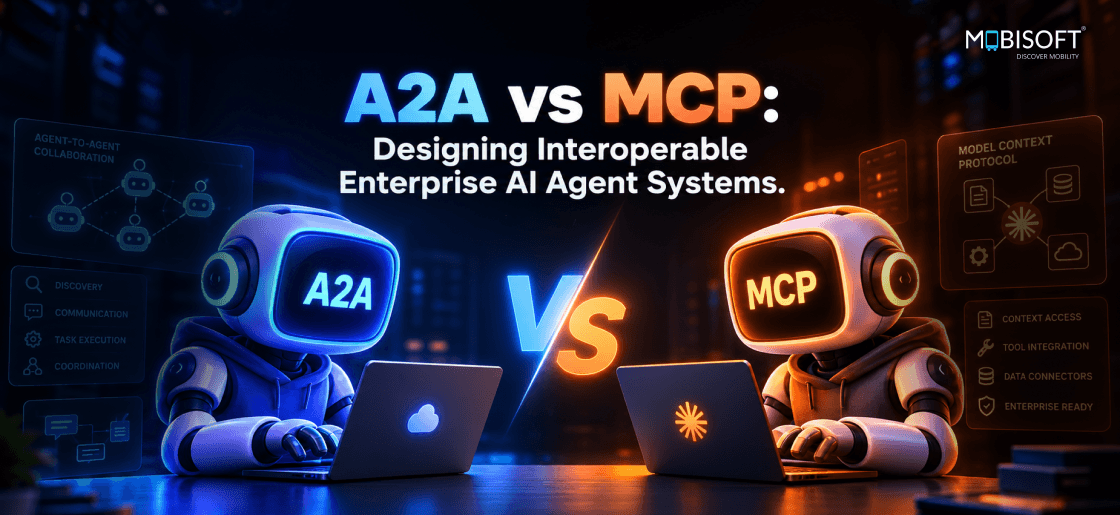
A2A and MCP are the two protocols every enterprise architecture team eventually argues about. Someone wants to standardize on one before the next sprint. Someone else points out that the two solve completely different problems. Both sides are partly right, and partly missing the point. A2A vs MCP is not a rivalry your team needs to settle before moving forward. Each protocol handles a distinct job, and most serious multi-agent systems end up needing both running side by side.
Here is what this guide covers:
- What each protocol actually does, in plain terms
- The core differences between A2A protocol and MCP
- Three production-ready multi-agent architecture patterns
- How to design systems where both protocols work together
- Governance, observability, and when a single agent is enough
Model Context Protocol vs A2A confusion usually comes from a simple mistake. Teams treat them as competing tools. In reality, they work as complementary layers. By the end, you will know exactly which combination fits your workflow.
A2A vs MCP: The Core Difference You Need To Know
Before comparing features, separate what each protocol governs. One protocol connects an agent to data. The other connects an agent to another agent. Getting this distinction right guides every decision that follows.
What Model Context Protocol Actually Does
This protocol defines how an AI agent reaches external tools and data. Think of it as a translator between the agent and a business system. The agent sends a request through the server. That server queries Salesforce, ServiceNow, or a database. It returns the result in a format the model understands.
The agent always acts as the client here. The business system never pushes data on its own. This one-directional design keeps the interaction predictable. It also makes the setup easier to secure. Anthropic released the specification in late 2024. It has since become the default way enterprises expose systems to AI models.
What Agent-to-Agent Protocol Actually Does
Agent-to-Agent protocol governs communication between two or more agents. One agent, called the orchestrator, breaks a large task into pieces. It hands each piece to a specialist agent built for that job.
The specialist agent works on its piece and reports back. This exchange can run for minutes or hours. A single API call cannot match that duration. Agent-to-agent communication supports status updates during that time. Users see progress instead of a final result only. Google introduced the A2A specification in April 2025, with more than 50 enterprise vendors joining as launch partners. Google donated the protocol to the Linux Foundation two months later, moving it to neutral, multi-company governance.
Why These Two Protocols Are Not Competing
Framing this as A2A protocol vs MCP misses the real architecture. A single AI agent querying five systems needs only MCP. It has no other agent to coordinate with. Teams weighing which path fits their roadmap benefit from AI strategy consulting. That step maps the decision before any code gets written.
A workflow split across four specialist agents needs A2A too. Each of those four agents still needs MCP for its own data. The protocols sit at different layers of one stack. Neither protocol replaces the other in practice.
A Simple Way To Remember The Split
Picture MCP as the wiring between an agent and its tools. Picture A2A as the phone line between two working agents. One wire carries data back and forth constantly. One line carries instructions and delegated results.
This mental model holds up well in real projects. Every box in an architecture diagram fits one category. It is either a system connection or an agent connection. The protocol choice follows directly from that category. Sketching this out early saves confusion once implementation actually begins.
MCP Explained: Connecting Agents To Business Systems
This protocol has become the standard way enterprises expose systems to AI agents. It removes the need for custom code per model. Understanding its mechanics matters before building anything larger.
How MCP Servers Work
An MCP server sits between the AI agent and one business system. It exposes that system's capabilities in a structured format. A Salesforce MCP server might expose an opportunity lookup. It might also expose a task creation function.
Each session between the agent and server stays temporary. It starts when a conversation begins and ends when it closes. Business state always lives inside the system itself. It never lives inside the MCP server. This keeps the server lightweight and easy to replace.
What MCP Exposes
MCP servers expose three types of capabilities. Resources cover read-only data like customer records. Tools cover write actions like creating a support ticket. Prompts cover reusable templates that guide agent queries.
This structure keeps read access separate from write access. An agent with only Resource access cannot modify production data. Teams building custom connectors often start with MCP server development services. That approach gets the separation right from day one. A poorly scoped server can expose far more than intended.
Where MCP Fits In A Single-Agent Setup
A single support agent might query a CRM and billing system. It might also query an internal knowledge base. All three connections run through MCP servers. No second agent enters that workflow at any point.
This remains the most common enterprise AI agent pattern today. It solves real problems without adding multi-agent complexity. Most teams start exactly here with their first deployment. Many never need to move past this single-agent stage.
The Security Layer MCP Requires
Every MCP server needs authentication before touching production data. Rate limiting and audit logging matter just as much. Enterprise teams usually layer role-based access control on top. MCP itself does not mandate one specific security model.
A missing audit log turns a small incident into a major one. Logging every call and every parameter helps enormously. Security teams need that trail once something goes wrong.
| MCP Dimension | What It Means |
| Direction | Agent to business system, one way |
| State | Held by the business system, not the server |
| Session | New session created per conversation |
| Best fit | Single agent needing multiple system connections |
A2A Explained: How Agents Talk To Each Other
This protocol solves a different problem than MCP does. It answers how agents discover each other and delegate work. It also defines how agents report results across a workflow.
The A2A Agent Card
Every A2A-compatible agent publishes an Agent Card. This document lists what the agent can do. It also lists expected input and produced output. An orchestrator reads this card before delegating any task.
Agent Cards make AI agent interoperability possible across teams. A finance team's reporting agent can work with a legal agent. Custom point-to-point code becomes unnecessary in that setup. The card also lists required authentication details clearly. This tells the orchestrator exactly how to connect first.
The A2A Task Lifecycle
A task moves through defined states once submitted. It starts as submitted, then moves to working. Some tasks pause at input-required for more context.
The task ends as completed, failed, or cancelled. Each state transition gets logged along the way. This gives architects a clear trail for debugging. Lifecycle tracking separates real multi-agent work from a simple chain.
Why Streaming Matters For Long Tasks
Long-running tasks benefit heavily from streaming updates. A twenty-minute report can stream progress section by section. Users see movement instead of a blank loading screen.
Streaming also lets the orchestrator react early to problems. A flagged anomaly in section one can trigger escalation. That escalation happens before the full report even finishes. This responsiveness matters most in legal or financial review.
Discovery Through An Agent Registry
Agent Cards alone are not enough at enterprise scale. Teams need a central place to find registered agents. That registry also confirms each agent passed security review. This is the backbone most multi-agent AI systems rely on.
Without a registry, orchestrators hardcode agent URLs manually. Some teams rely on informal documentation instead. Both approaches break down once agent counts grow past a handful.
The Enterprise AI Agent Stack: Where Each Protocol Sits
Mapping both protocols onto one stack makes the split obvious. Each layer solves one distinct problem on its own. Skipping a layer usually means building something fragile later.
Five Layers From User To Business System
The user interface sits at the top layer. No single protocol governs that layer directly. Below it, an orchestration layer uses A2A for delegation. Specialist agents sit in the middle of the stack.
Those agents use A2A to receive tasks from above. They use MCP to reach their assigned data below. An MCP access layer enforces authentication and logging. Business systems like SAP sit at the very bottom.
When You Need Only MCP
A single agent accessing multiple systems needs only MCP. No delegation happens, so A2A adds pure complexity. This covers a large share of enterprise deployments today.
Internal productivity agents fit this pattern especially well. Teams evaluating a first deployment often benefit from AI agent integration work. That work starts with one well-scoped agent first. Starting narrow keeps early testing simple and explainable.
When You Need Both
Complex workflows needing distinct specializations require both protocols. A procurement workflow might need three separate agents. One handles compliance, one handles vendor research, one drafts contracts.
Each agent needs its own MCP connections for data. A2A then ties their separate outputs together cleanly. Regulated enterprise environments rely on this combination heavily.
Why Layer Separation Prevents Costly Rework
Teams that blur these layers often rebuild within a year. An orchestrator holding direct MCP connections gets hard to test. It also becomes harder to hand off between teams.
Keeping orchestration and system access separate pays off later. One team can own a specialist agent's MCP layer. A different team can own the orchestration logic above it. This separation becomes the starting blueprint for most scaled deployments.
A2A Security Versus MCP Security: What Changes
Security requirements differ sharply between the two protocols. Each one protects a different kind of connection. Understanding both prevents gaps that attackers can exploit later.
Authentication Requirements For Each Protocol
MCP servers typically authenticate using API keys or OAuth tokens. The business system controls who can call which capability. Enterprise teams add role-based access control on top of this baseline. Firms researching broader AI-driven business solutions often start their security planning here.
A2A connections need mutual authentication between two active agents. Enterprise deployments usually require mutual TLS for internal agent traffic. Cross-organization A2A connections need OAuth 2.0 with short-lived tokens. Long-lived credentials create unnecessary risk in agent-to-agent settings.
Validating Inputs And Outputs
MCP tool calls should validate every parameter before execution. A malformed parameter can trigger unintended writes to production systems. Strict schema validation at the MCP server catches this early.
A2A task inputs need the same discipline applied consistently. Every task should validate against the Agent Card's declared schema. Unexpected fields in a response deserve a flag for review. This habit catches integration bugs before they reach production traffic.
Cross-Organization Connections Need Extra Scrutiny
Internal MCP servers and internal A2A agents carry lower risk. Cross-organization A2A connections raise the stakes considerably higher. Data leaving your enterprise boundary needs legal review first.
A signed data processing agreement should exist before any connection. CISO approval should be a formal gate, not an afterthought. Treat every external agent as untrusted until proven otherwise through review.
Three Multi-Agent Architecture Patterns For Enterprises
Enterprise teams converge on three recurring patterns past single-agent setups. Each pattern uses A2A and MCP differently. Together they form a shared enterprise AI agent architecture. Each pattern fits a distinct type of workflow.
Hierarchical Orchestration
A single orchestrator receives every request in this pattern. It delegates subtasks to specialist agents below it. This structure gives architects clear accountability throughout.
One agent owns every routing decision made. Regulated workflows, including financial approvals, lean on this heavily. The tradeoff is a potential bottleneck under load. Every request routes through that same orchestrator agent. Customer onboarding workflows commonly use this exact structure.
Peer Collaboration
Agents of equal authority coordinate directly in this pattern. No central orchestrator manages the overall workflow here. This works well for research or content generation tasks.
Task structure often is not fixed in advance. Agents can work in parallel across the workflow. That parallel execution often reduces total latency significantly. Governance gets harder since no single agent owns outcomes. This pattern fits trusted internal environments best of all. A research agent and a writing agent might trade drafts.
Hybrid Mesh
Most production systems in 2026 blend both approaches. Structured stages run through hierarchical orchestration as usual. Exploratory subtasks use peer collaboration inside a specialist cluster.
Human checkpoint agents pause the workflow at key points. Any regulated decision triggers a required sign-off there. Biotech and research-heavy sectors favor this hybrid pattern. Structured compliance stages sit alongside open analytical work. A recent AI-powered research intelligence platform for biotech innovation reflects this same layered thinking. It pairs structured pipelines with flexible analysis stages.
Choosing Between The Three Patterns
Start with the governance requirement, not technical preference first. A workflow touching financial or personal data needs hierarchy. It almost always needs a checkpoint agent too.
Purely internal research can tolerate peer collaboration's flexibility. Most enterprises eventually land on hybrid mesh over time. That happens once they run several workflows together. Hybrid mesh offers hierarchy where it matters most. It offers flexibility where structure would only slow things. A broader AI agent development overview covers this decision process in more depth.
| Pattern | Best For | Main Risk |
| Hierarchical orchestration | Regulated, auditable workflows | Orchestrator bottleneck |
| Peer collaboration | Research and exploratory tasks | Harder governance and auditing |
| Hybrid mesh | Complex enterprise production workflows | Higher setup and operational cost |
Real Enterprise Use Cases For Each Protocol
Abstract architecture discussions only go so far. Seeing where each protocol shows up in practice helps clarify the decision. These examples reflect patterns common across deployments today.
Common Single-Agent MCP Use Cases
A customer support agent connecting to a CRM is a classic MCP-only case. Adding a ticketing system does not change that classification. An internal knowledge assistant pulling from documentation and a wiki fits the same pattern. A sales research agent might query a CRM and a market data feed. That setup still counts as single-agent overall.
None of these examples need a second agent involved. Each one queries multiple systems through separate MCP servers. Coordination between agents never enters the picture here.
Common Multi-Agent A2A Use Cases
Contract processing that spans extraction, legal review, and compliance checks often needs three agents. IT incident response often splits into diagnosis, remediation, and communication agents. That separation is another common enterprise case. Financial reporting often separates data gathering, analysis, and narrative writing. This pattern shows up frequently in practice.
Each of these workflows benefits from genuine specialization. A compliance agent trained on regulatory language differs meaningfully from an extraction agent. Splitting that expertise across dedicated agents produces better results. One generalist agent attempting everything usually falls short.
A Hybrid Example Worth Studying
Customer onboarding often combines both needs well. A single orchestrator manages the overall flow from request to completion. It delegates identity verification to one specialist and account setup to another.
Each specialist agent connects to its own systems through MCP. The orchestrator never touches those systems directly itself. This separation keeps each enterprise AI agent focused and easier to test independently.
Making A2A And MCP Work Together
Getting agents from different teams to cooperate takes more than protocol choice. It requires shared infrastructure both protocols can plug into. This is where a working A2A MCP architecture comes together in production.
Building An Enterprise Agent Registry
Agents need a shared place to discover each other first. This happens before any A2A task submission occurs. An enterprise registry stores each agent's card and owning team.
It also tracks approved data classification and production status. This registry becomes the single control point for participation. New agents typically pass a security review before registering. That step catches risky access patterns before production deployment.
Designing Data Contracts Agents Can Share
Agents built by different teams often produce mismatched outputs. A shared schema for inputs and outputs prevents that. Every output should carry a data classification tag too.
This discipline matters more as agent count grows. Your enterprise AI agent architecture needs it past two agents. Without shared contracts, every new pairing needs custom code. That custom code becomes a maintenance burden over time.
The Human Checkpoint Agent Pattern
Regulated decisions need a human at a specific point. A Human Checkpoint Agent pauses the task there. It notifies a reviewer and waits for their decision.
That decision returns to the orchestrator as structured output. This pattern gives compliance teams a clean audit trail. It shows exactly when a human reviewed an action. Mapping which decisions genuinely need a checkpoint takes careful planning upfront.
Idempotency And Retry Design
Network failures happen during task submission sometimes. A submission can fail partway without a clear signal. Idempotency keys let orchestrators retry without duplicating actions.
This matters most for agents that write data. Every write-capable agent should deduplicate using that key. Skipping this step risks duplicate transactions reaching real users. Reading on AI and machine learning applications adds useful context here.
Observability And Governance For Multi-Agent Systems
A workflow spanning four agents and eight systems fails unpredictably. Observability needs design from the very start. Bolting it on after an incident rarely works well.
What To Track Across Agents
Every workflow needs one trace ID following the request. That ID should span every agent and system call. Without it, investigation means checking eight logs manually.
Task state transitions should link back to that ID. MCP call latency and inference cost should too. This visibility turns hours of work into minutes. Teams that skip this discover the gap during an incident.
Governance Policies That Matter Most
Five policies cover most enterprise governance needs. Agent registration requires security review before going live. Cross-agent data flow rules block unauthorized sensitive data.
Human oversight policies require a checkpoint for regulated decisions. Incident response policies pause every agent after confirmed harm. Cost governance tracks spend per workflow type closely. These five policies together keep multi-agent AI systems safe to operate at scale.
Assigning Accountability Across Agents
Multi-agent failures raise a question single agents avoid. Which agent is responsible when output turns out wrong? Clear ownership at registration prevents later disputes entirely.
Each specialist agent needs a named owning team upfront. The orchestrator's team owns how it synthesizes results. That separation of responsibility helps during incident review.
When Not To Use Multi-Agent Architecture
Multi-agent systems solve a specific class of problem well. They are not the default for every workflow. Forcing the pattern adds cost without adding real value.
Signs A Single Agent Is Enough
A task that cannot split into independent pieces skips A2A. One agent with the right MCP connections handles it. Adding coordination overhead only slows that work down.
Check whether the task needs distinct specializations first. Strict latency requirements matter here as well. A ten-second response window rarely benefits from delegation. Coordination itself adds measurable overhead to any workflow.
Common Multi-Agent Mistakes To Avoid
Chaining three agents that just pass along output is not real design. It is three sequential calls dressed up. A single agent with a good prompt handles this faster.
Splitting work to avoid a long context window is another mistake. Modern models handle far larger windows than before. Reach for retrieval-augmented generation instead of extra agents. Building infrastructure before genuine need wastes real budget. Most firms validate one agent first. They scale into multi-agent design once usage justifies it.
A Quick Self-Check Before You Commit
Ask whether the task splits into independent pieces cleanly. Ask whether subtasks truly need different specialist context. Ask whether your latency budget allows coordination overhead. Ask whether more than one team needs to own separate agents.
A no across most of these points to one agent. Save multi-agent investment for workflows where several answers are yes. Revisit this checklist before every new project. It keeps architecture decisions grounded in actual requirements, not trends.
Measuring Success After Deployment
Launching an agent system is only the first milestone. Ongoing measurement tells you whether the architecture choice actually paid off. Track a few specific metrics from the very first week.
Metrics That Matter For MCP-Only Agents
Track task completion rate for the single agent first. Track average latency per query across connected systems too. A rising error rate on any single MCP server deserves quick attention.
Cost per completed task matters just as much as speed. Model inference cost combined with MCP call volume gives a clear picture. Watch this number monthly to catch unexpected cost growth early.
Metrics That Matter For Multi-Agent Systems
Measure task completion rate per specialist agent, not only overall. A single underperforming specialist can drag down an entire workflow. Isolating that agent quickly prevents a small issue from spreading.
Track A2A task failure rate separately from MCP call failures. This separation tells you whether the problem sits in coordination or system access. End-to-end workflow latency, including all delegation overhead, matters more than any single agent's speed.
Reviewing The Architecture Choice Periodically
Revisit the single-agent versus multi-agent decision every few months. Usage patterns change as adoption grows across the organization. A workflow that started simple sometimes grows complex enough to justify splitting.
The reverse also happens sometimes in practice. A multi-agent workflow that never uses its full flexibility might simplify well. Regular review keeps the architecture matched to actual, current usage rather than original assumptions.
Set a recurring calendar reminder for this review rather than relying on memory. Quarterly checkpoints work well for most teams. Bring both engineering and business stakeholders into that conversation. Engineers see the technical debt building up. Business stakeholders see whether the workflow still matches real demand. Combining both perspectives produces better decisions than either group alone.
Choosing A Starting Point For Your Own Rollout
Choosing between A2A and MCP rarely happens in isolation. The right combination depends on task structure and governance needs. It also depends on how many teams contribute agents over time.
A single-agent-first approach serves most organizations best early on. A well-scoped single agent solves most of the problem alone. Coordination adds real value only later. That is where enterprise AI agents working together earn their place.
An AI in market research platform built on retrieval-augmented chat shows this pattern. It focused on energy sector insights through one well-scoped agent. That agent connected to the right data sources directly. The scoped approach kept the build focused. It let the team validate real usage first. Expansion only followed once that usage justified it.
Protocol Maturity And Ecosystem Support
Choosing infrastructure means weighing how mature each standard actually is. Vendor support, tooling, and community adoption all factor into that assessment. Both AI agent communication protocols have moved past the experimental stage by 2026, and both now sit under neutral, multi-vendor governance rather than a single company's roadmap.
Where MCP Stands Today
MCP reached production maturity faster than most predicted. Major vendors including Salesforce, Atlassian, and Microsoft now ship official servers. Anthropic donated the specification to the Agentic AI Foundation in December 2025, with OpenAI and Block as co-founding partners. SOC 2 compliance and enterprise single sign-on support are widely available.
This maturity makes MCP a safer default choice today. Teams rarely need to build core infrastructure from scratch anymore. Most integration work now focuses on connecting existing servers correctly.
Where A2A Stands Today
A2A sits earlier on the tooling maturity curve by comparison, even though its governance is settled. Production deployments grew steadily through 2025 and into 2026. Registry products and observability tooling around the protocol are still actively developing.
This earlier stage does not mean A2A is unready for production. It means more of the surrounding infrastructure needs custom building today. Enterprises adopting A2A now should expect to build registry and observability tooling themselves.
What This Means For Your Roadmap
Teams starting fresh should expect MCP integration to move faster. A2A projects need more lead time for supporting infrastructure. Budgeting extra time for registry and governance tooling avoids schedule surprises.
Neither protocol's earlier stage should discourage adoption where the use case fits. Both are backed by major vendors committed to long-term development.
Planning An Implementation Timeline
Budget and timeline questions come up early in planning around MCP vs A2A. Realistic expectations here prevent scope surprises later in the project. Both protocols carry different implementation curves worth understanding upfront.
What A Single MCP Server Typically Takes
A single well-scoped MCP server usually takes a few weeks. That estimate assumes clear requirements and a stable target system. Authentication, rate limiting, and audit logging add meaningful implementation time.
Enterprise platforms connecting many systems take considerably longer to complete. Multiple MCP servers, shared authentication, and centralized logging all add scope. Planning an iterative rollout tends to work better. A single large launch carries more risk overall.
What A First A2A Orchestrator Typically Takes
A first A2A orchestrator plus a small set of specialist agents takes longer. Registry infrastructure, Agent Card design, and observability all add real scope. Most teams budget several months for a genuinely production-ready first deployment.
Each additional specialist agent typically adds less time than the first one. Shared infrastructure like the registry and observability stack gets reused. This is why the single-agent-first approach saves real budget over time.
Common Timeline Mistakes To Avoid
Teams often underestimate observability and governance work specifically. These pieces do not show up in a simple feature list. They still consume a large share of total engineering effort.
Skipping a security review to hit a deadline creates real risk. That shortcut usually costs more time later during an incident response. Building review time into the original schedule avoids this trap entirely.
Treating the registry as an afterthought is another frequent misstep. Teams sometimes build two or three agents before any registry exists. Retrofitting a registry after agents go live means re-registering everything from scratch. Proper sequencing from the start avoids that duplicated work entirely.
Avoiding Vendor Lock-In Across Both Protocols
Enterprise architects worry about lock-in for good reason. Committing to one vendor's implementation can limit flexibility later. Both were designed with genuine AI agent interoperability in mind from the start.
How MCP Reduces Lock-In Risk
MCP is an open specification, not a single vendor's product. Any team can build a compliant server for any system. This means switching AI model providers does not require rebuilding every integration.
A well-built MCP server should work with any compliant AI client. Testing against multiple clients during development confirms that portability holds up. This discipline protects the investment made in each server over time.
How A2A Reduces Lock-In Risk
A2A agents built by different teams, even on different models, can interoperate. An orchestrator built on one model can delegate to a specialist built on another. The Agent Card contract is what makes this possible.
This flexibility matters most in large enterprises with multiple AI vendors already in use. Teams are not forced to standardize on one model provider company-wide. Each specialist agent can use whichever model performs best for its specific task.
Practical Steps To Protect Future Flexibility
Document every Agent Card and MCP schema thoroughly from the start. Avoid vendor-specific extensions unless genuinely necessary for the use case. Test new agents against the registry's published contracts before deployment.
These habits keep the architecture portable as vendor offerings change. They also make onboarding new team members considerably easier over time. A new engineer can read a documented contract quickly. Tracing through raw implementation code takes far longer.
Review vendor roadmaps annually as part of this same discipline. A vendor that stops supporting open specifications signals real risk. Checking this early prevents a painful migration later. Switching costs only grow as adoption deepens across teams.
Final Thoughts
The A2A vs MCP debate dissolves once you separate what each governs. MCP gives an agent reliable access to business systems. A2A gives agents a shared language for delegating work. Most enterprise workflows worth building at scale use both together, layered as complements.
Start by asking whether your task splits into independent specialist work. If it does not, one agent with solid MCP connections wins. If it does, invest in a registry and shared data contracts first. Build observability before your first multi-agent workflow reaches production. A well-designed protocol strategy saves real rework later. It keeps governance clean as usage grows across more teams and workflows. Treat the protocol choice as a decision, not a preference. Revisit it as your agent roster grows over time.

Frequently Asked Questions
Do you help enterprises choose between A2A and MCP for their first project?
Yes, we start by mapping your workflow against the A2A vs MCP decision points covered in this guide. You get a clear recommendation on which protocol fits before any development begins.
Can Mobisoft Infotech build the agent registry my team needs?
We design and build the registry infrastructure that keeps enterprise AI agent architecture organized across teams. You get a single control point for agent discovery, security review, and data classification from day one.
What does it take to connect an AI agent to Salesforce or SAP?
We handle the MCP server setup that gives your agent secure, structured access to these systems. This is exactly the kind of MCP for AI agents that removes the need for custom integration code per model.
How do you keep multiple AI agents from working against each other?
We build the coordination layer that keeps every multi-agent AI systems deployment accountable and traceable. You get clear task delegation, structured handoffs, and a full audit trail across every agent involved.
Will our agents work with tools built on different AI models?
Yes, we design for genuine AI agent interoperability from the start of every build. You get agents that exchange tasks and results cleanly, regardless of which model powers each one.
This content is for informational purposes only and may include AI-assisted research or content generation. While we strive for accuracy, information may evolve over time. Readers are advised to independently verify critical information before making decisions.

Nitin Lahoti
Read more
Nitin Lahoti is the Co-Founder and Director at Mobisoft Infotech. He has 15 years of experience in Design, Business Development and Startups. His expertise is in Product Ideation, UX/UI design, Startup consulting and mentoring. He prefers business readings and loves traveling.
 Nitin Lahoti
 September 18, 2026