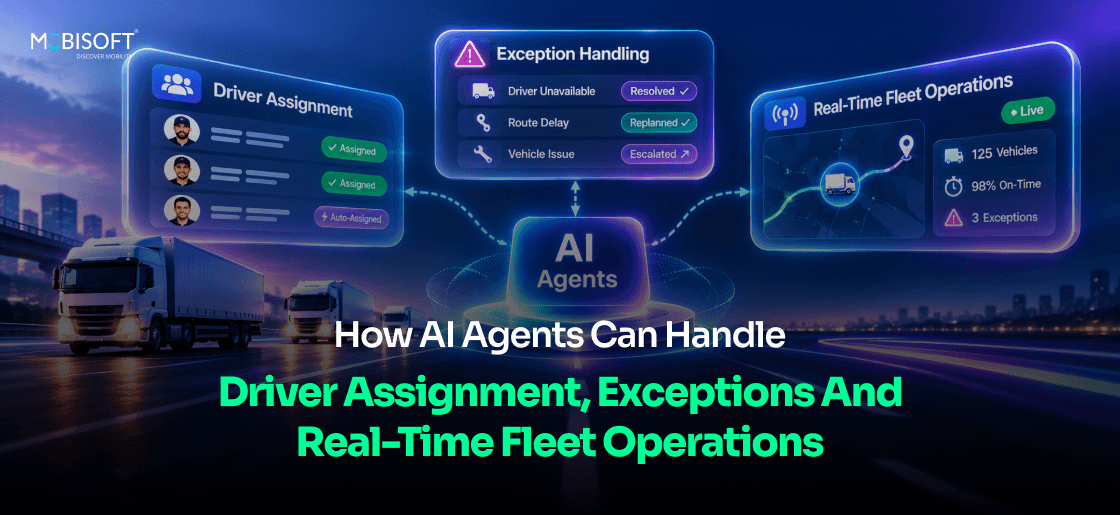
Many fleet operators already run a TMS, a routing engine, and live telematics. What they often lack is a way to act on all three the moment a plan breaks. A breakdown, a sick call, and a road closure can land within ten minutes of each other. Each one needs a different response. AI agents in logistics fill that role. They detect each exception and weigh options against cost, service, and driving hours. Then they act within limits the operations team sets.
The harder design work is not the model itself. Teams have to agree which actions an agent may take alone and which need a controller. Every action also has to be recorded in the TMS first, so controllers can see it and override it. Our AI agent development services start with those two decisions, then build the solvers, language models, and integrations around them. Get both right, and most technology choices that follow become simpler.
What Are AI Agents in Fleet Management?
An AI agent in fleet management watches the live state of a fleet. It decides what to do, then does it. It works within the limits the operations team sets. When a case falls outside those limits, it hands it to a person with a short brief.
How Agents Differ From Rule-Based Dispatch
Rule-based tools apply fixed logic to situations someone predicted. They're fast within that design. They fail when something new happens. Autonomous AI agents work from goals instead of fixed rules.
- Perceive: They combine telematics, traffic, job, and driver data into one live picture.
- Decide: They weigh options against several goals at once, including cost and compliance.
- Act: They update routes and message drivers without waiting in a queue.
- Escalate: They pass anything beyond their authority to a controller, with options ready.
- Learn: They compare outcomes with predictions and adjust future choices.
Agents rarely replace existing platforms. They sit on top of the TMS, telematics, and the driver app. Our fleet management software shows how that data layer can support agents from day one.
What Agents Should Not Decide
Human-in-the-loop AI agents leave the risky calls with people. Vehicle roadworthiness stays with humans. So do a driver's fitness for duty and any new, high-stakes case.
The law points the same way. UK GDPR rules on automated decisions changed on 5 February 2026, under the Data (Use and Access) Act 2025. Important decisions made only by automated systems now need safeguards. In the EU, the AI Act treats systems that assign work based on how individuals behave as high-risk. Those duties apply from 2 December 2027.
A Reality Check on the Hype
Agentic AI draws plenty of hype, and many projects fail. Gartner predicts more than 40 percent of these projects will be cancelled by the end of 2027. It points to rising costs, unclear value and weak risk controls. It also warns about "agent washing," where vendors relabel chatbots and basic automation as agents.
Fleet work is a better fit than most areas. Decisions are frequent and time-sensitive. Each outcome is measurable within hours. That makes agentic AI in logistics easier to test honestly than many office uses.
Why Manual Dispatch Struggles at Scale
Dispatchers aren't the problem. The structure of the job limits what any person can handle in real time.
Survey data shows the strain. In February 2026, Deep Current published a survey of 600 freight decision-makers across four regions. It found 83 percent say they work in reactive mode. Three in four make more than 50 operational decisions a day. Two-thirds use five or more systems to handle a single shipment end to end.
Four Structural Limits
- One problem at a time: A dispatcher handling a breakdown can't reroute around a closure in the same minute. The case that waits longest usually has the worst outcome.
- Local fixes: Under pressure, the nearest free driver gets the job. That fixes one problem but rarely gives the best result for the whole fleet.
- Fatigue: Late decisions in a long day get less care than early ones. Overnight teams feel this most.
- Knowledge in people's heads: One dispatcher may know which sites have tight access. When they're off sick, that knowledge goes with them.
Driver assignment shows these limits most clearly. Each change affects other routes, and changes happen dozens of times a day.
Agents address all four limits. They handle open cases at the same time and check the effect on the whole fleet. Their choices at 2 am match their choices at 9 am. Site notes and customer preferences live in the system. For a wider view of where AI fits in operations, see our artificial intelligence solutions.
Inside the Agent: Five Layers
A working agent is built in layers, each with one job. Good AI agent architecture keeps them separate, so teams can test and improve each layer alone.
Layer 1: Perception
This layer collects live data and cleans it. Typical inputs include the following.
- Telematics: Position, speed, fuel, and fault codes, often every 15 to 30 seconds.
- TMS data: Jobs, time windows, route plans, and delivery status.
- Driver app: Scans, status updates, and reported problems.
- External feeds: Live traffic, closures and weather.
- Compliance data: Tachograph records and remaining driving hours.
Volumes grow fast. A 500-vehicle fleet reporting every 30 seconds creates about 1.4 million position events a day. An event-driven architecture suits this load. The system publishes each change as an event, and other layers react to it.
Older systems often lack modern interfaces. Our guide to AI integration with legacy systems covers practical ways to connect them.
Layer 2: State Representation
This layer holds the fleet's digital twin. It's a live model of every vehicle, driver, job, and constraint. It also looks ahead, such as where each van will be in 30 minutes. Every decision reads from this model. If the model is wrong, every decision built on it suffers.
Layer 3: The Decision Engine
The decision engine has two jobs. Each one needs a different tool.
- Assignment optimisation: A large matching problem with a huge number of possible combinations. Mathematical solvers handle it far better than language models.
- Exception reasoning: A problem that depends on context and has competing goals. Large Language Models (LLMs) help here by weighing options and drafting messages.
"Why did the agent move six drops to Van 14?" A controller deserves a plain answer in seconds. The solver does the maths. The language model explains it.
Layer 4: Action Execution
This layer turns decisions into actions. It sends driver instructions and writes new ETAs to the TMS. It also notifies customers and raises alerts. Speed matters. A good decision that arrives 20 minutes late loses much of its value.
Layer 5: Learning
The learning layer compares predicted outcomes with real ones. It tracks journey times, delivery success, and how long each stop actually takes. Then it adjusts the models behind future decisions. Over months, the system builds up knowledge of site timings and customer habits.
How the Agents Work Together
Multi-agent systems split these jobs across specialists. One agent handles assignment. Another manages exceptions, and a third handles customer messages. They need a coordinator that decides which agent acts and when. Each agent also needs its own permissions, so it can only change the records it owns. Without a coordinator, two agents can change the same route at once.
Our guide to AI agent orchestration explains the main coordination patterns. We'd decide how agents coordinate before building any single agent, because changing it later means reworking every agent's permissions.
Open standards are also improving. Two protocols matter most for fleet teams. Anthropic's Model Context Protocol gives agents a standard way to reach tools and data. Google's Agent2Agent protocol lets agents talk to each other. Both now sit under the Linux Foundation's Agentic AI Foundation, which formed in December 2025. Agent2Agent joined in August 2026. In practice, an assignment agent built on one vendor's model can now call tools and agents built on another. That lowers the risk of being tied to one vendor. It also means the TMS connection you build for one agent can be reused by the next one you add.
How Do AI Agents Automate Driver Assignment?
This is the most frequent decision in fleet operations. A 200-vehicle fleet with 15 stops per vehicle has 3,000 stops to plan each day. Plans are built the night before, yet sickness, breakdowns, and late orders force many same-day changes.
The Optimisation Problem Behind It
Matching drivers and vehicles to timed stops is a vehicle routing problem with time windows. It's NP-hard, which means finding the perfect answer takes too long for a whole fleet. Agents combine three methods.
- Exact solvers: For small clusters and local re-planning.
- Heuristics: Large neighbourhood search and similar methods for fleet-wide plans.
- Learned estimates: Models trained on past journeys to predict real stop times.
Constraints the Agent Never Trades Away
Some rules never get traded for a lower cost. The agent removes any option that breaks them before it compares the rest.
- Driving hours: Remaining daily and weekly time under the assimilated drivers' hours rules.
- Licence categories: The right entitlement for each vehicle.
- Vehicle capability: Refrigeration, tail lifts and payload for each load.
- Hard time windows: Customer slots a plan can't miss.
This is where vehicle allocation and driver choice come together. A chilled pharmacy drop needs a refrigerated van and a trained driver. Both must be free at the right time.
A Worked Example: The Morning Wave
Here's a hypothetical case. At 05:40, a driver on a 22-stop route reports sick. Within seconds, the agent checks every option.
It finds two drivers with enough legal hours and the right licence. Splitting the route between them keeps 21 of 22 time windows. The last drop moves to an afternoon route, and that customer gets a new slot by email. The controller sees the plan in the TMS and approves it. The whole exchange takes minutes. Done by phone, it would take half an hour.
How Can AI Agents Handle Fleet Exceptions in Real Time?
Exceptions are events that push the fleet off its plan. Most fall into six types. For AI agents in logistics, the core design task is setting a clear response for each type.
Vehicle Breakdown
A broken-down van can't finish its remaining drops. The agent books recovery and spreads the stops across nearby vehicles. Then it tells affected customers and re-plans the area. A controller steps in for dangerous goods or high recovery costs.
Driver Hours Limit Approaching
This is where driver assignment and compliance overlap. The exception is highly predictable, yet manual teams often spot it late. The agent tracks remaining hours continuously. It flags any route that can't finish legally and moves the final stops. A person only gets involved when no compliant option exists.
Traffic Incident or Road Closure
Traffic causes the most frequent exceptions in urban delivery. Speed decides the outcome. A closure that goes unnoticed for 15 minutes can cause several missed time windows. The agent reroutes as soon as the event arrives. It escalates when many vehicles are hit at once.
Failed Delivery Attempt
Failed deliveries are common in last-mile work, though the figures vary with how each source defines failure. Parcel Monitor puts UK first-attempt success at 93.7 percent. InPost's consumer research, by contrast, found that one in three parcels fails at the first attempt. UK cost estimates for each failed attempt sit around £12 to £14. The agent can offer a new slot or redirect to a locker. Valuable items and claims go to a person.
Adverse Weather
Severe weather is rare but can upset a large share of the day's plan. It tests AI orchestration harder than any other exception. Routing, assignment, and customer agents all act at once, and their plans must agree. Safety comes before finishing the route here. We'd keep a human sign-off on any plan that sends drivers into severe conditions.
Driver No-Show
A missing driver at the start of the day causes major disruption. It usually comes to light just before the morning wave. The agent reshuffles routes using the same hard constraints as planning. A controller approves any booking of agency drivers above a set cost limit.
Integrating Agents With the TMS and FMS
Agents add a decision layer above existing systems. How that layer connects decides whether it helps the team or confuses it.
Keep the TMS as the System of Record
The Transportation Management System (TMS) holds the job list, assignments, and delivery status. It should stay the single source of truth.
The safe pattern runs in a fixed order. First, the agent reads current data and makes its decision. It writes that decision to the TMS. Only then does it message drivers and customers, based on what the TMS now shows. Controllers see every action in their usual screens and can override it there.
The risky pattern bypasses the TMS. An agent that messages drivers directly, or keeps its own records, creates two conflicting records. Controllers lose sight of changes. Compliance reports break, and manual overrides get overwritten.
Connect the FMS and Driver App Reliably
The Fleet Management System (FMS) supplies the agent's live view of vehicles. Its feed has to update often and keep working when connections drop. If positions stop arriving, the agent should know its data is out of date and act more cautiously.
The driver app is the main channel to drivers. A reassignment that arrives late is an operational failure, however good the decision. We'd track delivery receipts for every urgent message.
Practical API Integration
Most fleets run a mix of modern and older systems. A few principles keep the connections safe.
- Events over polling: Subscribe to changes where systems allow it. Poll only where they don't.
- Safe retries: Make every update safe to repeat, so a retry never creates a duplicate job.
- Checks on write-back: Check each change against TMS rules before saving it.
- Clear ownership: Decide which system wins when two disagree, and log each conflict.
Rolling Out Safely: From Recommendations to Supervised Autonomy
The most common mistake is giving autonomous AI agents full authority too early. We'd move through three stages.
- Stage 1, recommend: The agent suggests actions, and dispatchers approve or reject them. Four to eight weeks is a sensible starting range.
- Stage 2, supervised autonomy: The agent acts alone on low-risk decisions, such as routine reassignments. It escalates anything urgent or costly.
- Stage 3, bounded autonomy: The agent handles everything within its approved scope. People review only decisions beyond its limits.
Setting Authority Boundaries
Authority should depend on two things. One is the decision type, such as routine assignment or breakdown response. The other is how much is at stake, judged by cost, whether it can be undone, and regulatory impact.
A simple test helps. "Could we undo this within ten minutes without harm?" If so, the agent can usually act. If not, a person decides. Rejected recommendations from Stage 1 are the best evidence for setting these limits. That's how human-in-the-loop AI agents earn wider authority over time.
How Do AI Agents Improve Fleet Operations?
Where does the investment pay back? The gains usually show up in four measurable places. Fleets miss fewer time windows and respond to exceptions faster. They also cover shorter distances and make better use of driver hours. How much each one moves depends on your starting point.
Fuel matters more than usual right now. UK diesel passed £2 a litre for the first time in late September 2026, according to the RAC. Fuel Finder's UK average was 198.4p a litre in the week to 1 November. At those prices, each kilometre saved is worth more.
A Worked ROI Example
This model uses example assumptions for a UK regional distributor. It runs 180 vehicles and 2,700 deliveries a day, with 12 dispatchers covering 24 hours. Replace each assumption with your own figures.
| Benefit | Assumption | Annual value |
| Fuel | 7.1 million km a year at £0.25 per km, with 4 percent less distance | £71,300 |
| Dispatcher capacity | 3 of 12 roles redeployed over time at £38,000 fully loaded | £114,000 |
| Failed deliveries | 5 percent failure rate cut by 15 percent, at £12 per re-attempt | £53,500 |
| Overtime | 2 hours per driver weekly at £18, cut by 10 percent | £31,100 |
| Total annual benefit | £269,900 |
Year one assumes £463,000 for build, integration, training and infrastructure. After that, running costs are about £110,000 a year, covering infrastructure, model usage and support for the agentic AI layer. So year one is negative, and payback arrives in roughly 26 months. Three-year net present value at 10 percent comes to about £77,000.
Reading the Model Honestly
- Fuel sensitivity: Each 1 percent of distance saved is worth about £17,800 a year here.
- Dispatcher capacity: It becomes a cash saving only when staff leave naturally or move to other roles. Cutting roles before the team trusts the agent usually slows adoption.
- Scope: A narrower first phase lowers build cost. Exceptions and customer ETAs alone would bring payback forward.
- Exclusions: SLA penalties and savings from fewer temperature-damaged loads are left out. They vary too much by contract.
For most AI agents in logistics, a tight scope does the most to improve return. Start where exceptions cost the most, then widen.
How Mobisoft Infotech Builds AI Agents for Fleet Operations
Mobisoft Infotech's Logistics Technology practice builds AI fleet agents for operators, 3PLs, and parcel carriers. We also build for field service teams and transport technology companies, adding agents to their platforms.
Compliance is designed in from the start. Every decision with regulatory weight is logged with its data and alternatives. The log also records who approved it. That record matters when a DVSA examiner or a customer asks why something happened.
We build around each client's existing TMS and telematics platforms. We set authority boundaries together with operations teams. Controllers who trust the agent use it fully. That trust is what turns an agent into an everyday tool.
Start With the Exception That Costs You Most
The value of AI agents in logistics comes from speed and consistency on decisions your team already makes. Replacing that team isn't the goal. The safest way to prove the value is narrow and measurable.
Three steps can start this month.
- Log every exception for 30 days by type, response time, and outcome.
- Pick the most expensive type. Write down which responses an agent may take alone, take with notice, or must escalate.
- Confirm the agent can write each decision back to the TMS before it messages anyone.
Run the agent in recommendation mode on that one type first. Compare its choices with your dispatchers' choices for a month. Where the two differ, the reasons will reveal more about your operation than any vendor demo. That evidence should decide how far, and how fast, its authority grows. Widen the scope only when the agent's record on the first type is clear.

Frequently Asked Questions
How does Mobisoft Infotech keep our controllers in charge?
We'll set authority boundaries with your operations team, decision by decision. Every action is written to the TMS first, whatever AI agent architecture sits beneath it. Controllers see it, and can override it in their usual screens. Trust grows because they're never working around the agent.
Do we need to replace our TMS or telematics?
No. Agents sit on top of the systems you already run, so nothing gets thrown away. The TMS stays the system of record, and controllers override from their usual screens. That's how AI agents in logistics fit in without a rebuild.
Which decisions should we never leave to an agent?
Vehicle roadworthiness and a driver's fitness for duty stay with people. So does any new, high-stakes case, and UK GDPR requires safeguards for significant automated decisions. Good human-in-the-loop AI agents don't guess at these. They hand over a short brief.
Where should we start with an agent?
Log every exception for 30 days, then pick the costliest type, such as breakdowns. Run the agent there in recommendation mode first, so nothing acts alone. Compare its choices with your dispatchers' for a month. That's what keeps agentic AI in logistics measurable.
Does Mobisoft Infotech build agents for fleets like ours?
Our Logistics Technology practice serves operators and parcel carriers. 3PLs and field service teams use it too. Transport technology companies often add agents to their own platforms. We'll build around your existing TMS and telematics, so nothing gets replaced.
What happens if our driver calls in sick right before leaving?
Within seconds, the agent checks every option. Say two drivers have enough legal hours and the right licence. Splitting the route between them keeps 21 of the 22 customer time windows intact. The controller approves it in the TMS, so driver assignment takes minutes.
How long until an agent pays for itself in our fleet?
It depends on scope. In one example model, a 180-vehicle fleet with a £463,000 build reached payback in about 26 months. A narrower first phase pulls that forward. Replace each assumption with your own figures before relying on it.
This content is for informational purposes only and may include AI-assisted research or content generation. While we strive for accuracy, information may evolve over time. Readers are advised to independently verify critical information before making decisions.

Nitin Lahoti
Read more
Nitin Lahoti is the Co-Founder and Director at Mobisoft Infotech. He has 15 years of experience in Design, Business Development and Startups. His expertise is in Product Ideation, UX/UI design, Startup consulting and mentoring. He prefers business readings and loves traveling.
 Nitin Lahoti
 November 19, 2026