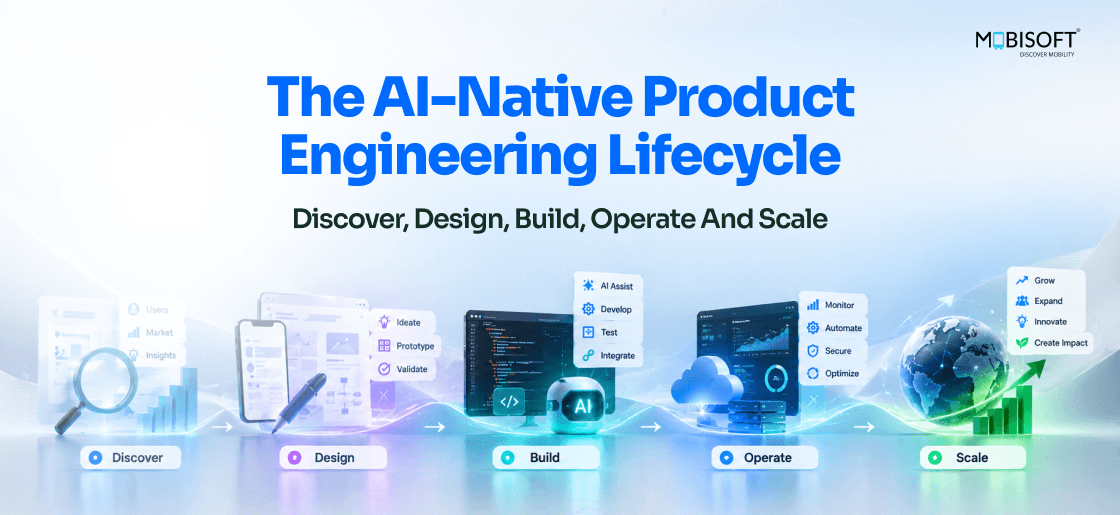
Most engineering leaders approving an AI initiative this year are not asking whether AI belongs on the roadmap. They are asking why last year's AI feature worked fine at launch, then slowly stopped working. That question has a direct answer, and the answer is AI-native product engineering. It is a different discipline from bolting a model onto an existing product.
The difference sounds subtle until a team lives through it. A product built AI-assisted treats the model as an add-on. Data, architecture, and quality gates get designed for traditional software first. A product built AI-native treats the model as the core of the value proposition from day one. Data architecture and operational discipline get built around it instead. This guide walks through the five-phase lifecycle that separates the two. Each phase gets covered with the decisions a CTO needs to own directly.
Why AI-Native Is a Different Discipline, Not a Feature Add-On
Getting this distinction right sets up every later decision in AI software development for the product. The term AI-native gets used loosely enough that it has lost precision in most planning conversations. That imprecision costs real money. The lifecycle, team, and architecture an AI-native product needs differ sharply from an AI-assisted one. Using the wrong lifecycle for the wrong category is a common cause of AI product failure.
Three Categories, Three Different Engineering Disciplines
An AI-enhanced product adds AI features to something that already works fine. An AI-assisted product uses AI to meaningfully speed up a core workflow. The product still functions if AI quality dips. An AI-native product cannot fulfil its core purpose without AI at all. That single fact changes everything downstream of it.
- Architecture origin: AI-enhanced bolts AI on as a layer; AI-native development designs the architecture around the model from day one
- Failure mode: an AI-enhanced product degrades gracefully; in an AI-native product, AI failure is product failure
- Quality model: AI-enhanced treats AI quality as one metric among many; AI-native treats it as the primary measure of health
- Team requirement: AI-enhanced needs AI consulting support; AI-native software engineering needs a dedicated AI engineering role from the start
The Mindset Changes That Undermine Teams That Skip Them
Teams moving from traditional product engineering to a genuinely different discipline often skip a few mindset changes without realizing it. Old habits then work against AI product quality at nearly every turn. Quality no longer means the software matches a specification. It means the AI does what users need well. That change is the whole premise of AI product engineering as a distinct field.
- A specification once defined exact behavior for every input; an AI capability behaves probabilistically instead
- Post-launch improvement used to mean fixing bugs; in AI products it means addressing score decay, model drift, and knowledge staleness
- Data used to be an asset that mattered only for features touching it; now data quality equals AI quality directly
- Testing used to be a phase completed before launch; evaluation is now continuous, since behavior keeps changing after ship
The Three Product Categories Worth Distinguishing Early
Before walking through the lifecycle itself, it helps to separate AI-native from two categories it often gets confused with. Getting this label wrong early tends to produce a mismatched team and a mismatched budget six months in.
AI-Enhanced: A Useful Layer, Not the Core Product
An AI-enhanced product adds AI features to something that already worked without them. Naming this decision explicitly is a routine part of AI product strategy work. A CRM with AI-drafted email templates is a common example. It is useful, but not the reason customers buy the product. The failure mode here is mild. If the AI feature breaks, the core product still functions, and users mostly shrug and move on.
AI-Assisted: A Meaningful Speed Gain With a Fallback
An AI-assisted product sits in the middle. A code editor with AI completion speeds up a developer's workflow meaningfully. Losing that feature would genuinely hurt the experience. But the editor still works as an editor without it. The team needs real AI engineering skill here, though not necessarily a dedicated AI organization.
AI-Native: No Fallback, No Shortcut on Rigor
An AI-native product has no fallback. A search product built around an AI answer engine cannot degrade to a non-AI version and still deliver its value. Neither can a legal research tool built around AI-native document analysis. This is the category where the full five-phase lifecycle of AI-native software development earns its cost. Applying that same rigor to an AI-enhanced feature would be overkill. Skipping it for an AI-native product is how teams end up rebuilding six months after launch.
Discover: Where AI Creates Value Worth Building
Traditional product discovery asks what users need that does not exist yet. AI product discovery asks something different. Where does AI create capability that is technically feasible, defensible, and measurable? Getting this question wrong early costs far more than getting it wrong in code later.
The Opportunity Signals Worth Checking First
Not every user problem benefits from an AI solution. Treating AI as a default tool for every feature adds complexity without matching benefit. A useful opportunity map separates problems where AI holds a real advantage from problems better solved with deterministic logic.
- High input variability, where users express the same need in many phrasings that would need an enormous rule set
- Heavy context sensitivity, where the right answer depends on context that keeps changing, not a small fixed set of conditions
- A genuine synthesis requirement, where a human expert would need to read and connect information rather than just retrieve it
- An existing feedback loop, where user behavior already generates signal on output quality that can improve the system over time
Three Technical Gates Before Anyone Commits Engineering Time
This is one of the more consequential checkpoints in AI product discovery work. An opportunity that clears the mapping exercise still needs to pass three feasibility gates. Skipping these gates leads to an expensive discovery further down the line. The AI capability cannot hit acceptable quality, for reasons nobody checked early.
Data Readiness
The first gate asks whether the data this capability needs is available, accessible, and good enough. That covers training data, a retrieval corpus, tool access data, and user context data. Each type gets checked for volume and recency, not just existence.
Quality Measurability
The second gate asks whether "good" can even be defined and measured for this output. If domain experts regularly disagree on what counts as correct, quality is effectively unmeasurable at scale. That ambiguity will surface later as an unshippable feature. It is a common trap in early AI product development planning.
Latency and Cost Tolerance
The third gate checks whether the AI approach meets the latency ceiling the use case demands. It also checks whether inference cost fits what the business model can absorb. A conversational interface needs sub-two-second responses; a research task can tolerate fifteen. Cost that cannot be optimized down at volume kills a use case as surely as a quality miss.
The Business Case Looks Different From a Traditional Feature
AI product development carries a financial model traditional software does not. Inference cost scales with usage instead of approaching zero at the margin. A traditional feature costs engineering time upfront and modest maintenance after launch. An AI capability adds evaluation build, ongoing quality engineering, and inference costs that grow with adoption.
This matters for how a CTO frames the case to finance. Revenue in an AI-native product ties directly to AI quality. Users churn fast when quality degrades in a way they notice. The business case needs to model quality-to-retention correlation explicitly, which is a routine expectation in mature AI product development budgeting. Quality investment belongs in the model as revenue protection, not a line item to trim.
Organizations without deep in-house depth across every phase often look for a partner who has run this lifecycle before. Such an AI solution provider engages across Discover through Scale rather than handing off a design document and disappearing after Build. That partnership means applying the opportunity mapping framework first. The three feasibility gates run before any engineering budget gets committed.

Design: The Decisions That Are Hard to Reverse Later
The Design phase sets the architectural choices that determine cost, quality, and scalability for the product's life. These choices are harder to undo than typical architecture decisions. They touch the evaluation framework, the data pipeline, and operational discipline all at once.
Choosing an AI Approach Per Capability
The first and most consequential design decision is which AI approach fits each capability. Direct generation, retrieval-augmented generation, fine-tuning, and agents are not interchangeable. Picking the wrong one for a task is one of the costliest mistakes in AI-Native Software Development.
- Direct generation suits tasks where the model's own knowledge is sufficient and facts do not change often
- Retrieval-augmented generation suits knowledge living outside the model's training data, like internal documentation or policies that change over time
- Fine-tuning suits strong domain-specific style or format needs where prompt engineering alone cannot reach the required consistency
- Agents suit multi-step tasks requiring tool access and sequencing, but carry the highest cost and the widest failure surface
Deciding Where Human Judgment Stays in the Loop
One design decision often gets discovered through a production incident rather than made deliberately. Where does a human need to stay involved? Getting this wrong in either direction creates real risk. Too much human review slows the product down; too little turns a bad output into an unrecoverable one.
- Human-in-the-loop approval fits high-stakes, irreversible actions, where the product needs a review interface and the key metric is time-to-review
- Human-on-the-loop monitoring fits moderate-stakes repetitive actions, using a dashboard rather than approving every step; common in AI-Native Software Development
- Human-in-the-training-loop feedback capture fits stable processes where errors are visible, treating corrections as the primary quality signal
- Fully autonomous operation fits only low-stakes, high-volume tasks, and needs the strongest automated guardrails since no human catches individual failures
Getting the Human Involvement Level Wrong in Either Direction
Teams new to this decision tend to default to one extreme, and both defaults create real problems. Full human review on everything feels safe. It slowly turns the AI capability into a bottleneck, since every output waits in a queue. Full autonomy feels efficient instead. It removes the safety margin that would catch a bad output before it reaches a customer.
The right level should map to the actual cost of an error. It should not map to how nervous the team feels about the technology. A capability drafting internal meeting notes can run with far less oversight than one approving a loan. Mapping this out capability by capability avoids both failure modes. A single policy for the whole product usually cannot. Mobisoft's AI native digital product engineering outsourcing practice works through this mapping alongside internal teams rather than handing over a template.
Designing Data to Power AI, Not Just Store It
AI-native development lifecycle planning treats data architecture as a structural decision, not something layered on afterward. Four distinct data layers need different freshness guarantees and different design treatment.
- Inference data needs millisecond freshness: user queries, tool call results, and session context passed to the model at query time
- Retrieval data needs near-real-time freshness: the document corpus, refreshed on an event basis as source documents change
- Training and fine-tuning data runs on a batch cadence: labeled examples, user corrections, and an evaluation dataset that keeps expanding
- Feedback data closes the loop: implicit engagement signals, explicit corrections, and outcome signals tied to whether the user's task succeeded
This is the mechanism behind what most teams call the data flywheel. Product usage generates feedback. Feedback becomes training data. Training data improves the model, and a better model brings in more usage. Each turn builds an advantage that is genuinely hard for a competitor to replicate without the same volume of feedback. Designing for this loop is a defining trait of AI-native development lifecycle thinking.
Specifying Quality Before Any Code Gets Written
The evaluation framework belongs in the Design phase, not bolted on after the application exists. Teams that design evaluation after building the product end up with quality standards built around what they happened to make. Those standards rarely reflect what users need most.
- Define three to five quality dimensions specific to the capability, like accuracy, helpfulness, and completeness, rather than borrowing generic ones
- Set a minimum quality threshold below which the product should not launch; treat it as the first production gate
- Design the evaluation dataset to include happy path, edge cases, and adversarial inputs, not just cases the team already expects
- Choose an evaluation method for the AI-native development lifecycle: an automated judge, a human calibration protocol, or implicit signals
In Design, the same partnership model means selecting the right AI approach per capability. It does not default to whatever pattern the team used last time. Teams building the application layer separately from the AI capability itself sometimes need both pieces staffed together. Mobisoft's custom software development services keep those two efforts moving in step, rather than drifting apart over a long build.
From Mobisoft's Lifecycle Partnership to a Shipped Product
A prototype that fails a feasibility gate early saves months of wasted Build-phase work later. Organizations weighing their AI maturity at a company-wide level often want this broader context before scoping any single build. The evaluation framework gets specified before a single line of code exists. Quality thresholds get written down rather than left as a vague intention.
Why Coordination Between the Two Sides Matters
This pairing matters more than it might seem at first glance. It is a recurring theme across real AI application development engagements. An application layer built without close coordination with the AI capability tends to accumulate integration debt fast. The two sides evolve on different timelines, with different assumptions about what the other one will deliver. Catching that mismatch early is far cheaper than untangling it once both halves are deep into their own sprint cadence.
Shortening Design With Prior Lifecycle Experience
For organizations comparing candidate use cases before settling on one, lifecycle experience matters more than most teams expect going in. A service provider who has run this before tends to shorten Design considerably. The tradeoffs between approaches become familiar territory instead of a fresh debate. The questions worth asking have already been asked elsewhere.
Once a product is live, Operate-phase quality engineering continues as an ongoing service, not a one-time handoff at launch. Monthly reporting tracks progress against the thresholds set back in Design. Drift gets caught before it reaches a support ticket this way.
Organizations planning this work across a wider portfolio, not just one product, often want a broader reference point first. Mobisoft's enterprise AI planning guide covers how that sequencing tends to play out across several initiatives at once.
Build: Engineering Practices Traditional Teams Skip
The Build phase for AI application development includes practices that simply do not exist in traditional product development. Teams unfamiliar with AI engineering tend to skip exactly the ones that prevent common production failures.
Building Evaluation and Code in Parallel, Not in Sequence
The most consequential Build phase decision is whether evaluation gets built alongside the application or added after. Teams that defer evaluation almost always end up with a weaker dataset, since domain knowledge is freshest early. They also discover quality problems in production that a parallel build would have caught in development.
This kind of parallel discipline is a hallmark of serious AI application development. A workable rhythm assigns an evaluation deliverable to every sprint. Sprint one defines the evaluation structure and collects the first batch of test cases from domain experts. The application team builds the integration layer in parallel. Later sprints add adversarial cases as tool integrations expand. Regression cases follow, drawn from the previous sprint's failures. By the final sprint before launch, the suite has accumulated real coverage. It is not a rushed benchmark assembled in the last week.
Treating Prompt Engineering as a Real Engineering Discipline
Prompt engineering sets model behavior directly, which means prompt quality is product quality. A poorly engineered prompt produces a weak product even paired with a strong model. AI-assisted software development teams that treat prompts as throwaway text pay for that choice in production.
- Version every prompt in source control alongside application code, using semantic versioning that separates structural changes from wording refinements
- Attach an evaluation score to every prompt version, and block deployment whenever that score shows a regression
- Keep a rollback path so any prompt version can go live again within minutes
- Place critical safety instructions at both the start and end of the system prompt; models attend more there
- Mark retrieved content explicitly as data rather than instructions, so the model never follows directions embedded in a search result
What a Production Readiness Checklist Really Covers
This checklist is where AI-Native Software Development either proves itself or exposes missing groundwork. Most teams building their first AI-native product underestimate how many items belong on the pre-launch checklist. A realistic list runs well past the standard "does it work" question that traditional launches lean on.
- Tool selection accuracy benchmarked against a representative test set, not just the happy path cases the team wrote first
- Guardrail false positive rate measured against real traffic samples, not synthetic inputs the team already expects to pass
- Prompt injection defenses tested against known attack patterns, with retrieved content explicitly marked as data rather than instructions
- A rollback path confirmed to work in minutes, tested for real, common in mature AI-assisted software development teams
- An incident response plan with a named owner, not a document nobody has rehearsed against a simulated incident
Skipping items on this list to hit a launch date rarely saves the time it appears to save. Most of what gets skipped resurfaces within the first month in production. A planned review would have caught it at a better time.
Running a Sprint Rhythm Built for AI Work
Standard agile ceremonies were not built with evaluation in mind. Teams that skip AI-specific adaptations end up assessing quality only right before launch. A few additions close that shortfall without overhauling the whole process.
- An evaluation review, held weekly at minimum, reviewing score trends as part of routine AI application development practice
- A prompt retrospective after any significant prompt change, comparing quality scores before and after and updating a shared playbook
- A monthly model performance check that reviews provider update notes and reruns the evaluation suite against new model versions
- A definition of done that includes an evaluation score, not just functional completion alone
Operate: Keeping an AI Product Good After Launch
Operate is where AI-native products diverge most sharply from traditional software. In a conventional product, operating well means infrastructure reliability and support. In an AI-native product, it also means a continuous quality engineering discipline that never really stops. AI products degrade even when nothing technically breaks.
Four Operational Disciplines With No Traditional Equivalent
AI application monitoring for an AI product needs to watch things a traditional dashboard was never built to catch. A service can be technically functioning, with zero errors logged. It can still produce outputs users have stopped trusting without warning.
- AI quality monitoring runs continuous evaluation on production outputs, using an automated judge alongside implicit signals like corrections
- Model performance management tracks behavior changes after a provider updates a model, since one update can change format and cost
- Knowledge and data freshness monitoring watches whether the retrieval corpus has gone stale as source documents age
- Inference cost management tracks cost per feature and flags regressions early, since AI costs scale directly with usage
Understanding Why Good AI Products Go Bad
Quality degrades through several distinct mechanisms, and each needs a different warning signal and a different fix. This is one of the sharpest differences from traditional AI-assisted software development work, where degradation is rarer. Teams that do not understand which mechanism is at play tend to apply the wrong fix. That costs a sprint.
- Model drift happens when a provider updates the model, sometimes without notice; the fix is a fresh benchmark run first
- Knowledge staleness happens when the retrieval corpus falls behind reality; the fix is scheduled re-indexing with freshness metadata built in
- Distribution drift happens when user behavior changes and real queries drift from what the evaluation set covers
- Adversarial accumulation happens as a product grows; the fix is expanding guardrail patterns and the adversarial test set
Classifying an AI Incident Correctly
An AI quality incident is a new category traditional incident response playbooks were never written for. The product can stay up and respond normally while producing outputs that are wrong, biased, or unacceptable. That makes detection and scoping genuinely harder than a standard outage. This is exactly why AI application monitoring needs its own playbook.
- A systematic harmful output incident demands disabling the affected capability within thirty minutes, without waiting to diagnose the cause
- A quality regression, where the automated score drops fifteen percent in a day, needs root cause work within two hours
- A slower drift, trending down over a week, gets a planned response with root cause work within roughly two weeks
- A cost anomaly, where inference cost exceeds one and a half times baseline, needs a fix shipped within two weeks
Scale: Growing Without Breaking Quality
Scaling an AI-native product means evolving the architecture, the team, the data pipelines, and the governance model together. It is not just adding infrastructure capacity, which is a common blind spot in AI application monitoring at scale. Products that scale servers without scaling these other dimensions see quality erode as usage grows.
How the Architecture Needs to Evolve With Volume
Early on, a single model behind a simple abstraction layer is the right starting point. Basic retrieval gets added if needed. As usage and capability count grow, model routing by task complexity and semantic caching become necessary to control costs. At meaningful scale, agent orchestration across business systems starts solving problems a simple chat-and-retrieval setup genuinely cannot.
At platform scale, with a large and growing user base, the architecture typically moves again toward multi-tenant design. Per-tenant fine-tuning and usage-based cost attribution become standard at this stage. Each stage carries a distinct risk of its own. Unmonitored inference cost shows up early. Prompt management chaos appears in the middle stages. Agent security becomes the concern once the product supports enterprise customers.
How the Team Needs to Evolve Alongside It
AI-native engineering lifecycle planning for team structure follows a similar arc. Early teams stay small and generalist, with every engineer sharing ownership of AI quality. As the product scales, quality work becomes specialized enough to need a dedicated platform team. That team provides infrastructure to product teams focused on user-facing capabilities.
At the largest scale, a center of excellence sets standards and owns the evaluation framework and model strategy. It also provides governance for enterprise customers. Individual product teams keep ownership of their specific capabilities under that guidance. Skipping straight to heavy governance before the team has the scale to justify it usually slows a small team down.
What Enterprise Customers Add to the Scale Equation
Once an AI-native product reaches enterprise customers, a new set of pressures shows up. This is where AI-native engineering lifecycle planning earns its keep. A consumer-facing product rarely deals with these early. Enterprise buyers want customization, which pulls the architecture toward per-tenant configuration. They also want isolation guarantees, which pulls it toward stricter multi-tenant security boundaries than a self-serve product typically needs.
That tension between customization and standardization is worth naming during Scale planning. It touches both the architecture and the team structure behind it. A platform team built purely for standardization struggles to serve enterprise requests quickly. A team built purely for customization struggles to keep a coherent core product as contracts grow.
The Data Flywheel Builds Slowly, Then Quickly
At early scale, the data flywheel turns slowly. Feedback volume is low, and improvements arrive incrementally. At meaningful scale, it builds real momentum. The product has already seen enough edge cases to handle them well. The evaluation dataset covers a much fuller slice of the real input distribution than it did at launch.
- Feedback capture needs active design, not just click tracking, through interfaces that produce structured signal for AI-native engineering lifecycle work
- A systematic data labeling operation converts raw feedback into training examples; this is domain-specialist work worth building early
- A regular fine-tuning cadence, monthly or quarterly, should produce a measurable benchmark improvement each cycle the team can track
Picking a Toolchain Without Overthinking It
The tooling question comes up early in most planning conversations, often before the harder architectural questions get settled. A reasonable toolchain matters less than getting the sequencing right. Still, a few choices are worth making deliberately, rather than defaulting to whatever a blog post recommended last.
Integration and Orchestration Layer
A provider-agnostic integration layer belongs at the base of the stack, regardless of which library a team picks. This keeps switching costs low if a provider's pricing changes later. For orchestration, a framework built for complex, stateful workflows suits teams building genuine multi-step agent behavior. This pattern shows up often once the lifecycle reaches real scale. A simpler role-based framework suits teams that need less flexibility and want to move faster early.
Evaluation and Observability Tooling
Evaluation tooling splits naturally into prompt-level and pipeline-level concerns. Both sit at the center of any serious AI-native software development lifecycle. A dedicated prompt evaluation tool handles the former well. Retrieval-specific evaluation tooling handles the RAG pipeline case. Generic frameworks tend to miss failure modes like poor chunking or stale indexing. For observability, a vendor-agnostic standard for traces avoids getting locked into one platform's proprietary format. That matters more than it seems once a team outgrows its first AI application monitoring setup.
Security Testing Tools
AI-specific security testing needs tools beyond a standard web application scanner. A dedicated AI red-teaming framework covers a wider range of injection patterns than most teams could realistically build themselves. Pairing it with a custom test suite for domain-specific scenarios closes what a generic tool leaves open on its own.
Team Competencies Worth Planning For
Several competencies AI-native software development lifecycle work requires are simply not part of a traditional engineering career path. That makes hiring and internal development planning matter more than usual.
What a Team Can Develop In-House vs. What Needs a Dedicated Hire
LLM integration engineering is one that most experienced backend engineers can develop within a few months. It is not typically a standalone hire. Evaluation and benchmark design is only partially developable internally, since ground truth work often needs genuine domain expertise. A contract domain expert can often supply that piece. Prompt engineering is learnable by most engineers, and even product managers, at a basic level. Advanced work for complex capabilities still takes real practice.
Agent and orchestration engineering becomes critical once a team reaches multi-agent workflows. Most teams hit this stage partway through a full AI-native software development lifecycle. It is expensive to develop from scratch under timeline pressure, making it a strong candidate for a dedicated hire. AI security engineering becomes critical for any customer-facing capability. Security engineers can extend their toolkit to cover it, but AI-specific threats genuinely require focused study of their own.
Why AI Product Management Deserves Its Own Hiring Plan
AI product management deserves separate mention, since it gets overlooked more often than the engineering roles. Defining AI success metrics differs meaningfully from defining traditional feature metrics. A PM used to shipping deterministic features often struggles to communicate AI uncertainty to stakeholders expecting a fixed answer. An experienced product manager can develop this intuition over time. It matters across the full AI-native software development lifecycle, not just at launch. A track record of shipped AI products is a genuinely high-signal hire when budget allows.
A useful rule of thumb: hire ahead for competencies with a long ramp-up time, like agent engineering and AI security. Develop internally for competencies most engineers pick up quickly, like basic prompt work. Getting this backward tends to leave the most expensive hire underused for months. A dedicated prompt engineer hired before any agent experience exists is a common example.
Governance and the EU AI Act Across the Lifecycle
AI product governance is not a separate function bolted onto the end of a project. It belongs in every phase: opportunity assessment in Discover, human-in-the-loop decisions in Design, and security controls in Build. Ongoing oversight covers Operate and Scale.
What the EU AI Act Requires by Lifecycle Phase
Regulatory obligations layer onto every stage of the AI-native software development lifecycle too. The EU AI Act, with full enforcement beginning in August 2026, creates obligations that apply differently by lifecycle phase. Risk classification applies to any system affecting EU persons, regardless of where the deployer is based. That classification belongs in Discover, before building even starts. High-risk system obligations, covering domains like credit, employment, and healthcare, span Design through Operate. They require documented system purpose, human oversight, and audit logging.
Organizations that fine-tune general-purpose models carry transparency obligations beginning at Build and continuing through Operate. These include documenting training data sources clearly. Building these checks into the existing lifecycle is meaningfully cheaper than treating compliance as a separate exercise. Retrofitting it once a regulator asks questions costs far more.
A Realistic Path From Discovery to Scale
Most CTOs already have a rough intuition for what AI can and cannot do well. The harder problem is usually sequencing the lifecycle correctly. Each phase should inform the next one, not happen in isolation.
What Each Phase Should Produce Before the Next One Starts
This sequencing is what separates a well-run AI-native software development lifecycle from one that stalls halfway through. Discover should produce a scored opportunity map and an honest cost model. A green light alone is not enough. Design should produce a chosen AI approach per capability and an explicit human-in-the-loop decision. A written evaluation framework with a minimum threshold belongs on paper before Build starts. Build should treat the evaluation dataset as a sprint deliverable, with the same seriousness as application code.
Operate should have AI application monitoring running across all four operational disciplines before real traffic arrives. Retrofitting it after the first quality complaint costs more and teaches less. Scale decisions, from architecture evolution to team specialization, should follow observed volume and risk. They should not chase anticipated volume that may never materialize.
The Cost of Skipping or Compressing a Phase
Teams that skip a phase, or compress it early, tend to pay for it later at a much higher cost. This is where a well-sequenced AI-native SDLC earns back its upfront time investment. A rushed Discover phase produces a Design phase built on the wrong assumptions. A rushed Design phase produces a Build phase with no clear quality bar to aim for. Sequencing well the first time is consistently cheaper than fixing it after launch.
Discipline Decides What Lasts
Reliability comes from treating each lifecycle phase as a genuine engineering discipline, not a checklist item. Discover decides whether an opportunity deserves engineering investment at all. Design makes the architectural choices that are hardest to reverse later. Build turns those choices into a working product with evaluation built in from the start. This is what serious AI-Native Product Engineering looks like in practice.
None of this requires waiting for a better model or a more mature toolchain. The distance between a demo that works and a product that holds up is a discipline problem. Closing it means designing evaluation before writing application code. It means building quality monitoring before real traffic arrives, not after the first complaint reaches support.
Start with one well-scoped capability and run the full lifecycle honestly. Apply the same discipline as the product scales into more capabilities and more users. That discipline decides whether an AI product still works a year after launch. It matters more than any single tool or model choice made along the way.

Frequently Asked Questions
How long does the Discover phase typically take before a team starts building?
Discover usually runs three to five weeks when done properly. That covers opportunity mapping, the three feasibility gates, and a business case with an honest cost model. Compressing this phase to save time is a common cause of an expensive rebuild later. Problems caught here are far cheaper to fix than problems caught after Build.
How does a team know when an AI capability is ready to launch?
Readiness means clearing the minimum quality threshold defined during Design, measured on a representative benchmark. It also means a completed security review and a working incident response plan. A capability that has not cleared its documented threshold should not launch, no matter how impressive the demo looked.
What causes an AI product to degrade after a successful launch?
Degradation usually traces back to a few mechanisms. The model provider updates the model, the knowledge base goes stale, or user behavior drifts. Adversarial inputs can also accumulate as the product grows. None of these show up as a traditional error, which is exactly why AI application monitoring needs to be purpose-built.
When does a team need a dedicated AI platform team instead of embedded AI engineers?
A dedicated platform team typically becomes necessary once a product reaches fifteen to fifty engineers. Ten or more AI capabilities is usually the second signal. At that point, centralizing infrastructure saves more time than it costs in coordination. Below that scale, embedded AI engineers within product teams usually work better.
How should a team think about vendor lock-in when choosing an AI approach?
A provider-agnostic integration layer keeps the option open to switch models as pricing and quality change. Calling one provider's API directly throughout the codebase closes off that option. This matters most in the Scale phase, when switching costs are highest. Planning for this in AI-Native Development from Build onward is considerably cheaper than retrofitting it later.
This content is for informational purposes only and may include AI-assisted research or content generation. While we strive for accuracy, information may evolve over time. Readers are advised to independently verify critical information before making decisions.

Nitin Lahoti
Read more
Nitin Lahoti is the Co-Founder and Director at Mobisoft Infotech. He has 15 years of experience in Design, Business Development and Startups. His expertise is in Product Ideation, UX/UI design, Startup consulting and mentoring. He prefers business readings and loves traveling.
 Nitin Lahoti
 September 22, 2026