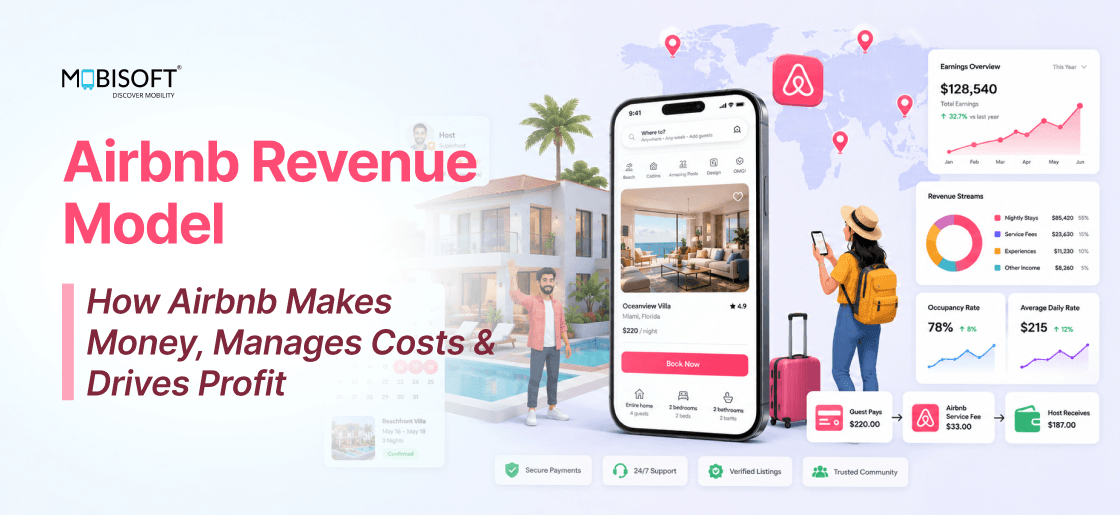
Airbnb does not own any real estate. Yet it books more stays than the world's largest hotel chains combined. Understanding the Airbnb revenue model means understanding value creation. It shows how a company profits from assets it never owns. This piece breaks down Airbnb revenue streams in detail. It also covers Airbnb's cost structure and the Airbnb profit strategy.
Airbnb's 2024 results tell a clear growth story. The company generated over $11.1 billion in revenue. That figure grew 12% from the prior year. Full year net income landed near $2.6 billion. Gross booking value reached almost $82 billion. Airbnb processed this volume across a global network of more than 5 million hosts. These numbers make Airbnb a clear example. A platform business model can work at real scale.
This is not only a finance story. It is also a lesson in Airbnb business strategy. It shows how trust, pricing, and cost discipline combine to build a lasting company.
What Airbnb Is: The Business Model in Plain English
Airbnb runs on a marketplace business model built around two groups. It connects guests with the hosts who have a space to rent. Airbnb builds the platform, the trust systems, and the payment tools. These tools make the exchange work between strangers.
The Airbnb business model was not the first accommodation marketplace. Other options existed long before Airbnb launched. What set Airbnb apart were specific design choices built for scale. The review system creates mutual accountability. The host guarantee lowers the risk of property damage. Guest verification reduces safety concerns. A pricing algorithm helps hosts earn more without hospitality training.
These are not simple product features. Together, they form the trust infrastructure that makes the marketplace function. Without this system, Airbnb would resemble a classified ad site. With it, Airbnb became a $75 billion company.
Airbnb did not win by undercutting hotel prices. Budget accommodation already existed before Airbnb arrived. It won by building trust instead. That trust made a better product accessible to nervous travelers. A private home in a real neighborhood suddenly felt safe to book.
Airbnb's Nine Blocks
Breaking Airbnb down through a standard business model canvas helps here. It clarifies how each piece supports the next one.
- Customer segments include hosts, ranging from individuals with a spare room to full-time property managers. Guests include leisure travelers, business travelers, and families booking longer stays.
- Value propositions for hosts include extra income and global reach. For guests, value comes from unique stays, group pricing, and access to real neighborhoods.
- Channels include the mobile apps, organic and paid search, social sharing, and host referral programs.
- Customer relationships rely on self-service tools backed by trust signals. Reviews and Superhost status carry most of this weight.
- Revenue streams include guest and host service fees, Experiences commissions, and business travel services.
- Key resources include the platform technology, the trust and safety systems, and the global host network itself.
- Key activities include platform development, host and guest acquisition, and regulatory navigation across cities.
- Key partnerships include payment processors, insurance carriers, and cleaning service networks.
- Cost structure leans heavily on technology, marketing, and support. Physical assets play almost no role here.
Why Airbnb Is Hard to Displace?
Airbnb's edge comes from cross-side network effects. More hosts attract more guests through better choice and pricing. More guests attract more hosts through stronger earnings potential. This cycle eventually reaches critical mass in a given city. From there, the advantage compounds steadily over time.
The largest inventory earns the most search visibility. That visibility fills more bookings across the platform. Those bookings generate more reviews from real guests. Trusted reviews attract guests willing to pay more. Higher prices then attract better hosts. The cycle simply repeats itself from there.
Same-side effects matter too, in a quieter way. A host with 500 reviews books far more easily than a host with five. This rewards hosts who invest time building their reputation. Leaving Airbnb for a rival platform carries a real cost. It means abandoning that entire review history at once. Traditional hotel bookings never carry this kind of cost.
This pattern reaches well beyond travel booking. Companies offering event hospitality solutions face a similar early climb. They must prove reliability to vendors and customers before any marketplace can truly scale.
Why the Airbnb Business Model Resists Easy Copying
Many startups have tried building a similar accommodation marketplace over the years. Most struggled to reach meaningful scale despite reasonable execution. Capital alone cannot buy the trust Airbnb accumulated over fifteen years. Reviews, dispute resolution history, and brand recognition all take time to build. A competitor entering today faces a market with entrenched supply already. Hosts already have reviews, photos, and booking history built up on Airbnb. Moving to a new platform means starting that reputation from zero again.
This dynamic explains why the Airbnb business model proves so durable competitively. It is not the app or the algorithm that competitors struggle to match. It is the accumulated social proof sitting inside millions of host and guest profiles. New entrants can copy features quickly, but they cannot copy history.

How Airbnb Makes Money: The Complete Revenue Architecture
Airbnb's revenue model has changed considerably since its 2008 founding. The original version charged only hosts a fee. Today's structure charges both sides of the transaction. It has also expanded into Experiences, business travel, and early advertising work. Understanding Airbnb revenue streams in detail helps here. It explains how this business actually operates day to day.
Guest Service Fee: the Largest Revenue Component
The guest service fee drives most of Airbnb's revenue. Guests currently pay a fee of roughly 14% to 16.5%. This percentage applies to the booking subtotal, calculated before cleaning fees and taxes. The fee appears clearly as a line item at checkout.
For a $1,000 weekly apartment rental, the math works out simply. The guest fee typically adds $140 to $165 to the total. This range has crept upward from Airbnb's earlier years. Fees once sat closer to 12% to 14% of the subtotal.
- Standard short stays of one to seven nights usually sit near the top of this range. Demand stays strong here, and price tolerance runs higher.
- Longer stays of 28 nights or more often earn reduced pricing. Airbnb applies discounts here that appeal to price-sensitive renters.
- Premium listings carry similar percentage fees. Even so, the dollar amount rises with the overall booking value.
Host Service Fee: The Lower But High-Volume Stream
Airbnb also charges hosts a fee on every booking. Under the standard split-fee structure, most hosts pay close to 3%. This applies to the booking subtotal before any guest fee. Hosts using the single-fee structure pay differently. This structure is common among professional managers running booking software. They pay a combined fee near 15.5%, with no separate guest fee charged.
Airbnb keeps the standard host fee deliberately low on purpose. Leadership has said publicly that host retention matters more than extra fee revenue. A host who leaves for a rival platform takes everything along. Their listing, their reviews, and their future bookings all go too. The low fee works as a retention investment, not a pricing concession.
Businesses building two-sided platforms from scratch face similar needs. Working with a team offering custom mobile app development helps here. New marketplaces can build booking, payment, and review systems correctly from day one.
The Complete Revenue Breakdown by Category
Guest and host service fees on accommodation still dominate total Airbnb revenue. Together they likely account for close to 90% of the total figure. Airbnb Experiences contributes a smaller but faster-growing slice of that pie. Its 20% commission structure drives that faster growth rate. Business travel and corporate stays form another fast-growing segment. Corporate bookings tend to run longer and carry higher average values.
Airbnb reports revenue as total service fees earned. This differs from gross booking value, the total transaction volume flowing through the platform. In 2024, Airbnb processed close to $82 billion in gross booking value. That volume generated $11.1 billion in revenue for the year. The math works out to an effective take rate near 13.5%. This figure has stayed remarkably steady across several recent years.
The Cleaning Fee: Revenue Neutral but Strategically Important
Hosts set the cleaning fee themselves, not Airbnb. This fee passes straight through to the guest at checkout. Airbnb keeps none of it for itself. Even so, cleaning fees strongly shape total booking cost. That cost, in turn, affects overall guest demand.
High cleaning fees on short stays remain a common complaint. They are also a frequent reason travelers pick hotels instead. A one or two night trip feels different with a large flat fee attached.
In 2022, Airbnb changed its search algorithm in a meaningful way. It began showing total price, including the cleaning fee, up front. This replaced the older practice of showing nightly rate alone. Hosts who had advertised low nightly rates with high cleaning fees noticed a shift. Their listings suddenly ranked lower in search results. The change improved pricing transparency for guests overall. It also created short-term friction for hosts relying on the older tactic.
Emerging Revenue Categories: The Next Layer of Growth
Airbnb continues testing new categories beyond its core fee structure. Advertising represents one early area of exploration for the company. Hosts could someday pay to boost their listing's visibility in search. This model resembles advertising tools already common on other marketplace platforms. Financial services represent another area worth watching closely over time. Airbnb has discussed potential tools for host payments and insurance bundling.
None of these categories contribute meaningfully to Airbnb revenue yet today. Together they signal where the company sees future growth potential. Diversifying beyond core service fees reduces reliance on booking volume alone. It also opens paths to higher margin revenue over time.
Airbnb's Cost Structure: The Capital-Efficient Machine
Airbnb's defining financial trait sets it apart from traditional hotel companies. Its numbers look nothing like Marriott's or Hilton's for one clear reason. Hosts bear the primary cost of supply, not Airbnb itself. Airbnb pays no mortgages, no property insurance, and no housekeeping salaries. Hosts provide the entire physical infrastructure on their own. Airbnb simply shares in the resulting revenue afterward.
This asset-light structure builds a distinct cost base. Technology, people, and marketing dominate spending here. Airbnb's gross margin in 2024 sat close to 75%. Traditional hotel companies, by comparison, run margins closer to 25% to 40%. That gap appears once property costs enter the picture. Hotel companies do gain some advantages Airbnb never sees. Depreciation tax shields and property appreciation both help their bottom line. Even so, the structural difference in operating margin remains real and significant.
Airbnb's Cost Categories: The 2024 Breakdown
Airbnb's highest costs break into four broad buckets. Together, these buckets consume roughly 55% to 60% of total revenue. That split leaves a healthy operating margin behind for the company.
- Operations and support cover customer service and dispute resolution. This bucket also includes payment processing and trust and safety work.
- Product development covers engineering, AI investment, and app development. Platform infrastructure work falls under this category too.
- Sales and marketing covers performance advertising, brand campaigns, and host acquisition efforts across every market.
- General and administrative costs cover legal teams, finance, and HR. Public company overhead also falls into this bucket.
Operations and Support: The Hidden Cost of Trust
Trust and safety spending ties most directly to Airbnb's long-term survival. A guest who damages a host's property creates real risk here. Without proper resolution, that host loses willingness to keep hosting. A guest who arrives at a misrepresented listing faces a different risk. That experience weakens trust in the entire platform at once. Airbnb's operations spending largely targets these exact failure points.
This budget funds AirCover, Airbnb's host protection program. It covers property damage and liability claims for hosts. The budget also funds guest identity verification across the platform. Ongoing review system maintenance draws from this budget too. Payment dispute handling and city compliance teams round out the list. These teams navigate rental law across hundreds of cities worldwide.
AirCover: The Trust Infrastructure That Enables the Marketplace
AirCover provides substantial property damage protection per booking. It also includes liability coverage for hosts facing guest-related claims. Income loss protection applies too, if a listing becomes unusable. This matters most when damage affects upcoming scheduled bookings. This coverage comes bundled into the host fee automatically. Hosts pay no separate charge for this protection. Comparable programs at rival platforms often work differently. Hosts there must buy separate insurance policies on their own.
This inclusion works as much as a competitive moat as a cost. Hosts with valuable properties often choose Airbnb for this exact reason. Coverage comes included here rather than being sold separately elsewhere. Airbnb has said significant damage claims remain rare overall. They affect only a small fraction of total bookings each year. Even so, the protection matters greatly when claims do occur.
Product Development: Investing in the Platform Itself
Airbnb's product spending reflects its identity as a technology company. It competes for attention from consumers and hosts at the same time. This investment spans several areas across the platform. Consumer booking apps and host management tools both draw funding. Trust infrastructure behind verification work matters too. Artificial intelligence increasingly draws a growing share of this budget.
Airbnb leadership has spoken publicly about AI's growing importance. They see it as the technology most likely to expand the platform. Recent AI work has focused on a few clear areas. Trip planning tools help guests find the right listing faster. Pricing assistance helps hosts set competitive rates with less guesswork. AI-powered customer service aims to lower support costs over time. A genuine AI solution provider would recognize this dual purpose immediately. AI here works as both a product investment and a cost reduction tool.
Sales and Marketing: the Acquisition Cost of Two Sides
Acquiring both sides of a marketplace costs more than acquiring users alone. A single-sided product never faces this particular challenge. Airbnb's marketing spend covers host acquisition, bringing new properties onto the platform. It also covers guest acquisition, bringing new travelers to book them. How efficiently Airbnb manages this dual acquisition shapes overall growth sustainability.
Marketing efficiency has improved sharply since Airbnb went public in 2020. In 2019, sales and marketing consumed close to 32% of revenue. By 2024, that figure had dropped to roughly 19%. This improvement traces back to sustained brand investment over several years. That investment now drives most of Airbnb's traffic through direct channels. Paid search plays a much smaller role than it once did. This shift stands as the single biggest advantage inside Airbnb's cost structure.
General and Administrative Costs: The Overhead of a Public Company
General and administrative costs cover several less visible expenses across the business. Legal spending makes up a significant portion of this bucket. Airbnb faces ongoing regulatory battles across dozens of cities worldwide. Each battle requires dedicated legal resources and specialized local counsel. Finance and accounting functions also fall under this same category. Public company reporting requirements add real costs that private companies avoid.
Executive compensation and corporate infrastructure round out this spending bucket. Office costs remain relatively modest given Airbnb's remote-friendly work culture. Even so, the legal and compliance burden keeps growing as regulation expands. This cost category matters less for revenue growth directly. It matters greatly for protecting Airbnb's ability to operate in key markets.
Profit Strategy: From Unprofitable Growth to Margin Expansion
Airbnb was not profitable through most of its first decade. Losses continued steadily through 2019 without much relief. They deepened sharply in 2020 as the pandemic hit travel demand hard. That crisis forced the most consequential cost decisions in company history. The resulting operating model has proven both sustainable and expanding since then.
The COVID Pivot: An Accidental Discovery of Lean Operations
In March 2020, Airbnb faced an unprecedented refund wave. The company processed roughly $1 billion in guest refunds within a single week. Global lockdowns had eliminated travel demand almost instantly that month. The company cut close to 1,900 jobs in response. That figure represented about 25% of its entire workforce. Marketing spending was halted entirely during this period. What emerged was a leaner model built out of necessity. Leadership later described it as the version of Airbnb they should have built originally.
Several decisions from 2020 permanently reshaped Airbnb's cost base going forward. Cutting performance marketing revealed something important about existing traffic patterns. Direct traffic had been driving far more bookings than attribution models showed. Paid ads were often taking credit for bookings that would have happened anyway. Airbnb also dropped side projects in hotels and transportation entirely. This let the company focus completely on its core marketplace. The workforce cuts built a leaner culture that has lasted well into recovery.
The Financial Recovery Trajectory
Airbnb's revenue told a dramatic story across these years. It fell from $4.8 billion in 2019 to $3.4 billion in 2020. A net loss near $4.6 billion accompanied that decline. Pandemic disruption and IPO-related charges both drove that loss. Revenue then climbed steadily each year that followed. It reached $6.0 billion in 2021 and $8.4 billion in 2022. The climb continued to $9.9 billion in 2023 and $11.1 billion in 2024.
Net income followed a similar upward arc over time. Losses persisted through 2021 before turning meaningfully positive. The company posted $1.9 billion in profit during 2022. The 2023 figure of $4.8 billion included a large one-time tax benefit. The 2024 figure settled into a more normalized $2.6 billion instead. Marketing spending as a share of revenue fell steadily across this window. It moved from roughly 25% in 2021 down to about 19% by 2024.
This trajectory reveals genuine operating leverage at work here. Revenue nearly doubled between 2021 and 2024 across the board. Headcount, meanwhile, grew only modestly during that same stretch. That combination describes a platform business gaining real efficiency. More revenue arrived per employee, and less was spent acquiring it. This is a clean example of Airbnb profitability built on structural discipline. It did not rely on one-time gains to look good on paper.
Gross Booking Value Versus Revenue: Understanding Take Rate Economics
Airbnb's statements report revenue as service fees earned each year. This differs from gross booking value, the total transaction volume flowing through. The relationship between these two numbers carries a specific name. Analysts call it the take rate, and it matters greatly here. It remains the most important metric for understanding Airbnb's monetization approach.
Take rate has held in a narrow band since 2020. It has stayed near 13% to 14% throughout this period. Gross booking value, meanwhile, climbed from $18 billion to nearly $82 billion. This stability reflects a deliberate balancing act by leadership. Raising fees increases revenue per booking in the short term. It also risks reducing total volume across the platform over time. Both hosts and guests respond to higher costs by pulling back. Airbnb leadership has consistently favored growing booking volume instead. Expanding the take rate itself has taken a back seat.
How Airbnb Makes Money Compared to Its Earlier Years
Looking back helps clarify how far this business has traveled. In its earliest years, Airbnb barely covered its own operating costs. Growth mattered more than profit during that entire founding decade. Investors funded expansion with the expectation that scale would eventually pay off. That bet took over a decade to fully prove out.
Today, the question of how Airbnb makes money has a much cleaner answer. Service fees on both sides of every transaction fund a profitable business. Adjacent categories like Experiences and business travel add incremental margin on top. The company no longer needs constant outside capital to keep growing. This shift from growth-at-any-cost to disciplined profit marks a genuine turning point.
Host Economics: What Makes Hosts Stay
Airbnb's supply consists of millions of active listings worldwide. This supply forms the company's most critical asset by far. It is also the one asset Airbnb never directly controls itself. Every listing belongs to an individual or company that chose to list. The owner can delist from the platform at any time. Many hosts list on rival platforms simultaneously as well. Understanding what makes hosting financially attractive explains a lot here. It shows why supply thrives in some markets and struggles in others.
The Host Earnings Model: What Hosts Actually Make
Host earnings vary widely depending on several key factors. Location, property type, and management approach all define the outcome. A casual host renting a spare room earns modestly most years. This holds especially true in smaller secondary markets. A professional operator running several premium listings earns quite differently. That operator can build a full income from the same platform.
- Casual hosts renting a single room usually see strong margins. Their costs stay limited to cleaning time and basic supplies.
- Investment property hosts running a dedicated rental face higher costs. Mortgage payments and management software fees both eat into profit.
- Multi-listing operators managing several properties often earn substantial revenue. Staff and maintenance costs grow alongside their expanding portfolio, though.
The Superhost Program: Incentivizing Quality Supply
Superhost status rewards hosts who meet specific performance marks consistently. Strong ratings, low cancellation rates, and fast response times all count. Superhosts receive a meaningful ranking boost across search results. A visible badge on their listing improves booking conversion noticeably. Priority customer support comes bundled with this status as well.
The underlying logic here stays fairly simple to follow. Superhost listings consistently earn higher booking rates than comparable listings. Stronger reviews tend to follow these higher booking rates too. By creating this distinction, Airbnb builds real pressure among hosts. That pressure pushes hosts toward delivering better service overall. Better service improves guest satisfaction across every interaction. Satisfied guests book again, and that drives platform revenue upward.
Host Acquisition and Retention: The Supply Engine
Airbnb's host acquisition strategy has shifted considerably since its early years. Growth once relied on grassroots outreach and personal relationships. Free professional photography helped early hosts present their listings well. Word-of-mouth referrals among early adopters carried much of the weight too. After 2020, focus shifted toward professional host acquisition instead. The company began targeting managers who bring several listings at once.
A real tension runs through this entire strategy. Individual hosts provide authenticity and neighborhood variety that hotels cannot match. Professional operators provide consistency and inventory depth guests often want. That depth reduces booking uncertainty for travelers browsing the platform. Airbnb needs both groups working together to succeed long term. The balance between them shapes guest experience and competitive positioning alike.
Host Costs That Rarely Make the Headlines
Hosting involves several costs that rarely appear in simple earnings summaries. Furnishing a property to a competitive standard requires meaningful upfront investment. Photography, staging, and basic renovations all add to that initial cost. Ongoing costs include utilities, internet service, and periodic deep cleaning between guests. Software subscriptions for calendar management and pricing tools add small recurring fees, too.
Insurance represents another cost many new hosts underestimate at first. Standard homeowner policies often exclude short-term rental activity entirely. Hosts frequently need supplemental coverage beyond what AirCover provides by default. Tax obligations vary significantly by city and add further complexity. Understanding this full cost picture matters before assuming hosting will be profitable.
How Airbnb Defends Its Position
Airbnb competes against four distinct types of rivals today. OTA giants like Booking.com and Vrbo run similar marketplace models. Hotel chains like Marriott and Hilton serve overlapping travel needs differently. Niche marketplaces serve narrower travel segments with focused offerings. Regulatory pressure from city governments poses perhaps the most serious threat.
The Competitive Position Against Key Rivals
Booking.com holds a dominant position across European accommodation bookings overall. A massive catalog spanning hotels and short-term rentals backs this position. Airbnb counters with its authentic home experience and deep review system. Low host fees, designed to build loyalty, help too.
Vrbo remains Airbnb's closest rival in whole-home vacation rentals specifically. This holds particularly true for family travel across the United States. Hotel chains counter Airbnb's group pricing advantage differently. They rely on consistency, loyalty programs, and business travel infrastructure. Google Travel poses an entirely different kind of threat, meanwhile. It controls search distribution that could someday intercept booking traffic. That traffic might never reach Airbnb directly if this shift happens.
The Regulatory Threat: The Competition Airbnb Cannot Beat Through Product
Short-term rental regulation represents Airbnb's most serious long-term risk. It may matter more than any single commercial competitor over time. Cities from Barcelona to New York have imposed varying rules. Some require manageable registration, while others ban certain rentals outright.
New York City's Local Law 18 took effect in September 2023. It requires hosts to register with the city government directly. Hosts must also stay present during a guest's entire visit. This effectively eliminated most investment property rentals from that market. Airbnb's listings in New York dropped by roughly 80% afterward. Similar regulatory pressure has emerged in several other cities. Berlin, London, Barcelona, and Amsterdam all fall into this group.
Airbnb's regulatory response involves engaging proactively with city governments directly. The company proposes registration frameworks that satisfy housing data needs. These frameworks aim to preserve marketplace function wherever possible. Airbnb also diversifies supply toward markets with friendlier regulatory rules. How this ongoing conflict resolves will shape Airbnb's future significantly. Its urban supply base may recover, stabilize, or continue shrinking.
Why Competitors Struggle to Replicate the Full Model
Understanding how Airbnb makes money helps explain why rivals struggle to catch up. Building a booking app is relatively straightforward with enough engineering talent. Building the trust layer underneath it takes years of accumulated reviews instead. Competitors can undercut fees temporarily, but fees alone rarely win host loyalty. Hosts care more about booking volume and platform reliability than marginal fee savings.
This is why Vrbo and Booking.com have coexisted with Airbnb rather than displacing it. Each platform found a distinct niche instead of competing head to head everywhere. Vrbo leans into whole-home family travel, while Booking.com leans into hotel inventory. Airbnb's advantage sits specifically in unique, host-managed, trust-verified stays.
Airbnb Experiences: The Business Within the Business
Airbnb Experiences launched back in 2016 as a genuine expansion. It represents Airbnb's biggest move beyond pure accommodation booking. Experiences include activities and classes hosted by local experts directly. Hotels and tour agencies play no role in this category. A cooking class in a chef's home kitchen fits this model well. The pitch here stays simple and easy to understand. Authentic local expertise becomes directly accessible without a concierge markup attached.
The Experiences Business Model
Experiences run on a meaningfully different economic model than accommodation. Airbnb charges experience hosts roughly 20% commission per booking. Experienced hosts contribute time and expertise rather than physical property. This commission applies to a smaller transaction than typical accommodation bookings. Even so, the rate charged runs notably higher in comparison.
The unit economics favor Airbnb in a few specific ways. Experiences carry lower product development costs than new categories usually require. They run on the same platform infrastructure as accommodation bookings already. Supply acquisition costs run lower here, too, for a simple reason. Individual experience hosts cost less to recruit than property hosts do.
Online Experiences: A Lasting Innovation From a Difficult Year
The pandemic forced Airbnb to launch Online Experiences in April 2020. These live sessions ran entirely over video call platforms. Guests anywhere in the world could book regardless of their location. A tea ceremony host in Kyoto illustrates this shift well. That host once welcomed only a handful of guests in person. Suddenly, that same host could welcome a hundred participants online.
Online Experiences outlasted the pandemic that originally created them. They now serve several distinct and valuable use cases. Corporate team-building events for remote companies represent one clear example. Accessible versions of popular in-person experiences represent another. Introductory sessions sometimes lead travelers toward booking the in-person version later. This category remains smaller than in-person Experiences in total revenue. Even so, it opened a genuinely new market with no prior equivalent.
Why Experiences Strengthen the Core Accommodation Business
Experiences do more than add a new revenue line to Airbnb's business. It keeps guests engaged with the app between accommodation bookings. A guest who books a cooking class today may book a stay tomorrow. This cross-selling effect strengthens guest loyalty across the entire platform. It also differentiates Airbnb from hotel booking sites in a real way.
Hotels cannot easily replicate authentic, host-led local experiences at scale. A concierge desk recommendation lacks the personal connection Airbnb Experiences offers directly. This differentiation supports Airbnb's broader positioning as more than an accommodation platform. It reinforces the idea that Airbnb sells travel experiences, not just rooms.
Growth Vectors: Where Airbnb Is Headed Next
Core accommodation keeps growing steadily, and profitability stays firmly established. Airbnb now sits at the expansion stage typical of mature platforms. The foundation works well, and margins remain genuinely healthy. The strategic question becomes where to deploy capital next. Airbnb currently pursues four distinct growth directions at once. Each direction carries a different investment profile and risk level.
Co-Hosting Network: Professionalizing the Long Tail of Supply
Many potential Airbnb hosts own properties that sit underused today. They often lack the time to manage guest communication directly. Daily operational demands can overwhelm a part-time host quickly. Airbnb's co-hosting network solves this specific problem for owners. It connects them with experienced local co-hosts who handle operations. These co-hosts manage listings in exchange for a revenue share.
This model unlocks supply that would otherwise never appear on Airbnb. It also professionalizes quality across a wide range of listings. Airbnb does not earn direct revenue from these arrangements itself. Payment flows directly between the host and the co-host instead. The supply expansion still drives additional bookings and revenue indirectly.
Airbnb Rooms: A Return to the Original Vision
Airbnb launched Rooms in 2023 as a deliberate throwback. It reconnected with the platform's original 2008 concept directly. Spare rooms inside occupied homes defined that early vision. The product presents a curated selection of room-share listings today. A dedicated search experience helps guests find these listings easily. A Host Passport feature shares details about the host beforehand. Guests can review a host's interests and home rules before booking.
Room-share listings carry lower average booking values than full apartments. Even so, they often produce higher margins per transaction. Hosts here face lower property costs than whole-home hosts do. They typically skip cleaning fees entirely for shared spaces. This format also addresses a real affordability gap in the market. That gap widened as average listing prices climbed with professional operators.
AI-Powered Trip Planning: The Platform Expansion Bet
Airbnb's most significant recent investment centers on AI-powered trip planning. This tool aims to help guests plan an entire trip. Booking accommodation alone no longer satisfies this broader ambition. If successful, this expansion would reposition Airbnb entirely. It would move from accommodation booking toward broader travel planning. This directly challenges Google Travel in a new arena.
Airbnb's advantage here comes from genuinely proprietary data. No general AI assistant can access this specific information easily. The company holds booking data showing where people actually travel. It also holds review data showing what guests truly enjoyed. An AI trained on this data offers a real edge. General-purpose assistants simply cannot match this level of specificity.
Business Travel and Corporate Stays: Better Unit Economics
Business travel now represents a meaningful share of total bookings. This segment also happens to be growing quite fast. Corporate stays typically run two weeks or longer per booking. These stays carry higher average booking values than leisure travel. Corporate travel managers booking for employees add another dimension here. This B2B segment comes with dedicated procurement budgets attached.
Airbnb's corporate program offers several practical features for these clients. Consolidated invoicing simplifies expense tracking for corporate accounts. Expense management integration streamlines the process further still. A dedicated badge marks listings as genuinely work-friendly too. This segment offers meaningfully better unit economics than leisure travel overall. Higher average booking value and predictable demand both contribute to this.
Airbnb as an Investment: Financial Health and Valuation
Airbnb went public in December 2020 under difficult circumstances. It raised $3.5 billion at a valuation near $47 billion. This happened despite the company facing a pandemic revenue crisis. By 2024, Airbnb had firmly established its financial position. It became one of the most profitable travel technology platforms at its scale. The company generated $2.6 billion in net income that year. This came on $11.1 billion in total revenue. Evaluating Airbnb profitability from an investor's view requires close attention. Several specific metrics reveal whether the model keeps compounding.
Key Financial Metrics: The Investor's Dashboard
| Metric | 2024 Figure | What It Shows |
| Revenue | $11.1 billion | Grew 12% year over year |
| Gross Booking Value | Nearly $82 billion | Growth outpaced revenue growth itself |
| Adjusted EBITDA | $4.0 billion | Represents a 36% margin, reflecting strong operational profitability |
| Free Cash Flow | $4.5 billion | Represents a 40% margin, funding ongoing share buybacks |
| Nights and Experiences Booked | Exceeded 491 million | Shows continued volume growth even as expansion pace moderates slightly |
| Average Daily Rate | Climbed year over year | Reflects a gradual mix shift toward premium listings and markets |
Valuation and Comparable Analysis
Airbnb trades at a premium relative to most hospitality companies. Its asset-light structure produces margins no hotel operator can match. The comparable universe here splits into two distinct camps. Hotel operators like Marriott and Hilton trade at lower multiples. Capital-intensive physical assets explain much of that valuation gap. Marketplace peers like Booking Holdings and Expedia trade differently, though. They sit closer to Airbnb's range, given similar asset-light traits.
Airbnb's premium over Expedia reflects two specific advantages clearly. Its stronger margin profile stands out immediately in comparisons. Its brand-driven direct traffic advantage matters just as much. Its discount relative to Hilton tells a different story, though. Hilton's franchise revenue proves more predictable across economic cycles. Hilton collects fees regardless of which platform books the room. The market largely treats Airbnb as still early in expansion. International growth and adjacent revenue development both remain ahead.
Investors weighing Airbnb often ask a simple question about durability. Can this margin profile hold as competition and regulation both intensify? The answer depends heavily on how well Airbnb defends its trust moat. It also depends on whether new categories like Experiences keep growing. So far, the numbers suggest genuine resilience rather than a temporary peak.
Lessons for Marketplace Builders
Airbnb's journey began with air mattresses in a San Francisco apartment. It grew into an $11 billion revenue platform over time. This journey holds specific lessons for two-sided marketplace builders everywhere. Some lessons only emerged after costly early mistakes were made. Together, they form a useful outline of a sound Airbnb business strategy.
The Eight Marketplace Lessons From Airbnb's Journey
- Trust infrastructure is not simply a feature to add later. It is the product itself, and marketplaces connecting strangers must invest here proportionally.
- Charge the side with less leverage, but do so gently over time. Airbnb charges guests considerably more than hosts, since guests have more alternatives available.
- Quality becomes a real competitive advantage at scale, not only at launch. Superhost status lets Airbnb compete for travelers who might otherwise pick boutique hotels.
- The review system functions as the true moat here, not the supply itself. Individual listings come and go, but accumulated trust persists across years.
- Geographic density matters more than geographic breadth ever will. A hundred listings in one city serve everyone better than ten scattered across ten cities.
- Brand recognition remains the most durable moat in consumer marketplaces broadly. Heavy reliance on organic traffic pushes acquisition costs close to zero.
- The cold start problem requires subsidizing one side deliberately and early. Airbnb solved this through free photography and personal outreach before demand existed.
- Regulation is a risk that good product design alone cannot remove. Marketplace builders in regulated industries need engagement built into daily operations from day one.
Applying Airbnb's Model to a New Marketplace Idea
A few diagnostic questions help separate strong marketplace ideas from weak ones. Can trust infrastructure make the core transaction safe enough for strangers? Which side of the marketplace carries more switching costs overall? Does the fee structure actually reflect that cost asymmetry correctly? Does a natural geographic density threshold exist to guide expansion order? What level of brand investment would eventually achieve dominant direct traffic?
Founders exploring these questions often benefit from expert help early on. Working with a team offering custom software development services matters here. Building reliable trust and payment infrastructure from the outset avoids costly rebuilding later.
Conclusion: Airbnb's Blueprint for a Marketplace That Changed an Industry
Airbnb's path started with three air mattresses on a San Francisco floor. It grew into an $11.1 billion revenue platform over fifteen years. This is not primarily a technology story. The booking system and pricing algorithm are excellent tools, but neither is impossible to copy with enough capital. What remains genuinely hard to replicate is the trust built over fifteen years of reviews, the Superhost program, and a strong organic brand.
This lesson applies to any marketplace connecting strangers for high-stakes transactions. The real moat is never the platform itself. It is the trust system that makes the marketplace viable, one that accumulates value in ways competitors cannot copy quickly. Anyone building a marketplace today should ask what trust infrastructure would make switching to a competitor genuinely costly for everyone involved.

Frequently Asked Questions
How Does Airbnb Make Money?
Airbnb earns revenue mainly through service fees charged on every booking. Guests pay a fee ranging from roughly 14% to 16.5% at checkout. Hosts pay a separate fee, typically around 3% under the standard structure. Together, these fees generated $11.1 billion in Airbnb revenue in 2024. That revenue came from nearly $82 billion in gross booking value.
How Profitable Is Airbnb?
Airbnb is highly profitable relative to most technology and travel companies today. In 2024, the company generated $2.6 billion in net income. That came on $11.1 billion in total revenue for the year. Adjusted EBITDA reached $4.0 billion, representing a 36% margin. This places Airbnb well above most comparable marketplace businesses in the sector.
What Is Airbnb's Take Rate and How Does It Compare?
Airbnb's effective take rate sits near 13% to 14% of gross booking value. This splits the fees between guest fees and host fees across every booking. Booking.com charges merchants a comparable percentage without a separate guest fee. Airbnb's blended take rate remains broadly competitive across the wider industry.
How Does Airbnb's Business Model Compare to Hotels?
Airbnb and hotels serve the same basic need through very different structures. Hotels own or franchise properties and absorb direct operating costs themselves. This produces gross margins between 25% and 50% typically. Airbnb operates as an asset-light marketplace earning a transaction percentage instead. This produces gross margins near 75%, well above hotel norms. Hotels offer consistency that Airbnb cannot fully replicate at scale. Airbnb offers unique local stays and stronger group pricing in return.
What Is Airbnb's Biggest Risk?
Short-term rental regulation stands as Airbnb's most serious long-term risk today. New York City's Local Law 18 reduced local listings by roughly 80%. Similar regulatory pressure exists in Barcelona, Amsterdam, Paris, and London currently. Regulation cannot be overcome through better product design alone, unfortunately.
How Does Airbnb Handle Trust and Safety Between Strangers?
Airbnb's trust infrastructure includes AirCover for host property protection primarily. Identity verification applies to both guests and hosts across the platform. A review system signals reliability on both sides of every transaction. Hosts with hundreds of positive reviews carry far more credibility than newcomers. Airbnb invests heavily in operations spending dedicated to trust and safety work.
What Is Airbnb Experiences and How Does It Make Money?
Airbnb Experiences are activities and classes hosted by local experts directly. Guests book these through the platform alongside standard accommodation. Airbnb charges experience hosts a 20% commission on every booking. This rate runs higher than the standard accommodation fee, though transactions stay smaller. Experiences grow faster than the core accommodation business currently.
What Is Airbnb's Revenue Model and Why Is It Asset-Light?
Airbnb's revenue model earns service fees from transactions without owning any property. Hosts own the homes, manage the cleaning, and cover mortgage costs themselves. Airbnb takes a percentage of each booking while avoiding operational costs entirely. This structure produces gross margins near 75% for the company. That figure sits well above what traditional hotel companies typically achieve.
This content is for informational purposes only and may include AI-assisted research or content generation. While we strive for accuracy, information may evolve over time. Readers are advised to independently verify critical information before making decisions.

Nitin Lahoti
Read more
Nitin Lahoti is the Co-Founder and Director at Mobisoft Infotech. He has 15 years of experience in Design, Business Development and Startups. His expertise is in Product Ideation, UX/UI design, Startup consulting and mentoring. He prefers business readings and loves traveling.
 Nitin Lahoti
 July 15, 2026