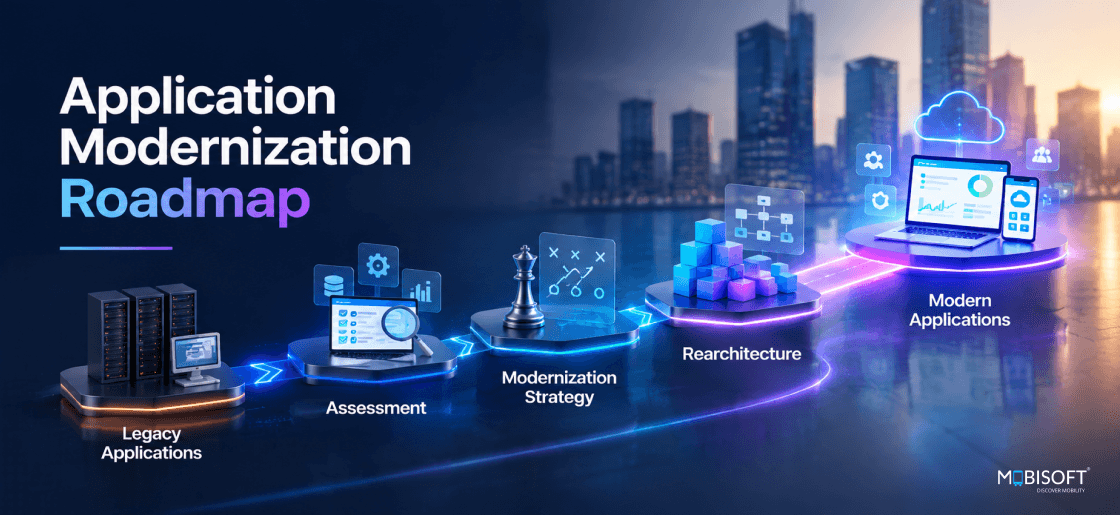
An application modernization roadmap decides whether a multi-year programme survives contact with reality. It secures executive sponsorship, sequences work by value, and gives teams a governance structure for the long haul. A weak roadmap reads like a task list sorted by engineering preference. It rarely survives the first budget review.
Building a roadmap today looks different from building one three years ago. AI tools now compress discovery timelines, sharpen prioritization scoring, and cut delivery costs across nearly every phase. Ignoring that reality means presenting outdated budgets to leadership.
This guide walks through six steps for building a roadmap that holds up under pressure. Each step covers what to capture, how AI tools help, and where human judgment still decides the outcome.
Why Modernization Roadmaps Fail
Every application modernization roadmap fails in predictable ways. Recognizing those patterns before you build is the cheapest form of risk management available to a programme team. AI tools address some of these patterns directly. Others remain entirely human challenges, no matter how advanced the tooling gets.
Technology-First Sequencing
Many roadmaps start with 18 months of infrastructure work. No visible business benefit appears until much later. Organizational patience runs out before real value arrives.
AI-assisted analysis tools can flag the highest-pain, highest-value components early. That makes value-first sequencing a data-backed choice rather than a guess. The decision to act on that data still belongs to executives and business stakeholders.
Weak Discovery Investment
Some teams skip proper assessment to save time. Scope then grows mid-programme once real complexity surfaces. Typical scope growth after a rushed start runs between 30% and 50%.
AI tools cut discovery time by 40% to 60%, which removes the old excuse for skipping it. Thorough discovery is now affordable in both time and budget. The decision to fund it, however, still rests with leadership.
No Sequencing Logic
An application modernization roadmap that lists items without explaining their order creates problems later. When trade-offs appear, and they always do, there is no framework for resolving them. Teams end up debating priorities from scratch every quarter.
Clear sequencing logic, documented once, saves that debate from repeating. It gives every stakeholder a shared reference point during disagreements.
Static Roadmaps
A roadmap built once and never revisited becomes historical trivia within a year. Twelve months in, it bears little resemblance to the actual work underway. Quarterly review discipline is what keeps a roadmap relevant.
AI Tool Plan Missing
Many roadmaps still present costs and timelines as if AI tools do not exist. That single oversight leaves 25% to 35% of achievable budget reduction unclaimed. Naming AI tools upfront, rather than adding them later, is a planning discipline with no technical barrier attached.
Stakeholder Fatigue
Long modernization programmes also risk a subtler failure. Stakeholders attending review after review without seeing change eventually stop engaging altogether, even when the underlying delivery is on track.
Rotating in fresh examples of delivered value at each review, rather than repeating the same status format, keeps attention from fading over a multi-year timeline. Small, visible wins deserve as much airtime as large milestones.
Real-World Cost Of Failure
The financial impact of a failed roadmap rarely shows up as one dramatic number. It accumulates through smaller, compounding costs that are easy to underestimate at the outset.
- Rework from wrong sequencing decisions, often 15% to 25% of budget
- Extended consultant or contractor engagements past original scope
- Lost engineering time re-explaining priorities every quarter
- Delayed feature work on the product side of the business
A programme that avoids these patterns rarely spends more upfront on planning. The difference lies in discipline, not budget size.
Common Application Modernization Strategies
Before sequencing any work, it helps to know which modernization path fits which system. Six established application modernization strategies cover almost every scenario an enterprise portfolio presents. Picking the wrong one for a given system is a common source of wasted budget.
Rehost And Replatform
Rehosting moves an application to new infrastructure without changing its code. It works well for systems that are stable but running on expensive or unsupported hardware. Replatforming goes one step further, making small adjustments to take advantage of cloud-native features.
Both paths deliver quick wins with limited risk. Neither addresses deeper architectural or technical debt problems sitting underneath the application.
Refactor And Rearchitect
Refactoring cleans up code structure without changing external behavior. It suits systems with valuable business logic buried in poor implementation. Rearchitecting changes how components interact, often breaking a monolith into independent services.
Application rearchitecture typically takes longer than refactoring but unlocks independent deployment and scaling. Teams often choose this path for capabilities identified as high value during prioritization scoring, especially within a broader enterprise application modernization effort spanning many systems at once.
Rebuild And Replace
Rebuilding starts fresh, keeping the same scope but discarding legacy code entirely. It suits systems where technical debt has become unmanageable. Replacing swaps a custom system for a commercial product, which fits capabilities that no longer offer competitive differentiation.
Choosing among these six paths depends heavily on the scoring completed during assessment. A capability with high feasibility and low complexity often suits rehosting. One with high value and high complexity often justifies a full rearchitecture instead.
Matching Strategy To System
A simple rule of thumb helps narrow the choice before deeper analysis begins.
Stable system, expensive hosting: rehost
- Stable system, cloud-native gaps: replatform
- Valuable logic, poor structure: refactor
- Monolith blocking independent teams: rearchitect
- Unmanageable technical debt: rebuild
- Commodity function, no differentiation: replace
Applying this rule during assessment saves considerable time during later prioritization discussions.
Strategy Cost And Risk
Each strategy carries a different balance of cost and delivery risk, worth comparing before committing to one per capability.
| Strategy | Relative Cost | Relative Risk |
| Rehost | Low | Low |
| Refactor | Medium | Medium |
| Rearchitect | High | Medium |
| Rebuild | High | High |
Matching the strategy to actual system condition, rather than defaulting to the most modern-sounding option, keeps programme cost predictable.

Step 1: System Inventory And Assessment
The roadmap cannot exist before the systems inventory is complete. This point sounds obvious, yet skipping it remains the most common early mistake. Assessment data determines sequencing, cost estimates, and risk identification for everything that follows.
AI tools have changed assessment economics substantially. Work that once took eight to twelve weeks of senior engineer time now takes four to six weeks. Cost drops by roughly 40% to 50% at the same time. There is no longer a credible argument for skipping thorough assessment before building a legacy system modernization plan.
Choosing the right partner for this phase matters. Many enterprises bring in product modernization services to run assessment consistently across large, sprawling portfolios rather than leaving it to individual teams.
What To Capture Per System
A complete system inventory captures technical and business data side by side. Score each system on five dimensions, each rated one to five.
- Technical health: complexity, test coverage, dependency count, documentation quality
- Business criticality: revenue impact, user count, regulatory weight
- Current pain level: maintenance cost, incident rate, developer frustration
- Modernization urgency: security risk, end-of-life timeline, compliance gaps
- AI tool applicability: language support, code quality, schema type
This scoring produces a ranked inventory. That ranking becomes the factual basis for every sequencing decision made later.
AI Tools That Speed Assessment
Automated tools now handle much of the groundwork before the first engineer meeting even happens. Codebase analysis platforms generate complexity scores, dependency maps, and technical debt figures within hours rather than weeks. Security scanners flag vulnerabilities and end-of-life dependencies automatically.
Human effort still matters for interpretation. Domain experts confirm business function, compliance teams validate regulatory requirements, and stakeholders score business criticality. Roughly 40% of assessment work stays human-led regardless of how capable the tooling becomes.
Assessment Team Composition
A well-balanced assessment team combines four distinct roles, each contributing a different lens to the inventory.
- Senior engineers interpreting AI-generated technical output
- Domain experts explaining business function per system
- A data specialist reviewing quality and ownership questions
- A compliance representative flagging regulatory constraints early
Skipping any one of these roles tends to leave a gap that surfaces only once execution begins. A five to eight person team usually covers a mid-sized portfolio without becoming unwieldy to coordinate.
Common Legacy Challenges
Legacy portfolios tend to share a recurring set of problems that assessment needs to surface early.
- Undocumented business rules buried inside old code
- Single engineers holding critical system knowledge
- Vendor support that ended years ago
- Data spread across duplicate, unsynced tables
- Integration points nobody has fully mapped
Each of these challenges affects cost estimates directly. Ignoring any one of them during assessment tends to resurface later as an unplanned budget request.
Older systems sometimes carry an additional complication worth naming directly. Database modernization needs, buried inside decades of accumulated schema changes, often take longer to untangle than the application code sitting on top of them.
Assessment Outputs
Six specific outputs need to come out of the assessment before roadmap construction starts. Each one prevents a distinct category of mid-programme surprise.
- Technical debt inventory with severity scores per component
- Business capability map connecting systems to business outcomes
- Integration inventory with complexity ratings
- Data quality findings that guide migration budget
- AI tool applicability scoring per phase
- Compliance and security gap list
Skipping any of these tends to surface as unbudgeted cost later. Integration scope alone often grows 20% to 50% mid-programme when the inventory is incomplete.
Assessment Timeline
A full assessment cycle typically spans several distinct activities, each with its own AI-assisted timeline.
- Codebase complexity analysis: hours instead of weeks
- Dependency and integration mapping: days instead of weeks
- Module documentation review: one to two weeks
- Security and compliance scanning: three to five days
- Business capability mapping: one to two weeks
Total assessment time usually falls between five and ten weeks with AI assistance, against fourteen to twenty-six weeks under a fully traditional approach.
Step 2: Business Capability Mapping
The business capability map translates technical assessment into a business case. It answers a simple question. What does this system actually do for the business, independent of how it is built?
A single monolithic e-commerce application might serve twelve distinct capabilities within one application modernization process. Product catalogue, pricing, inventory, cart, checkout, payment, and order management are common examples. Each capability becomes a candidate unit for modernization, extractable and deliverable on its own timeline.
Getting this translation right takes close collaboration between technical teams and the people running enterprise software development. Capability boundaries often cut across existing team structures.
The Two-Stage Mapping Process
Traditional capability mapping needed three to four weeks of workshops and code reading. AI tools compress the discovery side sharply by surfacing where capability logic actually lives in the code before the first workshop begins.
Stage one
It runs AI discovery across five days. Code analysis tools surface modules and data tables tied to each capability. Dependency mapping reveals capability boundaries based on real code coupling, not assumptions.
Stage two
It runs expert validation across one to two weeks. Domain experts review AI-generated summaries, correct inaccuracies, and confirm which capabilities deliver which business value. Legal and compliance teams confirm regulatory requirements per capability.
Combined, this process takes about two weeks against five to six weeks traditionally. That is roughly a 65% time reduction, though human validation stays non-negotiable throughout.
Building The Capability Map
Each capability entry needs eight fields to be useful for prioritization later.
- Capability name and business function
- Technical components and data owned
- Integration points with other systems
- Named business owner
- Complexity score, rated one to five
- Business value score, rated one to five
A capability map without a named business owner tends to stall during validation. Someone accountable needs to sign off before the capability moves into scoring.
Capability maps should stay living documents rather than one-time artifacts. Revisiting the map at each quarterly review catches drift as systems evolve and business functions change ownership between teams.
Capability Boundaries
Poorly drawn capability boundaries create migration problems later. A capability that shares a database table with three other capabilities is far harder to extract cleanly than one with its own isolated data.
Testing boundary quality early avoids a common trap. Teams sometimes discover mid-migration that a supposedly independent capability actually depends on five others, forcing a costly resequencing effort.
Common Mapping Mistakes
A handful of recurring errors account for most capability mapping problems.
- Drawing boundaries around team structure instead of business function
- Skipping validation with actual business owners
- Treating shared reference data as a separate capability
- Leaving integration points undocumented until extraction begins
Catching these errors during mapping costs far less than catching them during migration.
Step 3: Prioritization Scoring
With capabilities mapped, the next task is ranking them for sequence. This is where technically-led roadmaps most often go wrong. They prioritize by what is architecturally interesting rather than what delivers business value. That approach consistently loses organizational support once stakeholders stop seeing progress they can measure.
This scoring step is the core of any credible application modernization framework, since it converts subjective opinion into a repeatable, defensible process.
The Four Scoring Dimensions
Each capability gets scored across four weighted dimensions.
| Dimension | Weight | What It Measures |
| Business pain | 30% | Incidents, workarounds, maintenance cost |
| Business value unlocked | 35% | Revenue, competitive gap, roadmap enablement |
| Technical risk reduction | 20% | Vulnerabilities, compliance gaps, EOL risk |
| Migration feasibility | 15% | Dependency count, data ownership clarity |
Business value carries the highest weight deliberately. AI tools cannot determine strategic business value without business context, which makes this dimension the most human of the four.
Scoring In Practice
A payment processing capability might score four on pain, five on value, four on risk, and three on feasibility. Multiplying each score by its weight and summing produces a weighted total of 4.20, marking it high priority.
An internal reporting capability might score two on pain, two on value, one on risk, and five on feasibility. Its weighted total lands at 2.25, a lower priority despite being an easy technical win.
This scoring approach also supports application rationalization, since low-scoring, low-value capabilities frequently turn out to be strong candidates for retirement rather than modernization at all.
The 90-Day Value Rule
The most important sequencing constraint is organizational, not technical. A programme that delivers no visible business value within 90 days consistently loses momentum before reaching its most important phases.
Executive sponsors disengage first. Budget reviews turn adversarial. Engineers get pulled back onto product work, and the programme stalls in the background.
A notification service that cuts support tickets by 30% satisfies business stakeholders within 90 days. So does a reporting migration that drops generation time from four hours to ninety seconds. Infrastructure changes like a database migration or a new server cluster rarely count, since business stakeholders cannot see or measure them directly.
Partners offering digital product engineering outsourcing often build this 90-day checkpoint into contracts. It protects programme funding through the riskiest early stretch.
When Scores Conflict
Sometimes two capabilities land close in weighted score but point toward different sequencing choices. In that situation, feasibility should usually break the tie for early phases, while value should break the tie for later phases.
Business stakeholders should always see the tie-break logic, not just the final number. That transparency prevents disputes once the sequence gets published.
Step 4: Sequence Design
Prioritization scoring produces a ranked list. Sequence design converts that list into a migration order governed by three distinct logics at once. Roadmaps optimizing for only one logic consistently hit problems the other two would have prevented. Planning Enterprise Application Maintenance alongside this sequence, rather than after launch, keeps every newly modernized service stable once it reaches production.
Business Value First
Business value sequencing is the primary logic. The capability delivering the most value at an acceptable feasibility level migrates first. This logic sustains organizational commitment throughout a long programme, which is often the deciding factor for enterprise application modernization efforts spanning multiple years.
Engineering teams often resist this ordering initially. AI-assisted analysis frequently shows that capabilities can be extracted using an API facade pattern before a full database migration completes. That removes the usual technical objection to value-first sequencing.
Technical Dependencies
Some capabilities genuinely cannot move before others. A payment service cannot adopt a new architecture until the account service it depends on exposes a stable API. These are hard constraints, not preferences, and must be mapped before finalizing the sequence.
Dependency analysis tools generate this constraint map in hours rather than weeks. That prevents the common error of sequencing purely by value, only to discover mid-programme that a top-priority capability was technically blocked all along.
Risk Reduction Logic
Early extractions should not be the highest-risk capabilities in the portfolio. Teams need to build confidence with the extraction pattern first. The first two or three moves should come from the high-feasibility end of the scoring matrix.
This does not mean choosing the least valuable capability to start. It means finding one that is valuable enough to matter and feasible enough to succeed before the team has mastered the full pattern. A well-sequenced application modernization roadmap treats this early phase as practice, not proof of overall readiness.
Combining The Three Logics
A workable phase structure blends all three logics across the programme timeline.
- Phase 0, foundation: pipeline setup, observability, AI tool activation, five weeks
- Phase 1, first value: high value plus high feasibility, delivered within 90 days
- Phase 2, core capabilities: top-scoring items with dependency constraints applied
- Phase 3, complex migrations: shared data decomposition, partner coordination
- Phase 4, completion: legacy decommissioning and cost optimization
Before locking the sequence, validate three things using dependency analysis tools. Confirm no capability precedes its own dependency. Confirm data architecture work supports rather than blocks the sequence. Confirm phase durations reflect AI-adjusted timelines, not traditional estimates.
Sequencing Pitfalls
A few mistakes appear repeatedly across sequence design, regardless of industry or portfolio size.
- Ignoring feasibility in favor of value alone
- Scheduling too many high-risk extractions back to back
- Underestimating partner coordination time for external integrations
- Failing to revisit sequence after the first phase completes
Reviewing the sequence against this list before publishing catches most avoidable errors early, when correcting them costs almost nothing.
Documenting The Sequence
A published sequence document should answer four questions for every phase, in plain language stakeholders can review without technical background.
- What capabilities move in this phase
- Why they were chosen for this position
- What depends on this phase completing
- What business outcome this phase produces
Publishing this document widely, rather than keeping it inside the engineering team, reduces the number of sequencing disputes raised later.
Step 5: Milestone Definition
A sequence without milestones is just a list with dates attached. Milestones convert sequence into commitment, defining what done means and what would trigger a programme review.
Technical Success Criteria
Each milestone needs concrete technical acceptance criteria before it counts as complete.
- Full behavioral equivalence testing against the legacy system
- 100% of production traffic routed for 30 continuous days
- Test coverage at 80% or higher
- Published API documentation and operational runbook
- Legacy component fully decommissioned, not just traffic-rerouted
Business Success Criteria
Technical completion alone does not close a milestone. Business criteria confirm the change actually mattered to the organization.
- Specific business metric maintained or improved, named and measured
- User acceptance testing completed with real business users
- No increase in support ticket volume tied to the capability
Phase Gate Decisions
Every milestone needs an explicit go or no-go decision before the next phase begins. A go decision requires every technical and business criterion met, plus a stable 30-day observation period. No-go triggers include performance regression, data integrity issues, or a raised regulatory concern.
When a no-go occurs, the standard response rolls back to legacy routing, runs a root cause analysis, and sets a revised milestone date. Treating this as routine rather than exceptional keeps trust intact with stakeholders.
Keeping Milestones Realistic
Milestones set too aggressively tend to erode credibility faster than slow ones. A missed date once is a scheduling issue. A pattern of missed dates signals that the underlying application modernization process itself needs revision.
Building a small buffer into each milestone date, rather than promising the fastest possible outcome, protects the programme's reputation across its full lifespan. Ongoing support planning should start alongside these milestones, so newly launched services stay stable from day one rather than being added afterward.
Milestone Cadence
Most enterprise programmes settle on a 90-day milestone rhythm, matching the value guarantee established during sequencing. Shorter cadences risk excessive overhead. Longer cadences risk losing stakeholder attention between checkpoints.
Each milestone should also carry a named owner accountable for its criteria. Diffused ownership across a whole team tends to slow decision-making exactly when speed matters most.
Communicating Milestones
Milestone updates should reach three distinct audiences, each needing a different level of detail. Engineering teams need full technical criteria. Executive sponsors need a short business summary. Wider stakeholders need only a status color and a one-line outcome.
Send the same technical report to all three audiences, and you may lose the business audience fast. Tailoring the format per audience keeps engagement steady across a multi-year timeline.
Step 6: The AI Tool Integration Plan
This is the section most 2022-era roadmaps never had, and it separates a credible application modernization strategy from an outdated one. It names which AI tools activate in which phase, shows the cost impact of each, and treats Day 1 activation as non-negotiable.
A roadmap missing this section is effectively quoting traditional costs when AI-assisted costs are achievable. That gap alone can mean asking leadership for 25% to 35% more budget than necessary.
When To Activate Each Tool
Timing activation correctly avoids leaving savings on the table.
- Discovery tools: activate day one, before any engineer touches the codebase
- Coding assistants: activate day one of development, never later
- Test generation tools: configure during week one of the first testing phase
- Documentation tools: run continuously from week one onward
- Migration and monitoring tools: activate before the first production cutover
Late activation of coding assistants alone can cost a ten-engineer team roughly $4,500 a day in lost productivity, based on typical blended engineering rates. Building this activation schedule into the application modernization strategy from the start, rather than treating tools as an afterthought, is what actually captures the savings.
The Cost And Savings Case
A roadmap should present both a traditional cost estimate and an AI-assisted one, with the source of each saving spelled out clearly. That transparency builds credibility with finance and leadership alike.
| Programme Phase | AI Saving | Primary Source |
| Discovery and assessment | 40-45% | Automated code and dependency analysis |
| Service extraction | 30% | Coding assistants, generated tests and docs |
| Data migration | 40% | Automated schema conversion tooling |
| Change management | 0% | No meaningful AI impact on this phase |
Annual AI tooling for a ten-engineer programme typically runs $55,000 to $120,000. Against a $3 million traditional programme, AI-assisted delivery often saves roughly $900,000, an eight-times return on the tooling spend itself. Two line items deserve honesty here. Change management and programme management see close to zero AI impact, and budgeting them at full traditional rates protects credibility.
Presenting The Case To Finance
Framing matters when this budget line reaches a CFO's desk. AI tooling should appear as an infrastructure investment, not overhead buried inside team cost. A two-column comparison, traditional against AI-assisted, makes the return obvious without requiring a technical explanation.
Savings should also be broken out by phase rather than presented as a single blended figure. That level of detail signals a team that has actually modeled the numbers rather than applied a generic discount.
Tool Selection Criteria
Not every AI tool suits every codebase. Three criteria narrow the field quickly before committing budget.
- Language and framework support for the target systems
- Integration with existing development and testing pipelines
- Vendor track record with enterprise security requirements
Piloting a tool on one capability before full rollout catches mismatches early, well before the cost of switching grows significant.
Measuring AI Impact
Claimed productivity gains mean little without measurement against a baseline. Tracking three metrics before and after tool activation keeps the AI tool plan honest.
- Story points or features delivered per engineering week
- Time from code commit to production deployment
- Defect rate in newly written or modified code
Reviewing these metrics at each quarterly review confirms whether AI-adjusted estimates still hold, or whether the roadmap needs a mid-course correction.
Teams new to AI-assisted delivery sometimes see a temporary dip before gains appear, as engineers adjust to new workflows. Expecting this adjustment period avoids premature changes to the tool plan.
Roadmap Governance
An application modernization roadmap built once and never revisited turns into a historical document within six months. Business priorities, team composition, and technology all keep changing during a multi-year programme. Governance is what lets the roadmap adapt without losing coherence.
Four Governance Mechanisms
Four recurring mechanisms keep a programme honest against its own plan.
- Weekly status review: engineering lead and programme manager track blockers
- Quarterly roadmap review: validates delivered value, reprioritizes remaining work
- Phase gate review: formal go or no-go decision at each phase boundary
- Change control: formal approval required for any scope addition
AI-generated status summaries can cut weekly reporting overhead by 40% to 50%, freeing that time for the judgment calls that still require people. Consistent use of these mechanisms is itself one of the clearest application modernization best practices a programme can adopt.
Quarterly Review Checklist
Every 90-day review should cover four areas without exception.
- Delivery: which milestones completed, which slipped, and why
- Business value: did completed work deliver the outcomes promised
- Risk and scope: has anything new appeared since the last review
- Financials: is spend tracking to the AI-adjusted forecast
Reviews should produce updated milestone dates, a revised sequence if priorities changed, and communication to stakeholders within five business days.
Warning Signals To Watch
Certain patterns should trigger immediate intervention rather than waiting for the next scheduled review.
- Executive sponsor absent from reviews for 60 or more days
- Team spending over 20% of time firefighting the legacy system
- First major milestone running four or more weeks late
- Scope grown more than 20% without a budget adjustment
- Business stakeholders no longer attending milestone reviews
Each of these signals points to a specific, addressable cause. Ignoring them tends to compound the underlying problem instead of letting it resolve on its own.
A single warning signal rarely justifies halting a programme outright. Two or more appearing together within the same quarter usually does, and deserves an immediate executive conversation rather than waiting for the next scheduled review.
Governance Overhead
Some teams treat governance meetings as pure overhead to minimize. That instinct works against the programme over a multi-year timeline. A 30-minute weekly status check costs far less than the rework that follows an undetected drift from plan.
Keeping governance lightweight but consistent, rather than heavy but sporadic, tends to produce the best outcome for programme health.
Who Owns Governance
Clear ownership prevents governance mechanisms from silently lapsing under delivery pressure. A named programme manager should own the weekly cadence. The executive sponsor should own the quarterly review.
Without this clarity, governance activities are usually the first thing dropped when a phase runs behind schedule, which is exactly when they matter most.
Sustaining Modernization Beyond The Roadmap
A roadmap gets a programme started, but ongoing operation determines whether the investment holds its value. Systems modernized under one roadmap still need continuous patching, monitoring, and capacity planning long after the last milestone closes. Organizations can support these ongoing operational needs with enterprise application monitoring services as part of a broader maintenance strategy.
Treating maintenance as a separate afterthought tends to erode the gains a modernization programme just delivered. Budgeting for support from the outset protects that investment over time.
Database Considerations
Data architecture deserves its own attention within any roadmap. Database modernization frequently sits on the critical path for multiple capability extractions at once, since shared tables create dependencies that block otherwise independent work.
Planning data migration early avoids the common trap of discovering ownership conflicts only after extraction has already begun. Schema conversion tooling speeds up the mechanics, but data quality remediation still requires deep business context that only internal teams can supply.
A recurring pattern deserves attention here. Data quality issues discovered mid-programme, after extraction has already begun, typically add 20% to 40% in unbudgeted cost. Running data profiling during assessment, well before any migration work starts, catches most of these issues while they remain cheap to fix.
Rearchitecture Versus Rebuild
Not every capability needs a full rebuild. Some benefit from targeted application rearchitecture that changes internal structure while preserving external behavior, which is often faster and less risky than a ground-up rewrite.
Deciding which path fits which capability is itself a scoring exercise, using the same feasibility and value dimensions applied earlier in the roadmap. A capability scoring high on both complexity and value usually justifies the extra investment a rebuild requires.
Planning For Ongoing Support
Budgeting for support should happen during roadmap construction, not after the first service reaches production. A realistic process treats maintenance as a funded phase rather than a cost absorbed informally by whichever team is available.
This distinction matters most for larger enterprise application modernization programmes. Dozens of newly modernized services can accumulate faster than an unplanned support model can absorb.
Enterprise Modernization Challenges
Large organizations face a distinct set of obstacles that smaller teams rarely encounter at the same scale. Recognizing these obstacles early keeps the roadmap grounded in what is actually achievable across a big, complex portfolio.
Coordinating Business Units
Enterprise application modernization programs normally affect several different business units within the organization and systems owned by those business units. Prioritization of the capabilities becomes difficult when capabilities which are important for one unit have a very low importance ranking in the other.
The only way to overcome this challenge would be to use the same scoring methodology across all the units involved and have a centralized steering committee for the program that would include representatives of all of them.
Parallel Legacy Operations
Legacy systems rarely shut down the moment a replacement goes live. Both versions typically run in parallel for a defined observation period, which strains operational capacity across the transition.
- Staff must support two systems simultaneously for weeks or months
- Data must stay synchronized between old and new during the overlap
- Rollback procedures must remain fully tested throughout the period
Budgeting explicitly for this parallel running phase, rather than treating it as a brief formality, prevents the most common source of last-mile programme delay.
Handling Regulatory Complexity
Regulated industries also bring additional levels of complexity to the sequencing process, which pure technical sequencing is not capable of overcoming. For example, compliance needs might dictate the need for moving certain capabilities together, regardless of the score they get on their own.
Early engagement of compliance and legal teams during the assessment phase will ensure there will be no nasty surprises later in the process, when the sequencing would have already been completed.
Skills Gaps Across Teams
Modernization work often requires skills the existing team has not used before, particularly around cloud-native architecture and AI-assisted development workflows. Underestimating this gap is a common planning mistake.
- Budget training time explicitly into early programme phases
- Pair less experienced engineers with specialists during first extractions
- Track AI tool proficiency alongside delivery velocity
Treating skill-building as a scheduled activity, rather than something absorbed silently into delivery time, keeps velocity estimates realistic across the whole programme.
How Mobisoft Builds Modernization Roadmaps
Mobisoft treats the application modernization roadmap as the first deliverable of every programme, never proposing one before assessment makes it credible. This approach follows the best practices consistently across programmes of different sizes and industries.
The Roadmap Process
The process runs across four stages spanning six to eight weeks total.
- Week 1: AI-powered assessment begins across the full codebase
- Weeks 2-4: parallel technical and business discovery streams run together
- Weeks 4-6: prioritization scoring and sequence design synthesis
- Weeks 6-8: leadership review, validation, and formal approval
This timeline compares to twelve to eighteen weeks under a traditional, non-AI-assisted process for comparable scope. Cost typically runs $25,000 to $100,000 depending on system scope. Any client considering legacy application modernization at scale should expect assessment depth to match that investment.
What You Get
A completed roadmap engagement delivers a specific, tangible set of outputs.
- Technical assessment with ranked system inventory
- Validated business capability map
- Prioritized, sequenced migration plan
- AI-adjusted, two-column cost model
- Milestone definitions with go and no-go criteria
- Governance framework for ongoing review
If the underlying programme lacks a compelling return on investment, that gets flagged before work begins rather than after budget is spent. A roadmap leading to a poorly justified programme helps no one involved.
Who This Fits
This legacy system modernization approach suits organizations running multiple legacy systems with unclear modernization priorities. It also fits teams that have tried planning internally and found the process stalling on disagreement rather than technical difficulty.
Smaller, single-system modernization efforts may not need the full six-step process. A lighter version, covering assessment and sequencing only, often works for a narrower scope.
Getting Started
Organizations evaluating a first roadmap engagement should prepare three things before the initial conversation. A rough inventory of systems in scope, even if incomplete, speeds up assessment planning considerably.
- A named executive sponsor able to commit budget and attention
- A short list of business outcomes the programme should target
- Access to relevant engineering and business stakeholders early
Programmes that arrive with this groundwork already done move faster. First conversation to formal roadmap approval takes noticeably less time than starting from a blank slate.
None of this preparation needs to be perfect before the first conversation happens. Assessment exists precisely to fill in the gaps that internal teams have not yet had time to document fully.
Conclusion
System inventory, capability mapping, and weighted scoring turn opinion into evidence business leaders can act on. AI tools compress timelines and cut costs across most phases, but business judgment still decides what matters most for their application modernization roadmap.
Governance keeps the plan alive long after the launch presentation ends. Quarterly reviews, phase gates, and clear warning signals prevent a roadmap from drifting into irrelevance. The 90-day value rule protects momentum precisely when programmes are most fragile.
Enterprises that treat the roadmap as a living document consistently outperform those that treat it as a one-time exercise. Regular review and adjustment as conditions change make the difference. Getting the sequence right from the start makes every later decision easier to defend.

Frequently Asked Questions
Can your team join our existing engineering staff?
Yes, this engagement folds around your existing engineering staff rather than replacing it. Mobisoft Infotech pairs specialists with your team during discovery and delivery. That partnership supports enterprise application modernization without disrupting daily operations.
What happens after the roadmap gets approved?
Approval opens the assessment and discovery phase immediately, not weeks later. Mobisoft Infotech begins legacy system modernization work within days of sign-off. You receive a detailed onboarding plan covering the first month.
Can you modernize only part of our system portfolio?
Yes, most engagements start with a subset of the portfolio rather than everything at once. Mobisoft Infotech scopes each phase independently, so application rationalization and sequencing still apply within that smaller boundary. You add more systems later as budget and priority allow.
Do you handle database migration as part of this?
Yes, moving your data is included wherever the roadmap calls for it. Mobisoft Infotech plans database modernization early, since shared tables often block unrelated capability extractions. You get a dedicated budget line for this work, not a vague estimate.
When would you recommend rearchitecture over refactoring?
This path fits capabilities with high business value and real technical complexity. Mobisoft Infotech recommends application rearchitecture only when refactoring cannot resolve the underlying coupling. You get a documented rationale before committing a budget either way.
Does Mobisoft Infotech work with regulated industries?
Mobisoft Infotech has delivered projects across healthcare, finance, and logistics clients. Regulatory requirements guide scoring and sequencing from the assessment phase onward. Every engagement follows the same application modernization best practices, regardless of industry.
This content is for informational purposes only and may include AI-assisted research or content generation. While we strive for accuracy, information may evolve over time. Readers are advised to independently verify critical information before making decisions.

Nitin Lahoti
Read more
Nitin Lahoti is the Co-Founder and Director at Mobisoft Infotech. He has 15 years of experience in Design, Business Development and Startups. His expertise is in Product Ideation, UX/UI design, Startup consulting and mentoring. He prefers business readings and loves traveling.
 Nitin Lahoti
 August 21, 2026