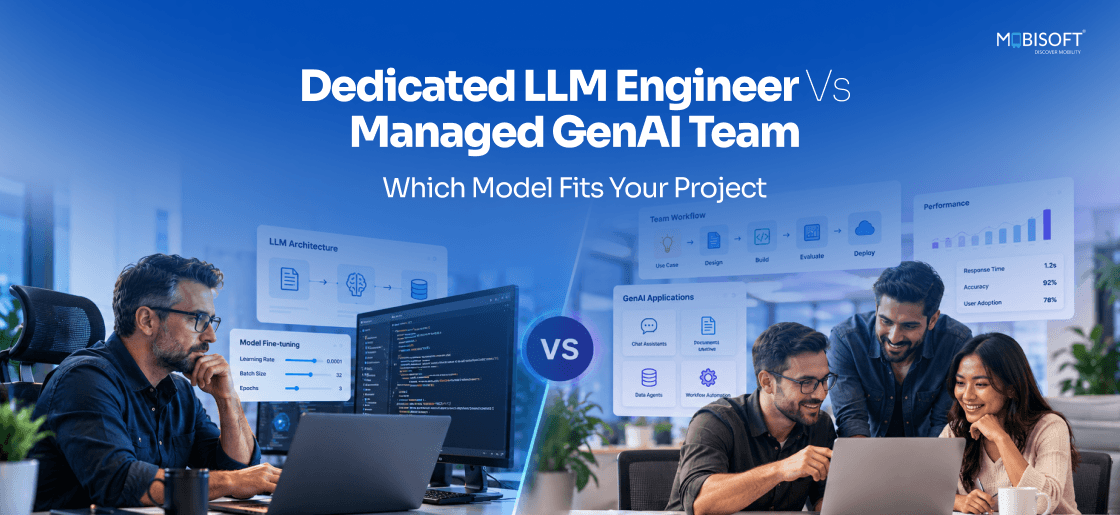
Technology leaders adding AI capability face a real fork in the road. You either bring in a single specialist who joins your existing team, or you hire an LLM engineer through a managed group that owns delivery from start to finish. Marketing pages don’t really explain what each option actually costs you in time and oversight. A dedicated specialist works under your technical direction and sits in your daily standups. A managed AI development team assembles several specialists who coordinate their own work. Neither option wins by default.
The right choice depends on your project scope, your internal management bandwidth, and how many specializations the work actually needs. Get this decision wrong and you either pay for coordination you never needed, or you skip oversight the project required. Some engagements also call for on-premises LLM deployment, and that choice interacts directly with which talent model fits. This guide breaks the decision into six practical dimensions, covering cost, quality control, and delivery speed. By the end, you will have a clear framework instead of a guess.
Two Different Ways To Access AI Talent
A dedicated AI engineer and a managed team are not different sizes of the same service. They differ in how work gets directed, how risk gets shared, and what happens when scope changes mid-project. Understanding both models before you compare costs saves you from a decision built on the wrong assumptions.
What A Dedicated LLM Engineer Actually Delivers
When you hire LLM engineer on a dedicated basis, you get one specialist working almost exclusively on your project. This person joins your Slack channels and your sprint planning. They work under your technical direction, where your team assigns tasks and reviews the output. You provide product context, system access, and conflict resolution when priorities shift.
The provider handles vetting, payroll, and replacement if the engineer underperforms. Basic onboarding support usually comes included as well. What the provider does not handle is project management or multi-specialization coverage. One engineer brings one area of depth, whether that is retrieval-augmented generation, evaluation, or agentic workflows. Cross-specialization coordination simply does not exist, because there is only one person on the engagement.
Quality accountability sits with you in this model. The provider stands behind the engineer's skills and professionalism, not the final output of your product. That distinction matters more than most contracts make clear, and it shapes how much internal review your team needs to budget for.
What A Managed GenAI Team Delivers
A managed generative AI team looks different from the ground up. You get three to five specialists covering complementary skills, plus a team lead who manages delivery. A typical composition pairs an LLM engineer with a quality engineer and an MLOps specialist, sometimes adding an agentic AI engineer as scope grows.
The provider runs sprint planning, coordinates between specialists, and answers for outcomes rather than just hours logged. Quality assurance happens across the whole engagement, not just within one person's individual work. Your job shifts toward setting product direction and validating output quality through subject matter experts who understand your business context.
What the provider still does not supply is strategic direction or domain knowledge specific to your business. You set the what, and the managed AI development team delivers the how. This model suits programs that need multiple skill sets working in parallel, something a single dedicated hire cannot replicate no matter how strong that individual happens to be.
How Each Model Handles Changing Priorities
Priorities shift on almost every AI project once real usage data starts coming in. A dedicated LLM engineer absorbs those shifts through your own management chain, since you decide what takes precedence when new requirements appear. That flexibility comes with a cost, because reprioritizing a single specialist's work still requires someone on your side to make the call and communicate it clearly.
A managed team absorbs shifting priorities differently. The provider's team lead reprioritizes across specialists within the agreed scope, though larger changes still need your product owner's sign-off during a direction session. Neither approach removes the need for someone to own the decision. The difference is whether that ownership sits entirely inside your organization or gets shared with the provider's delivery structure.
Why This Choice Trips Up So Many Leaders
Most leaders default to whichever model looks cheaper per hour. That instinct misses the real cost driver behind either engagement. A dedicated engineer who needs 15 percent of a senior manager's time to direct is not actually the cheaper option once you add that management cost back into the total.
If your project needs three specializations, a lone generalist stretched across all three usually produces mediocre results in each area instead of strong results in one. The comparison only makes sense once you weigh total cost against total outcome, not rate against rate. A dedicated AI development team built from the wrong model rarely fails because of talent. It fails because the engagement structure did not match the actual work.
Six Dimensions That Decide The Right Model
Six factors determine which engagement model actually fits your situation. Score your project honestly on each one before you commit budget to either path, since a rushed answer here tends to produce a rushed and expensive correction later.
Scope Clarity And How Many Specializations You Need
A single, well-defined specialization favors a dedicated hire. The engineer can go deep on your codebase and your architecture without splitting attention across competing priorities. Projects that need three or more specializations working together, such as retrieval systems, evaluation, and infrastructure, are harder for one person to cover at a production standard.
That kind of work benefits from a structured LLM development team with clear role separation built into the engagement. Reading about in-house vs contract generative AI engineers helps clarify where your scope sits before you commit to either model. Score this dimension a 1 if your scope is narrow and clear, and a 5 if it spans three or more specializations at a program level.
Internal Management Capacity You Actually Have
Directing an external specialist takes real time from someone on your side. If you have a strong engineering manager who can review output daily, a dedicated hire works well within that structure. If that manager is already stretched thin across other priorities, adding oversight duties creates a bottleneck rather than genuine progress.
This is often the most underestimated factor in the entire decision, and it deserves an honest answer rather than an optimistic one. A manager who says they can find the time doesn’t account for the actual hours daily code review and task assignment consume. Score a 1 if strong internal management is genuinely available, and a 5 if that capacity is limited or already committed elsewhere.
Codebase Integration Depth Your Project Requires
Some AI work demands deep familiarity with your existing systems, data models, and internal APIs. That kind of integration rewards a dedicated engineer who learns your codebase over weeks and stays embedded in your architecture decisions. The value driver here is depth, not breadth.
Other projects can be delivered against a clean, well-documented interface. In that case, a managed GenAI team can build and hand off work without needing months of internal context first. Score a 1 when deep codebase integration is the primary requirement, and a 5 when well-defined API integration points are enough.
Quality Ownership, Budget Shape, And Delivery Timeline
The final three dimensions often move together in practice. Quality ownership asks who is accountable when something breaks in production, your team or the provider. A dedicated LLM engineer leaves that accountability with you, since your team reviews and approves the work before it ships.
Budget shape asks whether you prefer a lower per-head rate or better cost efficiency per specialization delivered. Timeline asks whether your work can proceed one task at a time or genuinely needs several people building in parallel to hit a deadline. Score each dimension the same way, with 1 favoring dedicated and 5 favoring managed.
| Dimension | Favors Dedicated Engineer | Favors Managed Team |
| Scope and specializations | One area, clearly defined | Three or more areas at once |
| Management capacity | Strong internal oversight available | Limited internal bandwidth |
| Codebase integration | Deep architecture familiarity needed | Well-defined API interface is enough |
| Quality accountability | Your team owns final quality | Provider owns agreed outcomes |
| Budget structure | Lower per-head rate matters most | Per-specialization efficiency matters more |
| Delivery pace needed | Sequential work is acceptable | Parallel progress is required |
Add your scores across all six dimensions once you have rated your project honestly. A total between 6 and 12 points toward a dedicated engineer being the clearly right choice. A total between 13 and 20 suggests leaning toward a dedicated engineer for execution while adding advisory support in weaker areas. A total between 21 and 28 suggests leaning toward a managed team even if the per-head cost runs higher. A total between 29 and 30 makes the managed generative AI team the clearly right structure for your program.

What Each Engagement Model Actually Costs
Sticker price rarely tells the full story on either side of this decision. The real comparison has to include management time, coordination overhead, and quality review, not just the invoice line item from the provider.
Dedicated Engineer Costs Beyond The Hourly Rate
A dedicated LLM engineer billed at typical US market rates runs close to thirty-four thousand dollars monthly for full-time work. Add internal management time at roughly 15 percent of a senior manager's salary, and that adds another few thousand dollars monthly. Coordination overhead for scheduling and task handoff adds more, and quality review from a senior engineer adds still more on top.
None of that additional cost appears on the provider's invoice, yet your organization pays it every month regardless of who tracks it. Knowledge transfer also carries an ongoing cost, since documentation review takes real hours even when it is not billed as a separate line item.
Managed Team Costs Including Delivery Overhead
A managed team covering three specializations often lands in a similar or slightly higher total monthly range than a single dedicated hire. The difference is what that fee already includes from day one. Project management, internal quality assurance, and coordination between specialists are built into the engagement rather than billed separately against your engineering manager's calendar.
An enterprise LLM platform rollout, for example, often needs exactly this kind of coordinated, multi-skill delivery from the very first sprint. Client validation time still applies, since subject matter experts need to confirm output quality, but that time investment runs far lower than directing daily engineering work.
| Cost Component | Dedicated Engineer (Monthly) | Managed Team, 3 Specialists (Monthly) |
| Direct engagement fee | ~$33,800 | ~$50,000 |
| Internal management time | ~$4,500 | Included |
| Coordination overhead | ~$1,500 | Included |
| Quality review | ~$3,000 | ~$1,500 (validation only) |
| Knowledge transfer investment | ~$1,200 | ~$1,000 (structured into delivery) |
| Total monthly cost | ~$44,000 | ~$52,500 |
| Specializations covered | 1 | 3 |
The Per Specialization Insight Most Leaders Miss
Once you divide total annual cost by the number of specializations actually delivered, the comparison flips for multi-skill projects. A single dedicated engineer at the totals above runs close to five hundred and twenty-eight thousand dollars annually for one specialization covered.
Three dedicated US-rate engineers covering three specializations, once you add internal management for all three, can cost well over one and a half million dollars annually. A managed team covering the same three specializations often lands closer to six hundred and thirty thousand dollars annually, working out to roughly two hundred and ten thousand dollars per specialization instead of over five hundred thousand.
- The crossover point tends to arrive once a project needs two or more specializations sustained for six months or longer. Below that threshold, a single dedicated hire usually remains the more efficient choice on pure economics.
How Each Model Manages Quality
Cost only matters if the output actually works in production once it ships. Quality management looks different depending on which model you choose, and the gaps tend to show up at different points in the project timeline.
Evaluation, Benchmarking, And Code Review
With a dedicated AI engineer, evaluation quality depends heavily on that individual's discipline, since they often double as their own reviewer with no independent check. A managed GenAI team typically includes a dedicated quality engineer working in parallel with the build itself, catching evaluation gaps before they reach production rather than after.
Code review follows a similar pattern across both models. Your own team reviews a dedicated engineer's work, so review quality depends entirely on how much AI-specific knowledge your reviewers already possess. A managed team's lead reviews engineering output directly, and cross-specialist review often catches integration issues a single reviewer would miss.
Architecture Consistency And Knowledge Transfer
Architecture decisions made by a lone engineer rarely get cross-checked unless you provide that review capacity yourself. Inconsistent architecture tends to surface as integration failures later, once different pieces of the system need to interact under real load.
A managed team's lead, and an architect when one is engaged, reviews architecture across every specialization for consistency. Knowledge transfer follows a comparable pattern. With a dedicated hire, documentation quality varies by individual and should be written into the contract as an explicit deliverable from week one. A managed provider usually structures transfer into the delivery cadence as a standard deliverable rather than an afterthought left to the final week.
| Quality Dimension | Dedicated Engineer | Managed Team | Risk If Poorly Managed |
| Evaluation and benchmarking | Depends on the individual engineer | Dedicated quality engineer role | Undiscovered quality problems at launch |
| Code review | Your team reviews the output | Team lead plus cross-specialist review | Technical debt that compounds over time |
| Architecture consistency | No cross-review unless you provide it | Team lead reviews across specializations | Integration failures once systems interact |
| Production incident response | May or may not be available post-handover | Support commitment for a defined period | Slower resolution of live quality issues |
Where Each Engagement Model Tends To Fail
Every engagement model carries risk regardless of how well it fits your project on paper. Knowing the common failure points ahead of time lets you build mitigations into the contract rather than discovering them mid-project when the cost of fixing them is already higher.
Common Risks With A Dedicated Specialist
Skill mismatch is the risk that costs the most in lost time. An engineer who claims broader skills than they actually have can cost six to eight weeks of opportunity cost before the gap becomes obvious to your team. A two-stage technical evaluation before the engagement starts, paired with a replacement guarantee clause, reduces this exposure significantly.
Management bottlenecks appear when the internal manager directing the engineer becomes unavailable through illness, competing priorities, or departure. Without a backup, the dedicated engineer becomes effectively unproductive during that gap. Designating a backup technical direction contact solves this before it becomes a problem.
Scope creep shows up when a dedicated engineer gets pulled into work outside their core specialization, such as an LLM engineer suddenly asked to also build evaluation tooling. The result tends to be mediocre output across multiple domains instead of strong output in one. Adding specializations should mean adding engineers, not expanding one person's scope past what they were hired for.
Knowledge silos form when critical system knowledge lives entirely in one person's head. If that engineer leaves at the end of the engagement without structured handover, the organization struggles to operate what was actually built. Documentation as an explicit deliverable from the start prevents most of this risk.
Common Risks With A Managed Team
A managed GenAI team can only deliver against clear product direction, so a direction vacuum is the single biggest risk on this side. If your product and engineering leads are not available for regular decisions, the team either stalls or builds something that misses the mark. Naming a product owner who commits to bi-weekly sessions closes this gap early.
Team composition mismatch happens when a team gets assembled for the wrong specialization mix. An MLOps engineer cannot substitute for an agentic AI engineer once a project reveals it actually needs agent architecture. Defining specialization needs precisely before the team is assembled, and negotiating composition adjustment rights into the contract, prevents this from derailing a program.
Provider quality assurance overconfidence is a subtler risk. Provider quality accountability is only as strong as the provider's actual internal QA process, and a weak process can deliver worse results than a strong individual dedicated engineer would have. Evaluating the provider's quality process directly, not just the proposed team, and validating the first sprint before committing fully, protects against this.
Integration depth limitation appears when a managed team stays disconnected from your actual development workflow, using separate standups and separate tools that require translation. Requiring the team to work inside your existing tools and version control closes most integration gaps before they ever start.
Building a real team of AI engineers rather than relying on one stretched generalist reduces several of these risks simultaneously, particularly the single point of failure risk that follows any solo dedicated hire.
Moving Between Models As Your Program Grows
The choice between dedicated and managed rarely stays fixed for the entire life of a program. As use cases expand and internal capability builds over time, the right model tends to shift along with it.
Moving From Dedicated To Managed As Scope Widens
Organizations that started with one or two dedicated LLM engineers often outgrow that model once a second capability requires specializations the original hires never covered. At that point, adding a managed engagement for the new work, while keeping existing engineers on maintenance duties, tends to work better than stretching one person across unfamiliar territory.
This is also frequently the moment leaders start exploring how to build a generative AI team with real structure behind it rather than continuing to add ad hoc hires one at a time. The management constraint version of this pattern shows up when internal management capacity itself becomes the limiting factor, such as when a manager leaves or a reorganization removes oversight capacity entirely.
Moving From Managed To Dedicated As Ownership Matures
The reverse pattern shows up once a managed team has delivered the core capability and the organization wants to own operations going forward. Contract-to-hire conversion, where the strongest managed team members join full time, is one of the more effective ways to build lasting internal capacity without starting a hiring search from scratch.
The managed provider documents everything throughout the engagement and transfers that knowledge to the newly dedicated internal specialists over a defined transition period. A second version of this pattern happens once a program matures enough that specific capabilities need sustained, integrated ownership rather than continued programme-style delivery, while the managed team stays engaged for whatever new capability comes next.
| Transition Pattern | Typical Trigger | How Leaders Manage It |
| Dedicated to managed | Second capability needs specializations current hires lack | New work goes to a managed team; existing hires continue on maintenance |
| Managed to dedicated | Core capability is built and ownership needs to move in-house | Contract-to-hire the strongest team members with structured transfer |
| Dedicated to managed | Internal management capacity itself becomes the constraint | Negotiate a transition where the managed team absorbs direction duties |
| Managed to dedicated | Programme matures and specific capabilities need sustained ownership | Keep the managed team for new work; bring in dedicated specialists for mature ones |
Matching The Right Model To Your Actual Scenario
Real decisions rarely fit a single dimension cleanly, so seeing how the framework plays out across common situations helps translate the scoring exercise into an actual decision.
A Series A startup building its first customer-facing AI feature, with a strong internal engineering manager and a tight budget, usually scores low on the six dimensions and fits a dedicated hire well. An enterprise running a program that spans document processing, an agentic assistant, and production monitoring almost always scores high. Because no single engineer covers three specializations at a genuine production standard.
A company that already built its AI pipeline but lacks an evaluation framework often needs one dedicated quality specialist for a defined remediation window. A mid-market company launching its first agentic program across multiple business systems, with limited internal AI management capacity, tends to land in the lean-toward-managed range.
| Scenario | Approximate Score | Model That Tends To Fit |
| First AI feature, strong internal manager, tight budget | 8 | Dedicated LLM engineer |
| Multi-specialization program, new internal AI team | 28 | Managed GenAI team |
| Existing pipeline needing evaluation remediation only | 10 | Dedicated quality specialist |
| First agentic program across several business systems | 24 | Managed team, lean toward managed |
| Mature program transitioning toward in-house ownership | 20 | Transition from managed to dedicated |
Reviewing patterns around AI workforce augmentation can help you see where your own situation actually lines up before you commit budget to either path.
Building Your AI Development Team With The Right Structure
Neither model is inherently superior to the other. The right answer depends on your scope, your management bandwidth, and how many specializations your roadmap actually demands over the next six to twelve months. Getting clear on those three answers first prevents the most common and expensive mistake in this decision, which is choosing based on hourly rate alone.
A short scoping conversation, held before any contract gets signed, tends to save far more than it costs in either time or budget. What would it actually take for your team to answer these six questions honestly this week, rather than guessing under deadline pressure later? Organizations exploring broader artificial intelligence solutions often find that the engagement model matters just as much as the underlying technology choice itself.
Providers offering LLM development services across both engagement types can usually recommend the right structure once they understand your scope, timeline, and internal capacity in detail. That recommendation should include cases where a dedicated individual genuinely outperforms a managed team, not just cases that favor the provider's preferred offering.
What To Confirm Before You Sign Either Contract
Once you know which model fits, the contract details decide whether the engagement actually delivers what the scoring exercise promised. A handful of specific commitments separate a smooth engagement from a costly one.
Vetting Standards For Individual Specialists
Ask exactly how the provider evaluates technical depth before placing a dedicated engineer on your project. Your decision to hire LLM engineer based on a resume review alone leaves too much room for skill mismatch to surface late. Request a paid trial period or a structured technical assessment specific to your use case, not a generic coding test that says little about production AI experience.
Ask what the replacement process actually looks like if the placed engineer does not meet expectations within the first few weeks. A strong contract names a specific window, often thirty days, during which replacement carries no additional cost to your organization.
Composition Guarantees For Managed Teams
Confirm the exact specializations included in a managed AI development team before signing, along with named individuals rather than roles alone. Team composition mismatch is one of the more common risks on the managed side, and a vague contract makes it harder to hold the provider accountable when the mix turns out wrong for your actual work.
Ask whether composition can be adjusted mid-engagement if the project reveals a different specialization mix than originally scoped. Providers offering genuine generative AI development services should be comfortable negotiating this flexibility rather than locking you into a fixed team for the full contract term.
Documentation And Handover Commitments
Documentation quality varies enormously across both engagement models, so it belongs in the contract as an explicit deliverable rather than an informal expectation. Specify what documentation looks like, who reviews it, and when it gets delivered relative to project milestones rather than only at the very end.
For a dedicated engineer, build knowledge transfer sessions into the final two weeks of the engagement at minimum. For a managed team, confirm that transfer is structured into the regular delivery cadence rather than compressed into a rushed handover at contract close.
Post Engagement Support Windows
Production issues seldom wait for a convenient time to appear, so confirm what support looks like once the engagement formally ends. A dedicated engineer may or may not remain available for consultation after handover, and that availability should be written into the contract rather than assumed.
A managed team typically offers a defined post-handover support commitment, with the team lead accessible for consultation during an agreed window. Clarifying this upfront prevents a gap in support exactly when your internal team is least prepared to absorb production incidents alone.
Conclusion
Choosing between a dedicated hire and a managed team comes down to honest self-assessment more than market comparison. Score your project across scope, management capacity, and specialization depth before you talk to any provider about rates. Your decision to hire AI developers made against a clear framework outperforms one made against a rate card every single time.
Whichever model fits today, revisit the decision as your program matures, since the right structure for month one rarely stays the right structure for month twelve. The six dimensions covered here are not a one-time test. They are a recurring checkpoint worth revisiting every time your AI roadmap adds a new capability, a new specialization requirement, or a change in internal management bandwidth. Treat the scoring exercise as a habit rather than a single decision, and the model you choose will keep pace with how your project actually grows.

Frequently Asked Questions
What is the real difference between a dedicated LLM engineer and a managed team?
A dedicated LLM engineer works under your direction, and your team owns final quality. A managed AI staff augmentation team takes over delivery, assigns tasks, and answers for agreed outcomes instead of hours worked.
When should you hire LLM engineer talent instead of a full team?
Hire LLM engineer talent when your project has one clear specialization and your manager has time to direct daily work. This fits best when deep codebase integration matters more than parallel delivery.
Does a managed team cost more than a dedicated engineer?
Per head, yes. Per specialization, a managed GenAI team often costs less once you add in the management time a dedicated hire quietly requires from your own staff.
Can a managed generative AI team convert to in-house hires later?
Yes. A generative AI team commonly transitions into full-time hires once the engagement builds trust. Providers structure knowledge transfer in from the start, so the switch stays smooth.
What does effective AI team augmentation actually require from internal leadership?
AI team augmentation needs about eight to twelve hours weekly from a named product owner and technical lead. That covers direction sessions and quality checks, nothing more.
How do generative AI developers on a managed team coordinate with each other?
Generative AI developers on a managed team follow sprint planning run by a team lead. Daily task assignment and shared quality review keep every specialist aligned.
How long does it take to start either engagement model?
A dedicated engineer usually starts within two to three weeks. A managed GenAI team needs two to four weeks to assemble and onboard before work begins.
What internal role should own this decision?
A CTO or VP Engineering should own this call, working with procurement on contract terms. Scoring your AI development team structure needs technical input, not procurement alone.
Is it possible to run both models at the same time?
Yes. A dedicated AI development team member can maintain one capability while a separate managed team builds another, as long as the scopes stay clearly divided.
This content is for informational purposes only and may include AI-assisted research or content generation. While we strive for accuracy, information may evolve over time. Readers are advised to independently verify critical information before making decisions.

Nitin Lahoti
Read more
Nitin Lahoti is the Co-Founder and Director at Mobisoft Infotech. He has 15 years of experience in Design, Business Development and Startups. His expertise is in Product Ideation, UX/UI design, Startup consulting and mentoring. He prefers business readings and loves traveling.
 Nitin Lahoti
 September 29, 2026