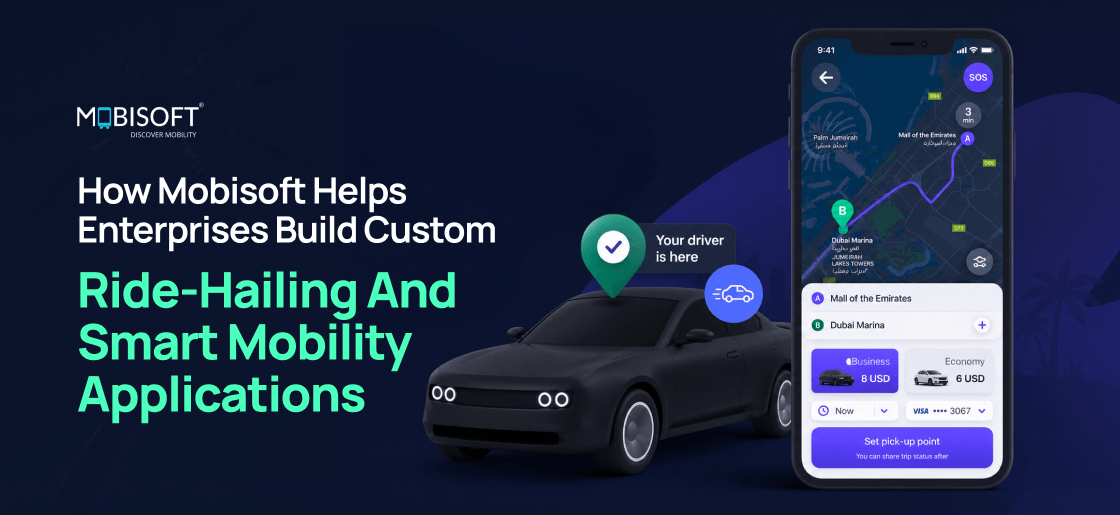
Custom ride hailing app development is one of the most technically demanding mobile product challenges an engineering organisation can take on. It requires real-time infrastructure that processes thousands of driver position updates per second, a matching algorithm that pairs passengers with drivers in under a second, a dynamic pricing engine that responds to supply and demand shifts within minutes, mobile apps that work reliably on low-end devices with poor connectivity, a payments stack compliant with payment card industry standards across multiple markets, and a safety layer that protects passengers and drivers around the clock. Mobisoft builds these systems for enterprises entering the Rideshare & Carpooling App Development space, regional operators launching mobility services, and technology companies modernising legacy transportation infrastructure.
Mobisoft is a mobility app development company that designs and develops end-to-end ride-hailing platforms for enterprises, regional operators, and transportation companies aligned with their personalisation requirements and business vision.
The full platform includes:
- A Passenger App (React Native, iOS, and Android) covering ride booking, vehicle class selection, real-time driver tracking, dynamic fare display, in-app payments, and SOS safety
- A Driver App (React Native, iOS, and Android) covering trip acceptance, navigation, earnings dashboard, offline trip handling, and background GPS with battery optimisation
- A Matching Engine using PostGIS geospatial driver selection with sub-200ms computation
- A Real-Time GPS Layer with WebSocket delivery to the passenger app
- A Dynamic Pricing Engine using H3 hexagonal zone-level supply-demand calculation
- A multi-market Payments stack supporting Stripe, Razorpay, UPI, Apple Pay, and Google Pay
- A Fleet Management system with OBD-II telematics and CSRD ESG carbon reporting
- An Operator Admin Console, and a Safety layer with three-channel offline SOS.
The platform covers multi-jurisdiction compliance, including GDPR, DPDP Act 2023, POSH Act, DVLA PHV, FMCSA HOS, PDPA Singapore, PCI-DSS SAQ A, and CSRD ESRS E1.
Custom vs Off-the-Shelf: The Business and Technical Case for Building Your Own Ride-Hailing Platform
The ride-hailing market has two distinct segments that require completely different approaches. The first is the consumer segment with massive network-effect advantages, international recognition, and very high investments in accumulated infrastructure. Uber, Lyft, Grab, Ola, and DiDi dominate this segment. Competing head-to-head with these platforms in their core urban markets is a waste for new startups, as the gap is too wide. The second segment is the enterprise and regional operator market. This includes regulated non-emergency medical transport, specialised transportation networks, logistics carrier dispatch, private campus and corporate networks, and white-label regional services. This is where custom mobility app development wins decisively.
The Build vs Buy Decision: Seven Dimensions
The table below compares off-the-shelf SaaS platforms with a custom platform built by Mobisoft across the seven dimensions that matter most to enterprise operators.
| Dimension | SaaS Platform | Custom Platform (Mobisoft) |
|---|---|---|
| Matching Algorithm | Fixed vendor algorithm; no access to logic; A/B testing not possible; improvements tied to vendor roadmap. | Fully custom: vehicle class eligibility, rating filters, demand-weighted ranking, acceptance-rate optimisation, distance vs time weighting. Every parameter is operator-controlled. |
| Dynamic Pricing | Simple demand multiplier; no zone-specific strategies; no demand prediction; no operator-defined pricing floors or ceilings. | H3 hexagonal zone granularity, configurable surge caps and floors, LightGBM demand prediction, event-aware pricing, anti-shock rate limiting, market-specific rules. |
| Vehicle Classes | Pre-defined ride types from the vendor (standard, premium, pool). Adding a class requires vendor development. | Unlimited configurable classes with custom pricing, matching rules, driver requirements, and UI. New classes added by the operator in the admin console. |
| Regulatory Compliance | Supports only markets where the vendor operates at launch. FMCSA HOS, DVLA, POSH Act, DPDP Act may not be supported. | Compliance requirements mapped in the Discovery Sprint and built into the data model, driver onboarding, app flows, and reporting from Day 1. |
| Brand Ownership | Vendor design system; limited customisation; core UX decisions are fixed. | Complete brand ownership: custom design system, branded native apps under the operator's developer accounts, custom domain for deep links. |
| Data Ownership | Trip data in the vendor's data warehouse; analytics through vendor's dashboard; no access to raw data. | Full data ownership in the operator's AWS account. Raw trip data in S3 for custom analytics, ML, and compliance. Data never shared with a third party. |
| System Integration | Standard integrations from the vendor's catalogue. Custom integrations are expensive and often not possible. | Custom API connectors for any operator system: IBM Maximo, Oracle TMS, airport FIDS, campus access control, healthcare EMR. |
Enterprise Ride-Hailing Use Cases Mobisoft Builds For
Regional ride-hailing operator
A mobility company launching a branded ride-hailing service or investing in bike sharing system development across one or more cities. The direct competitors can be Uber, Lyft, or Ola in specific markets. Requires the complete six-application platform, real-time matching with sub-one-second dispatch, H3 zone-based surge pricing, driver onboarding with background check integration, and multi-city zone configuration.
Airport and ground transportation
Airlines, airports, or ground transport operators are building a dedicated ride-hailing service. Includes meet-and-greet, pre-booked transfers, and real-time flight delay handling. This is done using FlightAware or FIDS API integration for dynamic ETA adjustment, zone-based airport pickup enforcement by terminal bay. International passengers also get the support of multi-currency.
Healthcare non-emergency medical transport (NEMT)
Healthcare systems or insurers are building patient transport platforms for medical appointments. Requires a wheelchair-accessible vehicle (WAV) matching where the passenger mobility profile and vehicle capability must match before dispatch, Medicaid or Medicare eligibility verification and billing API, driver NEMT certification verification, and HIPAA-compliant data handling with an AWS BAA.
Logistics and delivery fleet dispatch
Logistics companies are building a driver dispatch platform for package delivery, freight, or field-service technicians. Includes multi-stop route optimisation, proof-of-delivery with photo, GPS, and signature, FMCSA HOS compliance for US-regulated carriers, ELD integration, and WMS or TMS integration via REST or EDI.
Campus and private network
Universities, hospitals, or large campuses running a private ride service within a defined geographic zone. Requires a geo-fenced campus boundary, user verification against the campus identity system, a curated driver pool with campus background check, semi-fixed route optimisation, and integration with campus access control systems.
White-label platform for operators
A technology company building a Rideshare App Development solution licensed to multiple regional operators, covering carpooling, vanpooling, and dynamic rideshare matching. It requires multi-tenant architecture with a single deployment, full data isolation per tenant, per-tenant branding under the operator's developer accounts, and per-tenant pricing, driver pool, and compliance configuration.
The Complete Ride-Hailing Platform Architecture: Six Applications, the Matching Engine, and the Real-Time Data Layer
A production-grade smart transportation software platform is not a single application. It is a system of six applications, a matching engine, a real-time communication layer, a payments stack, a fleet management system, and a safety and compliance framework. Understanding the architecture at this level is the prerequisite for correct scoping, realistic timeline estimation, and avoiding the expensive mid-project architecture mistakes that derail transportation app development projects in their third or fourth month.
The Six-Application Platform Architecture
The table below details each of the six applications that make up a production-grade ride-hailing platform.
| Application | Platform | Users | Key Features |
|---|---|---|---|
| Passenger App | React Native (iOS + Android); Expo OTA updates | Riders: consumers, patients, campus users, business travellers | Ride booking (immediate and scheduled)Real-time driver tracking, ETA countdownFare estimate with surge displayIn-app payments: card, wallet, Apple Pay, Google PaySOS safety button and trip sharingRating, review, trip history and receipts |
| Driver App | React Native (iOS + Android); offline SQLite queue; audio alerts | Ride-hailing, NEMT, and logistics drivers | Trip acceptance with a countdown timerTurn-by-turn navigation (Google Maps / Mapbox)Passenger OTP pickup confirmationEarnings dashboard, document upload, and expiry trackingVehicle pre-trip DVIR checklistFMCSA HOS logging for US-regulated carriers |
| Admin Console | Next.js + TypeScript + Tailwind CSS; real-time WebSocket | Operators, fleet managers, pricing managers, support, and compliance officers | Real-time fleet map with live driver positionsTrip lifecycle monitoringDriver and passenger managementDynamic pricing configurationGeofence management and manual dispatch overrideBulk CSV export; RBAC across all roles |
| Driver Onboarding Portal | React (web + mobile); OCR auto-fill; background check webhooks | Driver applicants; compliance review officers | Multi-step onboarding: personal details, licence, vehicle, insurance, background checkBackground check integration (Checkr US, GBG UK)OCR auto-fill for document fieldsCompliance officer review queue (approve / reject / request more info)Driver activation on full approval within 24-48 hours |
| Operations Dashboard | React web; real-time WebSocket; Mapbox GL JS | City operations teams, safety, and incident response officers | Real-time trip map with SOS, stalled trip, and driver offline overlaysPriority SOS alert queue with audio alarmManual dispatch and trip interventionDriver location history playback for incident investigationDemand heatmap by zone and time window |
| Reporting and Analytics | React dashboards; AWS Redshift Serverless; Glue ETL; S3 data lake | Finance, operations analysts, leadership, ESG teams | Trip volume and revenue by city, zone, vehicle class, and timeDriver utilisation and passenger retention metricsDynamic pricing analytics: surge frequency and supply responseFinancial reconciliation: gross bookings, commission, payouts, refundsCSRD ESG carbon emissions reporting for EU operators |
The Matching Engine: How Mobisoft Builds Real-Time Driver Selection and Dispatch
The matching engine is the most consequential technical component of any ride-hailing platform. It determines whether passengers wait two minutes or eight minutes for a driver, whether drivers earn at or above their target hourly rate, and whether the platform achieves the utilisation rates that make unit economics viable. A poorly designed matching engine creates a compounding problem: long wait times reduce passenger demand; lower demand means fewer trips per driver hour; drivers reduce online time; fewer drivers mean longer wait times. This cycle is hard to reverse once it starts. This is one of the most critical considerations in enterprise ride hailing app development.
Matching Algorithm Architecture and Technology Stack
The matching engine runs on the following stack:
- Python FastAPI for the matching service, horizontally scalable on AWS ECS Fargate
- PostGIS on Amazon Aurora PostgreSQL for geospatial driver position queries
- Redis ElastiCache for the real-time driver availability pool, position cache, and TTL management
- AWS SQS FIFO for the trip request queue, with exactly-once processing so no requests are dropped under load
- DynamoDB for trip records, driver state machine, and passenger sessions
Matching Process (per trip request, four steps)
Step 1: Eligibility Filter
Retrieve available drivers from Redis. Filter by: within catchment radius using PostGIS ST_DWithin on Aurora (3-5 km urban, 10-15 km rural); vehicle class matching the requested ride type; driver rating above platform minimum (default 4.0, configurable per operator); not on an active trip; not in a temporary do-not-dispatch grace period following a post-cancellation cooldown.
Step 2: Candidate Ranking
Composite score is calculated as follows:
- Estimated time-to-pickup or ETA (40%): routing API call per candidate; lower ETA scores higher
- Driver acceptance rate (20%): penalises cherry-picking and improves platform-wide acceptance
- Trip count in zone today (15%): favours zone-resident drivers and reduces dead mileage
- Driver rating (15%): higher-rated drivers ranked higher, particularly for premium classes
- Time waiting for a trip (10%): prevents starvation of drivers with lower scores on the day
Step 3: Dispatch
The top-ranked driver receives a trip offer via push notification. The acceptance window is 15 seconds, configurable by the operator. A decline or timeout sends the offer to the second-ranked driver. The cascade continues until accepted. If no acceptance is received after N attempts, the trip returns to the queue with an expanded radius and is re-matched.
Step 4: Post-Acceptance
A trip record is created in DynamoDB. The driver states updates en route in Redis. The passenger receives a push notification with the driver's name, vehicle plate, rating, and ETA.
Latency targets: matching computation under 200ms; driver push notification under 800ms; passenger notification under 1 second from acceptance.
POSH Act Pre-Filter (India Deployments)
If the passenger has selected a women-only ride preference, only female-verified drivers enter the eligibility set. This filter is absolute and non-overridable by ranking or shortage conditions. Driver gender is verified at onboarding via government ID and liveness check, and is immutable on the driver record.
The Real-Time Location and ETA Engine
Driver GPS Collection
react-native-background-geolocation with adaptive polling: 3-5 seconds on an active trip, 15-30 seconds while online and waiting, and 5 minutes when offline. An Android foreground service prevents the OS from killing it. iOS uses Significant Location Change mode for idle battery efficiency. A distance filter of 10m minimum movement triggers updates and prevents GPS jitter in stationary vehicles. The heartbeat interval is set at 15 seconds. Latency target: under 2 seconds from driver GPS event to Kinesis stream. Battery target: under 3% additional drain per hour at 5-second polling on a Samsung Galaxy A15.
Position Store
DynamoDB current_positions stores one record per driver with attributes for latitude, longitude, heading, speed, accuracy, timestamp, city_id, and status. PostGIS on Aurora handles geospatial queries using ST_DWithin for catchment radius at match time. A Redis cache of driver positions is maintained for sub-millisecond reads by the matching engine. Read latency targets: Redis HGET under 1ms; DynamoDB read under 5ms; PostGIS ST_DWithin on indexed table under 50ms for 10,000 drivers.
WebSocket Delivery to Passengers
API Gateway WebSocket API connects the passenger app on trip confirmation. The passenger receives driver position updates every 5 seconds and trip status events for en route, arrived, trip started, completed, and cancelled states. Lambda handles route events. Connection IDs are stored in DynamoDB for the trip lifetime. The passenger app reconnects with exponential backoff (1s, 2s, 4s, 8s maximum) on disconnect. End-to-end target: under 3 seconds from driver GPS event to passenger map update.
ETA Engine
Google Distance Matrix API (primary) or HERE Routing API (flat-rate contract for high volume). ETA is recalculated on every driver position event during dispatch. Routing API responses are cached in Redis with a 30-second TTL for the same origin area and destination, achieving over 60% cache hit rate in high-density urban zones. ETA accuracy target: within 15% of actual for 90% of trips.
Surge Pricing Engine
H3 hexagons at resolution 8 (approximately 600m diameter) tile the service area. The supply-demand ratio is calculated per cell every 60 seconds. The anti-shock rule prevents the multiplier from increasing by more than 0.5 times per 60-second cycle. Results are written to Redis per H3 cell with a 90-second TTL. Surge calculation completes in under 2 seconds for 500 H3 cells. LightGBM demand prediction alerts offline drivers 20-30 minutes before predicted peaks.
Passenger and Driver App Engineering: Building the Mobile Experience Layer
The passenger and driver apps are the interface between the platform's backend precision and the human experience of ride-hailing. Passengers experience the platform as map responsiveness, ETA accuracy, and payment reliability. Drivers experience it as offering clarity, earnings transparency, and understanding how the app behaves after 10 hours in the field. Every architectural decision in the backend manifests through these apps. Mobisoft's mobile app development solutions are built to perform reliably in real-world field conditions, not just demo environments, which is why both the passenger and driver apps are engineered to the same production standards.
Passenger App: Core Feature Engineering
Map and Booking Interface
Google Maps SDK via react-native-maps shows the booking screen with the passenger location pinned. Google Places Autocomplete, with a 300ms debounce, handles destination input. Nearby available drivers appear as animated markers before booking, giving a visual indication of zone supply levels. Client-side interpolation of driver markers between 5-second server updates renders at 60fps for smooth animation. Map tiles are cached at 50MB for patchy connectivity. Recent destinations are cached in local SQLite for instant display. Fare estimate is delivered within 500ms of destination selection.
Vehicle Class and Fare Display
Fare estimate is calculated as base fare plus per-km rate times estimated distance plus per-minute rate times estimated duration plus surge multiplier. The vehicle class selector shows available classes (Standard, Premium, WAV, Cargo, Motorbike) with fare per class and the nearest driver ETA per class. Class cards are swipeable horizontally. Surge displays as 'Prices are 1.8 times higher than normal' with a countdown to surge expiry. The fare difference versus Standard is shown in the premium classes. Fare accuracy target: within 15% of the final fare for 90% of trips.
Real-Time Trip Tracking
A WebSocket connection opens on trip confirmation. The driver position updates every 5 seconds with an animated marker and a route polyline updated per position event. ETA countdown is visible throughout. Route deviation alerts trigger if the driver is more than 300m off the expected route for more than 60 seconds, giving the passenger the option to call the driver or trigger SOS. Driver arrival notification is sent via push when the driver is within 200m of the pickup. In-app chat and masked VoIP calling ensure no personal numbers are exposed.
In-App Payments
Stripe covers the US, UK, EU, AU, SG, and UAE. Razorpay covers India and MY. UPI is available via Razorpay. Apple Pay and Google Pay are supported via their respective SDKs. An in-app wallet uses a prepaid balance in DynamoDB with a versioned balance and double-spend prevention via condition expressions. PCI-DSS SAQ A ensures card data sits exclusively on the processor's infrastructure. The platform stores only the payment method token. Payment success target: above 99% for tokenised cards. Charge latency: under 3 seconds from trip completion to notification.
Safety Features
The SOS button is a persistent floating button on the active trip screen that cannot be dismissed. Triggering it sends an SMS to emergency contacts via native SMS API (works without internet data), a priority alert to the operations dashboard, and an HTTPS alert to the platform API. All three channels deliver in parallel. Trip sharing provides a live tracking URL for non-app contacts. Offline SOS stores trip details, including driver name, plate, and GPS coordinates, in on-device SQLite updated every 5 seconds during the trip, so the SMS channel functions in data-dead zones. SOS delivery target: under 8 seconds to at least one channel when connectivity is available.
Driver App: Engineering for Eight Hours in the Field
A passenger uses the app for 5-15 minutes per trip. A driver may operate the app for 8-12 hours continuously while charging from a vehicle USB port, operating in bright sunlight with one hand available at traffic lights, and moving through tunnels and car parks. These constraints define the driver app's engineering requirements in any serious transportation app development engagement.
Background GPS Battery Management
Adaptive polling runs at 3-5 seconds on an active trip, 15-30 seconds while online and waiting, and 5 minutes when offline. react-native-background-geolocation uses a distanceFilter of 10m minimum movement to prevent GPS jitter in stationary vehicles, and a heartbeatInterval of 15 seconds for periodic updates. Android uses a foreground service with a persistent notification showing the driver's online status and current trip earnings. iOS uses Significant Location Change mode when offline. Battery benchmark: under 3% additional drain per hour above baseline at 5-second polling on a Samsung Galaxy A15.
Offline Trip Handling
Trip completion data is queued in op-sqlite in WAL mode when connectivity is lost. Queue entries include trip ID, completion timestamp, GPS coordinates, and proof-of-delivery photo (base64) for the logistics variant. Data is transmitted with an idempotency key when connectivity returns. The backend confirms before crediting earnings. Queue retry uses exponential backoff capping at 5-minute intervals. Earnings are credited after reconciliation, not at queue transmission time.
Trip Offer Clarity (Glanceable UI)
A full-screen trip offer modal shows trip distance, estimated earnings including surge, pickup location label, and vehicle class. The 15-second countdown timer is prominent. A single large accept button at a minimum 72dp height is the primary action. The reject button is smaller and secondary. An audio chime and a distinct haptic vibration pattern alert the driver when the app is in the background. The first three declines per hour incur no penalty. More than three declines per hour result in a slight reduction in priority ranking to reduce cherry-picking without punishing legitimate declines.
Navigation Integration
Google Maps SDK navigation launches automatically to the pickup on trip acceptance and redirects to the passenger's destination after pickup OTP is confirmed. A fallback to external navigation apps such as Waze or Apple Maps is available if the driver switches. The driver app continues background GPS regardless of which navigation is active. The route is pre-fetched on the trip offer, so navigation starts instantly on acceptance. Speed limit display with a visual alert at 10% over the limit and route deviation detection keeps the operations team informed.
FMCSA HOS (USA Logistics Variant)
49 CFR Section 395.3 property-carrying limits are enforced: 11-hour driving, 14-hour on-duty window, 10-hour off-duty, 30-minute break at 8 hours, and 60/70-hour weekly rule. Driver status options are Off Duty, Sleeper Berth, Driving (auto-detected via GPS above 8 mph), and On Duty Not Driving. HOS violation alerts appear visually at 30 minutes remaining, with a mandatory break alert and a supervisor push notification on violation. ELD integration covers Section 395.26 event types ELD-1 through ELD-8 and malfunction codes M-1 through M-9.
Earnings Transparency
Per-trip breakdown shows base fare, surge, tips, and bonuses. A daily and weekly earnings graph appears on the driver app home screen. Progress toward the driver-defined daily target is visible. Instant payout is available via Razorpay Route for India and Stripe Express for the US and UK. Surge earnings are highlighted in a distinct colour so drivers understand zone-based earnings incentives. Tax documents are accessible in the driver app, including Form 16A for India TDS and 1099 for US Stripe Express.
Dynamic Pricing Architecture: Surge Algorithm, Demand Prediction, and the Operator Control Layer
Dynamic pricing is the most commercially significant and most emotionally charged feature in a ride-hailing platform. When designed correctly, it reduces passenger wait times during peak demand by attracting additional driver supply to high-demand zones. When communicated poorly, it generates passenger backlash and regulatory scrutiny. Getting the pricing architecture right requires getting both the algorithm and the transparency UX right simultaneously, while giving operators enough control to manage the exceptions their local markets create. This is a key differentiator in smart mobility platform development.
Dynamic Pricing System Components
Base Fare Calculation
Per-trip fare equals base fare plus per-km rate times distance plus per-minute rate times duration plus booking fee minus promotional discount. Trip distance is derived from a GPS trace using Kalman-filtered Haversine segments. Duration runs from the trip start to the end timestamp. All rates are stored in DynamoDB per vehicle class per pricing zone. A minimum fare is enforced to prevent micro-trips from being uneconomical. A cancellation fee applies if the passenger cancels after the driver has been en route for more than three minutes. A waiting fee accrues after the grace period at pickup (default five minutes).
Operator configuration options:
- Per-zone: base fare, per-km, per-minute, minimum fare, booking fee, cancellation fee, waiting fee rate, and grace period
- Vehicle class-specific rates
- Time-of-day pricing bands for peak and off-peak windows
Surge Multiplier Engine
H3 resolution 8 hexagons (approximately 600m diameter) tile the service area. The supply-demand ratio is calculated per cell every 60 seconds. Formula: max(1.0, min(surge_cap, 1 + demand_coefficient times max(0, pending_requests minus available_drivers)); demand_coefficient defaults to 0.3. Anti-shock: the multiplier cannot increase by more than 0.5 times per cycle. Surge reduction decreases by 0.3 times per cycle when supply exceeds demand until it reaches 1.0 times. Results are written to Redis per H3 cell with a 90-second TTL. Passengers see 'Prices are 1.8 times higher' with a 30-minute countdown to the expected decrease.
Operator configuration options:
- Surge cap per zone and vehicle class (default 2.5 times)
- Surge blackout zones for hospital emergency entrances and disaster relief areas
- Surge-exempt trip types (scheduled rides lock the fare at booking time)
- Surge-exempt accounts for government emergency services and premium subscription passengers
ML Demand Prediction
LightGBM is trained on 90 days of historical trip data. Features include hour, day of week, upcoming events from a local event calendar API or Ticketmaster or Eventbrite integration, weather from OpenWeatherMap, and school term calendar. If the predicted demand 30 minutes ahead exceeds the supply by more than 40%, a gradual multiplier increase starts 20 minutes before the peak. Offline drivers in the predicted zone receive a push alert: 'High demand expected near you at 6 pm. Consider going online.' The model re-trains weekly on the latest 90 days. Accuracy target: within 15% of actual demand for 80% of predictions.
Operator configuration options:
- Operator enables or disables demand prediction per city
- Event calendar integration configurable via CSV upload or Ticketmaster API key
- The prediction confidence threshold for pre-surge activation is configurable
- Pre-surge driver communication is opt-in for drivers
Promotional Pricing
Fixed-fare promotions cover defined corridors and override dynamic pricing. Percentage discount promotions, first-ride-free (one per device fingerprint and payment method combination), promo codes (single or multi-use with configurable value, expiry, ride type, and zone eligibility), a loyalty programme (points per trip, redeemable for fare credits), and a referral programme (crediting both referring driver and passenger on the referred passenger's first trip) are all supported. Abuse prevention uses a device fingerprint and a payment method combination for a first-ride-free. Referral tracking uses fraud heuristics to prevent same-device referral rings.
Operator configuration options:
- Admin console promotion wizard: type, value, eligibility conditions, budget cap, date range, eligible zones, and vehicle classes
- Real-time promotion performance dashboard
- Bulk promo code generation for offline distribution via flyers or partnerships
Payments Architecture: PCI-DSS-Compliant Multi-Market Payment Processing for Ride-Hailing
The payment layer is the highest-risk component in a ride-hailing platform from a compliance, security, and user experience perspective. A payment failure at trip completion is the most damaging single UX event in the passenger journey. A PCI-DSS compliance gap exposes the operator to card scheme penalties. A driver payout delay damages driver retention more than any other operational issue. Building a payment stack that handles all three concerns across multiple markets requires specific architectural choices for each market, making it a critical step in any on demand transportation app development project.
Multi-Mode Payment Architecture
Card (Stripe or Razorpay)
The payment processor's SDK collects card data on the device. Card data never touches platform servers, ensuring PCI-DSS SAQ A compliance. The charge is initiated by Lambda on trip completion via a stored payment method token. An idempotency key equal to the trip ID prevents duplicate charges on Lambda retry. Stripe covers the US, UK, EU, AU, SG, and UAE. Razorpay covers India and MY. Both support 3DS2 for EU and UK Strong Customer Authentication. The platform stores only the token and the last four digits.
UPI (India)
Razorpay UPI supports VPA or QR at trip completion. Confirmation is delivered via Razorpay webhook to Lambda. Webhook HMAC signature is verified before processing. The UPI transaction ID is stored for reconciliation. Refunds go through the NPCI refund API and take 3-5 business days. UPI accounts for more than 55% of digital transactions in India in 2026. MDR is 0-0.5% versus 1.5-2% for card. The RBI per-transaction limit is 1 lakh rupees.
Digital Wallet (In-App Prepaid)
Prepaid balance is stored in DynamoDB per user with a versioned balance. Double-spend prevention uses DynamoDB condition expressions to verify that the balance is greater than or equal to fare and version equals the current value. Wallet top-up supports card, bank transfer via IMPS or NEFT for India, ACH for the US, SEPA for the EU, and Faster Payments for the UK. Auto-topup is configurable, and a low-balance alert triggers at 20% remaining.
Apple Pay and Google Pay
Stripe Apple Pay uses PKPaymentToken. Razorpay Google Pay uses PaymentData. Device biometric authentication (Face ID, Touch ID, or fingerprint) authorises payment. A device-specific dynamic card number (DPAN) is used in the transaction. No static card number is transmitted. PCI-DSS SAQ A applies via tokenisation. Secure Enclave authentication on Apple Pay provides an additional security factor.
Cash (Operator-Configurable)
The passenger selects cash at booking. The driver app shows a prominent 'Cash trip' flag throughout. The driver confirms cash received at completion. Cash trips are excluded from promotional discounts. Cash revenue is flagged as pending until driver confirmation. Daily cash reconciliation appears in the driver earnings dashboard. This mode is primarily used in markets with low digital payment penetration in parts of South Asia, Africa, and Southeast Asia.
Driver Payout
Weekly batch payout runs every Sunday night. Lambda calculates net earnings as gross fares times driver commission percentage minus deductions. Payout goes via NEFT or IMPS for India, ACH for the US, SEPA for the EU, and Faster Payments for the UK. Instant payout is available via Razorpay Route for India and Stripe Express for the US and UK for qualifying drivers who meet minimum trip count and rating thresholds. Payout status is visible in the driver app. India payouts include TDS Section 194O deduction and require PAN card verification before the first payout.
Fleet Management and Telematics: How Mobisoft Builds the Operational Layer That Keeps a Ride-Hailing Fleet Compliant and Profitable
Fleet management is the layer that most technology-first founders underestimate. Consumer ride-hailing platforms treat vehicles as attributes of the driver record. For enterprise operators running owned or leased fleets, fleet management is core infrastructure: certificates expire, vehicles need preventive maintenance based on actual usage, telematics data drives insurance cost, and driver behaviour affects both safety and fuel spend. Neglecting this layer creates operational crises that are visible to passengers. Enterprise mobility solutions require a complete fleet management system from day one.
Fleet Management System Architecture
Vehicle Lifecycle Management
Vehicle records in DynamoDB store VIN, make, model, year, capacity, fuel type, plate number, registration expiry, insurance expiry, periodic inspection certificate expiry (MOT for UK, PUC for India, state inspection for US), last service date, and GPS-derived current odometer. Automated compliance alerts fire 30 days before expiry for insurance and registration, and 14 days for inspection. Vehicles are auto-deactivated on expired certificates. DVLA API is used for real-time vehicle registration verification in the UK. RTO API covers road-worthiness certificates in India. Fleet operators who dispatch vehicles with expired insurance or inspection certificates face legal liability and potential licence revocation in regulated markets.
Driver-Vehicle Assignment
Many-to-many assignment supports shift scheduling: one vehicle can be assigned to multiple drivers across shifts, and one driver can be authorised for multiple vehicle types. Shift-based assignment carries start and end times. DVIR is required at shift start and end via the driver app. Critical defects, including brakes, tyres, and lights, prevent dispatch until cleared by a maintenance officer. Vehicle condition is cross-referenced across shifts for damage attribution. DVIR defect reporting integrates with the maintenance workflow to ensure issues are remediated before the next dispatch.
Preventive Maintenance Scheduling
Maintenance triggers include mileage-based schedules (every 10,000 km for oil change via GPS odometer), time-based schedules (annual brake fluid), and condition-based triggers from OBD-II sensor thresholds. Maintenance due alerts fire 500 km or 14 days before scheduled service. Work orders are created in the platform or via IBM Maximo 7.6.x REST API or Samsara or Fleetio integration. Vehicles are deactivated from dispatch when overdue beyond the grace threshold. Preventive maintenance based on GPS-derived actual usage is more accurate than calendar-based scheduling.
Telematics and Driver Behaviour
OBD-II dongles (Geotab GO9, Samsara VG34, or Teltonika FMB920) stream J1939 CAN bus data via MQTT to AWS IoT Core. Data per vehicle includes speed, RPM, throttle, hard acceleration above 0.4g, hard braking above 0.4g, hard cornering above 0.5g lateral, idle time, and fuel consumption. The driver behaviour score starts at 100 and is deducted per harsh event. Monthly driver scorecards are available in the driver app. Top scorers get priority in ranking and access to premium vehicle classes. Usage-based insurance (UBI) enables safe fleets to achieve a 15-25% premium reduction by sharing OBD-II data with participating insurers.
Fuel and Energy Management
Fuel card integration covers WEX, Corpay, and HPCL India. Purchases are linked to vehicle ID and driver ID via webhook. GPS cross-validation flags purchases when the vehicle GPS is not within 200m of the fuelling station, which serves as a fuel fraud indicator. Fuel consumption per 100 km is calculated per driver per week. Deviation from the vehicle baseline triggers a review alert. For the EV fleet, charge monitoring uses OCPP 1.6 or 2.0. A range alert fires when the state of charge drops below 20%, with the nearest charger displayed in the driver app.
CSRD ESG Carbon Reporting
GPS trip distance is measured at plus or minus 1.5% accuracy via a Kalman-filtered trace with odometer cross-validation. Emission factors per vehicle type and fuel use DEFRA UK, EPA US, and MoEFCC India standards. CSRD ESRS E1 Scope 3 Category 5 (business travel) and Category 9 (downstream transport) are covered. A signed auditor-ready CSV export is available per reporting period. A real-time carbon dashboard and an API endpoint for sustainability platforms such as Watershed and Persefoni are included. CSRD ESRS E1 is mandatory for EU operators above EUR 40 million revenue from FY2025. Scope 3 transport emissions are typically 30-60% of a transport company's total GHG footprint.
Safety Architecture and Multi-Jurisdiction Compliance: Building Ride-Hailing Platforms That Operate Legally and Safely
Safety and legal compliance cannot be added to a ride-hailing platform after launch. They are architectural constraints that shape the driver onboarding flow, the data model, the background check infrastructure, the passenger app UI, and the reporting framework from the first design session. A platform built without these constraints faces two outcomes: a costly compliance retrofit that takes longer than building it correctly the first time, or a regulatory or safety incident that imposes costs far larger than any retrofit. Mobisoft addresses this through mobility software development practices that embed compliance from day one.
Driver Verification and Background Check Architecture
Identity Verification
Government-issued ID OCR at onboarding covers passport, driving licence, and national ID. Auto-extraction captures name, date of birth, ID number, and expiry. Liveness check compares a selfie against the ID photo via a facial similarity API using Amazon Rekognition or Onfido. Liveness detection prevents photo spoofing. The driver record is not activated until identity verification passes. Annual re-verification is required for active drivers. India uses Aadhaar eKYC via UIDAI API for instant verified identity (Aadhaar stored as a hash). The UK uses the DVLA API for real-time licence validity and category checks. Singapore uses Singpass MyInfo API for verified identity and LTA driver licence status.
Driving Licence Verification
Licence is uploaded at onboarding. OCR extracts the number, expiry, and endorsements. Verified against the national licensing authority database, where the API is available, and re-verified at each renewal date. Endorsements for drink-driving or dangerous driving flag the driver for compliance officer review before activation. UK uses DVLA Licence Check API with real-time verification on onboarding and a quarterly automated re-check for all active drivers. Revocation is detected within 48 hours of the DVLA record update. India uses the Sarathi Parivahan DL API for class and validity. The US uses MVR (Motor Vehicle Record) via Checkr per state requirements.
Criminal Background Check
Third-party services include Checkr for the US, GBG for the UK, ACIC-compliant providers for Australia, and Refinitiv or LexisNexis for international checks. Background checks are run on the driver application. Results arrive via webhook in hours to three business days. Adverse findings are reviewed by the compliance officer against platform eligibility criteria, and the decision is documented. The UK requires a DBS Enhanced Check for PHV drivers in most local authority licensing jurisdictions. India requires a Police Verification Certificate. Australia requires a National Police Check via an ACIC-accredited provider.
Vehicle Certification
The registration document is verified via OCR plus API cross-check. The insurance certificate is verified. An annual roadworthiness certificate covers MOT for the UK, PUC for India, and state inspection for the US. Vehicle age and model eligibility rules are configurable by the operator. Vehicle photos covering front, rear, interior, and plate are verified by a compliance officer for physical condition. UK MOT check uses DVLA API. India uses the Vahan API for registration and fitness certificates. Airport authority licences often specify a minimum vehicle age above base TNC requirements.
Multi-Jurisdiction Compliance Matrix
The table below details the key requirements and technical implementations for each supported jurisdiction.
| Jurisdiction | Key Requirement | Technical Implementation |
|---|---|---|
| India: POSH Act | Women-only ride option for female passengers. Matching must be an absolute filter. Only female-verified drivers are eligible when this option is selected. | Absolute POSH pre-filter in matching engine: non-overridable, applied before all other ranking dimensionsDriver gender verified via government ID OCR and liveness check; immutable on driver recordPOSH ride flag stored per trip for compliance audit; monthly POSH count in admin reports |
| India: DPDP Act 2023 | Lawful basis for processing personal data; right to erasure within 30 days; data minimisation; DPDP-compliant Privacy Notice. | Consent management at registrationData deletion: account anonymisation within 30 days of requestTrip records retained with anonymised user ID for accounting and safetyDPO designation for platforms above the Significant Data Fiduciary threshold |
| UK: DVLA and PHV Licensing | PHV operator licence, driver PHV licence, vehicle PHV licence. Platform must verify DVLA licence validity and cannot dispatch a driver with a revoked or expired PHV licence. | DVLA Licence Check API on onboarding and quarterly automated re-check for all active UK driversPHV licence verification against the local authority database where API is availableOperator licence compliance dashboard |
| EU / UK: GDPR | Lawful basis for data processing; right to erasure and portability; data processor agreements with AWS; international transfer mechanisms. | GDPR Privacy Policy and consentDSR workflow (access, rectification, erasure, portability) within 30 daysTrip records pseudonymised 90 days post-completionAWS DPA; breach notification within 72 hours to supervisory authority |
| USA: FMCSA | 49 CFR Part 395 HOS for CMV operators; ELD mandate; DVIR pre/post-trip; driver qualification file. | HOS in driver app: 11-hr driving, 14-hr window, 10-hr off-duty, 30-min break at 8 hrs, 60/70-hr ruleAuto Driving detection above 8 mph; ELD integration per §395.26DVIR in driver app; data retention per §395.22 |
| Singapore: PDPA and LTA | Data protection with consent; PDPC breach notification within 3 business days for breaches affecting 500+ users; LTA point-to-point operator licence. | PDPA-compliant Privacy Notice; breach response planLTA driver and vehicle licence verification via LTA APISingapore's personal data transfer restrictions addressed via appropriate transfer mechanisms |
SOS Architecture: Safety When Connectivity Fails
The Problem with Standard SOS Implementations
Standard SOS implementations make an API call when triggered. If the passenger's device has no data connection in a tunnel, basement car park, or on a rural road, the API call fails silently. The passenger believes help is coming. It is not.
Offline SOS Architecture
On-device persistence using op-sqlite stores trip metadata, including trip ID, driver name, vehicle plate, and GPS position updated every 5 seconds during the trip in local SQLite.
When SOS is triggered, three parallel delivery channels operate:
- Native SMS API: uses the cellular SMS band rather than data; delivers to emergency contacts even without internet in areas with SMS-only coverage
- FCM or APNs push queue: the operations centre is alerted when connectivity returns
- HTTPS POST to platform SOS API: logged and escalated on connectivity return
In-app confirmation shows which channels were delivered. The operations dashboard triggers a priority audio alarm with a visual highlight. SLA is three minutes to acknowledge, after which the duty manager is escalated.
Additional Incident Features
- Route deviation: driver more than 300m off route for more than 60 seconds triggers an operations alert and a passenger in-app alert
- Stalled trip: no movement for more than 10 minutes during an active trip triggers an operations alert
- Driver offline mid-trip: connectivity loss during an active trip triggers an alert to the duty manager
- Post-incident evidence: full GPS trace stored for 90 days for insurance and legal purposes.
How Mobisoft Engages for Ride-Hailing Platform Projects: Delivery Model, Timeline, and Investment
Custom ride hailing app development is a product engineering programme. The architecture decisions made in the first two to three weeks propagate through the entire system. Reversing these decisions in Month 3 costs more in engineering time than the entire Discovery Sprint that prevented the error. Mobisoft's engagement model front-loads these decisions so that the build phase proceeds on a validated foundation.
Engagement Phases, Deliverables, and Investment
The table below covers all four build phases plus ongoing managed services.
| Phase | Duration | Key Deliverables | Investment (USD) |
|---|---|---|---|
| Discovery Sprint | 2-3 weeks | Requirements definition and use case mappingDatabase architecture choice with rationale ADRMatching algorithm design: geospatial approach, ranking dimensions, driver state machineReal-time layer selection: WebSocket API Gateway vs AppSync vs MQTTPayment processor selection per target market with compliance analysisDynamic pricing model: zone granularity, surge formula, operator controlsCompliance requirements inventory: FMCSA, DVLA, GDPR, DPDP Act, and POSH Act as applicableSix-application scope definition with MVP vs Phase 2 prioritisationTechnical prototype of matching engine and GPS tracking; Architecture Decision Record (ADR) | $5,000-$8,000 |
| MVP Build (Phase 1) | 14-18 weeks | Passenger App (iOS + Android): booking, real-time tracking, vehicle class selection, fare estimate, payment (one processor per market), SOS, trip historyDriver App (iOS + Android): trip management, GPS, navigation, earnings, document managementAdmin Console (web): fleet map, trip management, driver and passenger management, basic pricingMatching engine: geospatial matching, ETA calculation, basic surgeAWS infrastructure: multi-AZ Landing Zone, API Gateway, Lambda, DynamoDB, ElastiCache Redis, KinesisGDPR/DPDP privacy policy and data retention; Grievance Officer workflow | $50,000-$90,000 |
| Advanced Features (Phase 2) | 8-12 weeks | ML demand prediction (LightGBM, weekly retraining) and pre-surge driver communicationFull promotional pricing systemComplete compliance: FMCSA HOS + ELD (US), DVLA API (UK), POSH Act (India), PDPA (Singapore)Fleet management: vehicle lifecycle, DVIR, preventive maintenance, telematics integrationDriver behaviour scoring and gamificationBackground check integrations (Checkr US, GBG UK)Multi-city zone configuration; white-label branding finalisationNEMT HIPAA variant (if applicable); CSRD ESG carbon reporting (if EU operator) | $50,000-$90,000 |
| Performance, Scale, and Security | 3-4 weeks | Load testing: 50,000 concurrent passengers, 5,000 active trips, 2,000 driver position updates/secondPerformance optimisation: ElastiCache tuning, DynamoDB capacity planning, Lambda concurrencySecurity assessment: AWS Well-Architected Review, penetration testing (OWASP Mobile Top 10, OWASP API Security Top 10)PCI-DSS SAQ A self-assessmentDisaster recovery: AZ failover testing, RTO measurement | $20,000-$35,000 |
| Post-Launch Managed Services | 12-month initial term | 24/7 CloudWatch + PagerDuty monitoringWeekly performance reports: trip success rate, matching latency, payment success rate, driver availabilityMonthly Well-Architected review; quarterly feature sprintCompliance monitoring: document expiry alerts, licence re-check schedule, regulatory update monitoringFinOps: RI optimisation, right-sizing, monthly cost reportIncident response SLA: P1 within 15 minutes; P2 within 1 hour | $6,000-$18,000/month |
What Separates Mobisoft from Generic App Development Vendors
Matching Algorithm Depth
Generic app vendors typically implement basic distance-based assignment without demand-weighted ranking, acceptance-rate optimisation, or starvation-prevention weighting. As an enterprise app development company, Mobisoft offers deep expertise in scalable architectures to build production-grade matching with PostGIS ST_DWithin geospatial queries, multi-factor ranking with configurable weights, POSH Act absolute pre-filter, driver state machine management, and cascade dispatch with radius expansion.
Real-Time Infrastructure Expertise
Polling-based location updates are the default for generic vendors. WebSocket fan-out via DynamoDB Streams at scale, end-to-end delivery under 3 seconds, and Kinesis position history require production AWS real-time architecture experience. Mobisoft's documented real-time path runs from DynamoDB position write to Kinesis to DynamoDB Stream to Lambda to API Gateway WebSocket, scaling to thousands of concurrent trips without architecture changes.
Dynamic Pricing System Design
Generic vendors apply a simple multiplier to the fare. H3 hexagonal zone calculation, anti-shock rate limiting at a maximum of 0.5 times increase per cycle, LightGBM demand prediction, and driver supply-response modelling require dedicated pricing system expertise. Mobisoft builds the full surge system with operator-configurable caps and blackout zones.
Multi-Jurisdiction Compliance
Generic vendors encounter FMCSA HOS, DVLA, POSH Act, and DPDP Act as mid-project scope additions with change request fees. Mobisoft maps compliance requirements in the Discovery Sprint and designs them into the data model, driver onboarding, app flows, and reporting from Day 1. Specific API integrations, including DVLA, UIDAI, Sarathi Parivahan, and NPCI, are built and tested before launch.
Mobile Engineering for Field Conditions
Apps that work in an office demo environment are not apps that work in the field. Background GPS battery management, offline SQLite queue, offline SOS multi-channel delivery, and adaptive polling for 8-hour driver use require field-tested mobile expertise. Mobisoft benchmarks adaptive polling (3-5 seconds on trip, 15-30 seconds on standby, 5 minutes offline), offline SQLite queue with idempotency keys, and offline SOS with native SMS delivery in data-dead zones on a Samsung Galaxy A15.
Related Services from Mobisoft
Enterprises building complex multi-platform products can work with Mobisoft as an enterprise app development company with deep expertise in scalable, compliance-ready architectures.
Platforms focused on pooled and shared transport can explore Mobisoft's Rideshare App Development capabilities, which cover carpooling, vanpooling, and dynamic rideshare matching.
Operators who need a trusted vendor for end-to-end product delivery can learn more about Mobisoft's mobile app development solutions that span native, cross-platform, and enterprise-grade applications.
The Ride-Hailing Platform That Works in the Real World
Every ride hailing app development project has a time-to-market objective. Some prioritise speed so aggressively that they launch with a polling-based location update instead of WebSocket real-time delivery, a simple distance-based driver assignment instead of a demand-weighted matching algorithm, and no offline SOS because it is treated as a Phase 2 feature. Passengers experience the polling latency as a driver marker that jumps across the map. Drivers experience distance-based matching as an unfair allocation system. The first safety incident without a working offline SOS in a data-dead zone becomes a regulatory and reputational crisis.
The engineering decisions that are expensive to get wrong are the matching algorithm design, the real-time infrastructure, the dynamic pricing zone granularity, the payment processor by market, and the compliance data model. All of these are made in the first two to three weeks of a properly scoped project. The Discovery Sprint investment pays for itself within the first month of the build phase by preventing the rework that incorrect architecture decisions create. This applies whether you are looking for scalable transportation software solutions to build from scratch or modernising a legacy dispatch system.
If you are building a custom mobility app development project, the most valuable first conversation is about the matching algorithm, the dynamic pricing design, and the compliance requirements for your target markets. The app interface follows from those decisions, not the other way around. Contact Mobisoft's smart mobility application development team to start that conversation.
Mobisoft Infotech: Ride-Hailing and Smart Mobility Platform Engineering
Custom Ride-Hailing Platforms | Regional Mobility Services | NEMT Healthcare Transport | Logistics Dispatch | Campus Mobility | White-Label Platforms for Operators
Technical Capabilities:
- Matching: PostGIS + FastAPI + Redis; under 200ms computation; cascade dispatch
- Real-Time: WebSocket API Gateway; DynamoDB Streams; under 3s GPS-to-passenger
- Dynamic Pricing: H3 hexagonal zones; LightGBM demand prediction; anti-shock rules
- Mobile: React Native; cold start under 2.5s; offline SOS; background GPS under 3% per hour
- Fleet: OBD-II J1939 telematics; DVIR; IBM Maximo; CSRD ESG; EV OCPP
Compliance:
- POSH Act (India); DPDP Act 2023; DVLA PHV (UK); FMCSA HOS + ELD (USA)
- GDPR (EU and UK); PDPA (Singapore); PCI-DSS SAQ A; CSRD ESRS E1
- HIPAA NEMT variant; airport authority compliance; multi-jurisdiction data residency

Frequently Asked Questions
What does Mobisoft build for enterprise ride-hailing platforms?
Mobisoft delivers complete custom ride hailing app development for enterprise operators, regional mobility companies, healthcare NEMT providers, logistics companies, and campus networks. The full scope includes Passenger App (React Native, iOS, and Android), Driver App, Admin Console, Driver Onboarding Portal, Operations Dashboard, and Reporting Platform. The backend uses Python FastAPI with PostGIS, Redis, AWS DynamoDB, Kinesis, and API Gateway WebSocket. Multi-market payments cover Stripe, Razorpay, UPI, Apple Pay, and Google Pay. Compliance covers GDPR, DPDP Act 2023, POSH Act, DVLA, FMCSA HOS, PDPA Singapore, PCI-DSS SAQ A, and CSRD ESRS E1.
How does the ride-hailing matching algorithm work?
Mobisoft's matching engine runs four steps per trip request. First, eligibility filter: PostGIS ST_DWithin on Aurora PostgreSQL finds drivers within the catchment radius and filters by vehicle class, driver rating above 4.0, and availability. If a passenger requests a women-only ride, the POSH Act's absolute pre-filter applies. Second, candidate ranking by composite score: ETA (40%), acceptance rate (20%), zone trip count (15%), driver rating (15%), and wait time (10%). Third, dispatch: the top-ranked driver receives a 15-second push offer with a cascade to the next driver on decline. Fourth, post-acceptance: DynamoDB trip record and passenger push notification with driver details and ETA. Matching computation completes in under 200ms.
How does dynamic surge pricing work?
Mobisoft's surge engine tiles the service area in H3 hexagons at resolution 8 (approximately 600m diameter) and measures supply versus demand per cell every 60 seconds. The formula is max(1.0, min(surge_cap, 1 + demand_coefficient times max(0, pending_requests minus available_drivers))), with demand_coefficient defaulting to 0.3. An anti-shock rule prevents the multiplier from increasing by more than 0.5 times per cycle. Passengers see 'Prices are 1.8 times higher' with a 30-minute countdown before confirming. Operators can configure the surge cap (default 2.5 times), blackout zones, and surge-exempt accounts. LightGBM demand prediction alerts offline drivers 20-30 minutes before predicted peaks.
What safety features does Mobisoft build into ride-hailing apps?
Six safety layers are built in. First, a persistent SOS button on the active trip screen triggers SMS to emergency contacts (no internet required), an operations dashboard alert, and an HTTPS platform API alert simultaneously. Second, offline SOS stores trip details and GPS position locally in op-sqlite updated every 5 seconds, so the SMS channel works in data-dead zones. Third, live trip sharing provides a real-time tracking URL for non-app contacts. Fourth, route deviation monitoring alerts both operations and the passenger if the driver is more than 300m off route for more than 60 seconds. Fifth, driver verification at onboarding and annual re-verification. Sixth, a full GPS trace is stored for 90 days for insurance and legal use.
What regulatory compliance does Mobisoft support?
Multi-jurisdiction compliance is built from day one.
India:
- POSH Act absolute pre-filter in the matching engine
- DPDP Act 2023 consent and erasure workflow
- Aadhaar eKYC via UIDAI
- Sarathi Parivahan DL verification
- TDS Section 194O for driver payouts
UK:
- DVLA Licence Check API with quarterly re-check
- DBS Enhanced Check
EU and UK:
- GDPR DSR workflow
- AWS DPA
- 72-hour breach notification
USA:
- FMCSA 49 CFR Section 395.3 HOS
- ELD Section 395.26 integration
- DVIR
Singapore:
- PDPA breach notification within 3 business days
- LTA licence verification
All markets:
- PCI-DSS SAQ A and CSRD ESRS E1 Scope 3 for EU operators
Can Mobisoft build a white-label ride-hailing platform?
Yes. White-label capabilities include custom app name, icon, splash screen, colour palette, and typography for iOS and Android, with apps published under the operator's Apple Developer and Google Play accounts. Custom domain deep links and a web booking widget are supported. Multi-tenant architecture runs a single deployment with full data isolation per tenant, independent driver pools, pricing configuration, and compliance settings per tenant. Business rules, including base fare, per-km and per-minute rates, surge parameters, driver commission structure, and vehicle class eligibility, are all configurable. An API-first design allows booking capability to be integrated into travel management systems such as TravelPerk and Concur.
What are the technical differences between a custom ride-hailing platform and a white-label SaaS solution?
Seven key differences stand out. First, matching algorithm: SaaS is fixed while custom allows full control of ranking weights and dispatch rules. Second, dynamic pricing: SaaS uses a simple multiplier while custom implements H3 hexagonal zone calculation, LightGBM demand prediction, and anti-shock rate limiting. Third, compliance: SaaS supports the vendor's markets while custom-building FMCSA HOS, DVLA, POSH Act, DPDP Act, and PDPA into the data model from day one. Fourth, integration: SaaS offers a standard catalogue while custom connects to IBM Maximo, Oracle TMS, airport FIDS, and hospital EMR systems. Fifth, data ownership: SaaS puts data in the vendor's warehouse, while custom gives full ownership in the operator's AWS account. Sixth, brand control: custom apps are published under the operator's developer accounts. Seventh, long-term cost: SaaS per-trip fees of $0.10-$0.50 per trip accumulate while custom platform fixed infrastructure costs are lower at scale.
This content is for informational purposes only and may include AI-assisted research or content generation. While we strive for accuracy, information may evolve over time. Readers are advised to independently verify critical information before making decisions.

Nitin Lahoti
Read more
Nitin Lahoti is the Co-Founder and Director at Mobisoft Infotech. He has 15 years of experience in Design, Business Development and Startups. His expertise is in Product Ideation, UX/UI design, Startup consulting and mentoring. He prefers business readings and loves traveling.
 Nitin Lahoti
 June 12, 2026