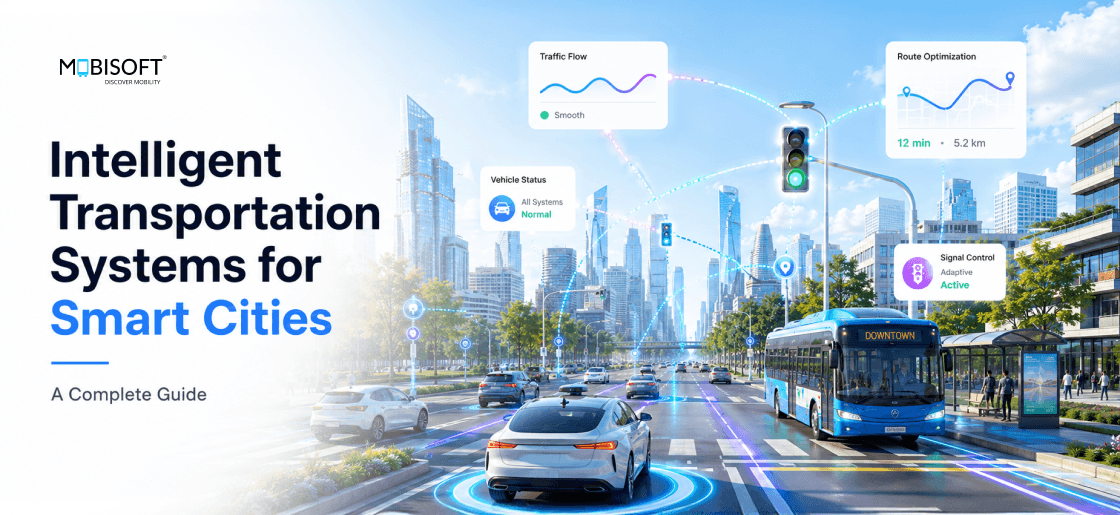
Ask a commuter what wastes the most time in their day, and gridlock usually tops the list. Cities lose billions every year to congestion, and most of that loss comes down to traffic systems that react instead of predict. An intelligent transportation system changes that by using sensors, live data, and connected vehicles to manage roads as conditions actually change, not on a fixed schedule set years ago.
Companies face a scaled-down version of this problem with employee transportation. A shuttle that runs late every week, or a commute nobody can predict, adds up. Employees notice. Some start looking elsewhere, even if the reason never comes up directly in a conversation with HR.
This piece breaks down how the technology works, and how a company might apply the same thinking to its own workforce, starting with something as simple as a single shuttle route.
What An Intelligent Transportation System Actually Does
Strip away the jargon and an intelligent transportation system is really just three things working in sequence: something that watches the road, something that makes sense of what it sees, and something that acts on it. Cameras and sensors do the watching. Software does the interpreting. Signals, alerts, and rerouted vehicles are the actions.
Older traffic control worked nothing like this. A city engineer would set a signal to run a 90-second cycle and leave it running that way for years. It was regardless of whether the road below it was empty at 2 AM or backed up for a mile at rush hour. Sensors broke that habit. Once a system can measure what's actually happening on a stretch of road right now, there's no reason to keep guessing.
Airports also use it to manage ground vehicles between terminals. A manufacturing plant with three shifts uses a smaller version of it to stop 400 cars from hitting the same gate at once. The scale differs, but the underlying habit of watching, interpreting, and acting doesn't change much.
The Technology Stack Behind Most Deployments
| Layer | What It Does | Common Tools |
|---|---|---|
| Sensing | Reads live conditions off the road | Cameras, radar, GPS, IoT sensors |
| Communication | Moves that data somewhere useful | 5G, V2X, cellular |
| Analytics | Turns raw data into a decision | Machine learning, computer vision |
| Application | Puts that decision in front of a person | Dashboards, apps, alerts |
Skimp on the sensing layer and everything downstream suffers, because no amount of clever analytics fixes bad input data. Cities and companies that fund all four layers evenly tend to get systems that hold up under real traffic, out on the actual road rather than in a vendor demo.
Why This Is Becoming Urgent For Cities
For most major cities, population growth exceeded infrastructure growth, and eventually, the numbers catch up. The rare experience of commuting in an unpleasant traffic situation became a permanent feature of everyday routine for numerous metropolitan areas. It cost billions of dollars worth of lost productivity and increased fuel consumption per year.
The Cost To Companies And Commuters
Decades of underfunded infrastructure maintenance and replacement add another layer. Most bridges and signal systems were not built to endure the current traffic volume and cannot be replaced at the pace that will match the needs. These transportation infrastructure challenges make efficient transportation systems increasingly important for cities. In such cases, intelligent traffic management systems increase the capacity of existing infrastructure by dynamically changing signal timing without building any new concrete.
There are usually some number of accident-prone intersections in any city. Most of them are also predictable once an employee monitors the data. Predictive alerts and sensors help to predict the particular combination of road conditions, speed, weather, and other factors that leads to the accident.
Infrastructure Under Growing Pressure
Companies feel a smaller version of the same pressure. An employee stuck in traffic loses time, shows up rattled, and it can easily bleed into the rest of their day. A dependable urban transportation management system helps here in roughly the same way it helps a city: less friction, fewer surprises, less compounding stress across a team.
Fleet managers running their own vehicles feel it even more directly, because a route plan built on last month's traffic patterns is already out of date. Businesses looking at a transportation management system (TMS) are usually trying to solve one specific problem: knowing where every vehicle is right now instead of finding out about a delay after someone complains.
There's also a retention angle worth taking seriously. People definitely weigh commute quality before taking up a job. A rough, unpredictable commute wears on someone slowly, and by the time it shows up in attrition numbers, the damage has been building for months.
The Market Numbers Heading Into 2026
The global intelligent transportation system market sat at roughly USD 31.14 billion in 2025, and it's expected to cross USD 34.29 billion in 2026, as per Fortune Business Insights. From there, growth holds at close to 11.48 percent a year through 2034, which puts the market somewhere around USD 81.82 billion by the end of that stretch. That's not a modest curve.
| Region | 2025 Value | 2026 Projection | Global Share |
|---|---|---|---|
| Asia Pacific | USD 20.6 billion | USD 22.46 billion | 66.14% |
| Europe | USD 5.79 billion | USD 6.55 billion | 18.61% |
| North America | USD 3.84 billion | USD 4.31 billion | 12.33% |
Asia Pacific alone accounts for two out of every three dollars spent globally. It says a lot about where urban density and government investment are colliding hardest right now.
On the corporate side, employee transportation spending is climbing at roughly 7.9 percent a year through 2030. A big part of that shift is philosophical. Commute infrastructure used to sit in the "nice to have" column of a facilities budget. It's increasingly treated as something closer to a retention line item, which is why HR and facilities leaders have started sitting in on smart mobility solutions decisions alongside operations teams.
Factors Affecting Growth
National governments in several countries are now mandatorily writing smart infrastructure requirements in new road projects. Smaller cities that couldn't previously justify the up-front cost are getting there faster. It's because of subsidy programs built specifically to cover what they lack in their own budget. Advanced traffic management systems are also being implemented on the public funding side. It manages signals and congestion in real time, still pulling the largest share of the money.
Where This Technology Actually Shows Up
It helps to walk through the specific applications rather than talk about ITS as one big abstract category, since a city or a company usually starts with just one of these and builds outward.
Traffic Signals That Adjust On Their Own
An intelligent traffic management system watches live traffic volume at an intersection and adjusts the signal timing before congestion even becomes visible to a driver sitting at a red light. Cities running this kind of system report noticeably shorter commute times, and it's not a marginal win either.
The same idea shrinks down nicely for private use. A logistics yard where 300 trucks need to leave within the same half hour faces a version of rush hour every single day. A smart traffic management system paired with staggered gate access smooths that out considerably, and facilities managers who've made the switch usually notice the difference within the first week.
Keeping Track Of Buses, Trains, And Shuttles
Instead of hearing about a late pickup from a frustrated employee, employee transportation solutions use data for live updates. Routes that consistently run half-empty become obvious pretty quickly too. This allows a fleet manager to consolidate them and put that freed-up vehicle somewhere it's actually needed.
Harsh braking and speeding events get logged automatically as well. It means coaching can happen before something goes wrong rather than after an incident report gets filed. Insurance companies have started factoring this kind of driving data into corporate fleet premiums, so the safety upside comes with a financial one attached.
People who use Uber or Ola on weekends have certain expectations about their experience and can easily tell when something goes wrong. Shuttle booking software should provide them with the ability to book their place on the bus and track the approaching shuttle on the map. This level of convenience makes all the difference in how often people will use the shuttle service instead of their own cars.
Tolls, Parking, And Congestion Pricing
Sensors now handle identification and payment automatically while a vehicle keeps moving, which cuts down both the idling time and the emissions tied to it. A lot of cities have taken this same infrastructure and extended it into parking systems and congestion pricing zones.
Congestion pricing specifically is spreading fast. Drive into a dense downtown zone during peak hours in more and more cities now, and there's a variable fee attached, one that often funds transit improvements directly. Corporate fleet planners have started building these charges into their route decisions.
Correct Data Implementation
Routing apps pull from thousands of live sensors to tell a driver what's actually happening on the road right now, not what usually happens at that hour. Weather gets folded into this too. A storm rolling through can reroute thousands of trips within minutes, something a fixed schedule simply can't account for.
A structured carpool management system borrows this same routing intelligence for employees who drive their own cars, matching people heading the same direction so fewer vehicles show up at the office gate each morning. Splitting gas money tends to be an easy sell on its own.
What AI Is Actually Changing In Traffic Systems
For most of the history of traffic engineering, the job was reactive by necessity: something breaks, or someone crashes, and then a team investigates and adjusts. AI in transportation has flipped that order in a lot of places. Machine learning models now sit on top of historical accident data and live feeds together, which means a dangerous intersection can get flagged and fixed before it produces a headline.
From Reactive To Predictive
AI traffic management system will do all of that using constant analysis of vehicle maintenance data, camera footage, and signal information instead of regular manual review. Once the pattern of repeating harsh braking events was found, it becomes the priority for the system's operators to investigate.
Computer Vision And Everyday Applications
Computer vision deserves its own mention here. An intelligent traffic control system built on it can tell the difference between a pedestrian stepping off a curb, a cyclist, and a car, in real time, and adjust signal behavior to protect whichever one is actually at risk. Some cities are going a step further and mounting lidar sensors on regular city vehicles, quietly mapping pavement condition as they drive their normal routes, so road crews know where a pothole is forming before it swallows a tire.
Transit agencies can now predict bus bunching and correct it before it happens, adjusting dispatch intervals in response. Predictive maintenance flags a failing part on a bus or train days before it would've caused a breakdown mid-route. And smaller cities without a dedicated data science team can now just ask a system plain-language questions about current traffic conditions instead of needing to build custom queries themselves, which matters more than it sounds like it should for municipalities without deep technical budgets.
Cars Talking To Everything Around Them
Vehicle-to-everything communication, shortened to V2X, lets a car exchange information directly with traffic signals, other vehicles, and roadside sensors. Autonomous shuttles running on fixed routes in a handful of pilot cities depend entirely on this kind of connectivity plus sensor fusion to navigate safely, and a few corporate campuses have started experimenting with similar shuttles for short internal loops between parking and office buildings.
None of this works without fast, reliable networks underneath it. 5G's low latency is what makes millisecond reaction time possible instead of the second-or-two delay older networks would introduce, and that difference matters enormously at highway speeds. Insurers are already tracking outcomes from early V2X pilots, and the collision warnings, arriving several seconds before impact, are giving drivers genuinely useful time to brake or steer clear.
Bringing This Back To Corporate Fleets
City-level thinking and corporate fleet management solve the same underlying problem at different scales, which is easy to forget when they get treated as unrelated topics. Employees drive the exact same congested roads that city planners are trying to fix, so a good urban transportation management system ends up helping both groups at once.
A dedicated fleet platform gives managers something they didn't have before: live visibility into where every vehicle actually is, plus route suggestions based on current conditions rather than a static plan drawn up months ago. That shift alone moves a fleet operation from constant damage control toward something closer to actual planning.
Safety data flows differently
Instead of learning about a rule violation from an angry email, a dispatcher sees it the moment it happens. HR benefits in a quieter way, since attendance data that used to require chasing down paper logs now populates automatically from the same tracking system. And because route optimization directly reduces fuel burn and vehicle wear, most companies running a decent-sized fleet see real savings show up within their first full fiscal year of using the system, savings that often get reinvested into expanding the program further.
What Changes For Riders And HR
Riders notice the difference too, even if they can't always articulate why. A shuttle that consistently shows up when it says it will builds a kind of quiet trust that a shuttle running fifteen minutes behind never earns. That trust translates into fewer complaints landing on HR's desk and, during any kind of workforce negotiation, a stronger case that the company is actually taking commute quality seriously.
The Sustainability Angle Nobody Should Skip
Transportation is consistently one of the largest sources of urban carbon emissions, which means sustainable urban mobility is mostly the same work viewed through a different lens. Getting people out of single-occupancy cars and into shared, well-tracked transit does more for emissions than almost anything else a city can do without touching the vehicles themselves.
Single Driver Versus Shared Transport
| Factor | Driving Alone | Shuttle Or Carpool |
|---|---|---|
| Emissions per person | Highest | Cut by sharing the trip |
| Parking needed | One spot per car | Far fewer spots overall |
| How predictable | Depends entirely on traffic | Better with live tracking |
| What a company can measure | Almost nothing | Cost and ridership per ride |
Corporate transport programs move a smaller needle, but the mechanics are identical. A well-run shuttle consolidates a dozen separate commutes into one vehicle. Automated carpool matching pulls even more cars out of the daily parking crunch, sometimes enough that a facilities team can actually shrink the lot or repurpose part of it. Electric shuttles paired with smart routing currently produce the biggest measurable emissions cut available to a corporate fleet.
There's a reporting dimension too that's easy to overlook. Companies now disclose commute-related emissions as part of standard ESG reporting, and having real ridership data on hand makes that number credible instead of estimated. It shows up in recruiting conversations as well. Younger candidates in particular tend to notice and ask about this, and a well-run carpool or shuttle program backs up the sustainability talk with something a candidate can actually see.
Actually Building One Of These For A Company
Nobody needs to replace an entire fleet overnight to get started, and trying would probably backfire. A more sensible path looks something like this:
A Simple Rollout Plan
Start by pulling real commute data, current routes, timing, how full vehicles actually run, rather than assuming anyone already knows the answer. That audit usually surfaces the actual pain points fast: maybe it's chronically late pickups, maybe it's a route running at a quarter capacity every day. Pick one piece of technology and run it as a genuine pilot before touching anything else. Connect scheduling to whatever HR system already exists so attendance stops being a manual chore. And decide upfront what "working" looks like: on-time rate, cost per ride, whatever matters most, so there's something concrete to point to when it's time to ask for a budget to expand.
Getting Onboarding And Vendor Selection Right
A new hire walking in without knowing which shuttle to catch or how to book a seat starts their first week more stressed than they need to be. A short digital onboarding checklist covering app downloads, route assignment, and where exactly to stand for pickup solves most of that confusion in about five minutes.
Remote and hybrid hiring complicates this slightly, since there's no in-person orientation to walk someone through it. Practical remote onboarding tools, a short video is usually enough to let a new hire understand their transport options before they've even set foot in the office.
Ask specifically whether a platform integrates with existing payroll and HR software without custom engineering work, and ask for references from companies running a similar fleet size rather than settling for the vendor's flagship client story. A short pilot with a real vendor almost always surfaces integration headaches cheaper and faster than a full rollout would.
How To Know If It's Actually Working
A satisfaction survey with vague happy-face ratings won't convince anyone controlling a budget to expand a program. Numbers do that job better.
On-time performance is the simplest one to start with: what percentage of shuttle trips actually arrive within the window they promised. Cost per ride ties the financial side together, comparing fuel, maintenance, and staffing against how many rides actually got delivered that month, and a number trending down while service quality holds steady is a genuinely good sign. Utilization tells a different story: empty seats on a recurring route usually mean the schedule needs trimming, while a route that's consistently full is asking for another vehicle. And adoption rate, simply whether more or fewer people are choosing to use the shuttle or carpool option over time, ties all of it back to whether people actually find the program worth using.
What Tends To Go Wrong At Scale
Rolling this out across a whole city or a large company runs into a fairly predictable set of obstacles.
Data, Interoperability, And Funding Gaps
Data privacy usually comes up first, since tracking vehicles and riders generates location data that needs a real policy before it gets deployed widely, not an afterthought bolted on once someone asks about it. Interoperability trips up a lot of larger rollouts too. Different vendors build to different data formats, and a platform that can't talk to the other systems already in place creates headaches nobody budgeted for. Funding remains a genuine constraint, particularly on the public side where infrastructure competes against a dozen other line items every budget cycle, though public-private partnerships are increasingly picking up the slack.
Legacy hardware is its own problem. Older signal controllers frequently weren't built with any modern connectivity in mind, and retrofitting them tends to cost excessively more. This is why a phased upgrade spread across a few budget cycles beats trying to fix everything at once.
People, Security, And Contract Risk
The people's side matters just as much as the technology. Drivers and dispatchers used to doing things a certain way for years don't automatically trust a new system, and that resistance is worth taking seriously rather than dismissing. Involving frontline staff during the pilot phase, before the full rollout, tends to build the kind of buy-in that a top-down mandate never quite manages.
Security is worth flagging too, since every connected sensor and vehicle is technically a door someone could try to open. Strong authentication and regular audits aren't optional extras here. And contracts deserve a close read before signing, specifically around data ownership and export rights, since getting locked into a vendor with no easy way to leave later is a real risk that's easy to overlook in the excitement of a good demo.
Where This Is Headed Next
A few developments worth keeping an eye on: digital twins, essentially a virtual copy of a city's traffic system, let planners test a new signal timing plan or a road redesign in simulation before touching a single real intersection. As 5G coverage keeps expanding, expect intelligent traffic control system deployments to spread well past the handful of major metros currently running them. AI copilots for traffic operators are starting to show up too, suggesting signal changes or incident responses while leaving the actual decision with a human. Micromobility, including bikes, scooters, and pedestrian paths, is increasingly getting folded into the same data platforms cities already use for vehicle traffic. It gives planners a much fuller picture of how people actually move through a place.
And as data formats standardize across vendors, switching platforms should get considerably less painful for cities and companies alike. Corporate mobility tends to follow a step or two behind these public-sector shifts, so expect shuttle and carpool platforms to pick up predictive routing and AI-assisted dispatch not too long after cities prove it out.
Conclusion
Pick one commute problem worth fixing and pilot a smart transportation system solution against it. Track on-time rate and cost per ride from day one, not as an afterthought. Choose a platform that connects cleanly to existing HR systems and gives riders visibility into their own pickups.
The companies that get this right treat the pilot as real data collection, not a formality before a bigger rollout. A single route, tracked honestly for a full quarter, tells you more than any sales deck. Costs drop, complaints fall, and adoption climbs on its own once people trust the system to work.
An intelligent transportation system, built this way, turns a daily employee frustration into one of the more visible wins a company can point to, both on a balance sheet and in a retention conversation nobody wants to have twice.

Frequently Asked Questions
Does adding an intelligent traffic management system mean ripping out existing signal hardware?
No. Most rollouts bolt new sensors and software onto signal controllers that are already in the ground. An intelligent traffic management system usually works as a layer on top of existing infrastructure, and full hardware replacement only comes up when the controller itself is too old to accept any new input at all.
Who is responsible if an AI traffic management system makes a bad call and causes a crash?
This is still murky, and it varies by jurisdiction and by contract. An AI traffic management system typically operates with a human able to override its decisions, and most current deployments keep a person in the loop specifically so liability doesn't rest entirely on the software.
Will a shuttle or carpool platform lock a company into one vendor long-term?
It can, if the contract isn't written carefully. Ask upfront whether your data, ridership history, routes, and cost per ride export cleanly if you switch platforms later. A smart mobility solutions vendor that resists giving you that export right is telling you something worth paying attention to before you sign anything.
How fast does a corporate transport program actually pay for itself?
It depends heavily on fleet size, but companies operating a decent number of shuttles often see savings in their first full year. Fuel and maintenance costs drop once routes get optimized, and a transportation management system (TMS) makes that saving visible instead of buried in a fuel budget nobody's tracking closely.
Does a digital onboarding checklist need to be different for drivers versus office staff?
Yes, a little. A driver needs route assignments and shift timing up front. Office staff mostly need app setup and pickup point info. A single digital onboarding checklist can cover both if it's built with separate sections rather than one generic list trying to serve two very different jobs.
This content is for informational purposes only and may include AI-assisted research or content generation. While we strive for accuracy, information may evolve over time. Readers are advised to independently verify critical information before making decisions.

Nitin Lahoti
Read more
Nitin Lahoti is the Co-Founder and Director at Mobisoft Infotech. He has 15 years of experience in Design, Business Development and Startups. His expertise is in Product Ideation, UX/UI design, Startup consulting and mentoring. He prefers business readings and loves traveling.
 Nitin Lahoti
 June 10, 2021