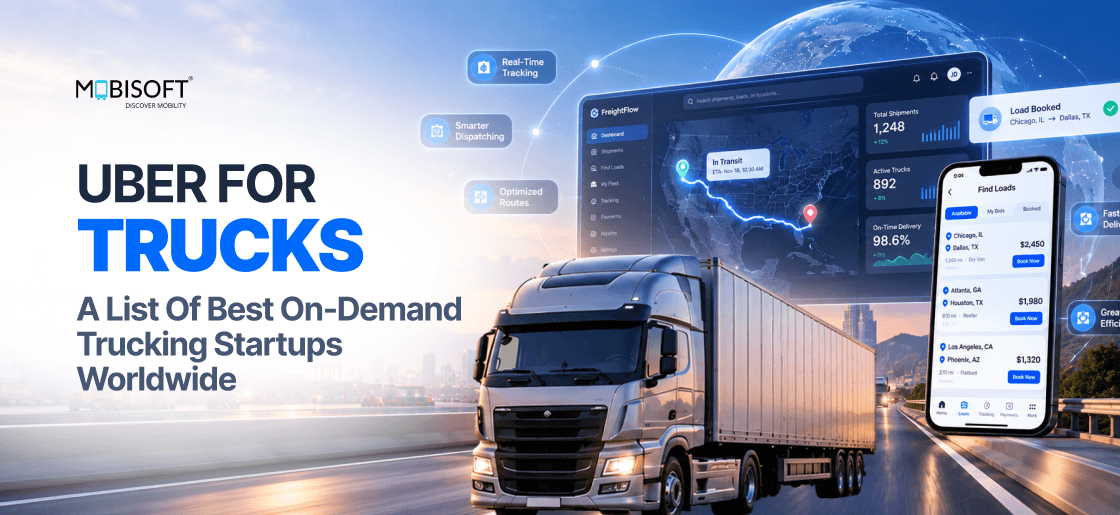
Most people already trust an app to send a cab or deliver dinner within minutes. Freight has finally caught up, with Uber for trucks now letting shippers book verified trucks from a phone. Service providers can now manage pricing upfront and track cargo in real time. This change has steadily replaced the phone tag that once ran this industry.
Digital freight brokerage is valued near 5.2 billion dollars in 2026, heading toward 8.6 billion by 2035, and the money tells only part of the story. Some platforms scaled into billion-dollar businesses and went public, while others burned through hundreds of millions and vanished within a few years. This guide sorts through both outcomes and shows which companies are thriving today, plus where the technology goes next.
How The Business Model Works
The Uber-for-trucking model borrows its logic from ride-hailing. The transaction underneath involves more moving parts, though. A shipper posts a load through an app. The listing includes pickup location, cargo type, and delivery deadline. Nearby carriers see that listing. They either submit a competitive quote or accept a fixed rate. The platform already calculated that rate in advance. Delivery gets confirmed, and payment clears automatically. The platform keeps a small commission for the match.
Three Parties In Every Transaction
Every on demand trucking app transaction runs on three roles. These roles work in sync. The system breaks down fast the moment any one of them falls short.
- Shippers post loads, set pickup windows, and track cargo until it arrives
- Carriers browse open listings, submit quotes, or accept fixed rates through the app
- The platform matches supply with demand, verifies credentials, and processes payment
- Dispute resolution teams step in when a delivery gets disputed or delayed
A platform without enough active carriers frustrates shippers with delays. Steady shipper demand matters just as much. Carriers drift toward competitors the moment loads dry up. Solving both sides at once remains the single hardest problem in this business. That difficulty explains why so many well-funded startups eventually folded despite strong early growth.
Fixed Rates Versus Bidding Pricing
Most Uber for freight platforms price loads in one of two ways. Fixed-rate pricing quotes a set cost upfront. That quote factors in distance, weight, and vehicle type. The shipper knows the exact price before confirming. The carrier knows exactly what the job pays, but the bidding marketplace pricing works differently. Carriers submit competing quotes instead. Market conditions then set the final price, close to real time. Fuel costs and open capacity on that route both play a part.
Enterprises moving large, predictable volumes often outgrow both standard models. A freight marketplace software development partner can help. That partner builds a bidding engine tuned to a company's own carrier network. This custom engine tends to outperform a shared public marketplace. That edge grows once volume climbs and predictability starts to matter more than sheer reach.
Advantages Over Traditional Freight Brokering
Traditional freight brokering still runs on phone calls and manual paperwork. This happens in many corners of the industry. Closing a single load this way can eat up several days. Delays compound fast once a shipment gets stuck. Two dispatchers cannot always reach each other. Trucking companies like Uber compress that entire cycle into minutes through automated matching.
- Faster load matching through algorithms instead of cold outreach
- Transparent, upfront pricing instead of hidden markups in the chain
- Real-time GPS tracking from pickup straight through to delivery
- Digital paperwork that replaces faxed bills and physical signatures
- Automatic payment release once a delivery gets confirmed
Shippers gain a level of visibility they never had with traditional brokers. Carriers gain access to a far wider pool of loads too. Nobody spends half the day chasing dispatchers anymore. Those calls often went unanswered. That single change alters how small operators compete against larger fleets.
Current On-Demand Trucking Market
The freight industry has spent several years absorbing a prolonged recession. Margins got squeezed across the board. Several well-funded freight startups simply did not survive it. Convoy is the clearest cautionary tale in the category. Bill Gates and Jeff Bezos backed the company. It raised over 647 million dollars in total. A severe downturn hit its revenue in 2023. The company shut down abruptly that October. Its assets were sold to Flexport for just 16 million dollars. The platform changed hands again in July 2025. DAT Solutions bought the Convoy technology outright, for 250 million dollars. That kind of consolidation now defines the sector.
Survivors Versus Casualties
The first wave of trucking startups treated this space like a simple matching problem. Build an app. Connect shippers to trucks. Collect a commission, then scale fast. That playbook stopped working around 2022. Winning platforms today combine load matching with real transportation management software. They also lean on predictive analytics and AI-powered pricing, adjusting quotes throughout the day.
Some enterprises want that level of control. They avoid depending on a shared marketplace entirely. Instead, they turn to a custom transportation management system built around their own network. Every pricing rule then reflects the company's actual operations. Every routing decision does too, not a generic algorithm tuned for someone else's freight.
Consolidation And Market Share
Mergers and acquisitions have steadily become the real story of this sector. The standalone app model that dominated a decade ago is fading. Companies with capital to buy their way into scale now win instead.
- Uber Freight acquired Transplace for 2.25 billion dollars in 2021 to add deep logistics management capability
- Full Truck Alliance formed when China's Huochebang and Yunmanman merged, later listing on Nasdaq
- Mahindra Logistics acquired Rivigo's B2B express business in 2022 after the startup's model struggled
- Cargomatic was acquired by ITG Transportation Services in 2024 and now runs as a subsidiary
Standalone Uber for trucking apps kept struggling to hold margins on their own. Scale now comes from combining technology, capital, and an existing freight network. A clever idea alone rarely gets a company there. Building everything from scratch is a far riskier bet today. Hoping the unit economics work out later looked easier a decade ago.
Public Listings And Investor Scrutiny
India's BlackBuck went public in December 2024. It now trades as Zinka Logistics Solutions on the NSE and BSE. The listing marked a genuine turning point for every Uber for trucks platform still chasing scale. It proved these platforms can mature into publicly traded, revenue-generating businesses. Full Truck Alliance has also been eyeing a secondary listing in Hong Kong. Public listings bring scrutiny that private funding never provided. Analysts now expect these companies to show real unit economics, not user growth alone.
Top Uber For Trucks Companies Worldwide
Here is where the platforms that defined this category stand today. Some scaled into billion-dollar businesses. Others got folded into larger competitors. A few disappeared entirely once the funding dried up. Each profile below covers what the company actually does now, not just what it launched with.
Uber Freight: United States
Uber Freight remains the most recognized name in Uber for truckers technology. Shippers get freight delivery booking through the app. Pricing stays transparent, and payments arrive fast. The automated dispatch system matches shippers to carriers using live market data. A 2021 acquisition added deeper capability. The company bought Transplace that year for 2.25 billion dollars.
- Founded in 2017 by Travis Kalanick and Garrett Camp
- Headquartered in San Francisco, United States
- Reached break-even profitability in its Q4 2025 results
- Disclosed a data breach in August 2026 linked to an extortion group
Operations continued without disruption after the breach. The company engaged law enforcement immediately, too. Enterprises can avoid depending on a third-party marketplace. A dedicated trucking management software platform offers a similar option. It builds around a company's own fleet.
BlackBuck, Now Zinka Logistics Solutions: India
BlackBuck built its reputation as India's largest trucking platform. It connects over 200,000 partner trucks. That network spans roughly 1,000 locations. Every booking comes with competitive pricing and real-time tracking. Chanakya Hridaya, Rajesh Yabaji, and Ramasubramaniam B founded the company in 2015. It is headquartered in Bengaluru. The company went public in December 2024. It now trades as Zinka Logistics Solutions. The IPO gave the market a rare look at real trucking-tech financials. It remains one of the strongest trucking startups in USA-style matching models. This success extends well outside American borders.
DAT Solutions And The Convoy Platform: United States
Convoy originally built smart routing algorithms. These filled every truck to capacity and cut fuel waste. The company raised over 647 million dollars from investors, including Jeff Bezos and Bill Gates. Dan Lewis and Grant Goodale founded it in 2015 in Seattle. A severe freight recession hit its revenue hard in 2023. The company shut down abruptly that October. Flexport bought its assets soon after, for just 16 million dollars.
DAT Solutions then purchased the Convoy Platform in July 2025. The price was 250 million dollars. DAT folded the technology into its existing load board network. The story is a useful reminder. Even heavily funded freight startups stay exposed to macro downturns. Strong early traction offers no real protection.
Transfix: United States
Transfix built a network connecting shippers with active carriers. That network reaches tens of thousands. Its proprietary algorithms generate accurate freight quotes within seconds. Drew McElroy, Jonathan Salama, and Prabhat Supekar founded the company in 2013 in Manhattan. Transfix later canceled planned public listing efforts. It sold off its brokerage unit entirely. The company then repositioned around AI-powered freight technology, not pure load matching. Several trucking companies like Uber have followed a similar pivot. Margins on straight brokerage kept compressing.
Cargomatic: United States
Cargomatic connects local truckers with shippers moving cargo. Its focus stays on major metro areas, mainly California and New York. Shippers track cargo in real time. The platform also maximizes how fully each truck gets loaded. Among on demand trucking apps on this list, Cargomatic stands out. Its focus stays metro-only, not long-haul routes. Jonathan Kessler founded the company in 2013 in Long Beach. ITG Transportation Services acquired it in June 2024. It now operates as a subsidiary within the XLR8 Truck Lines portfolio.
Fleet operators running their own trucks need comparable insight. This applies outside a marketplace too. Fleet tracking software fills that gap. Dispatch teams get live location data. They also see utilization patterns across an entire private fleet.
FreightBro: India
FreightBro goes beyond simple truck matching. It gives freight forwarding companies full visibility into their shipping processes. Forwarders generate professional quotes in a few clicks. They manage contracts directly through the platform too. Anand Babu, Mohammed Zakkiria, and Raghavendran Viswanathan founded the company in 2016 in Chennai. FreightBro became the first Indian platform to integrate Maersk Spot pricing. Forwarders now get live ocean freight rates alongside road transport options.
Shippers handling complex, multi-region cargo often need more support. One matching app rarely covers everything. A partner providing full transportation logistics solutions covers sourcing, warehousing, and delivery in one system. That beats stitching together separate vendors for each function.
Porter: India
Porter has emerged as one of India's strongest hyperlocal delivery stories. It connects businesses and individuals with mini trucks and two-wheelers. Larger commercial vehicles round out the fleet for both intracity and intercity moves. Porter is headquartered in Bengaluru. It became India's second unicorn of 2025. A Series F round led by Kedaara Capital and Wellington Management pushed it there. The company is now valued at nearly 1.2 billion dollars. It also reports actual profitability, a rare combination in this sector. Porter's growth shows something important. Hyperlocal versions of the Uber for trucks model can outcompete broader long-haul platforms. Solving one specific need well is enough.
Full Truck Alliance: China
Among freight platforms in Asia, Full Truck Alliance stands out clearly. Two of China's largest trucking networks formed it. Huochebang and Yunmanman merged into a single company. That company now serves millions of registered trucks. Cloud-based logistics management powers the whole operation. An online-to-offline matching system connects demand and supply. It also cuts fuel waste and lowers emissions across routes. The company now trades on Nasdaq. It continues exploring a secondary Hong Kong listing through 2025 and 2026.
Trucker Path: United States
Among Uber for truckers apps built for drivers rather than shippers, Trucker Path stands apart. It has built a massive driver community around finding quality freight. Practical tools round out the platform. Truck stop locators, weigh station alerts, and live fuel prices serve a network exceeding 700,000 drivers.
- Founded in 2013 by Ivan Tsybaev and Viktor Radchenko
- Headquartered in Mountain View, United States
- Acquired by China's Renren years ago
- Operates as a driver-focused super app, not a shipper marketplace
A partnership with Goodyear Commercial Tire and Service Center adds another perk. Member drivers can access roadside tire assistance directly through the app.
CargoX: Brazil
Nearly 40 percent of Brazil's trucks run empty at any given moment. CargoX built its entire business around fixing that one inefficiency. A bidding platform matches shippers with available capacity. That network exceeds 100,000 truckers. Federico Vega founded the company in 2013, headquartered in São Paulo. CargoX has reportedly crossed 200 million dollars in annual revenue. That makes it one of Latin America's most established Uber for freight platforms. The company also launched a blockchain-based shipping document system. Forwarders can now exchange paperwork securely, instead of relying on older, slower email chains.
Platform Comparison By Region And Model
| Platform | Region | Core Model | Current Status |
| Uber Freight | United States | Matching plus transportation management software | Active, breakeven profitability |
| Zinka Logistics (BlackBuck) | India | Fleet matching and tracking | Publicly listed, 2024 IPO |
| Full Truck Alliance | China | Cloud-based load matching | Nasdaq listed, expanding |
| Porter | India | Hyperlocal mini truck and courier matching | Unicorn, profitable |
| DAT Solutions (Convoy Platform) | United States | Load board plus smart routing | Active under new ownership |
The table makes the change since 2019 obvious at a glance. Far fewer independent startups survive today. The ones that do are almost all backed by real capital. Existing freight infrastructure matters more than a clever app alone. Investors now reward proven operations over promising pitch decks.
Why Enterprises Choose On-Demand Trucking
Enterprises no longer treat on demand trucking companies as a novelty. Last-minute deliveries were once the only use case. Supply chain leaders now build these platforms into daily capacity planning. Demand spikes and seasonal surges both factor in. Owning a private fleet ties up enormous capital. Vehicles, drivers, insurance, and maintenance all add up. Most companies would rather deploy that capital elsewhere.
Cost Control Without Owning A Fleet
On-demand platforms let enterprises scale capacity up or down. That scaling follows actual shipping volume. It beats fixed assumptions baked into a five-year fleet plan.
- Pay only for loads actually shipped, not idle truck capacity sitting in a lot
- Avoid upfront capital investment in vehicles, insurance, and full-time driver payroll
- Access surge capacity during peak seasons without signing any long-term commitment
- Reduce empty miles through smarter, algorithm-based route matching across the network
This flexibility matters more now than ever. Freight demand has become genuinely unpredictable. Pandemic-era supply chain disruptions reshuffled how goods move. Customers now expect faster arrival too. Finance teams strongly insist on contracts for Uber for trucking companies for exactly this reason. Expanding the owned fleet further makes less sense now.
Real-Time Visibility Changes How Teams Plan
Older freight processes left shippers guessing. A shipment's location stayed unknown until it physically arrived at the dock. Modern platforms track every load from pickup straight through delivery. Dispatchers flag delays hours in advance. Procurement teams adjust inventory orders using live transit data. Static estimates were often wrong by the time anyone checked them. That single change in visibility justifies the switch for many operations teams.
In-House Systems Versus Marketplaces
Some enterprises eventually outgrow the typical on demand trucking apps marketplace. They want dedicated infrastructure instead. That infrastructure reflects their own network and pricing rules. The decision usually comes down to volume. A company moving a few hundred loads a year rarely justifies custom software. A company moving thousands a month often saves significantly by owning the technology outright.
Complex supply chains rarely run on load matching alone, either.
- Warehousing needs coordination that a pure matching app cannot provide
- Customs documentation adds a layer that most marketplaces skip entirely
- Last-mile delivery often requires a separate handoff and tracking step
- That gap is why so many growing shippers eventually look for a partner. That partner should own the whole chain, not just one link in it.
Building An Uber For Trucks Platform
Uber Freight and Convoy walked into an easier market a decade ago. Most of the easy market share is already claimed by well-capitalized incumbents. Success now depends less on a clever idea. Disciplined execution across every part of the business matters more.
Essential Platform Features
A functioning Uber for trucks app needs more than a booking button. A payment gateway alone will not compete against established players either.
- Real-time GPS tracking across pickup, transit, and delivery stages
- Automated load matching based on vehicle type, capacity, and route
- Verified carrier onboarding with background checks and license validation
- Transparent pricing through either fixed rates or live bidding
- In-app payments with fast, reliable settlement for carriers
Skipping any of these features early usually means retrofitting them later. Retrofitting almost always costs far more than building the right architecture from day one. Founders who cut corners here typically pay for it twice. Engineering time gets lost once. Carrier trust gets lost the second time.
The Technology Stack
Founders often underestimate backend complexity. A simple-looking booking screen hides a lot. Route optimization, live tracking, and payment reconciliation all need to run together without lag. Otherwise, the whole experience falls apart. Dispatch operations also need dedicated tooling as volume grows.
- Driver assignment and duty scheduling handled automatically
- Compliance documentation stored and updated in one place
- Settlement and payout reconciliation run without manual entry
That kind of software frees founders to focus on growth. Manual dispatch work that eats an entire team's day disappears.
Common Startup Mistakes
Several early trucking startups in USA and abroad failed for a familiar reason. The underlying idea was not flawed. Execution missed basic operational realities instead. Those realities only show up once volume actually scales.
- Underestimating driver retention costs and churn during slow seasons
- Launching in too many markets before proving unit economics in one
- Ignoring compliance requirements around driver hours and vehicle safety
- Pricing too aggressively to win share, then struggling to raise rates later
Convoy's collapse partly traces back to a brutal freight recession outside its control. Plenty of smaller players failed for a simpler reason. They scaled too fast without a durable margin structure. A slower, more deliberate growth curve would have saved several of them.
Technology Trends In Trucking
The technology underneath these platforms has evolved considerably. This began with the first Uber for trucking apps launched. A handful of trends now stand out. These trends genuinely change daily operations, not just add another dashboard nobody uses. Here are the developments actually worth tracking into next year.
AI In Back-Office Operations
Artificial intelligence has moved from experimental pilot programs into core operational tooling. This change spans freight companies broadly. Invoicing now runs mostly on automation. Load matching and appointment scheduling do too. Manual work has dropped sharply since even two years ago.
- Invoice generation and reconciliation run with minimal review
- Load matching adjusts automatically as new capacity appears
- Appointment scheduling books and reschedules without a phone call
Large freight brokers report AI agents completing millions of shipping-related tasks. These tasks once required manual review. Human teams now focus on genuine exceptions instead. Repetitive work that trucking companies like Uber once handled by hand has mostly disappeared.
Predictive Maintenance And Downtime
Fleet operators increasingly rely on AI-powered diagnostics. These catch mechanical issues before they cause a breakdown. Remote monitoring tools flag problems early. Shop visits drop as a result. Fewer trucks need emergency, unscheduled repair work now.
- Sensors track engine performance and flag anomalies in real time
- Maintenance scheduling moves from fixed intervals to actual vehicle condition
- Technician shortages become far less disruptive with fewer emergency repairs
This change matters given how expensive unplanned downtime becomes. A single idle day on a long-haul route erases margin fast. That one day can cost an entire week's worth on that lane. Fleets that adopted predictive tools early already see the difference in their bottom line.
Cybersecurity As A Board-Level Priority
Freight companies handle sensitive shipment and payment data. Major Uber for freight platforms are no exception. That data makes them attractive targets for cybercriminals. These criminals increasingly combine phishing tactics with fraudulent carrier identities. The goal is to intercept high-value freight before anyone notices. Uber Freight's own August 2026 breach disclosure shows how seriously these threats have escalated. Platforms now treat security as a company-wide priority. It no longer stays confined to the IT department alone.
Autonomous Trucking Pilots
Driverless trucks are no longer purely experimental. Companies now run autonomous routes on limited highway corridors. Texas is emerging as a major testing hub for these deployments.
- Fleet management systems built specifically for driverless operation
- Specialized maintenance networks for sensor and hardware upkeep
- Regulatory sandboxes that let pilots run under close supervision
Full nationwide adoption remains years away, regardless of how quickly individual pilots are progressing.
Regional Differences In On-Demand Trucking
The Uber for trucks model does not look identical everywhere. Regulatory environments differ by country. Infrastructure maturity and freight density matter too. What works in one market often needs real adaptation before it works anywhere else.
- United States: dense highway infrastructure rewards long-haul, cross-country matching
- India: fragmented, trust-based demand rewards hyperlocal digital platforms
- China: policy alignment on empty-mile reduction accelerates platform scale
- Latin America: structural inefficiencies like empty trucks remain largely unsolved
United States: Long-Haul Focus
Interstate highway infrastructure makes long-haul matching especially valuable here. Platforms tend to focus heavily on cross-country freight and load boards. Enterprise transportation management integration matters more than short hyperlocal trips here. Distance and scale define competitive advantage in this market, more than anywhere else on this list.
India: Hyperlocal Fragmentation
India's fragmented trucking industry was historically dominated by small independent operators. Trust and word of mouth ran the show. That created massive room for digital matching platforms. Both BlackBuck and Porter capitalized on this fragmentation. Their on demand trucking apps built genuine trust into the industry. It previously ran on informal networks alone.
China: Government-Aligned Scale
Full Truck Alliance's growth reflects a national push to digitize logistics. Government support for reducing empty truck miles has aligned closely with the platform's own goals. That alignment between policy and business is not common anywhere else in this industry.
Latin America: Emerging Infrastructure Gaps
Brazil's CargoX built its entire value proposition around one structural inefficiency. Roughly 40 percent of Brazil's trucks run empty at any given moment. Similar gaps persist in other emerging markets. Digital freight platforms have underserved these markets. The United States and India got attention first. Real room remains for the next CargoX to emerge somewhere else entirely.
Evaluating An On-Demand Trucking Platform
Not every on demand trucking app provider fits every shipper's needs. A few practical factors should guide the decision. This matters well before any contract gets signed. Getting this evaluation wrong tends to show up months later. Missed pickups and frustrated customers follow.
| Pricing Model | Best For | Rate Certainty | Common Risk |
| Fixed Rate | Predictable, repeat shipments | High, quoted upfront | Overpaying during low-demand periods |
| Bidding Marketplace | Irregular or urgent freight | Variable, based on demand | Price spikes during peak seasons |
| Contracted Enterprise Rate | High-volume shippers | High, negotiated in bulk | Requires long-term commitment |
Coverage And Network Density
A platform with strong coverage in one region may offer weak carrier density elsewhere. Shippers moving freight across multiple states need to confirm actual carrier availability. This applies to countries too, along specific routes. A headline network size says little about any single lane. A quick test shipment on the exact route reveals far more than any sales pitch.
Pricing Transparency And Hidden Fees
Some Uber for trucks platforms advertise low base rates. Fees for fuel surcharges often only show up once the invoice arrives. Detention time and expedited pickup fees hide there too. Reading the full pricing structure before committing prevents unpleasant surprises. Ask for a sample invoice from an existing customer. Do this if anything on the pricing page reads unclear.
Integration With Existing Systems
Enterprise shippers running their own warehouse management should check one thing. ERP systems need proper API integration from the platform too. Manual data entry between disconnected systems creates errors. It also slows down the entire shipping workflow. A platform without solid API documentation usually signals deeper technical gaps elsewhere.
- Confirm real-time tracking accuracy through a trial shipment before full rollout
- Check carrier vetting standards, including insurance and safety record requirements
- Compare cancellation policies and how last-minute changes actually get handled
- Review customer support responsiveness during genuinely active shipment issues
The Future Of On-Demand Trucking
The Uber for trucks category has grown up fast. The gap between survivors and casualties is easy to see now. Companies that paired real technology with operational discipline made it through the shakeout. Platforms chasing growth without margins mostly did not.
Expect more consolidation ahead. Smaller platforms will keep getting absorbed into larger networks. These networks bring deeper relationships and capital to spare. Public listings like Zinka Logistics Solutions already show something clear. Investors want real profitability, not just growth. AI-powered pricing will keep raising the bar for everyone left standing.
The goal might be building a new platform. It might be running an existing fleet smarter instead. Either way, today's choices decide who competes a decade from now. The companies covered here show both paths clearly.

Frequently Asked Questions
How do AI pricing models decide fuel cost adjustments mid-route?
Pricing engines pull live fuel index data and recalculate the quote before a carrier accepts a load. Uber for freight platforms weight this against route distance and current capacity on that lane. A spike in diesel prices shows up in the quote within minutes this way.
What data does predictive maintenance software track besides engine sensors?
Beyond engine performance, predictive systems log brake wear patterns, tire pressure trends, and transmission temperature over time. Fleet software correlates that data against route type and load weight, since trucking companies like Uber now use this to flag a failure risk days before a dashboard warning light would.
How does Mobisoft's dispatch software handle driver assignment logic?
Our systems weigh driver location, hours-of-service limits, and route familiarity before assigning a load automatically. Our trucking management software checks compliance data in the background too, so a driver never gets assigned a load that would push them past a legal duty limit.
Fixed rate or bidding pricing, which suits my freight better?
The right model depends on how predictable your shipping volume is. Fixed rates work best for regular, repeat shipments where cost certainty matters most. Bidding models suit irregular or urgent freight, where uber for freight platforms let market conditions set a fair price in real time.
What's the difference between rule-based and machine-learning load matching?
Rule-based matching applies fixed logic, like nearest available truck first, every time. Machine-learning matching instead scores each pairing on historical acceptance rates and route performance. This is how leading trucking startups improve match quality as more trips are completed, rather than following the same static rule indefinitely.
This content is for informational purposes only and may include AI-assisted research or content generation. While we strive for accuracy, information may evolve over time. Readers are advised to independently verify critical information before making decisions.

Nitin Lahoti
Read more
Nitin Lahoti is the Co-Founder and Director at Mobisoft Infotech. He has 15 years of experience in Design, Business Development and Startups. His expertise is in Product Ideation, UX/UI design, Startup consulting and mentoring. He prefers business readings and loves traveling.
 Nitin Lahoti
 February 15, 2019