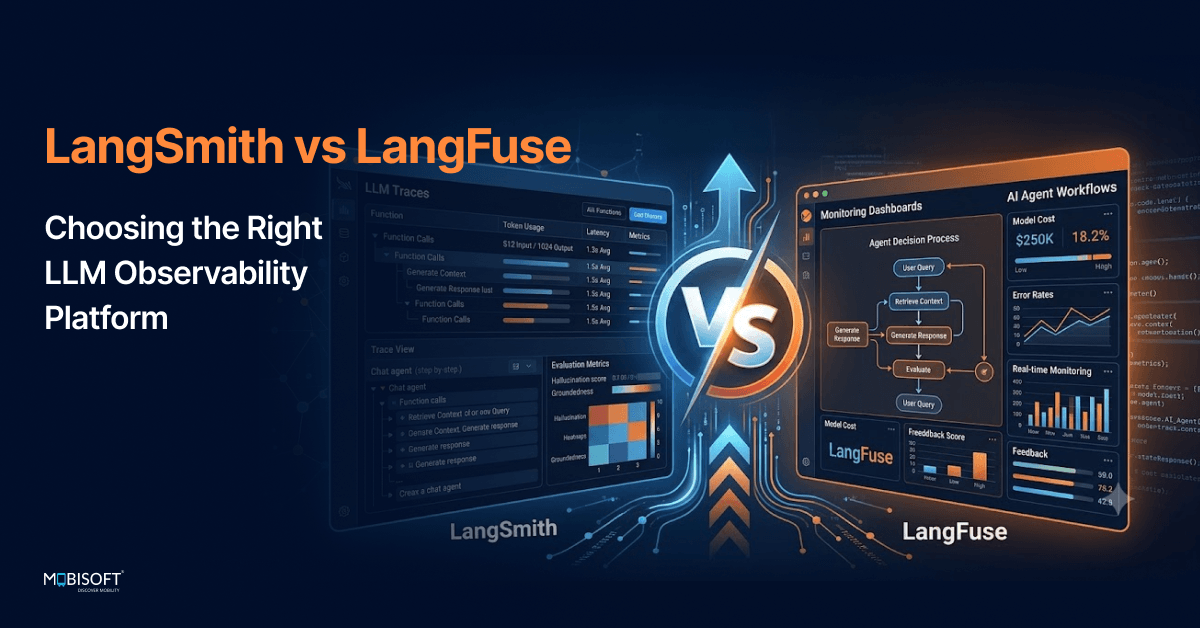
Building an LLM prototype is the easy part. Production is a different story entirely. Agents call tools, chain prompts, and occasionally fail in ways nobody can quite trace. Without visibility into a request, debugging turns into pure guesswork.
That's why LLM observability has become a baseline requirement, not a luxury. Teams need to see every trace and track the cost sitting behind it. LLM monitoring tools make that kind of visibility possible. In 2026, two platforms dominate this conversation: LangSmith and LangFuse. Developers weighing LangSmith vs LangFuse are deciding how they'll debug and scale for years. Some teams bring in outside generative AI consulting services to make that call faster. Either way, it seems the decision adds real friction or removes it entirely. We'll get into exactly what separates these two platforms shortly.
What is LLM Observability?
So what does LLM observability actually mean? It means tracking what happens inside an LLM call, start to finish. That includes prompts, tool calls, token counts, latency, and the final output. Without it, you're staring at a black box.
Traditional application monitoring tools weren't built for this work. They track uptime, error rates, and response times well enough. But they have no concept of a prompt or a hallucinated answer. An API call either works or it fails, in their world. LLM behavior isn't nearly that binary. The same prompt can produce a different answer tomorrow.
That gap explains why LLM monitoring became its own category. Most platforms here rest on four pillars. Tracing comes first, capturing every step inside a request. Evaluation follows, scoring outputs against quality criteria. Prompt management matters too, version control for the instructions agents follow. Cost monitoring rounds things out, since token spend can spiral fast. Together, these form the backbone of any serious LLMOps platform. Get one pillar wrong, and the rest lose much of their value.
Picture a RAG pipeline that retrieves five documents, then reranks and generates an answer. That's already three steps worth watching, before the actual LLM call even runs.
What is LangSmith?
LangSmith comes from the team behind LangChain, which says a lot about its design. It started as a tracing and debugging tool for LangChain applications. Over time, it grew into something bigger. Today, LangSmith positions itself as a full agent engineering platform. It's not just a logging layer bolted onto a framework.
That positioning matters. LangSmith observability isn't an afterthought feature. It's baked into how the platform handles tracing, evaluation, and deployment together. If your team already works with LangGraph for orchestration, the integration feels almost invisible. You barely notice the wiring, because there isn't much wiring to notice.
LangSmith has grown quickly through 2026, partly thanks to its Interrupt conference announcements. New releases like LangSmith Engine and Context Hub pushed it further into production. That's beyond simple trace viewing now. The platform also rolled out Managed Deep Agents and Sandboxes at Interrupt. That gives teams a production runtime without stitching one together themselves. Many teams treat it as one of the more complete LLM observability tools available. That's especially true inside the LangChain ecosystem. Some businesses lean on outside AI services company partners before making that call. For teams outside that world, the calculus looks different.
What is LangFuse?
LangFuse took a different path from day one. It launched as an open source observability platform. It was built for teams who wanted to see the code behind their tools. That openness wasn't a marketing angle. It was the actual product.
In 2025, LangFuse moved nearly its entire feature set under the MIT license. Tracing, prompt management, evaluations, and even the playground all became free to self-host. Only a thin layer of enterprise compliance features stayed commercial. That's a rare move in a market full of closed, seat-locked tools.
Then came January 2026, when ClickHouse acquired LangFuse outright. The deal made sense on a technical level, too. LangFuse's data layer already runs on ClickHouse internally. Postgres couldn't keep up with high-volume trace ingestion. Pairing observability with serious data engineering solutions infrastructure was, frankly, an obvious move. LangFuse observability now sits inside a broader data platform strategy. It's not a standalone startup roadmap anymore. By some counts, the project crossed 26 million monthly SDK installs heading into 2026. Few open source tools reach that scale this fast. For teams wanting a framework-agnostic, self-hostable alternative, that backing strengthens the pitch. It also makes LangFuse a credible long-term bet among LLM monitoring tools.
Key Features of LangSmith
LangSmith packs a lot into one platform. Some features matter more than others, depending on your stack. But the full list shows real engineering depth. Here's what stands out.
- Tracing with nested spans: Every tool call and token cost gets its own span inside the trace. You can drill into a single step without losing the broader picture. That makes LLM tracing genuinely usable instead of overwhelming.
- LangSmith Engine: An autonomous layer that watches production traces, clusters failures, and suggests fixes. It's less a tool, more a second engineer reviewing your logs overnight.
- Evaluation framework: Supports LLM-as-judge scoring, custom code evaluators, and human review side by side. Few LLM debugging tools cover all three approaches under one roof.
- Prompt Playground: Syncs directly into LangGraph Studio, so prompt edits carry over without manual copying.
- Pairwise annotation queues: Reviewers compare two outputs side by side, which speeds up subjective quality calls considerably.
- Unified cost view: Tracks spend across an entire agent workflow, not just one LLM call in isolation.
- Messages View: Turns messy multi-turn traces into something readable at a glance. That's useful for AI agent monitoring during long conversations.
- Context Hub: Versions agent instructions and policies, similar to how teams version code.
- LLM Gateway: Enforces spend limits and redacts PII before requests leave your environment.
- CI integration: Works with pytest, Vitest, and GitHub workflows, gating deployments on eval scores automatically.
- AWS Marketplace availability: Makes enterprise procurement simpler for teams already buying through AWS.
That's a dense feature set, honestly. Few competitors match it item for item.
Key Features of LangFuse
LangFuse covers similar ground but gets there from the open source side. This is LLM monitoring built from the ground up. It isn't bolted onto an existing product. The feature list is just as deep, and most of it ships free.
- All-in-one core: Tracing, prompt management, evaluations, datasets, and a playground, all under one roof. No separate add-ons required.
- Full self-hosted access: Every core feature works identically on a self-hosted MIT deployment. No feature gets locked behind a paywall just because you're running your own servers.
- Framework-agnostic SDKs: Supports LangChain, LlamaIndex, the raw OpenAI SDK, and OpenTelemetry. If your stack doesn't use LangChain at all, this matters enormously.
- Evaluation tools: LLM-as-judge scoring and structured prompt experiments cover most testing needs. These count among the more flexible LLM evaluation tools on the market right now.
- Human annotation queues: Manual review workflows for cases where automated scoring just isn't reliable enough yet.
- ClickHouse-backed data layer: Built for high-throughput ingestion and fast analytical queries. That matters once trace volume climbs into the millions.
- Compliance add-ons: SCIM, audit logs, and project-level RBAC ship commercially. They're layered on top of the open core.
- Multimodal input support: Covers image and audio inputs inside traces.
None of this requires LangChain specifically. That single fact matters for most of what comes next in this comparison. It matters especially for teams doing serious generative AI monitoring. Many of those teams run multiple frameworks at once.
Architecture and Integration Differences
Architecture is where these two platforms genuinely diverge. LangSmith was built assuming you're already inside the LangChain world. That assumption pays off if true, and costs you if it isn't.
LangGraph checkpoints, persistent memory, and LangSmith's tracing layer all talk to each other natively. Set an environment variable, and tracing just works. Outside that ecosystem, things get more manual. You can still use LangSmith with other frameworks through its SDK. The experience feels less native, though.
LangFuse took the opposite bet from the start. Its SDKs work with LangChain, LlamaIndex, the OpenAI SDK directly, and plain OpenTelemetry. That last point matters more than it sounds. OpenTelemetry compatibility means LangFuse can sit inside an existing observability stack. Most engineering teams already run one. No separate dashboard, no second system to babysit.
For teams not using LangChain at all, this difference becomes the whole decision. Picture a team running CrewAI or AutoGen instead of LangGraph. LangFuse traces that setup natively. LangSmith would need extra wiring to reach the same depth. Forcing a framework choice just to get decent tracing rarely makes sense. Some companies bring in AI consulting for businesses to map this decision properly.
Self-hosting differs, too. LangFuse offers a genuinely complete MIT self-hosted path. LangSmith's self-hosting sits behind the Enterprise tier, with real infrastructure requirements attached. Neither approach is automatically better. It depends on how much operational overhead your team can absorb. And it depends on how flexible your LLM observability tools need to be.
| Framework / SDK | LangSmith | LangFuse |
| LangChain | Native | Native |
| LangGraph | Native, deep integration | Supported via SDK |
| LlamaIndex | Partial, via SDK | Native |
| CrewAI / AutoGen | Manual wiring | Native via OpenTelemetry |
| Raw OpenAI SDK | Supported | Native |
| OpenTelemetry | Limited | Native |
Pricing Comparison
Pricing splits along a clear line. LangSmith charges per seat plus trace volume. LangFuse charges by usage units, with no seat fees on paid cloud tiers.
LangSmith's free Developer plan gives one seat and 5,000 traces a month. Retention on that tier is capped at 14 days. The Plus tier costs $39 per seat monthly and includes 10,000 traces. Retention stretches to 400 days if you pay for extended storage. Enterprise pricing isn't published. You negotiate it directly, and it usually includes self-hosting as an add-on.
LangFuse flips the model because it is free. Hobby tier includes 50,000 units a month, ten times LangSmith's free allowance. That comes with 30-day retention and two users. Core costs $29 a month and removes the user cap entirely. Retention stretches to 90 days. Pro jumps to $199 monthly, adding SOC2 and ISO27001 compliance plus three-year retention. Enterprise starts around $2,499 a month for dedicated support and custom volume terms.
| Platform | Tier | Price | Included Usage | Retention |
|---|---|---|---|---|
| LangSmith | Developer | Free | 5,000 traces/month, 1 seat | 14 days |
| LangSmith | Plus | $39/seat/month | 10,000 traces included | Up to 400 days |
| LangSmith | Enterprise | Custom | Negotiated, unlimited | Custom |
| LangFuse | Hobby | Free | 50,000 units/month, 2 users | 30 days |
| LangFuse | Core | $29/month | 100,000 units, unlimited users | 90 days |
| LangFuse | Pro | $199/month | 100,000 units, unlimited users | 3 years |
| LangFuse | Enterprise | $2,499+/month | Custom volume terms | Custom |
Self-hosting tips the comparison further. LangFuse's MIT license means a full self-hosted deployment costs nothing beyond your own infrastructure. LangSmith only offers self-hosting on Enterprise. That path adds real operational cost on top of licensing.
Overage pricing compounds this gap further. LangSmith charges $2.50 per 1,000 base traces beyond the included quota. Extended retention costs $5.00 per 1,000 instead. LangFuse charges roughly $6 to $8 per 100,000 units beyond its allowance. At real production volume, that structure favors LangFuse considerably.
For budget-conscious teams evaluating LLM monitoring tools, the difference is stark. A 250,000-unit month on LangFuse Core runs roughly $41. The same usage on LangSmith Plus often costs several hundred dollars instead. That's once seat costs get added in. That gap only widens as usage grows. It matters a great deal in budgeting for any enterprise LLM monitoring budget. Especially one built to scale.
Evaluation and Testing Capabilities
Evaluation is where both platforms take testing seriously. It isn't an afterthought tacked onto tracing.
LangSmith's evaluation framework supports three approaches at once. LLM-as-judge scoring handles high-volume automated checks. Custom code evaluators cover business logic that a generic judge model would miss entirely. Human review queues catch the subjective cases that nothing automated handles well. Datasets sit at the center of this. Teams replay the same inputs against new prompt versions. Then they compare results side by side.
LangFuse covers similar territory through its own LLM evaluation tools and prompt experiments. The dataset workflow feels comparable in practice. You build a set of test cases and run them against a candidate prompt. Then you inspect where outputs diverge from expectations. Human annotation queues exist here, too. Some teams need a person to make the final call.
Where the two platforms separate is CI integration. LangSmith plugs directly into pytest, Vitest, and GitHub workflows. It gates a deployment if eval scores drop below a threshold. That kind of automated gate turns evaluation into a real quality firewall. LangFuse supports CI workflows, too. The tooling here leans more toward custom scripting than pre-built integrations.
Consider a customer support agent handling refund requests. A bad eval score isn't abstract. It's a real refund issued incorrectly in production. For teams running serious LLM debugging tools, the difference comes down to CI plumbing. How much are you willing to build yourself? Some teams want the guardrail built in. Others would rather wire it up their own way. That gives them full control over threshold logic.
Agent and Multi-Step Workflow Support
Agents complicate observability in ways simple chatbots never did. A single user request might spawn five sub-agents, each calling its own tools. Some of those run in parallel.
LangSmith handles this natively through LangGraph. Persistent memory and checkpoints let an agent pause and resume. It picks up exactly where it left off, visible inside the same trace. For teams already building on LangGraph, this feels less bolted-on. It feels like part of the runtime, a genuine AI agent monitoring baked in.
LangFuse takes a more general approach. Multi-step and multi-agent workflows get traced through nested spans. That holds regardless of which framework spawned them. That generality costs a little polish compared to LangSmith's purpose-built views. But it buys flexibility. A team running agents across three frameworks doesn't need three separate setups.
Long-running autonomous agents create their own headaches, mostly around trace size. A research agent running for twenty minutes might call forty tools. That generates a trace nobody wants to scroll through manually. LangSmith's Messages View compresses that into something readable. It surfaces the conversation flow rather than every raw token. LangFuse handles this through its own UI layer. It leans more on structured LLM tracing views than one unified conversation pane.
Neither platform has fully solved debugging a failure four tool calls deep. Picture an agent calling a search tool that returns a malformed response. It retries with a different query entirely. Tracing that chain end to end is the whole point here. That remains genuinely hard, no matter which platform you pick. What both do well is make the attempt visible instead of hidden. That counts for more than it sounds like.
Security, Compliance, and Data Control
Security questions tend to surface late in the evaluation. That's often right when a deal is about to close. That's the wrong time to discover gaps.
Data retention works differently on each platform. LangSmith ties retention to your tier. That's 14 days on the free plan, up to 400 on Plus. Enterprise gets custom terms. Deletion follows whatever schedule your retention setting allows. Enterprise customers can usually negotiate something stricter.
PII redaction sits inside LangSmith's LLM Gateway. Requests get scrubbed before they ever leave your environment. That matters a lot for teams handling sensitive data inside prompts. Think of a healthcare team running clinical note summarization through an LLM. PII redaction there isn't optional. It's the baseline requirement for shipping at all. Spend limits live in the same gateway layer. Cost control and data protection share one control point instead of two.
LangFuse takes the compliance question to its Pro and Enterprise tiers specifically. SOC2 and ISO27001 certifications come bundled there. Pro adds three-year retention, while Enterprise gets fully custom terms. The open source core itself doesn't ship these certifications. They apply to LangFuse's hosted infrastructure, not deployments you self-host.
For regulated industries, this changes the calculation somewhat. A self-hosted LangFuse deployment puts compliance entirely in your hands, for better or worse. You own the audit, but you also own the responsibility. LangSmith Enterprise and LangFuse Pro both hand you a vendor-managed compliance story instead. Most enterprise LLM monitoring decisions in finance, healthcare, or government favor one thing. They favor whatever matches existing infrastructure policy, not marginal feature differences.
Community and Ecosystem
Community size tells you something about longevity, even if it's not the whole story.
LangSmith benefits from LangChain's enormous reach. Hundreds of thousands of developers already use LangChain or LangGraph somewhere. LangSmith rides that existing footprint. Conference attendance at Interrupt 2026 reportedly sold out at 800 attendees. Enterprise names like Coinbase and Apple presented production deployments on stage.
LangFuse built its following differently. Think GitHub stars, Docker pulls, and word of mouth among self-hosting developers. Tens of thousands of stars and millions of monthly SDK installs back that up. This is a genuinely active open source base. It's not just a marketing number on a homepage. That kind of organic adoption is hard to fake.
The ClickHouse acquisition adds a new variable to LangFuse's roadmap. Both companies have publicly committed to keeping the MIT license intact. That matters enormously to the existing community. Whether that commitment holds over several years remains an open question. Honestly, nobody can answer that with certainty yet. For now, though, the LLM observability market looks healthier with two communities. They're pulling in different directions, rather than one player setting every rule.
Which Tool Should You Choose
| Team profile | Likely fit |
| All-in on LangChain/LangGraph | LangSmith |
| Multi-framework or framework-agnostic stack | LangFuse |
| Early-stage, budget-tight | LangFuse |
| Enterprise with existing AWS procurement | LangSmith |
| Regulated industry needing self-hosted control | LangFuse (self-hosted) |
Picking between these two LLM monitoring platforms comes down to four honest questions. Not a feature checklist.
First, how much are you willing to commit to LangChain or LangGraph specifically? If the answer is fully, LangSmith's integration depth probably wins outright. If you're framework-agnostic or actively avoiding lock-in, LangFuse fits better from day one.
Second, what does your budget actually look like? Budget-conscious, early-stage teams tend to land on LangFuse's free or Core tiers. Larger budgets with existing AWS procurement relationships sometimes favor LangSmith instead.
Third, how big is your team, and what compliance box do you need checked? Small teams rarely need SOC2 on day one. Regulated industries usually need it sooner than they'd like.
Fourth, and this gets overlooked constantly, could running both make sense? Some teams trace LangGraph-specific workflows in LangSmith. They route everything else through LangFuse's framework-agnostic layer. It's not the cleanest setup, admittedly. But it solves a real problem for mixed-framework shops. Ask yourself this directly. Which constraint costs more if you guess wrong: framework lock-in or compliance gaps? Whichever LLM observability tools you land on, it deserves more than a coin flip.
Conclusion
LangSmith and LangFuse solve the same problem differently. One leans into a tightly integrated ecosystem. The other bets on openness and framework freedom. If your stack already runs on LangChain or LangGraph, LangSmith feels native. If you want full control, self-hosting, and an MIT license, LangFuse pulls ahead. Neither choice is wrong, honestly. It depends on what your team already trusts. Perhaps that's the most honest answer we can give.
We expect this market to keep consolidating fast. ClickHouse's buying LangFuse and LangChain's Interrupt announcements point the same direction. LLM observability tools are no longer optional extras tacked onto agent projects. They're becoming the backbone of any serious enterprise LLM monitoring strategy. Expect more mergers and bundled platforms within the next year or two. Whichever platform you pick today, treat it as a starting point. Which one will still fit your stack in two years?

Frequently Asked Questions
If we start with one platform, how hard is it to switch later?
Switching is rarely as painless as a sales call makes it sound, so it's worth planning for before you commit. LangSmith doesn't offer a built in export path for trace history, which often means starting over, maybe running both tools side by side for a while during the handoff. LangFuse's open data layer makes the move smoother, since you control the underlying Postgres and ClickHouse instances, and traces follow open formats like OpenTelemetry. Even so, prompt versions and annotation history rarely carry over cleanly either way. Treat your first pick as a two year bet, not a casual trial.
Does adding tracing slow down our actual LLM calls?
Honestly, both platforms add some overhead, though it's usually small enough not to matter for most teams. LangSmith's tracing runs asynchronously by default, so spans get sent in the background while your application keeps moving. LangFuse works similarly, batching events before shipping them off, which keeps the hit on latency minimal too. Where things get noticeable is at very high throughput, say thousands of concurrent agent calls, where network calls to either platform can queue up. We'd recommend load testing with tracing enabled before launch, not after. It's a detail teams tend to skip, then regret once traffic actually arrives.
Can a small team realistically self-host LangFuse without a dedicated DevOps person?
It's doable, but we wouldn't call it effortless. LangFuse ships Docker Compose templates that get a basic instance running within an afternoon, which is genuinely impressive for a tool this capable. The catch shows up later, once Postgres and ClickHouse need tuning, backups, and monitoring of their own. A two or three person engineering team can usually manage this on the side, especially early on with modest trace volume. Once you're handling millions of traces monthly though, expect to either dedicate real attention to infrastructure or take a hard look at the managed cloud tier instead.
What happens to our trace data if we downgrade or cancel a paid plan?
This is worth checking before signing anything, since policies vary more than people expect. LangSmith generally restricts access to historical traces once you drop below the retention window tied to your tier, so data older than your new plan allows may simply become unreachable. LangFuse's cloud tiers behave similarly for hosted accounts, though a self-hosted deployment sidesteps this entirely since the data lives on your own infrastructure regardless of subscription status. If long term data ownership matters to your compliance team, that difference alone might tip the decision toward self-hosting, even if the cloud tier looks cheaper upfront.
Do either of these tools alert us in real time when something breaks in production, or just show dashboards after the fact?
Both go beyond passive dashboards, though the depth differs. LangSmith's evaluation framework can trigger alerts when scores drop below a set threshold, and its CI gating extends that same logic into deployment pipelines. LangFuse supports webhook based alerting too, letting teams pipe anomalies into Slack, PagerDuty, or wherever incidents already get triaged. Neither platform replaces a dedicated incident response system, to be fair. Think of them as the early warning layer that tells you something's wrong with an agent's output, not the system that pages someone at 3am. You'll still want that separately.
This content is for informational purposes only and may include AI-assisted research or content generation. While we strive for accuracy, information may evolve over time. Readers are advised to independently verify critical information before making decisions.

Mobisoft Team
Read more
Get the latest insights, industry trends, and expert perspectives from the Mobisoft Infotech team. Stay updated with our teams collective knowledge, discoveries, and innovations in the dynamic realm of technology.
 Mobisoft Team
 June 23, 2026