Most engineering leaders do not wake up one day and decide to try a new team model. They try it because the old one stopped working. Traditional software development outsourcing had a structural flaw that no contract could fix: the vendor's job was to deliver what the contract described. The client's need was to deliver what the market required. These two things are rarely the same.
That gap produced decades of software projects delivered on time, on budget, and for a requirement that no longer existed.
Remote engineering pods emerged from that frustration. Not from a whitepaper. Not from a consulting framework. From product leaders who got tired of the handoff model and started embedding remote engineers directly into their sprint cycles.
What they discovered changed how the best engineering organisations in the world think about team structure.
What Is a Remote Engineering Pod and Why Does It Matter
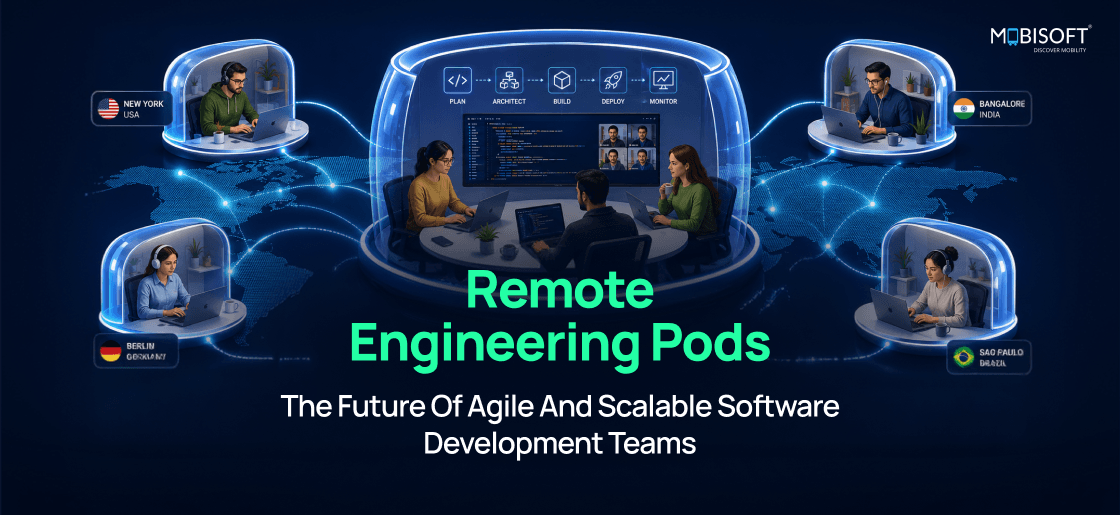
A remote engineering pod is a dedicated, cross-functional software engineering team of four to eight engineers. It operates as an integrated extension of your engineering organisation, not as a vendor doing work for a client.
Pod engineers are in your Jira. They attend your sprint planning. They push to your GitHub repository. They are held to the same quality standards as your in-house team.
The difference between a pod and traditional outsourcing is not geography. Remote teams have existed for decades. The difference is integration.
The Problem With the Old Model
Traditional software development outsourcing was built on isolation. The vendor's engineers worked inside the vendor's systems. Progress was reported at milestones. Problems surfaced at delivery, not during development.
Scope changes required formal change orders. The vendor had no incentive to absorb informal changes because the contract baseline was the only thing that could be measured.
The result was predictable. By the time the software arrived, the requirement had moved.
What Makes the Pod Model Different
A remote engineering pod removes the vendor-client boundary entirely. There is no handoff or a separate system. The pod is part of your team structure, distributed across locations.
Five things make a pod structurally different from outsourcing:
- Dedicated Allocation: The same engineers work exclusively on your product, building context over time.
- Cross-functional Composition: Frontend, backend, QA, and DevOps sit within the pod.
- Sprint Commitment: The pod commits to and owns sprint goals, not hours billed.
- Integrated Tooling: Your Jira, GitHub, Slack, and CI/CD pipeline from day one.
- Shared Quality Standards: Your code review process, test coverage requirements, and deployment practices.
The State of Distributed Engineering in 2026
The infrastructure for distributed collaboration is now as mature as the infrastructure for co-located work. Engineering talent in Bangalore, Krakow, Medellín, and Warsaw has reached the quality level that makes the pod model viable at scale.
Global software development teams that were once a compromise are now a strategic choice. Now, most high-growth technology companies use remote engineering pods as their primary scaling mechanism. The model speeds up team foundation and gives access to specialised skills unavailable locally.
Remote Engineering Pods vs Traditional Outsourcing
The comparison that explains everything is not about cost. It is about accountability.
| Dimension | Traditional Outsourcing | Remote Engineering Pod |
| Team Ownership | Vendor owns the team; handoff boundary diffuses accountability | Pod and in-house team are one unit; no vendor-client divide |
| Change Responsiveness | Scope changes need formal change orders | Sprint cadence absorbs priority changes naturally |
| Quality Standards | Vendor-defined; may differ from yours | Your CI/CD pipeline, your code review, your test bar |
| Transparency | Progress reports at milestones | Real-time visibility into commits, PRs, ticket updates |
| Knowledge Retention | Knowledge leaves with the vendor's engineers | Knowledge stays in your codebase and team relationships |
| Commercial Model | Fixed price or T&M; no delivery accountability | Dedicated team pricing; continuity depends on delivering value |
| Scalability | New contract, new scoping, new ramp period | Add a pod in weeks; reduce in weeks; no legal complexity |
The row that matters most long-term is knowledge retention. A pod that has worked on your product for twelve months accumulates context that is genuinely irreplaceable. That context lives in your codebase and in your in-house team's relationships. When an outsourcing engagement ends, it walks out the door.
Why Now Is the Right Time
Three things converged to make 2026 the best moment in history for the pod model.
Collaboration Tooling Has Finally Caught Up
GitHub Copilot, Linear, Loom, Figma, and Slack have made the distance between an engineer in Bangalore and a product manager in London operationally irrelevant for day-to-day work.
Async-First Culture Is Now the Default
The best distributed teams no longer try to replicate the synchronous co-located experience. They design work to be async-first with synchronous touchpoints for decisions.
The Cost Difference Is Real and Defensible
The cost difference between a Tier-1 US engineer and an equivalent-quality engineer in India, Eastern Europe, or Latin America sits at three to six times. At quality parity, that is not an ethical shortcut. It is a structural advantage.
The Six Remote Engineering Pod Structures
Not every product needs the same pod. The structure of a remote engineering pod should match the product, the in-house team it augments, and the strategic objective behind it. Using the wrong structure gives you a team that technically exists but does not deliver.
Here are the six structures and when to use each.
Full-Product Pod
This pod owns a complete product area end-to-end. The in-house team provides product requirements and architectural review.
Composition:
- Pod Lead
- Three to five full-stack engineers
- One QA plus
- 0.5 DevOps
Interface: Loose coupling. The pod is a semi-autonomous product unit.
Best for: Well-defined product areas that can be owned by a single team.
Duration: Six months to multi-year. Value compounds with familiarity.
Feature Pod
This pod works on your existing backlog alongside your in-house team. It does not own a separate product area. It extends your throughput.
Composition:
- Pod Lead
- Two to four specialists
- One QA
Interface: Tight coupling. Same sprint cycle, same backlog, same ceremonies.
Best for: Products with a large backlog and a team that needs more engineering throughput without changing its operating model.
Duration: Three to twelve months, often used for a defined acceleration period.
Platform Engineering Pod
This pod owns nothing product-facing. It owns internal infrastructure such as CI/CD pipelines, developer tooling, cloud infrastructure, and platform services.
Composition:
- Infrastructure lead
- DevOps engineers
- SRE
Interface: Service provider. The pod delivers internal infrastructure to product teams.
Best for: Organisations that need to improve developer productivity without hiring permanent platform engineers.
Duration: Long-term retainer. Platform engineering is ongoing, not project-bounded.
Technology-Specific Pod
This pod is composed entirely of specialists in one domain. Mobile, data engineering, ML/AI, embedded systems. It brings depth that your in-house team does not have.
- Composition: Domain specialists only.
- Interface: Consulting interface. You provide business context. The pod provides domain execution.
- Best for: Products expanding into a new technology domain, where hiring a full specialist team would be premature.
- Duration: Six to twenty-four months, depending on strategic priority.
Scaling Pod
This pod mirrors your in-house team's composition and works from the same backlog. It is not a separate unit. It is a parallel squad.
- Composition: Mirrors your existing team ratio of frontend to backend engineers.
- Interface: Parallel team. Two squads, one backlog.
- Best for: Products with a large backlog where the in-house team is the bottleneck.
- Duration: Project-bounded, typically four to sixteen weeks of defined acceleration.
Build-Operate-Transfer Pod
This pod builds your product, operates it for a defined period, and then transfers the team or the knowledge to your in-house operation.
- Composition: Full production team with Team Lead, engineers, QA, and DevOps.
- Interface: Three phases. Independent in months zero to three. Progressive shadowing in months three to twelve. In-house ownership in months twelve to twenty-four.
- Best for: Organisations building a new product or entering a new market who want external execution during the risky early phase and in-house ownership long-term.
- Duration: Eighteen to thirty-six months total.
The critical thing about team augmentation services is that not every engagement is a feature pod. Matching structure to context is the decision that determines whether the model works.
Pod Team Composition: Designing the Right Role Mix
Composition is not a headcount decision. It is a delivery architecture decision. A pod with the wrong mix creates dependencies and hand-offs that destroy the model's primary advantage: the ability to take a feature from specification to production without leaving the pod.
The Core Role Framework
Pod Lead / Tech Lead
The Pod Lead owns technical direction, architecture decisions, client relationship management, and sprint commitment. Without a lead, every technical question escalates to your tech lead. Your tech lead becomes the de facto pod lead, and their time disappears.
Minimum seniority: Senior Software Engineer with five or more years of experience.
Senior Full-Stack or Backend Engineer
The pod's primary delivery engine for non-trivial features. Must be independently capable on the pod's primary stack without requiring pairing for standard feature work.
Without a senior engineer beyond the Pod Lead, complex features stall. Junior engineers need direction that the lead cannot provide alone at the pace.
Mid-Level Engineer
The volume delivery engine for medium-complexity features. Two to four years of experience. Should complete standard features with occasional guidance.
This layer provides delivery volume at the right cost point. A pod that is entirely senior is over-engineered for routine work. A pod that is entirely junior is under-capable of complex features.
QA Engineer
Every pod with a feature delivery mandate needs one. Minimum mid-level with three years of experience. Must be capable of automated test development (Playwright, Cypress, Selenium) and exploratory testing.
Here is the absence consequence most teams underestimate: without QA, testing gets distributed to developers who are measured on feature delivery. Regression rates climb. Production incidents increase. Client confidence erodes faster from this gap than from any other composition failure.
DevOps / Platform Engineer
At 0.5 FTE for pods of four to six engineers, scaling to at least one FTE for larger pods. Must be independently capable on the pod's cloud platform and CI/CD toolchain.
Without DevOps, deployment becomes a manual ceremony that the Pod Lead performs. CI/CD pipelines go stale. Deployment frequency drops and sprint completion drops with it.
UX/UI Designer (Where Applicable)
Required for full-product pods building consumer-facing products. Not required for backend API pods or platform engineering pods.
Without a designer embedded in the pod, UI work waits for a separate resource. That dependency breaks the pod's self-containment. UI features take two to three times longer.
Recommended Configurations by Product Type
Different products need different mixes. Here is what works across the most common product types.
Consumer Mobile Application
Team size: 5 to 7 engineers
- Pod Lead (mobile architect)
- 2 to 3 mobile engineers
- 1 QA engineer
- 1 backend engineer
- 0.5 DevOps
Stack: Swift, Kotlin, React Native or Flutter, Fastlane for CI/CD
SaaS Web Application (B2B)
Team size: 5 to 8 engineers
- Pod Lead (full-stack or backend architect)
- 2 to 3 full-stack engineers
- 1 QA engineer
- 0.5 DevOps
- 0.5 UX designer (optional)
Stack: Next.js or React, Node.js or Python FastAPI, PostgreSQL, Playwright
Data Engineering or Analytics Platform
Team size: 4 to 6 engineers
- Pod Lead (senior data engineer)
- 2 to 3 data engineers
- 1 analytics engineer
- 0.5 DevOps
Stack: dbt, Snowflake or BigQuery, Airflow, Great Expectations
API Platform or Microservices Backend
Team size: 4 to 7 engineers
- Pod Lead (backend architect)
- 2 to 4 backend engineers
- 1 QA engineer
- 0.5 to 1 DevOps
Stack: Go, Node.js or Python FastAPI, Kafka, Kubernetes, Pact
AI/ML Product Feature
Team size: 4 to 6 engineers
- Pod Lead (ML engineer or AI architect)
- 1 to 2 ML engineers
- 1 data engineer
- 1 AI backend engineer
- 0.5 MLOps
Stack: PyTorch, LangChain, MLflow, Evidently AI
When you hire dedicated developers for a pod, the composition decisions above are not optional optimisations. They are the structural requirements that make the pod capable of end-to-end delivery.
Time Zone Architecture: Designing Collaboration That Works
Time zones are the most cited concern about remote engineering pods and the most consistently mismanaged. The naive approach is to require the remote pod to mirror your working hours entirely. This extracts an unsustainable productivity cost from pod engineers, creates resentment that drives attrition, and wastes the time zone difference as a delivery advantage.
The sophisticated approach designs collaboration to extract maximum value from overlap hours while enabling autonomous execution in non-overlap hours.
The Four Collaboration Models
Synchronous Overlap Model
Four to six hours of working hours overlap per day. The pod partially operates in your time zone, typically by shifting its schedule. All ceremonies happen in the overlap window. Async work fills the remaining hours.
Best for feature pods with frequent requirement discussions. Velocity is predictable. The time zone model creates equivalent velocity at lower cost, not amplified velocity.
Async-First Overlap Model
Two to three hours of working hours overlap per day. The overlap is used for decisions and blocker resolution only. The pod executes autonomously for the rest of its working day.
Stand-ups are async (Loom video plus Slack thread). One thirty-minute sync call during the overlap window. This model scales to multiple pods without proportionally increasing your synchronous time burden.
Best for mature product areas where the pod does not need frequent direction. Requires a high-quality backlog.
Follow-the-Sun Model
Eight to twelve hours of product coverage per day. Pods in different time zones hand off to each other sequentially. APAC pod commits work and posts a handoff note. EMEA pod picks up where APAC stopped. Americas pod takes the final handoff.
The effective engineering day for the product becomes sixteen to twenty hours. Development that takes a single-timezone team three days takes a follow-the-sun operation two days. That velocity advantage compounds at scale.
This model requires Run-level distributed engineering maturity. It does not work for organisations new to remote pods.
Fully Async Model
Zero to one hour of overlap. The pod operates entirely on its own schedule. All requirements in Jira, all design decisions in Figma or architecture documents, all reviews via code review, and async Loom recordings.
Appropriate only for highly mature, well-documented products with stable architecture. Not a starting point.
Optimal Time Zone Pairings
| Client Location | Recommended Pod Location | Natural Overlap |
| United Kingdom (GMT/BST) | India (IST, UTC+5:30) | 4.5 to 5.5 hours |
| United States East (EST) | India (IST) | 4 to 5 hours with a moderate shift |
| United States (PST) | Eastern Europe (CET/EET) | 3 to 6 hours |
| Middle East (GST, UTC+4) | India (IST) | 7 to 8 hours |
| Australia (AEST) | Philippines (PHT, UTC+8) | 2 to 3 hours |
The Middle East plus India pairing stands out. Seven to eight hours of natural overlap without any schedule adjustment from either party. It is the most frictionless time zone pairing globally for remote engineering pods, with maximum synchronous availability at offshore economics.
The GMT plus IST pairing is also a natural match. The UK morning gets async updates from the previous evening's pod work. The afternoon is the primary synchronous window. No uncomfortable shifts required for either party.
Sprint Governance for Remote Engineering Pods
The failure mode of distributed agile is well-documented. The team adopts the Scrum vocabulary while maintaining a waterfall reality: requirements in batches, extended delivery cycle, delayed feedback loop.
This failure mode is more common in remote engineering pods than in co-located teams. The ceremonies are the primary integration point between the pod and the client. Poorly run distributed ceremonies actively obstruct velocity rather than enabling it.
The Two-Week Sprint Operating Calendar
Sprint Kickoff (Monday, Week 1 for 60 minutes, synchronous)
- Attendees: Pod Lead, all pod engineers, client Product Manager, client Tech Lead.
- Agenda: sprint goal agreement (ten minutes), backlog review and ticket walkthrough (thirty minutes), commitment ceremony where pod engineers pull tickets they commit to completing (fifteen minutes), blockers and dependencies identified (five minutes).
- Pre-condition: all sprint tickets must be written, estimated, and have acceptance criteria before the kickoff. The kickoff is not a refinement session.
Daily Stand-Up (Async, fifteen-minute window each morning)
Each pod engineer posts a Slack update with three points: done yesterday, doing today, blockers.
The Pod Lead monitors for blockers and raises them with the client Tech Lead within two hours. Synchronous stand-up three times per week is available for teams in the Synchronous Overlap model.
Midpoint Check-In (Wednesday or Thursday, Week 1 for thirty minutes, synchronous)
- Attendees: Pod Lead, client Product Manager.
- Agenda: sprint progress as a percentage of committed tickets in Done or In Review, early risk identification for tickets unlikely to be completed, priority adjustment if required.
This is the primary risk management tool in the sprint. Problems identified on Wednesday are fixable. Problems identified on Friday are not.
Sprint Review and Demo (Friday, Week 2 for forty-five minutes, synchronous)
- Attendees: Pod Lead, pod engineers, client Product Manager, client Tech Lead, and any relevant stakeholders.
- Agenda: demo of completed features against acceptance criteria (twenty-five minutes), sprint metrics review covering velocity, quality, and deployment frequency (fifteen minutes), next sprint preview from the Product Manager (five minutes).
Retrospective (Friday Week 2 or Monday Week 3 for forty-five minutes, synchronous, pod only)
No client in the retrospective. This is an internal pod tool. The agenda covers what went well, what should change, and one experiment for the next sprint.
Action items are shared with the client Tech Lead as a transparency signal, not as a reporting obligation.
Backlog Refinement (Thursday, Week 1 or Week 2 for thirty minutes, rolling)
- Attendees: Pod Lead, client Product Manager, optional client Tech Lead.
- Agenda: refine the top ten to fifteen tickets for the next sprint, add acceptance criteria, estimate complexity, and identify dependencies.
- Pre-condition: the Product Manager writes first-draft tickets before refinement.
Async Communication Protocols
Good async communication is what separates a pod that sustains velocity from one that grinds to a halt between ceremonies.
Blockers
Post to the #blockers channel, tagging the Pod Lead and the relevant client team member. Include the blocked ticket link, the specific question or dependency, and the impact on delivery.
Response SLA
Client response within two hours during the overlap window. Pod Lead escalation if no response within four hours. If the blocker requires an architecture decision that cannot be resolved within four hours, schedule a fifteen-minute synchronous call in the next overlap window. Do not wait until the next ceremony.
Architecture or Design Decisions
Pod Lead writes an Architecture Decision Record (ADR) draft in shared documentation. Post a summary in #tech-decisions with a twenty-four-hour comment window. A decision with no response within forty-eight hours is treated as approved by silence, unless the Pod Lead flags it as requiring active approval.
If the decision has significant cost, security, or compliance implications, a synchronous review call is required before proceeding.
Code Review
All PRs posted in the shared GitHub repository with the PR template completed. Pod engineers review each other's PRs within four hours. In-house team reviews for architectural changes within the same business day.
If a PR receives two or more rounds of comments without resolution, schedule a fifteen-minute review call. Async code review that goes beyond three rounds is a process failure, not a technical one.
Production Incidents
P1 incidents are the one exception to the async-first model. The Pod Lead posts immediately to #incidents with severity, affected service, symptom, initial hypothesis, and who is investigating. Updates every thirty minutes until resolved.
P1 response: Client engineering lead acknowledgement within fifteen minutes. Synchronous war room call within thirty minutes, regardless of time zone. The on-call pod engineer joins regardless of local time.
Measuring Remote Engineering Pod Performance
Measuring pod performance is both more important and more misunderstood than measuring a co-located team. Physical distance removes the informal signals that let engineering leaders sense team health intuitively. Metrics must compensate for absent proximity.
The most instinctive metric, hours worked, is also the most useless. It incentivises the appearance of effort over the delivery of outcomes.
The Five-Category Metric Framework
Sprint Delivery Velocity
Story points committed versus delivered per sprint. Sprint completion rate with a target above eighty percent. Velocity trend over a three-sprint rolling average.
Warning signals: sprint completion rate below sixty percent for two consecutive sprints; velocity declining more than twenty percent over three sprints without an identified cause.
Code Quality Indicators
Test coverage above eighty percent for new code. PR review comment density as a signal of review thoroughness. Defect escape rate below five percent (production bugs within thirty days of deployment).
Warning signals: test coverage declining below seventy percent; defect escape rate climbing above ten percent; PR review turnaround consistently exceeding eight hours.
Deployment Frequency and Reliability
Deployment frequency above twice per week for feature pods. Deployment success rate above ninety-five percent. Mean Time to Recovery below two hours for deployment issues. Lead time from code merge to production is below twenty-four hours.
Warning signals: deployment frequency declining (indicates CI/CD health or confidence issues); success rate below ninety percent (indicates quality or process breakdown).
Collaboration Health
Average blocker resolution time below four hours. Ceremony attendance above ninety percent. Async update compliance above ninety percent. In-house Tech Lead satisfaction score above seven out of ten monthly.
Warning signals: blocker resolution time exceeding eight hours on average; satisfaction score below six for two consecutive months.
Pod Team Stability
Engineer retention above ninety percent annually. New engineers make up less than twenty percent of the pod size per month. Time for new pod engineers to reach full velocity is below four weeks.
This is the most under-measured predictor of pod performance. The institutional knowledge accumulated by engineers who have worked on your product for six to twelve months is not replaceable quickly. High churn on a remote engineering pod is more damaging than high churn on an in-house team because the informal context transfer mechanisms simply do not exist at a distance.
Onboarding a Remote Engineering Pod in 30 Days
The first thirty days determine the trajectory of the entire engagement. A well-executed activation builds product context, establishes communication norms, delivers the first working software, and creates confidence on both sides.
A poorly executed activation does the opposite. It creates ambiguity, delays the first meaningful contribution, and sets a negative trajectory that is expensive to reverse.
Week 1: Foundation (Days 1 to 7)
Activities
- Tool access provisioned: GitHub, Jira, Slack, CI/CD, cloud environments
- Architecture deep-dive: ninety-minute session with the client Tech Lead covering system architecture, technology stack, coding standards, and deployment processes
- Codebase onboarding: pod engineers clone and run the application locally; identify and resolve environment setup friction
- First ticket assignment: Pod Lead picks one to two real tickets per engineer; not exercises
- Development standards review: CI/CD pipeline walkthrough, code review process, branching strategy, deployment workflow
Deliverables
All pod engineers have working development environments. Architecture overview document written by the Pod Lead. First tickets pulled and in progress.
Go / No-Go
Go: every engineer has a working environment and first ticket in progress by end of Day 7. No-Go: environment setup still incomplete after seven days. This signals infrastructure documentation problems that must be resolved before productive work begins.
Week 2: First Delivery (Days 8 to 14)
Activities
- First PRs submitted: each engineer submits at least one PR by the end of Day 10
- Sprint 0 delivery: a lightweight calibration sprint with three to five tickets, not a full commitment sprint
- First stand-up cadence operational
- Blocker communication tested: at least one blocker should be raised, communicated, and resolved during Week 2
Deliverables
First PRs reviewed and merged. Sprint 0 board showing in-progress and Done tickets. First blocker resolved within the agreed SLA.
Go / No-Go
Go: at least two PRs merged per engineer; Sprint 0 above seventy percent complete by Day 14. No-Go: no PRs submitted by Day 10. This indicates direction, access, or motivation problems requiring immediate diagnosis.
Week 3: Sprint Commitment (Days 15 to 21)
Activities
- First full sprint commitment: pod participates in sprint planning and commits to a realistic sprint goal, targeting sixty to seventy percent of estimated full velocity to account for continued onboarding overhead
- All sprint governance ceremonies operational: planning, async stand-up, midpoint check-in, review, retro
- Pod Lead presents preliminary velocity estimate and sprint completion confidence to client Tech Lead
- Quality gates enforced: CI/CD pipeline blocking merges that fail quality gates
Deliverables
First sprint in progress with full governance. Velocity estimate documented. Quality gates active and enforced.
Go / No-Go
Go: sprint running with above eighty percent of tickets in progress or Done by Day 21. No-Go: sprint completion below fifty percent at Day 21 without a clear reason. This indicates sizing, direction, or technical blocker problems requiring immediate review.
Week 4: Productive Delivery (Days 22 to 30)
Activities
- First sprint review with client stakeholders: demo of first sprint deliverables
- Velocity baseline established from Sprint 1 actuals
- Thirty-day pod health review: Pod Lead plus client Tech Lead review onboarding against the checklist
- Sprint 2 planning based on learned velocity, not estimates
Deliverables
First sprint delivered and demoed. Thirty-day review document. Sprint 2 backlog planned and estimated. Velocity baseline recorded.
Go / No-Go
Go: Sprint 1 delivered above seventy percent of committed story points; demo received positively; team health score above seven out of ten. No-Go: Sprint 1 delivered below fifty percent without a clear systemic cause; retrospective identifies fundamental issues in direction, quality, or communication that the Week 5 model must address.
Scaling From One Pod to a Global Engineering Network
A single remote engineering pod is a team structure. A network of pods is an organisational model. These two things require different governance, coordination mechanisms, and leadership structures.
Organisations that try to manage a three-pod network with the same communication cadence they used for one pod discover that coordination overhead grows faster than delivery capacity. The transition requires deliberate architectural thinking.
Three Maturity Levels of Multi-Pod Coordination
Two Pods
Direct coordination between Pod Lead A and Pod Lead B. The client Tech Lead oversees both. Weekly cross-pod sync between the two Pod Leads. Shared API contract review is the primary integration governance.
Risk: shared interface conflicts where both pods change the same API without coordinating. Mitigated by explicit API contract documentation and cross-pod PR review requirements.
Three to Five Pods
An Engineering Lead (EL) layer is introduced. A dedicated Engineering Lead, functioning at a senior architect or VP Engineering level, coordinates across pods. Pod Leads report to the EL. The EL owns cross-pod architecture, shared standards, and the technical roadmap.
Shared elements at this level: service mesh or API gateway, shared CI/CD infrastructure, shared component library, common security and compliance standards.
Risk: architectural divergence where pods adopt different technical patterns independently. Mitigated by EL-level architecture governance and cross-pod code review standards.
Six or More Pods: Global Engineering Network
A platform team is introduced to provide shared infrastructure services to all product pods. Engineering community of practice (CoP) for knowledge sharing across pods. Architecture Review Board (ARB) for significant cross-pod technical decisions.
Shared infrastructure at this level includes an internal developer platform (IDP), feature flag service, observability platform, secrets management, and authentication and authorisation services.
Risk: organisational complexity begins to outpace delivery benefit. This level is appropriate only for organisations committed to sustained global engineering delivery at scale.
The Engineering Handbook
The engineering handbook is the most important governance document in a multi-pod network. Without it, each pod develops its own local standards. A five-pod organisation becomes five different engineering cultures in one codebase.
With an engineering handbook, a pod engineer who moves from Pod A to Pod B recognises the codebase, understands the deployment process, and contributes from Day 1.
Minimum contents include:
- Approved technology stack and the ADR process for proposing new technologies
- Coding style guide per language, with linter configuration checked into the repository
- Test coverage requirements: above eighty percent for new code, above seventy percent for modified legacy code
- PR template requirements: description, testing steps, screenshots
- Deployment process, feature flag policy (cleanup within two sprints), and deployment freeze windows
- Incident severity definitions: P1, P2, P3, with response time SLAs and on-call responsibilities per pod
- Security review requirements for features handling PII or financial data
- Async communication principles: write first, synchronise to decide
- Expected response times per communication channel and escalation paths
The Business Case for Remote Engineering Pods
Most organisations model only the direct cost comparison and miss seventy-five percent of the pod model's value. The full business case has four dimensions.
Dimension 1: Direct Cost
A remote pod of four to six engineers can cost around $150,000 to $400,000 per year, depending on geography and specialisation.
The in-house equivalent in major US markets: $800,000 to $2,000,000 per year approximately.
That calculation includes salary multiplied by 1.35 for benefits, $20,000 to $60,000 recruitment cost per hire, $15,000 to $25,000 in office and equipment per person per year, and twenty to thirty percent management overhead on individual contributor cost.
The three to six times cost difference at quality parity is not an estimate. It is a structural reality.
Dimension 2: Velocity to Market
Pod formation takes four to eight weeks to a productive, delivering team. Hiring an equivalent in-house team takes four to eight months.
That three-to-six-month velocity advantage is worth twenty-five to fifty percent of the first year's milestone value for time-sensitive products. For a product targeting $3 million in first-year revenue, three months of earlier market entry is worth $150,000 to $225,000 in time-adjusted milestone value. In addition to the cost saving, not instead of it.
Dimension 3: Engineering Scalability
Scaling from one pod to three pods takes eight weeks. Scaling equivalent in-house headcount from five to fifteen engineers takes six to nine months: job posting, interviewing, offer and notice period, then three to four months of partial productivity ramp.
A product team that can scale up in eight weeks and scale back in four weeks operates at a delivery agility that no permanent headcount model can match. The pod model creates options. Options have value.
Dimension 4: Strategic Risk Reduction
An organisation with a five-person in-house engineering team has a concentration risk. Same team, same location, same talent market. Two key engineers leave, and the product roadmap is in crisis.
An organisation with a two-person in-house core and one remote engineering pod has distributed knowledge and execution capacity. The diversification hedges against local talent market disruption, individual engineer departure, and geographic concentration risk.
This is an insurance premium most engineering leaders know they need but few model explicitly in their team structure decisions. Software development outsourcing done right, through a pod model, is precisely that hedge.
Choosing a Remote Engineering Pod Partner
The quality of a remote engineering pod engagement is determined less by the technology stack and more by the operational maturity of the engineering partner. A partner that has staffed and operated pods for five years across multiple time zones has already solved the problems you are about to encounter.
Offshore development company partners vary significantly in that maturity. Here is how to tell them apart.
Eight Evaluation Criteria
Track Record of Sustained Pod Engagements
Look for references for pod engagements that ran twelve months or longer at production quality. The partner should be able to describe how the pod handled engineer transitions, scope changes, and product pivots.
Red flag: partners who can only show short-term project engagements or references all under six months old.
Dedicated Allocation
The partner assigns dedicated engineers to each pod. The same engineers work on your pod for the engagement duration. Pod Leads are senior engineers, not project managers with a technical background.
Red flag: engineers who move between clients based on availability rather than engagement continuity.
Time Zone Overlap Capability
The partner has engineers in the time zones that enable the collaboration model you need. They have experience managing overlap hours efficiently and established async protocols for non-overlap hours.
Red flag: partners whose only time zone offering does not overlap with your business hours.
Engineering Standards and Quality Practices
The partner has documented engineering standards applied consistently across all pods. Minimum test coverage requirements, code review protocols, deployment practices, and quality gates that block merges.
Red flag: partners who defer all quality standards to you, claiming to "do what you ask." That means they have no standards of their own.
Communication and Governance Maturity
The partner has a defined sprint governance model that they can articulate and have applied across multiple engagements. The Pod Lead has the communication skills to represent the pod to your stakeholders without hand-holding.
Red flag: partners who rely entirely on you to design their process.
Engineering Depth and Specialisation
The engineers proposed for your pod have verifiable, production-level experience in your specific technology stack. Not category-level generalism.
Red flag: partners who propose engineers before understanding your technical requirements; engineers whose profiles show web development experience without depth in your specific stack.
Pod Scaling Capability
The partner can add or remove engineers within weeks. They have a talent pipeline deep enough to fill new pods without compromising quality on existing engagements.
Red flag: partners who cannot commit to a scaling timeline or have only managed single-pod engagements.
IP, Security, and Compliance Practices
Clear IP assignment in the MSA. Background-checked engineers who comply with your security policies. Evidence of security compliance certification: ISO 27001 or SOC 2.
Red flag: ambiguous IP ownership clauses; resistance to background checks; no professional indemnity insurance.
A partner that meets all eight criteria is providing more than engineering capacity. They are providing an engineering operating model: a repeatable, governed way of delivering software across distributed teams.
The fully-loaded cost of a low-maturity partner often exceeds the cost of a mature one. A pod that requires significant client-side process design, quality management, and direction does not save money. It moves the cost from the partner's invoice to your internal headcount.
Conclusion: The Remote Engineering Pod as a Competitive Advantage
The remote engineering pod model is not a cost reduction strategy in a team structure's clothing. Organisations that treat it purely as a payroll reduction miss what it actually builds.
A distributed engineering organisation scales with opportunity, retains institutional knowledge, and operates across time zones. That is genuinely hard to replicate through traditional hiring.
A team that activates a new pod in four weeks moves faster than any competitor stuck in a six-month hiring cycle. Three pods across three time zones deliver sixteen hours of engineering per day. That is not an incremental gain. It compounds every month.
Engineering depth in web, mobile, cloud-native, and AI stacks, combined with sprint governance that works across eight to twelve time zone hours, is what separates a pod partner worth working with from one still figuring it out at your expense. The eight evaluation criteria above exist for exactly that reason.
Mobisoft Infotech has operated remote engineering pods for clients across the US, UK, UAE, Australia, and Singapore for over a decade. Our teams run from India, with IST coverage that works for US East and UK clients, and full overlap for Middle East clients.

Frequently Asked Questions
What Is a Remote Engineering Pod?
A remote engineering pod is a dedicated, cross-functional software engineering team of four to eight engineers that operates as an integrated extension of your engineering organisation. Pod engineers work in your tools, attend your sprint ceremonies, and are held to your quality standards. It is not a vendor relationship. It is a team structure.
How Does a Remote Engineering Pod Differ From a Body Shop?
A body shop provides individuals. A pod provides a team. The difference matters operationally. A pod has full-stack composition, team continuity across the engagement, sprint ownership (the pod commits and delivers, not just efforts), and embedded quality standards. Staff augmentation services that operate as a body shop offer headcount. A pod offers a delivery unit.
What Is the Follow-the-Sun Development Model?
The follow-the-sun model uses pods in time zones eight to twelve hours apart to create a continuous sixteen to twenty-hour engineering day. APAC pod commits work and posts a handoff note. EMEA pod picks up at the start of the day. Americas pod takes the final handoff.
The velocity outcome is a thirty-three percent compression of the development calendar for handoff-compatible work. The model requires Run-level distributed engineering maturity in async documentation, feature branch discipline, and shared codebase documentation.
How Quickly Can You Scale a Remote Engineering Pod?
Adding a pod takes four to eight weeks. Scaling an equivalent in-house team takes six to nine months. Scaling back a pod takes weeks and requires no employment law navigation. The pod model creates delivery agility that permanent headcount simply cannot match.
What Should You Look for in a Pod Partner?
One should look for the following 8 things: sustained engagement track record (twelve months or longer), dedicated allocation (no time-sharing), time zone capability, documented engineering standards, governance maturity, engineering depth in your specific stack, scaling capability with a defined timeline, and clear IP and security compliance. A dedicated software development team partner who cannot demonstrate all eight is learning the model at your expense.
How Do You Build a Global Engineering Network From Multiple Pods?
Two pods: direct Pod Lead coordination, client Tech Lead oversight, shared API contract documentation.
Three to five pods: Engineering Lead layer, platform pod for shared services, engineering handbook.
Six or more pods: platform team providing an internal developer platform, engineering community of practice, and Architecture Review Board.
This content is for informational purposes only and may include AI-assisted research or content generation. While we strive for accuracy, information may evolve over time. Readers are advised to independently verify critical information before making decisions.

Nitin Lahoti
Read more
Nitin Lahoti is the Co-Founder and Director at Mobisoft Infotech. He has 15 years of experience in Design, Business Development and Startups. His expertise is in Product Ideation, UX/UI design, Startup consulting and mentoring. He prefers business readings and loves traveling.
 Nitin Lahoti
 June 17, 2026