What This Guide Covers
- What is trucking dispatch software - and what it is not
- Manual dispatching vs. automated dispatching: the honest comparison
- How dispatch software actually works (the workflow)
- Key features: load assignment, route optimization, tracking, billing, compliance, and more
- The business case: empty miles, fleet utilisation, and ROI
- Dispatch software vs. TMS vs. load boards: what each owns
- Dispatch software for carriers vs. freight brokers
- AI and the next generation of dispatch
- How to choose the right platform: 7-factor framework
- Implementation: what to expect and what goes wrong
- Frequently asked questions
- Book a demo - Mobisoft Dispatch
What Is Trucking Dispatch Software?
Let's start with what it actually is, not the marketing version.
The trucking dispatch software solution is used for dispatching loads in trucks by linking the load to the driver, truck, route, and schedule. The system will replace the old-fashioned solutions, such as the dispatcher spreadsheet, whiteboard, radio checks, and paper rate confirmation, with just one system doing all the work in real time.
At its core, dispatch software answers three questions:
- Which driver and truck should take this load?
- What is the most efficient route, given current conditions and hours-of-service constraints?
- Is this happening as planned? And if not, what do we do about it?
In case of more advanced systems, dispatching loads in trucks means more than just assigning drivers to loads, since these platforms will automate the entire process through such functions as automated load matching with brokers, creating invoices based on completed loads, alerting for violations before incurring any penalties, and tracking the shipment in real time without any need for contacting people.
One-Line Definition
Dispatching loads in trucks is a trucking dispatch system that takes over all the functions associated with dispatching trucks and managing loads. This software solution will replace the spreadsheets, radio communications, and paperwork involved in the processes.
What dispatch software is not
It's worth being clear about this, because the market uses terms loosely, and it causes real confusion when fleets buy the wrong product.
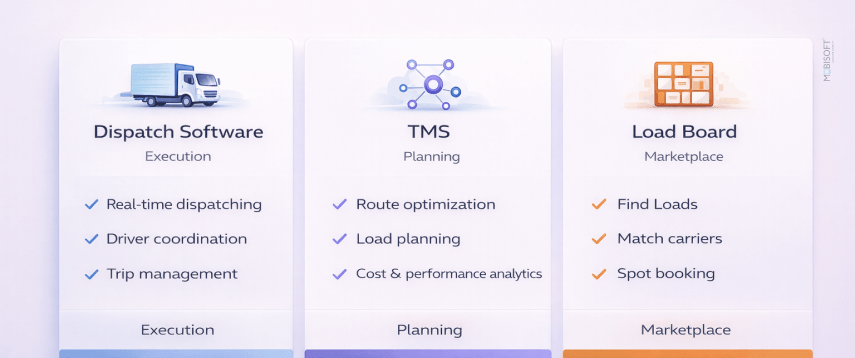
- It is not a load board. Load boards list available freight for carriers to find and bid on. Dispatch software manages the execution once a load is assigned, but most platforms now integrate with load boards to pull opportunities directly.
- It is not a TMS. Transportation Management Systems (TMS) are typically more comprehensive enterprise platforms covering carrier sourcing, freight procurement, and multi-modal planning. Dispatch software focuses on operational execution: the actual movement of loads by specific drivers and trucks. (covered in detail later on)
- It is not fleet management software alone. GPS tracking and vehicle telemetry are features within dispatch platforms, but a standalone GPS tracker is not dispatch software. The dispatch layer connects vehicle location to load assignment, route optimisation, and driver communication.
If you want to see how this works in a purpose-built platform, explore Mobisoft's trucking dispatch software built for carriers, brokers, and hybrid operations.
Manual Dispatching vs. Automated Dispatching
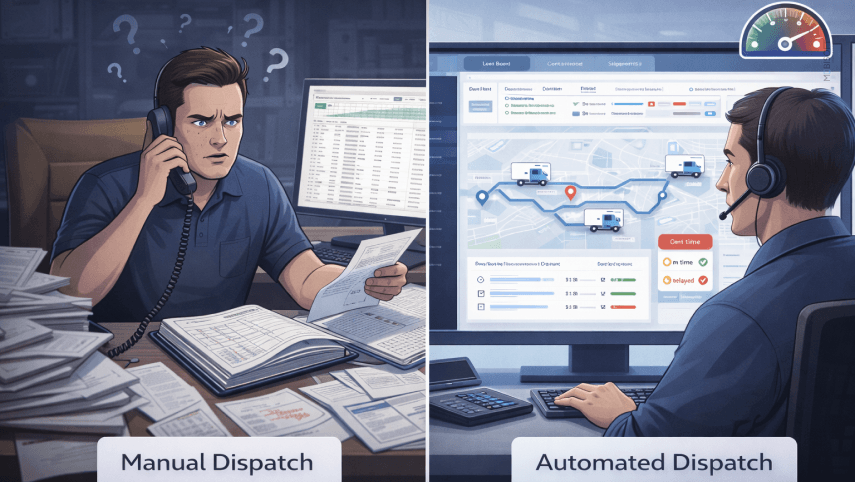
Before you evaluate any software, it helps to be honest about what manual dispatching actually costs you.
Picture a typical morning at a ten-truck carrier operation without modern dispatch software for trucking company operations. Your dispatcher comes in and begins going over his list. It might include going over the board, pulling up three different spreadsheets, reading emails from brokers, calling drivers to verify their availability, figuring out if that driver has enough hours left according to the HOS regulations, and writing down assignments on paper.
By 8:30 AM, three trucks are assigned. Two others are sitting because the dispatcher is waiting for a callback from a driver who might be available. One load was assigned to a truck that's 180 kilometres from the pickup, simply because it was the first one the dispatcher remembered. The dead miles on that misassignment cost $140 in fuel before the first loaded kilometre.
Now multiply that by 365 working days. That's a real number on your P&L.
Limitations of Manual Dispatching
- Load assignment by memory and gut feel
- Route planning with Google Maps or experience
- Driver location: phone calls and check-ins
- HOS compliance: manual log checking
- Billing: typed from rate confirmation sheets
- Customer updates: phone calls on request
- Backhaul planning: reactive, when the driver calls
- Empty miles: 16–20% of total mileage (ATRI 2025)
- Revenue per hour: limited by dispatcher bandwidth
Benefits of Automated Dispatching
- AI-assisted load assignment by proximity, HOS, and profitability
- Optimised routes factoring traffic, weight limits, and delivery windows
- Real-time GPS: driver location on dashboard, no call required
- HOS automatically tracked and surfaced in assignment view
- Invoices are auto-generated from completed load data
- Customers track their own loads via the portal or link
- Backhaul suggestions before the driver reaches delivery
- Empty miles: 8–12% target with optimised assignment
- Revenue per hour: dispatcher manages 3x the load volume
The Empty Miles Problem: The Number that Moves the P&L
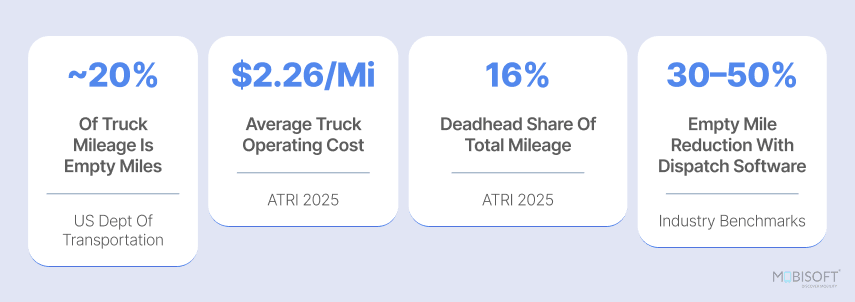
Here is the number that should focus this conversation. According to the US Department of Transportation, empty miles account for nearly 20% of total truck mileage in freight operations. ATRI's 2025 operational cost analysis puts deadhead (empty miles) at roughly 16% of total mileage.
At $2.26 per mile average operating cost (ATRI 2025), every empty mile costs you money. A 500-mile deadhead run costs $1,130 before it earns a dollar. For a 10-truck fleet doing that once per day, that's $4.1 million per year in operating cost with zero revenue attached to it.
Trucking dispatch software addresses this directly. By matching return loads to drivers before they complete a delivery, optimising assignment based on proximity rather than familiarity, and surfacing backhaul opportunities from load boards, modern platforms cut deadhead by 30 to 50%. That improvement alone typically justifies the software investment within months.
For a detailed side-by-side breakdown of where manual processes break down and where automation takes over, see this guide on manual vs automated dispatch systems.
How Dispatch Software Actually Works
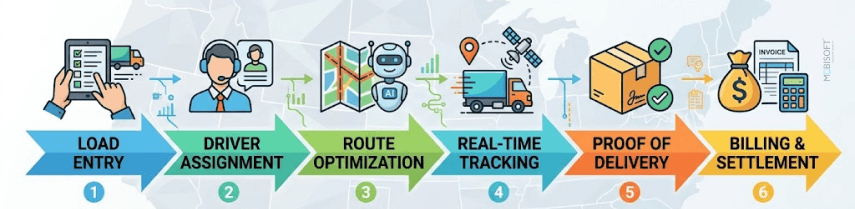
Here is the load lifecycle through a modern trucking dispatch software platform, from load entry to invoice payment:
Step 1: Load Entry
A load enters the trucking dispatch system via one of three paths: manually entered by the dispatcher (pickup/delivery addresses, commodity, weight, rate confirmation), automatically pulled from a load board integration (the freight dispatch software imports the load directly from DAT, Truckstop.com, or a broker's TMS), or received via EDI from a shipper's system. In modern platforms, AI can also parse a broker email or PDF and create the load record automatically.
Step 2: Driver and Equipment Matching
The automated dispatching software evaluates available drivers against the load requirements. Key criteria include: Driver proximity to pickup location, HOS left, type of equipment and its carrying capacity, preference or qualification of the driver for handling such freight, and past performance on those same routes. The dispatcher gets a list ranked in order, with "the most efficient choice for this load" being the top option. One click to assign.
Step 3: Route Optimisation
Once assigned, the route optimization software generates an optimised route considering traffic conditions, road weight restrictions, height restrictions, preferred truck stops, HOS-compliant rest stop suggestions, delivery window requirements, and fuel efficiency. The driver receives the route on a mobile app. No printing, no phone dictation.
Step 4: Real-Time Monitoring
From the very second the truck hits the road, your dispatcher sees his live GPS coordinates, speed, ETA of delivery and pickup, countdown to HOS limitations, and current exception(s), be it traffic jam, extended stoppage, or deviation from the planned route. Your customers get a tracking link without a phone call to your dispatcher.
Step 5: Proof of Delivery and Billing
captures electronic proof of delivery (ePOD) (signature, photos, timestamp) via the mobile app. This triggers the billing workflow. The invoice is auto-generated from the load record, rate confirmation, and ePOD timestamp. It goes to the customer for payment. The dispatcher's involvement is zero.
Step 6: Settlement and Analytics
Driver pay settlements are calculated automatically from completed loads: per mile, per load, or against contracted rates. Finance has real-time visibility into receivables and payables. Management dashboards show fleet utilisation, revenue per mile, on-time delivery rate, and real-time empty mile percentage.
For a deeper look at how alerts, dashboards, and decision loops power real-time dispatch operations control, this resource covers the command centre model in detail.
Key Features of Modern Trucking Dispatch Software
Not all dispatch software for trucking companies is equal, and not all features matter equally to every operation. Here is what to understand about each capability: what it does, why it matters, and what to look for when evaluating platforms.
Load Assignment and Management
Load Assignment Dashboard
The primary dashboard for dispatchers: a full picture of current, pending, and available loads in relation to available drivers and their statuses. The load database stores commodity information, load weight and size, pick-up and drop-off time windows, rate confirmation, specialized requirements (hazmat, refrigeration, oversized cargo), and carrier instructions. Load assignment can be done manually (dispatcher assigns a driver), based on rules (the system assigns automatically according to predefined criteria), and assisted by AI algorithms.
Backhaul and Load Matching
Before a driver completes a delivery, good truck dispatch software surfaces return load opportunities, from integrated load boards or the platform's own load pool, that match the driver's location, equipment, available HOS, and home terminal. This is the primary mechanism for reducing empty miles. Platforms with load board integration (DAT, Truckstop, Amazon Freight, broker APIs) can pull real-time available loads and score them against each driver's situation.
Route Optimisation
Intelligent Route Planning
Route planning in a driver dispatch system far exceeds the possibilities of using Google Maps. High-end algorithmic solutions consider: vehicle weight and height limits for each road segment, traffic and incident data, optimal locations of HOS-compliant rest areas, optimization of fuel stops according to current prices, delivery time windows, multi-stop sequencing for LTL deliveries, and weather conditions. The routes are updated dynamically according to changing circumstances rather than being pre-calculated.
Fuel Optimisation
Modern trucking dispatch software solutions incorporate feeds of real-time fuel prices along with fuel network preferences to optimize the choice of fuel stops for drivers. For a fleet moving 1,000 miles a day in each truck, even the savings of $0.05 per gallon in the fuel cost, thanks to the optimal route calculation, can result in annual savings of more than $2,000 per truck. At the fleet-wide level, this is usually enough to cover the platform cost.
Real-Time Tracking and Fleet Visibility
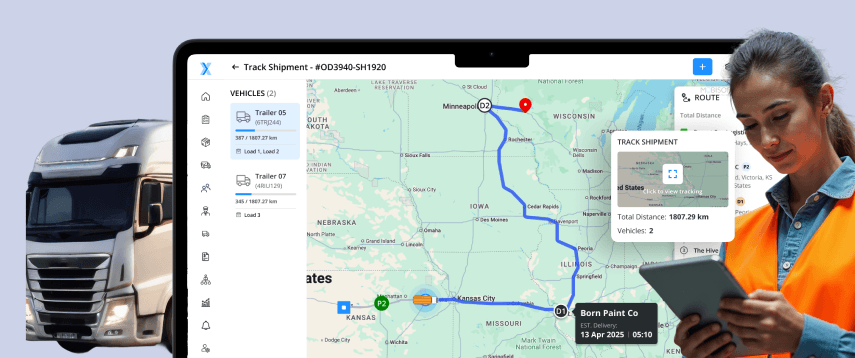
Live GPS and Fleet Map
The fleet management software displays real-time positioning information of every vehicle on the dispatcher's map view, along with HOS compliance status, current load, next point, and expected time of arrival. Without making any check call, dispatchers will get the opportunity to know everything about the whole fleet of trucks at once. Proximity searching will show which drivers are near enough to pick up the new shipment.
Customer Visibility Portal
Instead of answering "Where is my freight?" calls all day long, dispatchers will forward a tracking link to the customers. This real-time tracking for trucking solution will display the real-time location of the truck, expected time of arrival, and status changes (picked up, en route, out for delivery, delivery completed). By 2026, shippers unable to track their shipments will have no choice but to opt for carriers with such a feature.
To explore how modern fleet tracking software handles live GPS visibility, geofencing, and HOS overlays across an entire fleet, this overview covers the full capability set.
HOS Compliance and Driver Management
Hours of Service Integration
A carrier must comply with the Hours-of-Service regulations. Violation of these rules results in severe penalties ($16,000 and above per violation). Integration of cloud-based trucking dispatch software with an ELD (Electronic Logging Device) will allow dispatchers to know about every driver's available driving hours in real-time mode from the assignment page. The system will never allow loading drivers beyond their HOS restrictions and suggest ideal load scheduling based on the number of available hours.
Driver App and Communication
Load information, including route, pick-up, delivery information, and customer contacts, is communicated to the drivers via a mobile app rather than any printed materials or phone instructions. This dispatch software for owner operators eliminates the need to call for routine communications. Status updates such as "en route," "arrived at location," "load delivered" can be triggered either through geofencing or by the driver using the app.
Electronic Proof of Delivery (ePOD)
ePOD and Document Management
The driver captures delivery confirmation via the mobile app at the point of delivery. The data includes customer signature, delivery photos, timestamps, and any exception notes. All of it is immediately available in the trucking dispatch software platform and triggers the billing workflow. No more chasing paper PODs, faxed BOLs, or disputing delivery times without evidence. ePOD is also the key to clean, fast accounts receivable. Customers who dispute invoices without photographic, timestamped delivery evidence almost always lose.
Automated Invoicing and Billing
Freight Billing Automation
As soon as the ePOD is completed successfully, the billing module creates the customer invoice automatically. Access to an integrated accounting software platform (QuickBooks, Sage, NetSuite, and Xero) eliminates the need for manually entering the invoice details. This includes reconciling the carrier's invoices against contracted rates. It is done automatically and eliminates the most time-consuming process in the back office of a freight broker.
Driver Settlement and Payroll
Driver pay calculation, such as per mile, per load, percentage of revenue, or complex multi-rate contracts, is all automated from completed load data. Settlements are generated without the dispatcher re-entering completed trip data. Drivers can view their earnings and upcoming settlements in the driver app, reducing pay disputes. This transparency improves driver retention in a market where turnover exceeds 90% annually at large carriers.
Load Board Integration
Load Board and Broker Connectivity
Modern best trucking dispatch software platforms integrate directly with major load boards (DAT, Truckstop.com, 123Loadboard, Amazon Freight Partner) and freight broker APIs. Loads flow directly into the dispatch system. No need for tab-switching or re-entry. Carrier rate history, broker reliability scores, and lane profitability data are surfaced alongside the load opportunity so dispatchers make better decisions faster. AI can score and rank opportunities by profitability, fit, and relationship score.
Reporting and Analytics
Business Intelligence Dashboard
Management visibility across the operation in real time: revenue per mile, empty mile percentage, on-time delivery rate, fleet utilisation, driver performance scores, lane profitability analysis, and cash flow tracking. Good trucking dispatch software doesn't just generate these numbers at month's end. It surfaces them live, so decisions are made on current data, not last week's spreadsheet. API access allows custom reporting in BI tools like Power BI or Looker.
The Business Case: What Dispatch Software Actually Does to Your Margins
Numbers are easier to trust than promises. Here is what consistent industry data shows across a realistic range of mid-market carrier and broker operations.
Empty Mile Reduction
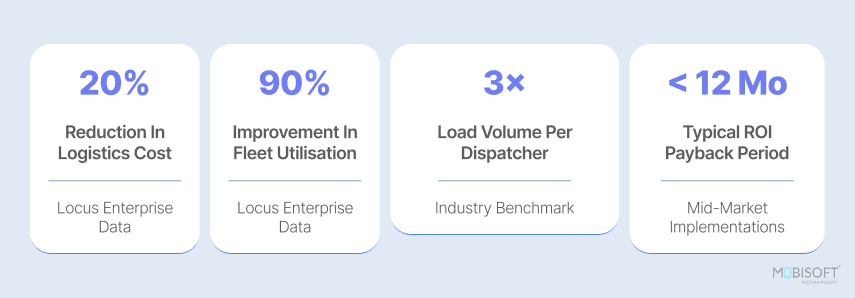
Empty miles are the single biggest efficiency lever in trucking. Industry benchmarks show fleets moving from 16–20% deadhead to 8–12% with optimised dispatch, a reduction of 30 to 50%. At $2.26 per mile operating cost and a 10-truck fleet averaging 500 miles per day each, that's:
Before: 1,000 empty miles per day across fleet × $2.26 = $2,260 daily dead cost
After: 600 empty miles per day × $2.26 = $1,356 daily dead cost
Annual saving: $904 per day × 300 working days = $271,200
That is one metric on a 10-truck fleet. Real operations see savings across multiple categories simultaneously.
Fleet Utilisation
Locus reports that enterprise customers using its custom trucking dispatch software improved fleet utilisation by up to 90%. It means that trucks went from being used for 4.5 hours per shift to being loaded for close to 9. At the less dramatic end, a 20% utilisation improvement on a 20-truck fleet is the equivalent of adding 4 trucks without buying or leasing them.
The Dispatcher Productivity Factor
The dispatcher bandwidth is one cost you can easily miss. An experienced dispatcher handling a manual fleet operation could usually manage up to 8 - 12 trucks at once without a drop in efficiency. Checks would not be done, the allocation of the loads would be suboptimal, and there would be a lot more billing errors than needed.
Using a trucking dispatch software development solution, an experienced dispatcher can handle 25–40 trucks effortlessly. Why? Because the software frees them from all tedious and less valuable activities, like verifying locations, availability checks, HOS calculations, and entering billing information. All the dispatcher does is make exception-based decisions and solve problems arising from the work.
In other words, by using an automation system, a carrier could double its fleet size until it hired another dispatcher. Meanwhile, freight brokers could handle twice as much cargo as before without recruiting more dispatchers.
For a complete breakdown of where each system fits in the broader logistics stack, this article on transportation management system vs dispatch software clarifies the boundaries in detail.
Dispatch Software vs. TMS vs. Load Boards: The Clear Difference
These three categories get mixed up constantly, and sometimes even intentionally, by vendors trying to seem more comprehensive than they are. Here is the honest breakdown.
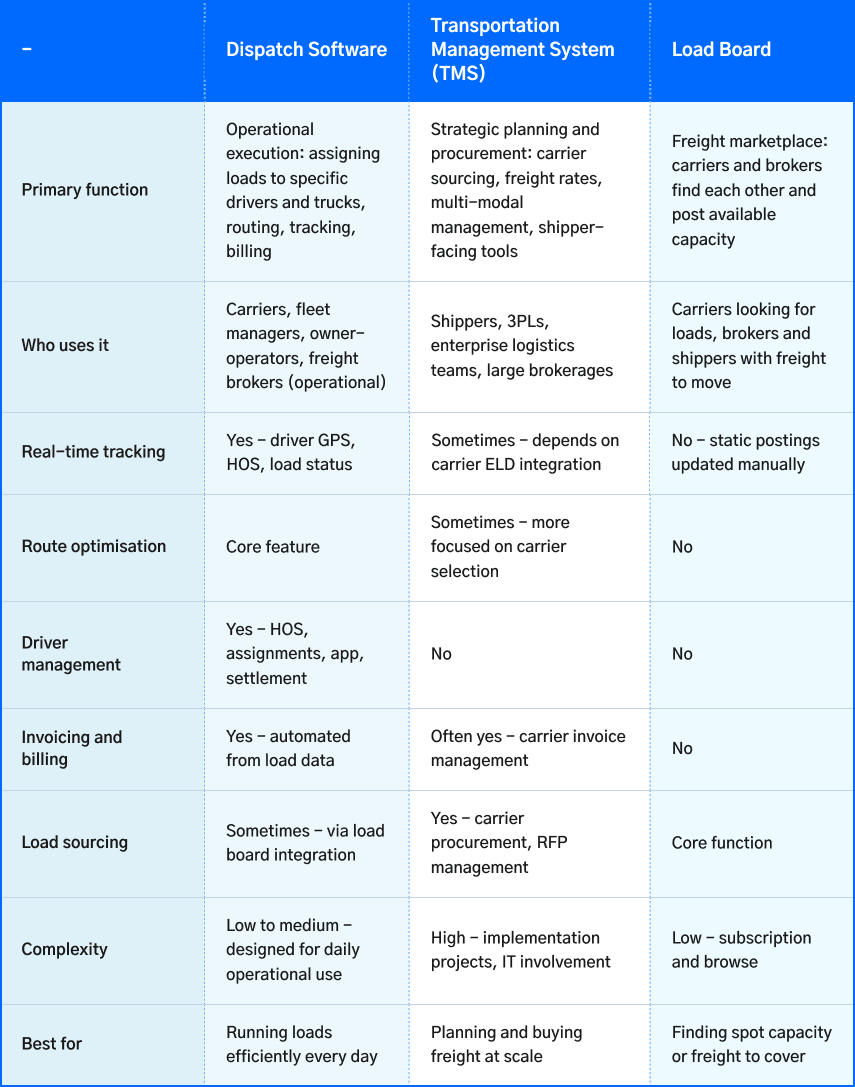
Dispatch Software for Carriers vs. Freight Brokers
The same trucking dispatch software category serves two very different operations. Understanding what each needs prevents buying the wrong product.
For Asset-Based Carriers
If you own trucks and employ drivers, your truck dispatch software needs to manage:
- Your specific assets: vehicle types, capacities, maintenance schedules, ELD data
- Your specific drivers: HOS compliance, certification, assignment history, pay rates
- Your specific lanes and customers: contracted rates, delivery window requirements, performance SLAs
- Your fleet utilisation: which trucks are loaded, which are empty, which are in maintenance
Asset-based carriers need deep HOS integration, robust driver app functionality, and settlement accuracy. A platform that's weak on driver management or ELD integration is the wrong choice for this operation, regardless of how good its route optimization software is.
For Freight Brokers
Freight brokers don't own trucks. They connect shippers with carriers and manage transactions using freight bidding software and dispatch tools. Your freight dispatch software needs to manage a completely different workflow:
- Load board integrations: pulling available freight from shippers and posting your capacity
- Carrier sourcing and qualification: building a preferred carrier network, tracking carrier safety scores, insurance, and authority
- Rate negotiation and margin management: the spread between what the shipper pays and what the carrier accepts
- Customer and carrier communication: shipper portals for visibility, carrier portals for load acceptance
- Billing on both sides: invoicing shippers, reconciling carrier invoices, managing factoring
Broker-focused platforms integrate heavily with load boards and have strong carrier relationship management tools. Asset-management features are less relevant. If you're evaluating a platform that leads with ELD integration and driver settlement, it was probably built for asset carriers, not brokers.
For Hybrid Operations (Carrier + Brokerage)
Many growing carriers also broker loads, using their own trucks where they can and placing excess freight with third-party carriers. This is actually the most common operation type for carriers with 10 to 100 trucks. You need both workflows in one platform, without switching between tabs.
Not many platforms do this well. Look specifically for platforms that explicitly market to 'asset-based brokers' or 'carrier/broker hybrids' and ask for a demo that shows both workflows running simultaneously.
AI and the Next Generation of Dispatch
AI in trucking dispatch software is in production at major platforms right now. The capabilities are meaningfully different from what existed two years ago.
AI-Assisted Load Assignment
When presented with the list of drivers that may handle the load, the AI algorithm in the automated dispatching software analyzes every single match based on several dozen criteria at once. Driver's current location, HOS left, availability of the right type of equipment, previous experience handling this route, relative profitability compared to the opportunity cost for the driver, and the reliability rating of the broker. The dispatcher sees a ranked recommendation, not a raw list.
AI Document Processing
Dispatchers historically spend significant time manually entering load data from broker emails, rate confirmations, and PDF load tenders. AI can now read these documents, both structured and unstructured, and automatically create load records. PCS Software's Cortex AI, launched in 2025, allows dispatchers to upload a PDF or even a photo of a load tender and have the load management system parse and populate the load record automatically.
Predictive Backhaul Matching
AI systems that learn from historical lane data can accurately predict. Before a driver completes a current delivery, it proactively surfaces profitable backhaul loads for return routes from the available ones. PCS Software's Backhaul Booster uses load board data and historical haul patterns to make these suggestions automatically. The result: dispatchers don't have to go looking for return loads. The system finds them.
AI Voice and Communication Agents
The newest frontier: AI agents that can make or take calls on behalf of dispatchers to check in with drivers, negotiate rates with brokers, and send status updates to customers. PCS Software's 'Cora' AI voice assistant handles routine broker communication. The dispatch team focuses on exceptions and decisions; the AI handles the repetitive communication volume.
The market is moving fast. Platforms that were built before 2022 and are adding AI as a module often deliver less capable AI functionality than platforms that were architected for AI from the ground up. When evaluating, ask specifically: is AI a feature bolted onto the platform, or is it embedded in the core workflow?
For operations exploring how AI integrates with broader logistics software development capabilities, this resource outlines the technology stack behind modern transportation platforms.
How to Choose the Right Dispatch Software: 7-Factor Framework
There are dozens of dispatch software for trucking companies on the market in 2026. Choosing the wrong one is expensive, not just in licence fees. The operational disruption of implementing something that doesn't fit, and the cost of eventually switching, are significant.
Here is a seven-factor framework for evaluating platforms. Go through each factor with the specific operation you're running, not the theoretical ideal operation you might have in three years.
Factor 1: Operation Type Fit
- Is the platform designed for asset carriers, freight brokers, or hybrid operations?
- The answer determines which features will be primary (asset carriers: driver app, ELD, settlement; brokers: load board integration, carrier management, two-sided billing; hybrid: all of them).
- A platform that leads with the wrong workflow will feel wrong from day one.
Factor 2: Fleet Size and Growth Trajectory
- A five-truck carrier and a 200-truck carrier have fundamentally different requirements.
- Platforms designed for small carriers (Owner-operator focused: Truckbase, TruckerCloud, Axon) are excellent for their target, but will create friction at scale.
- Enterprise platforms (McLeod, TMW, Oracle TMS) are overkill and overpriced for small operations.
- Be honest about where you are and where you're realistically going in the next two years.
Factor 3: ELD Integration
- If you operate commercial vehicles, HOS compliance is mandatory. Integrate with your existing ELD provider, or you need to switch providers.
- Confirm specifically which ELD brands are supported (Motive, Samsara, KeepTruckin, PeopleNet, Omnitracs, etc.) before committing.
- 'ELD integration available' on a website does not mean your specific ELD is supported.
Factor 4: Load Board and Broker Integration
- For carriers who source freight from load boards: confirm specifically which boards are integrated and at what depth.
- Can loads be imported automatically? With multiple simultaneous boarding from the platform?
- Does the platform pull rate intelligence from load board data? Shallow integration is similar to no integration, resulting in rework.
Factor 5: Mobile App Quality
- Your drivers will use the app on their devices, possibly in poor cellular coverage, every day. A poor driver app kills adoption regardless of a good desktop platform.
- Ask for a hands-on demo of the driver app. Download it yourself and test it on a real mobile device.
- Questions to answer: Does it work offline and sync when online? Is the UI readable in sunlight? How easy is it to navigate through?
Factor 6: Billing and Accounting Integration
- Billing automation is one of the highest-ROI features in dispatch software. Confirm: which accounting platforms are natively integrated (QuickBooks, Xero, Sage, NetSuite)?
- Is the integration real-time or batch export? Can the platform handle your specific billing complexity?
- Cover fuel surcharges, accessorials, multi-currency if applicable, detention billing, and per-diem charges to avoid unexpected friction.
Factor 7: Implementation and Support
- Even the best dispatch platform fails without proper implementation and support. Ask for two references from operations of similar size and type.
- Ask specifically: implementation time, unexpected challenges, and how responsive support was when something broke.
For 24/7 fleet operations, same-day email support is not adequate. Confirm the support SLA.
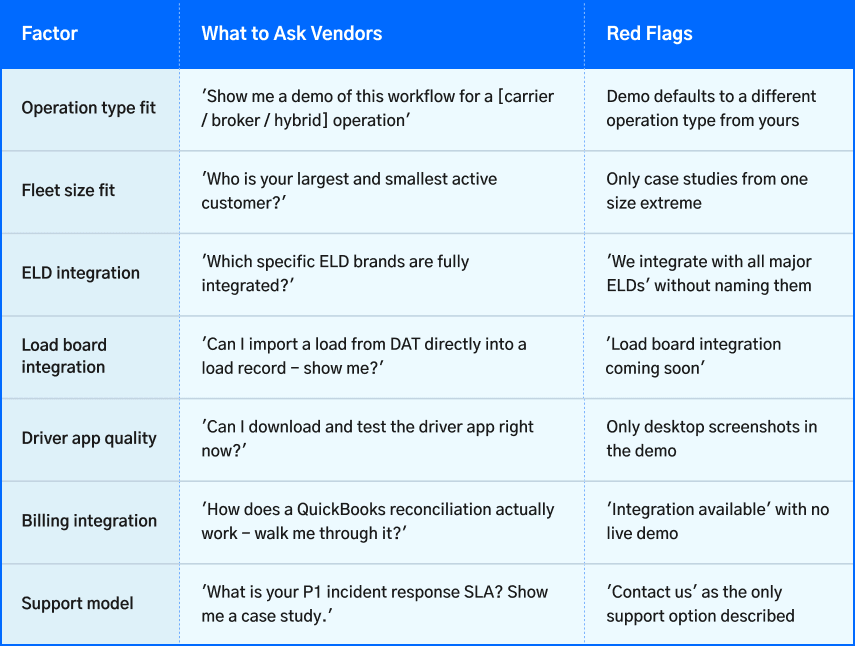
Implementation Checks and Precautions
Most software implementations fail not because the software is bad, but because the implementation is poorly managed. Trucking dispatch software is no different; here are the three most common failure modes:
Data quality is worse than you think
The most common implementation delay is bad data. Your existing carrier and customer records have inconsistencies, duplicate entries, and outdated rate tables that have never mattered because a human was working around them. When those records are imported into a structured database, every inconsistency becomes a problem. Spend a week cleaning data before you start implementation. Don't skip this.
Driver app adoption is not automatic
Getting dispatchers to use new fleet management software is relatively straightforward, as they are desk workers with time to learn. Getting drivers to use a mobile app consistently is harder. They are in a cab, on a schedule, and often not technology enthusiasts. Mandate app usage from Day 1. Make it clear that paper POD will not be accepted after cutover. Brief fleet managers on enforcement. Soft rollouts fail because non-adoption becomes the norm.
ELD integration takes longer than expected
If your ELD integration requires coordination with the ELD vendor (credentials, API access, data format configuration), start this process three to four weeks before planned go-live. ELD vendor response times are often slow. A trucking dispatch system implementation that is ready to go but waiting on ELD API credentials is a frustrating and avoidable delay.
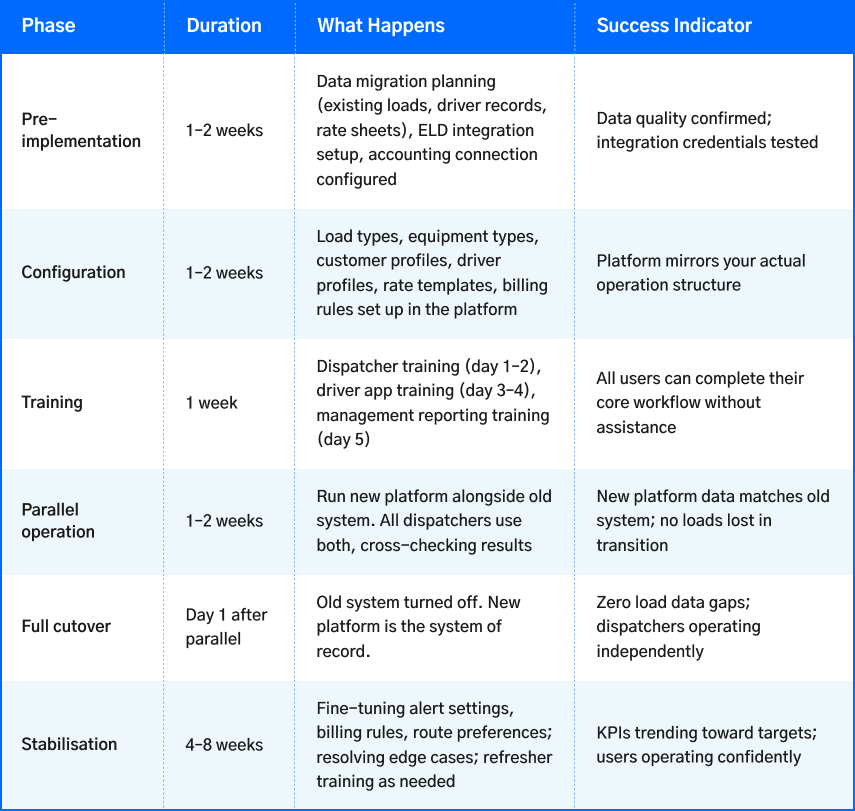
Mobisoft Dispatch: Purpose-Built for Carriers, Brokers, and Hybrid Operations
Mobisoft's trucking dispatch software is built for operations that have outgrown spreadsheets and radio calls but don't want the complexity and cost of an enterprise TMS implementation. It covers the full load lifecycle in a single mobile-first platform. This covers load creation, AI-assisted driver assignment through real-time tracking for trucking, ePOD, automated billing, and settlement.
What's in the Platform
- Load Management: Create, import, and manage loads from a centralised load management system dashboard. Load board integration with DAT, Truckstop, and major broker APIs.
- AI-Assisted Dispatch: Ranked driver recommendations per load based on proximity, HOS, equipment fit, and profitability. One-click assignment.
- Route Optimisation: Multi-stop route optimisation software with real-time traffic, HOS-compliant rest stops, fuel optimisation, and height/weight restriction filtering.
- Fleet Visibility: Live GPS map with HOS overlay, proximity search, and geofence-triggered event capture for every truck.
- Driver App (iOS + Android): Load details, route, ePOD capture, in-app messaging, and earnings view. Works offline and syncs on reconnection.
- Automated Billing: Invoice auto-generation from ePOD confirmation. Integration with QuickBooks, Xero, and Sage. Carrier invoice reconciliation with variance flagging.
- Driver Settlement: Automated pay calculation from completed loads. Transparent settlement view in the driver app.
- Compliance: ELD integration (Motive, Samsara, KeepTruckin), HOS surfacing in dispatch view, document storage for driver qualifications, and vehicle compliance.
- Analytics: Revenue per mile, empty mile tracking, on-time delivery rate, fleet utilisation, and lane profitability, all live on the management dashboard.
About Mobisoft Infotech
Mobisoft Infotech is an enterprise software company specialising in transportation, logistics, and fleet management software. Mobisoft Dispatch is the company's best trucking dispatch software platform for carriers and brokers. It is cloud-native, mobile-first, and built for operations running 5 to 500 trucks across global markets.

Frequently Asked Questions
What is the average cost of trucking dispatch software?
The pricing depends greatly on the fleet size and functionality that's included. Small fleets with basic cloud-based trucking dispatch software platforms (1–10 trucks) start at between $50–$150 per truck per month. For a fleet of 5 trucks, this would be $250–$750 per month. Medium-tier truck dispatch software with advanced features like route optimisation, invoicing, and accounting integration costs between $100–$300 per truck per month. Custom pricing is available for enterprise-sized software for larger fleets or 3PL providers. Most software platforms either charge per truck, per load, or per user. It's important to know what's being charged before comparing pricing.
How quickly will I see ROI?
For most mid-market fleet and brokerage operations, ROI is measurable within 90 days. It is primarily through empty mile reduction, billing cycle acceleration, and dispatcher efficiency gains. A full return on investment of the yearly cost of the platform occurs in 6–12 months. The major factor that determines how quickly the return will occur is the extent of adoption. Platforms where the dispatchers and drivers have a consistent adoption from the first day of implementation will experience faster ROI compared to those where there is partial adoption.
Can small fleets (under 5 trucks) benefit from dispatch software?
Yes, and often disproportionately. Owner-operators and small fleets using dispatch software for owner operators spend the most time per load on manual tasks relative to their operation size. Entry-level cloud platforms are now priced accessibly for small fleets, and the time savings on billing alone justify the cost within the first month.
Does dispatch software replace dispatchers?
No, and it's essential to understand this when introducing the software to your team. The automated dispatching software eliminates the less productive tasks for the dispatchers. The tasks include location verification, manual hours-of-service calculations, and manually typing invoices from the rate confirmation document. It does not replace the dispatcher's judgment on load prioritisation, customer relationships, exception handling, or carrier negotiations. What it does do is allow one dispatcher to manage 3x the load volume of a dispatcher working manually.
What integrations are essential for a trucking dispatch platform?
Four integrations are mandatory for any dispatch software for trucking companies. The mandatory integrations include electronic logging devices (ELD) and telematics, load board APIs such as DAT or Truckstop, accounting integration such as QuickBooks, Xero, or Sage, and Google Maps or HERE Maps for maps and traffic. All other integrations add value but can be added after initial adoption. Don't delay implementation, waiting for every integration to be perfect.
What's the difference between dispatch software and a TMS for a small carrier?
For a carrier with under 50 trucks, the practical difference is less significant than the marketing suggests. Many platforms market themselves as ‘TMS’ but functionally cover the trucking dispatch system execution workflow that asset carriers need from a Transporters TMS system. The important question is not whether the platform calls itself a TMS or dispatch software, but whether it covers: load management, driver assignment, route optimization software, ELD integration, driver app, billing, and the specific load board integrations you need. If yes, the label doesn't matter.

Nitin Lahoti
Read more
Nitin Lahoti is the Co-Founder and Director at Mobisoft Infotech. He has 15 years of experience in Design, Business Development and Startups. His expertise is in Product Ideation, UX/UI design, Startup consulting and mentoring. He prefers business readings and loves traveling.
 Nitin Lahoti
 April 20, 2026