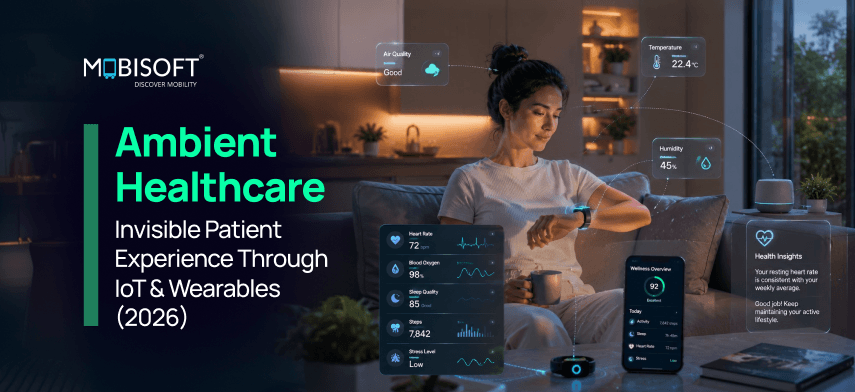
Nobody tells a patient that the hardest part of managing a chronic illness is remembering to manage it. But that is what most healthcare technology quietly demands. Log in. Take a reading. Charge this before it matters. Show up with data you probably forgot to collect.
Ambient healthcare IoT wearables patient experience is built on a different assumption entirely. That the best care is the kind that does not interrupt a life. Sensors that monitor without being noticed. Wearables that flag deterioration before the patient feels it. AI that processes data at the edge and only surfaces something when it genuinely needs to.
That is not a convenience feature. For a 78-year-old managing heart failure and living alone, it is the difference between a nurse calling on a Tuesday afternoon and an ambulance arriving on a Wednesday night.
Consider what this makes possible in practice. A clinician reviewing three months of continuous glucose data before an appointment, not a single HbA1c number taken that morning. A care coordinator who already knows about the fluid retention before the patient mentions feeling off. A family member quietly notified that their father's kitchen has been unusually quiet since 6 am. None of it required the patient to do a thing.
What Ambient Healthcare Actually Is
The word "ambient" comes from the Latin ambire, meaning to surround. That is precisely what ambient healthcare does. It surrounds the patient with monitoring rather than asking them to show up for it.
Traditional care works on intervals. You visit a clinic, a reading is taken, you go home, and three months pass before anyone looks at you again. Whatever happens in between is largely invisible to the care team.
Wearable health monitoring patient experience breaks that model. A smartwatch monitoring heart rate continuously produces thousands of data points a week. A blood pressure cuff the patient must remember to use three times a week produces three. The quantity difference is not trivial. It is clinically significant. Implementing these connected health experiences requires IoT mobile app development services that support reliable device connectivity and continuous data collection.

Here is the part that gets overlooked, though. The patients who need continuous monitoring most urgently are also the ones for whom active health engagement is hardest. A 78-year-old managing congestive heart failure, limited mobility, and early cognitive decline does not need a more engaging health app. They need a home that watches over them quietly.
Passive health monitoring is not a compromise. It is the entire point.
What makes this possible now, specifically, is the convergence of three things:
- Wearable sensors accurate enough for clinical use
- Edge AI fast enough to process data locally without round-trip cloud latency
- Connectivity infrastructure (5G, LTE-M, BLE) reliable enough to sustain continuous transmission
The technology stopped being a barrier a few years ago. The barrier now is design. Building systems that deliver clinical intelligence through IoT healthcare solutions without making the patient do any of the work.
Medical device software development plays an important role in turning connected sensors and wearable devices into reliable healthcare technologies that support continuous monitoring and clinical care.
The IoMT Market: Where It Stands in 2026
Numbers first, because they are striking.
The IoMT market sits at USD 56.07 billion in 2025, growing at 17.48% annually toward USD 125.49 billion by 2030. The wearable medical devices segment specifically is moving faster, projected to reach USD 105.36 billion by 2030 at a 29.5% CAGR.
Adoption on the patient side has reached a point where it cannot be called "emerging" anymore:
- 64% of patients use at least one IoMT device in daily life
- 79% of patients are willing to share health data with their healthcare provider
- 85% of healthcare providers use IoMT devices to support patient monitoring
The infrastructure side is catching up, too. Edge computing in healthcare was valued at USD 8.21 billion in 2025, growing toward USD 47.23 billion by 2035. Over 91% of US healthcare facilities now use 5G-enabled edge systems for real-time patient monitoring.
5G healthcare IoT is not a future concept. It is active in hospitals right now, powering robotics, real-time data streaming, and private campus networks that can handle thousands of concurrent connected devices without the interference problems Wi-Fi creates at scale.
One number that does not get talked about enough: healthcare ransomware now averages USD 10.93 million per incident, with roughly one major breach per week across the sector. 80% of healthcare organisations have already had an IoT-related security incident. The growth of IoMT security healthcare as a budget line is not optional. It is the cost of entry.
The Six-Layer Ambient Health Stack
Ambient healthcare IoT is not one technology. It is a layered system where each layer depends on the ones around it. Understanding the stack is a prerequisite to building any part of it well.
Layer 1: Body Sensors
This is the outermost point of contact with the patient. Wearables and implantables that capture physiological data continuously.
The current device landscape includes:
- Smartwatches for heart rate, ECG, SpO2, and other activities
- CGMs like Dexcom G7 and Abbott Libre 3 for continuous vital signs glucose monitoring
- ECG chest patches like ZioPatch and Biobeat for cardiac rhythm
- Smart rings (Oura) for sleep staging and HRV
- Implantable cardiac monitors like the Medtronic LINQ II
- Smart inhalers for medication dose tracking and technique detection
The privacy consideration here is significant. Body sensor data sits in the most sensitive category under both HIPAA and GDPR Article 9. There is also an equity issue that does not get enough attention: optical sensors measuring SpO2 and heart rate via PPG have documented accuracy disparities by skin tone. Any IoT wearable patient monitoring outcomes assessment must account for whether accuracy holds across the actual demographic range of the patient population.
Layer 2: Near-Body Home Sensors
This is where monitoring becomes truly invisible. No wearable required.
Passive infrared motion sensors, floor pressure sensors, doorway sensors, radar-based presence detection. These capture activity patterns, room transitions, gait, and daily routine data without any action from the patient whatsoever.
Ambient assisted living systems built on this layer can detect cognitive decline through changes in room activity, identify fall risk through gait pattern shifts, and flag medication non-adherence via smart dispenser logs. All passively.
The privacy design challenge here is real. In-home sensor monitoring requires clear consent architecture. What is being monitored, why, who sees it, and how to pause it must all be patient-controlled.
Layer 3: Smart Home Environment
The home itself becomes part of the care infrastructure at this layer. Smart lighting that responds to movement after dark reduces fall risk for older adults. Smart thermostats maintain safe temperatures for elderly residents who may not notice dangerous heat or cold. Air quality sensors give COPD and asthma patients advance warning of indoor pollution triggers. Door sensors and smart locks create a quiet safety net for dementia patients prone to wandering. Smart stove detection catches unattended burners before they become emergencies.
Smart home health at this layer is doing two things simultaneously: generating environmental data relevant to clinical care, and actively preventing the household incidents that escalate into emergency department visits.
The privacy consideration worth flagging: smart home data looks benign on its own. Combined with clinical records, it creates a detailed profile of daily life and physical capacity. Data sharing between consumer smart home platforms and healthcare providers requires explicit, separate consent. Not buried in a terms of service.
Layer 4: Connectivity
The protocol choice here determines everything downstream: latency, power consumption, reliability, and security surface.
| Protocol | Best Use Case | Key Characteristic |
| BLE 5.3+ | Wearables to smartphone | Ultra-low power, short range |
| LTE-M | Standalone wearables, rural deployment | Nationwide coverage, low power |
| NB-IoT | Infrequent sensors (dispensers, fall triggers) | Ultra-low power, very low throughput |
| Private 5G | Hospital campus IoMT | Sub-millisecond latency, massive device density |
Every protocol requires end-to-end encryption and device authentication. No exceptions for HIPAA compliance.
Layer 5: Edge AI
This is the layer that makes ambient intelligence clinically viable.
The conventional approach sends raw data to a central cloud for processing. That creates two problems for healthcare. First, latency: the round trip from a wearable detecting an arrhythmia to a cloud-processed alert reaching a clinician can take seconds. For a cardiac event, seconds matter. Edge AI processing at the device or home gateway brings that down to milliseconds.
Second, privacy. Raw vital sign data streaming to cloud storage creates a significant HIPAA exposure surface. An edge model that generates an alert only when a threshold is crossed, transmitting only the alert and its context, dramatically reduces what leaves the device.
A 2026 paper in Scientific Reports documented a CNN-LSTM model running on an NVIDIA Jetson Nano edge device, achieving 91.9% accuracy and 90.8% F1-score for cardiac anomaly detection, with only 8.7% latency overhead. The model used federated learning for updates without centralising patient data. That is edge AI healthcare wearables working as intended.
Layer 6: Clinical Integration
Data has no clinical value until it reaches the systems clinicians actually use.
HL7 FHIR R4 is the standard for FHIR device integration in the US, EU, and increasingly globally. The key resources are Device, Observation, DeviceUseStatement, and Patient. Apple Health's FHIR integration, Epic's patient-generated health data APIs, and Cerner's HealtheLife platform are the main clinical entry points.
The practical problem: FHIR defines the standard but does not mandate consistent implementation. Most EHR vendors interpret it differently. The last mile from a specific wearable's proprietary SDK to a specific EHR's FHIR implementation almost always requires custom middleware. This is where most IoMT deployments lose time and clinical value.
FHIR wearable device integration is the most time-intensive step in any ambient health deployment. Plan accordingly.
Technology Architecture: What Actually Matters for Builders
Private 5G in Hospitals
Where Wi-Fi creates congestion with thousands of concurrent devices, private 5G provides dedicated spectrum, deterministic latency, and the device density that a comprehensive hospital campus IoMT requires. Siemens and Kantonsspital Baden began installing 7,000 IoT sensors across Swiss healthcare facilities in October 2024. Some hospitals are already running private 5G networks for robotics and real-time clinical data streaming.
For home-based care, LTE-M and NB-IoT give devices the ability to transmit health data independently of home Wi-Fi. This matters for rural and low-income households where Wi-Fi reliability cannot be assumed. These are also the households most likely to carry the highest chronic disease burden.
Edge AI: The Privacy and Latency Solution Together
Edge computing healthcare solves two problems simultaneously. It cuts alert latency from seconds to milliseconds for time-critical cardiac events. And it keeps raw biometric data on the device rather than in cloud storage, reducing the HIPAA exposure surface of the entire system.
Federated learning extends this further. Models update using local patient data without that data ever leaving the device. The aggregate model improves. No patient data is centralized.
The FHIR Last Mile
The last mile is always the hardest. FHIR R4 is specified. What is not specified is how each EHR vendor implements it. Mapping a Dexcom CGM data stream to Epic's specific FHIR implementation requires different middleware than mapping the same data to Cerner's. Build time for custom middleware per EHR target. Four to eight weeks per vendor is a realistic estimate.
Eight Deployment Use Cases With Clinical Evidence
Heart Failure Remote Patient Monitoring
Between 20% and 25% of heart failure patients are readmitted within 30 days of discharge. That statistic has driven more IoMT investment than almost any other in healthcare.
The monitoring setup is straightforward:
- Smart scale for daily weight
- Pulse oximeter for SpO2
- Wearable blood pressure cuff for morning trend
- Optional ECG patch for high-risk patients.
Weight gain of more than 2kg in 24 hours, SpO2 decline, or blood pressure deviation from baseline triggers care coordinator review.
Heart failure RPM programmes reduce readmissions by 25 to 50% and save an average of USD 8,000 per patient per year by preventing hospitalizations.
The patient experience is almost nothing. Step on the scale in the morning and go about the day. If something is trending wrong, the care coordinator calls. That is it.
Builder note: The scale must be zero-friction. No app pairing at each weigh-in. It should have automatic sync, and it should be rechargeable. The design should be user-friendly for caregivers, too. The family member managing the monitoring environment is often the one who notices when the device stops transmitting.
Continuous Glucose Monitoring for Diabetes
38.4 million Americans have diabetes. Traditional quarterly HbA1c testing gives a 90-day average and nothing else. No information about daily glucose patterns, hypoglycaemia risk, or how specific foods affect that specific patient.
CGMs like Dexcom G7 and Abbott Libre 3 provide readings every one to five minutes. Closed-loop systems pair with insulin pumps to adjust delivery automatically. AI models built on months of individual CGM data can predict dangerous glucose events hours before they occur.
A 2025 scoping review across 80 studies in PLOS Digital Health found that wearables for remote patient monitoring of chronic disease demonstrate improved glycaemic control across the evidence base.
The clinical leap here is personalisation. Population-average glucose responses to foods are useful. Individual glucose responses, built from months of that person's continuous CGM data, are far more actionable.
Builder note: CGM integration with prescribing systems is the highest-value next development. When CGM data suggests a medication adjustment is warranted, the path to the clinician and the pharmacy should be one step, not three separate workflows.
Post-Discharge Wearable Monitoring
Hospital discharge is a cliff-edge. One day: 24-hour clinical monitoring. The next: quarterly outpatient appointments.
Adhesive biosensor patches worn for 30 to 90 days post-discharge bridge that gap. Continuous ECG, respiratory rate, temperature, SpO2, and activity. Threshold alerts route to a monitoring centre or care coordinator. Remote intervention happens before the patient deteriorates to the point of needing the ED.
IoT remote patient monitoring outcomes across post-discharge programmes show a 9.6% mean decrease in hospitalisations and 3% decrease in all-cause mortality for monitored populations.
Builder note: The 72-hour window after discharge is the highest-risk period. The patch must be active, paired, and transmitting before the patient leaves the hospital. Not after they get home and try to set it up themselves.
Aging-in-Place Smart Home Monitoring
79% of older adults in the US want to remain in their homes as they age. The safety gap between that preference and the clinical reality of ageing alone is where ambient assisted living technology operates.
PIR motion sensors track activity patterns across rooms. Floor sensors and radar-based presence detection analyse gait and detect falls. Smart medication dispensers log every dispensing event. Smart scales track weight trends. Doorway sensors capture daily routine data.
The clinical mechanism is baseline deviation. The system learns two to four weeks of normal activity patterns for that individual. When the kitchen goes quiet at an unusual time, when bathroom frequency changes, or when the morning routine does not start, an alert goes to the care coordinator or family.
A systematic review of 80 fall detection studies published in Sensors in October 2025 found that hybrid sensor solutions combining wearable and non-wearable approaches achieve the highest detection performance, with deep learning methods outperforming traditional algorithms.
Aging in place smart home health builder note: privacy design is the primary acceptance barrier, not technology. Non-camera solutions with local processing eliminate the surveillance perception. The framing matters too. "The home is watching over you" lands very differently than "we are monitoring you."
Hospital At Home
Over 350 US hospitals now run hospital-at-home IoT monitoring programmes, supported by CMS reimbursement. Clinical-grade wearable patches, connected blood pressure cuffs, pulse oximeters, smart scales, and telehealth carts give patients acute-level care in their own homes.
The clinical monitoring is, in many cases, more continuous than equivalent inpatient care. Most hospital wards check vitals every four hours. A hospital-at-home patient with a continuous vital sign patch is monitored around the clock.
Patient satisfaction in these programmes consistently outperforms equivalent inpatient care. Being in your own home, in your own bed, with family present, while receiving clinical-grade monitoring is a meaningfully different experience.
Builder note: Know the accuracy limitations of consumer-grade devices in clinical contexts. The Scientific Reports 2026 evaluation of Garmin wearables showed a 3-minute 49-second tachycardia detection delay compared to a medical-grade ECG. Acceptable for trend monitoring, but not for acute cardiac care. Match device grade to clinical application.
Smart Medication Management
Medication non-adherence costs USD 300 billion annually in the US and causes 125,000 deaths. Smart dispensers are the most direct measurement of actual medication-taking behaviour available outside of in-person observation.
The dispenser monitors whether the correct compartment opens at the correct time. Non-dispense events trigger patient reminders, then caregiver alerts, then care coordinator review if unresolved. Weekly adherence summaries go to the pharmacist. Pattern analysis identifies why doses are missed. A consistently missed Tuesday evening dose led, in one documented case, to the prescribing clinician switching the regimen to once-daily morning dosing.
A 2026 study in Frontiers in Digital Health by Perx Health found 95% medication adherence in patients aged 65 and over using a well-designed IoT adherence system.
Builder note: Multi-medication patients need a single device that handles all their medications. One device per medication is not a viable patient experience. Refill integration is the next highest-value step.
COPD and Respiratory Disease Monitoring
COPD exacerbations are the leading driver of COPD hospitalisations. Many are preventable with early detection.
The monitoring stack for IoT remote patient monitoring outcomes in respiratory disease includes a pulse oximeter, a smart inhaler with dose and technique sensors, a connected spirometer, an activity tracker, and an air quality sensor for indoor pollution triggers.
SpO2 decline below the patient's personal threshold triggers an immediate alert. But the most clinically specific signal in COPD monitoring is inhaler use pattern. Rescue inhaler frequency increasing over 48 hours, combined with declining SpO2, generates a composite exacerbation risk score that the care team reviews before the patient deteriorates to ED-level severity.
Builder note: The smart inhaler is the primary signal source in COPD monitoring, not a secondary one. Build the stack accordingly.
Cognitive Decline Detection Through Passive Behaviour Monitoring
Mild cognitive impairment can be detected through changes in daily activity patterns months to years before clinical diagnosis. The behavioural signatures are subtle: decreased kitchen activity, changed bathroom visit frequency, unusual nocturnal movement, and longer time completing routine tasks.
PIR motion sensors across every room, smart appliance sensors, sleep sensors under the mattress, and door sensors tracking social activity. These can help in monitoring, and the patient doesn’t even have to rely on wearables. The system establishes an individual baseline over four to eight weeks and tracks deviation over months.
Research from AAL laboratory studies found that individuals with mild cognitive impairment spent more time at the refrigerator and kitchen cabinets compared to cognitively healthy peers. That is the kind of signal that only passive health monitoring over weeks and months can capture.
A neurologist reviewing a patient's six-month passive monitoring data before an appointment already knows that kitchen activity has declined steadily for eight weeks. The clinical conversation starts with evidence, not just patient-reported symptoms.
Builder note: Privacy design for this application needs the most care of any ambient health use case. Involve older adults and their families in consent design from the beginning. Continuity of data collection over months and years is what generates clinical value. Design for long-term trust, not just initial consent.
The Clinical Outcomes Evidence Base
The evidence for IoT remote patient monitoring outcomes is no longer thin. It is becoming robust.
| Application | Key Outcome | Source |
| Heart failure RPM | 25 to 50% readmission reduction; USD 8,000/patient/year saved | JMIR systematic review, 2025 |
| Fall detection (hybrid sensors) | Highest detection accuracy vs wearable-only or non-wearable-only | Sensors systematic review, Oct 2025 |
| Medication adherence (65+) | 95% adherence with well-designed IoT system | Perx Health, Frontiers in Digital Health, 2026 |
| Edge AI cardiac anomaly detection | 91.9% accuracy, 90.8% F1-score | Scientific Reports, 2026 |
The pattern across the evidence is consistent. Continuous monitoring catches deterioration earlier. Earlier detection means intervention before hospitalisation. Intervention before hospitalisation means lower readmissions, lower mortality, and lower cost.
Smart hospital technologies overall reduce operational costs by up to 30%, according to Deloitte's smart hospital research. That figure covers the full stack: IoMT, edge AI, automation, and clinical workflow integration together.
Ambient Healthcare for Aging in Place
By 2030, all baby boomers will be over 65. The 80-plus cohort will triple by mid-century. The healthcare system cannot absorb that demographic reality through institutional care models alone. It is arithmetically impossible.
Ambient assisted living technology for aging in place is not a niche application. It is the largest and most urgent deployment context in the entire ambient assisted living space.
The clinical case is specific. Falls are the leading cause of injury-related death in older adults, with 3 million older adults treated for fall injuries in US emergency departments each year. Medication non-adherence in the elderly population is a primary driver of hospitalisations. Early cognitive decline, caught and managed, can slow progression. But catching it requires continuous observation that quarterly appointments simply cannot provide.
Aging in place smart home health technology is mature enough to deploy. The gap between capability and adoption is not technical. It is acceptable.
68% of older adults aged 65 and over are interested in IoMT-enabled ambient healthcare fall detection systems. Actual adoption lags well behind that. The gap reflects real concerns:
- Cameras in the home feel intrusive, even when the stated purpose is safety
- False alarms erode trust rapidly and permanently
- Systems that require a complex setup from someone living alone do not get deployed
- Medicare and Medicaid coverage for smart home sensors remains limited
Any builder targeting the aging-in-place market must treat acceptability design with the same rigour as technical design. The best sensor array in the world does not help a patient who turned it off because it felt like surveillance.
The Patient Experience Dimension
Here is the paradox at the centre of invisible patient experience healthcare: the better the ambient system works, the less the patient experiences it as technology.
The heart failure patient whose fluid retention is caught before hospitalisation does not experience the smart scale or the monitoring algorithm. They experience a call from their nurse who seems to already know what is happening. The experience of ambient healthcare is the experience of being cared for, not the experience of using a device.
Three principles govern ambient healthcare design principles that actually work in practice:
Friction-Zero Data Collection
The monitoring must require nothing from the patient beyond their passive presence. Every active step required is a failure point, specifically for the patients who most need continuous monitoring. Charging a device, opening an app, and confirming a reading; each one is a place where the monitoring stops. Design for zero-action data collection as the default. Active patient interactions should be optional enhancements, not required steps.
Human Interpretation Of Machine Data
When the system detects a concerning pattern, the optimal response is a human conversation. Not a push notification saying "anomaly detected." The care team member calls, provides clinical context, addresses the patient's concerns, and takes action. The AI detects. The human explains. The patient experiences the care team's response, not the algorithm's output.
Transparent Consent and Visible Control
Patients must know exactly what is being monitored, why, and who can see it. Not because regulation requires it. Because it is the foundation of the trust that makes ambient monitoring sustainable in the long term.
Patients who discover monitoring they did not fully understand tend to disengage completely. Visible physical indicators that monitoring is active, plain-language explanations of each sensor, and in-app controls to pause or modify monitoring are all part of the design.
Trust built through transparency holds. Trust assumed through invisibility does not.
Security, Privacy, and Regulatory Compliance
IoMT security in healthcare is not a checklist item. It is an architectural decision that must be made before the first device is deployed.
The threat landscape is specific to healthcare. Ransomware hits the sector at roughly one major incident per week. 80% of healthcare organisations have already experienced an IoT-related security breach. The average per-incident cost is USD 10.93 million. IoMT devices on unsegmented networks give attackers a path into clinical systems. That is the actual risk.
The compliance requirements vary by geography:
HIPAA:
Encryption of all ePHI at rest and in transit. Multi-factor authentication for all ePHI access. Business Associate Agreement with every cloud vendor touching device data. Audit logging for all PHI access.
GDPR:
Body sensor data (heart rate, glucose, SpO2, ECG) is biometric health data under Article 9, the highest protection category. Explicit consent required. Data Protection Impact Assessment before deployment. EU data residency for EU patients.
India DPDP Act 2023:
Health data as sensitive personal data. Data localisation requirements still evolving. Monitor finalisation of health data rules.
FDA SaMD:
Wearables making specific diagnostic or treatment claims require FDA clearance as Software as a Medical Device. The line between "general wellness" and SaMD is getting harder to maintain as consumer devices make increasingly clinical claims. Every clinical claim about wearable data needs SaMD classification assessment.
The security architecture must be designed into IoMT security healthcare deployments from the beginning. Network segmentation separating IoMT devices from clinical systems. Device authentication before any network access. TLS 1.3 for all transmissions. Signed firmware updates. Choose vendors with HITRUST or SOC 2 Type II certification.
Adding security after a breach is exponentially more expensive than building it in before deployment.
Building Ambient Health Infrastructure
The minimum viable ambient health system has four components that must work together before any clinical value is possible.
- Device integration layer: SDK integration for the specific device fleet being deployed. BLE, Wi-Fi, and cellular protocol handling. Device authentication and pairing flows. Raw data normalisation to FHIR Observation format. Offline buffering for connectivity gaps. Battery and connectivity status monitoring.
- Edge processing layer: Real-time threshold alerting. Local anomaly detection models. Signal quality scoring to discard or flag low-quality readings (motion artefact is the primary culprit with wearables during physical activity). Patient-specific baseline calibration.
- Clinical integration layer: FHIR R4 Device and Observation resources. SMART on FHIR app integration for EHR access. Real-time alert delivery with severity-based routing. Care coordinator dashboard with patient panel and alert queue. Alert acknowledgement and escalation workflow. Audit logging for every alert action.
- Patient-facing layer: Health summary display. Care team communication triggered by monitoring events. Consent management and monitoring controls.
All of this can be achieved through intelligent healthcare mobile app development and scalable software development.
The Alert System: The Most Consequential Architecture Decision
Most IoMT deployments succeed or fail at the alert layer. Too few alerts and clinical events get missed. Too many care teams stop paying attention to all of them. Alert fatigue is a documented clinical problem, not a theoretical one.
The alert system needs five characteristics to work:
- Clinical specificity: Alerts generated from patient-specific baselines, not generic population thresholds
- Tiered severity: Critical routes to immediate clinical response; moderate to care coordinator review; low to the patient's health summary
- Bidirectional acknowledgement: Every alert has a documented response and close-out
- Patient-adjusted thresholds: The system learns individual normal variation and calibrates accordingly
- False positive rate monitoring: Track and report false positive rates by alert type to enable ongoing calibration
Six Data Quality Problems That Undermine Ambient Systems
These are not edge cases. They are routine and must be designed for:
- Motion artefact: Optical sensors produce spurious readings during physical activity. Build signal quality scoring into every reading.
- Battery and connectivity gaps: Design for graceful degradation. Alert the care coordinator when monitoring goes silent, not only when a threshold is crossed.
- Sensor placement drift: Adhesive patches and wrist-worn devices produce different readings depending on placement consistency. Build calibration checks into the patient app.
- Patient non-engagement: A patient who stops wearing the sensor has effectively turned off the monitoring. Non-engagement must be detectable, not assumed away.
- Pipeline latency: For critical alerts, the end-to-end path from wearable detection to clinician notification must be under 60 seconds. Each step in the pipeline adds latency. Measure and monitor it.
- Demographic accuracy disparities: Optical sensors have documented accuracy differences by skin tone. The npj Digital Medicine living systematic review from January 2026confirms skin pigmentation affects Apple Watch accuracy. Test your specific device fleet across the demographic range of your patient population.

Frequently Asked Questions
Which wearable devices are actually FDA-cleared for clinical use versus general wellness?
FDA-cleared devices include the Apple Watch for AFib detection and certain ECG patches, such as the ZioPatch. General wellness devices like fitness trackers and sleep rings do not require clearance because they do not make diagnostic claims. The line is getting blurry as consumer devices add more clinical-sounding features. Before deploying any wearable in a clinical programme, check its specific cleared indications, not just its feature list.
Does Medicare cover remote patient monitoring through IoT devices?
Yes, CMS reimburses RPM under CPT codes 99453, 99454, 99457, and 99458. Coverage applies when a patient has a chronic condition, readings are collected for at least 16 days per month, and a licensed clinician reviews the data. Reimbursement rates vary and are updated annually. Hospital-at-home programmes have separate CMS reimbursement pathways that have expanded significantly since 2022.
How long does it take to see clinical results after deploying an RPM programme?
Most heart failure and COPD programmes see measurable readmission reduction within 90 days of deployment. The first 30 days are typically spent establishing individual patient baselines. Meaningful outcome data usually requires at least six months of programme operation across a sufficient patient panel. The programmes that see the fastest results are the ones that pair monitoring with a dedicated care coordinator response workflow, not just data collection.
Can ambient monitoring work for patients in rural areas with poor internet connectivity?
Yes, and this is one of the stronger arguments for LTE-M and NB-IoT connectivity. These protocols allow devices to transmit health data directly over cellular networks without depending on home Wi-Fi. Rural patients tend to carry a higher chronic disease burden and benefit most from continuous monitoring. The technology gap in rural ambient healthcare is less about connectivity now and more about device cost and programme access.
What happens to a patient's data if they switch healthcare providers?
This is one of the less-resolved questions in ambient healthcare right now. FHIR R4 is designed to support data portability, but implementation is inconsistent across EHR vendors. Patients have rights to their health data under HIPAA, but wearable and IoMT data held by device manufacturers sit in a gray area. Programmes should have a clear data portability and deletion policy documented before onboarding patients, not after they ask.
Is ambient monitoring suitable for patients who are not comfortable with technology?
It depends entirely on how the system is designed. Passive monitoring through home sensors and automatic-sync wearables requires almost no technical ability from the patient. The problem arises when setup, pairing, or troubleshooting is left to the patient. Programmes that succeed with low-tech populations include hands-on device setup before the patient goes home, a caregiver in the loop, and a single phone number to call when something looks wrong. The technology can be invisible. The onboarding cannot be.
This content is for informational purposes only and may include AI-assisted research or content generation. While we strive for accuracy, information may evolve over time. Readers are advised to independently verify critical information before making decisions.

Pritam Barhate
Read more
Pritam Barhate, with an experience of 14+ years in technology, heads Technology Innovation at Mobisoft Infotech. He has a rich experience in design and development. He has been a consultant for a variety of industries and startups. At Mobisoft Infotech, he primarily focuses on technology resources and develops the most advanced solutions.
 Pritam Barhate
 May 7, 2026