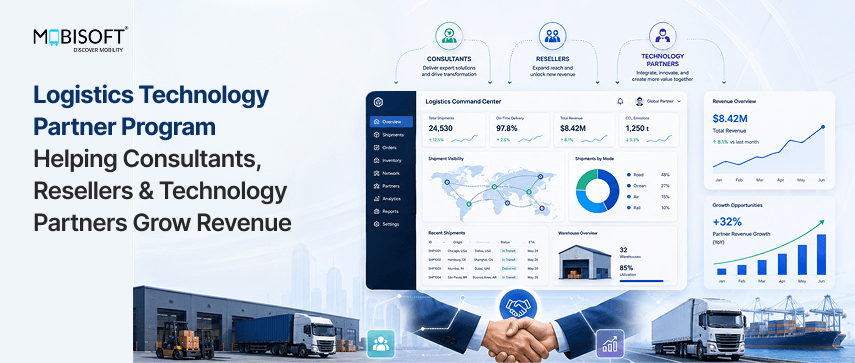
Logistics and transportation are among the most technology-intensive sectors in the global economy, and among the most underserved by the general-purpose software development market. The regulatory requirements across FMCSA Hours of Service, Electronic Logging Device mandates, DOT HAZMAT handling protocols, CSRD Scope 3 Category 7 emission reporting, and state weight and dimension regulations create a compliance architecture complexity that most generic development firms cannot navigate. Partners who work in the sector, whether as technology consultants, fleet management solution resellers, TMS implementation partners, or transportation and logistics companies advisors, encounter client requirements that need this specific depth. Mobisoft's logistics and transportation engineering practice exists to meet it, and the logistics technology partner program is designed to convert that depth into partner revenue.
Key programme reference points:
- 9 solutions in the full portfolio: FMCSA HOS enforcement, ELD integration, offline-first driver and field apps, proof-of-delivery, fleet tracking, enterprise system integration (SAP, Maximo, OSIsoft PI), AI-powered logistics, CSRD ESG emission technology, and cold-chain and intermodal logistics.
- 2 engagement models: Co-Delivery (15-25% below standard, 20-35% partner margin), and White-Label (20-30% below standard, 25-45% margin). Both are accessible to logistics consultants, TMS resellers, and supply chain technology solutions advisors.
- FMCSA 395.3: The specific federal regulation (49 CFR Part 395) governing Hours of Service enforcement in commercial truck driver apps, covering the 11-hour driving limit, 14-hour on-duty window, and 30-minute break requirement enforced in application logic, not just in driver-facing display.
The Logistics Technology Partner Opportunity: Why Regulatory Complexity Creates Premium Revenue
The logistics and transportation sector generates more partner revenue per client relationship than most other technology sectors because the gap between what clients need and what generic technology vendors can credibly offer is wider here than almost anywhere else. FMCSA HOS enforcement, ELD compliance, HAZMAT routing, cold-chain integrity monitoring, CSA score tracking, and CSRD Scope 3 emission reporting are not capabilities that generic development firms learn from reading the regulations. They require production experience in the operational environments where the regulations apply. This is the core commercial case for a logistics technology partner program built on genuine domain depth.
Why Logistics Technology Clients Pay a Premium for Domain-Expert Partners
The table below compares what a generic engineering partner delivers against what a domain-expert partner like Mobisoft delivers across four common logistics client scenarios. The differences are commercially significant and immediately visible to logistics IT procurement teams.
| Client Situation | Risk: Generic Partner | Value: Mobisoft Domain Expertise |
| Commercial carrier (Class 8 trucks) needing HOS-compliant driver app | Builds display-only app without HOS enforcement. Drivers can exceed limits, exposing carriers to FMCSA fines. | FMCSA 395.3 enforcement built in: 11-hour driving limit, 14-hour duty window, 30-minute break rules, FMCSA-registered ELD integration, and audit-ready compliance records. |
| Oilfield services company with Permian Basin field technicians | Connectivity-dependent app fails in no-coverage areas. Offline fixes add to the cost and delay deployment by 4–6 months. | Offline-first architecture from day one: op-sqlite, write-ahead queue, offline GPS capture, and automatic sync with exponential backoff retry. |
| 3PL managing mixed-fleet shipments through the Port of Houston | Limited expertise in intermodal tracking, HAZMAT workflows, and port gate integrations leads to costly architecture rework and delays. | Domain-led discovery covers intermodal tracking, DOT-compliant HAZMAT workflows, and port gate integration patterns before development begins. |
| Corporate logistics manager handling CSRD Scope 3 reporting | Misinterprets CSRD ESRS E1 requirements, relies on estimated data, fails audit, and must rebuild reporting processes. | CSRD-ready emissions reporting with ±1.5% GPS accuracy, DEFRA/EPA/MoEFCC factors, and auditor-ready signed CSV exports accepted from initial deployment. |
Partner Revenue Opportunities in the Logistics Technology Partner Program
Mobisoft's logistics technology partner program offers two revenue structures calibrated to different partner types. Co-Delivery Partners provide domain expertise while sub-contracting mobile and AI engineering to Mobisoft, earning 20-35% engineering margin plus advisory and project management fees. White-Label Partners build a branded logistics development practice, pricing at US/UK market rates with Mobisoft delivering under the partner brand at 20-30% below standard rates, generating 25-45% margin annually from an established practice in Year 2-3.
FMCSA HOS Enforcement Architecture: Mobisoft's Most Commercially Differentiating Capability
FMCSA Hours of Service compliance is the most commercially significant logistics technology capability in Mobisoft's portfolio. It is also the capability where the gap between genuine domain expertise and claimed expertise is most visible, most consequential, and most immediately apparent to experienced logistics IT professionals. For partners active in this space, the logistics technology partner program provides specific proposal language and regulatory citations that differentiate client-facing proposals from generic competing bids.
The HOS Enforcement vs Display Distinction: What Every Partner Needs to Know
The HOS display shows the driver how many hours they have remaining before a violation. The driver sees a countdown. If they choose to continue driving beyond the limit, the app records the violation but does not prevent it. This is what most general-purpose development firms build when asked for HOS compliance. This is advisory HOS. It is not FMCSA-compliant enforcement.
HOS enforcement works differently. The application logic prevents the driver from logging driving time beyond the regulatory limits. Specific rules enforced in the application logic include:
- Section 395.3(a)(1): 11-hour driving limit after 10 consecutive hours off duty. Application logic blocks a driving status change after 11 cumulative hours; the driver must change to an on-duty-not-driving or off-duty status.
- Section 395.3(a)(2): 14-hour on-duty window (cannot extend past 14 hours after start). Application logic prevents additional driving after 14 consecutive hours since the duty period began.
- Section 395.3(a)(3)(ii): 30-minute rest break after 8 hours of driving without a break. Application logic requires a 30-minute break before accepting a driving status change after 8 cumulative hours of driving without a qualifying rest break.
- Section 395.3(b)(1)-(2): 60/70-hour rule (interstate carriers). Running total of on-duty hours against the 7-day (60-hour) or 8-day (70-hour) limit; configurable threshold alert; no additional driving when the limit is reached.
The commercial value for partners is direct. A logistics technology consultant who introduces Mobisoft by stating that the driver app enforces HOS by section number in the application logic, rather than simply displaying it to the driver, is proposing something that the carrier's safety director can immediately evaluate and that most competing proposals cannot match.
The Complete FMCSA HOS Solution
| FMCSA Feature | What Mobisoft Implements | Regulatory Ref | Partner Proposal Language |
| Driving status enforcement | Validates every status change and blocks actions that breach driving limits, duty windows, or break requirements. Rule-specific alerts displayed in real time. | 49 CFR §395.3(a) | HOS enforcement through §395.3(a) validation logic, preventing violations at the driver interface rather than post-trip reporting. |
| ELD integration | Integrates with FMCSA-registered ELDs via Bluetooth, USB, and API. Supports multiple providers through a unified integration layer and records malfunction events. | 49 CFR §395.22, §395.26 | FMCSA-registered ELD integration with multi-provider support and malfunction event recording per §395.22. |
| Driver tamper prevention | Driver edit requests only. Submitted annotations remain immutable with a complete audit trail. | 49 CFR §395.28 | Driver edit workflow with immutable audit records and FMCSA-ready submission support. |
| HOS records retention | Six-month online retention, long-term archiving, and FMCSA-format export for roadside inspections. | 49 CFR §395.8(k) | Six-month online retention with Bluetooth, USB, and web-based FMCSA record exports. |
| Yard move & personal conveyance | Carrier-controlled activation, configurable personal conveyance limits, automatic duty-status reversion, and full auditability. | 49 CFR §395.1(e) | Carrier-configurable yard move and personal conveyance with complete audit trails. |
| Short-haul exemption | Detects qualifying operations automatically and reverts to standard HOS rules when exemption criteria are no longer met. | 49 CFR §395.1 (e)(1) | Automated short-haul qualification tracking with standard HOS fallback. |
| Team driving | Linked co-driver HOS logs, sleeper berth tracking, dispatcher visibility, and alerts when available hours require a rest stop. | 49 CFR §395.3 (a)(3)(i) | Team-driving HOS support with linked logs, sleeper berth provisions, and remaining-hours visibility for dispatchers. |
Electronic Logging Device Integration and Telematics
ELD integration is the capability that most fleet technology partners cite as the most technically complex aspect of driver app development. The FMCSA ELD technical specification (Section 395.26) defines a data format, a communication protocol, and a set of event types that the ELD must record and transmit. Generic development firms attempt to implement this specification from documentation. Mobisoft has implemented it in production across multiple FMCSA-registered ELD providers. This depth is part of what partners in the channel partner program can immediately reference in client conversations with fleet operators and carriers.
ELD Technical Architecture
All three FMCSA-required transfer methods are implemented:
- Bluetooth: Native Bluetooth Low Energy (BLE) connection to ELD device; data transfer via FMCSA-specified BLE profile; connection management for interruptions in noisy RF environments (cab electronics, other BLE devices).
- USB: USB host mode detection and data transfer; automatic ELD recognition on USB connection; data format validation before import.
- Web transfer: Carrier portal integration for FMCSA web upload; encrypted data package in FMCSA Section 395.26 format; audit hash included.
The following ELD data event types (per Section 395.26) are all implemented:
- ELD-1: Login/logout events with driver identification.
- ELD-2: CMV engine power-on/power-off events.
- ELD-3: CMV movement events (begins moving/stops moving).
- ELD-4: Duty status change events (7 status types).
- ELD-5: Intermediate/duty status check events.
- ELD-6: Accumulated hours at midnight events.
- ELD-7: Malfunction or data diagnostic detection events (malfunction types M-1 through M-9; data diagnostic types D-1 through D-8).
- ELD-8: Special-use conditions (yard move, personal conveyance, exempt driver).
Mobisoft implements a normalised integration layer between the driver app and specific ELD manufacturers. The layer handles manufacturer-specific BLE profiles and firmware quirks. The driver app receives normalised event data regardless of ELD manufacturer. Adding a new ELD provider requires implementing the normalisation adapter, not modifying the driver app or the HOS logic.
ELD malfunction codes M-1 through M-9 (power, engine synchronisation, timing, positioning, data recording, data transfer, missing required data, data consistency, and other) generate specific driver notifications and dispatcher alerts. The driver app includes the FMCSA-mandated driver malfunction handling workflow covering paper log reversion, carrier notification, and the 8-day resolution window.
Telematics Integration Beyond ELD: Fleet Visibility Features
Real-time GPS fleet tracking uses PostGIS geospatial indexing for sub-second query performance on large fleets. The configurable GPS update interval ranges from 15 seconds to 5 minutes, depending on fleet size and cellular plan constraints. GPS positions are stored in a time-series-optimised schema. Historical playback with speed, idle time, and stop duration analytics gives fleet managers and dispatchers full visibility for CSA safety score investigations, customer delivery disputes, and fuel theft investigations. Geofence-based arrival and departure alerts reduce dispatcher manual monitoring.
Geofence management supports polygon and radius geofences for customer locations, depot yards, restricted zones, and state border crossings. Automatic duty status suggestions on geofence entry and exit replace manual check-in calls. State border crossing detection supports IFTA fuel tax reporting. Restricted zone enforcement reduces insurance exposure from unauthorised parking.
Engine diagnostics via J1939 and OBD-II provide fault code retrieval and display, engine RPM, coolant temperature, and oil pressure monitoring. Speeding detection from engine data is more accurate than GPS-based speed for enforcement purposes. Engine fault codes alert maintenance before breakdowns, and fuel consumption patterns identify inefficient driving behaviour.
Driver behaviour scoring uses a composite score drawn from speeding events, hard braking events, rapid acceleration, sharp cornering, and idling time. Per-driver trend analysis and fleet ranking feed coach mode overlays on the driver app. Driver behaviour scores correlate directly with CSA safety scores and insurance premiums. Carriers with documented driver behaviour improvement programmes qualify for lower insurance rates.
IFTA mileage reporting uses automatic jurisdiction mileage calculation from GPS tracks. State border crossing detection uses PostGIS and official state boundary polygons. The IFTA report exports in a format compatible with state filing portals, eliminates manual odometer-based mileage recording, and reduces audit exposure.
Offline-First Driver and Field Operations Apps
The assumption that mobile app users have reliable cellular connectivity is the single most common reason logistics mobile apps fail in production. Commercial truck drivers on rural routes, oilfield service technicians in the Permian Basin, port yard workers inside metal container terminals, and warehouse personnel in concrete-construction facilities all encounter connectivity gaps that a connectivity-dependent app cannot bridge. Mobisoft's offline-first architecture is designed for these conditions from sprint 1.
Complete Offline-First Technical Architecture
The architecture has five components:
- Local data store (op-sqlite): op-sqlite replaces React Native's default SQLite with a C++ native module that operates 10-100x faster for write-intensive operations. The local store maintains a complete copy of the driver's active workflow data (HOS logs, delivery manifests, inspection checklists, work orders) regardless of network state. The store is encrypted at rest using AES-256.
- Write-ahead queue with UUID idempotency: All state changes that need synchronisation to the server are written to a write-ahead queue before local state is updated. Each queue entry carries a UUID. When connectivity is restored, the queue is processed in order. The server validates the UUID before processing to prevent duplicates. Entries are retained until server acknowledgement is received.
- GPS capture at action moment: GPS position is captured at the exact moment a driver action is taken (delivery confirmation, inspection completion, incident report, fuel stop log) and stored locally with the action record regardless of connectivity. Delivery disputes are resolved with a GPS-stamped record from the moment of delivery, not from a later location record.
- Background GPS tracking: Background GPS tracking continues through app kill on Android and during low-power mode on iOS. Battery optimisation uses duty-cycle GPS (GPS active at configurable intervals, power-gated between intervals). Fleet managers maintain GPS tracks of vehicles regardless of whether the driver's phone is actively in use.
- Sync conflict resolution: When two offline instances of the same record synchronise simultaneously, the conflict resolution strategy is defined per record type: last-write-wins for status records, field-level merge for annotation records, and conflict flagging for records requiring human review. Data integrity is maintained when both driver-side and dispatcher-side changes occur during a connectivity gap.
Thermal and Environmental Testing for Field Operations Apps
Logistics field operations apps are used in environments that laboratory testing does not replicate: Texas summer heat (ambient temperatures above 45 degrees Celsius), construction site dust, chemical plant humidity, and arctic cold for temperature-sensitive pharma delivery. Mobisoft's testing protocol includes specific environmental conditions:
- Thermal throttling test: Android CPU performance degrades 40-60% at sustained temperatures above 45 degrees Celsius. Mobisoft tests application performance on devices placed in a thermal chamber at 45 degrees Celsius for 30 minutes before running performance benchmarks. Apps that fail performance targets under thermal throttling are optimised before production deployment.
- Gloved operation test: Logistics drivers, field technicians, and warehouse workers frequently wear gloves. All touch target sizes are validated at a minimum of 48x48dp (double the Android minimum). Interaction patterns that require precision touch are replaced with glove-compatible alternatives.
- Screen brightness test: Outdoor logistics operations require screen readability in direct sunlight. Mobisoft's colour contrast and UI design standards target a minimum 300cd/m effective brightness equivalent. Devices used in outdoor logistics deployments are specified with at least 400cd/m peak brightness in procurement guidance.
- Low-RAM device test: Logistics fleet operators frequently issue mid-range Android devices (2GB-3GB RAM) for cost control. Mobisoft validates app performance on Samsung Galaxy A-series equivalent devices. Cold start performance target is under 3 seconds on 2GB RAM devices after 30-minute idle.
Offline Proof-of-Delivery with GPS
Proof-of-delivery disputes are one of the highest-cost operational problems in last-mile and freight delivery. A carrier that cannot prove where and when a delivery occurred faces chargeback claims, customer relationship damage, and potential liability for missing or misdelivered cargo. The operational standard is GPS-verified proof of delivery captured at the delivery moment, regardless of network connectivity.
Complete Offline PoD Feature Set
GPS-stamped delivery confirmation captures GPS position at the exact moment the driver confirms delivery and stores it locally with the delivery record. The position includes latitude, longitude, altitude, accuracy radius, and timestamp. A GPS-stamped record showing the driver confirmed delivery at a specific coordinate and time resolves delivery disputes that are currently adjudicated by manual investigation. The accuracy radius documents the confidence level of the position fix.
Offline signature capture uses a capacitive stylus-compatible canvas element. The signature is stored as a compressed SVG with a hash and included in the delivery record. Signature quality validation (minimum stroke count, minimum bounding box) prevents invalid empty signatures from being accepted. Customer-signed delivery confirmation eliminates the most common dispute scenario.
Offline photo capture is triggered at delivery confirmation. Photos are stored locally in compressed format with configurable quality. Photo requirements are configurable: required for all deliveries, required for high-value deliveries, or optional. Photos sync to the carrier's document management system on reconnection. Photographic evidence resolves quantity and condition disputes, particularly for pallets, refrigerated goods condition at delivery, and bulk liquid levels.
HAZMAT delivery confirmation requires the driver to confirm the UN number, packing group, and quantity against the shipping paper. The app validates the confirmation against the manifest. Any discrepancy flags the delivery for dispatcher review before the driver can proceed. HAZMAT acceptance signature includes driver confirmation of placard verification. Partners proposing a custom transportation management system integration can reference this workflow as part of the compliance evidence trail.
The Electronic Bill of Lading workflow pre-populates BOL data from the TMS or order management system. The driver confirms conditions at pickup (count, condition, exceptions), documents exceptions with a photo and GPS at the pickup point, and obtains the shipper's signature on the BOL at pickup. Delivery confirmation cross-references the original BOL. The complete BOL lifecycle is captured digitally, and freight claims are resolved with the complete digital record rather than manual paper BOL reconstruction.
All PoD records (GPS position, signature, photos, BoL, HAZMAT confirmation) are packaged as a delivery record bundle on sync. The bundle includes a cryptographic hash for integrity verification. Records sync to the carrier's TMS, document management system, or customer portal via API with configurable retention (90 days local, indefinite cloud). PoD records are available to customer service and billing within minutes of sync.
Fleet Tracking and AI-Powered Logistics Automation
The progression from real-time fleet tracking to AI-powered logistics automation is the technology investment trajectory that most logistics operators are on. The question is not whether to add AI to logistics operations. It is which AI capabilities create demonstrable ROI in the specific operational context and which create complexity without proportionate value. Mobisoft's AI logistics practice is built around the former.
Real-Time Fleet Tracking: The PostGIS Foundation
Mobisoft's fleet tracking architecture is built on PostGIS, the PostgreSQL spatial extension that provides optimised geospatial query performance at fleet scale. The technical choices made in the fleet tracking data architecture determine whether the system performs at 50 vehicles or degrades at 500.
PostGIS GiST spatial indexing on the vehicle position table enables bounding box queries for visible map extent with sub-50ms response at 10,000+ active vehicles. Point-in-polygon queries for geofence evaluation use ST_Within with the spatial index. Geofence evaluation for 1,000 geofences against 500 vehicles runs in under 200ms.
TimescaleDB time-series partitioning manages the vehicle position history table with an automatic data retention policy: configurable default of 90 days at full resolution, 1 year at 5-minute resolution, and indefinite 1-hour resolution. Continuous aggregate materialised views serve common analytics queries. Historical playback for a 500-vehicle fleet over 90 days executes in under 2 seconds with TimescaleDB partitioning. Without partitioning, the same query degrades to 30+ seconds at this scale.
The real-time dashboard uses WebSocket push from the server to the dispatcher dashboard. Position updates are pushed within 500ms of GPS transmission. React-based map components use cluster rendering for high-density vehicle areas. Vehicle state is encoded in the position update (driving, idle, parked, in violation). 500 concurrent dispatcher connections to the same fleet tracking stream do not degrade the position update rate.
Mobile data efficiency is achieved through GPS positions transmitted as compressed binary messages rather than JSON, reducing cellular data usage. Typical position report: 28 bytes binary versus 180+ bytes JSON. Logistics operators with drivers in areas with limited data plans report a 70-80% reduction in cellular data cost compared to previous JSON-based position reporting.
AI-Powered Logistics: Production-Ready Applications
The following five AI applications are production-ready in 2026 for partner proposals:
| AI Application | Technical Approach | Operational Value | Production-Ready 2026? |
| Route optimization | Multi-constraint VRP solver with delivery windows, vehicle capacity, HOS limits, traffic, geofences, and HAZMAT routing. | 8–15% fewer miles while maintaining HOS compliance. | Yes, with reliable operational data. |
| Predictive maintenance | Fault-code analysis, vibration monitoring, time-series prediction, and CMMS integration for automated work-order creation. | 20–35% fewer unplanned breakdowns and lower maintenance costs. | Yes, with 6–12 months of sensor data. |
| Demand forecasting | Shipment volume forecasting using historical data, weather, holidays, and economic indicators. | 85–90% forecast accuracy, improving driver and asset planning. | Yes, with 12–18 months of TMS data. |
| Document processing (BOL, PoD, invoices) | OCR, document classification, field extraction, and exception detection across logistics documents. | 95–98% accuracy and 70–80% less manual data entry. | Yes for standard documents; specialized formats require tuning. |
| AI exception management | Real-time shipment monitoring with AI-driven triage, automated responses, and escalation summaries. | 60–75% less manual triage and faster customer communication. | Yes, with human review for complex cases. |
Enterprise System Integration for Logistics: SAP, IBM Maximo, OSIsoft PI, TMS, and WMS
Logistics technology partners who serve enterprise clients encounter a consistent integration requirement: the new mobile or AI application must connect to the legacy enterprise systems that the client has been running for years. SAP for work order and asset management. IBM Maximo for heavy equipment maintenance. OSIsoft PI for process sensor data. Various TMS and WMS platforms for shipment and warehouse management. The quality of these integrations determines whether the new mobile app becomes part of the operational fabric or a parallel data entry system that gets abandoned. Partners using the technology partner program can reference Mobisoft's production integration track record across all major enterprise platforms.
SAP ERP Integration for Logistics Operations
SAP Plant Maintenance (PM) integration uses OData API for work order creation, status update, and completion. The mobile app creates work orders in SAP PM from field inspection findings. Work order status synchronises from SAP PM to the mobile app's task list. Completion confirmations in the mobile app close the SAP PM work order, and an offline queue handles work order operations when SAP PM is unreachable. Field technicians manage their entire work order lifecycle in the mobile app with SAP PM updated in real-time without manual data entry. Partners proposing an Enterprise Transport Management System integration can reference this SAP PM workflow as a native capability.
SAP Materials Management (MM) integration uses OData API for material availability check, reservation creation, goods movement posting, and stock transfer. Field technicians can check part availability, create material reservations, and confirm goods usage without leaving the field. Offline check with stale cache fallback handles connectivity-sensitive environments. Material consumption is recorded in SAP MM at the time of use rather than at end-of-day reconciliation.
SAP Warehouse Management and Extended Warehouse Management (WM/EWM) integration uses OData API for transfer order creation, bin-to-bin movement, and goods receipt processing. The warehouse mobile app provides guided putaway and picking using SAP WM/EWM transfer orders. Pick-by-light and voice-directed picking interfaces are compatible with SAP EWM task management. Warehouse mobile apps that replace paper pick lists and RF scanner workflows with a modern mobile interface improve pick accuracy and reduce training time.
SAP Transportation Management (TM) integration uses OData API and the TM Integration Framework for freight order creation, carrier assignment, and shipment status update. Driver app status updates are posted to SAP TM as freight order milestones. ETA predictions from the AI route optimisation engine are written back to SAP TM as planned arrival times. Logistics operators using SAP TM gain real-time driver position and status without manual data entry.
IBM Maximo Integration for Asset-Intensive Logistics
IBM Maximo is the dominant asset management system for heavy equipment-intensive logistics operations: port terminals, rail yards, aircraft ground support, mining haul trucks, and offshore supply vessels. Mobisoft's Maximo integration enables mobile workforce management for maintenance technicians who work on Maximo-tracked assets.
- Maximo REST API and Maximo Integration Framework (MIF): work order retrieval, status update, and completion via REST API; asset record lookup and update; labour and materials posting; failure code and cause code recording from mobile inspection workflows.
- Maximo 7.6.x and Maximo Application Suite (MAS) 8.x compatibility: Mobisoft's Maximo integration layer supports both the legacy 7.6.x REST API and the newer MAS 8.x API. Clients migrating from Maximo 7.6 to MAS 8.x can do so without a parallel mobile app rebuild.
- Offline Maximo work order management: Maximo work orders are downloaded to the mobile device at the start of the shift. All work order updates (status changes, labour time entries, materials consumption, failure recordings) are queued locally. Maximo synchronisation occurs at configurable intervals or on demand.
- Maximo inspection form integration: BIRT-based inspection forms in Maximo can be replaced with mobile-native inspection forms that offer superior UX for field technicians. Inspection results are posted directly to Maximo work order records via the REST API.
OSIsoft PI and AVEVA PI Integration for Process Sensor Data
OSIsoft PI (now AVEVA PI) is the dominant process historian platform in energy, chemicals, and industrial logistics operations. Mobisoft's OSIsoft PI integration enables mobile apps that consume real-time and historical sensor data from PI as part of maintenance, inspection, and operations workflows.
Integration methods include PI Web API (REST) as the primary integration method for mobile apps, supporting real-time and historical data retrieval from PI Data Archive, PI AF (Asset Framework) queries for asset-contextualised sensor data, and batch query support for multi-asset dashboard loading. PI AF SDK is used for integrations requiring programmatic AF asset hierarchy traversal, implemented in Python backend services that pre-aggregate sensor data for mobile consumption.
Mobile use cases enabled by PI integration include pump condition monitoring (vibration signature trend from PI displayed alongside work order history), tank level monitoring (real-time and trended level data for liquid storage), and temperature monitoring for cold-chain (real-time trailer temperature from reefer sensor via PI with automated threshold breach alerts).
All PI data access from mobile apps is mediated through an API gateway layer. Mobile apps do not access the PI Web API directly. The API gateway handles PI authentication, rate limiting, data aggregation, and field-level access control. PI credentials are never exposed to the mobile app layer.
HAZMAT Compliance Technology and Cold-Chain Monitoring
HAZMAT transportation compliance is a specialist area where generic development firms create liability exposure for carriers. The technical requirements cover UN number validation against the DOT hazardous materials table, packing group verification, placard determination, route restriction enforcement, and emergency response plan linkage. All require a combination of regulatory knowledge and engineering precision that most development teams cannot provide.
HAZMAT Compliance Mobile Technology
UN number and hazard class validation uses a real-time lookup of the complete DOT 49 CFR Part 172 Hazardous Materials Table in the mobile app. The UN number entered by the driver is validated against the table. The app returns the correct proper shipping name, hazard class, packing group, and label requirements. Discrepancies between the driver's manifest and the table generate a mandatory exception workflow. Incorrect placarding is the most common DOT HAZMAT violation, and app-level validation before departure eliminates entry errors.
The placard determination engine automatically calculates placard requirements from the total quantity of hazardous materials in each hazard class in the load (per 49 CFR Section 172.504 aggregate gross weight per hazard class). The app notifies the driver of required placards. The driver confirms placard installation before departure, and photographic evidence of placard installation is captured at departure. Automatic placard requirement calculation eliminates manual errors and provides compliance documentation for DOT roadside inspections.
HAZMAT route restriction enforcement applies a routing restrictions database covering tunnel restrictions, bridge weight limits, city-centre restrictions, and state-specific routing requirements. The route optimisation engine applies HAZMAT routing restrictions specific to the load's hazard class. Routes through restricted areas are blocked. The driver is offered an alternative routing. HAZMAT carriers are liable for routing restriction violations even when the driver is unaware of them, and app-enforced routing eliminates that exposure.
Emergency response information access integrates the Emergency Response Guidebook (ERG) and carrier-specific Emergency Response Plans (ERP). The driver can access the correct ERG guide and ERP for any UN number in their load without internet connectivity. Emergency contact numbers for the carrier's CHEMTREC subscription are pre-loaded for offline access (per 49 CFR Section 172.602).
Digital HAZMAT shipping paper is created from manifest data. The driver signature and date, shipper certification statement, and emergency contact section are included. The document is generated as a PDF with a QR code linking to the carrier's online document portal and stored locally for roadside inspection presentation. Digital shipping paper reduces manual preparation errors, and the QR-code-linked document portal gives enforcement officers immediate access to the complete shipping record (per 49 CFR Sections 172.200-204).
Cold-Chain Monitoring and Compliance Technology
Real-time reefer temperature monitoring uses Bluetooth or cellular integration with reefer telematics units (Carrier, Thermo King, Daikin). Real-time temperature and setpoint data appear in the driver app and dispatcher dashboard. Temperature excursion alerts have configurable thresholds and escalation paths. Integration with OSIsoft PI supports the pharmaceutical cold-chain, where the temperature record is part of the GMP audit trail. FDA FSMA Sanitary Transportation of Human and Animal Food (21 CFR Part 1, Subpart O) requires maintenance of temperature control during transport, and the temperature monitoring record is the compliance evidence for FSMA requirements.
Automatic excursion documentation records the excursion event with start time, duration, maximum excursion temperature, and GPS position. The driver is prompted to document the cause (door opening, reefer failure, ambient temperature) and any corrective action. The excursion record is attached to the affected shipment record in the TMS. Temperature excursion documentation is required for insurance claims on temperature-sensitive cargo and for FSMA compliance investigations.
The pre-trip inspection checklist for temperature-sensitive loads covers reefer pre-cool confirmation, food safety cleaning certification, and temperature monitoring device calibration check. All checklist items are linked to the specific load record, and a PDF export is available for customer or regulatory audit. This documentation meets USDA FSIS 9 CFR Part 97 (poultry transport) and FDA 21 CFR Part 1, Subpart O requirements.
Pharmaceutical cold-chain monitoring uses continuous 1-second interval temperature logging (versus 5-minute standard), multi-point sensor integration for trailer temperature distribution mapping, GDP (Good Distribution Practice) deviation reporting in GDP-required format, and integration with pharmaceutical company QMS for deviation investigation workflow. EU GMP Annex 15 and US USP Chapter 1079 (Good Storage and Distribution Practices for Drug Products) both require continuous temperature monitoring and GDP deviation documentation.
Intermodal cold-chain tracking maintains temperature record continuity through intermodal transfers (truck to rail to vessel). The cold-chain record is transferred from the trucking app to the rail or port operator's system at each handoff. Each leg's temperature record is linked to the same shipment identifier. The end-to-end cold-chain record is available to the consignee in a single view, providing the unbroken chain of temperature custody records from origin to destination that food safety and pharmaceutical importers require.
CSRD ESG Scope 3 Emission Technology: The Regulatory Revenue Opportunity for Logistics Partners
The Corporate Sustainability Reporting Directive (CSRD) and its European Sustainability Reporting Standard ESRS E1 create a technology requirement that logistics operators, corporate transport managers, and sustainability consultants are only beginning to understand fully. For Mobisoft's logistics partners, CSRD Scope 3 emission technology represents a new revenue stream that does not require any logistics consulting expertise beyond the ESG reporting relationship.
The CSRD Scope 3 Category 7 Technology Requirement
CSRD ESRS E1 requires large companies (EU-listed or EU-based with 500+ employees) to report Scope 3 Category 7 greenhouse gas emissions from employee commuting. The standard requires:
- Actual distance-based calculation, not average estimates.
- Per-vehicle-class emission factors (car, motorcycle, public transport, cycling, walking).
- Methodology documentation with uncertainty quantification.
- Auditor-acceptable evidence in the form of a signed CSV with GPS trace data.
Companies that estimate Scope 3 Category 7 from HR survey data (the most common non-technology approach) produce emission figures with 30-50% uncertainty ranges. External CSRD auditors are increasingly rejecting survey-based Scope 3 estimates because ESRS E1 requires quantitative uncertainty disclosure. GPS-confirmed actual trip data is the only approach that meets the standard with acceptable uncertainty levels (+-1.5% with Haversine distance at GPS accuracy).
Beyond Category 7: Scope 3 Categories Relevant to Logistics Operations
Category 4 (Upstream transportation and distribution) covers freight emissions from the upstream supply chain. CSRD requires emission data for contracted carrier movements. Mobisoft's telematics and fleet tracking data generate the GPS-based mileage and vehicle class data required for Category 4 emission calculation. The carrier portal provides the Scope 3 calculation input. Logistics companies that are Category 4 reporters need a technology system to collect carrier emission data.
Category 7 (Employee commuting) covers all companies with employee commuting, including logistics company headquarters and operations centre staff. For companies using employer-organised transport such as corporate shuttles, carpooling programmes, or company bus services, the employer has direct operational control over the emissions. Companies already running employee commute software for their shuttle and carpool programmes have an advantage here, since GPS-based trip records from the platform double as the auditor-acceptable evidence CSRD requires.
Category 9 (Downstream transportation and distribution) covers outbound delivery emissions for parcel carriers and last-mile delivery. For 3PLs and carriers performing downstream distribution for their clients, the Scope 3 Category 9 calculation requires GPS-verified mileage by vehicle class. Mobisoft's fleet tracking provides the GPS mileage and vehicle class data for Category 9 calculation. PoD records provide delivery attribution for per-shipment emission allocation. 3PLs and carriers that provide Scope 3 Category 9 emission data to their clients generate a new revenue stream from the emission reporting capability.
Category 11 (Use of sold products for vehicle manufacturers) is an emerging area. Tier 1 suppliers to automotive and commercial vehicle OEMs are beginning to receive Category 11 emission data requests. This is not a current primary Mobisoft application, but it is worth monitoring for the 2027-2028 CSRD reporting cycle for logistics technology advisors serving automotive supply chain clients.
The Mobisoft Logistics Partner Programme: Commercial Structure and Support
Logistics technology partners who want to add Mobisoft's logistics and transportation engineering capabilities to their practice have two commercial models available. Each is calibrated to a different type of logistics technology partner. Consultants, resellers, and technology firms can each find a logistics technology partner program structure that fits their existing client relationship model and delivery capacity. Firms already operating a software reseller partner program will find the White-Label model a natural extension of their existing commercial approach.
Logistics-Specific Partner Support
FMCSA HOS compliance proposal section: A 2-page proposal section citing FMCSA Part 395 by section number (HOS enforcement vs display distinction, ELD integration specification, driver tamper prevention, records retention), formatted for direct insertion into logistics client proposals. Proposals that cite Section 395.3(a)(1) for the 11-hour driving limit and Section 395.28 for driver tamper prevention are immediately more credible to carrier safety directors than proposals describing HOS compliance generically.
48-hour logistics technical scoping: For active partner opportunities, Mobisoft's logistics domain engineering team provides a preliminary architecture assessment within 48 hours. This covers FMCSA compliance assessment, offline architecture recommendation, ELD integration scope, SAP/Maximo/PI integration complexity, and AI roadmap recommendation. The scoping is available at no charge for qualified partner opportunities. Partners proposing Transporters TMS software solutions can use the 48-hour scoping to confirm integration scope before the formal proposal stage.
Logistics case study library: A library of logistics and transportation case studies (anonymised) covering FMCSA HOS enforcement deployment, offline field operations (oilfield, port), fleet tracking implementation, TMS/SAP integration, and CSRD ESG platform. Organised by industry sub-sector (commercial trucking, oilfield services, 3PL, port operations). Case studies that are specific to the regulatory environment in which the client operates are more credible than generic development portfolio items.
Quarterly logistics technology briefing: A 60-minute quarterly webinar for logistics partners covering regulatory changes in FMCSA, DOT, and CSRD that affect logistics technology partnerships; new Mobisoft logistics engineering capabilities; and technology market signals in the logistics sector (new ELD mandates, new TMS adoption trends, CSRD scope expansion). FMCSA compliance requirements are updated regularly. The ELD mandate scope has expanded twice since the initial mandate. CSRD is in early implementation with significant regulatory evolution expected through 2028. The quarterly briefing keeps partners current without requiring them to monitor the regulatory landscape independently.
Why Logistics Domain Expertise Converts: The First Step for Logistics Partners
The logistics technology sector rewards domain expertise more than almost any other sector because the cost of getting it wrong is immediately visible and financially concrete. A driver app that displays HOS status without enforcing it fails the carrier's safety director's first technical question. An offline-first app that loses data when a field technician goes out of range does not survive the first Permian Basin deployment. A CSRD emission calculation based on survey averages does not survive the external auditor's uncertainty quantification requirement. These are the conditions that make a genuine logistics technology partner program commercially valuable, not a generic software reseller program that happens to serve logistics clients.
Partners who introduce Mobisoft to logistics clients are introducing an engineering practice that has built production systems in the operational conditions the client actually faces. The FMCSA compliance architecture is cited by section number because it was implemented by section number. The offline-first architecture handles 200+ queued transactions during a multi-hour connectivity gap because it was designed and tested for that specific requirement. External auditors accept the CSRD emission calculation because the GPS accuracy and the emission factor methodology meet the standard that auditors apply. This is what distinguishes a true transportation technology partner program from a generic arrangement.
If you have a client in commercial trucking, oilfield services, 3PL, port operations, supply chain technology solutions, or corporate logistics who has asked about any of the nine solutions in this guide (FMCSA HOS, ELD, offline driver apps, fleet tracking, AI routing, SAP/Maximo integration, HAZMAT compliance, cold-chain monitoring, or CSRD ESG), that is the starting point. Submit the brief to your Mobisoft logistics channel partner manager. The 48-hour logistics technical scoping will confirm whether the requirement fits Mobisoft's domain practice and provide specific technical language for the client conversation.
White-Label and Tailored Logistics & Transportation Solutions for Partners
Mobisoft specialises in white-label and tailored logistics and transportation solutions designed around each client's operational, compliance, and integration requirements. Whether a partner is supporting a commercial carrier, 3PL, field services organisation, port operator, or enterprise logistics team, solutions are engineered to fit existing workflows rather than forcing businesses into rigid software models. Partners can deliver projects under their own brand while leveraging Mobisoft's proven expertise in logistics technology, regulatory compliance, enterprise integrations, and field mobility. This allows consultants, resellers, and technology firms to expand their service offerings, pursue larger opportunities, and deliver specialised logistics solutions without building an in-house transportation engineering practice.

Frequently Asked Questions
What is the difference between FMCSA HOS enforcement and HOS display, and why does it matter for partners?
HOS display shows the driver their remaining hours and logs violations after the fact. HOS enforcement prevents the status change: the app blocks the driver from logging driving time that would violate the 11-hour limit, 14-hour on-duty window, or 30-minute break requirement. FMCSA 49 CFR Part 395 requires enforcement, not display. Carriers who deploy a display app believing it provides compliance are exposed to FMCSA fines. Proposals that specify enforcement by section number (Sections 395.3(a)(1), 395.3(a)(2), 395.3(a)(3)(ii)) win over proposals that describe HOS compliance generically.
How does Mobisoft's offline-first architecture work for logistics field operations?
Five components: op-sqlite local store (10-100x faster than default React Native SQLite; AES-256 encrypted at rest; maintains complete workflow data regardless of connectivity); write-ahead queue (all state changes queued with UUID for idempotency; auto-sync on reconnection; server acknowledges before queue entry is removed); GPS capture at action moment (position captured at delivery confirmation, inspection completion, or incident report, not from reconnection location); background GPS tracking (continuous through app kill on Android; battery-optimised duty-cycle positioning); and conflict resolution (field-level merge for annotations; last-write-wins for status records; conflict flagging for records requiring human review).
What enterprise integrations does Mobisoft support for logistics clients?
Seven integration areas: SAP ERP (PM work orders via OData, MM materials management, WM/EWM warehouse mobile, TM transport management milestones); IBM Maximo (REST API and MIF for work orders, asset records, labour/materials posting; supports Maximo 7.6.x and MAS 8.x); OSIsoft PI/AVEVA PI (PI Web API for real-time and historical sensor data; used for pump condition monitoring, tank level monitoring, cold-chain temperature monitoring); TMS (freight order creation, carrier assignment, shipment milestones, ETA updates); WMS (transfer orders, bin-to-bin movements, goods receipt); fleet telematics platforms (normalised data from Samsara, Geotab, Verizon Connect); and HAZMAT data (DOT 49 CFR Part 172 Hazardous Materials Table for UN number validation and placard determination).
How do logistics partners make proposals credible to FMCSA-regulated clients?
Three specific actions: Use Mobisoft's FMCSA HOS compliance proposal section, which cites Part 395 by section number and is available from the partner portal. Request the 48-hour logistics technical scoping for the specific opportunity, which identifies applicable HOS rules, ELD mandate scope, applicable exceptions, and integration architecture for the client's existing fleet management systems. In the initial client conversation, ask the carrier's safety director whether their current app enforces HOS limits in the application logic or only displays the driver's status. The safety director who has been managing FMCSA risk understands the significance of the question immediately.
What AI logistics features are production-ready in 2026 for partner proposals?
Five production-ready AI applications: route optimisation with HOS constraints (multi-constraint VRP with OR-Tools/VROOM; 8-15% miles reduction in production deployments); predictive maintenance from telematics data (LSTM time-series model from J1939 engine data; 20-35% reduction in unplanned breakdowns with 6-12 months of sensor history); demand forecasting for capacity planning (Prophet or LSTM from TMS history; 85-90% weekly lane accuracy with 12-18 months of data); document processing for BOL, PoD, and invoice (computer vision and fine-tuned classification; 95-98% accuracy for standard document types; 70-80% reduction in manual data entry); and AI exception management (LLM-powered triage with human-in-the-loop for complex exceptions; 60-75% reduction in manual triage time).
What is the logistics partner onboarding process, and what support is available?
Four-stage process: application (10 minutes: describe your logistics client base, the specific opportunity in mind, and which engagement model fits); partner qualification call (60 minutes: logistics domain expertise alignment, pipeline discussion, commercial terms); agreement and onboarding (half-day for Co-Delivery; full-day for White-Label; includes FMCSA compliance module overview, and logistics case study library access); and first opportunity (48-hour technical scoping on the first identified logistics opportunity at no charge for qualified partners). Ongoing support includes quarterly technology briefings, a dedicated logistics domain specialist, and FMCSA/DOT regulatory update alerts.
Can Mobisoft build intermodal and port logistics technology?
Yes. Mobisoft's logistics domain practice includes intermodal container tracking across rail, truck, and port handoffs, port gate integration, HAZMAT workflow for port chemical shipments, and cold-chain monitoring for temperature-sensitive port cargo. Specific capabilities: intermodal shipment record that follows a container across transport mode handoffs with a consistent identifier; port gate integration for automated yard management; HAZMAT placard and UN number validation at port check-in; reefer temperature monitoring with Carrier/Thermo King/Daikin integration; and OSIsoft PI integration for port operations sensor data. The Port of Houston and the broader port and intermodal sector represent specific Mobisoft partnership opportunities for consultants and SIs with existing port operator relationships.
This content is for informational purposes only and may include AI-assisted research or content generation. While we strive for accuracy, information may evolve over time. Readers are advised to independently verify critical information before making decisions.

Nitin Lahoti
Read more
Nitin Lahoti is the Co-Founder and Director at Mobisoft Infotech. He has 15 years of experience in Design, Business Development and Startups. His expertise is in Product Ideation, UX/UI design, Startup consulting and mentoring. He prefers business readings and loves traveling.
 Nitin Lahoti
 June 8, 2026