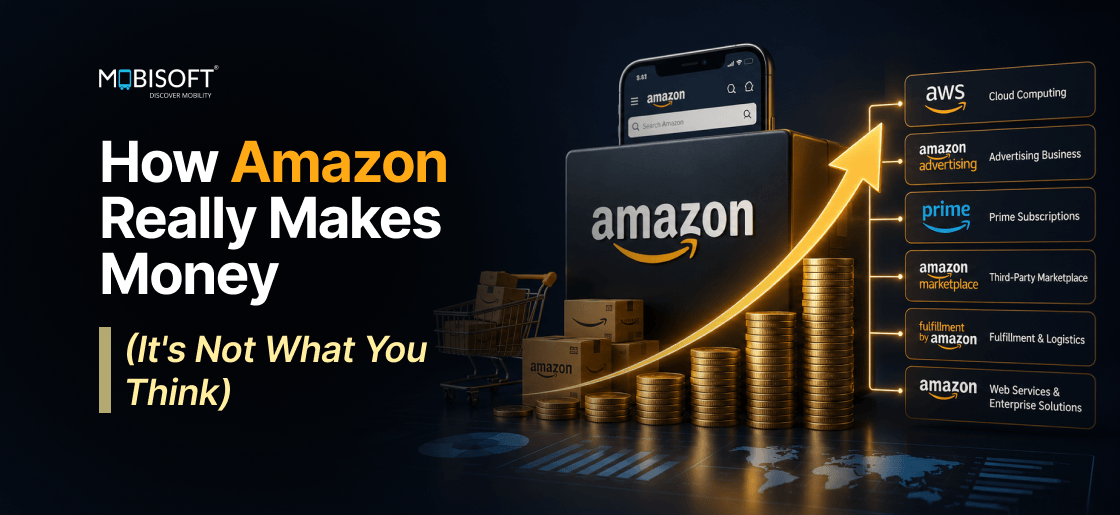
"Amazon is an online store." That's what most people assume, and it used to be true for some time, but not anymore. Behind the checkout page sits a cloud computing giant, an ad network worth more than Snapchat and Pinterest combined, a logistics operation bigger than most national postal services, and a subscription business with 200 million paying members. Five businesses, one name. That's the actual Amazon business model, and it works precisely because retail, the part everyone sees, loses money or barely breaks even without anyone noticing, while the parts nobody thinks about print cash.
We're going to walk through how Amazon makes money using the numbers Amazon itself disclosed for 2024. Why does a cloud division most shoppers have never heard of generate more profit than the entire online store? That's the question this piece answers. Consider the Amazon business model explained, built on filed numbers rather than assumptions.
Amazon Sells at Cost So It Can Sell Infrastructure at Margin
Thirty years. That's roughly how long Amazon spent building logistics, data centres, and cloud infrastructure meant to serve itself first. Somewhere along the way, leadership realized this internal machinery could be rented out. Retail wasn't the destination. It was the excuse needed to build something far bigger, and here's the proof:
- Online store revenue reached roughly $247 billion in 2024. Margins on that revenue? Thin, and in some quarters, negative.
- Why keep an unprofitable business running at this scale? Because it generates customer data, keeps warehouses full, and gives third-party sellers a reason to show up.
- Less than 10% of Amazon's total revenue comes from AWS, yet AWS produced close to 68% of total 2024 operating income.
- Digital ads carry almost no cost of goods sold, so nearly all $56 billion of Amazon Advertising's revenue turns straight into margin.
- Prime members generate over $170 a year each in subscription fees alone, cash that helps bankroll the very logistics network retail leans on.
The Five Businesses Inside Amazon (Amazon Revenue Breakdown)
| Business Unit | 2024 Revenue | Operating Margin | What It Really Is |
| AWS | $59.2B | ~67% | Cloud infrastructure and AI services rented to millions of businesses worldwide |
| Amazon Advertising | $56.2B | >85% (est.) | A digital ad platform built on purchase intent data |
| Prime and subscriptions | $44.3B | N/A (subsidises retail) | A bundled subscription ecosystem priced at $139 a year in the US |
| Online stores (1P retail) | $247.2B | <2% | Direct product sales; thin margin; mostly a data and logistics engine |
| Third-party seller services | $157.4B | ~5 to 10% | Commission and fulfilment fees from roughly 60% of Amazon's unit sales |
| Physical stores | $21.4B | ~2 to 3% | Whole Foods and Amazon Go; strategic for Prime and last-mile delivery |
Look at those numbers side by side, and the Amazon revenue breakdown basically writes itself. AWS plus advertising equals about $115 billion at genuinely high margins. Everything else, including online stores, the third-party marketplace, and physical stores, adds up to roughly $425 billion at margins so thin they barely count. So what holds it all together? Prime, mostly. Retail volume covers shared infrastructure costs for AWS and advertising, and profit flowing back from those two funds funds the customer acquisition that keeps retail alive in the first place.
If you're building something meant to last, start where Amazon did. A real product development strategy treats whatever you build for internal use as a potential product on its own, not just overhead you tolerate.
Amazon Web Services: The Accident That Became Everything
Nobody at Amazon set out to sell cloud computing. They had a scaling problem: Black Friday and Prime Day needed enormous server capacity, but building for peak load meant paying for idle servers the rest of the year. Somebody eventually asked an obvious question. If Amazon had this exact infrastructure problem, didn't every other company building software online have it too? AWS answers that question, and its growth is one of the clearest proof points inside the entire Amazon business model.
Amazon S3 launched in 2006, the first AWS product, closer to a custom MVP development experiment born out of necessity than a carefully market-tested launch. Analysts called it a distraction. Big mistake. Fast forward to 2024, and here's where things stand:
- AWS pulled in $59.2 billion in revenue and $39.8 billion in operating income, more profit than any cloud provider anywhere.
- Microsoft Azure claims higher cloud revenue by some measures, around $75 billion for fiscal 2024.
- Market share still favors AWS, at roughly 31% of public cloud infrastructure versus Azure's 25% in early 2025.
What AWS Actually Sells
Think of AWS less as one product and more as several businesses stacked under a single brand name:
- Compute, meaning EC2 and Lambda, makes up roughly 35% of AWS revenue and sets the benchmark competitors chase.
- Storage products like S3, EBS, and Glacier contribute about 15%. S3 in particular functions almost like the internet's shared filing cabinet.
- Databases, RDS, DynamoDB, Aurora, add another 15%, though Google's Spanner and Azure's Cosmos DB compete hard in this space.
- AI and machine learning sit at only around 10% today. That share is deceiving, though, since it's growing faster than 40% a year.
- Networking (VPC, CloudFront, Route 53) accounts for roughly 10%, and security (IAM, Shield, GuardDuty) makes up about 5%.
- Everything left, including developer tools, analytics, IoT products like CodePipeline and Kinesis, fills out the rest.
Why Switching Away From AWS Is So Expensive
Nobody stays on AWS because the features are unbeatable. They stay because leaving hurts. Build your architecture around specific AWS services, IAM rules, VPC configurations, S3 file structures, and untangling all of it later becomes an expensive, multi-year headache. AWS itself admits as much: enterprise migrations typically run 18 to 36 months and cost two to five times a company's annual cloud spend.
Here's what actually drives that cost:
- AWS offers over 200 distinct services. No customer uses all of them, but large enterprises typically rely on 30 to 80.
- Every service adopted raises the exit cost further, since leaving means rebuilding it elsewhere or rewriting code tied to AWS-specific tooling.
- IAM, VPC networking, and S3 addressing sit underneath nearly everything else, which is exactly why they're the hardest pieces to migrate away from.
AWS AI: The Next Growth Chapter
Overall AWS growth sits at a healthy 17 to 19% annually. Its AI segment blows past that number, growing north of 40% year over year in 2024. Three products explain why:
- SageMaker gives developers a managed environment for training and deploying custom models.
- Bedrock offers API access to several foundation models at once, with Claude, Llama, Mistral, and Amazon's own Titan, functioning as a kind of AI model marketplace.
- Trainium and Inferentia, Amazon's custom AI chips, handle training and inference more cheaply than standard GPUs.
Bedrock's cleverness has nothing to do with the technology itself. It's a hedge. Give customers access to multiple competing foundation models through one interface, and AWS never has to gamble its future on picking the right winner. Claude might dominate. Llama might. Doesn't matter much to AWS either way, because whoever wins, the customer stays on AWS infrastructure. This is the same trick AWS pulled during cloud computing's early years: hide the hardware, let customers worry only about their own workload.

Amazon Advertising: The Highest-Margin Business in the Portfolio
Ask most people what Amazon Advertising is worth, and they'll underestimate it badly. In 2024 it brought in $56.2 billion, ahead of YouTube's $34.7 billion, ahead of Twitter/X's $2.5 billion, ahead of Snap and Pinterest put together. Margins run 85 to 90%, since there's no inventory, no shipping cost, nothing physical anywhere in the equation. Call it the sharpest Amazon monetization strategy in the company's entire portfolio.
Why Amazon Advertising Earns More Per Dollar Than Rivals
One word separates Amazon from Google, Meta, and TikTok: intent. Someone browsing Instagram is, well, browsing. Someone typing into Amazon's search bar has already picked a product category, compared listings, maybe added something to a cart, and could be minutes from buying. That's purchase-intent advertising, which has far better payoff than Interest-based targeting.
Here's how the platforms compare, side by side:
- Amazon Sponsored Products: $8 to $20 CPM, 3 to 10x return on ad spend for well-run campaigns.
- Amazon DSP (off-platform retargeting): $3 to $15 CPM, typically 2 to 5x return.
- Google Search Ads: $2 to $50-plus CPC, 2 to 8x return, heavily dependent on query.
- Meta Ads: $8 to $20 CPM, 1.5 to 4x return, better suited to brand building than direct sales.
- TikTok Ads: $10 to $30 CPM, 1.5 to 3x return, strongest for brand discovery rather than conversion.
Funnel position explains everything here. Someone searching "noise cancelling headphones under $200" sits far closer to a purchase than someone who scrolled past headphone content on Facebook last Tuesday. The closer an ad gets to that actual buying moment, the more it's worth. Nothing gets closer than Amazon's own search page.
How Sellers Fund Amazon's Retail Business Through Advertising
Third-party sellers fight for the same search real estate Amazon's own private-label products occupy. Sponsored products, sponsored brands, and sponsored displays, are how sellers buy their way past organic rankings. The resulting loop ends up bankrolling Amazon's entire retail arm behind the scenes:
- More sellers join, chasing access to Amazon's customer base.
- More sellers competing for identical keywords drive ad prices up.
- Higher ad prices mean more ad revenue for Amazon.
- Amazon pumps that revenue back into fulfilment and customer acquisition.
- A better shopping experience pulls in more customers, which pulls in more sellers, and the cycle starts again.
In 2024, third-party seller services generated $157.4 billion. Advertising added another $56.2 billion. Combined, that's $213.6 billion, more than Amazon's own direct product sales once the cost of goods gets subtracted. So really, what is Amazon financially? A platform charging rent to sellers, not a retailer selling to shoppers.
Sponsored Products: The Economics of Amazon Search Advertising
Picture a headphone seller bidding $1.50 per click on "noise cancelling headphones." Win that auction, and the listing jumps to the top. Every click costs $1.50, sale or no sale. Say 5% of clicks convert at a $150 average order value. Do the math, and you get roughly $30 in ad cost per sale, about 20% of revenue, workable only if the product's margin can absorb that.
Here's the odd part. Logically, as more sellers bid the same keywords, cost-per-click should climb until returns get bad enough that people bid less, eventually pulling prices back down. But the reality is quite different. Competitors keep bidding when you stop doing it, dragging your organic ranking in the process. So not advertising can have more risks than advertising at a shrinking return.
Amazon Prime: The Loyalty Engine That Makes Amazon Hard to Leave
Prime launched back in 2005, offering unlimited two-day shipping at $79 a year. It has proved to be the most successful consumer subscription program since then. Today, they have expanded to videos, music, gaming, pharmacy discounts, grocery savings, and cloud storage. These services are offered as a bundle for $139/year.
None of these individual perks wins on its own merits. Netflix streams better. Spotify's library runs deeper. Google Drive costs less for comparable storage. So why does Prime work? It rewires the math behind every purchase decision a member makes:
- Prime members spend roughly 25% more on Amazon than similarly-situated non-Prime shoppers.
- Free delivery removes the friction of weighing an online price against a local one plus shipping.
- "Five dollars cheaper on Amazon, but eight dollars to ship" collapses into "Amazon is just cheaper."
- Getting checkout, delivery tracking, and account management this smooth took years of unglamorous work from mobile app developers, refining details most users never consciously notice.
What Each Prime Subscriber Is Worth
$139 a year in the US. Elsewhere it varies: about £95 in the UK, €89.90 in Germany, ₹1,499 in India. Amazon won't publish exact subscriber counts, but estimates suggest around 170 million in the US and over 200 million globally.
Here’s the difference in spending:
- A typical US Prime member spends close to $1,400 a year on Amazon.
- A non-Prime shopper with similar income spends roughly $600.
- That gap, about 2.3 times, comes almost entirely from the psychology around free shipping.
- Bundled perks, video, music, storage, delivery savings often add up to $200 to $400 a year, well past the membership fee.
- Annual renewal sits above 90%, among the highest retention rates any consumer subscription anywhere can claim.
Prime Video: Content That Justifies the Subscription Fee
$7 to $8 billion. That's what Amazon spent on Prime Video content in 2024, covering shows like The Boys and Rings of Power plus Thursday Night Football. As a standalone streaming investment, that number is hard to defend. As a retention tool for Prime membership overall? Makes a lot more sense.
Follow the logic here. Studies suggest members who actively watch Prime Video cancel at rates 20 to 30% lower than those who don't. Run a conservative estimate: if video content alone stops just 5% of subscribers from cancelling each year, and each retained subscriber is worth $1,400 annually versus $600 for a lapsed one, keeping just one million subscribers this way represents nearly $800 million in incremental yearly spending. Not charity. A retention line item with a fairly direct payoff, even if Amazon never publicly states the math this way.
The Prime Data Advantage
Forget the subscription fee for a second. The real value Prime hands Amazon is data. Ten years of shopping history builds a profile covering nearly every category someone has bought from, browsing habits, video-watching patterns, music taste, search history, delivery addresses. That kind of depth makes Amazon's ad targeting sharper than almost anything else advertisers can access today.
The resulting loop never really stops:
- Prime membership drives repeat purchases.
- Repeat purchases build increasingly detailed profiles.
- Detailed profiles sharpen ad targeting.
- Sharper targeting commands higher advertiser prices.
- Advertiser revenue funds more infrastructure.
- Better infrastructure enables faster, cheaper delivery.
- Faster delivery makes Prime more valuable, pulling in new subscribers, and the loop resets.
This isn't a metaphor. It's literally the mechanism behind why Amazon's ad business earns several times more per impression than most rivals manage.
Amazon Marketplace: The Platform That Owns Most of Amazon's Units
9.7 million. That's roughly how many third-party sellers list products through Amazon's marketplace right now, together accounting for about 60% of everything sold on the platform. That marketplace pulled in $157.4 billion in third-party seller services revenue during 2024, making it maybe the clearest Amazon ecommerce business model built entirely around sellers instead of owned inventory. Dig into this Amazon Marketplace, and you find the deepest insight in the whole Amazon business model analysis: running the platform beats being the retailer, every time.
How Amazon Earns From Third-Party Sellers
Several fees stack on top of each other here, each covering something distinct:
- Referral fee (commission): 6 to 45% of sale price depending on category, averaging around 15%, covering customer access and payment processing.
- FBA fees: $3.50 to over $12 per unit, covering picking, packing, shipping, and customer service.
- Storage fees: $0.75 to $2.40 per cubic foot monthly, higher for inventory sitting too long.
- Sponsored Products advertising: a cost-per-click auction averaging $0.77 to $1.50 per click.
- Professional account fee: $39.99 a month for platform access.
Add it all up, and the marketplace becomes one of Amazon's steadiest revenue engines, generating well over $100 billion combined every single year. None of it would hold together without inventory accuracy behind the scenes, either. A well-built warehouse scanning solution is often what keeps fulfilment promises like same-day and next-day delivery actually reliable at this kind of scale.
Want to compete in a marketplace this crowded? A good product alone won't cut it. Reliable ecommerce app development paired with a dependable order management system is often the actual line separating sellers who scale from sellers buried in operational chaos.
The Power Dynamic Between Amazon and Its Sellers
Let's be honest about the leverage here. Amazon holds nearly all of it:
- Amazon controls the search algorithm that decides which products get seen.
- Amazon can launch a competing product overnight through Amazon Basics.
- Amazon can change fee structures that sellers built entire businesses around, often with little warning.
- Amazon can delist sellers for policy violations, and appeals carry limited weight.
So why does seller supply keep growing anyway? Because Amazon's reach, roughly 300 million active shoppers globally, 200 million of them Prime members, is unmatched anywhere in e-commerce. A seller succeeding on Amazon reaches purchase-ready customers at a scale Walmart.com, eBay, and Etsy simply can't offer. Amazon's combined take often runs 35 to 50% of a seller's revenue, and the real alternative isn't keeping that cut. It's not reaching those customers at all.
Fulfilment by Amazon: The Infrastructure That Locks In Supply
FBA is probably the single most important piece of Amazon's marketplace strategy. Once Amazon stores, picks, packs, and ships a seller's inventory, that inventory physically lives inside Amazon's warehouses. Leaving isn't a matter of updating a listing. It means:
- Physically moving every unit of inventory somewhere new.
- Building an entirely separate logistics network from scratch.
- Accepting slower delivery that customers will notice instantly next to Prime-eligible competitors.
For Amazon, FBA turns what used to be a pure cost center into a revenue-generating service, layered on top of $250 billion in logistics infrastructure built over two decades. No rival has matched that investment. Sellers using FBA effectively help Amazon pay it down.
The Amazon Flywheel: Why the Whole Beats the Sum of Its Parts
Jeff Bezos sketched a flywheel on a napkin in 2001. The idea was that lower prices bring more customers, which in turn bring more sellers. This helps with a wider range of options for customers, which improves retention, and the cycle continues. That original engine still spins, but by 2026 this Amazon business strategy has grown into four separate flywheels running simultaneously.
- The retail and logistics flywheel is the original loop, more customers pulling in more sellers, more sellers bringing more selection. It's mostly plateaued in the US, where Amazon holds around 40% of online retail, so growth increasingly leans on the three flywheels below.
- The data and advertising flywheel runs on volume. More purchases mean richer behavioural data, richer data sharpens targeting, and sharper targeting pulls in more advertising dollars from sellers and brands. Advertising's $56.2 billion in 2024 revenue is basically a byproduct of this engine.
- The infrastructure and AWS flywheel starts internally, not with an outside customer. Retail's own demands push Amazon to build infrastructure; that infrastructure eventually gets sold externally as AWS, and AWS revenue funds even better infrastructure that loops back into Amazon's own retail systems.
- The Prime ecosystem flywheel ties everything together. Prime membership raises purchase frequency, more purchases mean more data, better data improves recommendations and delivery speed, and better value keeps people renewing, deepening their pull into the broader Amazon ecosystem with every cycle.
Here's the thing, though. None of these four flywheels spin on their own. They all depend on the same shared infrastructure underneath: fulfilment centres processing first-party orders, third-party FBA shipments, and same-day grocery deliveries, side by side, in the same buildings, with the same workforce. That shared cost base is precisely why Amazon's true cost to serve beats any single rival trying to build even one of these businesses in isolation.
Amazon's Financial Picture: A Decade of Building, a Decade of Harvesting
Two decades. That's roughly how long Amazon ran close to break-even on purpose, choosing growth over profit almost every time the two conflicted. Bezos laid out why in his 1997 shareholder letter and kept repeating it for twenty-five years straight: stay on "Day 1" forever, keep building instead of harvesting, treat long-term value as worth more than short-term profit. The harvest has clearly arrived now.
2024 Revenue and Profit by Segment
- North America retail and advertising: $387.2 billion revenue (+10% YoY), $21.2 billion operating income, 5.5% margin.
- International retail and advertising: $124.3 billion revenue (+8% YoY), $3.8 billion operating income, 3.1% margin.
- AWS: $59.2 billion revenue (+19% YoY), $39.8 billion operating income, 67.2% margin.
- Subscription services (mostly Prime): $44.3 billion revenue (+11% YoY), income folded into other segments.
- Advertising services: $56.2 billion revenue (+18% YoY), estimated margin above 85%.
- Total net sales: $637 billion (+10.2% YoY), $68.6 billion total operating income, roughly 10.8% overall margin.
AWS alone accounts for about 58% of total operating income, even though it represents just 9.3% of total revenue. That's a staggering concentration. Compare it to North America retail and advertising, generating $21.2 billion of operating income from $387 billion in revenue, a thin margin that's really propped up by advertising sitting inside the same segment. International retail, meanwhile, is only now approaching sustained profitability after years of losses.
Capital Spending: Investing in the Next Decade
$83 billion. That's roughly what Amazon spent on capital expenditure in 2024, about 13% of revenue, going toward fulfilment expansion, AWS and AI data centres, and satellite work under Project Kuiper. Few companies invest this much in a single year, and the logic is simple: today's AWS and advertising profits fund tomorrow's infrastructure. Where exactly did it go?
- AI-focused data centre capacity, driven by sharp demand growth from generative AI workloads.
- Logistics automation through robotics, steadily lowering per-unit handling costs.
- Project Kuiper, a satellite network built to rival Starlink and connect underserved regions to AWS and Amazon retail alike.
- Last-mile delivery through Amazon Logistics, now handling roughly 75% of US package deliveries without UPS or FedEx.
Free Cash Flow Over Time
| Year | Operating Cash Flow | Free Cash Flow | CapEx | Net Income |
| 2020 | $66.1B | $31.0B | $35.0B | $21.3B |
| 2021 | $46.3B | -$9.1B | $55.4B | $33.4B |
| 2022 | $46.8B | -$19.7B | $63.6B | -$2.7B |
| 2023 | $84.9B | $35.5B | $52.7B | $30.4B |
| 2024 | $112.7B | $38.5B | $83.0B | $59.2B |
A $2.7 billion net loss in 2022, mostly from a paper loss on Amazon's Rivian stake. The real story, however, was about over-investment. Amazon had built roughly 40% more logistics capacity than it needed, betting pandemic-era shopping growth would keep climbing at the same clip, but it didn't happen. As a result, the workforce was cut along with a few warehouses, and paused capital projects.
Amazon's Growth Bets: What Comes After the Core Business
Five core Amazon revenue streams, that combine AWS, advertising, Prime, the marketplace, and physical stores, generated $637 billion in total. So what's left to build? That's really the question behind Amazon's roughly $2.1 trillion market valuation in early 2026. Amazon has a habit of finding massive new revenue hiding inside infrastructure it built for entirely different reasons. A few bets worth watching:
Amazon Logistics as a third-party service
AMZL already delivers about 75% of Amazon's own US packages, cutting UPS and FedEx out of most volume. Multi-Channel Fulfilment already lets outside sellers tap the FBA network for their own websites. Expand this into a full logistics offering, and it competes directly with FedEx and UPS, with the infrastructure investment already sunk, meaning the added revenue is close to pure margin.
Healthcare
Three major moves so far: Amazon Pharmacy (built on the 2018 PillPack acquisition), Amazon Clinic (virtual care since 2022), and One Medical (bought for $3.9 billion, 200-plus physical clinics plus virtual visits). Familiar Amazon playbook: find an expensive, fragmented market run by high-cost incumbents, then undercut it with something leaner and tech-enabled. US healthcare, worth over $4 trillion, fits that mold.
Project Kuiper
A planned 3,236-satellite constellation aimed at delivering broadband globally, going head-to-head with Starlink. Amazon has committed roughly $10 billion through 2026. Why does this matter to AWS? Because connecting underserved regions to reliable internet extends both AWS cloud services and Prime into markets currently locked out by weak connectivity.
AI beyond AWS
Three levels here: infrastructure (Bedrock, SageMaker, Trainium, already meaningful revenue), applications (Alexa+, Amazon Q, Rufus, still early), and foundation models (the Nova series, competing against OpenAI and Anthropic more as a hedge than a near-term revenue driver). Amazon Q looks the most commercially promising of the bunch, integrating with Jira and Salesforce to go head-to-head with Microsoft Copilot, with native AWS integration as its biggest edge.
Amazon's Competitive Moat: Why It Is So Hard to Attack
Five categories at once, and in every single one Amazon holds at least one structural advantage a single-category rival simply can't match. No individual competitor is positioned to attack all five simultaneously, even though plenty win share here and there:
- AWS: switching costs across 200-plus integrated services, infrastructure reliability earned over years, heavy investment in Trainium chips. Azure (~25% share) and Google Cloud (~11%) remain the main challengers.
- Advertising: purchase-intent data no rival can replicate, a captive audience mid-decision, measurable ad-to-sale attribution. Google Shopping Ads, Walmart Connect, and TikTok Shop compete here.
- Prime: bundle lock-in across five-plus services in one subscription, logistics infrastructure that makes fast delivery credible. Walmart+ ($98/year), Instacart+, and Costco membership come closest.
- Marketplace: a 300-million-plus customer base, FBA lock-in on the supply side, advertising returns keeping sellers dependent. Shopify, Walmart Marketplace, and TikTok Shop pose the biggest threats.
- AI and emerging tech: AWS's existing infrastructure as a training base, Bedrock's multi-model access reducing vendor risk, consumer data enabling personalization at scale. Microsoft and Google remain the strongest rivals.
The Regulatory Risk Facing Amazon's Integrated Model
Everything that makes this model powerful happens to be exactly what regulators in the US, EU, and UK are scrutinizing hardest right now:
- Does Amazon favour its own private-label products, like Amazon Basics, over third-party sellers in search rankings? Both the EU's Digital Services Act and FTC investigations have raised this directly.
- Does Amazon mine aggregated seller data to spot high-selling products, then launch competing Amazon Basics versions? Amazon denies doing this systematically, though the claim appeared specifically in the FTC's 2023 lawsuit.
- Does bundling Prime Video with Prime's delivery subscription amount to anti-competitive tying that shuts out independent streaming? The EU has investigated this separately.
Real pressure, sure, but probably not fatal to the model as it stands today. The harshest possible outcome, splitting AWS from retail entirely, would genuinely break how the flywheel functions. Based on how digital antitrust cases have typically resolved elsewhere, though, behavioural remedies and transparency rules look far more likely than an actual breakup.
What Amazon Teaches Every Builder
Copying Amazon's exact playbook isn't realistic for most founders. Few have the scale, capital, or patience it took to build this. What does travel, though, is the reasoning behind these decisions, why they worked rather than just what they were.
- Infrastructure built for internal need often becomes a valuable external product. AWS, Amazon Logistics, Amazon Advertising, all started as tools solving Amazon's own problems first. Worth asking regularly: what have we built for ourselves that someone else might pay for?
- Profit from one business funding another only works when the two genuinely reinforce each other. AWS profits fund the fulfilment network that makes Prime valuable. Prime funds the customer acquisition that makes advertising valuable. No competitor can attack all of this at once, since each piece props up the others.
- Running near zero margin in one business can secure a strategic position worth more than the margin given up. Amazon's retail arm breaks even by design, not by accident, prioritizing market share and using the resulting volume to strengthen everything else.
- Subscription lock-in tends to beat pure transaction revenue at comparable scale. Prime's 90%-plus renewal rate comes from habit and bundled value, not contracts. Customers who stay because they want to are worth more than customers who stay because they have to.
- Data functions as infrastructure with compounding returns. Every transaction sharpens a profile, every sharper profile improves targeting, every improvement funds more data infrastructure. Thirty years of compounding here would take a rival decades to catch up to.
- Long time horizons enable strategies short ones simply can't support. Two decades of thin margins bought Amazon an infrastructure position now generating $68 billion in annual operating income, something no three-to-five-year plan could have produced.
- The most valuable customer is the one you can sell ten things to, not one thing profitably. Members using Amazon for groceries, streaming, pharmacy, and retail together are worth far more than single-category shoppers.
- Physical infrastructure remains a durable advantage even in a software-first world. Fulfilment centres, delivery fleets, and data centres are capital-intensive assets no rival can replicate quickly, no matter how much money gets thrown at the problem.
Use these as a starting framework for your own roadmap, not a finished playbook to copy line by line.
The Amazon Model: What It Means for Anyone Building a Digital Business
One company? Not really. It's a portfolio engineered so every piece reinforces and subsidizes the others, together building a position no single-market competitor can realistically challenge. Retail creates the customer base and the data. Data powers advertising. Advertising funds logistics. Logistics makes Prime worth having. Prime locks in the customer base, and that base makes the marketplace valuable enough that its own underlying technology eventually becomes AWS. AWS, in the end, funds everything else.
Want to build something with similar staying power? Internalize this compounding logic. Infrastructure built for internal use can become a product in its own right. Profit from one business can fund investment in another. Subscription lock-in changes the economics of nearly every decision downstream, and data generated simply as a byproduct of serving customers well becomes an asset that keeps compounding with every transaction.
Maybe the most important lesson has nothing to do with flywheel diagrams or patience through short-term losses. It's this: durable competitive advantages are rarely features or products. They're infrastructures instead, physical, digital, relational, taking years to build and remaining hard to replicate quickly even with unlimited capital behind you. Build the infrastructure. Monetize it beyond your own walls. Then go find your own flywheel.
About Mobisoft Infotech
Mobisoft Infotech designs and builds marketplace platforms, cloud-connected products, subscription ecosystems, and enterprise digital infrastructure for startups, scale-ups, and global enterprises. Across 14-plus years and 30-plus countries, we have helped founders and product leaders design the business models, technical architecture, and monetization strategies that turn digital products into durable businesses.

Frequently Asked Questions
How does Amazon make most of its profit?
Despite the retailer image, most of Amazon's profit comes from AWS, not from selling products. In 2024, AWS generated roughly $39.8 billion in operating income on $59.2 billion in revenue, a 67% margin working out to about 58% of total operating income from under 10% of total revenue. Amazon Advertising ranks second, with an estimated 85%-plus margin on $56.2 billion in revenue. Retail runs thin by comparison, functioning mainly as a customer acquisition and data engine rather than a genuine profit centre in its own right.
What is Amazon's take rate on marketplace sales?
Sellers pay through several stacked fees, and each one covers something different. The referral fee runs 6 to 45% of sale price, averaging around 15%. FBA sellers add $3.50 to over $12 per unit in fulfilment fees plus monthly storage. Most also spend 5 to 15% of revenue on Sponsored Products just to stay visible in search. Altogether, a typical FBA seller's total cost of selling runs 30 to 50% of revenue, depending on category and advertising intensity, though most still find it worthwhile given Amazon's reach.
Is Amazon Prime actually profitable on its own?
Not as a standalone line item, no. Prime Video content, unlimited delivery, and other perks often cost more than the $139 annual fee brings in directly. The real value shows up elsewhere: Prime members spend about 2.3 times more than similar non-Prime shoppers, renew above 90% annually, and cancel less often when they actively use Prime Video. That $44.3 billion in subscription revenue is really just an accounting entry, more bookkeeping than substance. Prime's true value comes through its lift to retail and advertising revenue, not through the membership fee itself.
Why is Amazon Advertising so valuable compared to other platforms?
Timing, mostly. Amazon Advertising catches users at the exact moment of purchase intent, while social platforms mostly reach people in a passive, browsing mindset scrolling for entertainment rather than products. Purchase history data lets advertisers target shoppers already active in a specific buying category, producing consistently higher returns than Facebook or TikTok deliver for direct-response campaigns. At $56.2 billion in 2024 revenue, margins above 85%, and 18% annual growth, only Google Search does better among major advertising platforms today.
How much money does AWS actually make, and why is the margin so high?
$59.2 billion in revenue, $39.8 billion in operating income, a 67% margin. Why so high? Once data centres exist, additional revenue costs very little to produce, roughly 33 cents per additional dollar earned, mostly in energy and staffing costs. Managed services like databases and serverless compute carry the highest margins of all, since Amazon sells operational expertise on top of raw hardware there rather than just capacity. Growth runs 17 to 19% annually, driven largely by AI workloads that demand more compute per dollar than typical web traffic ever did.
What is Amazon's biggest risk right now?
Regulation, probably above everything else Amazon faces right now. The FTC filed a major antitrust suit in September 2023, alleging self-preferencing and tying Prime benefits to FBA participation. The EU's Digital Markets Act labels Amazon a gatekeeper, requiring specific behavioural changes across its marketplace. Forcing a structural split and the flywheel economics powering this whole model would take a genuinely serious hit. More likely, though, are behavioural remedies that curb specific practices while leaving the core structure intact for now.
How is Amazon's model different from other ecommerce companies?
Three things set it apart, really. First, Amazon isn't primarily a retailer: roughly 60% of units sold flow through third-party sellers, where Amazon earns fees rather than product margin on each sale. Second, it runs profit centres entirely outside retail, with AWS and advertising together clearing well over $80 billion in operating income that subsidizes pricing standalone retailers simply can't match. Third, its logistics network, over a thousand fulfilment centres plus its own delivery fleet, gives it delivery control that UPS-and-FedEx-dependent rivals simply lack today.
What are Amazon's main revenue streams?
$637 billion in 2024 total, spread across six Amazon revenue streams: online stores ($247.2 billion, thin margins), third-party seller services ($157.4 billion), AWS ($59.2 billion, 67% margin), subscription services ($44.3 billion), advertising ($56.2 billion, 85%-plus margin), and physical stores ($21.4 billion). One pattern holds across all six categories without exception: retail generates the bulk of the volume, while AWS and advertising generate almost all the actual profit each year. Huge revenue paired with thin margins in one place, modest revenue paired with fat margins in another is a mismatch. It is really the entire story of how this company turns a profit.
This content is for informational purposes only and may include AI-assisted research or content generation. While we strive for accuracy, information may evolve over time. Readers are advised to independently verify critical information before making decisions.

Nitin Lahoti
Read more
Nitin Lahoti is the Co-Founder and Director at Mobisoft Infotech. He has 15 years of experience in Design, Business Development and Startups. His expertise is in Product Ideation, UX/UI design, Startup consulting and mentoring. He prefers business readings and loves traveling.
 Nitin Lahoti
 July 24, 2026