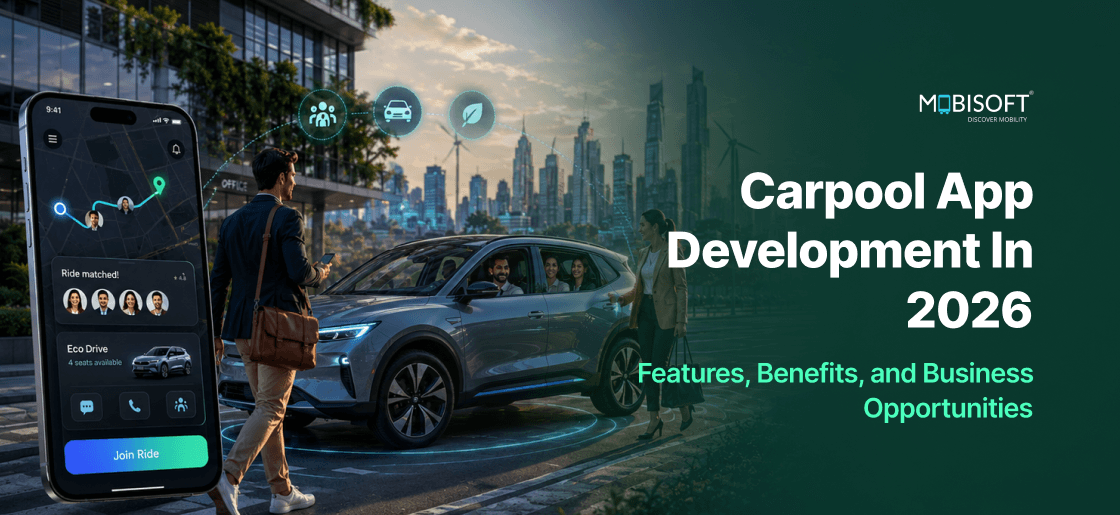
Carpooling is having a structural moment. The convergence of four independent forces has created the conditions for carpool app development to move from a niche shared transport option to a mainstream enterprise mobility product. These forces are: corporate sustainability mandates that require measurable transport emissions reductions; urban congestion that makes individual vehicle commutes increasingly impractical; employer-as-benefit economics that make transport subsidies competitive with salary; and AI matching quality that has finally reached the reliability threshold where carpooling can be trusted for daily commutes. This guide covers what to build, how to build it, what it costs, how to monetise it, and why 2026 is a meaningfully different moment for carpooling platform development than any previous year.
The 2026 Market Context: Why Carpooling Platform Development Is Different This Year
Carpooling has been technologically possible for over a decade. The apps have existed. The matching algorithms have been built. The business cases have been argued. And yet carpooling has remained at the margin of shared mobility, consistently outperformed in adoption by rideshare platforms that offer individual on-demand convenience. What has changed in 2026 is not the technology. It is the demand context. For teams exploring enterprise carpool app development, this shift in demand context is the starting point for every product and commercial decision.
The Four Market Forces Driving Carpooling in 2026
| Market Force | What Has Changed in 2026 | Impact on Opportunity |
| Corporate ESG Mandates |
|
|
| Urban Congestion and Parking Costs |
|
|
| AI Matching Maturity |
|
|
| Return-to-Office Dynamics |
|
|
The Business Model: Who Is Building What
Understanding which business model fits your target market is the first strategic decision in any carpooling software development project. The five main approaches each carry different capital requirements, sales cycles, and technical complexity.
B2B Enterprise Carpooling Platform
This is software sold to or operated for large employers. The employer pays per employee or per ride, and the platform manages the carpooling pool for that employer's workforce. Growth in this segment is strong: Scope 3 employee commute reporting mandates are creating active demand from sustainability directors, and the shift to measurable ESG outcomes means enterprises are willing to invest in enterprise mobility solutions that produce verifiable data. Build complexity is medium-high, requiring multi-tenant architecture, employer admin portals, ESG reporting, and schedule integration.
Consumer Carpooling Marketplace
A two-sided marketplace connecting drivers and passengers for commute sharing, funded by consumer transaction fees or subscriptions. Think of the BlaBlaCar model applied to daily commuters. Margin per transaction is lower, but volume potential is high in dense urban markets. This is the classic ride sharing app development model. Build complexity is medium: consumer UX, marketplace matching, payment processing, and rating systems.
White-Label Carpooling Platform for Municipalities
A platform licensed to cities, transit authorities, or smart city projects. It is subsidised by the public sector and is often free to end users. This segment is growing alongside urban sustainability commitments and park-and-ride programmes. The complexity is medium-high, with public sector procurement requirements, transit integration, and accessibility compliance. This is a natural fit for a Carpooling App Development Company with public-sector delivery experience.
Campus and Facility-Specific Platform
A carpooling platform built for a single large campus: university, hospital, science park, or industrial estate. The campus operator typically pays. Many large campuses have acute parking pressure and public transport gaps that make carpooling the best practical solution. The complexity is lower than multi-tenant deployments since there is no multi-tenancy requirement. This is also a strong entry point for commute management software vendors looking to prove the product before scaling to enterprise clients.
Integrated Corporate Mobility Platform
Carpooling as one mode in a broader corporate Mobility as a Service (MaaS) platform that also manages company vehicles, taxis, public transport, and bike sharing. This is an emerging model. The complexity is high, requiring a multi-modal architecture, diverse provider integrations, and a complex policy engine. Carpooling is typically the highest-impact individual module within these broader corporate mobility solutions.
Core Feature Architecture: What a Carpool App Must Build in 2026
The carpool app features set has evolved significantly since the first generation of consumer ridesharing apps. A 2026 carpooling app development project that targets the enterprise market must address the specific requirements of corporate adoption alongside the consumer-grade UX that employees expect. The features below represent the minimum viable set for a carpool platform targeting enterprise clients. A qualified Carpooling App Development Company will validate these requirements before a single line of code is written.
Passenger-Facing Core Features
| Feature | Specification | Why It Matters |
| Profile and Preference Setup |
| Schedule integration is the foundation of reliable enterprise matching; preference capture reduces post-match cancellations |
| Intelligent Ride Matching |
| Matching quality determines daily adoption; poor matches result in return to solo driving |
| Ride Booking and Confirmation |
| Calendar integration signals a trusted, dependable commitment rather than an ad-hoc arrangement |
| Live Driver Tracking |
| Reduces passenger anxiety; eliminates the most common reason for last-minute cancellations |
| In-App Communication |
| Reduces friction for common pre-ride adjustments without requiring phone number sharing |
| Trip History and Cost Tracking |
| CO2 data is the ESG metric employees can share; cost saving is a direct retention driver |
| Rating and Feedback |
| Accountability mechanism; low ratings trigger safety review; sustained ratings build matching pool trust |
| Emergency Contact and SOS |
| Safety feature that must be present in any enterprise carpool app; offline-capable SOS is required |
Driver-Facing Core Features
Driver experience is the supply side of any transportation app development project. Drivers who feel in control and see tangible benefits stay in the programme. The features below reflect that principle.
- Route and Schedule Posting: Driver posts home address, office address, departure time with a flexibility window, days per week, and available seats. System matches passengers to the route. Posting takes under 3 minutes and requires no active passenger searching after setup.
- Passenger Request Management: Receive booking requests from matched passengers. One-tap accept or decline with a required reason for decline. Acceptance rate is tracked but not penalised for legitimate declines. Prevents gaming while keeping the driver in control.
- Navigation with Co-Passenger Pickup: Turn-by-turn navigation routing through passenger pickup points in optimal order. Recalculates if the passenger is not at the pickup point on time. Multi-stop navigation must be purpose-built, not a standard maps link.
- Trip Management and Check-In: Start the trip when the first passenger is picked up. Mark each passenger as on board at pickup. Complete the trip on arrival. All actions trigger passenger notifications.
- Earnings and Benefit Tracking: Monthly summary of trips completed, passengers carried, estimated fuel cost contribution received, employer incentive points earned, and CO2 reduction contribution. Tangible benefit visibility is required to sustain driving behaviour.
- Driver Safety Features: GPS monitoring during the trip. Route deviation alert if the system detects an unexpected route. SOS button with emergency contact notification. Driver safety infrastructure must reach the same safety layer as passenger SOS.
Employer Administration Portal
The employer administration portal is what distinguishes an enterprise mobility solutions product from a consumer app with a corporate account. It is the interface through which HR, facilities, and sustainability teams manage, monitor, and report on their carpooling programme. Well-designed employee transportation software always includes a robust admin portal as a core deliverable, not an afterthought.
- Employee Roster Management: Add employees via SSO/LDAP integration or CSV upload. Employee auto-invited. Status tracking across invited, onboarded, active, and inactive states. Department and site tagging for reporting. SSO integration is a corporate IT requirement; manual employee management at enterprise scale is not feasible.
- Programme Configuration: Configure subsidy per trip or per month, matching pool boundaries, schedule windows, and required preference fields. Each employer configures their programme differently. Configuration without engineering involvement is required.
- ESG and Sustainability Reporting: Monthly and quarterly CO2 reduction report covering total vehicle trips replaced, CO2 savings versus solo driving baseline, participating employee count, and average trips per employee. Exportable for ESG report submission. This is the primary reason enterprise organisations purchase carpooling platforms.
- Utilisation and Adoption Reporting: Employee onboarding rate, monthly active user rate, average trips per active user, route coverage map, and adoption by department and site. HR and facilities teams need programme health metrics to identify underserved employee populations.
- Subsidy and Cost Management: Configure subsidy per trip, per month maximum, and by employee tier. Track subsidy expenditure versus budget. Monthly cost report. Cost per CO2 tonne metric for sustainability ROI reporting. Uncontrolled subsidy expenditure will cause programme cancellation.
- Incident and Safety Log: Safety events for the employer's employees: SOS triggers, route deviations, low safety ratings, unresolved complaints. Accessible to the employer's designated safety contact. Employers have a duty of care for organised transport.
AI Matching: The Feature That Determines Whether Employees Come Back
Carpooling matching is the hardest problem in carpool app development and the one that most directly determines whether employees adopt the app for daily use or try it once and return to solo driving. A carpool app with mediocre matching is a marketing cost, not a business. A carpool app with excellent matching is a sticky daily habit. Treating the AI powered carpool matching system as the primary product investment is the right strategic call.
The Matching Algorithm Architecture
| Dimension | What It Considers | Weight | Technical Implementation |
| Schedule Compatibility | Departure time overlap within flexibility window; probability of schedule match on requested days | 30-35% |
|
| Route Geometry | How closely driver route overlaps passenger route; total detour added for each potential passenger | 25-30% |
|
| Preference Compatibility | Conversation preference, music tolerance, temperature preference, gender preference, vehicle type | 15-20% |
|
| Match History and Trust | Previous successful matches with the same person; positive ratings exchanged; prior cancellation history | 10-15% |
|
| Workplace Proximity | Same department, team, or floor creates social context that improves match quality and communication comfort | 5-10% |
|
| Reliability Score | Driver's historical punctuality, cancellation rate, and rating aggregate; passenger punctuality and no-show rate | 5-10% |
|
Solving the Cold-Start Problem in Enterprise Carpooling
The cold-start problem is the network effect failure where a new carpooling platform has no drivers for passengers and no passengers for drivers. It is the defining commercial challenge in carpooling app development. Enterprise deployment provides a structural advantage over consumer apps, but the cold-start must still be explicitly managed.
- Employer anchor deployment: The optimal cold-start strategy is to launch at a single large employer with a concentration of employees at the same location. A single office building with 500 or more employees creates enough density for the matching algorithm to produce reliable same-day, same-route matches. The platform should prioritise enterprise sales precisely because the employer provides the demand anchor that consumer carpooling cannot generate organically.
- Driver-first recruitment within the employer: The most effective cold-start sequence is to identify and recruit drivers within the employee population before enabling passenger booking. Employees with regular routes, appropriate vehicles, and a willingness to carry colleagues are the supply side of the marketplace. If 10 to 15 percent of an employer's employees become active drivers on their established routes, the passenger matching pool can activate with high match rates from day one.
- Guaranteed matching commitment: For the first 60 days of a new employer deployment, the platform should operate a matching guarantee: any employee who requests a match on a standard commute day and cannot be matched is offered an alternative transport subsidy, such as a contribution toward a taxi. This removes the primary disincentive for early adoption. The cost of the guarantee reduces as network density increases.
- Route-by-route density management: Not all routes at a large employer will reach matching density simultaneously. The platform should prioritise route development based on employee home address cluster analysis: identify the most common residential clusters, activate carpooling on those routes first, and concentrate driver recruitment in those geographic clusters before attempting to serve the long tail of dispersed employee addresses.
Dynamic Matching and Schedule Flexibility
The most sophisticated challenge in enterprise carpooling matching is handling the real-world variability of hybrid work schedules. An employee who is in the office on Tuesday, Wednesday, and Thursday this week may have different days next week due to meetings, client calls, and team commitments. Static schedule matching breaks down within weeks as exceptions accumulate. A well-designed mobility app development approach solves this with three mechanisms.
- Dynamic matching mode: Rather than permanent pairing, each day's matches are generated from available drivers and passengers for that specific date. Employees confirm their office attendance in the app, or the app reads their calendar integration, and they are matched daily. This requires a more sophisticated matching service but produces significantly better actual utilisation rates because the match pool is always current.
- Regular match versus ad-hoc match: A regular match is a standing arrangement between a driver and one or more passengers on specific days, locked in for a period (typically two weeks) and auto-renewing if both parties confirm. An ad-hoc match is a one-off booking for a specific date, matched from the available pool on demand. Regular matches provide schedule certainty; ad-hoc matches provide flexibility for irregular office attendance.
- Calendar integration as matching input: The highest-quality enterprise carpool apps integrate with employee calendars (Google Calendar, Microsoft 365) to understand actual office attendance rather than relying on declared schedules. When the app knows the employee has a confirmed office visit on Tuesday, based on calendar entries mentioning the office address, it can proactively offer matches for that day without requiring the employee to manually request one.
Safety and Trust Architecture: Building a Platform That Employers Will Approve
Corporate adoption of carpooling platform development outputs is gated by two approval processes that consumer apps do not face: IT security review and HR/legal safety review. The IT review evaluates data security, integration architecture, and compliance certification. The HR/legal review evaluates duty of care coverage, safety features, incident management processes, and privacy compliance. Building a carpool app that passes both reviews without significant modification requires treating these as design requirements, not post-launch additions.
Safety Features Required for Enterprise Approval
- Driver identity verification: Every driver must be positively identified before their first trip via government ID verification, not self-declaration. Applicable APIs: VAHAN/Sarathi (India), DVLA (UK), state DMV (US), and biometric ID, where the government API is unavailable. Consumer apps use self-declaration or document photo upload; enterprise safety reviews reject this for employer-organised transport.
- Driving licence verification via official database: Active licence status confirmed at registration and periodically refreshed via the government licence database API. Daily batch check of all active drivers. Suspension detected and driver deactivated within 24 hours. Consumer apps verify at registration but do not monitor for subsequent suspension.
- Real-time GPS tracking during trips: Every active trip is GPS-tracked. The safety dashboard shows the live position of all active corporate carpools. Passengers can share their live location with personal contacts. Background GPS from the driver app with WebSocket position updates to the safety dashboard.
- SOS capability (offline-capable): One-tap SOS that works without a cellular signal. Multi-channel alert to the employer safety contact and personal emergency contact. Silent SOS option. Stored locally if offline and transmitted when the signal returns. SMS fallback. Consumer app SOS is often online-only and fails in car parks and tunnels.
- Route deviation detection: Automatic alert when the vehicle departs significantly from the planned route without driver notification. PostGIS route corridor with 3-level escalation. Cross-referenced with the traffic API before alerting. Target: less than 2% false positive rate. Consumer apps typically do not have deviation detection.
- Incident reporting and resolution workflow: Structured incident reporting for passengers and drivers. Mandatory resolution process. HR notification for serious incidents. In-app incident form with categorised types, severity classification, resolution workflow with SLA, and escalation to employer HR contact.
IT Security and Data Requirements for Enterprise Approval
- SSO integration: Employee login via the employer's identity provider (Microsoft Azure AD, Google Workspace, Okta). No separate password management. OAuth 2.0 / SAML integration with major identity providers. SCIM provisioning with auto-deprovisioning when an employee leaves. Add 4 to 6 weeks for SSO implementation.
- Data residency: Employee personal data is stored in a specific geographic region as required. EU data must stay in the EU; India data in India in some sectors. AWS regional deployment with explicit data classification and residency policy documentation. Add 2 to 4 weeks for data residency documentation.
- SOC 2 Type II certification: Evidence of systematic security controls over time, not just point-in-time. Engage SOC 2, auditor. 6 to 12 months to achieve certification. Required for many enterprise procurement processes, especially in the US market. Start the process early.
- API security and penetration testing: Annual penetration test from an accredited firm. OWASP API Security Top 10 compliance. Results shared with enterprise IT under NDA. The penetration test typically takes 4 to 6 weeks. Plan for a remediation period after the test.
- HRMS integration: Employee data sync with the employer's HR system (Workday, SAP SuccessFactors, Oracle HCM). Auto-update when employee details change. HRMS API integration or SCIM provisioning with real-time or nightly sync. Add 4 to 8 weeks for HRMS integration.
- GDPR / DPDP compliance documentation: Data Processing Agreement, privacy impact assessment, data subject rights process, and employee data handling documentation. DPA template compliant with GDPR and DPDP Act. DPIA conducted. Data subject rights workflow implemented. Legal review typically takes 2 to 4 weeks.
Monetisation Models: How Carpool Apps Generate Revenue
Carpool app monetisation in the enterprise segment is meaningfully different from consumer carpooling monetisation. Enterprise platforms charge for the software and service, not primarily for individual rides. Consumer platforms charge per transaction. Understanding which model fits your target market determines the revenue architecture from the beginning of carpooling app development. An employee carpooling solution with the right revenue model in place from day one grows sustainably; one that retrofits monetisation after launch typically does not.
B2B Enterprise Monetisation Models
- Per-employee per-month SaaS: Platform charges a monthly fee per enrolled employee, regardless of usage level. Employer pays based on the total eligible employee count or active user count. Predictable MRR. Scales with employer size. Lower usage does not reduce revenue. Requires a strong enterprise sales capability. Best for large employers with consistent employee populations and strong programme mandates.
- Per-trip transaction fee: Platform charges per completed carpool trip. Employer pays based on actual programme utilisation. May be combined with a platform access fee. Variable revenue dependent on usage. Incentivises the platform to drive adoption. Lower risk for the employer. Fair for early deployments and pilot programmes.
- Employer subsidy flow-through fee: Employer provides subsidies to encourage employee carpooling. The platform charges a processing fee on subsidy distribution, similar to a payment processing fee model. Revenue scales with subsidy generosity. Incentivises the platform to help employers design high-subsidy programmes. Requires significant employer investment in the programme.
- Annual platform licence and implementation: One-time implementation fee plus annual licence. Common for municipalities and large employers who want on-premise or private cloud deployment. Large upfront revenue. Long contract cycles. Relationship-intensive. Requires dedicated enterprise sales and customer success.
- ESG reporting module premium: Core carpooling platform at base price. Advanced ESG reporting (Scope 3 emissions methodology, science-based targets alignment, CSRD-compatible reporting templates) as a premium tier. Differentiates from competitors without ESG reporting. Increases ARPU significantly. Creates switching cost because ESG historical data accumulates in the platform.
Consumer and Hybrid Monetisation Models
- Booking fee on consumer transactions: Passenger pays a booking fee or service charge per trip. The driver receives a cost contribution from the passenger. The platform takes a commission. Viable in dense urban markets. Requires significant scale to generate meaningful revenue. Less compelling than the B2B enterprise model for most founders.
- Premium passenger subscription: Passengers pay a monthly subscription for premium matching features: priority matching, guaranteed match, preference filters, and schedule flexibility. Viable alongside a free tier. Requires enough free users to convert. Premium features must be genuinely superior to justify the subscription.
- Advertising and partner offers: Carpool apps reach an audience at a predictable location on commute routes. Relevant advertising from retailers near commute routes, fuel offers, and coffee chains near pickup points. Low individual revenue. Requires scale. Appropriate for consumer apps with large user bases.
- Data and analytics (anonymised): Commute pattern data sold to urban planners, employers, and transport authorities for route planning and infrastructure decisions. Viable for large-scale platforms with significant geographic coverage. Requires careful privacy compliance. Not a standalone business.
- White-label licensing: License the platform to other businesses or municipalities that want a branded carpooling app without building from scratch. Viable once the core platform is mature. Significantly extends market reach without equivalent engineering investment.
The ESG Reporting Module: The Differentiator That Closes Enterprise Sales
The ESG reporting module is the feature that most consistently determines enterprise purchase decisions for corporate mobility solutions in 2026. When sustainability teams, HR directors, and CFOs evaluate carpooling platforms, they have two questions: Does it work for our employees, and can we measure the environmental benefit? The second question is what the ESG module answers. Most carpooling platforms answer it inadequately.
What the ESG Module Must Produce
- Vehicle trips replaced: Number of solo car trips replaced by carpooling compared to the counterfactual (how the journey would have been made without the programme). Calculated as carpool trip count multiplied by passengers carried, where each passenger represents one solo vehicle trip replaced. Output: monthly total, cumulative annual, trend chart, breakdown by office location and department.
- CO2 savings: Tonnes of CO2 emissions avoided by replacing solo vehicle trips with carpooling. Calculated using average CO2 per km for a solo car journey (DEFRA for UK, MoEFCC for India, EPA for US) multiplied by journey distance and passenger count, minus the CO2 of the carpool vehicle for that journey. Output: tonnes CO2 avoided per month, per employee, cumulative annual.
- Scope 3 employee commute emissions reduction: Reduction in Scope 3 Category 7 (employee commuting) emissions as required for CSRD and GHG Protocol Scope 3 reporting. Methodology: GHG Protocol Scope 3 Category 7 applied to carpooled employees versus baseline solo vehicle. Output: aligned with GHG Protocol Scope 3 methodology, exportable as CSV and PDF for ESG report incorporation.
- Journey and fuel cost saving per employee: Average fuel cost reduction per participating employee and total programme fuel cost saving across the employee population. Calculated using average fuel cost per km multiplied by km saved by not driving solo. Output: per-employee annual saving, total programme saving, motivational metric for employee adoption communications.
- Programme health and adoption metrics: Active users, match rate, trips completed, seat fill rate, and trend over time. Calculated from platform usage analytics aggregated by employer. Comparison to the benchmark shows what adoption is normal for similar-sized employers. Output: monthly report to HR/facilities, dashboard view for real-time programme management.
The ESG Module Engineering Requirements
The ESG module is not a reporting dashboard bolted onto a carpooling platform. It requires specific data capture at the trip level to produce verifiable ESG metrics.
- Trip distance capture: Every carpool trip must have the origin-to-destination distance recorded from a GPS track or Google Maps calculation. This is the primary input for CO2 calculation. Apps that do not capture trip distance cannot produce credible CO2 savings data, and enterprise sustainability teams will ask for methodology documentation that requires verifiable distance data.
- Vehicle class recording: CO2 per km varies significantly by vehicle type (petrol sedan versus diesel SUV versus hybrid versus EV). The platform should capture vehicle class at driver registration and use the appropriate emission factor in CO2 calculations. An EV carpooling trip has near-zero Scope 3 tailpipe emissions but non-zero electricity generation emissions depending on the grid mix.
- Counterfactual methodology documentation: Enterprise sustainability auditors will ask what the baseline assumption is. The standard methodology assumes each passenger would have made a solo vehicle trip. Some auditors require documentation of the actual transport alternative. The platform should support a configurable counterfactual assumption and document the methodology clearly.
- Audit trail and data exportability: Enterprise sustainability reporting is auditable. The ESG module must be able to export all underlying trip data that feeds the summary metrics, so an external auditor can verify the calculations. Trip-level data (date, origin, destination, distance, passenger count, vehicle class) must be exportable in a standard format alongside the aggregated report.
Technology Stack and Architecture for a 2026 Carpool Platform
The technology architecture for a carpool app must accommodate four requirements that standard consumer booking apps do not face simultaneously: real-time GPS tracking of all active trips, a matching algorithm to run across all employee record everyday, a multi-tenant corporate administration architecture, and abundant availability of the daily commute service for employees. The stack below reflects production-grade choices for each component in a 2026 carpooling software development project. Teams using specialist enterprise app development services will typically have this architecture validated before the first sprint begins.
Recommended Architecture
- Passenger mobile app: React Native 0.74+ (iOS and Android) - One codebase for both platforms. FCM push notifications. Background GPS for live tracking. Offline trip details cache for signal-poor areas. AI-assisted dev saving: 35-40%.
- Driver mobile app: React Native + op-sqlite + MMKV + background-geolocation - Offline-first for vehicle operation. Background GPS continues when the app is backgrounded. MMKV for high-frequency GPS buffer. op-sqlite for offline trip details. AI-assisted dev saving: 35-40%.
- Employer admin portal: React 18 + TypeScript (web, desktop-primary) - Complex multi-tenant admin. ESG reporting charts. Employee management tables. Real-time safety dashboard. AI-assisted dev saving: 30-35%.
- Backend API: Node.js 20 + NestJS + TypeScript - Structured module architecture (MatchingModule, TripModule, SafetyModule, BillingModule, ESGModule, EmployerModule). WebSocket for live GPS. REST for booking and admin. AI-assisted dev saving: 35-40%.
- Matching service: Python 3.12 + FastAPI + scikit-learn / PostGIS - Python ML ecosystem for preference compatibility scoring. FastAPI for low-latency inference. PostGIS for geospatial route overlap calculation. Runs as a separate microservice. AI-assisted dev saving: 25-30%.
- GPS tracking service: Node.js + Socket.io + Redis adapter - Real-time WebSocket from driver app to passenger tracking view and safety dashboard. Redis pub/sub for multi-instance scaling. AI-assisted dev saving: 30-35%.
- Primary database: PostgreSQL 16 + PostGIS - Relational model for users, trips, employers, and matches. PostGIS for route geometry and proximity queries. ACID transactions for booking and match confirmation. AI-assisted dev saving: 35-40%.
- Message queue: AWS SQS + SNS - Daily matching job dispatch. ESG report generation. Employer report delivery. Notification fan-out. AI-assisted dev saving: 30-35%.
- Cache: Redis 7 (ElastiCache) - Matching result cache (30-minute TTL). Active trip status cache. Rate limiting for API endpoints. AI-assisted dev saving: 25-30%.
- GPS time-series: TimescaleDB (same PostgreSQL cluster) - High-frequency GPS positions from all active vehicles. Time-series partitioning. Efficient range queries for trip replay. AI-assisted dev saving: 30-35%.
- Notifications: FCM (push) + Twilio SMS + SendGrid email - FCM for app push. SMS for non-app users and emergency notifications. Email for employer reports and employee summaries. AI-assisted dev saving: 35-40%.
- Payment processing: Stripe Connect or Razorpay (India) - Cost-split processing. Employer subsidy distribution. Monthly employer invoice. Multi-currency for international deployments. AI-assisted dev saving: 30-35%.
- SSO integration: Auth0 or custom SAML/OAuth - Enterprise identity provider integration. SCIM provisioning. Employee auto-onboarding. Deprovisioning on HR system departure. AI-assisted dev saving: 25-30%.
- Cloud infrastructure: AWS ECS Fargate + RDS + ElastiCache + S3 - Container-based auto-scaling. 99.9%+ uptime target. Multi-AZ RDS. CloudFront CDN for static assets. AI-assisted dev saving: 35-40%.
The Matching Algorithm: Technical Deep Dive
The matching service runs as a Python microservice, separate from the Node.js core API. This separation allows independent scaling of the compute-intensive matching logic without affecting the core booking and tracking infrastructure. The daily matching job is the most compute-intensive operation in the platform. It runs in four stages.
- Pre-filtering: Before scoring, the matching service applies hard filters to reduce the candidate set from potentially thousands of employee pairs to a manageable set for scoring. Hard filters include: gender preference (women-only preference honoured as a strict filter), departure window overlap (driver and passenger flexibility windows must have at least 20 minutes of overlap), maximum detour constraint, and employer or campus boundary. After hard filtering, typically 95% of potential pairs are eliminated.
- Scoring: Each candidate pair is scored on the six dimensions described above. The score components are weighted and summed to produce a compatibility score. The matching service uses a pre-computed route geometry matrix (computed daily for all registered drivers using Google Maps API) to avoid real-time API calls during scoring, which would be too slow for large pools.
- Assignment optimisation: The final step is finding the assignment of passengers to drivers that maximises total system utility. This is a variant of the assignment problem in combinatorial optimization. For pools up to 10,000 users, a greedy assignment with local search refinement is computationally feasible. For larger pools, a beam search or approximate algorithm is required.
- Incremental daily update: The full matching job runs nightly for the following day's commute. Throughout the day, as employees update their office attendance via calendar integration or manual confirmation, the matching service runs incremental updates: checking whether confirmed or cancelled attendance affects any active matches and generating new matches for newly confirmed office attendance.
Development Costs in 2026: What Carpool App Development Actually Costs
Carpool app development costs in 2026 are 30 to 40 percent lower than equivalent 2022 to 2023 projects due to AI-assisted development tools. The ranges below incorporate these savings and reflect professional development at production quality for a carpool app development cost analysis targeting the enterprise market.
Development Cost by Scope Tier
| Tier | Included Features | Timeline / Cost | Best For |
| Tier 1: Consumer MVP |
| 14-20 weeks / $30K-$55K | Founders testing market hypothesis; campus or facility-specific deployment; pilot for a single employer |
| Tier 2: Enterprise Platform |
| 20-30 weeks / $60K-$105K | Enterprise-focused platforms targeting medium-large employers; B2B SaaS products entering the corporate mobility market |
| Tier 3: AI-Native Platform |
| 28-42 weeks / $105K-$160K | Platforms competing for large enterprise contracts; white-label ambitions; municipal or smart city carpooling platforms |
Component Cost Breakdown: Tier 2 Enterprise Platform
The following breakdown covers the Tier 2 enterprise platform in AI-assisted offshore development hours. The total range is 1,780 to 2,880 hours, with offshore mid-range being the most common engagement type. Nearshore is available at a higher rate for closer collaboration.
- UX design and mobile flows: 140-220 hrs. Carpooling UX is distinct; matching flow design requires domain knowledge.
- Passenger app (React Native): 200-320 hrs. Matching UI, SOS, and live tracking require expertise; standard screens AI-accelerated.
- Driver app (React Native, offline-first): 180-290 hrs. Offline trip management and background GPS require expertise.
- Employer admin portal (React 18): 180-290 hrs. ESG reporting UI and multi-tenant admin require domain expertise.
- Backend API (NestJS): 300-480 hrs. Matching integration, ESG calculations, and multi-tenant billing require expertise.
- Matching service (Python FastAPI): 120-200 hrs. Algorithm design is domain-specific; FastAPI scaffolding is AI-accelerated.
- GPS tracking service (WebSocket): 80-130 hrs. Socket.io and Redis patterns AI-accelerated; multi-subscriber design requires expertise.
- ESG reporting module: 80-130 hrs. CO2 calculation methodology and audit export require sustainability domain knowledge.
- Multi-tenant employer architecture: 80-130 hrs. Multi-tenancy design requires careful architecture; data isolation is critical.
- SSO integration (Microsoft + Google): 60-100 hrs. Each IdP has specific implementation requirements.
- Corporate billing (Stripe + subsidy): 80-130 hrs. Carpool cost-split and subsidy distribution are custom logic.
- Safety features (SOS, deviation, incident): 100-160 hrs. Safety system design requires careful implementation; offline SOS needs expertise.
- Testing, QA, matching scenario testing: 120-200 hrs. Test generation AI-accelerated; matching edge cases and safety tests requires domain knowledge.
- DevOps, AWS, Terraform, CI/CD: 60-100 hrs. Infrastructure-as-code from architecture AI-accelerated.
Business Opportunities and Go-to-Market Strategy for 2026
Carpooling platform development offers several distinct commercial opportunities. Each of them comes with different capital requirements, scale economies, and sales cycles. Understand which opportunity fits your organisation's resources and market position thoroughly. It is the first strategic decision in rideshare app development.
The Enterprise B2B Opportunity
The highest-value carpool app business model in 2026 is enterprise B2B: selling or licensing a carpooling platform to large employers as a corporate benefit and sustainability programme. The commercial logic is compelling.
- Large contracts, long retention: Enterprise contracts for carpooling platforms range from $50,000 to $500,000 or more per year for large employers. Once integrated with an employer's SSO, HRMS, and benefits platform, switching costs are high. Renewal rates for enterprise carpooling platforms with strong ESG reporting exceed 90 percent in research from the corporate mobility sector.
- ESG mandate as the sales trigger: The most effective enterprise sales motion in 2026 is entering through the sustainability team, not the HR or facilities team. Sustainability directors who are accountable for Scope 3 Category 7 employee commuting emissions are actively seeking interventions. A carpooling platform with CSRD-aligned ESG reporting is a compelling answer to a problem they are accountable for solving.
- Proof of concept programme: Enterprise sales for mobility software typically require a paid PoC (30 to 90 days at a single office location with a volunteer employee cohort) before a full deployment commitment. Price the PoC at $5,000 to $20,000. Use it to demonstrate matching quality, adoption rate, and ESG metrics. A successful PoC with strong metrics converts at high rates to full deployment.
- Partner channel through HR tech platforms: Several HR technology platforms (Workday, SAP SuccessFactors, Oracle HCM, Benify) have marketplace ecosystems where employers discover and integrate employee benefits. Listing on these marketplaces with native integration to the HR system significantly reduces the sales cycle by creating a trusted distribution channel.
The Municipal and Smart City Opportunity
Urban authorities in multiple markets are actively funding carpooling platforms as a component of smart city transport strategies. The commercial model differs from enterprise B2B, with public sector procurement requiring tendering processes, longer sales cycles, and specific compliance requirements. But contract values and strategic positioning are significant for any employee transportation management system that can meet public sector requirements.
- Carpooling into park-and-ride systems: Transportation authorities in the UK, EU, Singapore, and Australia are funding carpooling apps to facilitate commuter trips from their homes to park-and-ride stations, thus alleviating car congestion in the central urban core while expanding the catchment area of transit systems. Such programs usually pay for the entire cost of carpooling, providing carpooling services to the commuters for free.
- Carbon credits integration scheme: Certain cities and even private companies have considered integrating carpooling with carbon credit systems by converting the avoided CO2 emissions per commuter trip to a carbon credit or a carbon offset that can be sold or used to meet the company's carbon reduction goals.
- Smart cities' partnership with carpooling systems: Cities benefit greatly from aggregate and anonymized data on commute patterns, which can help with urban infrastructure design and planning. A carpooling app running on a large scale will collect valuable information on the patterns of commutes in urban areas, including peak travel periods and commuting flow direction.
Implementation Roadmap and Partner Selection for Carpool App Development
Building a carpool app in 2026 requires managing the interdependency between technical development, the enterprise sales pipeline, and the cold-start strategy simultaneously. Founders who focus exclusively on technical how to build a carpool app execution find themselves launching a technically excellent product into an empty market. Founders who focus exclusively on sales before the product is ready overpromise and under-deliver. The roadmap below sequences both streams.
The Development and Go-to-Market Roadmap
- Phase 0: Validation (Weeks 1-4)
- Technical: Discovery, define matching algorithm approach, define ESG methodology, wireframe all three user interfaces, define employer admin feature priority, specify SSO integration requirements.
- Commercial: Sign a letter of intent (not just interest, an actual commitment to pilot) from 1 to 2 employers before development starts. This validates demand and provides the employee data density needed for the cold-start strategy.
- Phase 1: Core Platform (Weeks 5-14)
- Technical: Passenger app and driver app (MVP), basic matching algorithm (schedule plus route geometry), PostgreSQL plus PostGIS, push notifications, basic GPS tracking, safety features (SOS, basic tracking).
- Commercial: Design the PoC parameters with the LoI employer (employee cohort size, duration, success metrics). Begin driver recruitment within the employer cohort. Brief the employer HR team on the programme.
- Phase 2: Enterprise Features (Weeks 15-24)
- Technical: Employer admin portal, SSO integration, multi-tenant architecture, ESG reporting module (basic CO2 calculation), GDPR/DPDP data framework, advanced matching (preference scoring).
- Commercial: Launch PoC with the LoI employer employee cohort. Operate active matching. Provide operations support. Collect feedback. Measure match rate and adoption metrics.
- Phase 3: AI and Advanced Features (Weeks 25-34)
- Technical: Advanced ML matching (full 6-dimension, assignment optimisation), calendar API integration, CSRD ESG reporting (Scope 3 methodology), incident reporting workflow, corporate billing automation.
- Commercial: Use PoC metrics as a case study for enterprise sales acceleration. Sign the second enterprise client. Demonstrate ESG reporting capabilities to sustainability teams at prospective employers.
- Phase 4: Scale and White-Label (Weeks 35+)
- Technical: White-label branding capability, municipal deployment features, multi-employer marketplace architecture, advanced safety AI monitoring, data export for ESG audit.
- Commercial: Onboard third and fourth enterprise clients. Evaluate municipal partnerships. List on HR tech marketplaces. Establish a partnership with ESG reporting tool vendors.
Partner Evaluation for Carpool App Development
When selecting a development partner for carpooling platform development, four tests reveal whether a team has genuine domain expertise or is generalising from standard app development experience.
The matching algorithm test
Two employees live 3km apart. Employee A drives to the office every Tuesday and Thursday, departing at 8:15 am plus or minus 15 minutes. Employee B needs to be at the office by 9 am on the same days, has no conversation preference, but prefers no music. Employee A specified music yes. A correct answer recognises that schedule compatibility is high, the route overlap is within standard detour tolerance, and the music preference conflict is a soft constraint that reduces the compatibility score but does not disqualify the match. The system should present the match with a note about the preference difference and allow both parties to resolve it. An answer that either disqualifies the match entirely or ignores the preference conflict indicates an algorithm design that is not nuanced enough for enterprise deployment.
The cold-start test
You are deploying at an employer with 800 employees at one office. 120 have registered. 15 are drivers. It is 3 days before launch, and the match rate is 40%. A correct answer identifies that 40% match rate at 3 days before launch is a risk. The immediate action is to identify employees in unmatched residential clusters, engage the employer HR team to encourage driver registration, and activate the guaranteed matching fallback (taxi subsidy for unmatched employees) from day one so that 100% of registered employees have a transport option. Any answer that simply says match rate will improve as more users join without a specific, immediate action plan indicates limited cold-start strategy experience.
The ESG methodology test
A client asks whether the ESG reporting is CSRD-compliant and can be used in their ESRS E1 climate disclosure. A correct answer describes the CO2 calculation methodology using DEFRA or MoEFCC emission factors applied to GPS-measured trip distances. It confirms alignment with GHG Protocol Scope 3 Category 7 methodology, explains that trip-level data is exportable for auditor verification, and recommends the client's sustainability team review the methodology with their ESG auditor. Any answer that simply says 'yes it's CSRD-compliant' without describing the methodology is a red flag.
The privacy architecture test
Can the employer's HR manager see which employee was in which carpool, with whom, and at what time? The correct answer is no. By default, the HR manager sees programme-level aggregate data (total trips, adoption rate, ESG metrics) but not individual trip records. Individual trip records are accessible only to the designated safety officer role. The HR manager can see whether a specific employee is enrolled and active, but not their trip history. This role-based access control is required for GDPR and DPDP compliance. Any answer where HR managers have default access to individual employee location history is a data protection compliance failure.
Carpool App Development in 2026: The Commercial Opportunity That Has Finally Matured
Carpooling has been a good idea for over a decade. What makes 2026 different is that the commercial context has finally aligned with the technology capability. ESG mandates are creating enterprise demand that bypasses the cold-start problem. AI powered carpool matching system quality has reached daily reliability. Hybrid working schedules have created the predictable commute patterns that carpooling requires. The enterprise sales motion through sustainability teams is producing shorter sales cycles than the HR or IT routes that previous carpooling platform founders tried.
For founders evaluating carpool app development in 2026: the enterprise B2B opportunity is the right starting point. A platform that can serve one large employer well, with reliable matching, defensible ESG reporting, and enterprise IT compliance, has a proven model that scales to the next employer with limited additional engineering. The consumer carpooling market remains competitive and margin-thin. The enterprise market is underserved by platforms that combine genuine matching quality with credible ESG metrics.
Build the AI powered carpool matching system first. Then build the ESG reporting module. Then get the first employer PoC. Everything else follows from those three steps in sequence. The carpool app development company that wins the enterprise market in the next three years will not be the one with the most features. It will be the one whose employees actually use it every day and whose sustainability team can defend the CO2 numbers to an auditor.
About Mobisoft Infotech
Mobisoft Infotech builds carpool apps, corporate mobility platforms, AI matching systems, and employee transportation management system solutions for enterprise and municipal clients. Our product engineering practice has delivered carpooling matching algorithms, safety-first driver apps, ESG reporting modules, and multi-tenant employer portals for mobility technology companies.

Frequently Asked Questions
How much does carpool app development cost in 2026?
Costs have dropped 30 to 40 percent from 2022 to 2023 due to AI-assisted development:
Tier 1: consumer MVP
- Includes passenger and driver apps, basic matching, GPS, SOS, and cost-split payment
- Costs $30,000 to $55,000 in 14 to 20 weeks.
Tier 2: enterprise platform
- Adds employer admin portal, SSO, multi-tenant architecture, ESG reporting, HRMS integration, advanced matching, and corporate billing.
- Costs $60,000 to $105,000 in 20 to 30 weeks.
Tier 3: AI-native platform
- Adds advanced ML matching, calendar integration, CSRD-aligned ESG, AI safety monitoring, white-label branding, and multi-employer marketplace.
- Costs $105,000 to $160,000 in 28 to 42 weeks.
- Ongoing monthly infrastructure and development costs typically run $5,000 to $15,000.
What are the key features of a carpool app in 2026?
Core carpool app features include: passenger profile with schedule and preference setup, AI matching (schedule, route, preferences, reliability score), real-time driver tracking, offline-capable SOS, trip history with CO2 saving, and post-trip rating. On the driver side: route and schedule posting, passenger request management, multi-stop navigation, and GPS-tracked trips. For employers: employee roster management with SSO integration, ESG reporting module (Scope 3 Category 7 CO2 calculation, audit-exportable), programme configuration, and safety log. IT requirements include SOC 2 Type II, GDPR/DPDP compliance, and HRMS integration.
What business model works best for a carpool app?
For enterprise-focused carpool apps in 2026, the most validated carpool app business model is per-employee per-month SaaS ($3 to $15 per employee per month) with an ESG reporting premium tier generating 20 to 40 percent additional ARPU. This model delivers predictable MRR, scales with employer size, and creates switching costs through data accumulation. Consumer transaction fee models (10 to 20 percent commission per trip) work but require significant scale. The highest-value hybrid is enterprise SaaS as primary revenue with white-label licensing for municipalities as a secondary stream. Enter through sustainability teams, not HR or IT, for the fastest sales cycle.
How does the carpool app matching work?
Enterprise carpool matching uses a multi-dimensional scoring algorithm. Schedule compatibility (30 to 35 percent) evaluates departure time overlap within stated flexibility windows. Route geometry (25 to 30 percent) uses PostGIS spatial calculation and Google Maps detour calculation. Preference compatibility (15 to 20 percent) aligns with conversation, music, and gender preference, with gender preference treated as a hard filter. Match history and trust (10 to 15 percent) and reliability score (5 to 10 percent) round out the scoring. The algorithm runs as a daily batch job, with an incremental service handling same-day updates. Assignment optimization uses a greedy algorithm with local search refinement.
How do carpool apps handle safety?
Enterprise carpool platform safety covers six areas: government API-verified driver identity and licence (with daily status checks), real-time GPS tracking with employer safety dashboard access, route deviation detection with 3-level escalation (targeting below 2 percent false positives), offline-capable SOS with SMS fallback and silent mode, automatic safety triggers (silence detection on night routes, sudden stop, extended journey time anomaly), and structured incident reporting with resolution workflow and HR notification. See companion article: 'Is Corporate Carpooling Safe? How Modern Mobility Platforms Ensure Employee Security.'
What technology stack is used for carpool app development?
Technology Stack for Carpool App Development
- Mobile Apps: React Native 0.74+
- Web Portal: React 18 + TypeScript
- Backend: Node.js + NestJS
- AI Matching: Python, FastAPI, scikit-learn
- Database: PostgreSQL + PostGIS
- Real-Time Tracking: Socket.io, Redis
- Infrastructure: AWS ECS, RDS, CloudFront
- Payments: Stripe Connect / Razorpay
- Authentication: Auth0 / SAML / OAuth
What is the cold-start problem in carpool apps, and how do you solve it?
The cold-start problem occurs when a new platform has no drivers for passengers and no passengers for drivers. Unlike rideshare, carpooling requires both sides to be present simultaneously on the same route. Four strategies resolve this: first, launch at one large employer (500+ employees) to provide demand density. Second, recruit 10 to 15 percent of employees as drivers before enabling passenger booking. Third, operate a 60-day guaranteed matching commitment where unmatched employees receive an alternative transport subsidy. Fourth, cluster employee home addresses and activate carpooling on the most common residential clusters first, rather than spreading thin across all routes simultaneously.
How does ESG reporting work in a carpool app?
Enterprise carpool apps track Scope 3 Category 7 (employee commuting) emissions under the GHG Protocol.
Emissions saved = (solo trips replaced × trip distance × regional CO₂ factor) − carpool vehicle emissions.
For CSRD/ESRS E1 compliance, reports must use an auditable methodology and provide trip-level records, including date, route, GPS distance, passenger count, and vehicle type. Sustainability teams typically require detailed methodology documentation.
This content is for informational purposes only and may include AI-assisted research or content generation. While we strive for accuracy, information may evolve over time. Readers are advised to independently verify critical information before making decisions.

Nitin Lahoti
Read more
Nitin Lahoti is the Co-Founder and Director at Mobisoft Infotech. He has 15 years of experience in Design, Business Development and Startups. His expertise is in Product Ideation, UX/UI design, Startup consulting and mentoring. He prefers business readings and loves traveling.
 Nitin Lahoti
 June 10, 2026