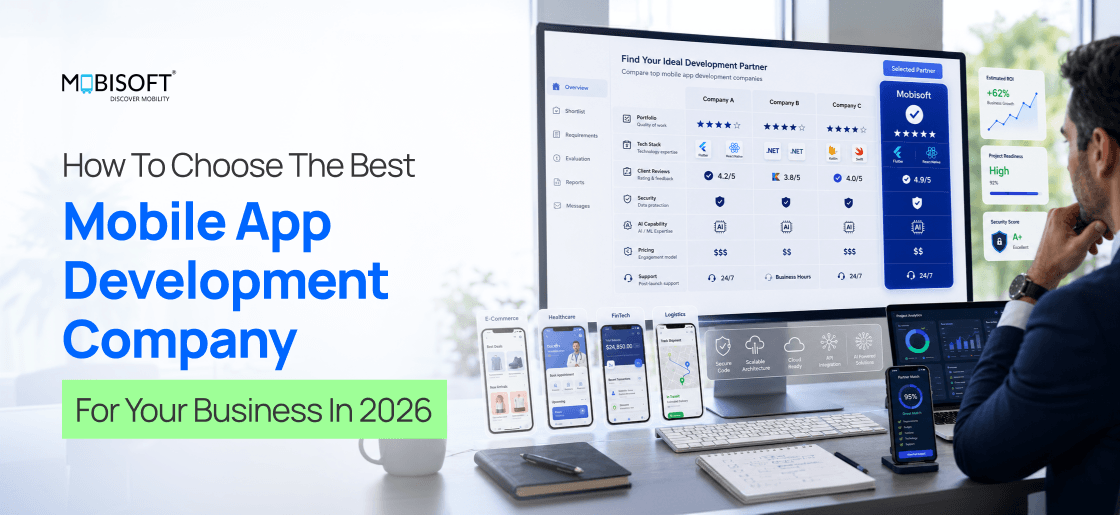
Picking a mobile app development company is a big call. Maybe one of the biggest a business makes. Think about what you're handing over. Your product vision, your intellectual property, your budget. Often the technical foundation of the whole business. And you're trusting it to a team you've never worked with. Choose badly, and the fallout varies. Missed deadlines and cost overruns hurt, yet you recover. A product that won't work or scale is worse. Security holes can outlast the vendor entirely. That kind of damage lingers for years. So this guide arms you with four things. The evaluation framework. The due diligence questions. The contract protections, and the red flags seasoned buyers rely on. First-timers usually learn these the hard way. Treat it as your mobile app development company selection guide.
The Mobile App Development Vendor Market in 2026
The phrase mobile app development company covers a lot of ground. Comparing two at random feels strange. It's like comparing a GP to a neurosurgeon. Both are doctors, technically. A solo freelancer in Eastern Europe counts. So does a 200-person agency in Bangalore. So does a 15-person studio in London. Each one is an app development company by the usual definition. Yet each fits a different client. Different needs, different budgets, different tolerances for risk.
So which vendor type fits you? That's the first real decision. And it sets up every criterion that follows. Picture a founder with $80,000 for an MVP. Now picture a FTSE 100 enterprise digitising a core process. Their needs barely overlap. The founder wants speed and flexibility. They want a partner who thinks in products. Often that means an MVP development company that ships fast. The enterprise rather wants compliance, governance, and the muscle to juggle many stakeholders.
Here's how we see it. The right software development company isn't the flashiest or the cheapest. Fit matters far more, we think. It should align with your project and process maturity. It should suit your capacity to manage them, too. A world-class enterprise agency can be wrong for a startup. A gifted solo freelancer may be the wrong fit for a regulated product. Reputation rarely beats fit.
The Vendor Type Taxonomy
Five distinct vendor categories dominate the market. The compact comparison below shows where each one fits.
| Vendor Type | Size | Rate (USD/hr) | Strengths | Limitations | Best Client Profile |
|---|---|---|---|---|---|
| Independent Freelancer | 1 | $25–$150 | Low cost, high flexibility, direct access, fast communication | Single point of failure, limited capacity, narrow breadth | Solo founder, simple MVP, tight budget |
| Small Specialist Studio | 3–15 | $80–$300 | Deep tech expertise, senior team, strong product thinking, agile | Limited capacity for large projects, gaps outside core area | Startups needing a long-term product partner |
| Mid-Size Agency | 20–100 | $50–$220 | Full-service, project governance, team redundancy, vertical expertise | Junior delivery risk, bait-and-switch risk, more overhead | Funded startups, $100K–$500K budgets |
| Large IT Services | 500+ | $40–$80 | Scale, compliance certs (ISO 27001, SOC 2), global reach | Commoditised delivery, junior-heavy, slow, high minimums | Enterprise digitisation, compliance-heavy work |
| Product Studio | 5–30 | $150–$350 | Strategy plus execution, UX-first, business model input | Expensive, unnecessary when strategy is already defined | Founders needing strategy and technical execution |
Large IT services firms and product studios sit at opposite ends of this range. For enterprise mobile app development, the scale, certifications, and account management of a large provider often matter more than raw speed, which is why many enterprises pair this guide with dedicated enterprise app development services when governance is the priority.
The AI-Augmented Development Agency, the New Variable in 2026
The emergence of AI assistance for apps, customised software, and custom MVP development (Cursor, GitHub Copilot, Claude Code, Lovable for prototyping) has created a meaningful capability stratification within the development agency market that did not exist till 2023. Agencies whose teams actively use AI coding assistance deliver 30 to 50 percent faster timelines on standard feature development compared to agencies that have not adopted AI tooling. Consider the cost implication. A 14-week project from an AI-augmented team at $12,000 per week may be faster and cheaper than a 20-week project at $9,000 per week from a non-AI-augmented team of equivalent developer seniority.
Ask one question specifically. "What AI development tools do your engineers use daily, and can you show me data on how they have affected delivery speed?" A credible answer cites specific tools (Cursor, GitHub Copilot, Claude Code) with specific workflow integration details. A non-credible answer is "yes, we use AI tools" without specifics. That often means individual developers use ChatGPT occasionally, which is not the same as a systematic AI-augmented development workflow.
The Eight-Dimension Evaluation Framework for Mobile App Development Companies
Evaluating a development company on the right dimensions is the difference between making an informed decision and making a confident one based on the wrong signals. The most commonly over-weighted criterion is portfolio aesthetics. A beautiful portfolio demonstrates design quality but says nothing about technical robustness, project management discipline, the mobile app maintenance services you will rely on after launch, or what the client relationship actually felt like. Use the eight dimensions below as your mobile app development company evaluation criteria, weighted by their actual impact on project outcomes.
The Eight Evaluation Dimensions and What to Look For
Good call on both. Here's the genuinely compact table, with the link pulled out and cells cut to phrases.
| Dimension | Weight | What to Look For | How to Evaluate |
| Technical capability | High | Stack proficiency, AI maturity, security, scalable architecture | Code review, requirement walkthrough, sample code |
| Communication | Very High | Speed, clarity, proactive style, plain language | Time their sales replies, request a status report |
| Project management | High | Scrum or Kanban, scope and risk handling, milestones | Sample project plan, an over-budget story |
| Client references | Very High | Re-engagement, problems resolved, estimate accuracy | Call two or three similar-project references |
| Domain expertise | Medium- High | Industry compliance and workflow knowledge | In-domain examples, test for true fit |
| Portfolio depth | Medium | Shipped, maintained, scaled apps | Open live apps, check App Store ratings |
| Post-launch support | High | Bug fixing, features, knowledge transfer, docs | Ask the critical-bug SLA and cost |
| Cultural fit | Medium | Compatible rhythm, willingness to challenge | Float a bad idea, see if they push back |
The Reference Check Process, the Most Important Due Diligence Step
Reference checks are consistently under-used in development agency selection. Buyers often accept the testimonial quotes on the vendor's website and skip the direct reference conversations that would reveal the real client experience. The reference check is the highest-return due diligence activity in vendor selection because past client relationships are the most predictive signal of future vendor behaviour.
The reference check is only valuable if you ask the right questions. "Were you happy with them?" is not useful, because almost no client gives a negative reference, and a uniformly positive answer tells you nothing. The questions that produce useful signal are these.
- Biggest problem. "What was the biggest problem or disappointment in the engagement, and how did the vendor handle it?" Every project has problems. A vendor who navigates them transparently is a better partner than one who reports a perfect project, which probably means a simpler project.
- Estimate accuracy. "How accurate were the original timeline and budget estimates?" This single question predicts financial risk better than any other signal. "We ran 50 percent over budget" is the most important data point in the call.
- Bad-news communication. "How did the vendor communicate when things were going wrong?" Ask whether they reported delays before the client noticed or after. Proactive bad-news delivery is rare and extremely valuable.
- Promise versus delivery. "Did the final product match what was promised in the proposal and demos?" This surfaces the bait-and-switch pattern and the overpromising pattern.
- Re-engagement. "Would you hire them again for your next project?" A client who would re-engage expresses genuine satisfaction. A client who hesitates expresses doubt they may not state directly.

Questions to Ask Every Mobile App Development Company Before Signing a Contract
The questions in this section reveal capability, process maturity, and alignment with your specific project. They are not gotcha questions. They are the questions to ask a mobile app development company that any professional team should answer clearly and specifically. Vague or defensive answers to straightforward professional questions are themselves significant evaluation data. Good mobile app developers welcome them.
Technical Capability Questions
- Architecture. "Walk me through the architecture you would use for an app like mine." A strong answer gives specific technology choices with reasoning, acknowledges trade-offs, and asks about your data model and integrations. A weak answer is "we would use React Native and a standard backend" with no reasoning or specifics.
- Code quality. "Can you show me a code review process you have in place?" A strong answer cites a pull request policy, linting and static analysis in CI/CD, and documentation and test coverage targets. A weak answer is "we care a lot about code quality" with no processes named.
- Zero-downtime migrations. "How do you handle database migrations in production without downtime?" A strong answer describes backwards-compatible or blue-green migrations and names tools such as Flyway, Liquibase, or Alembic. A blank pause, then "we'd make sure it's ready before pushing" reveals the real backend experience level.
- AI workflow. "Describe how your team uses AI coding tools in development." A strong answer names specific tools and task types (boilerplate, test generation, code review, documentation) with time-saving examples. "Yes, we use AI tools" with no specifics likely means occasional informal use.
- Security. "Walk me through the security measures that would be in our app." A strong answer covers authentication and authorisation, input validation, encryption at rest and in transit, OWASP Top 10 awareness, and a pre-launch review. "We follow security best practices" without naming them is a significant red flag.
- Code pride. "Show me a codebase you are proud of from a past project." A strong answer is a willingness to share code under NDA and explain architectural decisions. A refusal, or sharing poorly structured and untested code, tells you what you need to know.
Process and Project Management Questions
- Scope changes. "How do you handle scope changes after the project starts?" A strong answer is a formal change request process with impact analysis and a clear pricing mechanism. "We're flexible, we'll accommodate whatever you need" means arbitrary cost increases later.
- Sprint structure. "What does a typical sprint look like for a project like mine?" A strong answer covers duration, ceremonies, definition of done, sprint goals, demos, and backlog grooming. "We work in agile sprints" with no specifics is marketing, not practice.
- Status reporting. "How would you communicate project status to me?" A strong answer is a weekly written report (RAG status, completed work, plan, risks, budget tracking) plus an end-of-sprint demo and an escalation process. "We'll keep you updated regularly" has no format or frequency.
- Failure story. "Describe a project that went badly wrong. What happened and what did you do?" A strong answer is honest and specific about a failure and what they changed afterward. A claim of never having had a project go wrong is either dishonest or inexperienced.
- Quality assurance. "What does your QA process include?" A strong answer names a dedicated QA resource, multiple testing types, automation targets, and a UAT process. "The developers test their own code" is a real quality risk. Many teams strengthen this by letting clients hire mobile app testers for independent coverage.
- Named team. "Who specifically will be working on my project?" A strong answer names individuals with CVs or LinkedIn profiles, role descriptions, and availability. A generic team description without names is a strong bait-and-switch indicator.
Commercial and Engagement Model Questions
- Pricing structure. "How do you structure pricing, fixed price, time and materials, or retainer?" A strong answer explains each model honestly and recommends one for your project. "We can do whatever you prefer" suggests limited commercial experience.
- Estimate scope. "What does your estimate include, and what might cause it to increase?" A strong answer lists explicit exclusions, common cost drivers, and a contingency percentage. No exclusions listed usually means an underestimate built to win the bid.
- IP ownership. "Who owns the code and intellectual property after completion?" A strong answer is unambiguous: "You own everything upon final payment." "That's standard in our contract" is a redirect, so read the contract yourself.
- Code access. "What is your policy on access to code during development?" A strong answer is regular pushes to a client-owned repository from sprint one. "We push at milestones" means code is withheld as leverage.
- Milestone dissatisfaction. "What happens if we are not satisfied at a milestone?" A strong answer is a defined revision process with payment withheld until approval and specific acceptance criteria. "We'll fix whatever you need" means an informal negotiation at the vendor's moment of maximum leverage.
- Warranty. "What does your warranty or bug-fix period include after launch?" A strong answer is a specific period (30 to 90 days), a defined scope, and a response SLA under four hours for production-down issues. Vague "we'll support you after launch" has no defined terms.
Red Flags and Warning Signs That Predict a Problematic Vendor Relationship
The following red flags are not theoretical concerns. They are the specific patterns that consistently appear in post-mortem analysis of failed development projects. Use them as a mobile app development company checklist. The presence of one red flag is a reason to investigate further. The presence of multiple red flags in the same vendor is a reason to walk away regardless of how attractive the price or portfolio appears.
Pre-Sales Red Flags
- Quote without questions. A fixed-price quote arrives within 24 to 48 hours without detailed questions about your requirements, data model, or constraints. The quote is a number picked to win the bid, and the real cost emerges later through change requests.
- Unwillingness to share reference contacts. The vendor provides testimonial quotes but will not provide clients you can speak with directly. Either past relationships cannot withstand scrutiny or the testimonials are not genuine.
- No live, searchable apps. The portfolio shows beautiful screenshots and mockups but cannot provide App Store links to live, maintained apps. Any competent team that has shipped real apps can provide those links.
- Vague team description. The proposal describes "our experienced team" without naming individuals or committing to who will work on your project. This is the bait-and-switch pattern: senior talent for sales and junior delivery.
- Pressure to sign quickly. The vendor manufactures urgency, such as "this team is only available if you sign today." Legitimate companies have structured pipelines. Artificial urgency exists to prevent due diligence.
- Price dramatically below all others. One vendor quotes $40,000, where all others quote $120,000 to $180,000. They have misunderstood the scope, plan to under-resource the team, or are misrepresenting it. Dramatic outliers are outliers for a reason.
During Engagement Red Flags
- Status updates only when requested. You hear about progress only when you ask. Problems are being concealed until they cannot be hidden, and you will discover them at the worst possible moment.
- Demo quality diverges from reported progress. The report says 80 percent complete, but the demo shows 40 percent or significant quality issues. Reporting is not based on objective measurement.
- Scope creep without written change requests. Every scope discussion ends with a verbal assurance, but written change requests never appear. Verbal scope commitments are unenforceable.
- Named team members were replaced without notice. The engineers who presented are not the engineers doing the work, and you learn this only when you ask. The committed team was a sales team.
- Testing not visible in delivery. Code is delivered with no automated tests, and the answer is "we'll add tests later" or "we test manually." That is technical debt that will cost significantly to address.
- Documentation absent or incomplete. At milestone delivery, API docs, architecture decisions, and code comments are missing or superficial. This creates vendor lock-in and signals that maintainability is not a priority.
- Pushback-free acceptance of every requirement. Every request, however complex, gets "yes, we can do that" with no trade-off analysis. They either do not understand the implications or will recover the gap through scope-creep charges.
- Delays attributed only to external factors. Delays are always blamed on client feedback, third-party APIs, or scope, never on internal challenges. Excellent teams report their own delivery issues honestly.
- Code access restricted or conditional. The vendor holds sole repository access and grants it only at milestones. Code withholding creates leverage that can be exploited if the relationship deteriorates.
Running a Structured Selection Process From Longlist to Signed Contract
The selection process for a mobile app development company is itself an exercise in project management. It requires a clear process, defined evaluation criteria, consistent treatment of all candidates, and a decision framework that accounts for the multiple dimensions of vendor quality rather than reducing the decision to price alone. The process below consistently produces better selections than informal evaluations.
The Selection Process, Five Phases
- Phase 1, Requirement definition (3 to 5 days). Define your project in a written brief covering what the app does, who it is for, technical constraints, budget range, timeline, and success criteria. Share this with all candidates so proposals are comparable. Output is a one- to two-page brief and a shortlist criteria document.
- Phase 2, Longlist creation (3 to 5 days). Identify 8 to 12 vendors from referrals, Clutch.co, Upwork, LinkedIn, and targeted domain search. Apply initial screening (portfolio complexity, relevant technology, geography, budget) to reduce to 5 to 7. Output is a screened shortlist.
- Phase 3, RFP and proposal review (about 7 to 14 days). Send the brief, request proposals with technical approach, named team, project plan, pricing, and references, then score against a consistent rubric and reduce to 3 finalists. Output is scored proposals and a top three.
- Phase 4, Deep evaluation (5 to 10 days). Run a technical assessment with each finalist, complete two to three reference checks per finalist, and begin commercial negotiation with the preferred vendor. Output is reference notes, technical scores, and negotiated terms.
- Phase 5, Contract negotiation and signing (3 to 7 days). Negotiate scope, IP ownership, payment milestones, code access, change request process, warranty, confidentiality, and liability, with legal review for significant contracts. Output is a signed contract with protective terms in place.
The Vendor Scoring Rubric for a Defensible Decision
Scoring vendors against a consistent rubric prevents the decision from being dominated by whoever had the most impressive sales presentation. It ensures the dimensions that matter most receive appropriate weight. Multiply each score by its weight, sum the weighted scores, and treat the highest total as a strong input to the decision rather than the only input. If the calculation recommends a vendor but the reference checks raised specific concerns, the concerns take priority.
| Criterion | Weight | Score 1–5 | Scoring Guidance (5 = Excellent) |
|---|---|---|---|
| Technical capability | 25% | 1–5 | 5: named senior engineers, specific AI workflow, architecture matched to requirements, security shown. 1: generic answers, no tool knowledge. |
| Reference check quality | 25% | 1–5 | 5: references re-engage enthusiastically, specific praise, minimal variance. 1: references declined, over-budget history, specific complaints. |
| Communication quality | 20% | 1–5 | 5: response under 4 hours, clear and specific, proactive, no unexplained jargon. 1: over 24-hour response, vague, unclear writing. |
| Process maturity | 15% | 1–5 | 5: documented sprint process, sample reports with metrics, formal change requests. 1: "we use agile" with no specifics. |
| Domain expertise | 10% | 1–5 | 5: multiple shipped apps in your industry, compliance familiarity. 1: no relevant domain experience. |
| Portfolio quality | 5% | 1–5 | 5: multiple live, complex apps in your tier, App Store ratings above 4.3. 1: mockups only, poor ratings. |
The Project Brief Template to Send to Shortlisted Vendors
A clear brief ensures every vendor responds to the same requirements. Include the following sections.
- Company overview: Who you are, what you do, and why you are building this app.
- App overview: What the app does, who it is for, and the primary use case in one paragraph.
- Target users: Who will use the app, the estimated user base, and geography.
- Key features (MVP scope): Your P0 features and an explicit out-of-scope list.
- Technical requirements: iOS, Android, or web, known third-party integrations, data sensitivity or compliance needs (HIPAA, GDPR, PCI DSS), and performance requirements.
- Design requirements: Whether design is provided, needs creation, or is collaborative, and brand guideline availability.
- Timeline: Desired launch date, any hard deadline, and key milestones.
- Budget range: Provide a range rather than an exact number (for example, $80,000 to $150,000), which saves time and ensures comparable proposals.
- What you want in the proposal: Technical approach, proposed team with CVs, project plan, detailed pricing, and three similar client references.
- Evaluation criteria: How you will evaluate proposals using the rubric above, and your decision timeline. As a practical tip, an AI assistant can generate a first-draft brief from a ten-minute description of your project, with one to two hours of refinement for accuracy.
Contract Essentials That Protect Your Investment
The development contract determines your position if the vendor relationship deteriorates. A good contract does not guarantee a good project. It provides the legal framework for resolving disputes and protects your most important assets, your intellectual property, source code, and data, if the engagement fails. These protections should be non-negotiable regardless of the vendor's reputation or the warmth of the relationship during sales.
The Non-Negotiable Contract Terms
- IP and code ownership: All source code, designs, and documentation should be the exclusive property of the client upon creation, with the vendor waiving all claims. If a vendor insists on retaining any IP, understand exactly what and why, and consider walking away if it is core application IP.
- Code repository access: Source code lives in a client-owned repository with full read access at all times and commits at least every five business days. A vendor's refusal to commit to a client-owned repository from day one is a major red flag.
- Payment milestone structure: Payments are tied to specific, verifiable deliverables with defined acceptance criteria, not to time elapsed. Insistence on time-based billing regardless of progress is a risk signal.
- Acceptance criteria and revision process: Deliverables are deemed accepted within a set window unless objections are raised in writing, and the vendor corrects defects within that window at no charge. Ensure the criteria are specific and objective rather than subjective.
- Change request process: Scope changes are documented in a change request form, with no work starting until both parties approve pricing and timeline impact in writing. Flexible scope without formal change management is a recipe for budget overrun.
- Warranty and defect correction: The vendor warrants conformance for a set period (around 60 days) and corrects defects at no charge, with defined response times for critical and non-critical issues. Unwillingness to commit to a warranty signals low confidence in quality.
- Confidentiality and data protection: A mutual NDA covers all business information, with specific data protection obligations and a data processing agreement for apps handling personal data. Refusal of standard NDA language is unusual for any legitimate business.
- Termination provisions: The client can terminate for cause after written notice and an uncured material breach, with the vendor delivering all work product and source code within five business days. Termination without a delivery obligation is a significant risk.
- Personnel assignment: The named individuals from the proposal are assigned, and key personnel are not replaced without client approval, with replacements of equivalent seniority. Unwillingness to name personnel in the contract is a significant risk indicator.
- Liability cap and indemnification: The vendor indemnifies the client against third-party IP infringement claims, with liability capped at the project fee or a multiple for gross negligence. Legal review is recommended for any project above $100,000.
Pricing Models That Protect Your Budget
Each pricing model splits risk differently between you and the vendor. The compact comparison below shows where each one fits.
| Pricing Model | How It Works | Client Benefit | Client Risk | Best For |
|---|---|---|---|---|
| Fixed price | Set scope for a set fee, extras as change requests | Budget certainty, vendor absorbs estimation risk | Needs detailed spec, corner-cutting risk, scope disputes | Well-defined, smaller, first engagements |
| Time and materials | Pay for actual time at agreed rates | Maximum flexibility, transparent time | No ceiling, needs oversight, padding risk | Evolving requirements, ongoing partnerships |
| Fixed price with T&M change requests | Core scope fixed, additions via formal change requests | Budget certainty plus flexibility | Needs a spec and change discipline | Most startup and business projects (recommended default) |
| Capped T&M | T&M up to a maximum cap | Budget protection with flexibility, shared overrun risk | Vendor may sandbag the cap or cut scope at it | Some uncertainty with risk management needs |
| Retainer | Fixed monthly fee for agreed capacity | Consistent team, flexible priorities | No specific delivery guarantee, needs backlog management | Post-launch and long-term partnerships |
Geography and Team Location, Offshore, Nearshore, and Onshore Trade-Offs
The geography decision affects not just cost but communication rhythm, time zone overlap, cultural alignment, and the practical mechanics of collaboration. The cost differential is real, with 50 to 70 percent lower hourly rates for offshore relative to US or Western European rates, but cost is not the only variable that determines the true economics of mobile app development outsourcing.
The Geography Decision Matrix
| Region | Rate (USD/hr) | TZ Overlap (US/EU) | Notes | Best For |
|---|---|---|---|---|
| US / Canada | $120–$250 | Full US, partial EU | No language or culture barrier, real-time collaboration | Enterprise, US data residency, regulated work |
| Western Europe | $100–$200 | Excellent EU, 5–8h from US East | Strong English, similar business culture, GDPR by default | EU clients, regulated industries |
| Eastern Europe | $45–$100 | Full EU, 6–8h from US (1–3h overlap) | Excellent English, strong engineering, GDPR familiar | Quality-conscious clients with moderate budgets |
| Latin America | $35–$80 | Excellent US (0–4h offset) | Good English in hubs, US cultural familiarity, growing pool | US clients wanting nearshore overlap |
| India | $25–$65 | 4.5h from EU, 9.5–12.5h from US | Large talent pool, wide quality variance, screening essential | Budget-conscious clients with defined requirements |
| Southeast Asia | $20–$50 | Poor (12h+ offset) | Variable English, growing capability, async-heavy | Very budget-constrained projects |
Making Offshore Relationships Work, the Communication Infrastructure
The failure mode of offshore relationships is almost never technical capability. It is communication. Misalignment on requirements gets discovered at week 8 instead of week 2. Delays get reported at the end of the sprint instead of the day the blocker appeared. Demos reveal the team has been building the wrong thing because a requirement was ambiguous in writing but would have been clarified in a five-minute conversation. The infrastructure that makes offshore work includes the following.
- Synchronous daily standup with video: A 15-minute video call at the overlap window (for example, 8 am India and 3 pm UK) builds shared understanding that async communication cannot replicate. Video makes miscommunication visible faster.
- Shared project management in real time: Every task, status, and owner is visible to both sides in Jira, Linear, or equivalent. Status reports should add interpretation, not be the primary source of status.
- Weekly video demo at sprint end: A working demonstration with the client testing it live is the single most important communication event. Any offshore engagement without weekly demos discovers misalignment later and pays more to fix it.
- Written decision log: Every significant decision is documented within 24 hours. The most common source of late disputes is "I thought we agreed X," and a written log resolves these immediately.
- Escalation protocol: An agreed-upon process defines who escalates, to whom, and within what time when a blocker cannot be resolved at the team level. This prevents blockers from sitting unresolved for days.
Why Specialisation Matters for Domain-Specific and Generalist Development Partners
A development company that has built 10 healthcare apps understands HIPAA compliance, clinical workflow design, EHR integration patterns, and the FDA considerations for software as a medical device, by default and from experience. A generalist building its first healthcare app must research, learn, and make the same mistakes the specialist already made on previous clients' time and budget. This is why custom mobile app development in regulated and complex domains rewards specialisation.
The Domain Expertise Premium and When It Is Worth It
A specialist custom mobile app development company charges a premium, but that premium is usually cheaper than the compliance and rework costs of a generalist learning on your budget. The domains below show what expertise gets you and the typical premium worth paying.
- Healthcare and digital health: HIPAA compliance built into the architecture, clinical workflow knowledge, EHR integration (Epic, Cerner FHIR), and a PHI security posture. A generalist retrofits HIPAA expensively and risks a clinical workflow that physicians will not use. Premium is 25 to 40 percent.
- Fintech and financial services: PCI DSS architecture, financial data security, banking API integration (Plaid, Stripe, ACH), and AML and KYC capability. A generalist risks post-launch compliance issues and transaction bugs. Premium is 20 to 35 percent.
- Marketplace and on-demand: Dispatch algorithms, multi-party payments (Stripe Connect), trust and safety design, and geospatial query optimisation. A generalist risks expensive dispatch rework and payment errors. Premium is 15 to 25 percent.
- Enterprise SaaS and B2B: Multi-tenant architecture, SSO and enterprise identity (SAML 2.0, OKTA), role management, and audit logging. A generalist may build single-tenant and require massive rework to convert. Premium is 10 to 20 percent.
- AI-native applications: RAG pipeline design, LLM evaluation methodology, output quality measurement, and EU AI Act awareness. A generalist ships AI without evaluation infrastructure, causing quality problems at scale. Premium is 20 to 40 percent, the highest-ROI specialisation.
- Gaming and entertainment: Game loop design, real-time multiplayer architecture, in-app purchase mechanics, and performance optimisation. A generalist risks weak monetisation and an unscalable multiplayer architecture. Look for gaming-specific portfolio depth.
Managing Your Development Partner for the Best Outcomes
Selecting the right development partner is necessary but not sufficient for success. How you manage the engagement, the clarity of your requirements, the speed of your feedback, the discipline of scope management, and your engagement throughout is equally determinative. Even the best mobile app development services deliver poor results for a client who changes requirements weekly, approves deliverables late, and is unavailable to answer clarifying questions.
Your Responsibilities as a Client
- Be available: A team blocked on a clarifying question and waiting three days has lost three days of output. Commit to a 4 to 8 hour response time during business hours and set an escalation path for urgent questions. Developer waiting time is project time.
- Give feedback at sprint demos: The demo is the feedback mechanism. Saying "looks good, we'll review later" removes the value of the sprint structure. Review thoroughly, raise concerns within 24 hours, and make acceptance decisions within the agreed window.
- Write requirements before they are needed: The most common client-side cause of delay is requirements arriving without lead time. Aim to have them defined and reviewed one to two sprints before they are needed in development.
- Manage internal stakeholders: The team should never receive a direct requirement from anyone but the designated product owner. All requirements and scope requests flow through one person.
- Make decisions, not requests for options: When the team presents three options, decide in the meeting or within 24 hours. "We need to think about it" is a project delay.
- Respect the process: If you agreed to a formal change request process, use it. Informal scope requests to individual developers bypass the process that protects your budget and timeline.
The Sprint Rhythm: What a Well-Run Engagement Looks Like Weekly
- Monday, sprint start: You attend sprint planning (30 to 60 minutes) and prioritise the backlog. The vendor breaks down tasks and sets the sprint goal. Artifacts are the sprint backlog and sprint goal.
- Tuesday to Thursday: You stay available with under-4-hour responses and review designs or specs asynchronously. The vendor develops actively, runs daily standups, and escalates blockers. Artifacts are standup notes and draft specs.
- Friday, sprint end: You attend the demo (30 to 60 minutes), give feedback on all delivered features, and make accept or reject decisions. The vendor demos, runs the retrospective, and releases to staging. Artifacts are the demo recording, sprint report, and staging release.
- Ongoing: You refine upcoming requirements and approve deliverables within the agreed window. The vendor updates the tracker, manages technical debt, and addresses demo feedback.
Special Situations and Unique Considerations for Specific Project Types
The framework and contract guidance in this guide apply to all engagements. Three project types need additional consideration: AI-native applications, regulated industry products, and rescue projects. Each one stretches what you should expect from mobile app developers and their teams.
Selecting a Partner for AI-Native App Development
AI-native apps, where LLM integration, RAG pipelines, AI agents, or evaluation infrastructure are central to the product, require capabilities standard agencies do not have. The wrong partner builds an AI wrapper without evaluation infrastructure, deploys AI features without quality measurement, and produces a product that works in demos and fails in production. The questions that reveal genuine AI capability are these.
- Evaluation infrastructure: "Walk me through how you would design the evaluation infrastructure for an AI feature." A real AI partner knows that golden datasets, automated quality metrics, and regression detection are the foundation of quality. A partner without this knowledge ships demos.
- Model version changes: "How do you handle AI output quality degradation after model version changes from OpenAI or Anthropic?" Foundation models update, outputs change, and products break in subtle ways. Experienced partners have a process for this.
- Live AI products: "Show me the AI products you have shipped that are live in production with real users." The gap between a prototype and a production AI product is where most agencies have not yet operated. Require verifiable references.
- EU AI Act: "What is your approach to EU AI Act compliance for an app like mine?" The Act has obligations for apps serving EU users, and a partner without regulatory awareness creates exposure you will have to resolve.
Regulated Industry Products and the Non-Negotiable Compliance Requirements
Healthcare, financial services, legal technology, and education platforms for minors are regulated products where compliance failure is a legal liability, a reputational risk, and sometimes a criminal matter. Selecting a partner without genuine compliance experience in your specific environment is one of the highest-risk decisions a regulated business can make. The minimum capabilities and the questions that establish them are below.
- Healthcare (US): HIPAA technical safeguards, BAA signing, PHI handling in architecture, and FDA SaMD awareness for AI features. Ask, "Have you signed BAAs, can you share your HIPAA compliance framework, and have any products been subject to a HIPAA audit?"
- Financial services: PCI DSS architecture, SOC 2 Type II exposure, AML and KYC integration, and financial API security. Ask, "What PCI DSS level have your fintech apps been built to, and have you built SOC 2 Type II-auditable systems?"
- GDPR (EU users): GDPR-compliant data architecture, data residency, consent management, right to erasure, and DPA signing. Ask, "Do you sign Data Processing Agreements, and how do you implement the right to erasure?"
- EU AI Act (AI features): AI risk classification, technical documentation for high-risk AI, and conformity assessment experience. Ask, "What AI risk category would you classify our use case as, and what would that require?"
- Children's apps (COPPA and GDPR-K): Age verification, parental consent flows, data minimisation for minors, and restricted advertising. Ask, "How do you implement parental consent and an age gate in compliance with COPPA?"
Rescue Projects, Taking Over From a Failed Development Engagement
A rescue project, engaging a new partner to take over, complete, or rebuild an app after a failed first engagement, is one of the most complex and highest-risk scenarios. The new partner inherits someone else's architecture decisions, code of varying quality written by multiple hands, undocumented technical debt, and a client who is already stressed, over budget, and low on trust. Ask a potential rescue partner the following.
- Rescue track record: "How many rescue projects have you completed, and can you provide references specifically from them?" Codebase archaeology, technical debt assessment, and pragmatic keep-versus-rebuild decisions are different skills from greenfield development.
- Codebase assessment process: "What is your process for assessing a codebase you are inheriting?" A credible partner runs a structured audit covering code quality, security, architecture, test coverage, and dependencies, producing a written report before any rescue work begins.
- Handling the previous vendor: "How do you recommend we handle the previous vendor during transition?" The previous vendor may hold access to servers, accounts, or repositories, and an experienced partner has a clear protocol.
- Pricing reality: Rescue projects cost more per feature than greenfield because the team understands what exists before building what is needed. Budget a 30 to 50 percent premium over equivalent greenfield scope, plus a separate $5,000 to $15,000 for the initial technical audit before committing.
Choosing Your Mobile App Development Company to Protect Your Business
Selecting a mobile app development company is a high-stakes decision that too many businesses make too quickly, with too few data points, and with contract protections too weak to prevent the worst outcomes. The statistics at the start of this guide show 68 percent of projects exceeding budget or timeline and 42 percent of companies changing their primary partner within 18 months. It is the result of inadequate evaluation and contracts that do not protect clients when relationships deteriorate.
The process in this guide is not bureaucratic overhead. It is the minimum due diligence that experienced technology buyers apply consistently. The reference check calls, the technical assessment questions, the named-personnel contract term, and the client-owned repository requirement all cost hours to implement and save months of pain when they are needed.
Here is the fundamental advice. Choose based on technical capability, reference quality, and communication demonstrated over the sales process, not on price or portfolio aesthetics. Write a clear brief so all vendors respond to the same requirements. Score vendors on consistent criteria rather than gut feel. Negotiate contracts that protect your IP, your code access, and your budget. Invest the time in finding a partner you would genuinely want to work with for 24 months, because the strongest mobile application development services relationships are long-term partnerships, not one-time transactions. The best mobile app development company for your project is out there, and this framework is the most reliable path to finding it.
About Mobisoft Infotech
Mobisoft Infotech is a mobile app and digital product development company serving startups, growth-stage businesses, and enterprises across financial services, healthcare, logistics, retail, and technology in more than 30 countries over more than 14 years. We have been the second vendor for more rescue projects than we would like to count, which is what informs the red flag list in this guide. You can reach us at www.mobisoftinfotech.com, hello@mobisoftinfotech.com, in Pune, India.

Frequently Asked Questions
What is a reasonable budget to develop my app?
It depends on complexity and where the team sits. Take a standard MVP. Five to eight features, login, payments, notifications, both platforms. With an experienced offshore or nearshore team, budget $40,000 to $100,000. With a US or Western European team, $100,000 to $250,000. A marketplace app costs more. Roughly $80,000 to $220,000 offshore. Up to $550,000 onshore. A quote far below these ranges? Be cautious. It usually signals a simpler scope, a green team, or scope creep ahead. Here's the reliable test. Gather three to five proposals on one brief. Then watch where they cluster.
What questions should I ask before hiring them?
Five questions produce the most signal. First, "Walk me through the architecture you would use for an app like mine," which reveals genuine understanding. Second, "Describe a project that went badly wrong," which reveals honesty and accountability. Third, "Who specifically will work on my project, and can I see their CVs?" which reveals whether the named team is the delivery team. Fourth, "Can I speak with 2 to 3 past clients on similar projects?" the highest-value due diligence step. Fifth, "How accurate were your estimates on your last three projects?" the most predictive question for overruns. Strong answers filter out problematic vendors before any contract is signed.
How long does it take to build a mobile app?
A solid MVP runs 16 to 24 weeks. Call it four to six months. From kick-off to App Store launch. Roughly, it breaks down like this. Discovery and architecture, two to three weeks. Design, another two or three. Backend, four to six weeks. The mobile app itself, five to seven. QA, two to three. Submission prep, one or two. Simpler apps wrap in 10 to 14 weeks. Complex marketplaces stretch to 20 to 32. A six-to-eight-week quote worries us. That's underestimating or cutting corners. And don't forget App Store review. Apple and Google add a week or so.
Should I choose an offshore or onshore development company?
The decision depends on budget, communication needs, and compliance context. Offshore teams in India, Eastern Europe, and Southeast Asia offer 50 to 70 percent lower rates for equivalent quality but require structured communication to overcome time zone and cultural challenges. Onshore teams in the US and Western Europe offer full time zone overlap and minimal overhead, and are often required for regulated industries, at 2 to 4 times the rate. For most startups, an experienced offshore or nearshore team with AI-assisted workflow, structured sprint communication, and verifiable references is the highest-value choice. Eastern Europe and Latin America offer a particularly strong balance of cost and overlap.
What should be in a development contract?
The non-negotiable terms are clear IP ownership from creation, a client-owned code repository with commits at least every five business days, milestone-based payments tied to deliverables, named personnel with approval required for replacements, a formal change request process, a post-launch warranty of 30 to 60 days, termination for cause with code delivery within five business days, and confidentiality through a mutual NDA with data protection obligations for personal data. Each term protects a specific asset: your code, your budget, or your data, when the relationship is under stress. For contracts above $100,000, legal review by a technology-specialist lawyer is strongly recommended before signing.
What are the biggest red flags when hiring?
Eight red flags are most predictive. A quote within 24 hours without detailed questions means the estimate ignores your requirements. No named delivery team signals bait-and-switch. No live App Store apps means only mockups. Refusal to share reference contacts means past relationships cannot withstand scrutiny. A price far below all others usually means scope misunderstanding or recovery through change requests. Unwillingness to commit code to a client-owned repository creates dangerous leverage. No formal change request process leaves your budget unprotected. Artificial urgency to sign exists to prevent due diligence. Three or more of these in one vendor should be treated as disqualifying.
What is the difference between fixed-price and time-and-materials contracts?
A fixed-price contract commits the vendor to a defined scope for a fixed fee. You get budget certainty but need a detailed specification, since scope changes become priced change requests, and the vendor absorbs estimation risk within scope. It works best when requirements are well-defined and bounded. A time-and-materials contract pays for actual time at agreed rates, so the final cost is unknown, but requirements can evolve, and you bear the cost risk. It works best for longer partnerships with technical oversight. Most startups benefit from a hybrid setup with a fixed core MVP scope and additions handled as T&M change requests, which balances protection and flexibility.
This content is for informational purposes only and may include AI-assisted research or content generation. While we strive for accuracy, information may evolve over time. Readers are advised to independently verify critical information before making decisions.

Nitin Lahoti
Read more
Nitin Lahoti is the Co-Founder and Director at Mobisoft Infotech. He has 15 years of experience in Design, Business Development and Startups. His expertise is in Product Ideation, UX/UI design, Startup consulting and mentoring. He prefers business readings and loves traveling.
 Nitin Lahoti
 July 3, 2026