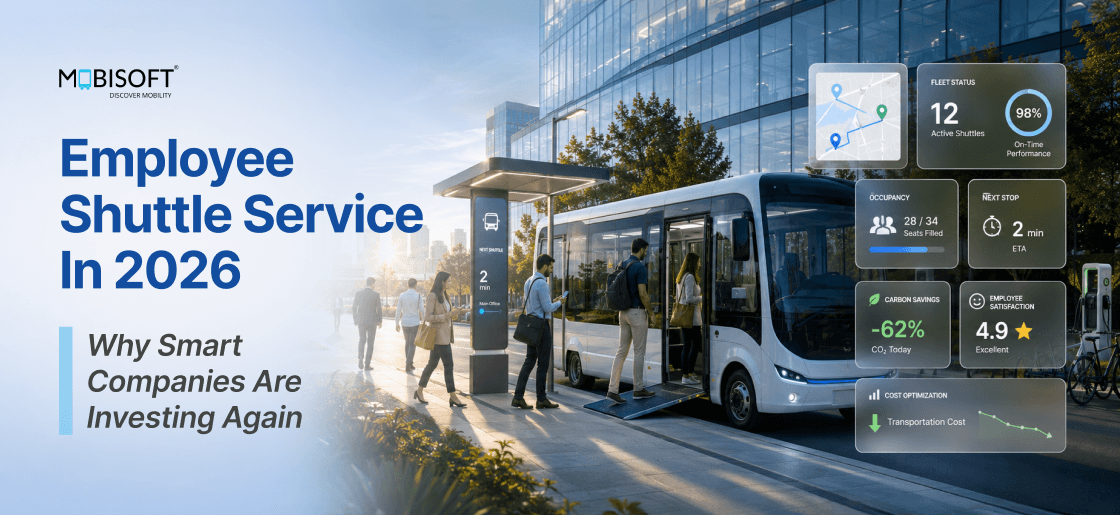
Picture two employees at the same company, both starting work at nine. One spends 45 minutes fighting traffic and arrives frustrated. The other rides a company shuttle, already through half their emails. That gap in energy and readiness repeats itself every single day. It also explains why more companies are rethinking their employee shuttle service strategy this year.
Return to office mandates forced this comparison into the open. Companies want consistent attendance, but employees resent the commute cost. A well built corporate shuttle service resolves that tension without forcing a compromise. It gives employees back their time and gives companies a controllable transportation asset. This blog breaks down why that trade works, backed by current data, current technology, and a practical build plan.
Companies across industries are asking the same practical question right now. Does a shuttle program actually pay for itself over time? The short answer is yes, when it gets planned correctly. Let’s see how.
The Commute Problem Companies Cannot Ignore
Office attendance has climbed back up since mandates took hold. Comfort with the daily journey has not followed the same path. The numbers behind this gap tell a clear story.
Office Occupancy Is Back But Uneven
Data from the Kastle Back-to-Work Barometer shows a clear pattern. The 10-city weekly average sat at 54.9 percent in early April 2026. That average has stayed fairly steady across recent weeks. Weekday attendance still clusters heavily around the middle of the week. Mondays and Fridays continue to lag well behind that midweek pattern. Attendance has concentrated into a few heavy days instead of spreading evenly. That pattern puts real pressure on any transportation plan built around a rigid schedule. A fixed five day model simply does not match how offices operate now.
Transportation planners now face a genuinely uneven demand curve each week. A route that feels crowded on Tuesday may sit half empty on Friday. Planning around average daily attendance misses this variation completely. Companies need visibility into daily patterns, not just weekly averages. This is exactly where flexible routing technology earns its value.
Mandates Are Costing Companies Talent
A University of Pittsburgh study covering S&P 500 firms tracked more than 3 million employee records. It found abnormally high turnover following return to office mandates. Women, senior staff, and highly skilled workers left at the highest rates. Hiring also slowed once mandates took effect at these companies. Time to fill open roles rose by 23 percent on average. Overall hire rates dropped by 17 percent across the same firms. Researchers described the pattern as brain drain tied directly to these mandates. That trade rarely looks good on paper for anyone involved.
Replacing a skilled employee takes noticeably longer once this pattern sets in. That delay adds real cost on top of lost productivity. A commute focused benefit can soften the resistance behind these mandates. It gives employees a genuine reason to accept the return to office.
The Commute Itself Has Gotten More Expensive
The average one way commute now runs close to 27.6 minutes, according to 2026 data. Vehicle ownership costs have climbed to 11,577 dollars a year, per AAA's 2025 report. Fuel, insurance, and depreciation make up the bulk of that total. Long distance commuting has also grown as a share of the workforce. Super-commuters traveling 75 miles or more have grown by nearly 33 percent since 2020. Commuting has turned into a real cost center for many households. It is no longer just a personal inconvenience employees absorb alone.
Employers Are Not Filling The Gap Yet
Transportation benefits remain far from standard among large employers. A 2023 Mercer survey found 18 percent of employers with 500 or more staff offered or planned one. That share rose to 21 percent among employers with 5,000 or more staff. More recent, broader data on adoption rates was not available at time of writing. Federal rules do offer some relief through pre-tax benefit caps. The 2026 combined transit and parking cap sits at 8,160 dollars per employee. Few companies actually use that allowance to its full potential. Most still lean on generic reimbursement policies instead of structured programs. A dedicated employee shuttle transportation plan closes that gap directly.
Reimbursement programs also put the planning burden back on employees. Workers must still find their own way to the office daily. A structured shuttle program removes that burden entirely from their plate.
What A Modern Employee Shuttle Service Looks Like
The shuttle programs of a decade ago relied on fixed routes. A handful of landmark pickup points served most of the workforce. That older model no longer fits how offices actually run today.
Routing Has Moved From Fixed Schedules To Flexible Plans
Modern workplace shuttle service programs flex around actual attendance patterns. They no longer assume everyone shows up five days a week. Ridership data now feeds directly into daily route planning. Companies can scale capacity up on the busiest weekdays. They can scale it back down again on quieter days. This kind of flexibility barely existed when most programs first launched. Hybrid schedules have made adaptive planning a genuine requirement, not a bonus feature.
AI Handles The Routing Work Now
Modern platforms recalculate routes constantly throughout the day. They factor in live traffic, current demand, and driver availability. A dedicated employee transportation solution processes these variables far faster than a human dispatcher. Static timetables have given way to adaptive plans that adjust in real time. A platform lacking this capability already feels behind the current market. Buyers increasingly treat adaptive routing as a baseline requirement.
Dispatch teams also benefit from this automation in practical ways. They spend less time manually adjusting routes during disruptions. That freed-up time goes toward planning improvements instead of firefighting.
Riders Expect Real Time Visibility
Live GPS tracking has become a baseline expectation for riders. Accurate arrival estimates and self-service booking round out the package. Employees expect a mobile app that behaves like consumer ride apps. They use those consumer apps daily for personal errands and travel. A shuttle platform without this visibility feels dated within a single year.
Push notifications keep riders informed about delays before they happen. This small detail cuts down on frustrated messages to dispatch teams. It also builds genuine trust in the reliability of the service. Companies exploring shuttle service app development expect this polish from day one.
Electric Vehicles Are Gaining Ground
Vans and electric minibuses are picking up real market share now. They cost less to operate across a full vehicle lifecycle. They also help companies meet tightening emissions targets more easily. This trend runs strongest across Europe and North America right now. Compliance pressure in those regions keeps building year over year. A true employee transportation management platform ties several functions together. Scheduling, routing, compliance, and reporting all live inside one connected system.
The Market Itself Is Growing Fast
Global demand for corporate transportation keeps climbing every year. The market reached roughly 42.37 billion dollars worldwide in 2026. Analysts project it will hit 54.87 billion dollars by 2031. That growth reflects a 5.31 percent compound annual rate. Mobility as a service platforms already capture over a third of revenue. Asia Pacific leads global growth, fueled largely by expansion in India and China. This growth signals rising demand for a reliable corporate employee transportation partner.
North America and Europe show steadier, more mature growth patterns. Regulatory pressure around emissions plays a larger role in those regions. Companies there often prioritize compliance features over pure cost savings.
Buses and coaches still dominate overall fleet composition worldwide today. Vans and electric minibuses continue gaining ground each year regardless. This split lets companies match vehicle type to actual route demand. A large campus route suits a bus. A smaller feeder route suits a van instead.
Current Employee Shuttle And Commuting Statistics
These figures anchor the rest of this blog in real numbers. Each one comes from current market research and government data sources.
| Metric | Figure | Source Year |
| Corporate employee transportation market size | 42.37 billion dollars globally | 2026 |
| Projected market size by 2031 | 54.87 billion dollars | 2031 forecast |
| Market growth rate | 5.31 percent CAGR | 2026 to 2031 |
| Average one way commute time in the US | 27.2 minutes | 2025 |
| Share of workforce classified as super-commuters | 9.3 percent | 2025 |
| Average annual vehicle ownership cost | 11,577 dollars | 2025 |
| Turnover increase after return to office mandates | 13 to 14 percent | S&P 500 study |
| Large employers currently offering transportation benefits | 18 to 21 percent | 2025 to 2026 |
| IRS combined transit and parking pre-tax benefit cap | 8,160 dollars per employee | 2026 |
Only 18 to 21 percent of large employers currently offer a transportation benefit. Commute costs, attrition risk, and market growth all point the other way. That gap represents a real opening for companies willing to move first.
Six Reasons To Offer An Employee Shuttle Service In 2026
The core reasons for offering a shuttle program have held up well over time. Each reason looks a bit different today because of new data and new technology.
Reason One: Protecting Employee Focus And Energy
A daily commute drains mental energy before the workday even starts. Sitting behind the wheel demands constant attention from start to finish. It leaves no room for anything else during that time. A shuttle commute converts that dead time into something usable. Employees can answer emails, review notes, or simply rest instead. That extra 27 minutes of focused time, twice daily, adds up fast. What would that time be worth across your entire team?
Multiply that saved time across a full year of workdays. The total adds up to real, measurable hours per employee. Employees arrive at their desks already mentally prepared for work. That head start shows up in early morning meetings and output.
Reason Two: Reliability That Employees Can Plan Around
Beating traffic was once the main selling point for shuttle programs. Reliability now matters even more than raw speed to most riders. AI powered routing gives employees a schedule they can actually trust. Accurate arrival estimates reinforce that trust morning after morning. Predictable pickup times reduce meeting delays tied to unpredictable commutes. Teams function better when everyone arrives close to the same time.
Managers can schedule early meetings with real confidence in attendance. Employees stop building in extra buffer time for traffic uncertainty. That saved buffer time turns into genuinely productive working hours instead.
Reason Three: Real Savings For Both Sides
Vehicle ownership costs sit near 11,577 dollars a year on average. That number climbs even higher across expensive metro areas. A well run company shuttle service costs less per person over time. It beats cash reimbursements and parking subsidies on a per head basis. Cloud based routing platforms now deliver real efficiency gains too. They cut per employee mile costs by 20 to 30 percent. Those savings compound quickly across a large workforce.
Parking costs drop as well once solo commuting rates decline. Fewer vehicles on site means less pressure on parking capacity. Facilities teams often redirect that reclaimed space toward other uses.
Reason Four: A Real Edge In Recruitment And Retention
Attrition after return to office mandates has been genuinely steep. Skilled workers have left at especially high rates industry wide. A shuttle benefit shows up during offer negotiations with strong candidates. This matters most in cities with limited transit options. Long typical commute distances make the benefit even more attractive. Only 18 to 21 percent of large employers offer this today. Early movers stand out clearly to job seekers comparing multiple offers.
Recruiters can highlight this benefit directly in job postings too. Candidates weighing similar salary offers often factor in daily convenience. A reliable commute option can tip that decision in your favor.
Reason Five: Stronger Teams Through Shared Time
In office days now cluster around the middle of most weeks. Shared shuttle rides have become a rare unstructured team moment. Casual conversation during a commute builds familiarity between colleagues. Video calls simply cannot replicate that kind of informal connection. That familiarity carries directly into daily project work afterward. Teams that know each other outside meetings tend to collaborate better.
New employees benefit especially from these informal shuttle conversations early on. They meet colleagues outside their immediate team in a relaxed setting. That early familiarity often speeds up onboarding into the wider company.
Reason Six: Sustainability Numbers That Actually Hold Up
Sustainability teams need real, reportable numbers to back their claims. Vague statements about fewer cars on the road no longer satisfy stakeholders. Electric vans and minibuses are becoming standard across many fleets. A modern employee commute solutions platform reports carbon reduction per passenger directly. That level of detail supports Scope 3 emissions reporting properly. It replaces guesswork with figures a sustainability team can actually defend.
Investors and regulators increasingly expect this kind of detailed reporting. A shuttle program becomes one clear data point in a wider ESG strategy. That data point strengthens the company's overall sustainability story.
An Illustrative Example Of Program Impact
The table below shows a realistic scenario built from earlier benchmarks. It is not a named case study. No public example currently publishes full metrics.
Picture a 500 employee technology company running a hybrid work schedule. Its typical one way commute radius runs about 45 minutes by car. The company introduces a shuttle program covering three routes into its main office.
| Metric | Before Shuttle Program | After Shuttle Program |
| Average one way commute time | 45 minutes solo driving | 40 minutes, with usable work or rest time |
| Employees driving solo to office | 78 percent | 42 percent |
| Commute related stress in employee surveys | Elevated | Reduced |
| Attendance consistency on scheduled office days | Inconsistent | More consistent |
| Estimated commuting emissions | Baseline | Reduced through shared, low emission rides |
Every company should run its own data through a proper ROI calculation. Geography, headcount, and existing benefits will change these exact numbers.
The direction of these numbers tends to hold true across most companies. Solo commuting typically drops once a reliable shuttle option exists. Reported stress usually falls alongside more consistent office attendance patterns.
How To Evaluate A Shuttle Service Booking Platform
Not every mobility platform fits a corporate workforce equally well. Some tools work far better than others for daily commuting needs.
Generalized Ride Apps Fall Short For Daily Commuting
Consumer car sharing apps work well for occasional trips around a city. They rarely offer the doorstep consistency a workforce needs daily. A dedicated bus transportation software platform closes that gap effectively. It handles recurring routes and fixed pickup points at scale. General consumer apps were never built to handle that kind of demand.
Pricing also works differently for a dedicated corporate platform. Consumer apps charge per trip, which adds up fast at scale. A dedicated platform typically offers predictable, volume based pricing instead.
What To Look For In A Platform
A strong platform should offer the following capabilities.
- AI route optimization that adjusts in real time to traffic and demand
- Live tracking with accurate arrival notifications for every rider
- Integration with existing company sign in and HR systems
- Reporting built specifically for ESG tracking and attendance data
- Scalability across multiple office locations and changing headcounts
Each capability above solves a distinct problem for a growing program. Route optimization handles daily operations without constant manual adjustment. Integration removes the friction of maintaining separate employee databases. Reporting turns raw ridership data into something leadership can actually use. Scalability protects your investment as the company grows or restructures.
Before choosing a system, ask one direct question first. Can it flex routes around hybrid attendance, or only fixed five day schedules?
Support And Onboarding Matter Too
Technical features only tell part of the platform story. Onboarding support determines how quickly employees actually start using it. A platform vendor should offer clear training for drivers and riders. Ongoing support matters just as much once the program goes live. Ask vendors how quickly they resolve routing issues during peak hours. A slow support response can undo months of careful planning fast. Strong employee transportation service vendors treat support as a core feature, not an afterthought.
Ask potential vendors for references from similarly sized companies. A quick reference call often reveals issues a sales pitch will not. This step takes little time but prevents a costly wrong choice.
Common Mistakes Companies Make With Shuttle Programs
Even well funded programs stumble when a few basics get skipped. Avoiding these mistakes saves both money and employee goodwill.
Launching Without Employee Input
Many programs launch based on assumptions rather than actual employee feedback. Route planners guess at popular pickup points instead of asking directly. A short survey before launch prevents this costly guesswork entirely. Employees know their commute patterns better than any planning team does. Skipping this step often leads to low ridership in the first month.
A simple survey can ask where employees currently live and commute from. It can also ask what would make them leave their car home. That direct feedback produces far more accurate initial route planning.
Ignoring Ridership Data After Launch
A shuttle program is not a set it and forget it project. Ridership patterns change as hybrid schedules and team structures evolve. Route data needs regular review to catch declining demand early. Companies that ignore this data often keep running near empty routes. That waste erodes the cost savings the program was meant to deliver.
Reviewing ridership numbers monthly catches these problems quickly. Underused routes can be merged or adjusted before costs pile up. Popular routes can gain extra capacity during their busiest hours.
Underestimating The Role Of Communication
Employees need clear, repeated communication about how the shuttle program works. A single launch email rarely reaches everyone who could benefit. Regular reminders about routes, schedules, and booking steps improve adoption steadily. Companies that treat communication as ongoing see stronger long term ridership.
New hires need this information again during their own onboarding process. Managers can also mention the shuttle option during team meetings. Consistent reminders keep the program visible across the entire company.
Building The Business Case Inside Your Company
A strong internal pitch relies on data your own company already holds. Gathering it well makes the difference between approval and delay.
Start With Data You Already Have
Pull together current commute survey results if your company runs them regularly. Add existing parking spend figures from facilities or finance teams. Include attrition data broken down by employee commute distance too. Current transportation benefit usage rounds out this initial baseline. This groundwork makes the business case concrete rather than theoretical.
Most HR and finance systems already hold much of this information. Pulling it together usually takes days rather than weeks. That speed lets you move from idea to proposal quickly.
Test Before You Scale
Run a small pilot on one or two routes before any full rollout. Use a scenario similar to the illustrative example covered earlier. A pilot lets you validate real ridership demand at low cost. It also helps you fine tune route timing before wider investment. Limited financial exposure makes this step easy to justify internally.
Choose a pilot route with a large concentration of employees nearby. This gives you the clearest possible read on real demand. A strong pilot result becomes your best evidence for full rollout.
Present Results Leadership Already Understands
Frame your pilot results using the same categories from the statistics table. Commute time, cost per employee, and attendance consistency all matter here. Emissions impact rounds out the metrics leadership already recognizes well. That familiarity, built from industry benchmarks, makes approval far easier to secure.
Involve Multiple Departments Early
A shuttle program touches more departments than people usually expect. HR cares about retention and recruitment impact most directly. Facilities cares about parking capacity and site logistics planning. Finance cares about cost per employee compared to existing benefits. Sustainability teams care about emissions reporting and ESG commitments. Looping in each department early prevents delays during final approval. It also builds broader internal support before the pilot even starts.
One short cross departmental kickoff meeting works well for this. Each stakeholder can raise concerns before the pilot design is final. This early alignment saves time during the eventual approval process too.
Final Thoughts
Employee shuttle programs have moved well past their old status as a perk. They now function as a retention tool and a cost control measure. They also serve as a genuine sustainability asset for the business. Return to office pressure pushed this change forward across many industries. Mature routing technology made the change practical at scale. Companies investing now are addressing commute costs and turnover risk together. They are also building emissions reporting into one coordinated program.
The data throughout this blog points toward one clear conclusion. Commuting costs employees and employers more than most people realize. A well designed shuttle program turns that shared cost into shared value. It gives employees back their time and gives companies a measurable, reportable benefit. Few workplace investments deliver returns across so many departments at once.
Ready To Build Your Program
A capable employee shuttle service app turns this business case into daily reality. Explore a custom transportation platform built around your routes and schedules. Your reporting needs deserve a system designed specifically for them. Reach out today to discuss what a dedicated employee transport service could look like. Your company deserves a plan built around its own routes and people.

Frequently Asked Questions
How Much Does An Employee Shuttle Program Cost?
Costs vary widely based on fleet size and route count. A well planned employee shuttle service often costs less than expected. Cloud based routing tools reduce per employee mile costs significantly. Companies typically compare shuttle costs against existing parking and reimbursement spend. That comparison usually favors a structured shuttle program over time.
Vehicle type also affects overall program cost meaningfully. Electric minibuses cost more upfront but save money over their lifetime. Many companies blend vehicle types to balance upfront and ongoing costs.
Can Small Companies Benefit From A Shuttle Program?
Yes, smaller companies can benefit from even a single shared route. A shared corporate shuttle service works well for companies near shared campuses. Some smaller employers partner with neighboring businesses to share routes. This approach spreads costs while still delivering the core commute benefits.
Business parks and shared office buildings make this approach especially practical. Multiple tenants can jointly fund one well used shuttle route. Everyone involved gets the benefit without carrying the full cost alone.
How Long Does It Take To Launch A Program?
A focused pilot program can launch within a few weeks. Full rollout timelines depend on fleet procurement and route complexity. Companies using an existing employee transportation software platform launch faster. Custom builds take longer but offer more tailored routing control.
Vehicle leasing arrangements can also speed up the launch timeline. Leasing avoids the delays that come with purchasing a new fleet. Many companies start with leased vehicles and transition later if needed.
Does A Shuttle Program Work With Hybrid Schedules?
Yes, modern programs are built specifically for hybrid attendance patterns. AI powered routing adjusts capacity around actual daily attendance. This flexibility makes a workplace shuttle service practical for hybrid teams. Fixed, rigid schedules are no longer the default approach in 2026.
Booking apps let employees confirm their seat only on office days. This on demand approach avoids wasted capacity on remote work days. It also gives employees full control over their weekly commute plan.
This content is for informational purposes only and may include AI-assisted research or content generation. While we strive for accuracy, information may evolve over time. Readers are advised to independently verify critical information before making decisions.

Nitin Lahoti
Read more
Nitin Lahoti is the Co-Founder and Director at Mobisoft Infotech. He has 15 years of experience in Design, Business Development and Startups. His expertise is in Product Ideation, UX/UI design, Startup consulting and mentoring. He prefers business readings and loves traveling.
 Nitin Lahoti
 October 18, 2017