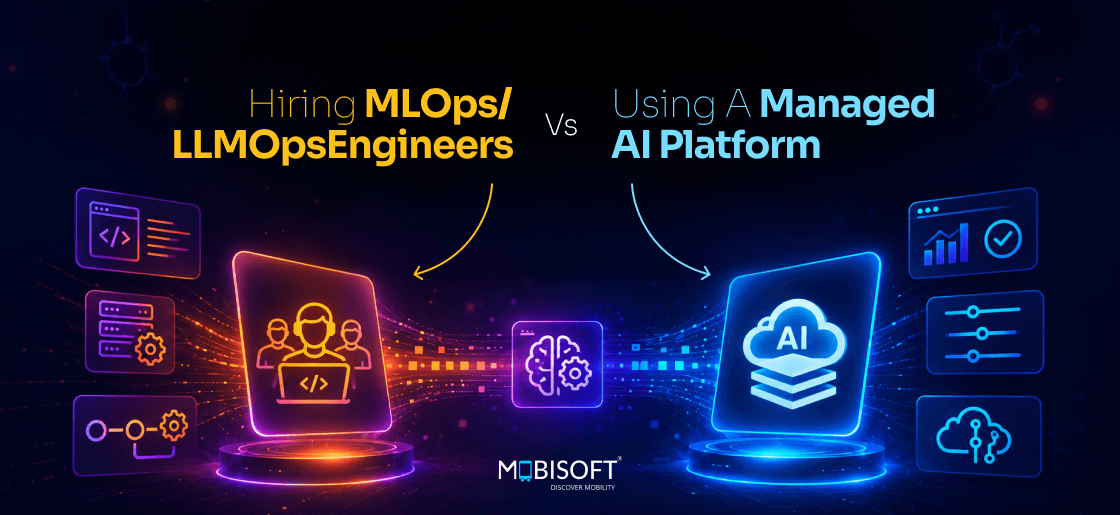
Choosing between MLOps and a managed platform decides how fast your AI program scales. Some teams hire engineers and build everything. Others buy a platform and move on. Both paths work, but each fits a different stage of growth. The wrong choice wastes budget and delays launches. Your answer depends on scale, compliance needs, and in-house skills. This guide compares costs, capabilities, and risks using the latest data. You will also get a scorecard that points to hire, buy, or hybrid. Neither option removes the need for clear ownership and measurement.
Start with the facts, then match them to your situation. Teams that want expert delivery support can consider Mobisoft’s AI development services. Pair that support with the decision framework below. That pairing prevents most expensive rework later.
Why Does the Hire or Buy Question Matter?
Every AI program reaches the same decision point. You must decide who runs the system after launch.
The Operational Bottleneck in AI Programs
Building a model or an agent is only half the work. Someone must deploy it, monitor it, and keep it healthy. Many teams discover this hurdle only after a visible failure. Early planning helps you avoid that painful surprise. The work spans release, monitoring, and repair. That ongoing discipline is machine learning operations. It decides whether a pilot becomes a lasting product.
Gartner expects over 40 percent of agentic AI projects to be canceled by 2027. Rising costs, unclear value, and inadequate risk controls cause those cancellations. Good operations planning addresses all three of these causes. Consider a support agent that performs well in a demo. In production, the model provider updates the model overnight. Answers change tone and accuracy, and nobody notices for two weeks. Which of your systems could fail this way today?
What Has Changed
Several developments make the decision harder than it was two years ago. Each one adds work that a pilot team usually doesn’t plan for.
- Model providers update models often, and behavior changes without notice.
- OpenTelemetry GenAI conventions now give tools a shared tracing standard.
- Langfuse joined ClickHouse, which signals consolidation among observability tools.
- Agents call tools and APIs, so traces must follow multi-step sessions.
- Regulators expect logs, human oversight, and documented controls.
Where Hidden Costs Appear
Teams budget for models and forget the AI infrastructure that keeps them running. That operating layer carries real and recurring costs. Idle inference endpoints bill continuously, even without traffic. Cross-region data movement adds egress charges to every invoice. Duplicate tooling appears when each team picks its own tracing tool. On-call work lands on engineers who were hired to build features. Add these items to your business case before you choose an operating model. Each hidden cost looks small on its own at first. Together they often exceed the original estimate. Track them carefully from the very first month.
Tie the Decision to Business Goals
Infrastructure choices should always follow clear business goals. You can make use of AI strategy services to ensure spending for desirable outcomes. Start with three simple questions about your roadmap:
- Which AI capabilities must stay reliable through next year?
- Which of those capabilities handle sensitive customer data?
- Which of them will grow fastest in usage?
Then size the operating model to match those answers. Share the answers with finance, security, and product leaders early. That habit prevents surprises during budget reviews. It also speeds up the later approval steps.
Three Operating Models at a Glance
Every team ends up with one of three models. Understanding each one makes the later scorecard easier.
The Buy Model
The buy model relies on an AI platform for most operating tasks. Your team configures the tools and handles only the challenges. Setup usually takes weeks instead of many months. Early value arrives while engineers focus on product work. Setup is fast, and subscription pricing stays predictable. Vendor staff maintains upgrades and security patches. Control over data location and internal behavior stays limited. Costs grow with usage and may exceed custom builds at scale.
The Build Model
The build model relies on engineers who own every component. They select open-source tools and run them on your own ML infrastructure. This path gives you maximum control over every layer. It suits teams with deep infrastructure skills and steady hiring plans. You choose every tool, and you can replace any of them. Data stays inside your network and meets strict residency rules. You need senior engineers, on-call coverage, and steady maintenance. Delivery takes longer because every layer needs design and testing.
The Hybrid Model
The hybrid model blends both approaches into one design. A platform covers tracing, storage, and dashboards. A small team builds custom layers and operates everything. Providers of MLOps services often support this setup. Expert partners can also add useful skills during the first months. Platform subscriptions replace months of commodity engineering. Engineers focus on caching, routing, release gates, and integrations. Costs stay flexible because headcount scales with real needs. Exit options stay open when traces use open standards. Most teams in mature programs end up here.
What Production AI Operations Actually Cover
Production AI needs more than a deployed endpoint. It needs a repeatable way to release, measure, and fix.
Classic Model Operations
Traditional workloads follow a familiar and well-tested lifecycle. A mature MLOps platform automates most of these steps.
- Training pipelines that rebuild models on fresh data.
- A model registry that stores versions and approvals.
- A feature store that keeps training and serving data aligned.
- Deployment pipelines with canary releases and rollbacks.
- Drift monitoring that flags changing data patterns.
These steps matter most for forecasting, scoring, and recommendation systems. Many enterprises still run dozens of such models beside newer language models. Teams that skip this base layer struggle once newer language workloads arrive later.
Language Model Operations
Language models add several new operating problems. LLM operations focus on prompts, retrieval, and token spending instead of trained weights. A small prompt edit can change results for every user.
- Prompt versioning with controlled releases and quick rollbacks.
- Evaluation sets and LLM-as-judge scoring on live samples.
- Guardrails for safety, privacy, and data protection.
- Model routing, provider fallback, and semantic caching layers.
- Tracing across retrieval, tool calls, and responses.
Each item needs an owner, a metric, and a rollback plan. Consider a retrieval pipeline that returns outdated policy documents. The model answers confidently from stale context. Only tracing and evaluation reveal the root cause quickly.
Classic Models and Language Models Compared
Classic tooling alone rarely covers language model needs. The table below shows where the two disciplines differ.
| Dimension | Classic ML Systems | LLM Applications |
| Main artifact | Trained model weights | Prompts, retrieval, and model calls |
| Quality check | Accuracy on held-out data | Evaluation sets and judge scores |
| Cost source | Training and serving compute | Tokens, context length, and tool calls |
| Drift signal | Data and concept drift | Prompt, model, and retrieval drift |
Two Roles With Different Skills
An MLOps engineer builds pipelines, registries, and serving infrastructure. Strong candidates know Kubernetes, Terraform, and CI/CD well. Many also manage feature stores and batch scoring jobs. Both roles share a common technical base.
- Strong cloud, networking, and identity fundamentals for production.
- Comfort with monitoring, alerting, and incident response.
- Clear writing for runbooks and design records.
- Practical experience with containers, orchestration, and infrastructure as code.
- Familiarity with model serving, batching, and latency tuning.
- A habit of measuring cost for each deployed workload.
Most teams need both skill sets, but not always in separate people. An LLMOps engineer adds prompt pipelines, evaluation, cost control, and agent tracing. This role also designs routing and caching layers. Many job posts now blend both roles into one title.
How Agents Change the Operations Workload
Agents behave like small programs that plan, call tools, and retry. Operating them well takes extra care and planning.
Tracing Multi-Step Sessions
A single user request may trigger ten model calls. It may also trigger several tool calls and retries. Traces must link every step to one session. Without that link, you cannot explain why an agent chose a bad action.
- Record each step's input, output, latency, and cost.
- Tag tool calls with the permission scope they used.
- Store the outcome beside the full path.
- Sample failed sessions each week for human review.
Tool Permissions and Approvals
Agents act on real systems, so permissions matter. Give each agent only the tools its task requires. Enterprise AI agent use cases show how agents now appear across support and finance.
- Require human approval for payments, deletions, and external messages.
- Use short-lived credentials for every tool call.
- Log each action with the user and agent identity.
Cost Control for Agent Loops
Agents can loop without ever finishing a task. One stuck loop may consume a day's budget within minutes. Someone on your operations team should design the limits and the alerts around them.
- Set maximum step counts for every agent task.
- Set token budgets for each session and each user.
- Alert on unusual spikes in tool calls.
- Route simple subtasks to cheaper and faster models.
What Managed Platforms Cover Today
Managed offerings fall into two broad groups today. Each group solves a different part of the problem.
Hyperscaler Platforms
Cloud providers bundle models, pipelines, and security into one account. A managed AI platform from a hyperscaler suits teams already committed to that cloud.
- Amazon SageMaker and Amazon Bedrock fit AWS-centric teams.
- Azure Machine Learning fits Microsoft-centric enterprises well.
- Google Vertex AI fits teams with BigQuery data assets.
Cost and Integration Trade-Offs
One 2026 analysis found SageMaker compute costs 15 to 40 percent more than EC2. Existing cloud commitments can offset that cost difference by 10 to 25 percent. The cheapest option is often the cloud you already pay for. Hyperscalers also add content filters and access controls through your identity system. That integration saves weeks of security work. It also ties your workloads closer to one provider.
Specialist Observability Tools
Specialist tools focus on tracing, evaluation, and cost tracking. Strong LLM observability shows what each request did and what it cost.
- Langfuse offers an MIT-licensed core with simple self-hosting.
- LangSmith integrates deeply with LangChain and LangGraph.
- Arize Phoenix is source-available under the Elastic License 2.0.
- MLflow is open source and exports OpenTelemetry GenAI traces.
- Weights & Biases Weave suits teams with existing experiment history.
- Helicone and LiteLLM act as gateways with cost tracking and routing.
OpenTelemetry support matters most when you need portability. Traces you can export are traces you can move later. Gateways and tracing tools solve different problems. A gateway sits in the request path and controls routing, limits, and caching. A tracing tool records what happened for later analysis. Most teams eventually run one of each. That split keeps your AI infrastructure flexible as tools change. Review both layers together so costs and ownership stay clear. Document who owns each layer before the first incident occurs.
Questions to Ask Every Vendor
- Where do you store prompts, outputs, and traces?
- Can you export all data in an open format?
- Which compliance reports and certifications can you share today?
- How do you price high-volume tracing and long retention?
- What happens to stored data if the contract ends?
- Can you support self-hosting if requirements change?
Where Managed Platforms Stop
Platforms handle most commodity needs quite well. Even managed MLOps services leave custom needs that require real engineering time. Prompt deployment pipelines need similar engineering effort. The tool stores versions, but your team builds the release gate and the rollback.
| Capability | Platform Coverage | Engineering Still Needed |
| Request tracing and token counts | Strong | Light SDK setup |
| Cost attribution by feature | Good | Custom tagging rules |
| Semantic caching | Weak | Custom build |
| Agent trajectory tracing | Partial | Custom span design |
What Managed Services Add
Some providers go beyond software and run the stack for you. They bundle monitoring, support, and upgrades under one contract. Providers may also offer AI managed services that cover incident response and cost reporting.
Questions to Ask Before You Sign
Evaluate any provider against your own operating needs. Ask for written evidence before you sign any contract. Request uptime history and incident reports from the past year. Confirm response times for severity one and severity two issues. Check whether the provider supports your cloud account and region. Review how the contract handles data deletion and handover. Ask for references from customers with similar workloads. Compare included services with items billed separately. Service levels deserve a very close reading.
Workforce augmentation
Another route adds people instead of tools. AI workforce augmentation places vetted engineers inside your existing team. They join your standups and follow your coding and security standards. Your team keeps ownership of the roadmap and the code. Ask the provider to document every pipeline, dashboard, and runbook they build. Review each engineer's skills in a short technical interview before work starts. Confirm who owns code quality and who handles production issues during each sprint.
The Case for Dedicated Engineers
Platforms cover the middle of the road. Engineers cover everything that falls outside it.
Staffing Models for Dedicated Engineers
You can add engineers in several ways. Reading about in-house vs contract AI engineers will significantly help you weigh control against speed. Full-time hires suit long programs with stable scope. They build deep context about your data and systems. Hiring can take months, and senior talent stays scarce. Plan for a long search before the first pipeline ships. Ask finance how a vacant seat affects your delivery dates. Include that delay in your launch estimate.
Matching Roles to Program Stage
Roles also differ by the stage of your program. An early program needs a generalist who builds pipelines and monitoring. A mature program needs a specialist who tunes cost and quality. Smaller teams often hand machine learning operations to a single generalist. Specialists enter the picture as spending and risk grow. They tune routing, caching, and quality gates for your exact workloads. They also write the runbooks that keep on-call work calm.
Many programs start with one generalist and add specialists later. This path keeps early costs low while your usage data matures. Each added role should own a clear metric. Where do your biggest operating risks sit today? Match each risk to the role that can reduce it.
- Generalists own pipelines, tracing, and release basics.
- Specialists own cost design, evaluation, and agent controls.
- Leads own roadmap, budgets, and vendor decisions.
Augmented and Contract Engineers
Augmented teams give you vetted skills without a long search. Capacity scales up for launches and down afterward. Knowledge transfers when you require documentation and pairing. Teams new to LLMOps usually gain the most from fast placement.
The table below compares the three staffing routes.
| Route | Speed to Start | Control | Best Fit |
| Full-time hire | Slow | High | Stable long programs |
| Contract engineer | Fast | Medium | Short builds and peaks |
| Augmented team | Fast | Medium | Scaling beyond one hire |
Contract work needs clear scope and a firm end date. Define deliverables before the new engineer starts work. Agree on documentation standards for every handoff.
- Write acceptance criteria for each pipeline and dashboard.
- Require runbooks for anything that runs in production.
- Schedule knowledge transfer sessions before the contract ends.
- Keep code and credentials inside your own repositories.
Contracts also reduce the risk of a bad hire. You can test a working relationship before you commit to a permanent seat. A strong contractor sometimes converts into a full-time hire. These choices often vary, and many companies mix routes as programs mature.
When Engineers Win
Dedicated engineering earns its cost in specific situations. Short builds often suit contract AI engineers better than permanent hires.
- Data must stay inside your own cloud account or network.
- Cost targets need custom routing and cache design.
- Your agents need unusual tracing or approval flows.
- Quality metrics depend on domain experts and proprietary data.
- Spending is high enough that small percentage savings matter.
Picture a bank that must keep prompts and outputs inside a private network. A hosted tracing service cannot meet that rule. Engineers deploy a self-hosted stack and control every access path.
What a Strong Hire Looks Like
Hiring well matters more than hiring fast. The best candidates combine platform skills with product judgment. A good MLOps engineer also understands release risk and incident response. The 2026 AIIT salary guide covers MLOps roles in the United States. It puts the median between 130,000 and165,000 dollars. Senior roles range from 140,000 to 257,000 dollars. LLM deployment skills add roughly 15,000 to 30,000 dollars to offers.
Use interview questions that test real judgment.
- How would you detect a quality drop after a model update?
- How would you cut inference cost without hurting answer quality?
- How would you design rollbacks for prompts and retrieval changes?
- How would you explain an agent failure to a non-technical leader?
Understanding LLMOps Engineer Cost
Salary is only the starting figure for your budget. Total cost also includes benefits, recruiting, tooling, and management time. Many finance teams add 25 to 40 percent to base pay. Hiring also takes a surprising amount of time. Senior candidates often need months to find and onboard. Your roadmap may not wait that long.
Comparing Costs Without Guesswork
Cost comparisons fail when they ignore time, scale, and idle capacity. Use explicit assumptions and share them with finance.
Managed Platform Cost Drivers
Subscription fees are only one of the line items. Usage and supporting services contribute to a significant chunk of managed AI platform cost.
- Compute markups on managed instances and endpoints.
- Always-on inference endpoints running at low utilization.
- Data egress between regions, clouds, and vendors.
- Storage growth from datasets and model artifacts.
- Premium GPU instances during periods of capacity shortage.
Engineer and Operating Costs
An engineer's cost includes salary, benefits, tools, and manager time. Add on-call load and lost focus when one person covers many systems. These costs stay fixed whether usage rises or falls. Document each assumption so reviewers can test it. Idle ML infrastructure raises that fixed burden even further. Delay carries a real cost as well. One bad release can erase months of careful tuning.
A Worked Break-Even Example
Break-even depends on one simple and useful formula. Divide the engineer's loaded cost by your expected savings rate. The result is the annual spend where savings cover the hire. These figures are illustrative, so replace them with your own.
- Assume a loaded cost of 200,000 dollars per year.
- Assume caching and routing save 25 percent of inference spend.
- Break-even spend equals 800,000 dollars per year.
- A part-time allocation at 40 percent cuts the threshold to 320,000 dollars.
Sensitivity and Hidden Benefits
Savings are not the only benefit you gain. Faster incident response and better quality monitoring add value that spreadsheets miss. Price AI managed services with the same assumptions for a fair comparison. Sensitivity analysis matters too, so test other assumptions. If savings reach only 15 percent, the threshold rises to 1.3 million dollars. If savings reach 35 percent, it drops to about 570,000 dollars. Test several scenarios before you commit to a model.
The Hybrid Cost Profile
Hybrid setups spread cost risk across two budgets. You pay platform fees at usage-based rates. You also fund a smaller engineering allocation for the weaknesses. Platform fees cover tracing, storage, and dashboards. A partial engineer allocation covers caching, routing, and release gates. A small reserve covers training, upgrades, and tool changes. Review each cost line every single quarter. Providers of managed MLOps services can often price that layer as one fee. Usage often grows faster than headcount, so the balance changes over time.
Common Myths About Hiring and Buying
Several beliefs push teams toward the wrong model. Test each one against your own data.
Platforms Do Not Replace Every Engineer
Platforms cover commodity tasks such as tracing and storage. Someone still instruments code, tunes thresholds, and responds to incidents. Even a fully managed setup needs a named owner inside your company. People still make every final call on quality. A good MLOps platform still depends on people who read its dashboards. Tools collect data, but people decide what to fix. Vendors support the platform but know little about your business logic. Incident response needs someone with context on your product.
Hiring Is Not Always the Costlier Route
Hiring costs more at low volume and less at high volume. The break-even point depends on spend and savings rate. A contract engineer lowers the threshold further because you pay only for needed capacity. Run the break-even math with your own numbers before you accept either claim. At low volume, a managed AI platform often wins on total cost.
Open Source Still Carries Operating Costs
Open-source tools carry no license fee, but quite heavy operating costs. Someone must patch, scale, secure, and back up each system. Self-hosting trades subscription fees for engineering time. Patching and upgrades arrive on a steady schedule. Storage grows quickly when you retain full traces. Security reviews apply to every self-hosted component. On-call coverage must exist for the tools themselves.
Selecting Tools With a Practical Checklist
A structured evaluation prevents tool sprawl across teams. Use the same checklist for every candidate.
Build a Capability Checklist
Score each candidate against the capabilities your workloads need. A capable MLOps platform should cover most of these items.
- Request tracing with sessions, spans, and token counts.
- Cost attribution by user, feature, and business unit.
- Prompt versioning with separate environments and quick rollback.
- Evaluation pipelines with human and automated scoring.
- Alerting on quality, latency, and spend thresholds.
- Role-based access and single sign-on support for dashboards.
- Data export in open formats for every record.
- Self-hosting or private deployment options for sensitive workloads.
Run a Two-Week Proof of Concept
Demos hide problems that real traffic reveals. Run a short proof of concept with production-like data. Strong LLM observability should show full traces during the trial.
- Instrument one real workflow with each candidate tool.
- Replay a week of anonymized traffic through every option.
- Measure setup time, trace completeness, and query speed.
- Estimate monthly cost at your projected volume.
- Ask security and legal teams to review each result.
Spot Red Flags During Vendor Demos
Experienced buyers learn to watch for warning signs.
- Dashboards that look polished but cannot filter by tenant or user.
- Vague answers about data location and retention.
- Pricing that hides ingestion, storage, or seat charges.
- Missing export options for traces and evaluations.
- Roadmap promises that replace features missing today.
A Decision Framework for Your Team
A scorecard turns opinions into a repeatable decision. Score each question from one to five. A strong AI platform choice follows from honest answers.
Six Questions to Score
Use one for a managed platform and five for dedicated engineers.
- How custom are your quality metrics, routing rules, and integrations?
- How strict are your data residency and sovereignty rules?
- How large is your annual inference spend?
- How much internal operations skill do you have today?
- How much control and auditability do you need?
- How quickly must you reach operational maturity?
Reading Your Score
Add the six scores and use the bands below.
- A total of 6 to 14 favors a managed platform with minimal engineering.
- A total of 15 to 22 favors a hybrid model.
- A total of 23 to 30 favors dedicated engineering and self-hosted tools.
Most teams land in the middle band. Programs heavy in LLMOps work often score higher on customization. That result explains why hybrid setups dominate mature programs.
Three Common Scenarios
Real situations show how the score works in practice.
- An early-stage startup with low spend and no operations hire should buy.
- A regulated mid-market firm needing residency control should choose self-hosted tools with one engineer.
- A global enterprise should adopt a cloud foundation plus a small engineering team.
Notice that none of these teams chose on price alone. Each weighed skills, risk, and speed against its own roadmap and budget. Teams comparing MLOps vs managed platform choices should rerun the scorecard every six months. Spend, skills, and tooling all change quickly.
Common Scoring Mistakes
Scorecards fail when teams answer with hopes instead of facts. Avoid these common errors when you score.
- Scoring future ambitions instead of current skills.
- Ignoring on-call load and incident duties for engineers.
- Treating residency rules as flexible when legal says otherwise.
- Skipping exit costs in the final comparison table.
- Scoring once and never revisiting the result.
Worked Scenarios Using the Scorecard
Three examples show how scores translate into decisions. These cases are illustrative, so your numbers will differ.
A Startup With Low Spend
A Series A company runs three AI features on 50,000 dollars of inference. It has no operations hire and needs maturity within four weeks. Customization needs are light, so that question scores low. Standard cloud residency is acceptable for this company. Spend is too small to justify a dedicated engineer. The total lands near 7, which favors a managed stack. The team spends its engineering hours on product features instead. A basic setup for LLM operations covers most needs at this stage.
A Regulated Mid-Market Firm
A financial services firm spends about 300,000 dollars yearly. Its data must stay inside its own cloud account. Three AI capabilities already run in production. Residency rules score at the top of the scale, while the spend is usually in the middle band. The total lands near 22, which favors a hybrid model. The firm self-hosts its tracing tools and assigns one dedicated engineer. That engineer also builds the release gates and custom quality metrics. Its legal team treats AI governance as a design input from day one.
A Global Enterprise
A global enterprise runs ten AI capabilities on one hyperscaler. Annual inference spend exceeds 2 million dollars. A strong DevOps group already exists inside the company. Scale justifies a cloud-native foundation for core services. A small platform team customizes cost control and agent tracing. The total lands near 19, which favors a hybrid model. The platform team serves several product squads and reports quality and cost monthly.
Governance, Security, and Compliance
Regulation now influences infrastructure choices as much as cost does.
Model Governance in Practice
A clear registry gives you a record of what runs in production. It answers who approved a change and why.
- Keep a registry with versions, owners, and approval dates.
- Record lineage from data to prompt to deployed model.
- Require passing evaluation results before every release ships.
- Keep rollback paths tested and documented for each release.
Consider a prompt change that improves tone but removes a required legal disclaimer. A registry with approvals and evaluation gates catches that change before release. Without those controls, the issue reaches customers first.
AI Governance and Regulation
Broader controls connect technical practice to legal duties. The EU AI Act requires automatic logging for high-risk systems under Article 12. General-purpose model duties have applied since August 2025. Article 50 transparency duties began applying in August 2026. The Digital Omnibus agreement moved high-risk dates to 2027 and 2028. Confirm current deadlines with counsel before you plan. NIST AI RMF and ISO/IEC 42001 offer practical structures for your program.
Data Residency and Vendor Exit
Managed MLOps platform tools may process prompts and outputs on their own infrastructure. Check where traces are stored and who can read them.
- Ask for data processing agreements and regional hosting options.
- Prefer tools that export traces in OpenTelemetry format.
- Test an exit plan before you sign a long contract.
- Choose self-hosting when residency rules leave no room.
Security Controls for Operations Tooling
Tracing tools store prompts and outputs, which often contain sensitive data. Treat them as high-value systems that need protection. Good LLM observability never means exposing raw customer data.
- Redact personal data before traces leave your application.
- Apply single sign-on and role-based access to dashboards.
- Encrypt stored traces and set clear retention limits.
- Keep audit logs of who viewed or exported data.
Planning Migration and Exit
Your first choice will not be your last. Plan the next move before you need it.
Moving From Build to Buy
Custom tooling can become a heavy maintenance burden for small teams over time. Teams sometimes outgrow it as usage and complexity grow. Many teams find that a managed AI platform replaces custom tracing code.
- Inventory every custom component and its owner.
- Map each component to a platform feature.
- Migrate tracing first, because it carries the least risk.
- Retire custom code only after parallel runs match results.
Moving From Buy to Build
Rising costs or new residency rules may push you toward self-hosting. Self-hosting your own stack needs a clear operating owner.
- Confirm that you can export traces, prompts, and evaluations.
- Deploy a self-hosted stack in a staging environment.
- Compare cost and quality over a full billing cycle.
- Cut over one workload at a time.
Test Portability Early
Portability is cheap at the start and expensive later.
- Keep prompts and evaluation sets in version control.
- Use OpenTelemetry instrumentation in every new application.
- Place a gateway between your code and model providers.
- Rehearse a restore from exported data every quarter.
Running the Hybrid Model
Most mature teams combine bought platforms with a small engineering core. That split keeps costs predictable as usage grows.
Who Owns What
Clear ownership prevents disparity between the platform and your engineers. It also supports AI governance reviews and audits.
- The platform runs tracing, storage, and dashboards.
- Engineers instrument applications and tune routing rules.
- Engineers build caches, release gates, and custom metrics.
- Product owners approve quality thresholds and budgets.
Small teams often follow one of three patterns.
- One engineer covers platforms, pipelines, and on-call duties.
- Two engineers split platform work from application support.
- A shared platform team serves several product squads.
Design On-Call and Incident Response
AI incidents need their own dedicated response playbook. Standard outage runbooks miss quality and safety failures.
- Treat harmful output, data exposure, or unauthorized actions as the highest severity.
- Treat large quality drops affecting many users as the next severity.
- Treat minor regressions as scheduled fixes with named owners.
- Hold a short review after every serious incident.
A 90-Day Starting Plan
Phased delivery lowers risk and shows early value. The order matters because each phase supports the next. Tracing comes first, since you cannot improve what you cannot see. Early machine learning operations discipline gives every later phase better data.
- Days 1 to 30 cover tracing, cost tagging, and baseline metrics.
- Days 31 to 60 cover evaluation sets and release gates.
- Days 61 to 90 cover routing, caching, and incident runbooks.
Metrics to Track
Metrics prove whether the operating model works.
- Cost per task and cost per user.
- Quality score against the agreed release threshold.
- Time to detect and fix a regression.
- Share of traffic served by cheaper models.
Getting Expert Help
Some teams prefer outside delivery support for speed. Mobisoft Infotech supports both paths in several ways. Its MLOps services run from assessment through ongoing operations. The team recommends managed tools wherever they fit your needs.
- Engineer placement adds vetted specialists to your team.
- Platform advisory compares stacks against your scale and compliance needs.
- Infrastructure builds run alongside your AI application work.
- A hybrid managed service operates the stack with defined service levels.
- Training sessions teach your engineers the release and review routines.
- Quarterly reviews compare cost, quality, and risk against agreed targets.
Choose the Model Your Evidence Supports
Neither path wins every time for every team. Managed platforms give speed and predictable setup. Engineers give control and deeper cost savings. Most programs end up with a hybrid that uses both. That hybrid keeps costs predictable while giving engineers room to improve results.
Your MLOps vs managed platform decision should follow evidence. Score your needs, model your costs, and test your exit plan. Revisit the answer as spending, skills, and regulation change. Small reviews every six months keep the model healthy.
Start with one production workload and add tracing this month. Review the data after thirty days, then decide where engineers add the most value. Share the findings with finance and security leaders. Ready to compare options for your own program? Talk to the Mobisoft team about a scoped assessment today.
Frequently Asked Questions
How do you test prompt changes before release?
We treat prompts like code. Our LLMOps practice runs each change against a fixed evaluation set and compares scores with the last approved version. A release goes ahead only when scores hold, and we keep the previous prompt ready so a rollback takes minutes.
Can I use OpenTelemetry without locking into one vendor?
Yes. We instrument applications with OpenTelemetry GenAI conventions, so traces move between tools without rewriting code. Any MLOps platform that accepts those traces keeps your exit options open. We also recommend exporting traces regularly, so a migration never starts from an empty archive.
How do I keep inference costs predictable?
We start with token budgets, model routing, and caching, because these three controls remove most surprise spend. Each one makes AI infrastructure costs easier to forecast. We then review cost per task every week and alert the owning team when spending drifts past the agreed limit.
How do I keep sensitive data out of traces?
We redact personal data inside the application before traces leave it. Access rules and retention limits then apply only to what remains, which shrinks your exposure. This approach supports model governance and audit reviews, and it keeps dashboards safe for wider teams to use.
How do I know when to retrain or update a model?
We watch drift signals and quality scores against agreed thresholds. Strong machine learning operations practice triggers an update on evidence instead of a calendar date. Each update then passes regression tests and a small traffic trial before it reaches every user.
Who should handle on-call for AI systems?
We usually assign first response to an MLOps engineer who follows clear runbooks. Product owners join for quality and safety incidents, since those need business judgment. Write escalation paths before launch, and hold a short review after every serious incident.
This content is for informational purposes only and may include AI-assisted research or content generation. While we strive for accuracy, information may evolve over time. Readers are advised to independently verify critical information before making decisions.

Nitin Lahoti
Read more
Nitin Lahoti is the Co-Founder and Director at Mobisoft Infotech. He has 15 years of experience in Design, Business Development and Startups. His expertise is in Product Ideation, UX/UI design, Startup consulting and mentoring. He prefers business readings and loves traveling.
 Nitin Lahoti
 October 5, 2026