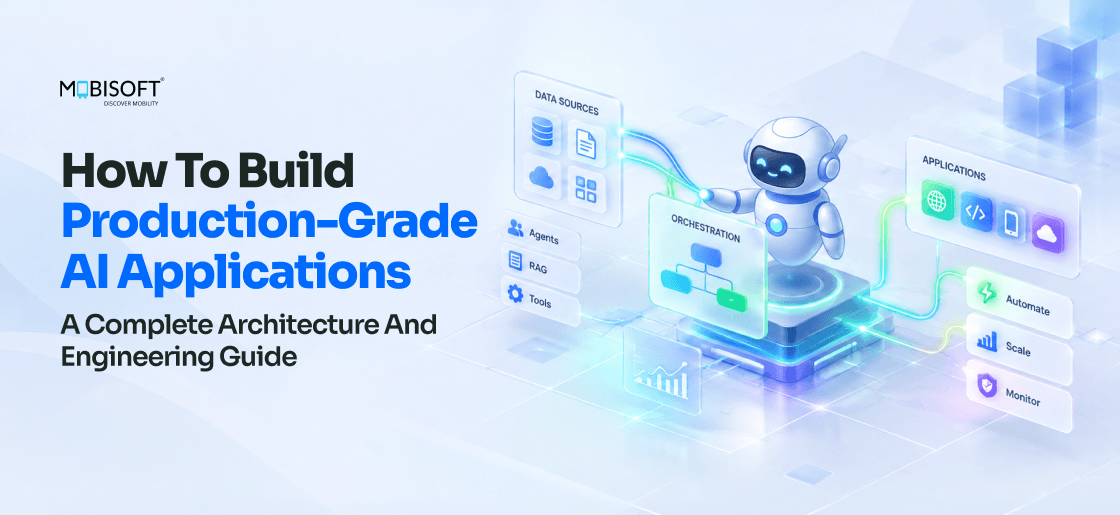
A quick prototype that produces impressive AI outputs is not a working system, and most teams find that out the hard way. Production-grade AI applications need reliability, cost discipline, and measurable quality. None of which shows up automatically just because a few test prompts looked good. The gap usually surfaces after launch, once real users depend on the product and every shortcut from the demo phase gets exposed at the worst time, right when everyone is watching closely and small cracks turn into visible problems fast. This guide walks through seven engineering disciplines that separate a working prototype from a system built to survive real traffic and real failure.
You will find the reasoning behind solid AI application architecture, the reliability tactics that keep a system standing during a provider outage, and the evaluation methods that catch quality problems before customers notice them. Each section pairs a specific failure mode with the fix engineering teams actually use to stop it. By the end, expect a clear checklist for production readiness, one that works just as well before launch as after it.
Why Demos Fail When They Meet Production Traffic
A demo and a production system look similar on the surface. Underneath, they run on entirely different assumptions about failure, scale, and cost.
The Nine Ways Production Differs From a Demo
A demo runs on curated inputs picked because they already work. Production traffic brings typos, ambiguous phrasing, and requests nobody planned for during testing.
Concurrency changes system behavior in ways a demo never reveals. A demo handles one request at a time. Production AI systems must manage many simultaneous users without one slow request blocking others. Getting this right matters even more for custom AI agent development at scale.
Provider reliability looks flawless right up until it fails. Demos rarely hit a rate limit or an outage. Production systems eventually meet both, often during a traffic spike nobody predicted. Cost stops being an afterthought once real volume arrives. A feature costing ten cents per interaction can turn into a six-figure monthly cost.
Quality measurement moves from subjective to systematic almost overnight. Nobody formally scores demo outputs. Production needs a repeatable way to catch responses that get worse over time.
The table below summarizes what actually changes across this transition.
| Dimension | Demo Behavior | Production Requirement |
| Input variety | Curated, happy path only | Arbitrary, including edge cases and adversarial text |
| Failure handling | Exceptions surface directly | Errors must degrade gracefully |
| Cost visibility | Rarely tracked | Tracked per feature and per user segment |
| Quality checks | One person's informal judgment | Automated, continuous, and benchmarked |
The Three Failure Patterns That Show Up First
Prompt brittleness is usually the first unpleasant surprise for production AI systems after launch. A prompt tuned against fifty test cases often loses quality against broader input. Unhandled provider failures come next in most postmortems. A single timeout from a model vendor can return a raw error. That happens whenever no retry or fallback path exists.
Cost overruns tend to appear within the first billing cycle. Teams that estimate cost from demo usage often underprice a feature badly. The real production cost frequently runs five to ten times higher. Each pattern above has a known engineering fix, covered later in this guide. None of them require a better model. They require better architecture wrapped around the model already in use.
Teams facing all three patterns often lack bandwidth to fix them alongside feature work. AI business consulting support can help diagnose the worst pattern and sequence fixes.
Pillar One: Building a Reliable LLM Integration Layer
The integration layer sits between application code and the model provider. Getting this layer right early prevents a painful rewrite months down the road.
Why a Provider Abstraction Layer Matters
Direct SDK calls to a single vendor create a costly dependency. A provider abstraction layer decouples application logic from any one vendor's specific API format.
Tools such as LiteLLM offer a unified interface across more than one hundred providers. This includes OpenAI, Anthropic, Google, and AWS Bedrock, among others. Swapping models becomes a configuration change rather than a code rewrite.
A well-built abstraction layer should offer several core capabilities for production AI systems.
- A single function call that behaves the same regardless of the underlying provider
- Automatic retry logic with backoff for transient network failures
- Cost tracking attached to every request, tagged by feature or use case
- Prompt templates stored outside application code and kept under version control
Routing Requests by Task Complexity
Not every task needs your most expensive model available. AI application architecture patterns that route simple tasks to cheaper models cut inference cost. Output quality does not need to suffer in the process. Simple classification or extraction tasks belong on fast, inexpensive models. Smaller model variants handle structured work at a fraction of premium pricing.
Complex reasoning tasks justify the added cost of a premium model tier. Legal analysis and multi-step technical synthesis are good examples of this category. Routing decisions should track actual task difficulty, not old habits.
Content generation tasks sit somewhere in between, depending heavily on the required output quality. Teams pursuing generative AI software development usually route this copy work to mid-tier models. Real-time interactive features need models that respond within roughly two seconds. Latency requirements often matter as much as raw model capability.
Making Caching Do the Heavy Lifting
Caching is one of the highest return investments available in AI application development. Two forms of caching matter most inside production systems.
Exact match caching returns a stored response whenever the same prompt reappears. This typically catches only a small share of traffic, since exact repeats stay uncommon.
Semantic caching compares the meaning of a new prompt against previously cached prompts. It relies on embeddings rather than exact string matching to find similarity. Systems with repeat-query patterns, like customer support tools, often see strong cache hit rates. That range typically falls between fifteen and forty percent.
Provider-native caching, such as Anthropic's prompt caching, targets long system prompts specifically. This can substantially reduce costs for the cached portion of any repeated request. It is worth enabling wherever your system reuses the same instructions often.
Choosing an Architecture That Scales With Demand
An integration layer only helps if the surrounding architecture can absorb growth. Scalable AI applications need infrastructure decisions made early. Traffic later makes those decisions expensive to reverse. Statelessness matters more than most teams expect at design time. A stateless request handler scales horizontally behind a load balancer without extra coordination.
Queue-based request handling smooths out spikes that would otherwise overwhelm a provider's rate limit. This pattern also protects users from timeouts during sudden bursts of demand. A production-ready AI architecture treats these two patterns as defaults from day one.
Separating Read Paths From Write Paths
Read-heavy AI workloads, like search, behave very differently from write-heavy ones, like content generation. Splitting these into separate services lets each scale on its own traffic pattern.
Enterprise AI architecture built around this separation avoids a common trap. Teams often bundle every AI feature into one monolithic service. That service then becomes a single point of failure for the whole product.
- Read-heavy services can lean harder on caching and horizontal replicas
- Write-heavy services need stronger idempotency guarantees and queue backpressure
- Each service can adopt its own retry and timeout policy independently
A team weighing these tradeoffs benefits from an outside review first. This comparison of Claude AI architecture for production systems walks through these patterns.
Multi-Tenant Considerations for Shared Platforms
Applications serving multiple customers or business units introduce an extra layer of complexity. Every cost, quality, and security control covered earlier needs a tenant dimension attached. Cost attribution becomes especially important once several teams share one model budget. Without per-tenant tracking, one high-volume customer can consume the whole shared budget.
Rate limiting also needs a per-tenant ceiling, not just a global one. A single noisy tenant should never degrade response times for everyone else nearby. Platforms exposing tools to multiple tenants need stricter boundaries on what each can trigger. An enterprise MCP server development engagement builds these boundaries into the tool layer. One tenant's agent should never reach another tenant's data.

Pillar Two: Designing a Production-Grade Retrieval Pipeline
Retrieval-Augmented Generation grounds model outputs in your actual data for production AI systems. It does not rely purely on what the base model already knows from training. A weak implementation and a strong one produce very different user experiences.
The Seven Stages of a Working RAG Pipeline
A retrieval pipeline is never a single step. It runs through seven distinct stages, and each one carries its own failure modes.
- Ingestion pulls raw documents into the pipeline and strips navigation text, headers, and footers, since left untouched, this noise pollutes the eventual embeddings.
- Chunking splits cleaned documents into smaller sections for retrieval. Splitting text at arbitrary character counts frequently cuts sentences and technical terms in half, which degrades the meaning captured inside each chunk.
- Embedding converts each chunk into a vector representation. Choice of model should match the specific content type, since code, multilingual text, and domain jargon each benefit from embeddings trained for that content.
- Storage holds those vectors in a database built for fast similarity search at scale.
- Query processing takes the user's question and prepares it for search, often rewriting or expanding it to improve match quality.
- Retrieval compares the processed query against stored vectors and pulls back the most relevant chunks.
- Reranking scores those retrieved chunks a second time against the original query, pushing the most useful ones to the top before they reach the model.
Which Optimization Actually Improves Retrieval Quality
Teams often invest engineering time in the wrong part of their retrieval stack. Some fixes deliver far more improvement than others in production AI systems.
| Optimization | Typical Quality Gain | Relative Effort |
| Cross-encoder reranking | 15 to 30 percent | Medium |
| Semantic chunking | 10 to 20 percent | Medium |
| Hybrid search, vector plus keyword | 8 to 15 percent | Medium |
| Query rewriting | 5 to 15 percent | Low |
Reranking consistently produces the largest quality jump for the effort involved. A cross-encoder model scores each retrieved chunk against the query directly. That approach beats comparing embedding vectors alone in most real tests.
Hybrid search matters most for technical content full of proper nouns and codes. Pure vector search sometimes misses exact term matches that keyword search catches with ease.
Common Ways Retrieval Quality Degrades Over Time
Retrieval systems do not stay static once they go live in scalable AI applications. Several failure modes creep in gradually and go unnoticed without active monitoring. Retrieval-generation mismatch happens when the model ignores retrieved context entirely. It answers instead from its own training data. The result is a confident-sounding answer that is not actually grounded in your documents.
Stale retrieval occurs when source documents update but the index does not follow. Users then receive outdated information presented with full confidence as current. Context stuffing failure appears when too many chunks get crammed into one prompt. Models tend to lose attention on content placed in the middle of a context. Researchers call this the lost-in-the-middle effect.
Retrieval systems that stay accurate need ongoing work, well past the launch event. A dedicated AI solution provider typically handles this through continuous monitoring after go-live. Teams without that ongoing discipline often watch quality erode within months.
Pillar Three: Evaluation Frameworks That Catch Problems Before Users Do
Evaluation is the discipline most teams underinvest in during AI application development. Yet it is the only thing that tells you whether a system actually works. Without it, every deployment decision is essentially a guess.
The Three Layers of a Working Evaluation Pyramid
Evaluation needs to happen at multiple points for production-ready AI applications. Each layer in this pyramid catches a different category of problem.
Offline evaluation runs against a benchmark dataset before any code ships to users. This layer should block deployment automatically once quality scores fall below a set threshold. Online evaluation samples live production responses on a continuous basis.
A typical sample rate sits between ten and twenty percent of total traffic. This is where a separate LLM acts as judge, scoring outputs against defined criteria. Business outcome correlation checks whether quality scores actually predict real results. A high evaluation score means little on its own. It only matters if it correlates with task completion or genuine user satisfaction.
How LLM-as-Judge Evaluation Actually Works
Human evaluation simply does not scale to traffic volume in AI engineering. Using a separate model to judge outputs is the practical alternative most teams adopt. The judge model should differ from the model actually being evaluated. This lowers the risk of a model favoring its own style over better answers.
Judge prompts need a clear scoring scale with specific descriptions per level. A vague instruction like rate this answer produces inconsistent and unreliable scores. Calibration against real human judgment remains essential before trusting any judge model output. If judge scores correlate poorly with human ratings, below roughly 0.7, rework the prompt.
What Belongs in Your Evaluation Dataset
A framework without a solid dataset behind it produces meaningless numbers on a dashboard. Building this dataset takes real time. It becomes one of the most valuable and reusable assets a team ever creates.
- Happy path examples covering the most common sixty to seventy percent of expected traffic
- Edge cases that sit right at the boundary of what the system handles
- Adversarial examples specifically designed to trigger failures or unwanted behavior
- Regression cases built directly from documented past production incidents
Start building this dataset at the very beginning of development, never after launch. Domain knowledge is freshest while a team is still deep inside the problem space. Early datasets built this way end up better than ones assembled later from memory.
Teams building AI agents should treat this dataset as required work. It should never be an afterthought bolted on before launch. A related piece on LLM evaluation for AI agent development covers agent scoring.
Turning Failed Evaluations Into Concrete Fixes
A failing evaluation score only helps if someone acts on it quickly. Many teams build strong pipelines and then let flagged failures sit unreviewed for weeks. This kind of discipline is what real AI engineering looks like in practice.
Assign every low-scoring response to a specific category during review. Common categories include retrieval failure, hallucination, tone mismatch, and incomplete answers. Categorized failures point directly at which pillar needs attention. A cluster of hallucination failures usually points back to the retrieval pipeline itself. Feed each fixed failure back into the evaluation dataset as a permanent regression test. This closes the loop between finding a problem and stopping its return.
Pillar Four: Reliability Patterns That Prevent Cascading Failures
Reliability engineering for AI applications borrows heavily from distributed systems practice. It adapts that practice for the specific failure modes model providers introduce. Getting this wrong means one provider hiccup can take down an entire feature.
Retry Logic That Actually Helps Instead of Making Things Worse
Not every failure deserves an automatic retry attempt. Applying retry logic to the wrong error type wastes money. It can also worsen an already degraded situation for other users. Getting retries right protects uptime for any team running production AI systems. Transient network errors, like timeouts, respond well to retries with exponential backoff. A typical pattern waits one second, then two, then four, then eight. Most implementations cap this at three or four total attempts.
Rate limit errors should always respect any retry-after header the provider sends back. Retrying immediately after hitting a rate limit only makes the underlying problem worse. Content filter rejections should never be retried under any circumstances. These responses are deterministic given the input itself. Retrying the identical request produces the identical rejection every single time.
Circuit Breakers Stop One Bad Provider From Taking Down Everything
A circuit breaker monitors error rates and halts traffic to a struggling provider. This kicks in once failures cross a defined threshold. It prevents every request from waiting through a slow timeout during an active outage. The pattern moves through three distinct states during operation.
Closed: Normal operation is proceeding as expected.
Open: The provider is failing, and traffic reroutes elsewhere automatically.
Half-open: The system is cautiously testing whether recovery has happened.
A typical configuration opens the circuit past fifty percent errors in a minute. After a brief cooldown, a small slice of traffic tests the provider again. Full routing only resumes once that test traffic succeeds.
Designing Graceful Degradation Before You Need It
Every AI feature needs a fallback path that keeps the core product working. This applies even when the AI component itself fails outright. That fallback must be designed before launch, never improvised mid-outage. An AI-assisted search feature can fall back to standard keyword search. Users still get relevant results, just without semantic ranking layered on top.
An AI content generation feature can drop back to a blank editable template. The user loses direct assistance but can still finish the task manually. This layered fallback design separates a fragile feature from a genuine production-ready AI application. Teams typically build this resilience from the first sprint. Retrofitting it later, after an incident, always costs more time and trust.
Pillar Five: Cutting Inference Costs Without Cutting Quality
Inference cost is often the line item that ends an otherwise promising AI feature. A cost that looks small per interaction can become unsustainable at real user volume.
The Cost Levers Ranked by Actual Impact
Some cost reduction tactics deliver far more savings than others for similar effort. Ranking these levers by impact helps teams prioritize correctly from the start. This kind of prioritization is what separates scalable AI applications from costly ones.
- Model routing: Model routing based on task complexity typically cuts costs by forty to sixty percent. This is usually the single highest impact change available to most teams. Most systems default to overusing premium models across the board.
- Semantic caching: Semantic caching reduces costs by roughly twenty to forty five percent. The exact figure depends heavily on how repetitive your query patterns actually are. Support and FAQ-style use cases benefit the most from this specific technique.
- Provider-native caching: Provider-native prompt caching can cut costs sixty to ninety percent on cached content. This applies specifically to the cached portion of long, repeated system prompts. It is a low effort change that many teams simply forget to enable.
- Batch processing: Batch processing suits any use case that tolerates hours of latency instead of seconds. Document processing pipelines and bulk annotation work fit this pattern well. Teams using batch processing typically save thirty to fifty percent on those workloads.
Building a Token Budget Before You Write a Single Prompt
Defining a cost target before writing any prompts prevents expensive surprises after launch. This is a simple exercise that most teams skip entirely during development. A ten-cent feature can become a fifty-cent one on the wrong tier. Production-ready AI applications catch that before it compounds.
Start by setting a target cost per interaction tied to your actual business model. A customer support use case might target under half a cent per interaction.
Break that target down into token allocations across each component. System prompt, user input, retrieved context, and conversation history each carry real cost. In a RAG-heavy application, these numbers add up faster than expected.
Monitor actual token usage against this budget once the feature goes live. Alert when the ninety-fifth percentile of tokens exceeds one hundred fifty percent of budget. That kind of spike usually signals something worth investigating.
Compressing Prompts Without Losing Meaning
Prompt compression reduces token count while preserving the information a model actually needs. This matters most for the retrieved context portion of RAG applications specifically. That component is often the largest single input contributor. Cutting a thousand tokens from one chunk adds up fast at scale. That math is the real case for AI application architecture built around compression.
Tools such as LLMLingua achieve meaningful compression while preserving most original quality. Selective context filtering offers a simpler alternative with less engineering overhead. It simply drops the lowest-ranked retrieved chunks before generation.
Reducing maximum output length is another lever worth testing carefully. Shorter, more concise responses often satisfy user needs just as well. This directly cuts output token costs without noticeable quality loss.
Measuring Whether an Optimization Was Worth the Effort
Not every cost optimization pays for its own engineering time. A/B testing each change against a control group confirms real savings.
Track cost per interaction before and after each change. Compare it alongside the quality score from the evaluation pipeline. An optimization that saves money while quality drops is not actually a win.
Some teams skip this measurement step entirely. They assume a documented technique will work the same way in their own system. Vendors selling AI engineering tools rarely publish numbers that disagree with their own pitch. Results vary enough by use case that skipping verification often leads to false confidence.
Pillar Six: Observability That Shows You What the System Is Actually Doing
Traditional infrastructure monitoring tells you whether a system is technically up. AI observability adds a separate layer on top of that. It tells you whether the system is actually producing good outputs.
The Three Layers Worth Tracking
Infrastructure metrics cover latency, error rates, and provider availability. These are the same categories any standard backend system already tracks. They answer whether the system is technically healthy right now.
Quality metrics track things infrastructure monitoring simply cannot see on its own. Response accuracy and user correction rates fall into this category. A system can be fast and error-free while still producing unhelpful answers consistently.
Business outcome metrics connect AI quality scores to real measurable results. Task completion rates and customer satisfaction scores fit here directly. This layer proves whether quality metrics actually matter to the business at all. A dashboard without a business layer is just noise dressed as enterprise AI architecture.
What Every Request Trace Should Capture
A useful trace records enough detail to debug a problem after the fact. It does more than simply confirm that a request happened at all. Missing fields here become painful gaps during an active incident.
- Model provider, model version, and which prompt template version handled the request
- Input and output token counts along with calculated cost for that call
- Total latency and time to first token for any streaming response
- A quality score from the evaluation pipeline, wherever one is available
Structured traces following OpenTelemetry's gen_ai semantic conventions make this data portable. This avoids locking an entire monitoring setup to one vendor's proprietary format.
Pillar Seven: Securing AI Applications Against Injection and Data Leakage
AI applications inherit every traditional web security requirement that already exists. They add an entirely new category of risk on top of that. Prompt injection is the most consequential of these newer risks.
Understanding Prompt Injection Attack Vectors
Prompt injection happens when an attacker embeds instructions inside data a system processes. The model then follows those hidden instructions instead of the intended ones. Unlike SQL injection, parameterized queries cannot solve this problem alone. Most SQL injection defenses do not carry over to AI application architecture at all.
Direct injection comes from user input attempting to override system instructions outright. Modern models resist most of these attempts through built-in safety training. Sophisticated attempts can still occasionally slip through that training. Indirect injection proves more dangerous and considerably harder to catch. A retrieved document or external data source can contain hidden instructions. These can redirect an AI agent toward an action the user never actually requested.
Multi-turn injection builds malicious context gradually across several conversation turns. Each individual turn looks harmless when viewed in isolation. The combined context, taken together, can alter model behavior in unintended ways.
Filtering Outputs Before They Reach Users
Output filtering catches problems that slip past input validation entirely. This layer matters just as much as input security does. Generated content can leak sensitive information even from perfectly clean inputs.
PII Detection:
PII detection should scan every output for names, emails, and payment details. This check should happen before any response reaches the end user. Dedicated detection models perform far better here than simple regex pattern matching. Regex alone misses too much for anything close to production AI systems.
Content Safety Filtering:
Content safety filtering applies a classifier to generated outputs before delivery. This catches harmful or inappropriate content that occasionally slips through training. Even well-trained models produce this kind of content on rare occasions.
Source Attribution:
Source attribution for factual claims helps users verify information on their own. This matters particularly inside RAG applications built on retrieved documents. Referencing the source document reduces harm from any hallucinated content that gets through.
Agent-Based Systems:
Organizations building agent-based systems that take real actions inside business tools face higher stakes. These security layers should be treated as non-negotiable rather than optional hardening. A well-built integration bakes in structured prompt boundaries from day one. Retrofitting security into an agent with broad tool access carries far more risk. Designing it in from the start costs far less.
Maintaining Systems After the Initial Launch
Shipping a feature is only the starting point for production AI systems. What happens across the following months usually decides whether the feature earns lasting trust.
Why Post-Launch Ownership Cannot Be an Afterthought
Models get deprecated, provider pricing changes, and user behavior changes as adoption grows. A system built without ownership for these changes tends to degrade. Nobody notices until complaints arrive.
Production-ready AI applications need an owner who reviews cost and quality on a schedule. Weekly reviews during the first quarter after launch catch most emerging problems early.
Handling Model Version Migrations Safely
Provider model updates arrive constantly. A new version rarely behaves identically to the one it replaces. Silent migrations, where a provider swaps a default model, cause unplanned regressions.
Pin exact model versions in production rather than tracking a moving alias. Test any new version against the full evaluation dataset before rolling it out.
- Run the new model version against the existing evaluation benchmark first
- Compare cost and latency profiles before switching any production traffic
- Roll out gradually to a small percentage of users, then expand
Budgeting for Ongoing Engineering Effort
Teams frequently budget for the initial build and forget the months that follow. Evaluation datasets need regular updates. Prompts need periodic tuning. Cost patterns need continuous review as usage grows.
Planning for this effort early keeps production-ready AI applications healthy well past launch.
The Production Readiness Checklist Before You Launch
Readiness is not a percentage score you can round up comfortably. A system with even one unresolved gap still has users who find it.
The Categories That Matter Most
Architecture readiness covers whether the abstraction layer, routing, and caching actually work as designed. Reliability readiness confirms retry logic and fallback paths behave correctly under real failure.
Quality readiness means an evaluation dataset already exists and runs automatically before deployment. Security readiness confirms injection detection and output filtering stay active, not just planned. A checklist with gaps barely counts as a plan for scalable AI applications.
Certain items stay non-negotiable no matter how many other boxes get checked. A missing fallback provider, missing retry logic, or missing evaluation dataset each signal danger. Each gap will eventually reach a real user in production.
Why Sequencing the Work Matters
Most readiness items can move forward in parallel across a development team. The evaluation dataset usually becomes the longest pole in the entire schedule. It needs genuine domain expertise, and that expertise cannot be rushed on a deadline.
Starting the evaluation dataset at the very beginning of development produces measurably better results. Teams that treat evaluation as a late-stage checkbox tend to ship weaker datasets. Those datasets get built from memory rather than fresh, current context. A rushed evaluation dataset is how weak AI application architecture patterns slip into production.
Organizations without in-house capacity often bring in advisory support to validate a readiness framework. This route is typically faster and less risky. Backfilling gaps after users depend on the system rarely goes smoothly. This piece on AI consulting for enterprise solutions covers this fit in more detail.
How Mature Teams Approach the Seven Pillars Together
None of these seven pillars work well in complete isolation from one another. A strong retrieval pipeline still fails users when evaluation never catches a quality regression. Cost optimization without reliability patterns just makes cheap failures happen faster and more often.
Mature engineering teams treat these pillars as one connected system, not separate checklist items. They calibrate circuit breakers against real production baselines instead of default settings. They rebuild evaluation datasets continuously as new failure patterns surface from real traffic.
This connected approach shows up clearly in enterprise AI architecture built for genuine longevity. Teams stop treating observability as a debugging tool used only after something breaks. Instead, observability data feeds directly back into evaluation datasets and cost budgets. That feedback loop keeps a system improving instead of slowly decaying after launch.
Scalable AI applications share this same trait across nearly every case worth studying closely. The architecture anticipates growth in traffic, data volume, and use cases sharing one platform. Building for that growth early costs less than retrofitting a demo system later.
Turning These Seven Pillars Into a Working System
Building production-grade AI applications is fundamentally a discipline problem. Every pillar covered here, from integration architecture through security, addresses one specific failure mode that only shows up once real traffic arrives at real scale. Skipping any single pillar does not make a system faster to build. It simply moves the cost of that gap into a future incident log. The pattern across every pillar stays consistent throughout this guide. Build the fallback before it becomes necessary. Measure quality before claiming it exists. Track cost before it surprises the entire team. Every pillar still needs an owner and a date on the calendar, since real users arrive faster than most teams expect.
AI system architecture built this way holds up under conditions a demo never faces. Teams that treat evaluation and cost budgets as core deliverables ship durable systems that last well beyond launch. That discipline separates a prototype from a system worth trusting for years. An incident forces the issue eventually. Fixing it late costs more than building it in early. Teams that skip this work rarely skip it twice.

Frequently Asked Questions
How do I know which model to use for which task?
We route simple tasks to cheaper models as part of standard AI application architecture. Complex reasoning and content generation get routed to stronger models where quality actually depends on it. This keeps cost proportional to what each task really needs.
What happens if my AI feature fails during peak traffic?
We build the fallback path first, which is core to reliable production AI systems. If a provider degrades or times out, the system reroutes or degrades gracefully instead of breaking outright. Users still get a working experience, even if it is a simpler one.
Does Mobisoft Infotech help build the evaluation dataset too?
Mobisoft Infotech treats the evaluation dataset as required work in AI application development. We start building it alongside the first sprint, not after launch, so quality regressions get caught early. You get a documented, testable baseline before real users ever see the system.
How do you plan for growth before it becomes a problem?
We design for growth from day one across every scalable AI application we build. Stateless services, queue-based handling, and clear read and write separation get built in from the start. You avoid the costly rework that comes from retrofitting scale later.
What does Mobisoft Infotech do differently after launch?
Mobisoft Infotech brings this discipline to every production-ready AI application it ships. We assign an owner who reviews cost, quality, and reliability on a fixed schedule after go-live. You get a system that stays healthy months and years after the initial release.
This content is for informational purposes only and may include AI-assisted research or content generation. While we strive for accuracy, information may evolve over time. Readers are advised to independently verify critical information before making decisions.

Nitin Lahoti
Read more
Nitin Lahoti is the Co-Founder and Director at Mobisoft Infotech. He has 15 years of experience in Design, Business Development and Startups. His expertise is in Product Ideation, UX/UI design, Startup consulting and mentoring. He prefers business readings and loves traveling.
 Nitin Lahoti
 September 21, 2026