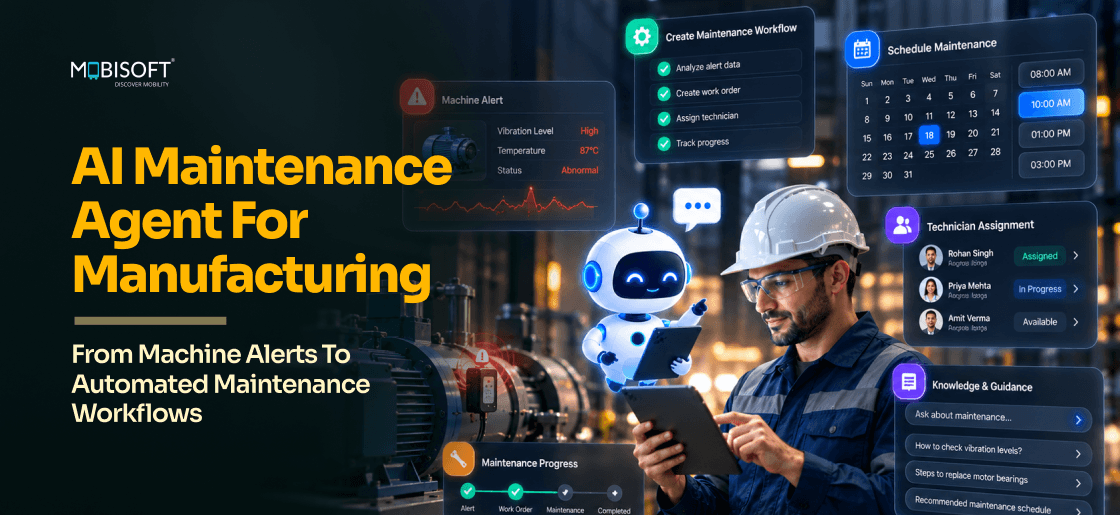
Most manufacturing plants don’t lack warnings. Their sensors flag early trouble almost every week. The missing piece is a clear path from alert to repair. Accuracy was never the real problem. The alert sat in an inbox, and nobody owned the next step. An agent closes that loop end to end. It reads the signal, raises the job, and books it around production.
We’d treat this as a workflow project first. It’s how we approach custom AI agent development for plant floors.
So who acts on the next alert in your plant today? The sections below trace one fault through an AI maintenance agent until the job is signed off. You’ll also see where data quality and technician trust decide the outcome.
Why Reactive Maintenance Still Costs Plants So Much
Most plants don't run purely on breakdowns anymore. They run on a mix of calendar-based servicing and emergency repairs. That mix often delivers the cost of both and the protection of neither.
The Calendar And Firefighting Middle Ground
Picture a pump that gets new bearings every 4,000 hours. Nobody checks whether it needs them. Half the time, the old bearings had years left. The other half, a lubrication fault wrecks them at 2,500 hours. Nobody was scheduled to look.
That's the trap of fixed intervals. You pay for planned work on healthy machines. You still pay for surprise failures on the ones that wear faster. "We've always changed them at 4,000" is a common answer when you ask why. Without condition monitoring in manufacturing that runs around the clock, though, a fixed calendar is the safest guess anyone's got.
| Maintenance Approach | How It's Triggered | Where It Fits |
| Run to failure | Something breaks | Cheap, non-critical equipment with spares on the shelf |
| Calendar-based preventive | A fixed number of hours or weeks | Equipment that wears predictably with time |
| Condition-based | A measured reading crosses a threshold | Assets where inspection or fixed sensors are practical |
| AI predictive maintenance | A model detects an early fault signature | Critical, instrumented assets where failure is expensive |
What An Hour Of Downtime Really Involves
Have you ever added up everything a single stoppage touches? The line stops, and so does everything feeding it. Upstream buffers fill while downstream assembly starves. Operators wait on full pay, asking, "Any idea when we're back up?" Meanwhile, the repair crew pays premium rates for parts that would've cost far less with a week's notice.
Siemens' True Cost of Downtime 2024 report put an idle automotive line at up to $2.3 million an hour. It also found large plants losing about 27 hours a month to unplanned stoppages. Will your plant's figure look like that? Probably not exactly, but it's rarely small.
Some sectors carry extra risk. In pharmaceutical filling, a failure mid-batch can mean scrapping the batch and requalifying the line. In food production, a refrigeration fault can spoil a week's stock overnight. So predictive maintenance in manufacturing starts where one failure hurts most.
Alarms Nobody Acts On
Sensors have collected condition data for decades. Volume is the problem. Can a team of six really watch 400 signals and compare each with its history? Not before the next changeover. "Probably a sensor glitch again" becomes the default reply. Alarms turn into noise, and failures still arrive as surprises.
What An AI Maintenance Agent Actually Does
An AI maintenance agent connects three things most plants keep apart. Sensor data sits in one system. Maintenance history lives in the CMMS. Technician schedules are in a spreadsheet or someone's head. The agent reads all three and acts on what it finds.
From Signal To Work Order In One Flow
Say a conveyor motor's vibration starts rising at 2 am. Here's how the flow runs.
- The agent spots a pattern that matches an outer-race bearing defect. It isn't certain, but it rates the fault as likely.
- It checks the motor's history. The bearing was last replaced 22 months ago, close to its usual life.
- It drafts a work order with the fault, the bearing part number, and the lockout steps for that motor.
- It checks stores. Two bearings are on the shelf, so nothing needs ordering.
- It finds the next changeover window on Thursday and suggests the job slots in there.
That's automated work order generation in practice. By 7 am, the planner sees one clear recommendation. There's no wall of alarms to sort through. "Approve" takes seconds. The job then lands with a qualified technician.
What Still Belongs To People
The agent doesn't replace experienced engineers. It can't hear that a pump "sounds off" or notice a loose guard on the way past. It also can't decide whether Thursday's production order matters more than the repair.
We'd recommend keeping people in charge of three calls. Planners approve work orders for critical assets. Technicians confirm the diagnosis on site. Supervisors decide when production gives way to maintenance. The agent handles the watching, sorting, and paperwork that eat up their day.
How It Fits With Wider AI Work
Say your plant already runs camera-based quality inspection. The IT lead's first question is often, "Do we need another platform for this?" Usually, no. A maintenance agent can share the same data platform and governance. Plants planning broader artificial intelligence solutions often pick maintenance first. Why? The savings are easy to measure.
What makes it an agent, and not just a dashboard? It takes the next step on its own. A dashboard shows a red light. An agent drafts the work order and books the slot. That's where maintenance workflow automation pays off.

Condition Monitoring In Manufacturing: The Sensor Layer
A model is only as good as its signals. Before choosing algorithms, we'd audit what's already measured. Which assets have sensors, and which ones send data anywhere useful?
Match The Sensor To The Fault
"We've got temperature sensors on every motor. Isn't that enough?" Often it isn't. A worn bearing changes the vibration spectrum weeks before it gets hot. A clogged filter shows up first as a pressure drop. Pick the wrong sensor and the fault's still there. You just can't see it.
| Sensor Type | What It Catches Early | Typical Equipment |
| Vibration | Bearing wear, imbalance, misalignment, gear damage | Motors, pumps, gearboxes, fans, CNC spindles |
| Temperature | Friction, lubrication failure, insulation breakdown | Motors, bearings, switchgear, heat exchangers |
| Motor current | Broken rotor bars, overload, pump cavitation | Motors in sealed or hard-to-reach spots |
| Oil analysis | Metal wear debris, water ingress, oil breakdown | Gearboxes, hydraulics, compressors |
| Pressure and flow | Impeller wear, filter blockage, leaks | Pumps, compressed air, cooling water |
| Ultrasound | Early bearing defects, air and steam leaks, arcing | Compressed air lines, steam traps, switchgear |
For rotating equipment, vibration usually tells you the most. That's why most industrial predictive maintenance programmes start there.
Getting Data Out Of PLCs And Historians
Many plants already collect more than they realise. PLCs and SCADA systems often log temperature, pressure and motor current every few seconds. It's just that the data never leaves the control network, so AI predictive maintenance can't use it.
Picture an engineer opening the historian and finding three years of pump pressure readings. "Nobody's ever looked at these," she says. That's a common starting point. Where does that data usually sit?
- Historians such as AVEVA PI, now part of AVEVA CONNECT, or Ignition
- Modern PLCs, which are easiest to read over OPC UA
- Older lines, which may need Modbus, PROFINET, or EtherNet/IP connectors
Why Edge Processing Comes First
High-frequency vibration data is heavy. One accelerometer at 20 kHz sends thousands of readings a second. Now multiply by 200 machines. Raw waveforms can't all go to the cloud.
So most predictive maintenance software does its first processing at the edge. A gateway near the machines works out the vibration spectrum. It then sends a compact summary upstream. "Bearing frequency up 40 percent this week" travels easily. Gigabytes of raw signal don't. If the network drops, the gateway keeps buffering.
Older Machines And Clip-On Sensors
What about a 1990s press with no sensors at all? "We can't rewire that thing," is the usual reaction. You don't have to. Wireless sensors clip on in minutes. Many run for years on one battery.
Range and interference matter on a factory floor full of steel. LoRaWAN suits long distances, while mesh options suit dense halls. Any good IoT software development company will survey the floor first. It usually saves weeks of dropped readings later, so it is crucial.
Predictive Maintenance Using Machine Learning: Choosing The Model
"Which algorithm should we use?" It's usually the first question. It's rarely the most important one. The right model depends on your data. Have you recorded past failures?
Start With Simple Baselines
Say a plant has three weeks of clean sensor data and no failure records. That's still enough to begin. A statistical baseline learns each signal's normal range. When a reading drifts well outside it, the system raises a flag.
These baselines go live fast and catch slow drift well. They can't tell you what's wrong, though. Rising vibration might mean a worn bearing, or simply a heavier product run that week.
Anomaly Detection Without Failure History
Most plants don't have neat records of past breakdowns. Old work orders say things like "fixed motor, running OK now." That's no use for training a classifier.
Unsupervised models get around this. That's why most AI predictive maintenance projects begin with them. They learn what normal looks like across many signals. Then they flag anything unusual. Picture a compressor where temperature and current both creep up while pressure holds steady. No single reading crosses a limit. Together, they don't look right.
The catch is operating modes. A machine running at half speed looks different from one at full load. Both are normal. The model needs to know that, or it'll raise false alarms every changeover.
Fault Classifiers Once Labels Exist
Once technicians start confirming what they found, things improve. Each confirmed fault becomes a labelled example. With enough of them, a supervised model can say "outer-race bearing defect, 78 percent likely" and not just "something's odd."
How many examples is enough? The answer depends on the fault type. We'd aim for a few dozen confirmed cases per fault type. Rare faults stay hard to classify for longer.
Predicting Remaining Useful Life
Knowing a fault exists is helpful. Knowing how long you've got is better. Then automated maintenance scheduling can pick the window. A bearing shows early wear three weeks before a shutdown. Will it last? Remaining useful life models try to answer exactly that.
They need the most data of any approach. Few plants run critical machines to failure on purpose. So these models often mix wear physics with sensor history. Their estimates widen with time. We'd read them as ranges.
Learning Across A Fleet
Say you run twenty identical pumps across three sites. "Can't one pump's history help the others?" It can. A fault learned on one pump helps spot it on the others. That's transfer learning. Newer pumps get useful predictions sooner.
Which Model To Start With
- If you've got no failure history, start with baselines and anomaly detection.
- If you've got a few years of reliable work orders, add fault classifiers for your most common failures.
- If you're running large fleets of identical equipment, plan for fleet learning from day one.
Picking the order is part of a wider AI strategy roadmap. Predictive maintenance using machine learning works best in layers. Nobody gets it right in one go, so you'll be upgrading models over time.
Automated Work Order Generation: From Alert To Executable Task
An alert on its own changes nothing. Someone still has to decide what it means. Who should go? That's the gap automated work order generation closes.
What A Useful Work Order Contains
Compare two versions. The old one reads "vibration alarm on Motor 7, please check." The technician walks over with no idea what to look for.
The agent's version reads differently. "Likely outer-race bearing defect on Motor 7, load side. Bearing installed 22 months ago. Part 6312-2RS in stores, bin B14. Lockout procedure attached. Suggested window is Thursday's changeover." The technician arrives knowing what to confirm.
Fields The Agent Fills In
- The asset, its location, and its full maintenance history
- The likely fault, with the sensor trend that triggered it
- Required skills and certifications, such as electrical authorisation for high-voltage work
- Parts and consumables, with a stock check already done
- Safety steps specific to that machine, including lockout points and any permits
- An estimated duration, based on how long similar jobs actually took
Priority Tiers The Agent Applies
Does a slow-drifting fan need the same response as a seizing compressor? Clearly it doesn't, so in AI predictive maintenance we'd recommend four tiers. Each one ties to how soon failure looks likely and how critical the asset is.
| Priority | When It Applies | Typical Response |
| Emergency | Failure looks imminent, or there's a safety risk | Technician dispatched within the hour |
| Urgent | Failure likely within a few days | Scheduled today or tomorrow |
| Planned | Early-stage fault, weeks of margin | Added to the weekly plan |
| Deferred | Healthy asset, condition-based service due | Next planned shutdown |
Picture two plants with the same alert. One has a spare line it can switch to. The other's running flat out. They'd set different thresholds. We'd agree on them with your reliability engineers.
Stopping Alarm Floods
At 1 am, a pump bearing starts failing. Vibration and temperature both rise, and motor current creeps up slightly. A naive system raises three alarms. Then it repeats them.
A well-built AI maintenance agent groups those signals into one event. It also knows when to stay quiet. If the machine's already down for planned work, nobody gets paged. Fewer, better alerts are how technicians learn to trust the system.
Closing The Loop With Technician Feedback
What did the technician actually find? That answer is the most valuable data in the whole system. "Bearing worn as predicted" confirms the model. "Loose mounting bolt, bearing fine" teaches it something new.
We'd recommend making that feedback a two-tap step on the mobile app. If it takes longer, people skip it. Those small confirmations add up. A decent model becomes an accurate one.
Automated Maintenance Scheduling And PM Optimisation
Where do the quickest savings usually come from? For many plants, the answer is the preventive maintenance schedule they already run, more than any rare-failure prediction. Calendar intervals were set when nobody could see inside the machine. Now you can.
Moving From Calendar Intervals To Condition
Say a hydraulic unit gets a filter change every three months. "It's barely dirty," the technician says on a light quarter. The filter is only half loaded. During a heavy quarter, it clogs in seven weeks. A fixed date gets both cases wrong.
With condition data, the trigger becomes the filter's actual pressure drop. Healthy units go longer between services. Hard-working ones get attention sooner. The safety margin stays the same, and the work lands where it's actually needed. That's the core idea behind automated maintenance scheduling.
Where Condition-Based Intervals Usually Pay Off First
- Filters and strainers, where pressure drop shows loading clearly
- Bearings on lightly loaded motors that rarely wear out on schedule
- Gearbox oil, where lab or inline analysis shows real contamination levels
- Compressor service, where efficiency loss shows up in energy use before anything breaks
Fitting Maintenance Into Production Windows
"Can it wait until Saturday?" Planners ask that every week. Without condition data, the honest answer is a guess.
An agent that sees both condition and plan can answer properly. Picture a spindle showing early bearing wear on a Tuesday. If the trend's slow, the agent replies "safe to wait, Saturday changeover suggested." If wear speeds up on Thursday, it asks for an earlier slot. Nobody has to keep checking a chart by hand.
Right-Sizing The Annual Shutdown
Shutdown lists are usually fixed months ahead. By the time the shutdown arrives, some of those assets are perfectly healthy. Others that weren't on the list are struggling.
We'd recommend reviewing the shutdown scope four to eight weeks out, using current condition data. Healthy assets can move to the next window. Newly flagged ones get added. Consider a plant with 60 assets on its shutdown list. If ten turn out healthy and three new problems appear, the crew's time goes where it matters most. That's maintenance workflow automation doing practical work.
Seasonal And Load Changes
Many plants run flat out in autumn and slow down in spring. Bearings and belts wear faster in the busy months. A calendar can't see that. Condition data can.
We'd recommend reviewing PM intervals after each peak season. The agent shows which assets wore faster than planned. "Can we stretch the conveyor service over summer?" Now there's data to answer that.
Keeping Statutory Work Fixed
One caution matters here. Picture an auditor asking, "Why was this pressure vessel examined late?" "The sensors said it was fine" won't be an acceptable answer. Some inspections don't move with condition data. Pressure vessel examinations and lifting equipment checks follow legal intervals. The agent should track those dates and never stretch them, however healthy the asset looks.
The Technician's Side Of Maintenance Workflow Automation
How much of a technician's day is actual repair work? Ask one, and you'll hear about paperwork, chasing parts, and hunting for old records. "Half my morning's gone before I pick up a spanner" is a common answer.
A Morning Before And After
Picture a technician starting at 6 am. Without an agent, she checks three alarm screens and reads handwritten notes from the night crew. Then she walks to stores to ask whether a bearing is in stock. It's 7:30 before she touches a machine.
With an agent, her phone already shows a ranked job list. The top job has the fault, the part location, and the lockout steps attached. She collects the bearing on her way past stores. By 6:20, she is at the machine.
What The Mobile App Should Do
"Can I use it with gloves on?" That's the test we'd recommend for any maintenance app. Big buttons matter more than clever features, and maintenance workflow automation fails fast if the app is fiddly.
Features Technicians Actually Use
- A ranked job queue that updates as conditions change during the day
- One-tap access to the machine's history and last three repairs
- Photo capture for before-and-after records
- Voice notes, so nobody types long reports on a small screen
- Barcode scanning for parts used, which keeps stock records accurate
- Offline mode, because plant floors often have patchy Wi-Fi
Confirming The Diagnosis On Site
The agent gives a hypothesis, and the technician decides. "Likely bearing outer race" tells the technician where to look first. A handheld vibration check might confirm it in minutes. Without that hint, the same diagnosis could take an hour.
Sometimes she will find something else entirely. That is fine. Her finding goes back in. The next prediction improves.
Remote Experts And Augmented Reality
What happens when a fault is unfamiliar? She might face a gearbox issue she's seen once in five years. With a smart glasses headset, she can stream her view to a senior engineer or the OEM's specialist. They can talk her through it without travelling to site.
In noisy plants, voice-controlled headsets often beat tablets. Integration with the maintenance platform usually needs custom work, though. We'd treat AR as a second-phase addition, once the core AI maintenance agent is stable.
Spare Parts And Inventory: The Overlooked Lever
Most storerooms have two problems at once. Shelves hold parts nobody has needed in years. Meanwhile, the bearing you need today is out of stock. Can better predictions help with both? In most plants, they can.
Ordering Parts Before They're Needed
Picture the alert "gearbox seal, likely failure in three weeks." That's enough time to order at normal prices. Without the warning, the same seal arrives by overnight courier at several times the cost.
We'd recommend linking each fault in your predictive maintenance software to the parts it'll need. When a prediction crosses a set confidence level, the agent checks stock. If the part's missing, a planner approves the order. Nobody orders blindly, and nobody waits on a courier.
Fixing Stock Levels With Real Usage
How were your minimum stock levels set? In many plants, the honest answer is "someone guessed years ago." Some parts sit untouched for a decade. Others run out every quarter.
Usage data from technicians' barcode scans changes that, especially when AI predictive maintenance adds forward demand. Combined with fault predictions, it shows which parts move and which don't. Slow movers can be reduced. Fast movers get higher minimums. That frees up cash tied in stock.
Keeping The Bill Of Materials Honest
A technician scans a bearing. The app says "part doesn't match BOM for this motor." Someone swapped it years ago and never updated the record. If it keeps happening, the agent flags the BOM for review. Next time, the right part gets picked first.
Watching For Obsolete Parts
"No longer available." Those three words can strand a machine for weeks. Older machines often need parts nobody makes anymore.
We'd have the agent track lifecycle notices for critical parts. Risky ones get flagged early. You'll have time for a last-time buy. In industrial predictive maintenance, this small feature prevents some of the longest outages.
Connecting The Agent To CMMS, MES And ERP
Without your maintenance history and production plan, an agent is guessing. Most of the real build effort goes into integration. It's also where weak projects tend to stall.
The CMMS Is The System Of Record
What if the agent kept work orders in its own app? Within a month, planners are checking two systems. Technicians close jobs in one and forget the other. Nobody trusts either history.
We'd recommend writing every work order straight into the CMMS your team already uses. Most major CMMS platforms offer APIs for this. That includes IBM Maximo, SAP S/4HANA Asset Management, and Infor EAM. Fiix, UpKeep, and Limble do too. The agent reads asset history and skills from it. Then it writes back new work orders and completion data.
What Flows In And Out Of The CMMS
- The agent reads the asset hierarchy, past work orders, PM schedules, parts lists, and technician certifications.
- It writes back draft or approved work orders, updated PM intervals, and asset health scores.
MES Knows When Machines Can Stop
"Line 2 is running a priority order until Friday." That's information only the MES has. Without it, the agent might pick the worst moment.
So the agent reads the MES schedule. Siemens Opcenter, Rockwell Plex, and SAP Digital Manufacturing are common sources. That's how automated maintenance scheduling finds real windows. It can also push upcoming jobs to operators' screens. "Bearing change on Line 2, Saturday 6 am" appears days ahead.
ERP Handles Parts And Cost
Parts and costs usually sit in the ERP. That's often SAP S/4HANA, Oracle, or Dynamics 365. The agent checks stock there. Purchase requests go through your normal approval workflow. When a job closes, its labour and parts costs post back to the right asset.
That cost trail matters later. When finance asks "is this compressor worth keeping?", the answer comes from real maintenance spend.
Historians And IoT Platforms
Does your sensor data already reach an IoT platform? AWS IoT, Azure IoT Hub, Siemens Insights Hub, and PTC ThingWorx are typical. The agent can read from those. A plant historian works just as well.
Either way, we'd keep the agent read-only toward control systems. Picture someone asking, "couldn't it just slow the motor down itself?" It shouldn't. It reads data and writes work orders. It never writes to PLCs. That rule keeps predictive maintenance software out of the safety path.
OT Security: Protecting The Plant Network
Linking plant sensors to an AI platform opens a door that used to stay shut. Done carelessly, it gives an attacker a path through the office network and down to the machines. That's a physical safety risk, beyond any data breach.
Keep The Layers Separate
Most plants follow the Purdue model. IEC 62443 is the usual security standard. Field devices and PLCs sit at the bottom. Business systems sit at the top. A demilitarised zone separates the two.
The AI maintenance agent belongs in the IT zone, above that boundary. Sensor data moves up through the DMZ, and nothing travels back down to the controllers.
Rules We'd Apply To Every Deployment
- Read from the OT network, but never write to PLCs or control systems.
- Never store OT credentials in a cloud-hosted platform.
- Never open a shortcut through the DMZ "just for the pilot."
- For critical sites, consider a hardware data diode that only allows one-way traffic.
Picture The Shortcut That Causes Trouble
A pilot is running late. Someone suggests a direct VPN from the cloud platform to a PLC "for a week, until the proper link is ready." Weeks turn into months. That temporary tunnel becomes the weakest point in the plant.
We'd recommend agreeing on the network design with OT security specialists before any sensor goes live. General IT security teams know a lot, but control networks have different priorities. Availability and safety come first there.
New EU Rules Worth Tracking
Say your plant supplies European customers. "Does any of the new EU regulation touch us?" Two laws matter for industrial predictive maintenance projects in 2026 and 2027.
The Cyber Resilience Act's reporting duties have applied since 11 September 2026. Makers of connected products, including sensors and gateways, now report actively exploited vulnerabilities within 24 hours. The Act's full obligations follow on 11 December 2027. Ask your sensor and software vendors how they'll meet them.
The new EU Machinery Regulation applies from 20 January 2027. Safety-related software now counts as a safety component. Cyber threats also can't be allowed to compromise safety functions. Could an agent that changes machine settings count as a substantial modification? Possibly, and that's a question for legal review. A read-only agent avoids it.
Ask Vendors The Right Questions
"Have you deployed on a segmented OT network before?" That one question filters out a lot of vendors. We'd also ask about ISO 27001. IEC 62443 alignment matters on the OT side. A recent penetration test of the integration design rounds it out.
Safety And Compliance Built Into Every Work Order
Maintenance is where many plant injuries happen. Faster work orders can't mean faster shortcuts, especially with automated work order generation. A well-designed agent makes the safety steps harder to skip, and that's how we'd judge one.
Lockout Steps Attached Automatically
It's 3 am, and a technician is heading to a conveyor motor. The work order already lists every energy source to isolate, in order. Electrical, pneumatic, and stored mechanical energy are all named. "Which valve was it again?" never comes up.
In the US, OSHA 1910.147 sets the lockout/tagout rules. Other regions have their own versions. The agent attaches the machine's own procedure to every relevant job.
Only Qualified People Get Assigned
Say a fault needs work on a 415-volt panel. The agent offers that job only to technicians with current electrical authorisation. If nobody qualified is on site, it'll escalate to the supervisor. The job never goes to whoever happens to be free.
Hazardous areas follow the same logic in AI predictive maintenance. In ATEX zones, only trained staff get the job. Certificate expiry dates sit in each technician's profile. Once one lapses, that person won't be assigned the work until it's renewed.
Permits The Agent Can Trigger
- Hot work permits when a job involves welding or grinding
- Confined space permits, with gas testing and rescue cover confirmed first
- Electrical isolation permits for high-voltage work
- Working-at-height permits for jobs on raised platforms
Statutory Inspections Stay On The Calendar
"When's the crane's next thorough examination due?" The agent always knows. Cranes and pressure vessels carry legal inspection intervals. In the UK, LOLER and PSSR set them.
Good condition data doesn't move those dates. We'd recommend using the agent as the single record for every statutory inspection, including reminders, assigned inspectors, and certificates. Then an audit is easy.
Keeping An Audit Trail
A bearing fails a day after the agent rated it low risk. "Who saw the alert, and what did they decide?" Every approval carries a timestamp and a name. That answer takes minutes. Good maintenance workflow automation builds the trail as people work, with no extra forms.
Measuring Results And Building The Business Case
"Is it working?" Your plant manager will ask within a month. A credible answer needs a baseline recorded before launch. Without one, every improvement is just an opinion.
Reliability And Cost Metrics
Say your team starts counting minor stops as downtime in month four. "Did things just get worse?" Probably not. The data says so anyway. We'd define each industrial predictive maintenance metric before launch.
Metrics Worth Tracking From Day One
- Unplanned downtime hours, split by line and asset class
- Mean time between failures for critical assets
- Mean time to repair, measured from alert to restart
- Share of maintenance hours spent on reactive work
- Emergency parts spend and number of expedited orders
- Technician wrench time, meaning hours spent on actual repairs
Is The Model Actually Right?
Model metrics deserve their own report. How many alerts led to a confirmed fault? How many failures happened with no warning at all? You'll need both numbers. A model that never misses but cries wolf daily gets ignored within weeks. "It's the AI again" is the sound of that happening.
Picture 40 alerts in month one, with 18 confirmed by technicians. That's a reasonable starting point. With tuning, that share usually climbs. We'd recommend reviewing those numbers monthly with the reliability team.
Lead time matters as well. An alert two hours before failure allows an orderly shutdown. Two weeks' warning avoids the emergency entirely. Parts and people get planned.
Building The Case Conservatively
Prevented downtime usually dominates the maths. Here's a worked example with illustrative numbers. A line loses 60 hours a year to unplanned stops. Finance values each hour at $40,000. If AI predictive maintenance prevents a quarter of those hours, that's 15 hours, worth $600,000 a year.
Smaller savings stack on top. There'll be fewer expedited parts and fewer unnecessary PM visits. Weekend overtime usually drops too. Each line's modest, but together they're real.
Where The Numbers Get Shaky
- Downtime cost figures are often estimates, so agree the hourly value with finance first.
- Some prevented failures would never have happened, and nobody can prove which.
- Early months include tuning time and false alarms that cost technician hours.
Vendors of predictive maintenance software sometimes quote tenfold returns. Your own pilot data will persuade a finance director far more. A cautious case that gets beaten will win you the next budget round.
Turning Maintenance Data Into Better Decisions
Once the agent has run for a few months, its records start answering bigger questions. "Should we replace Line 2's compressor?" "Why does Pump 14 keep failing?" An AI maintenance agent helps with budgets, training, and equipment choices too.
Spotting Repeat Failures
Say Pump 14 has needed a new bearing four times in eighteen months, always in the same position. Each repair looked routine on its own. Seen together, they point to a root cause.
Maybe the bearing is undersized for the real load. Maybe the lubrication interval doesn't suit how the pump actually runs. Either way, the fix is an engineering change. Another replacement just restarts the clock. Repeat-failure reports make these patterns hard to miss.
Repair Or Replace?
"This machine's always breaking down." Everyone in the plant knows the one they mean. Finance, though, needs more than a reputation before approving a replacement.
The agent tracks maintenance spend per asset over time. Picture a compressor whose annual repair bill has climbed for three years running. Set that trend beside the replacement cost. The decision gets easier to defend. Evidence replaces anecdote.
Energy Waste Hiding In Plain Sight
Compressed air systems are a good example. A compressor with clogged filters or a fouled intercooler still runs. It just burns more electricity to deliver the same air.
Consider a plant that links compressor efficiency to its service history. It might find efficiency sliding for weeks before each scheduled visit, long before anyone notices. Switching to condition-based service, triggered by the efficiency drop, cuts that waste. For condition monitoring in manufacturing, energy use is one of the most overlooked signals.
Finding Training Needs Without Blame
Say one technician's gearbox jobs need a second visit far more often than the team average. Is that a reason for a telling-off? Usually it points to a specific skills gap instead.
A few weeks shadowing a senior colleague usually helps. The data surfaces the gap early. Without it, nobody might notice for a year. We'd recommend sharing these reports with supervisors only, and framing them as support.
Planning Production Around Maintenance
Picture a production planner asking, "What's maintenance likely to need next month?" With a forecast, many clashes disappear. The agent can share a rolling 30-day forecast of expected work. Planners build changeovers around it. Fewer conflicts surface on the day. That's automated maintenance scheduling working alongside production.
A Phased Rollout Plan
Most plants go live in four to six months. Rushing it usually costs more time later. We'd let each phase prove itself before the next one starts.
Choosing The First Assets
We'd rank assets by two things. One is what a failure costs, in downtime, scrap, and repair. The other is frequency. The top twenty make a sensible pilot for predictive maintenance in manufacturing.
A bottling plant might pick its filler and two air compressors. That's small enough to manage. It still matters. Nobody needs to instrument 400 machines on day one.
How The Phases Usually Run
- Assessment takes two to three weeks. It covers asset ranking, a sensor audit, and the OT network design.
- Instrumentation and data pipelines follow. Clip-on sensors go up in days, while PLC and historian links can take several weeks.
- Baseline models go live once data flows. For the first month, a person reviews every alert before anything reaches technicians.
- Work order automation comes next, with CMMS integration and the technician app.
- Analytics, PM interval changes, and wider asset coverage come last.
Keep People Reviewing Early Alerts
"Why would I trust this?" Technicians will ask, and they're right to. For the first month, a reliability engineer checks each alert first. False alarms get tuned out early. Alerts that reach technicians are worth the walk.
Expanding Beyond The Pilot
Three months in, the pilot assets show steady, confirmed alerts. "Can we add Line 4 now?" Yes, that's the moment. Fleet learning helps here. A model trained on ten identical pumps can often cover the next twenty with little extra effort. That's when AI predictive maintenance starts to feel like part of the plant itself.
Where AI Maintenance Projects Go Wrong
Most failed projects make the same handful of mistakes. None of them involve the algorithm.
Starting With Bad Data
Many CMMS databases hold ten years of work orders. Half of them just say "repaired" with no detail. That history can't train a classifier. We'd budget time to clean up asset records and failure codes early. It's dull work, and it pays back more than any model choice.
Too Many Alerts, Too Soon
It's week two of a pilot. Technicians get 30 alerts a day, and most turn out to be nothing. By week four, they've stopped looking. Trust is hard to win back once it's gone. Start with fewer, higher-confidence alerts and widen the net slowly.
Leaving Planners And Technicians Out
"Nobody asked us what we needed." If you hear that after launch, it's already late. They know which alarms are noise. Bring them into design workshops from the first month.
Treating It As An IT Project
Picture a project run entirely from the IT department. The maintenance team calls it "their system," never "ours." Joint ownership works better. A maintenance lead decides what good looks like, while IT handles integration and security.
Predictive Maintenance Software Or A Custom Agent?
Not every plant needs a custom build. Many CMMS and IoT vendors now include predictive maintenance software modules. Is your equipment fairly standard, and does your CMMS already offer condition monitoring? If so, we'd start there.
When Off-The-Shelf Fits
Say you run one site with standard pumps on a single CMMS. A packaged product may cover most of what you need. It'll also be quicker to deploy.
When A Custom Agent Makes Sense
Consider a group with four sites on three different CMMS platforms. "Which system wins?" comes up in every meeting. That's where custom orchestration earns its keep. Plants with unusual equipment, strict OT network rules, or specific safety workflows are similar cases. A custom AI maintenance agent sits across those systems. It follows your procedures.
Many manufacturers end up with a mix. A packaged tool handles standard monitoring, while a custom agent runs the work order logic. Which parts of your maintenance process are genuinely standard? Which ones depend on how your plant actually runs?
What To Do Before Your First Pilot
Your first step is a ranked list. Score each asset by what a failure costs in downtime, scrap, and repair, and by how often it happens. The top twenty are your pilot candidates. Next, check what data you already have. Open the historian and the CMMS. Are failure codes filled in, or does every job just say "fixed"? That answer decides which models you can start with.
Then settle three decisions in writing. Which system owns work orders? Who approves urgent jobs at 2 am? Where does the OT network boundary sit, and who guards it? Get those right, and AI predictive maintenance stops being a trial. It's simply how your maintenance team works, with fewer surprises.
Mobisoft Infotech builds these systems end to end. Our work covers sensors, fault models, CMMS-linked work orders, and technician apps. Book a maintenance AI assessment today.

Frequently Asked Questions
What decides the cost of our AI maintenance agent?
Integration and sensor count usually set the budget. One site with a modern CMMS is a modest project. Four sites on three CMMS platforms take far longer. So we'd start AI predictive maintenance on the assets whose failures cost most.
Does Mobisoft Infotech need us to have a CMMS first?
Not for the pilot, but you'll want one later. UpKeep and Limble are lighter options that set up quickly. Old spreadsheets help too, since past repair dates seed asset history. Once that's in, automated work order generation writes jobs straight into the new system.
Can we run the agent on our own servers?
Yes, the full agent can run on-premises. Some plant OT security policies rule out cloud links entirely. A local GPU server can host smaller open models like Llama. The catch is that your IT team then owns every model update.
What happens when one of our sensors starts giving bad readings?
First, the agent flags the sensor itself. Say Pump 14's vibration sensor reads flat zero at 3 am. Real faults rarely look like that, especially when temperature doesn't move. A sensor repair job goes out, so condition monitoring in manufacturing stays reliable.
Will our OEM remote monitoring data work with the agent?
Usually yes, if the OEM shares it through an API. Compressor makers like Atlas Copco and Kaeser run their own monitoring portals. Email-only alerts work too, since the agent can parse them. Your planners then see OEM warnings inside the predictive maintenance software.
Do the models need retraining when our products change?
Sometimes, depending on how far operating loads move. A new bottle size on the same filler usually won't. Doubling line speed often does, since vibration patterns change. Tagging each new run in the MES helps predictive maintenance using machine learning adapt faster.
This content is for informational purposes only and may include AI-assisted research or content generation. While we strive for accuracy, information may evolve over time. Readers are advised to independently verify critical information before making decisions.

Nitin Lahoti
Read more
Nitin Lahoti is the Co-Founder and Director at Mobisoft Infotech. He has 15 years of experience in Design, Business Development and Startups. His expertise is in Product Ideation, UX/UI design, Startup consulting and mentoring. He prefers business readings and loves traveling.
 Nitin Lahoti
 October 27, 2026