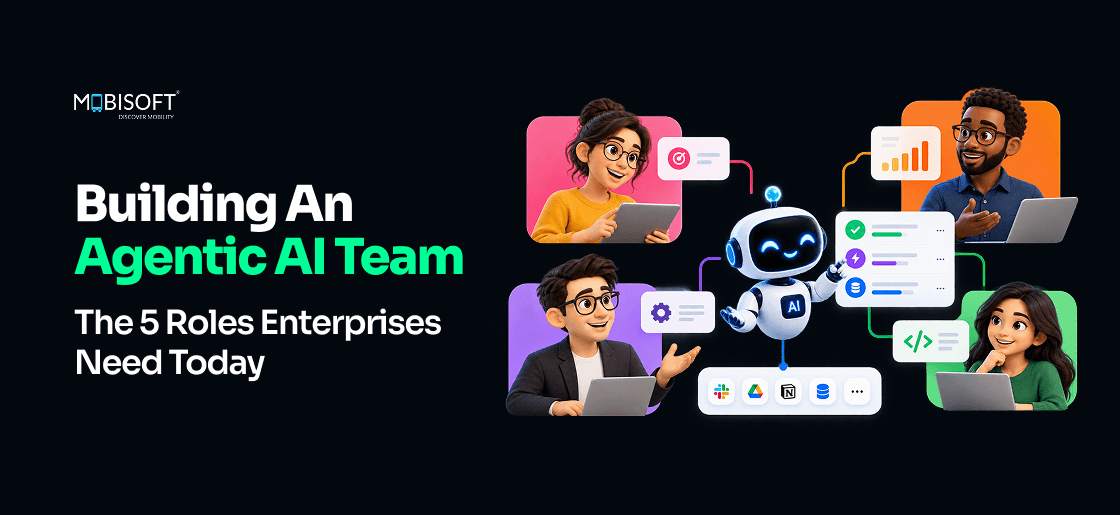
Most enterprise AI agent projects stall for a structural reason. A single engineer gets handed architecture, orchestration, integration, evaluation, and operations at once. That person cannot excel at all five at production quality, no matter how skilled they are. Agentic AI for enterprises works only when distinct specialists own distinct parts of the system. This guide breaks down the five roles a real enterprise agent programme requires.
It explains what each role delivers, how the roles work together, and when to hire each one. You will also see how team structure, hiring sequence, budgeting, and talent scarcity inform a realistic hiring plan. The goal is a working blueprint, not a vague list of job titles. By the end, you will know exactly which roles to prioritize first and in what order.
Why Agentic AI For Enterprises Needs A Full Team
Enterprises keep repeating the same hiring mistake with AI agents. They post one job description covering architecture, engineering, integration, evaluation, and operations. That job description describes five careers, not one. Each domain took the people who are good at it years to master.
Limits Of A Single Engineer
A single hire cannot cover five specializations at a production standard. Something gets shortchanged, and it is usually security, evaluation, or both. The agent looks impressive in a demo and then breaks against real enterprise data. Writing actions into a CRM or an ERP raises the stakes further. A poorly scoped agent that updates records without proper authorization becomes a compliance problem fast.
Five Distinct Engineering Domains
Building enterprise AI agents spans five separate disciplines. Each one carries its own body of knowledge and its own failure modes.
- System architecture covers agent, tool, memory, and guardrail design across the platform
- Agent engineering spans reasoning patterns, tool calls, and human-in-the-loop workflows
- Enterprise integration handles secure connections between agents and systems like Salesforce or ServiceNow
- Agent quality evaluation involves trajectory scoring and tool selection accuracy
- AI reliability operations includes cost control, observability, and incident response at scale
Treating these as one job title is how enterprise AI programs consistently underdeliver. Splitting them into defined roles is what makes an agentic AI team deliver on schedule.
What Happens Without Specialization
The table below shows what each domain demands and what goes wrong when nobody owns it.
| Domain | Depth Required | What Happens Without It |
| System architecture |
|
|
| Agent engineering |
|
|
| Enterprise integration |
|
|
| Quality evaluation |
|
|
| Reliability operations |
|
|
Each row above represents a distinct hiring decision. Skipping any one of them shows up in production within a few months. This is the core case for agentic AI for enterprises. Specialization, not headcount, determines whether an agent survives contact with real data.
Align Strategy Before You Hire
Role clarity solves half the problem, and sequencing solves the other half. The remaining risk sits upstream of any hiring decision. Teams sometimes assemble strong specialists around the wrong use case entirely. A clear AI business strategy engagement before hiring anchors the team to a use case worth the investment.
That upfront step answers a few questions cheaply, before payroll starts:
- Which workflow genuinely benefits from autonomous reasoning instead of simple automation?
- What does success look like in measurable terms after ninety days?
- Which enterprise systems does the first agent need to touch safely?
Skipping this step is how a well-staffed team still misses its target.
The 5 Enterprise Agentic AI Team Roles
Here is the full picture before the details. Every complete agentic AI team is built from these five roles.
- AI Architect designs the system, selects the approach, and sets the security model
- Agentic AI Engineer builds the agents and owns their reasoning quality
- Enterprise Integration / MCP Engineer connects agents to enterprise systems securely
- Agent Quality Engineer builds the evaluation framework and monitors production quality
- LLMOps / AI Reliability Engineer operates cost, observability, and deployment infrastructure
These are the AI agent roles in enterprise teams that recur across every serious deployment reviewed for this guide. Not every organization needs all five on day one. The sections below define each one precisely, then cover the order to hire them in.
Role 1: AI Architect
The AI Architect sets the technical direction before code gets written. This person decides how agents, tools, memory, and guardrails fit together.
What The AI Architect Delivers
The core output is a documented agentic AI architecture the rest of the team can build against.
- Agent system architecture covering agents, tools, memory, and guardrails
- Documents explaining why agents were chosen over simpler automation approaches
- Security architecture, including threat models and data classification rules
- MCP server ecosystem design showing which tools need dedicated servers
- Reference implementations the engineering team follows as a pattern
- Technology choices for the orchestration framework, vector database, and observability stack
Day-To-Day And Engagement Model
Most enterprises do not need this person full-time. A common model runs two to three days a week during the design phase. That drops to roughly one day a week once the build starts. After launch, the architect typically shifts to an on-call advisory role. Large platform programs running six or more agents often justify a full-time architect instead.
Day-to-day, the architect reviews agent designs from the engineering team. They also review MCP server security with the integration engineer. When the team hits architectural ambiguity, this is the person who resolves it.
What The AI Architect Does Not Do
The architect designs the system rather than writing production code. They do not manage the team or own daily delivery. Production operations stay with the reliability engineer, not the architect. The architect sets direction, and the rest of the team executes it.
A useful test during hiring is asking for a past architecture decision record. Strong candidates can explain a trade-off they made and why they made it. Weak candidates tend to describe tools instead of decisions. This distinction matters most among the five AI agent roles in enterprise teams, since architecture mistakes are the most expensive to reverse.
Role 2: Agentic AI Engineer
This role is the primary builder in building an AI agent team. The agentic AI engineer writes the code that makes agents reason and act.
Primary Deliverables
- Agent implementation using LangGraph workflows, CrewAI roles, or custom ReAct loops
- Reasoning pattern selection, including chain-of-thought and planning approaches
- Human-in-the-loop workflows with approval flows and full audit trails
- An agent evaluation framework covering trajectory scoring and tool selection
- Security controls against prompt injection, plus output monitoring and iteration limits
- Error recovery logic for what happens when a tool call fails mid-workflow
Seniority And Boundaries
This is not an entry-level role, and enterprises should not treat it as one. Agents that take write actions in CRM or ERP systems carry real failure consequences. Look for candidates who have shipped at least two production agent systems already. They should also understand agent-specific security, not general LLM security alone.
The agentic AI engineer does not build MCP server integrations directly. That work belongs to the integration engineer, covered next. Infrastructure operations and overall system architecture also sit outside this role. Clear boundaries here prevent the same one-person overload this guide opened with. For a closer look at what shipping a real agent involves, see AI Agent Development for Production, which walks through the engineering work behind this role in more depth.
AI Agent Orchestration And Multi-Agent AI Systems
Most enterprise use cases outgrow a single agent fairly quickly. One agent handles intake, another handles verification, and a third handles the write action. Coordinating that handoff correctly is what AI agent orchestration means.
Common Orchestration Patterns
- Sequential handoff has one agent complete a step, then pass context to the next
- Supervisor pattern uses a coordinating agent that routes tasks to specialist sub-agents
- Parallel fan-out lets multiple agents work on independent sub-tasks, then merges the results
- Agent-to-agent messaging has agents exchange structured requests rather than raw text
Orchestration As A Design Discipline
Poor orchestration design shows up as duplicated work or lost context between steps. A supervisor agent that routes wastes tool calls and inference budget. Multi-agent AI systems also multiply the failure surface every single agent adds. One agent failing silently can cascade into three or four downstream failures. Orchestration decisions belong to the architect and agentic engineer together. Neither role should make that call alone, mid-build.
Where Orchestration Fits Among The Five Roles
The architect decides the coordination pattern at the design stage. The agentic engineer implements that pattern inside the actual agent code. The integration engineer makes sure each agent in the chain has scoped tool access. The quality engineer evaluates the full multi-agent trajectory, not each agent in isolation. This is what building an AI agent team involves once a single agent stops being enough.
Enterprises without in-house orchestration experience often bring in AI software development services that specialize in multi-agent builds. That route usually beats learning these patterns through trial and error in production.
Role 3: Enterprise Integration / MCP Engineer
Agents are only useful once they can act inside real enterprise systems. That connection work is its own specialization, distinct from agent engineering. Proper MCP server integration is what makes this connection secure and auditable. No serious architecture treats this connection layer as an afterthought.
Primary Deliverables
- MCP server builds for tools such as Salesforce, ServiceNow, Jira, and internal databases
- Authentication at the tool layer, including enterprise SSO and identity propagation
- Role-based access control enforced per tool capability, not just per user login
- Audit logging that records every tool call with user, parameters, and timestamp
- Data classification enforcement so outputs get filtered according to clearance
- Gateway security, including allowlists, rate limiting, and injection prevention at the tool layer
Why This Role Stays Separate
Enterprise integrations demand deep knowledge of specific systems and their APIs. Salesforce, ServiceNow, and SAP each have their own quirks and constraints. OAuth 2.0 enterprise flows, SAML, and Active Directory add further complexity. The agent engineer typically has not built this kind of expertise. Integration engineers also navigate IT governance processes that are organizational as much as technical. That governance work alone justifies treating this as a dedicated role. Getting security sign-off from an enterprise IT team can take weeks on its own. An engineer who has done that before moves through approval far faster than one learning it live.
Enterprises still figuring out how to secure these connections have another option. Specialist MCP server integration work solves this without slowing the build.
Role 4: Agent Quality Engineer
Standard LLM evaluation checks whether an output looks correct. Agent quality evaluation checks something harder to measure. It asks whether the reasoning path that produced the output was right. Trust in any agentic AI team rests on this distinction being enforced consistently.
Primary Deliverables
- A trajectory evaluation framework scoring the reasoning path, not just the final answer
- A tool selection benchmark with at least 100 scenarios and a defined accuracy target
- An adversarial test suite covering prompt injection through tool results
- Production-quality monitoring using sampled sessions and implicit signals like rejection rate
- A quality incident classification system with clear detection and response protocols
Why Trajectory Evaluation Is Different
A standard LLM evaluator asks whether the final answer was good. Agent quality evaluation asks three additional questions at once. Was the reasoning path correct, were the right tools selected, and did the agent recover from failures properly? These questions need different methodologies and different tooling entirely. Most standard evaluation engineers have not built this specific skill set.
Hire this role before the first agent reaches production, not after. The production quality gate depends on a benchmark this role delivers. Without it, there is no defined threshold for what counts as safe to launch.
Consider a support agent that resolves tickets by querying three internal systems in sequence. An output-only check might confirm the final answer sounded correct. A trajectory check would confirm the agent queried the right systems in the right order. That second check is what catches a model silently guessing instead of verifying. Skipping it is one of the fastest ways to undermine an otherwise solid agentic AI architecture. How AI Consulting Helps Enterprises Build Scalable AI Solutions covers how that support fits into a broader AI programme beyond just this one role.
Role 5: LLMOps / AI Reliability Engineer
Someone has to operate what the other four roles build. That operational load falls to the LLMOps engineer.
Primary Deliverables
- An observability stack with agent-specific spans for iterations, tool calls, and checkpoints
- Inference cost optimization through model routing and semantic caching
- A deployment pipeline with an evaluation gate wired into CI/CD
- Operational dashboards tracking quality, cost, and latency service levels
- Incident response playbooks covering P0, P1, and P2 agent quality events
When To Bring This Role In
Early evaluation and basic observability often fall to the agentic AI engineer at first. That works fine before the first agent reaches production. Once production traffic starts, cost and reliability demands grow past what one engineer can absorb. That growth point is when a dedicated LLMOps engineer earns their place on the team.
This role operates infrastructure the other four roles created. It does not build agents, evaluate quality, or design MCP integrations. Clear ownership here keeps incident response fast instead of confused.
Picture three agentic AI teams running concurrently across support, billing, and onboarding. Each one calls a different mix of models depending on task complexity. Without routing and caching in place, cost scales linearly with every new session. The LLMOps engineer is the person who keeps that curve manageable as volume grows.
How The Five Roles Collaborate
A functioning agentic AI team is not five people working in isolation. Specific pairings repeat constantly across a healthy agent program.
- Architecture review has the architect and agentic engineer align on every major design decision
- Tool security review has the architect and integration engineer vet every new MCP server before production
- Evaluation integration keeps the agentic engineer and quality engineer aligned on the benchmark
- Quality monitoring has the quality engineer and LLMOps engineer calibrate alert thresholds together
- Cost versus quality decisions bring the agentic engineer and LLMOps engineer together on model routing
- Incident response draws on all five roles, each covering their own layer of the failure
This is what multi-agent AI systems look like once they reach production scale. No single role carries the whole system alone, and that is the entire point.
Timeline From Architecture To Production
Timelines vary by scope, but a recognizable pattern shows up across most first agent builds. Knowing the outline of that timeline helps set expectations with stakeholders early.
Weeks One Through Eight: Architecture And Design
The architect defines the system design, tool boundaries, and security model during this phase. Use case scoping and data availability checks happen in parallel. By the end of this phase, the team has a reference implementation to build against.
Weeks Eight Through Sixteen: First Agent Build
The agentic engineer and integration engineer work in tandem here. Tool results get reviewed jointly so reasoning quality and integration quality move together. A basic evaluation benchmark comes together during this phase, even before the quality engineer joins.
Weeks Sixteen Through Twenty: Production Readiness
The quality engineer, if already on board, finalizes the trajectory evaluation benchmark. Security review of every MCP server happens before any write action goes live. Human-in-the-loop checkpoints get tested against edge cases, not just the happy path.
Month Five Onward: Operate And Expand
Once the first agent is live, attention shifts to cost and reliability. This is typically when the LLMOps engineer joins if not already present. A second use case usually enters scoping around this point, informed by what the first agent proved. That expansion is what separates a single pilot from a real agentic AI team.
Common Mistakes Enterprises Make
Even organizations with budget and executive support stumble on the same patterns. Recognizing them early saves months of rework later. Most trace back to a missing role rather than a weak agentic AI team.
Hiring One Generalist For All Five Roles
This is the mistake this guide opened with, and it remains the most common one. A generalist can ship a demo, then struggles once production data arrives. Security weaknesses, brittle reasoning, and unmeasured quality tend to surface together. Splitting the work across specialists, even part-time ones, fixes this early.
Skipping The Architecture Phase
Some teams jump straight to writing agent code without a documented design. That choice often means rebuilding the system three to six months later. A short advisory engagement upfront costs far less than a mid-project rebuild. Document the reasoning pattern, tool boundaries, and guardrail design before anyone writes code.
Treating MCP Servers As A Quick Integration Task
Connecting an agent to Salesforce or ServiceNow looks simple in a proof of concept. Production-grade authentication, RBAC, and audit logging add real complexity fast. Enterprises that treat this as a side task end up with compliance failures later. A dedicated integration engineer catches these issues before they reach production.
Launching Without A Quality Benchmark
Teams under deadline pressure sometimes skip the evaluation framework to hit a launch date. Without a benchmark, nobody can say whether a prompt change improved or hurt quality. Regressions then surface through user complaints instead of monitoring dashboards. Building the benchmark before launch, not after, avoids this entirely.
Underestimating Inference Cost At Scale
A single agent in testing looks inexpensive to run. Multiply that by thousands of daily sessions across multiple agents, and cost shifts fast. Model routing and caching decisions made early prevent a painful cost surprise later. Closing that cost risk early is exactly what a dedicated LLMOps engineer is for. Cost discipline is as much a part of agentic AI architecture as reasoning quality.
The Hiring Sequence By Stage
You do not need all five roles from day one. Hiring all five at once is both impractical and inefficient for most budgets. The right sequence adds each role exactly when it starts creating value. This sequencing is what separates a durable agentic AI team from an expensive false start.
The Minimum Viable Agentic AI Team
The smallest functional team is two roles working together. An agentic AI engineer and an integration engineer form that starting pair. An architect supports them in an advisory capacity. Together, this pair can ship a production agent in eight to sixteen weeks.
- The agentic AI engineer builds the agent and covers basic evaluation temporarily
- Integration engineer secures two to three enterprise systems in scope
- Architect advises two to three days a week during the design phase
This minimum team cannot run systematic evaluation or manage production cost properly yet. Multiple concurrent agent builds also remain out of reach at this size. The next hiring stages exist specifically to close those limits.
Stage-by-Stage Hiring Plan
| Stage | Team In Place | Priority Hire | Trigger |
| Stage 0: Pre-build | Architect, advisory only | Architect for six to ten weeks | Programme committed, architecture undefined |
| Stage 1: First build | Agentic engineer, integration engineer | Both simultaneously | Architecture defined, first use case scoped |
| Stage 2: First production | Add quality engineer | Quality engineer before launch | Agent approaching production |
| Stage 3: Production at scale | Add LLMOps engineer | LLMOps engineer | Cost and reliability demands grow |
| Stage 4: Multi-agent platform | Full team, possible second engineer | Second agentic engineer | Multiple teams need agent capability |
Each stage adds exactly one role for a specific, observable trigger. That discipline keeps hiring tied to real need instead of headcount targets. It is also the fastest route to a working agentic AI team without over-hiring early.
Talent Scarcity In 2026
Every one of these five roles is genuinely scarce right now. The reasons differ by role, and so does the fix. This scarcity is the single biggest constraint on agentic AI for enterprises moving faster in 2026.
AI Architect Scarcity
Many candidates hold an inflated title without real programme depth. They may have strong engineering skills but limited architecture breadth across organizations. Look for candidates who can point to architecture decisions across multiple past programmes. They should also be comfortable pushing back on an engineering team's assumptions. Advisory contracts of six to twelve weeks open up a much wider pool than full-time hiring does.
Agentic AI Engineer Scarcity
Chatbot builders frequently call themselves agent engineers without production tool-use experience. Genuine multi-step, tool-using agent experience remains the scarcest profile in the market right now. Ask for production references that name specific security controls the candidate implemented. Trajectory evaluation experience and failure recovery design are strong signals worth screening for directly. A two-stage process, portfolio review plus a live scenario, filters out inflated titles quickly.
Integration Engineer Scarcity
MCP became a real enterprise standard only recently. Engineers who can secure it properly, not just build it, remain rare. Screen specifically for OAuth 2.0 enterprise flows, SAML, and Active Directory integration knowledge. Engineers with a MuleSoft or Boomi integration background often upskill into this role well.
Quality Engineer Scarcity
This role barely existed as a distinct title before 2025. Trajectory evaluation methodology is still new, and few candidates have practiced it at scale. A strong LLM evaluation engineer can typically develop agent evaluation skills within two to three months. An advisory engagement with a senior agent quality specialist accelerates that transition considerably. This role alone can decide whether enterprise AI agents are safe to ship on schedule.
LLMOps Engineer Scarcity
Many DevOps and SRE candidates claim LLM operations skills without hands-on evidence. The missing depth usually sits in cost optimization, prompt versioning, and agent-specific observability. Ask for before-and-after cost metrics from a real production system, not a general resume claim. SRE engineers with a genuine interest in AI infrastructure tend to upskill into this role well.
How To Solve The Scarcity Problem
- Require production references with real metrics, not portfolio demos alone
- Use advisory or contract engagements to widen the architect and quality engineer pool
- Look at adjacent backgrounds, such as integration engineers upskilling from MuleSoft or Boomi
- Accept realistic placement timelines, typically eight to twenty-one days depending on the role
- Work with a specialist AI agent development company that vets specifically for agent production experience
Team Structure Options
Once the roles are defined, the next decision is how to staff them. Four structures cover most enterprise situations.
Individual Contract Specialists
Each role gets sourced separately on its own contract. This suits organizations with strong internal technical leadership. Someone still needs to coordinate a multi-contractor team day-to-day. Expect a wide rate range depending on role scarcity and seniority.
Dedicated Remote Agentic AI Team
A pre-assembled team of three to five specialists arrives with one point of contact. This structure suits organizations without deep internal AI leadership already in place. An engineering manager is typically included once the team reaches three or more people. Assembly and onboarding usually take three to four weeks. The specialists have usually worked together before, which shortens the ramp-up period considerably. Coordination overhead drops since one manager, not the client, resolves day-to-day conflicts between roles.
Hybrid: Core Full-Time Staff Plus Contract Specialists
One or two long-term roles stay in-house, often the architect and the agentic engineer. Contract specialists fill the remaining specialist roles as needed. This works well for organizations building lasting internal AI capability. It is often the most cost-effective structure over a multi-year horizon.
Contract-To-Hire
Contract specialists start with an explicit path toward conversion. Each engagement functions as a trial for the eventual full-time role. This suits organizations that want an in-house team but cannot wait for a full hiring cycle. Conversion typically happens after sixty to ninety days if both sides see a fit. Every one of these structures can staff the same five AI agent roles in enterprise teams need, so the choice comes down to internal readiness, not role definitions.
Comparing The Four Structures
| Structure | Best Fit | Typical Timeline |
| Individual contract specialists | Strong internal technical leadership already coordinating the work | 7 to 21 days per specialist |
| Dedicated remote team | Organizations without deep internal AI leadership yet | 3 to 4 weeks for full assembly |
| Hybrid FTE plus contract | Long-term internal capability with project-based specialist roles | 4 to 6 months for FTE roles |
| Contract-to-hire | Building in-house capacity without a full hiring cycle upfront | 60 to 90 days to conversion |
Budgeting For An Agentic AI Team
Rates vary by role, seniority, and engagement model. Having a rough range in hand makes planning conversations far easier. Budget is often the deciding factor in how fast enterprises move to hire AI agent developers for a first production use case.
What A Dedicated Team Costs
A pre-assembled team of three to five specialists typically runs $120,000 to $200,000 per month. That figure usually includes an engineering manager for teams of three or more. Compared against separately sourced specialists, the effective hourly rate is often lower. Coordination overhead also drops significantly since the team has already worked together before.
Budgeting By Stage, Not All At Once
Early-stage budgets should cover the two-role minimum plus advisory architecture time. That keeps first-year spend proportional to a single production use case. Quality and reliability budgets scale in once the first agent nears launch. Planning budget stage by stage avoids over-hiring before the use case is proven.
How To Hire AI Agent Developers
Deciding whether to hire, contract, or partner externally comes down to three questions. How fast does the first agent need to go live? How much internal AI depth already exists on the team. How many agents does the roadmap plan beyond the first one?
Questions To Ask Before You Hire
Walk through these questions with stakeholders before writing a single job description. The answers determine whether contract, hybrid, or dedicated team fits your situation best.
- Does the organization already have someone who can vet an agent engineer's trajectory evaluation claims?
- Is there budget for an advisory architect, or does the first hire need to cover architecture too?
- Will the roadmap justify converting contract roles to full-time within a year?
- Does the compliance team require audit logging standards the integration engineer must meet from day one?
- How many additional agents does the roadmap realistically call for within eighteen months?
When A Partner Model Makes Sense
Many enterprises choose to hire AI agent developers through a specialist partner rather than five separate searches. A partner that already vets for production agent experience shortens placement timelines considerably. It also gives you access to roles like the quality engineer that are hardest to source alone.
Getting the underlying AI business strategy right before any hiring starts prevents the most common failure mode. That failure mode is assembling a skilled team around the wrong use case. Revisit that strategy work whenever the roadmap adds a second or third agent.
From there, the services that specialize in agentic systems can assemble the exact role mix a given stage requires. That might mean one advisory architect, or it might mean a full five-person team.
What A Complete Agentic AI Team Delivers
Framed by outcome rather than title, the five roles compound over three phases. Each phase builds directly on the foundation the previous one established.
Phase One: A Single Working Agent
The first milestone is one agent, live in production, with basic guardrails in place. Success here means the agent handles real inputs, not just demo scenarios. Human checkpoints catch the edge cases the agent should not handle alone yet.
Phase Two: Trustworthy At Scale
The second milestone adds a quality benchmark and defined cost controls. Trust builds once regressions get caught before users ever see them. Inference spend stays predictable even as session volume grows month over month.
Phase Three: A Reusable Platform
The third milestone turns individual effort into shared infrastructure. New agents launch faster because the architecture, evaluation tooling, and observability stack already exist. This is the phase where the agentic AI team stops being a project and becomes a capability.
Signs The Team Structure Is Working
- New agent use cases move from idea to pilot in weeks, not quarters
- Quality regressions get caught by monitoring before users notice them
- Inference costs stay predictable even as usage grows
- Security reviews happen before launch, not after an incident forces one
Signs A Role Is Missing
- Agents that behave well in testing but fail unpredictably against real data
- Write actions into enterprise systems with no clear audit trail
- No defined threshold for what quality counts as safe to ship
- Inference spend that nobody can explain month over month
Key Takeaways For Technology Leaders
A few principles carry more weight than any single hiring decision. Keep them in view as the programme moves from architecture to production.
- Agentic AI for enterprises needs five distinct specializations, not one generalist role
- Start with the two-role minimum viable team, supported by an advisory architect
- Add the quality engineer before launch, not after the first incident forces the issue
- Bring in LLMOps once production traffic makes cost and reliability primary concerns
- Treat orchestration design, budgeting, and hiring sequence as decisions made together, not separately
Technology leaders who get this sequence right ship faster with fewer expensive rebuilds. The roles, the order, and the collaboration patterns matter more than headcount alone.
Conclusion
Agentic AI for enterprises succeeds through role clarity, not raw headcount. The five specializations include architecture, agent engineering, integration, quality, and operations. While each demands distinct depth, you can start with the two-role minimum viable team and add roles as real production triggers appear. An advisory architect early prevents costly rebuilds later in the program. A quality engineer before launch sets the bar for what counts as safe to ship. An LLMOps engineer keeps cost and reliability under control once usage grows. Budget and orchestration decisions belong in that same sequence, not as afterthoughts.
Whether you build the team in-house, through contractors, or with a dedicated partner, the sequence matters more than the org chart. Get the roles and the order right, and the agents that follow will hold up under real enterprise conditions.

Frequently Asked Questions
What makes an agentic AI engineer different from a regular AI engineer?
A regular AI engineer typically ships single-turn LLM features with no ongoing reasoning across steps. An agentic AI engineer builds systems that plan, call tools, recover from failures, and hand off work across multiple steps, which is the core skill behind most enterprise AI agents running in production today.
Can quality and LLMOps wait until after launch?
Quality cannot wait. The evaluation benchmark defines the production gate every agent must clear before going live. LLMOps can often wait a little longer, since cost and reliability pressure only builds once real traffic arrives, making early agentic AI architecture decisions the more urgent priority of the two.
What is the fastest way to staff all five roles?
A dedicated remote team, typically assembled in three to four weeks, moves faster than sourcing five separate contractors one at a time. Enterprises that want to hire AI agent developers across every role at once usually prefer this route over individual searches that stretch hiring out for months.
Does every additional agent need a new orchestration design?
Not always. A single agent needs almost no coordination logic at all. Once a workflow adds a second or third agent, AI agent orchestration becomes a real design decision, not an afterthought, and it should sit with the architect rather than whichever engineer builds the newest agent.
What is the biggest hiring risk enterprises overlook?
Skipping the integration engineer role early on. Writing actions into enterprise systems without dedicated authentication and audit logging creates compliance exposure fast, often before anyone notices. Partnering with an established AI agent development company during this stage closes that risk before a single production incident forces the issue.
Should roles be hired directly or through a specialist partner?
Either path works, and the right one depends on internal maturity. Strong technical leadership favors direct hiring, while thinner internal depth usually moves faster with a specialist partner already vetted for agentic AI team placements across all five roles, especially when the roadmap includes more than one agent.
This content is for informational purposes only and may include AI-assisted research or content generation. While we strive for accuracy, information may evolve over time. Readers are advised to independently verify critical information before making decisions.

Nitin Lahoti
Read more
Nitin Lahoti is the Co-Founder and Director at Mobisoft Infotech. He has 15 years of experience in Design, Business Development and Startups. His expertise is in Product Ideation, UX/UI design, Startup consulting and mentoring. He prefers business readings and loves traveling.
 Nitin Lahoti
 September 29, 2026