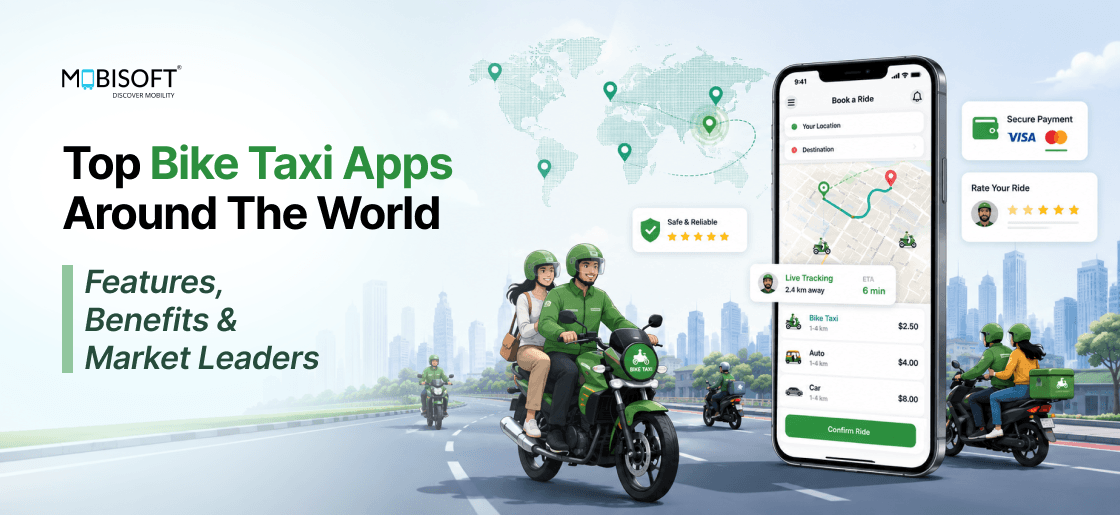
Bike taxis have moved far past their early experimental days. The global ride hailing app market crossed 188.60 billion dollars in 2026. Two wheelers are now the fastest growing segment in this space.
Every major bike taxi app on this list has changed since it first launched. Some platforms have disappeared entirely. New players have entered the market, and old ones have quietly closed shop.
This guide looks at where the ride hailing app industry stands today. We cover who the real players are. We also cover how artificial intelligence now runs the backend of every ride, and the regulatory pressure that is quietly becoming the biggest factor in this market.
Riders, investors, and anyone exploring bike taxi app development will find the full, current picture here.
What Are On Demand Bike Taxi Apps
A bike taxi app connects a rider with a nearby motorcycle.
- The rider opens the app
- Enters a destination
- Gets matched with a driver within seconds
Riders can make the payment inside the app and track the entire trip.
This is not the simple dispatch model from a decade ago. Today's bike taxi booking app relies on live data and automated pricing. Safety systems also run quietly in the background of every ride.
Every trip now generates data that feeds back into the platform. That data helps predict where riders will need a bike next.
How The Model Has Changed
Early platforms just matched supply with demand. A driver went online, a rider requested a trip, and the app connected the two.
Modern platforms now predict demand before it happens. They also verify drivers automatically and monitor routes in real time. Fares now adjust based on dozens of live signals at once.
This change did not happen overnight. It happened because the market got bigger and competition got fiercer. Riders also started expecting more from every trip.
Investors also began demanding better unit economics from every platform they backed. That pressure pushed companies to build smarter systems instead of just bigger fleets.
Why Bike Taxis Still Matter
Traffic congestion still exists in major cities. Bikes still cut through jams. Cars remain stuck for long stretches. A short trip that takes forty minutes by car often takes under fifteen minutes on a bike. This time advantage remains the single biggest reason riders choose two wheelers over cars.
Cost is the second reason. A bike taxi ride typically costs 30 to 50 percent less than a cab trip. For students, daily commuters, and gig workers, this price gap makes a real difference every month. Many riders use a ride sharing app because a daily car ride is simply out of budget.
More than 13 billion ride-hailing trips took place in the first half of 2025. Asia-Pacific accounted for 57.5% of the global market, and Latin America overtook Europe to become the third-largest region, according to ABI Research's Ride Hailing Market Data report.
Two wheelers sit at the center of that revenue figure. Dense cities, high smartphone use, and supportive local policies all support this growth.
Two wheelers are also projected to grow faster than any other vehicle category through 2031. The projected growth rate sits above 16 percent each year. That pace outpaces cars, autos, and every other segment tracked in current market reports.
Last Mile Connectivity Keeps Growing In Importance
Metro stations and bus stops rarely drop passengers exactly where they need to go. A bike taxi app fills that final gap between public transport and a rider's actual destination. Many operators also complement these services with bike rental software to support short-term bicycle access for commuters and tourists. This last mile use case has grown alongside metro expansion projects across Indian and Southeast Asian cities.
Commuters increasingly plan their entire journey around a mix of trains, buses, and short bike rides. A reliable passenger app experience for this last leg has become essential for many daily commuters.
The Move Toward Electric Fleets
Electric two wheelers are becoming a serious part of bike taxi app operations. Fuel costs keep rising, and electric bikes cut running costs for drivers significantly. A driver on an electric bike can save a meaningful amount on fuel every single week.
Governments across India and Southeast Asia are also pushing emission targets that favor electric fleets. Several platforms have started testing electric-only zones in major cities. Some cities now offer parking priority and toll discounts for registered electric taxis.
This move brings a few clear benefits:
- Lower operating costs for drivers over time
- Reduced emissions in already congested cities
- Access to government subsidies and tax benefits
- Quieter rides with less noise pollution
- Longer term savings that improve driver retention
Electric fleets are not universal ye. Battery range and charging infrastructure remain the biggest obstacles right now. Expect this to become standard for any serious shared mobility app strategy soon.
Why This Market Concentrates In Asia And Africa
Most major bike taxi app platforms operate in India and Indonesia. Some companies are active in parts of Africa. Very few exist in the US, UK, and other parts. This pattern comes down to everyday commuting habits.
Cities like Jakarta, Bengaluru, and Kampala face extreme congestion on narrow roads. Two wheelers offer a practical way through that congestion. Western cities generally have wider roads, stronger public transport networks, and far fewer daily motorcycle commuters.
There are early signs this could change. Uber launched a motorcycle taxi pilot in Paris, currently open only to loyalty program members. The service is still in its testing phase. Uber has not confirmed a wider European rollout. This pilot suggests the model may slowly start testing Western markets, even if adoption remains years behind Asia and Africa.
For now, the bike taxi app category remains a story about congested cities. Until Western regulation and road conditions catch up, Asia and Africa will likely stay the center of this industry.
Top Bike Taxi Apps Around The World In 2026
The list of major players has narrowed in the last decade. Some platforms grew into billion dollar companies. Others quietly shut down or faded out of the market entirely. A few pivoted their entire business model just to survive.
Here is where things stand today.
Rapido
Rapido is now the most valuable bike taxi app in India. The company raised 240 million dollars in May 2026, led by Prosus. This funding round valued Rapido at 3 billion dollars. WestBridge Capital and Accel also joined this funding round. That figure represents a sharp rise from Rapido's 2.3 billion dollar valuation just a year earlier.
Rapido now operates in more than 400 cities across India. The platform serves close to 25 million customers and works with roughly 1.5 million riders. Beyond bike taxis, Rapido has expanded into food delivery through its subsidiary, Ownly. It has also pushed further into smaller towns beyond the usual metro cities.
Co-founder Aravind Sanka has said the company wants to strengthen its driver network. He also wants to invest heavily in technology. According to Uber's own leadership, Rapido has overtaken Ola as Uber's biggest competitor in India. That marks a real change from where the market stood just a few years ago.
Uber Moto
Uber Moto remains active in India as part of the main Uber app. It has completed millions of trips since its 2016 launch and continues to expand across Indian cities.
Uber treats Moto as one part of a larger transport strategy. This strategy also includes cars, autos, and parcel delivery. This multi-modal approach lets Uber compete across every price point, not just the premium segment. A rider can open one app and pick a car, an auto, or a bike.
Uber Moto also benefits from Uber's existing driver verification systems and payment infrastructure. That shared backend gives Moto a level of reliability that smaller standalone apps struggle to match. Riders switching between a car and a bike get a smoother experience overall.
Uber has also faced the same Maharashtra licensing issues affecting Rapido and Ola. This has added real pressure to Uber's India operations.
Grab
Grab remains the dominant ride hailing app across Southeast Asia. The company is currently working through a proposed merger with GoTo, structured as a share swap arrangement. This deal is still under regulatory review as of mid 2026. Analysts expect meaningful cost synergies if the merger clears regulatory hurdles in the coming months.
Indonesia introduced a new commission cap earlier this year. The cap limits two wheel ride commissions to 8 percent, starting July 1, 2026. This cap directly affects Grab's bike ride revenue in one of its largest markets. The policy followed direct pressure from Indonesia's president on driver earnings and welfare.
Grab has positioned itself as an everyday super app, covering rides, food delivery, and digital payments. Two wheeler rides remain core to that strategy in dense cities like Jakarta and Manila. Grab has also expanded partnerships around electric vehicles to strengthen its position across the region.
Gojek And GoTo
Gojek, now under the GoTo Group, faces the same commission cap pressure as Grab. GoRide, Gojek's motorcycle taxi service, moved to the same 8 percent commission structure starting July 2026. This change followed direct pressure from Indonesia's government on driver welfare concerns. GoTo confirmed the new commission rate through an official company announcement earlier this year.
GoTo is also central to the ongoing merger talks with Grab. A successful merger would combine two of the region's largest transport networks into one entity.
Despite the regulatory pressure, GoRide remains one of the most used transport services in Jakarta. Millions of riders still rely on it daily for short and fast trips across the city. GoRide drivers have voiced mixed reactions to the new commission structure. Some welcome the change, while others want further reform.
Ola Bike
Ola Bike has struggled to keep pace with Rapido in recent years. Industry commentary consistently places Ola behind Rapido in market share across most Indian cities.
Ola was also caught in the same Maharashtra regulatory crackdown that affected Rapido and Uber in 2026. License revocations disrupted operations in one of India's most important markets.
Ola still operates its bike service through the main Ola app, alongside cars and autos. But its competitive position has clearly weakened compared to where it stood a few years ago. Ola's broader restructuring efforts across its ride hailing business have added further uncertainty for its bike segment.
SafeBoda
SafeBoda built its reputation on rider safety in Uganda. The company has however, made a major pivot in 2026. Facing a regulatory crackdown on ride hailing in Kampala, SafeBoda moved toward B2B corporate transport services.
This new model serves businesses directly, offering managed transport solutions for employees. Companies can now book recurring rides for staff instead of relying on individual consumer bookings.
SafeBoda also exited Nigeria entirely, signaling a narrower, more focused strategy. This pivot reflects a broader trend across Africa's boda-boda space. Consumer ride hailing alone is proving hard to sustain under tightening local regulation. SafeBoda's move suggests other African platforms may need to diversify their revenue streams too.
How AI Is Changing Bike Taxi Platforms In 2026
Artificial intelligence now sits at the center of nearly every major bike sharing platform development. It affects pricing, matching, safety, and even where drivers are told to wait. This change happened quietly, but its impact on the industry has been significant.
Riders rarely notice the AI working behind their trip. Yet it touches almost every part of the experience.
Smarter Fare Estimation And Dynamic Pricing
Modern platforms use AI models to calculate fare estimation in real time. These models factor in demand, weather, traffic, and even local events happening nearby. Fares can rise during a sudden downpour or drop during quiet afternoon hours.
This dynamic pricing approach helps balance supply and demand across the platform. It also keeps drivers incentivized to stay active during high demand periods. Without this system, platforms would struggle to keep enough drivers online during peak hours.
AI-Powered Driver Matching
Matching a rider with the nearest available driver used to be a simple distance calculation. Today, AI models factor in traffic conditions, driver ratings, and predicted trip duration. This approach reduces wait times and improves the overall passenger app experience.
Some platforms also use predictive positioning, sending drivers to high demand areas before requests even come in. This reduces pickup delays significantly during rush hours. A well-tuned matching system can shave several minutes off average wait times across an entire city.
AI In Safety And Trip Monitoring
Safety systems have become far more sophisticated. Platforms now use AI to monitor routes during a live ride tracking session. Any unexpected deviation can trigger an alert to the platform's safety team.
The SOS feature built into most major apps now works alongside this monitoring system. If a driver takes an unusual route or stops unexpectedly, the system can flag it automatically. A support team can then reach out to the rider directly within seconds. This layer of protection matters greatly for solo riders, especially at night.
The Trust Question Around Algorithmic Pricing
AI pricing brings real efficiency, but it also raises fairness questions. A June 2026 Consumer Reports investigation looked closely at this issue. It found that Uber and Lyft's AI-driven pricing led to very different prices for similar trips. Two riders taking the exact same route sometimes saw very different fares.
This finding sparked wider public debate about transparency in automated pricing systems. Riders want to understand why prices change, not just accept that they do. Regulators are starting to pay closer attention to this exact issue.
This ties directly into the broader regulatory pressure already affecting platforms in India and Indonesia. Governments are no longer just concerned with driver welfare. They are increasingly concerned with how algorithms treat riders as well. Expect more scrutiny of pricing algorithms across the industry in the coming year.
Regulatory Pressure Is Now The Biggest Factor In This Market
Funding and technology used to be the two forces behind this industry. In 2026, regulation has taken the top spot.
Maharashtra revoked bike taxi licenses for Rapido, Ola, and Uber this year. That decision shows how much power local governments hold. A single state decision can disrupt operations across an entire company's user base. Drivers in Maharashtra lost income overnight when these licenses were pulled.
Indonesia's commission cap tells a similar story from a different angle. The government stepped in directly to protect driver earnings. This forced Grab and Gojek to restructure their commission models. Both companies had to absorb lower margins on every two wheel ride booked through their platforms.
Driver Welfare Sits At The Center Of Most Disputes
Nearly every major regulatory action in 2026 traces back to driver welfare concerns. Commission caps, license reviews, and safety mandates all aim to protect the people doing the actual driving. This makes sense given how central drivers are to the entire model.
Without enough drivers earning a fair wage, no bike taxi app can function at scale. Platforms that ignore this reality risk losing both regulatory goodwill and driver loyalty. Driver strikes have already disrupted service in parts of India this year. These strikes show how quickly frustration can turn into action.
How The Top Bike Taxi Apps Compare
Each platform on this list serves a different region and a different type of rider. The table below summarizes where each app stands in 2026.
| Platform | Primary Market | 2026 Status |
| Rapido | India | 3 billion dollar valuation, 400+ cities |
| Uber Moto | India | Active, part of main Uber app |
| Grab | Southeast Asia | Pending merger with GoTo |
| Gojek/GoRide | Indonesia | New 8 percent commission cap |
| Ola Bike | India | Losing ground to Rapido |
| SafeBoda | Uganda | Pivoted to B2B corporate transport |
This comparison shows a clear pattern across the industry. Platforms tied to a single consumer model face the most regulatory and competitive pressure. Platforms that diversify into food delivery, corporate transport, or multi-modal rides tend to hold their position better.
What This Means For Riders And The Industry Going Forward
Riders should expect some short-term disruption in heavily regulated markets like Maharashtra. Prices may also change as platforms absorb new commission structures in Indonesia and similar markets. Some riders may notice slightly higher fares as a result of these adjustments.
Longer term, expect fewer but stronger platforms across most regions. Rapido, Grab, and GoTo look positioned to dominate their respective markets for the next several years. Smaller regional apps will likely continue struggling to compete at the same scale.
Electric fleets and AI-driven features will become the next major battleground once regulatory questions settle down. Platforms that master both will have a clear edge over slower competitors. Riders who value transparency and safety will likely gravitate toward platforms that invest heavily in both areas.
Building A Bike Taxi App In 2026
Building a bike taxi app today looks very different from building one a decade ago. Back then, a basic dispatch management system and a simple driver app were often enough to launch. That is no longer the case. Riders and regulators both expect far more from any new platform entering this space.
What A Modern Bike Taxi Platform Needs
A serious bike taxi app development company now builds platforms around a much wider feature set. Riders and drivers both expect a smooth, modern experience from day one.
Core features typically include:
- GPS tracking and live ride tracking for every trip
- Route optimization to reduce travel time and fuel costs
- Ride scheduling for planned trips ahead of time
- A digital wallet paired with a secure payment gateway
- Ride history and trip analytics for both riders and drivers
- Driver verification is built into the onboarding process
- Ratings and reviews after every completed trip
- Push notifications to keep users updated on ride status
- An SOS feature for emergencies
- A centralized admin dashboard for operations teams
Each of these features plays a specific role in building rider trust and driver retention. A platform missing even one of these features risks losing users to a competitor.
Why Is It Important to Build Compliance From The Start
Given how much regulatory pressure this industry now faces, compliance cannot be an afterthought. Modern platforms need built-in tools to handle licensing requirements across different cities and states. Commission structures also need to be flexible enough to adjust quickly when local laws change.
A platform built without this flexibility risks the same disruption Rapido and Ola faced in Maharashtra. Building compliance features early saves significant rework later, once a platform scales across multiple regions.
The Role Of AI In New Platform Builds
Any new bike taxi booking app built in 2026 should include AI-based dispatch from the start. Retrofitting these features later is far more expensive than building them in from day one. Predictive positioning, dynamic fare estimation, and automated driver verification all fall into this category. Together, they form the backbone of a competitive, modern smart mobility app. A platform that treats AI as an add-on rather than a foundation will always lag behind rivals.
Mobisoft has spent years building on-demand taxi app and shared mobility app solutions. We work with both startups and established operators. That experience carries directly into bike taxi app development. This applies whether you are building a new platform from scratch. It also applies if you are adding bike rides inside an existing ride booking app. Our team understands both the technical and regulatory sides of launching a bike taxi app.
Choosing The Right Bike Taxi App Development Company
Not every bike taxi app development company brings the same depth of experience. Look for a partner who has actually shipped ride hailing app products. Marketing pages alone do not prove real experience.
Ask about their approach to dispatch management, fare estimation, and driver onboarding specifically. A strong development partner should also show you how they handle scale. Your platform needs to work smoothly with ten drivers online and just as smoothly with ten thousand.
They should also explain how their admin dashboard gives you visibility into every part of your operations. This includes trip analytics, driver performance, and revenue reporting in one place.
Finally, ask how they plan for compliance across different cities and states from day one. Given everything happening in Maharashtra and Indonesia this year, this question matters more than ever.
Conclusion
The bike taxi industry has grown considerably since the last ten years. Rapido has become a genuine billion dollar company. Grab and GoTo are working toward a merger that could redefine Southeast Asia's transport map. SafeBoda has pivoted its entire business model to survive regulatory pressure in Africa.
Meanwhile, AI now quietly runs pricing, matching, and safety across nearly every major platform. Regulation has emerged as the force every operator must now plan around, not just funding or technology.
Where does this market go next as AI and regulation both intensify at the same time? The platforms that answer it well are the ones still standing a decade from now.
Ready To Build Your Own Bike Taxi Platform
Mobisoft can help if you are exploring bike taxi app development for your city or region. Our team builds intelligent platforms with every feature covered in this guide.
Get in touch with us to discuss your bike taxi app idea.

Frequently Asked Questions
How much does it cost to build a bike taxi app?
Cost depends on features and platform complexity. A basic version costs less than a full-scale app with AI dispatch and live tracking. Most bike taxi app development budgets scale with how many advanced features you include from day one.
How long does it take to launch a bike taxi app?
A basic version can launch in a few months with core booking and payment features. Adding AI-based pricing, safety tools, and multi-city support takes longer. Timelines depend heavily on your chosen bike taxi app development company and their existing tech stack.
What features are essential for a new bike taxi app?
Every platform needs real-time tracking, secure payments, and driver verification at a minimum. Fare estimation and ride history also matter for user trust. A strong admin dashboard helps you manage operations without adding cost later.
How do we handle regulation across different cities or states?
Regulation varies widely. Compliance needs to be built in from the start. Commission structures and licensing rules can change quickly. Flexible dispatch management systems make it easier to adjust to new rules fast.
Should we launch with AI features from day one or add them later?
Adding AI later is far more expensive than building it in from the start. Dynamic pricing and predictive matching work best when designed into the core system. Early fare estimation models also give you better data as your platform scales.
This content is for informational purposes only and may include AI-assisted research or content generation. While we strive for accuracy, information may evolve over time. Readers are advised to independently verify critical information before making decisions.

Pritam Barhate
Read more
Pritam Barhate, with an experience of 14+ years in technology, heads Technology Innovation at Mobisoft Infotech. He has a rich experience in design and development. He has been a consultant for a variety of industries and startups. At Mobisoft Infotech, he primarily focuses on technology resources and develops the most advanced solutions.
 Pritam Barhate
 March 11, 2017