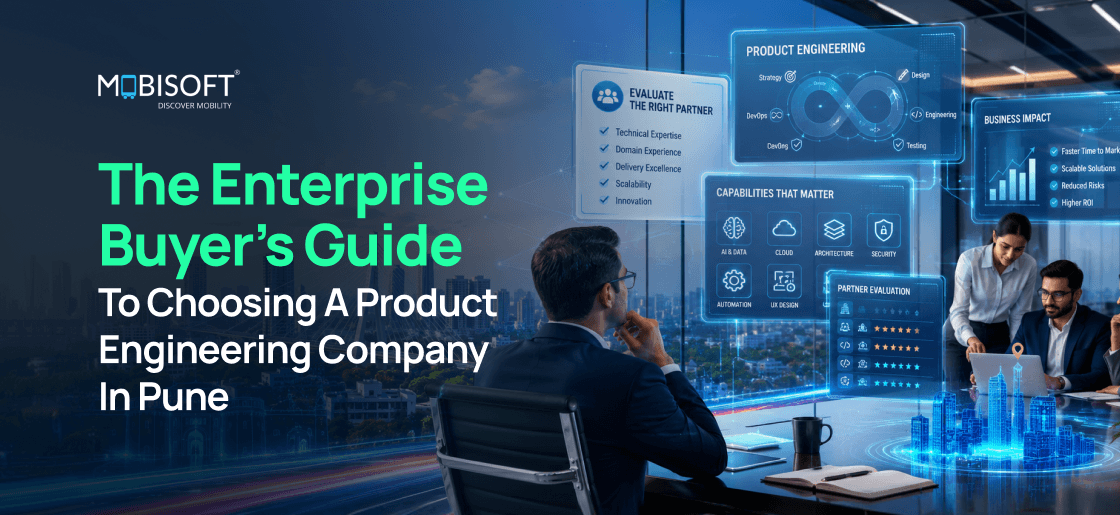
Pune has quietly become India's most consequential product engineering city. Bengaluru still leads on sheer scale, but the density of product engineering talent, the quality of domain knowledge accumulated in its technology companies, and the cost-to-quality ratio available to global buyers has reached a combination in Pune that Bengaluru, Mumbai, and Hyderabad do not replicate. This guide by Mobisoft Infotech, a product engineering company in Pune, includes evaluation criteria, costs, team models, and success factors that every buyer can use to compare.
Why Pune? The Product Engineering Ecosystem That Makes the City Uniquely Valuable to Global Buyers
Every major Indian technology city offers software development capacity. Bengaluru offers scale. Mumbai offers financial sector density. Hyderabad offers strong government infrastructure investment. Chennai offers manufacturing technology depth. Pune offers something different: a concentration of product engineering culture in a city that is large enough to have genuine talent depth but compact enough that talent density per organisation is significantly higher than in a sprawling metropolitan technology market.
Pune's Talent Ecosystem
Pune's talent pipeline is built on 100+ engineering colleges within 150km, including COEP Technological University, Pune Institute of Computer Technology (PICT), Vishwakarma Institute of Information Technology (VIIT), MIT World Peace University, Symbiosis Institute of Technology, Cummins College, and VIT Pune. Together, they produce 30,000+ technology graduates annually. The graduates from COEP, PICT, and Symbiosis compete with IIT output in product engineering disciplines, and the depth of the pipeline supports both talent acquisition and talent development within Pune companies.
IIT Bombay (Powai, Mumbai) is 150km from Pune. A significant concentration of IIT Bombay alumni is in Pune's product companies, including Mobisoft, with regular talent flow from Mumbai to Pune, as engineers prefer Pune's quality of life and lower cost of living. The result is IIT Bombay-calibre engineering talent accessible in Pune at Pune cost levels. This combination is not available to global buyers in Mumbai, where the same talent is priced at Mumbai cost levels.
Pune is also India's automotive capital, home to Tata Motors, Bajaj Auto, Mahindra and Mahindra, Force Motors, Bharat Forge, and 4,000+ auto component manufacturers. Bosch Engineering and Business Solutions and Continental are major engineering employers. This produces automotive software (AUTOSAR, CAN, ADAS) and manufacturing software (SAP ERP, MES, SCADA) talent depth unique to Pune. For global buyers in automotive, logistics, manufacturing, and supply chain technology, Pune offers domain expertise that other Indian cities cannot match.
In fintech, Pune's financial services technology depth is exceptional. Barclays, Deutsche Bank, Western Union, HSBC Technology, State Street, ICICI Bank, Bajaj Finance, and Piramal Finance all have major Pune operations. For global buyers building fintech, payments, banking, or financial services products, Pune offers engineering talent with production fintech experience at Indian cost levels. PCI-DSS, RBI compliance, and SWIFT integration knowledge are common in Pune's senior engineering population.
Pune vs Bengaluru vs Mumbai: The Decision for Global Buyers
The most common competing choice for global buyers considering Pune is Bengaluru. The comparison deserves a direct answer.
| Dimension | Comparison and Advantage |
| Talent Quality | Comparable for senior engineers. Bengaluru has more IIT alumni per sq km. Pune has more engineers from global R&D centres with a product engineering culture. Advantage: Slight edge to Pune for product engineering culture depth. |
| Talent Cost | Pune is 15-25% lower cost than Bengaluru at equivalent seniority. The gap is larger at principal and staff engineer levels. Advantage: Pune, materially. |
| Talent Attrition | Bengaluru's hyper-competitive market produces higher attrition (industry average 20-30% annually vs 12-18% in Pune product companies). Lower Pune attrition compounds into accumulated product context. Advantage: Pune, significantly for long-term dedicated team and ODC models. |
| Domain Depth | Bengaluru: stronger in enterprise software (SAP, Salesforce), deep tech, and e-commerce scale. Pune: stronger in automotive/manufacturing technology, fintech, and product engineering culture. Advantage: Domain-dependent. For product engineering, fintech, and manufacturing tech: Pune. |
| Infrastructure & Quality of Life | Bengaluru's infrastructure is increasingly strained. Pune has better outcomes relative to population density, lower cost of living, and better inter-city connectivity. Advantage: Pune, meaningfully for talent retention and ODC operational quality. |
| Overall Verdict | Pune suits buyers who prioritise product engineering culture, long-term team stability, domain depth in fintech/manufacturing/mobility, and cost efficiency over 3+ years. Bengaluru suits buyers who need talent for enterprise software, deep tech, or e-commerce at 100M+ scale. |
Product Engineering vs IT Services vs Software Outsourcing: Three Distinct Models, Three Different Outcomes
The terms product engineering company in Pune, software development company, and IT services company are frequently used interchangeably in Pune's technology sector marketing. They describe meaningfully different service models with different value propositions, different cost structures, and different quality outcomes. Understanding the distinction before evaluating vendors determines whether the evaluation criteria you apply are appropriate for the model you actually need. Mobisoft provides digital product engineering services as its primary model, with all six domain practices operating on product engineering principles.
| Dimension | IT Services | Software Development | Product Engineering |
| What they do | Staff augmentation, T&M development, and large enterprise IT maintenance. Client provides spec; vendor provides headcount. | Custom software against client specs. Typically project-scoped. Client defines what to build; vendor builds it. | End-to-end product building: discovery, architecture, design, development, QA, deployment, post-launch iteration. Client defines the problem; vendor owns engineering quality. |
| How engineers think | Execution-oriented: build what the spec says. Success = delivery of specified features. | Solution-oriented: build it well. Success = clean code that passes acceptance criteria. | Product-oriented: build what the user needs. Success = product adoption and business outcome. Engineers challenge specs when they don't serve the user's goal. |
| Domain knowledge | Generally shallow. Cross-domain engagements. Domain knowledge is the client's responsibility. | Variable. Some specialisation. Domain knowledge contributes to implementation quality. | Deep in specific domains. Regulatory requirements, operational constraints, and user behaviour patterns are brought to discovery, not learned from the client. |
| Architecture ownership | Client or client's tech lead owns architecture; vendor implements. | Typically collaborative. Vendors may recommend patterns, but the client has primary ownership. | Vendor owns architecture within the product vision. Architecture decisions made by the engineering team with client product owner's approval. |
| Post-launch | Typically out of scope. Post-launch support is a separate contract. | Variable. Some vendors provide post-launch support; others hand over and move on. | Post-launch iteration is the expected model. The team that built the product continues to improve it. Post-launch SLA is a contract deliverable. |
| Right engagement for | Large enterprise IT maintenance; defined short-term headcount needs; fully-specified projects. | Well-defined builds with stable requirements; clients with technical leadership who can direct development. | Products being discovered as they are built; regulated domains; growing products where engineering velocity compounds over time. |
The Evaluation Framework: How to Assess Any Pune Product Engineering, Software Development, or AI Development Company Systematically
A systematic vendor evaluation produces a better decision than an intuitive one. This evaluation framework is designed to be applied to every Pune-based vendor on your shortlist, whether you are seeking a product engineering partner in Pune for a first engagement or assessing enterprise product engineering services at scale. Vendors who perform well on this framework in the evaluation stage are more likely to perform well in the engagement stage. Vendors who perform poorly but present impressively in sales conversations are revealing something important about the gap between their presentation capability and their engineering capability.
The Five-Dimension Evaluation Matrix for Pune Product Engineering Companies
| Dimension (Weight) | What to Assess | How to Assess |
| Technical Capability Match 25% | Production experience in the specific technology, domain, and architectural patterns your product requires. Not which frameworks they have used, but whether they have deployed your specific requirements in a live production product. | Ask: "Show me a production app you built that requires [your specific requirement]. What architectural decisions did you make and why?" Production experience produces specific answers with named technical decisions. Presentation experience produces generic answers. |
| Domain Expertise Depth 20% | Does the vendor understand the regulatory environment, operational constraints, and user behaviour patterns of the domain your product serves? Domain knowledge prevents expensive post-development regulatory remediations. | Ask domain-specific questions only a vendor with genuine production experience can answer: "What POSH Act requirements affect the design of a corporate carpooling app?" or "What FHIR resource types does a patient scheduling app need for Epic integration?" |
| Process and Delivery Quality 20% | Does the vendor's development process produce working software reliably, surface problems early, and maintain quality standards that make the product viable in production? | Ask: "What is your Definition of Done and how is it enforced at sprint level?" and "Show me a sprint review recording from a comparable engagement." Working software demos distinguish product engineering companies from IT services companies. |
| Communication and Collaboration 20% | Will you be able to work with this vendor effectively across time zones, with the communication frequency your decision cadence requires, and with transparency about problems? | Evaluate the vendor's communication during the evaluation process itself. Do they respond within 24 hours? Do their discovery questions demonstrate they read your brief? Do they propose a specific communication structure or a generic assertion? |
| Commercial and Contractual Terms 15% | Do the contract terms protect the client correctly? IP at signing. DoD as a contract schedule. Post-launch SLA. Scope change control. Architecture review right. These five terms determine whether the client has recourse when vendor behaviour diverges from pre-sale promises. | Review the standard contract before commercial discussion. Ask: "When does IP in the deliverables transfer to us?" The correct answer for a client-funded engagement is at contract signing. |
Questions That Separate Genuinely Capable Pune Vendors from Impressive Presenters
Technical capability is the hardest dimension to assess without engineering expertise. The questions below are designed to be asked by a non-technical buyer and to produce answers that reveal genuine production engineering depth. These are among the most important questions to ask a product engineering company during vendor selection. The contrast between a production-capable answer and a presentation-capable answer is the primary evaluative mechanism.
Describe a production failure in an app you built: what failed, why, and the resolution timeline.
A production-capable answer is specific. For example: 'Our logistics driver app had a SQLite write queue corruption under rapid consecutive offline actions in a warehouse environment. Discovered through a Sentry error spike three days post-launch. Root cause: missing transaction wrapper. Deployed an emergency patch within 18 hours and added a corruption recovery mechanism.' The answer names the incident, the cause, the resolution, and the timeline.
A presentation-capable answer says: 'We have robust testing processes that prevent production failures.' No specific incident. No significant production deployments, or unwillingness to discuss failures. Both are disqualifying.
What AI development capabilities do you have in Pune, and how are they applied to product features?
A production-capable answer names specific AI implementations: on-device ML inference (TensorFlow Lite, Core ML) versus server-side (Python FastAPI, LangChain, OpenAI API). It covers specific use cases built: recommendation (collaborative filtering at a specific scale), matching (PostGIS plus multi-dimension scoring), classification (image or text at a documented accuracy), and LLM integration (streaming responses, prompt engineering, RAG architecture). It also discusses a cold-start strategy for matching and recommendations. Mobisoft's software development services include all of these AI capabilities within its product engineering practice.
A presentation-capable answer says: 'We have a dedicated AI team with expertise in machine learning and AI development.' No specific models, no scale metrics, no cold-start strategy.
Describe how you managed a situation where a client's product spec was technically correct but wrong for the user goal.
A production-capable answer gives a specific example: a named feature, the specific user goal conflict identified, how it was raised (a decision brief with two options, a recommendation, and a tradeoff analysis), the client's response, and the outcome. The vendor may also reference analytics data that revealed the conflict.
A presentation-capable answer says: 'We always work closely with clients to ensure alignment.' No specific example. If the vendor cannot recall a single instance of constructive pushback on a client spec, they have either not done significant product work, or they only execute and never challenge.
What OWASP Mobile Security risks are most relevant to a healthcare, fintech, or logistics app, and how do you test for them?
A production-capable answer names specific OWASP Mobile Top 10 risks: M1 (credential storage, specifically OAuth token in Keychain/Keystore), M2 (supply chain, specifically dependency scanning), M4 (insufficient input validation at API), M6 (privacy controls, specifically PII in crash logs), and M8 (security misconfiguration, specifically certificate pinning and HSTS). It describes specific testing methods for each.
A presentation-capable answer says: 'We follow OWASP guidelines and conduct security testing.' No named risks, no specific testing methods. Security that is asserted rather than evidenced.
How do you manage App Store submissions for apps in regulated categories like healthcare or financial services?
A production-capable answer names specific regulated category requirements: healthcare privacy policy, health data collection disclosure, age restriction requirements, fintech country availability restrictions, specific metadata that triggers enhanced review, TestFlight distribution for enterprise IT review before production submission, and experience with previous rejections and resolution timelines.
A presentation-capable answer says: 'We manage the App Store submission end-to-end.' No regulated category knowledge. An App Store rejection for a regulated app adds two to four weeks to deployment; a vendor with category experience knows the requirements before submission.
What early warning signs at month three would tell you an engagement is at risk, and what is your response to each?
A production-capable answer names specific indicators: decision turnaround time exceeding agreed SLA (product owner bottleneck); sprint velocity below baseline (complexity underestimate or onboarding overhead not closing); acceptance criteria negotiated down at sprint review (specification quality problem); test coverage below threshold (quality shortcuts under velocity pressure). It provides a specific response for each.
A presentation-capable answer says: 'We communicate proactively and resolve issues as a team.' No specific indicators, no specific responses. The ability to name specific warning signs indicates the vendor has encountered them and has a structured response.
Dedicated Development Teams in Pune: When This Model Outperforms Project Outsourcing and Staff Augmentation
The dedicated development team model available from Pune-based product engineering company in Pune engagements produces the highest long-term value for products with ongoing development needs, regulated domains where domain knowledge compounds over time, and growing organisations where engineering velocity is a competitive differentiator. When evaluating product engineering outsourcing in Pune, the dedicated team model is the structure most worth understanding in detail.
Three Dedicated Team Structures Available from Pune Product Engineering Companies
Specialist Squad
Typical size: 2-5 senior engineers focused on a specific capability such as AI/ML, mobile (iOS/Android/React Native), data engineering, infrastructure/DevOps, or backend API. Optional PM at 4+ engineers. QA shared or on-call.
Best for: adding specific technical depth to an existing engineering organisation; extending a capability that is scarce or expensive in the client's primary market. Pune's strength in AI development and mobile development makes specialist squads particularly high-value in these domains.
Expected monthly investment: $12,000 to $22,000, depending on seniority and technology specialisation.
Full-Stack Delivery Team
Typical size: 4-10 engineers, typically comprising 2-3 senior full-stack or mobile engineers, 1-2 backend, 1 designer, 1 QA, 1 PM, with an optional data engineer or DevOps for specific product requirements.
Best for: a product or product area needing a complete self-contained engineering team; startups with no internal engineers; enterprises launching a new digital product. This is the most common dedicated team structure in Pune product engineering engagements.
Expected monthly investment: $22,000 to $42,000, depending on team size and seniority composition.
India Office Model (ODC Equivalent)
Typical size: 10 to 30+ engineers, structured as a vendor-managed India engineering centre with dedicated physical space, dedicated team leadership, and HR/payroll/benefits handled by the vendor. Engineering direction comes from the client's global CTO or VP of Engineering.
Best for: established product companies needing permanent India-based engineering capacity at scale without establishing a direct India subsidiary. Series C+ companies with 50+ global engineers. Pune's lower attrition compared to Bengaluru makes the India office model more stable here than in comparable Bengaluru ODC arrangements.
Expected monthly investment: $45,000 to $150,000+, depending on team scale, seniority, and facility investment.
Why the Dedicated Team Model Compounds Value in Pune Specifically
- Lower attrition in Pune product companies means the dedicated team's accumulated product context is preserved longer. A Bengaluru dedicated team with 22% annual attrition loses approximately one-fifth of its accumulated product context every year. A Pune dedicated team with 13% attrition loses approximately one-eighth, creating a structural product context accumulation advantage over multi-year engagements.
- Pune's domain depth in automotive/manufacturing, fintech, and mobility means a dedicated team assembled in Pune for a product in these domains will have higher average domain knowledge than an equivalent team assembled in a less domain-concentrated city.
- Sprint velocity compounding is well-documented in dedicated team models. Months one to three, velocity is typically 40-70% of steady-state. Months seven to twelve reach 100-115% of steady-state. Year two velocity continues to improve, with the same team cost delivering 20-35% more sprint output than in months one to three. This compounding is more pronounced in Pune due to lower attrition, preserving the team context that drives the velocity improvement.
Offshore Development Centres in Pune: When the ODC Model Makes Sense vs Retainer vs Fixed Project
The offshore development centre model is a managed India-based engineering team that functions as the client's India engineering office. It is one of several engagement structures available from Pune product engineering services. Understanding the ODC model precisely prevents both premature adoption (before the team is large enough to justify the infrastructure) and unnecessarily delayed adoption (after the team is large enough that the retainer model is producing inefficiencies). For companies considering software outsourcing services, the ODC is the most structured option at scale.
ODC vs Retainer vs Fixed Project: The Decision Framework for Pune Buyers
Fixed-Scope Project
Right when: the product need is a specific, defined feature set with clear acceptance criteria and a completion point; requirements are stable; the client has technical leadership and can define the architecture; the engagement is three to six months or less.
Not right when: requirements are evolving; the product domain requires engineering iteration to discover the right solution; the client needs continuous development capacity after the defined scope is delivered; the product is in a regulated domain where domain expertise accumulation matters.
Typical scale in Pune: 2-8 engineers, three to six months, $20,000 to $150,000 total.
Time-and-Materials Retainer
Right when: the product has ongoing development needs with evolving requirements; the client has an engaged product owner with capacity for weekly sprint reviews and 24-48 hour decision turnaround; the product is post-MVP and being iterated on user feedback; the team size is 2-8 engineers.
Not right when: requirements are fully defined and unlikely to change; the client cannot provide product owner engagement; the team is large enough (10+ engineers) that the ODC model would be more cost-efficient and structurally stable.
Typical scale in Pune: 2-10 engineers, ongoing, $15,000 to $50,000 per month.
ODC (Offshore Development Centre)
Right when: the team size is 10+ engineers expected to remain at scale for 12+ months; the client has strong internal engineering leadership that can direct the India team remotely; the client wants India engineering capacity as a permanent capability rather than a vendor relationship; the client wants to reduce per-head cost versus the vendor-managed retainer.
Not right when: the team is smaller than 10 engineers; the client does not have strong technical leadership to direct the India team; the engagement is expected to be shorter than 18-24 months.
Typical scale in Pune: 10-50+ engineers, 18+ months, $50,000 to $250,000+ per month.
Build-Operate-Transfer (BOT)
Right when: the client wants to establish a permanent India engineering entity but needs 12-24 months to validate the India team model before bearing the full operational complexity of a direct India subsidiary. The ODC vendor manages the India team during the build and operate phases and transfers the team at an agreed point.
Not right when: the client has already decided definitively against a permanent India entity; the client has sufficient internal expertise to set up India operations directly; the client wants vendor accountability for delivery to continue indefinitely.
Typical scale in Pune: 10-30+ engineers, 12-24 month BOT then transfer, similar monthly investment to ODC plus a transfer fee.
What Mobisoft's ODC-Equivalent Model Includes
- Dedicated physical space: separated workspace in Mobisoft's Pune office with client branding, dedicated network infrastructure and security, and video call capability without background noise from other Mobisoft teams.
- Full HR and operational management: recruitment, onboarding, payroll, benefits, performance management, and retention managed by Mobisoft under agreed standards. Attrition management is a contract KPI. Proactive retention action is taken when any team member shows risk signals, not reactive action after resignation.
- India legal, tax, and compliance management: all India labour law compliance, PF, ESIC, TDS, and statutory compliance managed by Mobisoft. Clients do not need India HR legal expertise. Invoicing available in USD, GBP, EUR, or AED.
- Engineering direction from the client: the India team follows the client's engineering standards, uses the client's project management and development tools, operates in the client's sprint cadence, and attends the client's engineering ceremonies. Mobisoft manages the operational layer; the client owns the engineering direction.
App Development in Pune: What Enterprise-Grade Mobile Engineering Actually Requires and How to Evaluate It
App development in Pune spans a wide quality range: from simple web-wrapper apps produced by small studios to genuinely enterprise-grade mobile engineering produced by a product engineering company in Pune with deep mobile capability. The distinction matters enormously for buyers in enterprise, regulated, or operationally complex domains. An app that performs well in a demo environment and fails in the field conditions it was built for is worse than no app at all. This is a core reason why choosing the right product engineering partner for enterprise software matters more than choosing the lowest-cost provider. Buyers looking to modernise an existing mobile product should also consider software product modernization services as part of the engagement scope.
Enterprise Mobile Engineering Standards: What the Best App Development Companies in Pune Build To
Offline-First Architecture
The app's core user actions work without network connectivity. Data is stored locally in SQLite (op-sqlite for React Native performance), changes are queued in a write-ahead queue with idempotency keys, and synced when connectivity returns. GPS is captured at the moment of key actions (proof-of-delivery, SOS activation, shift check-in) regardless of connectivity.
How to verify: ask 'Describe an app you built where the user needed to complete a transaction without connectivity. What specific technology did you use for local storage and queue management?' A production answer names op-sqlite or expo-sqlite, write-ahead queue, and idempotency. A generic answer says 'local storage'.
React Native New Architecture Readiness
JSI (JavaScript Interface), replacing the old bridge, eliminates serialisation overhead. Fabric renderer replaces the old UI manager for synchronous UI operations. TurboModules enable native module lazy loading. Concurrent Mode supports responsive UI under heavy computation. The New Architecture is production-ready as of React Native 0.73+ and is the correct choice for enterprise apps built in 2025-2026.
How to verify: ask 'Are you building new React Native apps on the New Architecture with JSI and Fabric?' A vendor that answers yes and can discuss the migration implications for Hermes versus JSC is current. A vendor who says 'we use React Native' without knowing the JSI/Fabric distinction is building on an architecture that will require migration within two to three years.
Seven-Layer Enterprise Security
This covers session security (HS256 JWT, 30-minute expiry, refresh token rotation), field-level encryption for PII at rest, certificate pinning against MITM attacks, runtime application self-protection (RASP), secure input (jailbreak detection, screenshot prevention for sensitive screens), OWASP Mobile Top 10 testing before every production release, and a 90-day penetration test cycle for enterprise apps.
How to verify: ask 'What is your security architecture for an enterprise mobile app that handles employee PII?' A production answer names JWT rotation, field-level encryption, certificate pinning, and an OWASP test schedule. A generic answer says 'we follow industry security best practices'.
Performance on Mid-Range Android
India's mobile market is dominated by mid-range Android devices (2-4GB RAM, Snapdragon 600-series, slow internal storage). Enterprise apps deployed to Indian employees must perform correctly on Samsung Galaxy A-series, Redmi Note, and Realme devices. Cold start target: under three seconds on a 2GB RAM device. Background service battery drain: under 3% per hour. Offline sync on slow storage: under 500ms queue write.
How to verify: ask for performance benchmarks from a comparable production app. A vendor with production enterprise mobile experience has these numbers. A vendor without them has only been built for iOS or premium Android.
POSH Act, GDPR, and DPDP Act Compliance for Indian Enterprise Apps
Corporate apps deployed to Indian employees must satisfy POSH Act requirements (women's safety features, escalation pathways, anti-discrimination policy implementation). Apps processing European user data must satisfy GDPR. Apps processing Indian personal data must satisfy the Digital Personal Data Protection Act 2023 (DPDP Act). These are not optional compliance layers.
How to verify: ask 'For a corporate mobility app deployed to Indian employees, what POSH Act requirements affect the app design?' A production answer covers women-only matching as a categorical pre-filter for night shifts, a Guardian link to a trusted contact, and an ICC escalation pathway integrated into the safety incident flow. A generic answer says 'we comply with applicable laws'.
AI Development in Pune: What Genuine AI Engineering Looks Like and How to Distinguish It from AI-Branded Software Development
AI development in Pune ranges from companies that have renamed their software product engineering services 'AI-powered' to companies with genuine machine learning engineering capability, including data scientists, ML engineers, and LLM integration specialists who have built AI features into production products at scale. The distinction is significant. Distinguishing genuine AI engineering from AI-branded software development requires asking specific questions about specific production deployments.
The AI Development Capability Spectrum
LLM Integration (Entry-Level AI Development)
This covers integration of OpenAI, Anthropic, Gemini, or Llama APIs into a product; prompt engineering and chain-of-thought optimisation; RAG (Retrieval Augmented Generation) architecture for grounding LLM outputs in proprietary data; streaming response handling; and cost management (token usage, caching, model selection).
How to verify: ask 'Show me a production product where you built an LLM-powered feature. What model did you use and why? What was the latency target, and how did you achieve it? How did you manage the hallucination risk for this use case?' A production answer is specific to model choice, latency architecture, and hallucination management strategy.
ML Model Development (Mid-Level AI Development)
This level covers training or fine-tuning models on domain-specific data, recommender systems (collaborative filtering, content-based, hybrid), classification models for text, image, or structured data, anomaly detection, and time-series forecasting. The engineering team includes data scientists with Python, TensorFlow, PyTorch, and scikit-learn experience and production ML pipeline experience.
How to verify: ask 'What is the largest training dataset you have worked with for a client product? What model performance metrics were achieved? What was the cold-start strategy for a recommendation or matching model?' A production answer includes a specific dataset scale, F1 score or equivalent, and a specific cold-start approach, such as popularity-based fallback or content-based bootstrap. Mobisoft's Python development company team applies this same verification standard to every ML engagement.
Production AI Systems Engineering (Full AI Development)
This covers end-to-end AI system design: data pipeline (ingestion, cleaning, feature engineering), model training and evaluation, model serving (FastAPI, BentoML, Triton), monitoring and drift detection, A/B testing for model versions, feedback loops, geospatial AI (PostGIS, H3, DBSCAN for clustering), on-device ML (TensorFlow Lite, Core ML, ONNX for mobile inference), and AI safety and bias evaluation frameworks.
How to verify: ask 'How do you handle model drift in production? What monitoring do you have for a production ML model's performance degradation over time?' A production answer names a drift detection approach (PSI, KL divergence monitoring), a specific monitoring tool (MLflow, Grafana ML metrics, custom), a trigger threshold, and a retraining protocol.
Domain-Specific AI (Advanced AI Development)
AI systems built for specific regulated domains: clinical NLP for healthcare (FHIR resource extraction from clinical notes), financial fraud detection (transaction graph analysis), logistics AI (route optimisation, demand forecasting, ETA prediction under uncertainty), corporate mobility AI (employee matching, shift-aware route planning, real-time traffic adaptation), and ESG AI (GPS-based emission calculation at regulatory audit grade). Mobisoft's software development company in Pune has built production AI systems in all of these domains.
How to verify using Mobisoft-specific evidence: ask 'What AI features does HopToWork run in production?' Mobisoft's answer covers a Python FastAPI matching engine, PostGIS geospatial, six-dimensional employee matching score, DBSCAN residential clustering for route grouping, shift rotation pre-filter as a hard safety constraint, on-device LLM for admin query interpretation, and GPS Haversine emission calculation at ±1.5% documented accuracy for CSRD auditors. This is domain AI, not generic ML.
The Five Contract Terms That Protect You When Things Go Wrong in a Pune Product Engineering Engagement
Product engineering contracts in Pune are typically prepared by the vendor. Vendor-standard contracts are designed to protect the vendor, not the client. The five terms below should be non-negotiable requirements in any Pune enterprise product engineering services contract. All five are present in Mobisoft's standard contract. Their absence from a competitor's contract is the start of a negotiation, not a reason to accept the vendor-standard terms.
| Contract Term | What It Must Say | Why It Matters |
| IP Assignment at Signing | All IP created in the engagement is assigned to the client at the date of this agreement, unconditionally. The assignment does not depend on payment milestones or project completion. | IP assigned at final payment gives the vendor leverage throughout the engagement and the ability to withhold code access in a payment dispute. IP at signing gives the client full ownership from day one. |
| Definition of Done as Contract Schedule | The DoD (Schedule A) specifies conditions that must be met before any user story is marked complete: automated tests, QA on device matrix, OWASP test for security-relevant stories, acceptance criteria verified in working build, no open P1/P2 bugs, architecture documentation updated. | A DoD not in the contract is unenforceable. Without it, the client has no contractual basis to require automated tests or complete acceptance verification as a condition of sprint completion. |
| Post-Launch SLA in Contract Body | The vendor will provide post-launch support for a minimum of 90 days from production release. P1 (production down or data loss): 4-hour response, 24-hour resolution. P2 (critical feature broken): 24-hour response, 72-hour resolution. P3 (non-critical bug): 5 business-day resolution. | The first 90 days post-launch are the highest-defect period. Without a contractual SLA, the vendor has no obligation to fix production bugs on any timeline. |
| Scope Change Control Clause | Any change to the agreed project scope requires a written change order signed by both parties before work begins. The change order specifies additional scope, budget impact, and timeline impact. Work commenced without a signed change order is at the vendor's risk. | Without written scope change control, scope creep is uncontrolled. The vendor adds work without documenting the budget impact, then presents an overrun retrospectively when the client has limited leverage. |
| Architecture Review Right | The client has the right to request an independent technical review of the codebase and architecture at any point during the engagement. The vendor will provide access to the codebase and all relevant documentation within 5 business days of a written request. | An independent technical review is the most powerful quality assurance mechanism available to a non-technical buyer. Without a contractual right, the vendor can resist review on NDA or process disruption grounds. |
How Mobisoft Evaluates Itself Against Every Criterion in This Buyer's Guide
This guide is written by Mobisoft Infotech. It would be inconsistent with the guide's purpose not to apply it honestly to Mobisoft. The following is Mobisoft's self-evaluation against each dimension of the framework in this guide, including an honest statement of where Mobisoft is not the right fit.
Technical Capability in Pune
Strong in: React Native New Architecture (JSI, Fabric, TurboModules), offline-first (op-sqlite, MMKV, write-ahead queue), enterprise mobile security (seven-layer architecture), PostGIS geospatial, multi-tenant SaaS (SAML, SCIM, Workday/SAP HRMS), Python FastAPI AI serving, Node.js/NestJS backend.
Limited in: Unity/Unreal game development, smart contract/blockchain, embedded firmware (AUTOSAR, CAN), consumer social media at 100M+ DAU, mainframe modernisation.
How to verify: use the 12 technical questions from the earlier section. Ask Mobisoft's proposed lead architect directly. The answers should be specific, named, and tied to production systems. If the answers are generic, the technical capability for your specific requirement may not exist in the proposed team.
Domain Expertise Depth
Production experience in: healthcare (FHIR R4, HIPAA, NHS Digital, India ABDM), logistics (FMCSA HOS, ELD, offline PoD, warehouse mobile), corporate mobility (POSH Act, CSRD across 47 jurisdictions, employee carpooling AI), fintech (PCI-DSS, RBI, Razorpay, Stripe, idempotent transactions), on-demand platforms (two-sided marketplace, driver/passenger real-time), and enterprise SaaS (SAML 2.0, SCIM 2.0, HRMS, six-level RBAC).
Limited in: defence and aerospace, government information systems (NIC standards), semiconductor design software, and clinical trial management.
How to verify: ask the domain-specific questions from the technical question section. The POSH Act question and the Entra SSO with SCIM question are the most differentiated. Mobisoft's engineers can answer both specifically because they have built both in production.
Delivery Process Quality
Sprint reviews use live working software demos on target devices, not PowerPoint progress reports. OWASP Mobile and Web testing at every sprint. Automated tests as sprint deliverables (test coverage metrics in every sprint review). DoD as a contract schedule. Known limitation: months one to three, velocity is 40-70% of steady-state during the codebase onboarding investment period.
How to verify: ask to see a sprint review recording from a comparable engagement. Ask what test coverage percentage was reported at the last sprint review. Ask to review the DoD schedule from a comparable contract. These are requests a genuine product engineering company can accommodate; a presentation-only company cannot.
Communication Model
Daily standup completed by 9:30 am IST (completed, planned, decisions needed). Decision requests are responded to within 24 hours for blocking decisions, 48 hours for non-blocking decisions. Weekly sprint reviews. Monthly stakeholder reviews. P1 escalation: PM, then engineering lead, then CTO, in the contract.
How to verify: evaluate Mobisoft's communication during the evaluation process. If Mobisoft responds to your enquiry within 24 hours, asks questions that demonstrate the brief has been read, and proposes a specific communication structure rather than a generic assertion, the communication during the engagement is likely to match.
Commercial Terms
All five essential terms are in Mobisoft's standard contract: IP assignment at signing, DoD as Schedule A, post-launch SLA (P1: 4h/24h, P2: 24h/72h, P3: 5 business days) in the contract body, scope change control clause, and architecture review right.
How to verify: Request Mobisoft's standard contract before commercial discussion. Verify IP assignment timing, DoD schedule, post-launch SLA, scope change control, and architecture review rights. If any of the five terms are absent, request them as a negotiation point before signature.
Where Mobisoft Is Not the Right Fit
Products requiring game development (Unity, Unreal), blockchain/smart contracts, embedded automotive firmware (AUTOSAR/CAN), consumer social media at 100M+ DAU, or mainframe modernisation. Engagements shorter than three months where the onboarding investment cannot be recovered in the sprint output. Clients who cannot provide an engaged product owner (weekly sprint reviews, 24-48 hour decision turnaround). Products where the client's specification is fully defined and will not evolve. In those cases, a fixed-price project vendor may be more cost-efficient.
How to verify: ask Mobisoft directly in the initial conversation whether your requirement falls within its genuine capability areas. If Mobisoft claims capability in everything, that is a red flag, not a green one.
The Evaluation Framework Is the Investment: Choosing the Right Pune Product Engineering Partner
Pune's product engineering ecosystem offers global buyers something genuinely valuable: the combination of engineering talent quality, product engineering culture density, domain expertise depth, cost efficiency, and talent stability that produces long-term product partnerships rather than short-term project deliveries. The ecosystem is real. The variation within it is also real.
The difference between a product engineering partner in Pune that builds a product worth the engagement and one that builds impressive demos that fail in production, miss regulatory requirements, and create architecture that becomes a constraint rather than a foundation. That difference is not visible in a sales presentation. It is visible in the 12 technical questions in this guide. It is visible in the sprint review artefacts from the evaluation matrix section. It is visible in the contract terms section. And it is visible in the reference client conversations.
If Mobisoft is on your shortlist, the application of this full framework to our evaluation is welcome. The questions in the technical section are questions our engineers can answer specifically and concretely. The red flags in this guide are absent from our engagement behaviour by design. The five contract terms are in our standard contract. And if, after applying this framework, Mobisoft is not the right fit for your specific product and stage, this guide will have helped you find the right product engineering partner. That is the outcome we intended when we wrote it.
Mobisoft Infotech · Product Engineering Company in Pune, India
- Product Engineering · Software Development · Dedicated Development Teams · Offshore Development Centre
- Mobile App Development · AI Development · Enterprise SaaS · React Native · Flutter · Node.js · Python . Java
- Six Domain Practices: Healthcare · Logistics · Mobility · Retail · On-Demand · Enterprise SaaS
- 16+ years · 150+ solutions · US · UK · UAE · Australia · Singapore · India
Start with the paid discovery sprint: one to two weeks, produces an architecture document and PRD that has value regardless of whether you proceed with Mobisoft. No lock-in from the discovery sprint. Reach out via our software engineering services page to get started.

Frequently Asked Questions
How do I choose the right product engineering company in Pune?
Start by writing down your product type, domain, and regulatory context, connectivity requirements, enterprise integration needs, AI requirements, timeline, and budget. Then evaluate vendors on five dimensions: technical capability match (25%), domain expertise (20%), delivery process quality (20%), communication model (20%), and commercial terms (15%). Use the technical questions in this guide to test genuine production capability. Check for red flags such as estimates without discovery, refusal of reference interviews, and deferred IP assignment. Conduct two direct reference client interviews before signing. Run a paid product discovery service sprint with your first-choice vendor before committing to a full engagement.
What makes Pune a good location for a product engineering or software development company?
Pune offers five structural advantages. Talent quality is built on 100+ engineering colleges within 150km, with 30,000+ graduates annually and a significant IIT Bombay alumni concentration. Product engineering culture is denser than other Indian cities, driven by Pune's automotive, manufacturing, and fintech R&D centre concentration. Cost versus Bengaluru is 15-25% lower at senior engineer levels. Attrition is meaningfully lower at 12-18% annually in Pune product companies compared to 20-30% in Bengaluru. Quality of life, lower cost of living, and better infrastructure produce better engineer retention outcomes at equivalent seniority levels.
What is the difference between a product engineering company and a software development company in Pune?
Three core distinctions apply. Engineering philosophy: a software development company in India executes specifications and builds what the spec says. A product engineering company in Pune builds what the product needs and challenges specifications when they do not serve the user's goal. Domain responsibility: Software development companies learn domain requirements from the client. Product engineering companies bring domain knowledge to the discovery conversation as a contribution. Post-launch model: software development companies deliver the product and move to the next project. Product engineering companies continue iterating post-launch, with post-launch SLA as a contract deliverable.
What does a dedicated development team in Pune typically cost?
Three cost ranges apply in the 2026 Pune market. A specialist squad of 2-5 senior engineers runs $12,000 to $22,000 per month. A full-stack delivery team of 4-10 engineers, including a designer, QA, and PM, runs $22,000 to $42,000 per month. An India office model or ODC of 10-30+ engineers runs $45,000 to $150,000+ per month. These are headline rates. Total cost of ownership also includes client management overhead, domain rework cost, architecture rebuild cost, and post-launch incident cost. A low-rate vendor without domain expertise frequently produces a higher total cost than a high-rate vendor with domain expertise.
What is an offshore development centre (ODC) in Pune, and when is it the right model?
An ODC in Pune is a vendor-managed India engineering team that functions as the client's India engineering office. The vendor provides dedicated physical workspace, HR and payroll management, IT infrastructure, and team leadership management. The client provides engineering direction and product priorities. The ODC model is right when the team size is 10+ engineers with 12+ months expected tenure, and the client has strong technical leadership to direct the India team remotely. It is not right when the team is smaller than 10 engineers, the engagement is shorter than 18 months, or the client lacks technical leadership. The Build-Operate-Transfer variant suits clients who want a permanent India presence but need 12-24 months to validate the model first.
What AI development capabilities should I expect from the best AI development company in Pune?
Assess four capability levels. LLM integration covers OpenAI, Anthropic, and Gemini API integration, RAG architecture, streaming response handling, and token cost management. ML model development covers training on domain data, recommender systems, classification, and anomaly detection. Production AI systems engineering covers data pipelines, model serving, drift detection, A/B testing, and geospatial AI. Domain-specific AI covers clinical NLP, financial fraud detection, logistics route optimisation, corporate mobility matching, and ESG emission calculation at regulatory audit grade. Ask for production evidence at each level. Mobisoft's verifiable evidence is the HopToWork platform, which runs all four capability levels in production.
What app development standards should I expect from the best app development company in Pune?
Five standards define enterprise-grade mobile engineering. Offline-first architecture means SQLite local store (op-sqlite), write-ahead queue with idempotency keys, and GPS capture at the moment of key actions regardless of connectivity. React Native New Architecture means JSI, Fabric, and TurboModules, not the legacy Bridge. Enterprise security means a seven-layer architecture with JWT rotation, field-level encryption, certificate pinning, and OWASP Mobile Top 10 testing before every production release. Performance on mid-range Android means a cold start under three seconds on a 2GB RAM device, tested on Samsung Galaxy A-series. Regulatory compliance means the POSH Act, GDPR, and DPDP Act 2023 are built into the architecture, not retrofitted. Engaging a digital transformation consulting partner early helps ensure these standards are defined before development begins.
How does Mobisoft position itself as a product engineering company in Pune vs competitors?
Mobisoft's positioning rests on five dimensions. Technical: strong in React Native New Architecture, offline-first, enterprise mobile security, PostGIS AI, multi-tenant SaaS, and SAML/SCIM; limited in game development, blockchain, embedded firmware, and 100M+ DAU consumer social. Domain: production experience in six domains (healthcare, logistics, corporate mobility, fintech, on-demand, enterprise SaaS); limited in defence, government information systems, semiconductor design, and clinical trials. Evidence: HopToWork is a live production product built by the same Mobisoft engineering team, and every capability Mobisoft claims is demonstrable in it. Process: working software at every sprint review, OWASP testing throughout, DoD as a contract schedule, and five essential contract terms in the standard contract. Honesty: This guide is designed to be applied to Mobisoft. If a buyer applies this framework and Mobisoft does not perform well, Mobisoft should not be the buyer's choice. The framework matters more than the sale.
This content is for informational purposes only and may include AI-assisted research or content generation. While we strive for accuracy, information may evolve over time. Readers are advised to independently verify critical information before making decisions.

Nitin Lahoti
Read more
Nitin Lahoti is the Co-Founder and Director at Mobisoft Infotech. He has 15 years of experience in Design, Business Development and Startups. His expertise is in Product Ideation, UX/UI design, Startup consulting and mentoring. He prefers business readings and loves traveling.
 Nitin Lahoti
 June 12, 2026