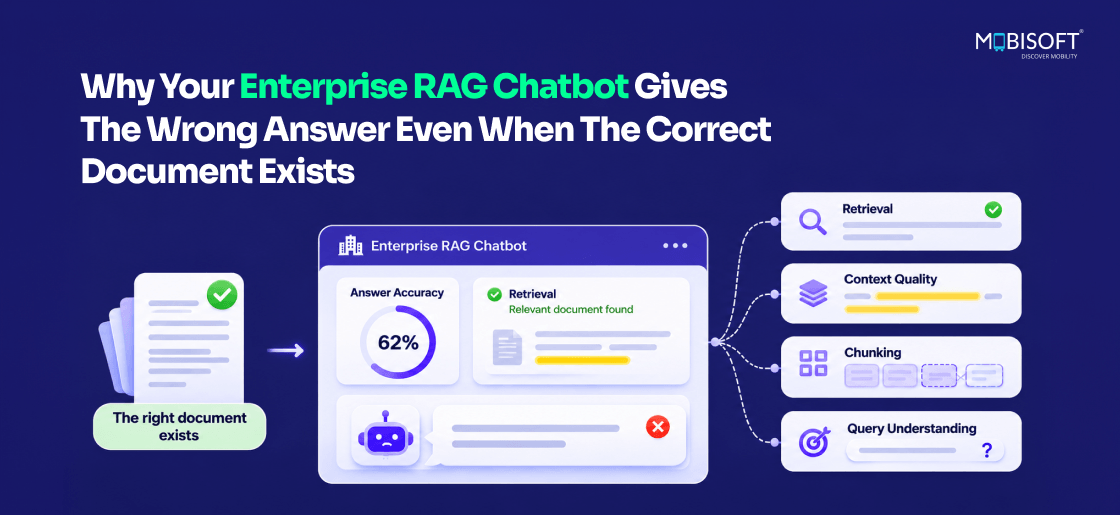
A RAG chatbot can quote a real document, cite it correctly, and still be wrong. The model didn't invent anything. It answered faithfully from a superseded policy, or from a commentary note that outranked the official source.
That's why RAG chatbot accuracy problems often don't start with the model. A new model or a stricter prompt leaves the ranking untouched. So the same wrong passage wins again.
In our AI chatbot development services, we trace a failing query before changing anything. Where did the correct document rank? Which chunk did the model actually read? Those two answers point to the real fix, whether it's metadata, chunking, or ranking.
This detailed blog explains the seven failure modes, using a simple test that separates retrieval errors and hallucinations. You can make use of the four-layer evaluation method, a three-stage audit, and a 12-week plan provided below. The ROI model near the end can be rerun with your own numbers.
Why Does A RAG Chatbot Give Incorrect Answers Even When The Correct Document Exists?
When the right document is in the index, RAG chatbot wrong answers often trace back to retrieval. Search may even find that document. But the model answers from a different, less reliable passage.
Why Does A RAG Chatbot Give Wrong Answers?
Picture a law firm's knowledge bot. A partner asks, "What's our standard liability cap?" The index holds the current 2024 template. It also holds a 2021 commentary note that quotes the old cap.
Search ranks the commentary third and the template fourth. The model answers from the commentary. So the partner gets the old figure, quoted from a real document.
Why The Wrong Passage Wins
A commentary note exists to explain things, so its sentences often read like the user's question. A template uses formal drafting language, which doesn't.
So the commentary scores closer in vector search. Which source should win when two documents disagree on a number? Without a rule, the friendlier text gets used. That's a RAG document retrieval problem, and better prompts alone rarely fix it.
Start With A Retrieval Audit
When a bot gets it wrong, the first instinct is often to add documents. We'd check the ranking first.
- Re-run the failing query and save the top five chunks.
- Note whether the correct document appears, and at what rank.
- Check whether that chunk holds the full answer or only part of it.
A typical audit note reads "correct doc at rank 4, answer taken from rank 3." That points to a ranking fix. Building your first bot instead? Our guide to conversational AI chatbot development covers the wider design process.
What Is The Difference Between Retrieval Failure And Hallucination?
A hallucination is content the model makes up. A retrieval failure is different. The statement is real, but it comes from the wrong source or from part of the right one. Both produce incorrect RAG responses, and they need very different fixes.
How To Tell Them Apart
Put the answer and the retrieved chunks side by side. Does every claim appear somewhere in those chunks? If it does, the model stayed faithful, and retrieval chose badly. If a claim isn't there, the model invented it.
| Question | Retrieval Failure | Hallucination |
| Is the claim in the retrieved text? | Yes, but from the wrong or partial source | No |
| Where's the fault? | Search, ranking, chunking, or filters | The generation step |
| What does the user see? | A confident answer with a real citation | A confident answer with no real basis |
| What fixes it? | Better chunking, reranking, metadata filters | Grounding rules, stricter prompts, refusal when unsure |
Why The Label Matters
It's tempting to call every wrong answer a hallucination. The usual response is a tighter prompt or a new model. But why replace a model that quoted its source faithfully? Neither step helps when that source was superseded.
We'd tag each failure before anyone changes code. A "retrieval, wrong version" tag sends the ticket to search. A "generation, unsupported claim" tag sends it to the prompt team. That's the practical core of RAG hallucination vs retrieval failure triage.
Faithfulness Is Only Half The Story
Answer faithfulness checks whether the retrieved context supports each claim in an answer. The open-source Ragas library scores it from 0 to 1. It's the share of claims the context backs up.
A perfect RAG answer faithfulness score of 1.0 can still hide a wrong answer. The model may have quoted the 2021 commentary perfectly. That's why we'd always pair faithfulness with retrieval checks. For the wider QA plan, see our guide to AI chatbot testing and evaluation.

What Causes Retrieval Failures In RAG Systems?
We'd check seven patterns when diagnosing RAG retrieval failures. They often appear together, so fixing one alone may not move accuracy much. Here's the full list, and five get a closer look below.
| Failure Mode | What Goes Wrong | Typical Symptom |
| Chunking misalignment | The answer is split across chunk boundaries | A correct figure missing its conditions |
| Embedding model mismatch | The model doesn't understand domain terms | Relevant documents ranked low |
| Vocabulary gap | Users ask in plain words, documents use jargon | The right policy never appears |
| Authority blindness | Ranking ignores source type and status | Commentary beats the official policy |
| Context overload | Too much text, or the answer buried mid-context | Answers ignore a chunk that was retrieved |
| Multi-hop failure | The answer needs several documents combined | Right in isolation, wrong in practice |
| Metadata and filter failure | No rules for version, region, or audience | An old or wrong-region document is used |
Chunking and context overload get their own section next. Reranking, which helps with several of these, follows after that.
Why Does RAG Retrieve The Wrong Document?
Vector search ranks text by meaning, measured as distance between embeddings. It doesn't know which document is current or official. So the usual answer is plain. Another passage matched the question better. "Closer in meaning" isn't the same as "correct".
Embedding Model Mismatch
General-purpose embedding models learn from broad web text. Specialist legal or clinical terms may be rare in that data. Take a query about "LLP member duties under the deed of adherence". It can land closer to generic partnership pages than to the deed itself.
We'd test two or three embedding models on your own queries first. Public leaderboards such as MTEB help with a shortlist. They can't tell you how a model handles your documents.
The Vocabulary Gap
Here, the embedding model may work fine. The user and the document just don't share words. A nurse asks, "What if a patient refuses treatment?" The protocol is titled "Informed Refusal and Capacity Assessment."
Keyword search catches exact terms, and vector search catches meaning. Running both together, known as hybrid search, narrows this gap. Query expansion helps too. One method, HyDE, has a model draft a sample answer. It then searches with that draft.
Authority Blindness And Version Errors
An enterprise RAG system may hold four versions of one policy. FAQs and emails about it add more noise. Similarity alone can't rank them. Add fields like "document_type", "status", and "effective_date" at ingestion. Then filter out superseded versions before ranking even starts.
Multi-Hop Questions
Some questions need three documents at once. Say a loan officer asks, "Can I approve this unsecured loan without a second signatory?" The answer needs the approval matrix. It also needs the current risk appetite and the income rules.
Search may return the matrix alone. The model then gives a number that's right on paper but wrong here. Query decomposition splits the question into parts and retrieves for each. Planning a larger build? Our generative AI development services include RAG systems built on your own documents.
How Does Document Chunking Affect RAG Accuracy?
Chunking decides what the model can read at once. When a chunk cuts an answer in half, retrieval cannot repair it. That makes chunking the first thing we'd review for RAG chatbot accuracy.
How A Split Changes The Answer
Take a clause that reads "The cap is $500,000, except in the cases listed below." Those listed cases carry a $2,000,000 cap. A fixed 512-token chunk may end right after "except in the cases". The exceptions land in the next chunk, with their own embedding.
A user asks, "What's our liability cap?" The first chunk matches, and the bot says $500,000. That figure is in the document. For many contracts, it is still the wrong answer.
Common RAG Chunking Strategies
Which chunk size is right? That depends on how your documents are built. Four approaches cover most needs.
- Fixed-size chunking splits text every few hundred tokens, often with some overlap. It works for short, uniform content such as FAQs.
- Structure-aware chunking splits on headings, clauses, and list items. It suits policies, contracts, and clinical protocols.
- Semantic chunking splits where the topic changes. It fits long reports and practice notes.
- Parent-document retrieval searches small chunks, then returns the larger section around the match. It keeps rules together with their conditions and exceptions.
These approaches can be mixed. We'd often pair structure-aware splits with parent-document retrieval for policy libraries.
More Context Isn't Always Better
Many current models accept hundreds of thousands of tokens. That doesn't mean they use all of it well. Liu and colleagues tested this in "Lost in the Middle", published in TACL in 2024. Models did best when key facts appeared at the start or end of the context. Accuracy dropped when the fact was buried in the middle.
Good RAG context retrieval sends fewer, better-ranked chunks instead of dozens. Put the strongest chunk first. Then give the prompt, the chat history, and the retrieved text a fixed token budget each.
How Does Reranking Improve Retrieval Quality?
First-pass search is fast but rough. It pulls a wide set of candidates, maybe 50 to 100 chunks. Reranking then reads each candidate against the question and reorders them. Only the top few reach the model, which makes this a high-value step in RAG pipeline optimization.
How A Reranker Works
Many rerankers are cross-encoders. Vector search compares two separate embeddings. A cross-encoder reads the question and the chunk together. That lets it catch detail that embeddings miss.
Why not rerank the whole index? Reading every chunk this way takes far too long. So we'd rerank a shortlist only. A sensible pattern is "retrieve 50, rerank, keep the top 5."
Hybrid Search Comes First
Reranking can only reorder what search found. If the right chunk isn't in the shortlist, no reranker will rescue it. That's why we'd run keyword search and vector search side by side.
Reciprocal rank fusion is a common way to merge the two lists. It rewards chunks that rank well in both. Exact codes matter here. A query for "policy HR-114" may only match through keyword search.
Add Authority And Recency Rules
Plain RAG reranking scores relevance. It still won't know that a policy outranks a commentary note. So we'd add a second step that weights results by source type and date. The rule might read "status=current, type=policy, weight 1.0".
Example Weights We'd Start From
- Current policy or signed template gets full weight.
- Official guidance gets slightly less.
- Commentary notes and FAQs get much less, and emails less again.
- Superseded versions are filtered out before ranking.
- Treat these as starting values. Test them against your own failing queries, then adjust.
What Reranking Won't Fix
A reranker can't repair a chunk that lost its conditions. It can't merge three documents into one answer either. So which problem do you have? The three-stage audit later in this guide tells you. Run it before you spend weeks tuning the wrong part.
Done well, these steps lift accuracy in the top three results. That's where it matters most.
Enterprise RAG Evaluation: Four Layers To Measure
Good evaluation works through four checks in order. First, confirm the right document is in the index. Then check that search finds it and that the model gets the right passage. Finally, check that the answer stays true to that passage.
The Four Layers
| Layer | What It Checks | Example Metric | Starting Target We'd Set | Failures It Catches |
| 1. Coverage | Is the answer document in the corpus? | Share of test questions with a source in the index | Above 95% | Missing or unindexed documents |
| 2. Retrieval | Is that document in the top results? | Hit rate at 3 (share of questions with the source in the top 3) | Above 85% at 3 | Embedding mismatch, vocabulary gap, authority blindness |
| 3. Passage | Is the right chunk ranked high? | Mean reciprocal rank (MRR) at 5 | Above 0.75 | Chunking errors, context overload |
| 4. Answer | Does the answer match the context? | Ragas faithfulness, plus correctness against the verified answer | Above 0.90 | Unsupported claims, multi-hop errors |
These targets are our own starting points. They aren't industry standards, so set yours once you've measured a baseline.
Build A Golden Dataset First
None of these RAG retrieval evaluation metrics work without a test set. We'd start with 200 to 500 real questions. Each one needs a verified answer and its source document.
Where The Questions Come From
- Pull most of them from real chat logs, including the ones users complained about.
- Have experts write extra questions for high-risk topics the logs don't cover.
- Mark each question as simple, multi-part, or version-sensitive.
A good entry pairs "What's the travel meal limit in Germany?" with "Expense Policy v7, section 4.2" as its source.
How To Improve Enterprise RAG Accuracy In The Right Order
That's why enterprise RAG evaluation runs layer by layer. Measure layer 2 before layer 4. If search misses the source, faithfulness tells you very little. A bot can be perfectly faithful to the wrong document.
Any plan to improve accuracy starts with the layer that fails. The four scores tell you where to spend effort. Run the full set again after every change, so a fix in one place doesn't break another.
How To Troubleshoot A RAG Pipeline: A Three-Stage Audit
A structured audit stops teams from guessing. Here's the routine we'd run. It suits any bot that users have stopped trusting.
Stage 1: Trace Every Failing Query
Take 50 to 100 queries users flagged as wrong. For each one, record four things.
- The top five chunks returned, with their scores.
- The rank of the correct document, or "not found".
- Whether the winning chunk held the full answer.
- Whether the final answer matched the winning chunk.
That last check separates generation errors from retrieval errors. The full trace takes a few minutes per query.
Stage 2: Tag Each Failure
Give every failing query one main tag from the seven failure modes. Add a second tag where two clearly overlap. After 50 queries, a pattern usually shows up. "Wrong version" might appear twenty times, while "multi-hop" appears twice. Tagging is the core of retrieval-augmented generation troubleshooting.
Stage 3: Fix In A Set Order
Fix the most frequent tag first, then re-run the golden dataset. Where several tags are common, this is the order we'd follow.
- Add a metadata schema and version filters. They remove superseded and wrong-audience documents before anything else runs.
- Re-chunk with structure-aware or parent-document splits. Any later tuning is wasted on broken chunks.
- Add hybrid search with authority-weighted reranking. This lifts the right source into the top three.
- Evaluate embedding models. A better model helps more once the chunks are clean.
- Add query decomposition for multi-hop questions. It's only worth the effort if those questions are common.
Why put embeddings fourth? Swapping models means re-indexing everything. Do it once chunking is settled, so you don't re-index twice.
Keep The Audit Running
RAG pipeline optimization isn't a one-off project. Documents change every week. We'd re-run the golden dataset after each content release. A note like "HR policy pack v9 published" is the trigger. Run it again before any model change.
Four Scenarios: Where Enterprise RAG Breaks
The four scenarios below are illustrations built from common patterns. They aren't client case studies, and the numbers in them are examples. Each one shows a different failure mode behind RAG chatbot accuracy problems.
Legal: Authority And Versions
A law firm's library holds several versions of most precedents. Commentary notes make up a large share of the index. Fee-earners start saying "it keeps quoting the old template."
What We'd Change
- Tag every record with its version and effective date at ingestion.
- Filter superseded versions out by default.
- Weight precedents above guidance, and guidance above commentary.
- Switch long precedents to structure-aware chunking.
Financial Services: Questions That Span Policies
A bank's compliance bot draws on its policy library and regulator guidance. It finds single documents well. Then a manager asks, "Can my team offer this product to existing customers?" That answer needs the regulator's rule and the internal policy. It also needs the team's own procedure.
So the bot answers from one document and misses the rest. These RAG retrieval failures come from questions that span sources. We'd route multi-part questions to query decomposition first. A knowledge graph linking rules to policies can follow, if those questions stay common.
Healthcare: Conditions Split From Actions
A hospital's protocol bot uses fixed-size chunks. One protocol reads "give drug B, unless condition C applies." The split lands between the action and the exception.
A nurse could get the action without the contraindication. That's a patient safety risk as well as an accuracy problem. We'd take clinical answers offline until each protocol passes clinician review. Of the RAG chunking strategies covered earlier, structure-aware splits with parent-document retrieval suit this best. They keep each condition with its action.
Clinical decision support can also fall under medical device rules in some markets. Your regulatory team should confirm the position before launch.
Retail: Old Products, New Questions
A retailer's service bot covers thousands of products. Its consumer guides use friendly language, while technical specs read more formally. Guides for discontinued products were never removed from the index.
An agent asks, "Does the X200 support wall mounting?" The bot answers from the X100 guide. That's a metadata gap in an enterprise RAG system. We'd tag each document with its SKU and product status at ingestion. Then every search would default to current products.
ROI Model: Fixing A Chatbot Users Stopped Trusting
This worked example uses illustrative numbers. It isn't a quote or a promised outcome. Swap in your own figures before you use it.
The Starting Point
Picture an advisory firm with 200 consultants. Its knowledge bot has been live for nine months. Of the 150 people who tried it, 60 have gone back to manual search. "I can't trust it on anything client-facing" is the common reason.
- Each returning user would save about 20 minutes a day.
- Staff time is priced at a $90 hourly cost. We've avoided the billing rate, which would inflate the result.
- About 10 incorrect RAG responses a week reach client work. Each one takes 2 hours to correct.
- The year has 220 working days.
What The Fix Costs
The program runs for 12 weeks. It covers the audit and a golden dataset, then the chunking and ranking fixes.
| Item | Calculation | Cost |
| Engineering | 2 engineers × 60 days × $500 a day | $60,000 |
| Expert time for the golden dataset | 15 days × 8 hours × $90 | $10,800 |
| Re-indexing and testing compute | Estimate | $6,000 |
| One-time total | $76,800 | |
| Ongoing monitoring and reranker costs | Estimate per year | $26,000 |
What It Returns
How many lapsed users will return? We've assumed 60%, so 36 people. We've also assumed client-facing errors fall by half.
| Benefit | Calculation | Annual Value |
| Time recovered | 36 users × 20 minutes × 220 days × $90 an hour | $237,600 |
| Fewer corrections | 520 errors × 2 hours × $90 × 50% reduction | $46,800 |
| Total | $284,400 |
The Payback
Why only nine months of benefit in Year 1? The fixes take the first 12 weeks. After the build and nine months of running costs, Year 1 still nets about $117,000.
From Year 2, the net benefit is about $258,400 a year. The one-time cost pays back in about 3.6 months after go-live.
Where The Numbers Get Shaky
- If only 30% of lapsed users return, annual value drops to about $165,600. Payback stretches to about 6.6 months.
- Don't expect users to come back on their own. A visible relaunch with a feedback button helps rebuild trust.
- Time saved only counts if people spend it on billable or useful work.
- The error count comes from what users report. Unreported errors would make the real figure higher.
The model leaves out reputational risk from a wrong client answer. That risk may matter more than the savings.
A 12-Week Plan To Improve RAG Chatbot Accuracy
Each phase ends with a measured result. The timings are planning estimates for one bot and one document library.
Weeks 1 To 2: Assessment
- Build the golden dataset from chat logs and expert questions.
- Score all four evaluation layers to set a baseline.
- Trace and tag the 50 to 100 worst failing queries.
The output is a one-page summary. It ranks the failure tags and names the first fix.
Weeks 3 To 6: Corpus And Chunking
- Design the metadata schema, then re-ingest documents with it.
- Archive superseded versions, so they can't be retrieved.
- Re-chunk long documents with structure-aware or parent-document splits.
Re-run the golden dataset at the end of week 6. Did passage scores move? If they didn't, check the chunking before going further.
Weeks 7 To 10: Retrieval
- Add keyword search beside vector search and merge the results.
- Add RAG reranking, then authority and recency weights.
- Test two or three embedding models on the golden dataset.
- Add query decomposition if multi-part questions aren't rare.
Weeks 11 To 12: Validation And Handover
Domain experts review a sample of answers in high-risk areas. They'll flag anything that doesn't match its source. Then the team sets alert thresholds for each layer. A drop below "hit rate at 3 of 85%" should trigger a review.
We'd relaunch the bot with a short note on what changed. A feedback button on every answer keeps the golden dataset growing.
How Mobisoft Infotech Helps
We build RAG chatbots that read your PDFs, SOPs, wikis, and tickets, so answers stay grounded in your own data. To limit wrong answers, we use grounding, guardrails, classifiers, and safe fallback logic. We also tune prompts for each domain.
Testing And Ongoing Optimization
Before launch, our testing and QA step checks responses, performance, and security under real-use scenarios. After launch, we track accuracy, resolution time, and user sentiment. You get dashboards and monthly improvements based on what the data shows.
For an existing bot, we'd begin with the retrieval audit in this guide. Its results show which part of RAG document retrieval needs work first.
Ongoing Support
- Monthly support covers model updates, new workflows, and technical fixes.
- Performance monitoring continues after go-live.
- Integrations connect the bot to your CRM, helpdesk, or internal systems.
Fix Retrieval Before You Change The Model
A wrong answer with a real citation is a retrieval problem until proven otherwise. The model read what it was given. So the work starts with what reaches it, and in what order.
Three steps fit inside this month.
- Pull 50 flagged answers from last month's logs, and record where the correct document ranked for each.
- List every document type in your index, and mark which ones are authoritative and which are superseded.
- Ask experts in your highest-risk topic to write the first 100 golden questions, each with its source.
The rank data shows whether you're facing a RAG retrieval accuracy problem or a generation one. The document list becomes your metadata schema. The golden questions give you a baseline to measure every fix against.

Frequently Asked Questions
What does Mobisoft Infotech need from us for an audit?
You'd share fifty flagged answers from last month's logs. We'd also need your document types, with each one's status. Experts add a hundred questions with sources. We trace and tag every failure, then send a one-page summary.
How do we build a golden dataset without chat logs?
Borrow questions from places where people already ask them. Old helpdesk tickets and intranet search logs both work. Then have experts write extra questions on high-risk topics, since logs rarely cover those. Tag each by type, so your enterprise RAG evaluation doesn't miss the hard ones.
Our files carry no version data. Where do we start?
Pull what exists already. Filenames and document footers often hold a date or status, and last-modified dates fill gaps. Tag the 100 most-queried documents by hand first. That's the fastest way to improve RAG retrieval accuracy before a full clean-up.
How do we stop answers from the wrong region?
Add region and audience fields at ingestion. Then filter by the user's profile before ranking starts. An employee in Germany asking about meal limits never sees the UK policy. Keep a global fallback document, so nobody's left with an empty reply.
How can our users spot a wrong version themselves?
Show each source's status and date beside every citation. A reader seeing "Expense Policy v6, superseded" knows to doubt the reply. It also makes RAG chatbot wrong answers easier to report. A feedback button then feeds those reports into your test set.
Do we need to re-index everything if we change chunking?
Yes, a new split needs fresh embeddings. Build the new index beside the old one. Run your golden dataset against both, then switch traffic once passage scores improve. Settle your RAG chunking strategies before testing embedding models, so you'll only re-index once.
How will Mobisoft Infotech track our accuracy after launch?
Dashboards track accuracy and user sentiment across every topic. Monthly improvements come from what the data shows. We'd re-run your test questions after each content release and before any model swap. That keeps RAG chatbot accuracy from sliding as documents change.
This content is for informational purposes only and may include AI-assisted research or content generation. While we strive for accuracy, information may evolve over time. Readers are advised to independently verify critical information before making decisions.

Nitin Lahoti
Read more
Nitin Lahoti is the Co-Founder and Director at Mobisoft Infotech. He has 15 years of experience in Design, Business Development and Startups. His expertise is in Product Ideation, UX/UI design, Startup consulting and mentoring. He prefers business readings and loves traveling.
 Nitin Lahoti
 November 13, 2026