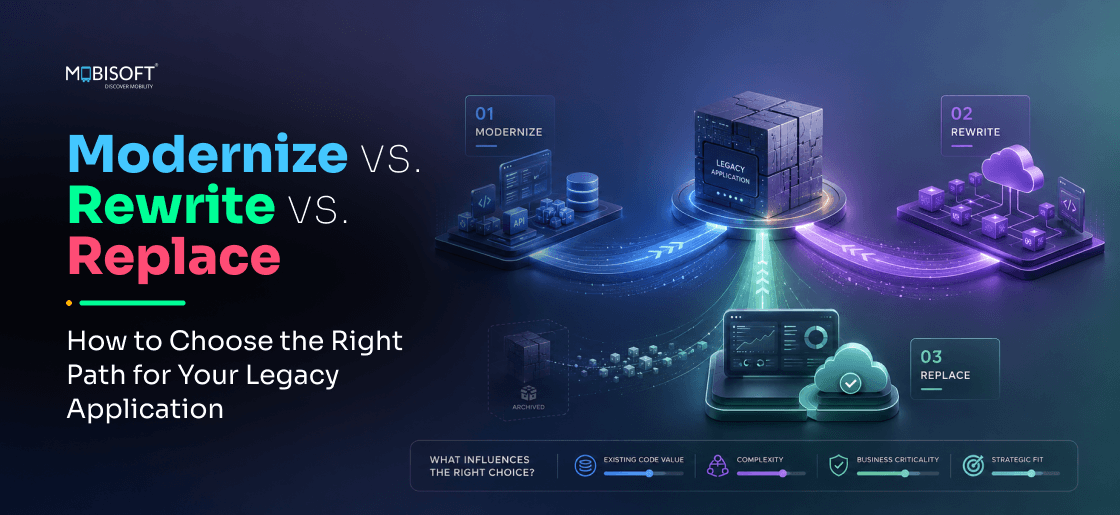
Every organization running an aging system eventually faces the same choice. You can modernize the application step by step. You can rewrite it from scratch, or replace it entirely. This decision defines the next several years of engineering roadmap, budget, and risk.
AI tools have compressed discovery and testing, two phases that once made Legacy application modernization expensive. That change makes gradual modernization more competitive against a full rewrite. The old argument that starting over costs less holds true less often now.
Choosing between these paths without real analysis leads teams toward the safest-feeling option. It rarely leads them toward the option that actually fits their needs. A team frustrated by old code often leans toward a rewrite. A team under real pressure often defaults to whatever looks fastest. This guide walks through the signals separating a right call from a guess. It shows where a solid strategy saves time and money.
The Assessment That Makes The Right Choice Clear
Most organizations choose the wrong path because they decide before they assess. A few patterns show up again and again:
- A team stuck with a frustrating system often pushes for a rewrite, but it simply wants out.
- A team that skips a real technical review leans toward a commercial product. It underestimates the custom work still needed.
- Pressure to move fast pushes some teams toward whatever choice feels quickest. It cannot always deliver what the business needs.
The right path depends on what the system actually looks like. It does not depend on how tired the team feels of maintaining it. A proper technical assessment now takes two to four weeks with AI-assisted analysis. That is down from six to ten weeks. It produces the evidence that makes the decision obvious. A sound application modernization strategy actually starts here.
Four Signals That Determine The Right Path
Four factors consistently separate teams that choose correctly from teams that guess. Each signal points toward a different path depending on what the assessment finds.
Business Logic Value
Business logic value matters first. A system encoding ten-plus years of refined domain rules holds real value. That value is worth preserving carefully. A system with basic or fully documented logic carries far less risk if rebuilt. Somewhere between these two, a commercial product may already encode equivalent rules. This applies to common functions like accounting or HR.
System Size And Complexity
System size and complexity come next.
- Systems above 150,000 lines of code with ten or more modules usually favor extraction.
- Heavy integration adds further risk to a single rebuild.
- Smaller systems, under 75,000 lines with limited integrations, can complete within eighteen months.
Any enterprise application modernization effort at this scale needs the same read. Size determines the safest path first.
Legacy Knowledge Availability
Legacy knowledge availability sets the risk profile directly. A team that partially understands its system can safely extract capabilities piece by piece. This holds even when AI-assisted analysis fills documentation gaps. A system with no remaining institutional knowledge leaves a rewrite team guessing. Nobody can confirm what behavior an undocumented system actually needs.
Business Continuity Requirements
Business continuity requirements close the list. Systems that cannot tolerate downtime favor an incremental approach. That approach keeps production running throughout. Systems that can tolerate a cutover window open up rewrite or replace as options.
| Signal | Points To Modernize | Points To Rewrite | Points To Replace |
| Business logic value | High: ten-plus years of refined domain rules | Low: basic or outdated logic, easy to replicate | Variable: commercial product may cover equivalent rules |
| System size | Complex, over 150K LOC, tight coupling | Small, under 75K LOC, limited integrations | Independent of size, product handles domain complexity |
| Legacy knowledge | Partial, AI analysis fills gaps | None: original engineers and documentation gone | Not applicable, vendor supplies documentation |
| Business continuity | Zero tolerance for downtime | Can tolerate a defined cutover period | Depends on vendor migration path |
AI-Assisted Assessment Timelines In 2026
Generating this assessment data used to take six to ten weeks. That was senior engineering time. AI analysis tools now compress that work into two to three weeks. They do not replace expert judgment, though. They automate the slow data collection that judgment depends on.
- Codebase complexity analysis: two to four weeks manually. Now four to eight hours with automated scanning.
- Business logic mapping: three to five weeks of manual reading. Now three to five days, with AI locating the valuable rules.
- Integration discovery: two to three weeks of manual tracing. Now three to five days of combined AI and human review.
- Legacy knowledge recovery: four to eight weeks of interviews. Now two to three weeks, with AI-generated summaries for engineers to review.
- Commercial product fit analysis: two to four weeks before. Now one to two weeks with structured, AI-assisted evaluation.
Combined, total assessment time drops from twelve to twenty-four weeks. It now runs four to six weeks. That is a forty to sixty percent time saving, with equal or better coverage.
Why Teams Pick The Wrong Path
Skipping the assessment step is the single biggest cause of a bad decision. Teams choosing based on frustration or a slick demo discover the real cost late. That discovery happens only after committing budget and headcount. Data from a proper assessment removes guesswork from a decision. Otherwise, that decision gets made on gut feeling. A disciplined legacy system modernization review catches this before it costs real money.
The Modernize Path: Incremental Renewal
Incremental legacy application modernization usually builds around the Strangler Fig pattern. It is the path recommended most often for complex systems. It carries the lowest failure rate and keeps the business running. It also delivers value in three to six months, not eighteen to twenty-four. AI tools have made this path faster and cheaper than before. That progress addresses the two costs that once favored a rewrite.
When Modernization Fits Your System
Several conditions point clearly toward this path:
- Code that encodes domain rules holds real business logic value. Regulatory requirements add to that value too. Careful, incremental extraction beats a risky rebuild.
- Replacing a system above 100,000 lines in one attempt carries very high failure risk. Extracting pieces gradually limits risk to each iteration's scope.
- Customers transacting on the system in real time make a full cutover commercially unacceptable. This is where modernization proves its value. The Strangler Fig approach keeps the legacy system live by design.
- Incomplete understanding of the legacy codebase still enables safer extraction. AI-assisted analysis filling documentation gaps helps more than starting from zero.
The Strangler Fig Approach With AI
The Strangler Fig pattern itself has not changed. It extracts one capability at a time. The legacy system keeps serving production traffic throughout. What AI changes is the cost and calendar time of each extraction cycle.
A traditional per-service extraction used to run twelve to twenty weeks. That covers codebase analysis and a behavioral test suite. It also covers new service implementation, documentation, and a careful cutover. AI-assisted extraction compresses that same cycle to roughly six to eleven weeks:
- Boundary analysis: two to three weeks, now three to five days.
- Test suite generation: three to five weeks, now one to two weeks.
- New service development: four to six weeks, now three to four weeks.
- Documentation generation: one to two weeks, now two to three days.
This compressed cycle is what makes digital product development services realistic on a shorter budget. Across a fifteen-service migration, that difference compounds. Traditional effort totals 180 to 300 engineering weeks. That is roughly three and a half to nearly six years. AI-assisted effort totals 90 to 165 weeks, closer to two to three years. That saves roughly 35% in time and cost.
What AI Does Not Change
Being clear about limitations matters as much as citing the savings.
- Service boundary decisions still require domain-driven design expertise that no tool can replace. Coupling data now arrives in hours instead of weeks.
- Data architecture migration remains one of the hardest problems in modernization. This is core to any real legacy system modernization effort at scale.
- Business logic validation also stays human. AI-generated tests confirm a new service behaves like the old one. They cannot confirm the old one was correct.
- Organizational change needs the same budget and time as always. This includes team restructuring and on-call ownership.
Modernization Cost By System Size
Cost scales predictably with system size. AI-assisted delivery reduces cost across every tier by roughly thirty percent.
| System Size | AI-Assisted Cost | Timeline |
| Small (under 75K lines, 4-6 services) | $280,000 to $1.4 million | 9-18 months |
| Medium (75K-350K lines) | $1.4 million to $7 million | 18-36 months |
| Large (350K+ lines, 15+ services) | $4.9 million to $24.5 million | 3-6 years |
| COBOL / mainframe | $1.5 million to $20 million | Varies by scale |
At large scale, size amplifies every AI saving. COBOL and mainframe systems see the deepest reduction, roughly thirty five percent. Automated translation tools handle a significant share of the conversion.
Organizations often weigh a modernization programme against ongoing technical debt. Strong Legacy software maintenance keeps the current system stable while that decision gets made. This buys time to plan the next step without added risk. Delaying the decision does not have to mean losing stability.
The Rewrite Path: Starting Fresh And Its Risks
A full rewrite means rebuilding the application from scratch with modern technology. It sounds like the most satisfying answer. It fails most often at scale, though. Engineers dislike legacy code, and the appeal of a clean slate is real. The problem is that legacy systems hold more complexity than the code reveals. Bugs that look like bugs are often intentional. They are business rules built for edge cases nobody remembers anymore.
AI tools have genuinely improved rewrite economics. GitHub Copilot and similar tools deliver real productivity gains. That gain runs twenty five to thirty five percent on greenfield development. What AI has not changed is the fundamental risk. The behavioral specification challenge remains, along with parallel running needs. The organizational cost of a delayed cutover remains too.
The Behavioral Specification Problem
Most rewrites fail or overrun for one reason. The team cannot fully specify what the legacy system does before starting the build.
- Business rules encoded as data patterns: A rate table might apply only for a certain digit. Code analysis alone cannot surface that pattern. Someone has to know why it exists.
- Timing-dependent behavior: A system might process month-end differently due to an old regulatory change. Static analysis will never reveal that reasoning.
- Integration side effects: A pricing API call might generate an audit record. A compliance system needs that record. The dependency stays invisible until it breaks after launch.
- Performance-critical edge cases: A query might run fine for most accounts. It might need a different code path above ten thousand transactions. It will pass every test until it meets production data.
Rewrite vs refactor debates inside engineering teams often miss this exact risk. Refactoring at least preserves behavior. A rewrite must rediscover that behavior from scratch.
When A Rewrite Is The Right Call
A rewrite earns its place when several signals line up together. It should never rest on just one signal alone.
- The system should be small enough to finish in eighteen months. That means under 50,000 to 75,000 meaningful lines. Programmes that cannot complete within that window carry over a seventy percent failure rate.
- Original engineers are gone, and documentation does not exist. Code may also be too obfuscated for AI analysis to summarize usefully. The cost of learning the system can exceed writing fresh requirements.
- What the business needs today looks nothing like the legacy system. The behavioral specification problem mostly disappears. The team builds to new requirements instead of reverse-engineering old ones.
- Few or no integrations reduce the scope growth that sinks most rewrite budgets.
How AI Changes Rewrite Economics
AI tools help meaningfully with development speed. They barely touch the riskiest phases of a rewrite.
| Rewrite Phase | Share Of Budget | AI Saving |
| Behavioral specification | 20-30% | Modest 15-20%, since validation still needs a domain expert |
| Architecture and design | 8-12% | About 25%, through AI-assisted documentation |
| Development of new system | 35-45% | Largest gain, roughly 28% |
| Comprehensive testing | 15-20% | About 30% through automated test generation |
| Parallel running and migration | 13-25% | Modest gains only |
| Change management and cutover | 5-10% | None, this stays entirely human work |
Teams often weigh an internal build against outside support. Experienced enterprise software development partners bring capacity that internal teams often cannot spare. A rewrite this size moves faster with sustained senior engineering attention. That attention is exactly what a specialized partner provides.
Five Disciplines Successful Rewrites Share
Programmes that succeed share five habits regardless of which AI tools they use:
- Box the scope to eighteen months maximum, from a completed specification to production. Split anything larger into phases instead of extending the timeline.
- Write the full behavioral specification before any new code. That typically takes two to four months for a medium system. A domain expert validates every item.
- Keep the legacy system under a preventive maintenance strategy throughout. Any new feature added during the rewrite becomes extra scope.
- Build a comparison test suite against the legacy system before development starts. Both systems then run on the same inputs, with outputs checked against each other.
- Plan and fund four to eight weeks of parallel running with real transaction comparison. This step catches behavioral differences that slipped past the specification.
The Replace Path: Commercial Products And SaaS
Replacing a legacy system with a commercial product is often the smartest economic choice. This applies to functions that do not differentiate the business. ERP, CRM, HR, and accounting software are utility functions in most industries. A well-maintained commercial product often delivers stronger functionality at lower cost. Sometimes a gap analysis points toward significant custom code instead. That finding often moves the conversation toward custom web application development. This happens especially when core workflows do not match any commercial product well. The catch is that organizations consistently underestimate the customization they will still need.
The Eighty Percent Rule And Its Limits
Standard guidance sets a bar for evaluation. A product should cover eighty percent or more of requirements, uncustomized. The rule holds up well in practice. The mistake is applying it to the pre-implementation requirements list. Requirements discovered during implementation get overlooked instead.
- Integration requirements are the most common blind spot. Twenty years of connections to partners and systems rarely make the original list. They typically add 30% to 40% of the project budget.
- Data migration complexity follows close behind. A legacy schema rarely maps cleanly to a commercial product's schema. Field mapping alone often becomes 25% to 40% of total project cost.
- Business process changes add real organizational work. Commercial products impose their own process model rather than adapting to yours.
- Regulatory and audit requirements round out the risk. Regulated industries often find 20% to 30% of standard functionality needs custom work.
Where AI Helps Replacement Projects
Commercial enterprise application modernization is the path where AI has the smallest impact. The highest costs are license fees, vendor implementation, and process change. No tool compresses those costs.
- Requirements gap analysis moves twenty to thirty percent faster with AI-assisted comparison scoring.
- Data migration to the commercial schema sees real gains too. Standard field mappings drop thirty to forty percent. Complex custom fields still need manual work, though. This is exactly where internal engineering capacity gets stretched thin.
- Integration rebuilding runs twenty five to thirty percent faster with copilot-assisted development. It does not reduce the actual number of integrations needing rebuilding.
- Custom gap-fill development for the remaining twenty percent also speeds up. That gain runs twenty five to thirty percent faster.
- Training material development sees the largest single gain. It runs forty to fifty percent faster through AI-generated documentation and guides.
License fees and vendor implementation pricing see no AI impact at all. Vendor pricing stays fixed by contract regardless of team efficiency. Process redesign and change management see zero impact too. That work stays entirely organizational. When customization debt outweighs the savings, this is not worth carrying forward.
Hidden Costs Vendors Rarely Mention
Data migration reality
Moving historical data to a packaged schema costs more than expected. AI tools help with the mechanics of data transfer. They do not simplify decisions about historical data retention or archive strategy. Budget twenty to forty percent of project cost for migration.
Customization debt
A product that felt like an eighty percent fit at launch often needs rework. That rework hits at every major release. Once customization scope passes fifteen percent of functionality, watch closely. Five-year total cost of ownership may then exceed a custom build's price.
Integration scope growth
What gets discovered during implementation is always larger. The requirements phase never captures the full scope.
Vendor roadmap dependency
Features your business needs may sit on a vendor's three-year plan.
Process change resistance
Users attached to old workflows resist new ones. Managing it is not optional. AI tools do nothing to reduce that particular cost.
Modernize Vs Rewrite Vs Replace: The Full Comparison
With the economics laid out, a side-by-side comparison makes trade-offs concrete. Every decision dimension worth weighing gets covered. This is where an application modernization approaches discussion usually gets easier. Abstract principles turn into numbers that map directly to your own system.
The Primary Decision Matrix
| Dimension | Modernize | Rewrite | Replace |
| Risk level | Low-Medium, rollback available | Very high, big-bang delivery | Medium, migration and vendor risk |
| Time to first value | 3-5 months | 18-24 months minimum | 6-12 months typical |
| Business continuity | Excellent, no forced cutover | Poor, requires full cutover | Medium, phased migration possible |
| Long-term control | High, you own the system | High, you own the system | Low, vendor controls roadmap |
Business logic preservation favors modernization clearly. Incremental extraction preserves and updates logic as it moves. A rewrite carries real risk here, since a specification gap only surfaces after launch. A commercial product simply replaces your logic with its own. That outcome is for better or worse depending on fit.
Which Path Actually Costs Least
The honest answer depends heavily on the situation, not a single universal ranking.
- Complex, large system with valuable business logic: AI-assisted modernization wins on cost, risk, and time. It typically runs $1.4 million to $7 million. A comparable rewrite runs $2.1 million to $12.6 million.
- Small, isolated system with no remaining knowledge: A tightly boxed rewrite can undercut modernization on cost. This applies especially with changed requirements. Modernization remains the safer choice whenever any legacy knowledge survives.
- Non-differentiating function with mature commercial alternatives: Replace wins only when fit is genuinely eighty percent or higher. Customization can steadily erase the apparent savings. Five-year total cost of ownership matters here too.
- Large mainframe or COBOL systems: AI-assisted modernization is consistently the strongest choice here. Rewrite risk at that scale is extreme. Commercial replacement rarely exists for genuinely differentiated core systems. This is where a disciplined application modernization strategy earns back its cost fastest.
Red Flags You Are Choosing Wrong
A handful of warning signs reliably flag a bad application modernization strategy:
- Choosing rewrite because engineers dislike legacy code is just a developer experience complaint. It is not an architecture signal, and it deserves modernization instead.
- Choosing rewrite for any system above 150,000 lines ignores a real scaling relationship. The behavioral specification problem grows linearly with system size.
- Choosing replace without a comprehensive requirements gap analysis is a common trap. A shallow requirements list consistently underestimates needed customization.
- Choosing replace because a vendor demo looked impressive is equally risky. Demos show the eighty percent that works flawlessly. They never show the twenty percent needing custom development.
Six Legacy Scenarios And What We Recommend
Abstract frameworks help, but concrete situations make the decision real. These common patterns illustrate how the signals above translate into an actual recommendation.
Large, Complex, Business-Critical Systems
A twenty-year COBOL banking core runs 400,000 lines with twenty five or more integrations. A shrinking pool of engineers still understands it. This calls for AI-assisted modernization through the Strangler Fig pattern. A system at this scale cannot be rewritten safely. Commercial banking cores are typically too generic for a differentiated institution. Automated translation tools handle a meaningful share of legacy code conversion. That cuts cost by roughly thirty five percent as each component retires. This scenario shows enterprise application modernization at its most demanding.
A legacy PHP monolith running a B2B SaaS product fits the same pattern. It spans roughly 180,000 lines across eight bounded domains. A twenty-engineer team already releases monthly. It is too large to rewrite safely, and the team needs independent deployment soon. AI-assisted rearchitecting toward microservices typically targets fifteen services. Coupling analysis identifies the natural service boundaries. Delivery runs over roughly two years.
Small, Isolated, Poorly Documented Systems
An abandoned startup application runs 35,000 lines of Node.js. It has no original engineers and no documentation. It is genuinely small enough for an eighteen-month scoped rewrite. Modern AI-assisted development can run throughout. If the domain has no real differentiation, mature commercial alternatives are worth evaluating first.
An internal reporting tool used by a dozen analysts is small and read-only. Source data is already available through an API. It is a strong candidate for either path. A scoped rewrite might run sixty to a hundred and twenty thousand dollars. A commercial analytics platform might run thirty to eighty thousand dollars a year. That covers licensing and configuration. Replace usually wins here unless the custom analysis logic is genuinely unique.
Non-Differentiating Utility Functions
An ERP system from 2004 runs heavily customized code, roughly forty percent custom. It has fifteen integrations and significant annual maintenance cost. It needs careful evaluation between replace and application modernization approaches. At that customization level, much original product value sits buried under custom work. The migration risk of full replacement is real too. If gap-fill code would stay under twenty percent of replacement cost, replace makes sense. Above thirty percent, modernizing just the custom components is usually the better call.
An HR system critical for payroll runs roughly 120,000 lines of aging Java. It has no test coverage. One engineer who understands it is about to leave. This needs urgent knowledge recovery before anything else. An immediate documentation sprint captures what remains. Automated test generation builds a safety net. Incremental refactoring follows from there. Full rearchitecting to services becomes a later phase. That phase begins once the immediate knowledge risk is addressed.
How AI Availability Changes The Decision Itself
AI tools do more than speed up execution once a path is chosen. They have measurably changed which path is correct in certain situations. This happens particularly by making modernization more competitive against rewriting.
The Cost Parity Change
The traditional case for rewriting a medium-small system rested on cost. Discovery, testing, and incremental extraction cost enough that starting fresh looked cheaper. AI compresses discovery by forty to sixty percent. It compresses test generation by fifty to sixty five percent. Those are the two cost factors that once made modernization pricier. The crossover point where rewriting becomes cheaper has moved meaningfully upward in system size.
- Under 25,000 lines: still usually favors a rewrite. Acceleration benefits both paths roughly equally here.
- 25,000 to 75,000 lines: rewrite is now only sometimes cheaper. This holds only when no legacy knowledge survives with a realistic eighteen-month window.
- Above 150,000 lines: AI-assisted modernization is strongly preferred regardless of tooling. Rewrite risk at that scale stays too high either way.
The Speed Parity Change
A second traditional argument favored rewriting on pure speed. Incremental modernization might take three years. A rebuild finishes in eighteen months by comparison. AI has compressed both timelines. It compresses modernization proportionally more, though. The phases AI helps most with show up more heavily there.
A medium system now sees first value in three to four months. It completes in twenty to twenty eight months rather than thirty to forty two. The rewrite timeline sits at fourteen to twenty months for a well-scoped programme. The old gap of thirty months against eighteen has narrowed. It now sits at roughly twenty four against sixteen. That is a real win for legacy system modernization timelines.
Where AI Still Does Not Move The Needle
Two factors remain untouched by AI availability. They should still push a decision toward rewrite when genuinely present:
- A true absence of legacy knowledge is one factor. No engineer understands the system, and AI analysis cannot summarize obfuscated code. That keeps discovery costs high no matter which tools get used.
- Completely changed requirements matter just as much. Building to new needs beats recovering old behavior, and the specification problem largely disappears.
How Mobisoft Helps You Choose With Evidence
The decision to modernize, rewrite, or replace deserves an assessment before a recommendation. It should never happen the other way around. Evidence comes first. The recommendation follows what the data actually shows about the system and situation.
The Assessment Process
- AI-powered codebase analysis runs before the first engineering meeting even happens. It surfaces complexity, coupling, and technical debt automatically.
- Semantic code search maps business logic and integration points. It produces AI-generated module summaries that engineers then validate.
- Commercial product gap analysis applies when replacement is genuinely in scope. It scores requirements against alternatives.
- Structured, AI-assisted comparison replaces the usual vendor pitch deck.
A real legacy application modernization strategy applies this same rigor. No recommendation ships without it. Total cost of ownership gets modeled for every viable path. This gets grounded in what the assessment actually found rather than industry averages. The final recommendation comes with documented reasoning. It is not the answer a client wants, but the one the evidence supports.
What You Get At The End
Assessment cost typically runs twenty to a hundred thousand dollars. Size and scope set that range. It completes in three to five weeks, with AI-assisted analysis running throughout. The output includes:
- A three-path comparison with AI-adjusted cost models for each viable option.
- A risk profile comparison across all three paths.
- A documented recommendation listing the evidence behind it.
Teams considering a broader rebuild sometimes also need support scoping a companion system. This applies alongside the legacy application itself. Outside engineering capacity planning often becomes part of that same conversation. That happens once the primary system's path is settled.
Making The Decision That Actually Fits Your System
Legacy application modernization strategy succeeds when the decision follows evidence rather than fatigue. AI-assisted assessment tools make that evidence available faster and cheaper than ever. Business logic value, system size, and legacy knowledge still determine the right path. Business continuity needs matter too. None of that has changed. What changed is how fast that evidence now arrives. AI-assisted delivery also compresses the cost of whichever path fits your system.
A team that skips the assessment is choosing instinct dressed up as strategy. Getting the assessment right is the highest-leverage step here. Do it before budget or headcount gets committed. The path that feels easiest today rarely holds up well three years later. Ask what your system actually needs. Then ask what feels satisfying to build. That question alone prevents most of the expensive mistakes covered here.

Frequently Asked Questions
What is the actual difference between modernization and refactoring?
Refactoring cleans up code without changing what it does or how it is built. Legacy application modernization goes further, changing the underlying architecture itself. You keep the business logic while the platform underneath it changes.
Does modernization work for very large or highly regulated systems?
Yes, and scale is often the strongest argument for it over a rewrite. Enterprise application modernization handles regulatory complexity and heavy integration loads without a risky cutover. The system stays compliant and operational throughout the process.
Is a rewrite ever cheaper than modernizing?
Occasionally, but only for small, isolated systems with little institutional knowledge left. Most rewrite vs refactor comparisons favor modernization once a system passes a certain size. Cost estimates for a full rewrite also tend to run well past initial projections.
How do teams typically combine modernization, rewrite, and replace strategies?
Many programmes are not just one path chosen once. Teams often mix application modernization approaches, replacing one function while modernizing the core. The combination usually reflects what each part of the system actually needs.
Where does Mobisoft fit into planning a modernization roadmap?
Mobisoft runs the assessment that turns this decision from a guess into evidence. That groundwork shapes a realistic legacy application modernization strategy before any code changes. The recommendation reflects what your system needs, not a default answer.
This content is for informational purposes only and may include AI-assisted research or content generation. While we strive for accuracy, information may evolve over time. Readers are advised to independently verify critical information before making decisions.

Nitin Lahoti
Read more
Nitin Lahoti is the Co-Founder and Director at Mobisoft Infotech. He has 15 years of experience in Design, Business Development and Startups. His expertise is in Product Ideation, UX/UI design, Startup consulting and mentoring. He prefers business readings and loves traveling.
 Nitin Lahoti
 August 26, 2026