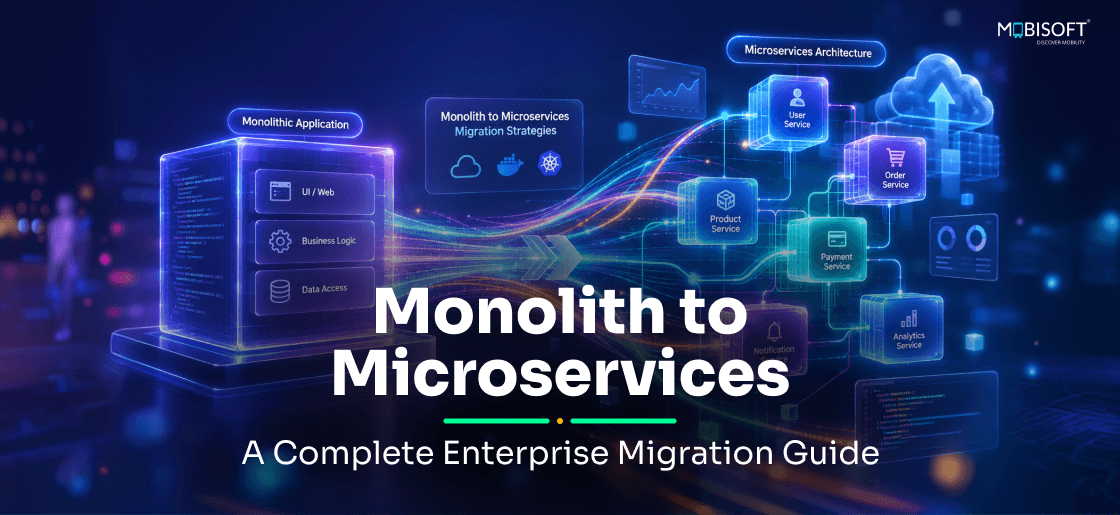
Enterprises everywhere are stuck with systems that once worked fine. A recent IDC study found something striking. Seventy-two percent of enterprises name monolithic architecture as their top constraint on transformation. That number explains why leaders now treat monolith to microservices migration as planned work. It is not a side project chosen to follow trends. Real, specific problems drive this decision instead. Deployment coupling slows releases down considerably. Team coordination overhead grows with every new feature shipped. Component scaling constraints waste infrastructure spend month after month. Each problem has a specific fix. Microservices architecture solves them only when applied correctly.
This guide walks through the decision, the method, and the real costs involved. It covers domain-driven design, the Strangler Fig extraction pattern, and the data layer. Organizational shifts that decide whether a migration succeeds get equal attention too. Getting software product modernization services right from the start prevents a stalled transition. AI tools have changed migration economics considerably, cutting both cost and timeline. The underlying discipline required, though, has not changed at all. That discipline starts with one honest question, asked before any code gets written today.
Why Monolith To Microservices Migration Fails Before It Starts
Most failed migrations share one root cause. Teams chase an architecture instead of solving a problem. The reason is rarely the technology itself.
The Problem Statement Test
A migration should start with a specific complaint. Teams that cannot deploy independently have a real problem. Teams that cannot scale one component alone face a real problem too. Teams blocked by another team's release schedule share that same issue.
Compare that to a vague line like "we should have microservices." It says nothing. Before any monolith to microservices migration strategy gets written, list the exact pain points. If nobody can name one clearly, the programme is not ready yet.
Consider a retail platform where checkout and inventory share one pipeline. A minor pricing fix now forces a full regression test. That specific pain point justifies investigating microservices. A generic desire to modernize does not. Writing the problem down early also creates a way to measure success later.
When A Modular Monolith Still Wins
AI coding tools have steadily raised the bar for what a monolith can handle. Diffblue Cover builds test coverage that makes large refactoring safer. Mintlify generates documentation automatically, keeping a large codebase understandable. GitHub Copilot helps teams maintain consistent patterns across many files.
These tools mean a well-structured modular monolith now delivers real deployment independence. This holds especially true for organizations under 40 engineers. A modular monolith with clear internal boundaries is often cheaper to run. It also stays easier to reason about than a distributed system that nobody fully understands.
The Team Size Signal
Team size remains one of the most reliable predictors of migration success. Organizations with 5 to 40 engineers usually see strong AI-assisted productivity gains. They rarely need the overhead distributed systems bring along with them.
Once headcount crosses roughly 40 to 50 engineers across four teams, coordination overhead grows. That threshold is where Enterprise Microservices Migration starts making real financial sense.
Domain-Driven Design As The Real Starting Point
Wrong service boundaries cause more failed monolith to microservices migration work than bad infrastructure. Domain-driven design gives teams a disciplined way to define boundaries. Those boundaries need to reflect genuine business capability, not convenience.
What A Bounded Context Actually Is
A bounded context is a specific area of the business. One model and one shared vocabulary apply consistently inside it. The concept, introduced by Eric Evans, remains the standard reference today. It shapes every credible microservices migration guide written since.
One bounded context typically maps to a single service. Sometimes it maps to a small cluster of related services instead. Getting this mapping wrong produces a distributed monolith. It can also fragment a system into hundreds of tiny, chatty services.
Signals That Reveal Hidden Boundaries
Several signals point toward where bounded contexts actually sit. Watch for these patterns during any discovery phase:
- The same word can mean different things in different modules, like customer in billing.
- A change in one module unexpectedly breaks something unrelated, revealing hidden coupling worth investigating.
- Two business areas can change on very different schedules, weekly versus quarterly.
- Engineers naturally use different vocabulary to describe different parts of the same system.
AI tools speed up this discovery work considerably. CAST Imaging maps module dependencies in hours, not weeks. Sourcegraph Cody traces a single business rule across a codebase within days.
This compressed timeline changes what discovery actually looks like. Manual code reading once consumed eight to twelve weeks of effort. AI assistance now finishes that same work in three to five weeks. Microservices migration domain experts still validate every finding by hand afterward. Coupling data alone cannot confirm whether a relationship reflects real business logic.
Mapping How Contexts Relate
Once bounded contexts are identified, their relationships determine communication patterns. A shared kernel calls for a jointly maintained library between two teams. A customer-supplier relationship calls for versioned API contracts instead.
Domain experts still need to validate every AI-generated boundary suggestion carefully. Code analysis surfaces coupling patterns well on its own. Only people with real domain knowledge can confirm whether that coupling reflects genuine business logic. Strong enterprise software development practice treats this validation as mandatory. A trusted partner applies that standard to every engagement.
The Strangler Fig Pattern For Live Systems
A strangler fig tree grows around its host until it fully replaces it. The Strangler Fig pattern borrows that same idea for monolith to microservices migration work. It remains the safest way to migrate a live monolith. The business keeps running throughout the entire process.
Building The Routing Facade
Every extraction starts with a facade or API gateway. All traffic passes through this layer first. Initially, it forwards every request straight to the existing monolith. As services get extracted, the facade shifts specific requests toward them instead.
This facade needs to support percentage-based traffic splitting and shadow mode testing. Instant rollback capability matters just as much here. Getting this piece right is the most important infrastructure decision in the programme.
The Seven-Step Extraction Cycle
Each service extraction follows a repeatable cycle inside a proven microservices migration process. Boundary analysis and contract definition come first. A behavioural test suite against existing monolith behaviour follows next. New service implementation comes after that, paired with documentation generated alongside the code.
Shadow mode deployment then compares the new output against the monolith. Results stay hidden from real users during this phase. Canary deployment gradually shifts live traffic afterward. Legacy decommission removes old code once the new service proves stable.
Choosing Your First Service
The first extraction sets the tone for the entire programme. It needs to satisfy four criteria at once. It should carry low coupling and sit inside a well-understood domain. It should also stay small enough to finish within six to ten weeks.
Notification services, reporting modules, and authentication services often make strong candidates. They tend to have clean boundaries and limited outbound dependencies. Choosing something too central can stall momentum for the rest of the microservices migration programme.
A notification service works well as a starting point for one clear reason. It usually operates asynchronously, so failures do not block the main flow. That safety margin matters more than people expect during a first attempt. Early mistakes teach lessons the whole programme benefits from later.
Solving The Shared Database Problem
Every migration guide underplays the data layer. It is usually the longest part of any monolith to microservices migration patterns discussion. Skipping past it causes real damage later.
Why Shared Databases Recreate The Monolith
Extracting services during the microservices migration process while leaving them attached to one database feels like progress. Pipelines separate, and deployments start to look independent. But the database still ties every service together beneath the surface.
Any schema change now requires coordinating across every affected service. This recreates the exact coordination problem microservices were meant to solve. The setup is known as a distributed monolith. It carries operational complexity without any real independence gained.
The Path To Database-Per-Service
Database decomposition should happen in stages rather than all at once. Table ownership gets mapped first, then enforced at the application level. Physical separation only begins after that.
Schema namespaces come next, creating logical separation inside one physical database. Physical separation follows only once ownership boundaries prove stable. Cross-service queries then get redesigned using API composition or event-driven read models.
Skipping straight to physical separation without this staged approach usually backfires. Teams discover in the middle of monolith to microservices that two services still need the same data. That discovery forces a rollback or a rushed workaround. Moving through logical ownership first surfaces these conflicts while they remain cheap to fix.
Handling Transactions Across Services
A single business action often touches multiple services at once. The old single-database transaction no longer works cleanly here. The saga pattern replaces it with local transactions and compensating steps.
| Saga Type | How It Works | Best Suited For |
| Choreography | Services publish events and react independently, with no central coordinator | Simple flows where teams accept eventual consistency |
| Orchestration | A central service manages the transaction sequence and compensations | Complex flows needing clear visibility into transaction state |
Choosing between these patterns depends on how many services participate. It also depends on how much failure visibility the team needs. Orchestration tends to be easier to debug overall. Teams building this layer often lean on dedicated custom cloud application development support. Experienced engineers regularly design these transaction flows for distributed cloud systems.
The Operational Platform You Need First
Extracting services before the platform is ready can turn monolith to microservices migration painful. A distributed system without proper visibility is genuinely hard to run. It ends up harder than the monolith it replaces.
Observability Before Anything Else
Distributed tracing across every service is non-negotiable before extraction begins. Centralized structured logging with correlation IDs helps engineers follow requests. It lets them trace one request across service boundaries without guessing.
Service-level metrics and alerting need to exist from day one. Adding them retroactively once something breaks costs far more. A service dependency map that stays current automatically beats a stale diagram.
Deployment And Resilience Basics
Each service needs its own independent CI/CD pipeline. Canary or blue-green deployment capability should come alongside it. Automated rollback triggered by anomaly detection removes pressure from manual decisions during an incident that may happen during legacy application modernization.
Resilience patterns matter just as much as deployment mechanics. Circuit breakers, retries with backoff, and call timeouts all help. They prevent one failing service from taking everything else down too.
Picture a payment service running slow under heavy load. Without a circuit breaker, every caller queues requests and runs out of connections. A circuit breaker trips after a set failure threshold instead. It returns a fast error rather than a slow hang. That single pattern often separates a contained incident from a full outage.
Kubernetes Or Managed Containers
Teams with 30 or more engineers and dedicated platform capability often prefer Kubernetes. Teams without a dedicated platform function usually move faster with managed services.
Managed services like Cloud Run or ECS reduce operational burden for smaller programmes. Kubernetes tends to justify its complexity mainly at larger scale. That scale usually means fifteen or more services with multi-cloud needs. Reliable DevOps automation services make either path considerably smoother to operate.
Why Team Structure Decides Success Or Failure
Technology choices get most of the attention in conversations regarding the microservices migration process. Organizational design, though, often decides the actual outcome. This part of the programme has no AI-assisted shortcut.
Conway's Law In Practice
Conway's Law states that organizations design systems mirroring their own structure. Teams organized by technical layer will build layered services regardless of intent.
That outcome recreates every coordination problem the microservices migration aimed to eliminate. Watching for this pattern early prevents months of wasted extraction work.
The Inverse Conway Manoeuvre
Reorganizing teams around business capability tends to produce far better outcomes for enterprise application modernization. Each team owns one bounded context end to end. That includes the interface, the logic, the data, and the operations together.
This approach, known as the Inverse Conway Manoeuvre, causes a temporary productivity dip. That dip typically lasts two to three months at most. Programmes that skip this step often rebuild team structure later anyway.
The dip happens for a simple reason. Engineers spend early weeks learning a new domain instead of shipping features. That short-term cost buys real long-term speed once ownership settles in. Organizations that push through this period rarely regret the decision.
Owning What You Build
Teams that build a service should also run it in production. On-call responsibility should stay with the builders too. This model keeps feedback close to the people who can act on it.
AI-powered observability tools have made this model far more sustainable. Faster anomaly detection helps considerably during live incidents. Automatically generated runbooks reduce the burden that on-call ownership once carried.
What Migration Actually Costs
Budget expectations for monolith to microservices should reflect system size and service count. Data layer complexity matters just as much here. AI tools have measurably lowered these numbers already.
Small And Medium Programmes
A small monolith with four to six services typically costs $376,000 to $978,000. That work spreads across nine to fifteen months with AI-assisted delivery. A medium monolith with seven to fifteen services runs higher. Expect $1.42 million to $4.05 million across eighteen to thirty months.
Large Enterprise Programmes
Large enterprise systems with fifteen or more services cost considerably more. Expect $4.63 million to $13.8 million with AI-assisted delivery. That work spans two and a half to five years. Programme management and organizational transformation stay largely human-driven costs.
Where AI Tools Change The Math
| Cost Component | Traditional Approach | AI-Assisted Approach | Typical Saving |
| Boundary analysis and DDD | Manual code reading over several weeks | Automated coupling analysis in hours, with human validation | 40-50% |
| Per-service extraction | Manual testing and coding throughout | AI-generated tests, code, and documentation | 30-35% |
| Data migration mechanics | Manual scripting and validation work | Automated replication tools with AI monitoring | 40-50% |
| Organizational change | Human-led restructuring only | No meaningful AI impact at all | 0% |
This AI-assisted model applies across every phase of delivery during monolith to microservices migration. Project timelines have compressed by 20 to 30 percent overall.
Not every cost line shrinks equally, though. Data quality remediation barely improves with AI assistance. Defining correct data still requires real business judgment. Organizational change costs also stay flat for a similar reason. Restructuring teams remains an entirely human undertaking regardless of tooling.
Anti-Patterns That Sink Microservices Migrations
Most failures trace back to a small set of repeatable mistakes. Recognizing these patterns early protects the programme better than any single decision.
Distributed Monoliths And Nanoservices
Services tightly coupled through long synchronous chains create a distributed monolith. This carries microservices complexity without any real independence gained. Splitting a system into hundreds of narrow nanoservices causes similar pain. Latency and operational overload follow soon after.
Both problems share the same root cause. Boundaries got drawn around technical convenience instead of business capability.
A useful rule of thumb helps here. A single user action needing more than three or four synchronous calls signals trouble. That threshold is not absolute, but crossing it repeatedly matters. It usually means the design is worth revisiting soon.
Skipping The Operational Platform
Extracting services before observability and resilience patterns exist guarantees trouble during legacy application modernization. Incidents stay invisible until customers notice them directly. Rollback becomes a manual, risky process instead of a routine one.
Investing five to seven weeks in platform readiness is not overhead. It is what makes every later extraction safe enough to attempt.
Ignoring Organisational Design
No clever architecture survives a team structure working against it. Migrating technology while keeping technical-layer teams guarantees a familiar drift. New services slide back toward layered coupling within a year or two.
This is the one anti-pattern AI tools cannot fix. It lives entirely in how people are organized and incentivized.
Building The Right Delivery Team And Partner Mix
Choosing the right delivery partner matters as much as choosing the monolith to microservices migration patterns. A partner who pushes microservices regardless of team size is optimizing incorrectly. They are protecting their own engagement, not your outcome.
What A Monolith to Microservices Modernization Partner Should Bring
A capable partner brings honest guidance about whether microservices actually fit. That includes recommending a modular monolith when team size does not justify complexity. Sometimes the right monolith migration strategy is simply a phased plan.
Extraction quality depends heavily on engineering discipline, not tooling alone. The platform layer deserves equal attention throughout the programme. Deployment infrastructure decisions influence everything extracted afterward. A partner treating both areas seriously delivers steadier, more predictable results.
Signs You Are Ready To Start
Readiness shows up in specific, checkable ways rather than vague enthusiasm. A clear, documented problem statement should already exist. Domain experts need to be available for boundary workshops. Leadership must agree to team restructuring, not just architectural change.
CI/CD, observability, and deployment automation all need to exist first. Programmes checking every box here see far fewer surprises later.
The Broader Case For Enterprise Application Modernization
Migration rarely happens in isolation from everything else touching a legacy estate. It usually sits inside a wider push toward enterprise application modernization.
Why This Fits A Larger Modernization Effort
Legacy systems carrying years of technical debt need more than architectural change. Legacy application modernization often means updating frameworks and cloud infrastructure too. Integration patterns typically need attention at the same time.
Treating microservices migration as one piece of a broader roadmap helps. It tends to produce more coherent outcomes than an isolated project. Systems age together, so modernizing them together avoids repeating discovery work.
A finance team running a decade-old core system illustrates this well. Extracting services alone rarely solves their underlying problem. Pairing that extraction with a cloud migration addresses root causes together. A framework upgrade alongside both efforts often makes even more sense.
Best Practices Worth Repeating
A handful of habits separate programmes that succeed from those that stall. Document every architectural decision as it happens, not months later. Treat the operational platform as a prerequisite, never an afterthought.
Following established microservices migration best practices consistently keeps quality steady. Consistency matters more than speed once a programme passes its first extractions.
Conclusion
A successful monolith to microservices migration depends less on technology and more on discipline. Getting service boundaries right through domain-driven design matters most. The Strangler Fig pattern keeps a live system safe through years of change. The data layer usually decides how long the whole programme actually takes.
Team structure decides outcomes as much as architecture does. No AI tool changes that particular reality at all. What AI-assisted delivery does change is cost and speed. It cuts migration expenses by 25 to 35 percent overall. It also produces stronger test coverage along the way. Before starting, ask what specific problem this migration solves. A clear answer, paired with solid groundwork, gives the programme a real chance. It can then deliver exactly what it promised.
What would independent deployment actually be worth to your teams this year?

Frequently Asked Questions
How long does a monolith to microservices migration actually take?
Timelines depend entirely on system size and service count. A small monolith with four to six services typically takes nine to fifteen months, while a large enterprise system with fifteen or more services can run two and a half to five years. Mobisoft Infotech scopes each monolith to microservices migration strategy around your actual codebase.
Can Mobisoft Infotech help decide if microservices are even the right move?
Yes, and that assessment often saves clients real money. Mobisoft reviews team size, deployment friction, and scaling needs before recommending a path forward, sometimes suggesting a modular monolith instead. You get an honest microservices migration strategy built on your actual constraints, not a default answer.
What happens to my existing monolith during the migration?
Your monolith keeps running in production the entire time. The Strangler Fig pattern extracts one service at a time while the legacy system handles everything not yet migrated, so customers never experience downtime. This approach is central to any sound microservices migration process.
How does Mobisoft Infotech handle the shared database during extraction?
Database decomposition happens in stages, never all at once. Ownership gets mapped and enforced at the application level first, and physical separation follows only once that ownership proves stable. This staged approach reflects proven monolith to microservices migration patterns rather than a rushed rebuild.
Does my team need to restructure before starting this migration?
Team restructuring often matters as much as the technical work itself. Conway's Law means teams organized by technical layer tend to rebuild that same coupling inside new services, so Mobisoft recommends aligning teams to business capability early. Following recognized microservices migration best practices from day one avoids costly rework later.
This content is for informational purposes only and may include AI-assisted research or content generation. While we strive for accuracy, information may evolve over time. Readers are advised to independently verify critical information before making decisions.

Nitin Lahoti
Read more
Nitin Lahoti is the Co-Founder and Director at Mobisoft Infotech. He has 15 years of experience in Design, Business Development and Startups. His expertise is in Product Ideation, UX/UI design, Startup consulting and mentoring. He prefers business readings and loves traveling.
 Nitin Lahoti
 August 24, 2026