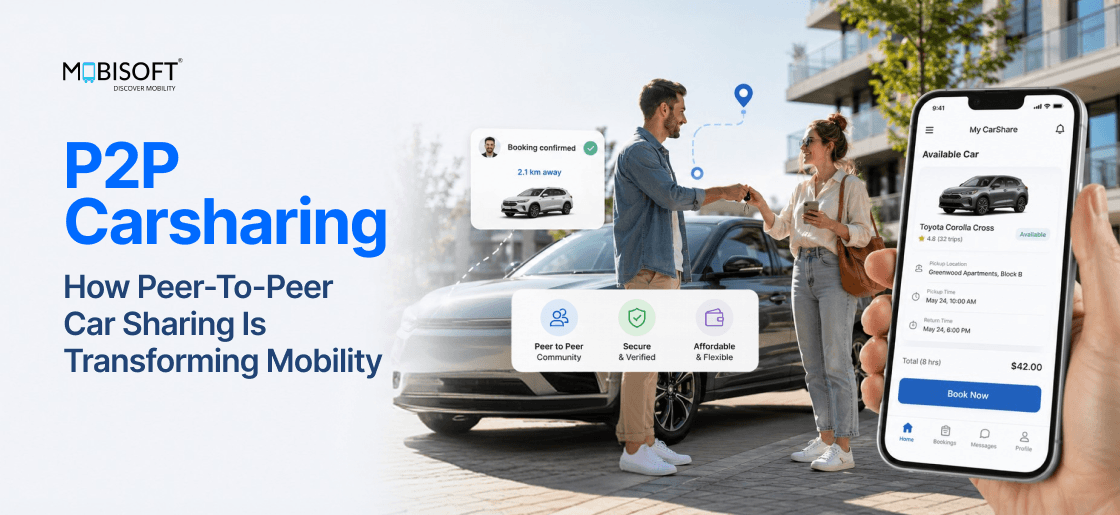
A private car sits unused for most of its life, parked outside a home or office. That distance between ownership and real use is where P2P carsharing begins. Car owners list their vehicle on a mobile app, and renters nearby book it. The owner earns money on a car that would otherwise sit idle. The renter gets a vehicle without buying one, insuring one, or maintaining one. Entrepreneurs are building platforms around it, city planners are studying its effect on parking and traffic, and investors are backing the founders who get the trust and safety pieces right.
This blog breaks down what the model involves for owners, renters, and the businesses that build it. It covers how a peer-to-peer car sharing app works end to end, the features that separate a serious platform from a weak one, and the numbers behind where this market is headed.
What Is P2P Carsharing
The term carsharing causes confusion across different regions. That confusion matters for anyone entering this space.
In North America, carsharing usually means a company-owned fleet. Members share that fleet between them. Ridesharing and carpooling mean something different there. Those terms describe privately owned vehicles shared for a single trip. In the UK, the meaning flips entirely. Carsharing there means privately owned vehicles shared for one trip. Company-owned fleets are instead called car clubs.
Peer-to-peer carsharing cuts through this confusion with a clear definition. It is a system where individuals list personal vehicles for rent. They do this through a dedicated app. The owner earns money from each completed rental. The renter gets short-term access to a car. No company owns the fleet in this model.
Carsharing Terminology At A Glance
| Term | Region | Vehicle Ownership |
| Carsharing | North America | Company-owned fleet |
| Car Club | UK | Company-owned fleet |
| Carsharing | UK | Privately owned, single trip |
| Peer-to-Peer Carsharing | Global | Privately owned, rented via app |
Why The Distinction Matters For Product Strategy
Founders often borrow features from the wrong category by mistake. A team building for the North American market might study Zipcar first. That research applies to fleet operators, not to peer-to-peer carsharing. The onboarding flow for an owner-listed marketplace looks completely different as well. It needs identity checks, vehicle listing tools, and payout systems. A fleet operator never needs any of those three things. Get this distinction wrong in the beginning, and you will waste months of development time.
How Does A Peer-to-Peer Carsharing Platform Work
A peer-to-peer car sharing app uses the one interface to connect owners and renters. Owners can list their cars, while renters can book and pay through the same interface.
The platform earns revenue through fees charged, commissions, and subscription tiers. Since there is no ownership, scaling is much faster because you don’t need to invest to increase the number of cars available to rent.
For Vehicle Owners
- Owners create a profile for their car, adding photos and setting a daily or hourly rental rate.
- They also choose availability windows for their vehicle. Owners can accept or decline any rental request.
- Many platforms let owners message renters before confirming a booking. This exchange builds trust on both sides of the transaction.
For Renters
- Renters search for nearby vehicles by location, price, and type. They select their dates and submit a booking request.
- Once approved, they pay directly through the app. Most platforms then coordinate a handoff for the vehicle.
- This happens either in person or through keyless entry technology.
Revenue Models Behind A Car Sharing Platform
Most car sharing platform operators earn through a commission structure. The platform takes a percentage of each completed booking. Commission rates typically range between 15 and 40 percent. That range depends on the region and the services bundled in. Some platforms charge renters a separate service fee too. This fee covers payment processing and customer support costs. A smaller group of platforms test subscription-based access instead. Renters pay a flat monthly fee for a set number of hours. It is the perfect choice in urban cities because of denser populations and constant demand in turn. So meticulously choose the right revenue mix for your dynamic, as it will decide the long-term unit economics.
Building Your Own Peer-to-Peer Car Sharing App
The growth curve above represents a real window for founders. Building a peer-to-peer car sharing app today means competing differently. Success depends on trust, speed, and user experience rather than fleet size.
Many entrepreneurs study adjacent models already proven in the market. Ride sharing apps share several technical building blocks with P2P carsharing. These include location search, in-app payments, and driver verification. Studying that architecture can shorten development timelines considerably.
The technical foundation matters, but sequencing matters just as much. Most successful launches start within one dense city first. They build a reliable base of verified owners early on. Expansion follows only once safety systems prove themselves at scale.
Choosing A Development Partner
The build decision shapes everything that follows for a new platform. Some founders choose to build a custom app from the ground up. Others adapt a proven white-label solution to move faster. A custom build offers full control over every feature and workflow. It also demands more time, budget, and ongoing engineering resources. A white-label approach can launch a working car sharing app in weeks. Founders should weigh runway, technical expertise, and timeline before deciding. Both ways can be successful if strong trust and safety design are prioritised. Founders exploring the rental side of this business often start elsewhere. Car rental mobile app development offers a useful foundation for this work. Booking flows, payments, and dispute handling overlap closely across both models.
Key Features Every Car Sharing App Needs
A well-built application needs more than a booking calendar. The right car sharing app features shape trust and daily usability. Getting these five elements right early saves rework down the line.
- Real-time availability and location search show renters which cars are nearby and available
- In-app verification checks driving history and identity before a booking is confirmed
- Keyless entry integration lets renters unlock a car directly from their phone
- Integrated insurance coverage protects both parties during the entire rental period
- Two-way rating and review system lets owners and renters evaluate each other post-trip
Feature Comparison By Priority
| Feature | Owner Benefit | Renter Benefit |
| Verification and background checks | Confidence in who drives the car | Faster approval process |
| Keyless entry | No need to meet renters in person | Flexible pickup times |
| Integrated insurance | Protection against damage claims | Reduced financial risk |
| Rating system | Screens future renters | Screens vehicle quality |
Platforms that skip any of these features tend to lose trust quickly. Trust is the actual product being sold here, not the vehicle itself.
How Pricing Tools Shape Owner Earnings
Pricing sits at the heart of owner satisfaction on any platform. Static pricing often leaves money on the table during busy weekends. Dynamic pricing engines instead adjust rates based on local demand signals. Owners can still set a floor and ceiling for their rates. This balance gives owners control while capturing extra revenue automatically. Platforms that get pricing right see higher owner retention over time.
Features That Set Leading Platforms Apart
- A few distinct features separate the best available apps from the rest of the market:
- Dynamic pricing tools help owners adjust rates during high-demand periods.
- GPS tracking gives owners peace of mind while a car is out.
- In-app chat lets owners and renters coordinate handoffs without leaving the app.
- Damage documentation tools let both sides photograph a vehicle before and after use. This step alone prevents most disputes before they even start.
A strong peer-to-peer car sharing app treats these as core, not optional. Platforms that blend owner-listed cars with a small managed fleet gain an edge. Those hybrid operators often rely on fleet optimization software to track utilization. It helps them balance owner-listed supply against company-owned backup vehicles.
Benefits Of P2P Carsharing
The appeal of P2P carsharing benefits spreads across three groups. Those groups are owners, renters, and the cities they live in.
For Owners
Owners turn an idle asset into a real source of income. A car parked most of the week can offset loan payments. It can also cover insurance and maintenance costs over time. Owners retain full control over their listings. They choose who rents their car and when it stays available. Some owners extend further into premium service tiers as well. Pairing a car sharing marketplace with chauffeur scheduling software opens a driver-included option. This lets owners offer a chauffeured trip alongside a standard rental.
For Renters
Renters skip the overhead that comes with full ownership. There is no loan, no insurance premium, and no maintenance bill. Renters pay only for the hours or days they actually use. They can also choose from a wider variety of vehicles. This selection often beats what a traditional rental counter offers.
For Cities
Fewer idle cars parked on the street can ease congestion. Shared vehicles reduce the total cars needed per household. That reduction cuts fuel consumption across a city's footprint. It also trims emissions tied to daily transportation.
The Wider Economic Case
Research into shared vehicle usage keeps pointing in the same direction. Every shared vehicle can replace several privately owned cars over time. Fewer cars on the road eases pressure on parking infrastructure. Cities spend less maintaining excess parking lots and structures as a result. That freed-up land can support housing, transit, or green space instead. The environmental case grows stronger as more owners list electric vehicles. A shared mobility platform built around efficiency benefits everyone involved.
Challenges Platforms Must Solve
No mobility model comes without friction of its own. P2P carsharing platform operators face a specific set of obstacles.
Gaining Trust
Trust remains the single biggest hurdle to overcome. Owners must trust renters with a personal, valuable asset. Renters must trust that a stranger's car will be safe. Insurance complicates this picture even further. Most personal auto policies exclude commercial rental activity. Platforms have to fill that coverage gap themselves.
Vehicle Availability
Demand creates another pain point, especially during peak hours. Weekend and holiday demand often outpaces listed vehicle supply. Founders launching a new shared mobility platform face a cold-start problem too. They need a critical mass of owners early on. They also need a steady stream of renters at the same time. Without both sides, the marketplace struggles to sustain itself.
Balancing Supply And Demand Over Time
Supply and demand rarely stay balanced without active management. Platforms track utilization rates for every listed vehicle closely. Low utilization in a specific area signals a marketing gap. High utilization instead signals room to recruit more owners there. Some platforms use targeted bonuses to attract owners in underserved zones. This data-driven approach keeps growth steady across every market segment.
Solving The Cold-Start Problem
Smart founders tackle this problem with a phased launch strategy. They recruit a small group of committed owners in one neighborhood first. Early incentives, like waived commission fees, help attract that first group. Once ten or twenty reliable listings exist, renter marketing can begin. Referral programs then help both owners and renters bring in new users. This sequencing avoids the trap of marketing to renters with no supply. Patience during this phase pays off once the marketplace reaches critical mass.
P2P Carsharing vs Traditional Car Rental
Traditional rental companies like Zipcar run company-owned fleets. This runs under a membership-based pricing model. Renters pay a monthly or annual fee plus reservation charges. Vehicle options stay limited to what the company has purchased. Locations also cluster mostly around major metro areas.
Peer-to-peer carsharing works differently at nearly every level.
| Factor | P2P Carsharing | Traditional Car Rental |
| Vehicle ownership | Private individuals | Rental company |
| Pricing model | Pay per booking | Membership plus fees |
| Vehicle variety | Wide, owner-dependent | Limited to company fleet |
| Geographic reach | Broad, neighborhood-level | Concentrated in metro hubs |
This structural difference explains why P2P carsharing scales faster. There is no fleet to purchase before a market launch. Founders only need a network of owners to onboard.
Where Traditional Rental Still Wins
Traditional rental companies still hold an edge in a few areas. Airport pickup counters remain a convenience that most P2P platforms lack. Corporate accounts also favor the predictability of a single rental brand. Long-term business travelers often prefer one consistent vehicle standard too. These gaps represent real opportunities for hybrid platforms to fill. A P2P carsharing platform that adds airport partnerships can close this gap.
Market Outlook For P2P Carsharing
The global peer-to-peer car sharing market sits near 3.36 billion dollars in 2026. Analysts project it will reach 8.82 billion dollars by 2031. That growth reflects a 21.3 percent compound annual growth rate.
Europe currently leads with roughly 36 percent of global revenue. Early adoption and strict emission rules drive that lead. Asia-Pacific stands out as the fastest-growing region worldwide. It expands by nearly 26 percent annually right now. Urbanization and mobile payment adoption both fuel that pace.
Rising vehicle ownership costs drive much of this growth. Total cost of ownership in major cities now exceeds 9,000 dollars yearly. That figure pushes younger renters toward access-based models instead. Low-emission zones are also expanding fast across the globe. More than 300 such zones now operate worldwide. This trend nudges both owners and platforms toward shared, electrified options.
Vehicle Segment Trends To Watch
Economy vehicles still dominate most peer-to-peer carsharing listings today. That segment holds close to 59 percent of total market share. Luxury vehicle listings, though smaller, are growing at a faster clip. That segment expands by nearly 23 percent annually as demand diversifies. Round-trip bookings still make up most reservations across every platform. One-way rental options are growing quickly as flexibility becomes a priority. Free-floating models are gaining ground fast, while station-based listings are still common.
Regional Signals Worth Watching
Several small-sized North American businesses merged or exited the market last year, after recent industry consolidation. This shakeout often precedes a healthier, more stable growth phase. Asia-Pacific markets like India show different dynamics entirely. Smartphone penetration and digital payment adoption are both climbing fast there. These conditions make emerging markets attractive for new platform launches. Understanding regional nuance helps founders choose where to launch first.
Safety, Insurance, And Regulation In P2P Carsharing
Trust and safety sit at the center of every successful platform. Regulators across regions still treat peer-to-peer carsharing inconsistently today. Some states and countries classify it alongside traditional car rental. Others apply entirely separate rules built specifically for this model.
Insurance Structures That Actually Work
Personal auto insurance rarely covers commercial rental activity by default. This gap forces platforms to build their own coverage layer. Many platforms now partner directly with commercial insurance providers instead. These partnerships create policies that activate only during active rentals. Owners keep their personal coverage active for all other daily use. This split structure protects both the vehicle and the platform itself. Clear, simple insurance terms also reduce disputes after an accident occurs.
Verification And Background Checks
Identity verification is mandatory, or else no one would trust the driver. Platforms typically check a government-issued ID against a live selfie. Driving history checks then flag renters with serious past violations. Some platforms add a minimum age requirement, often twenty-one or older. These checks happen automatically within minutes on most modern platforms. Manual review is reserved only for edge cases or flagged accounts.
Navigating Regional Regulation
Regulatory clarity varies widely between cities, states, and countries. Several American states now have specific peer-to-peer carsharing statutes in place. These laws define insurance minimums and liability rules for platforms. Europe generally treats P2P carsharing under broader digital platform regulation. Founders expanding across borders need local legal guidance early on. Ignoring this step can delay a launch or trigger costly penalties later.
Measuring Success After Launch
A platform that launches well still needs the right signals to grow. Founders should track a small set of metrics from day one. Owner acquisition cost shows how efficiently a platform recruits new listings. Renter repeat rate shows whether the experience earns lasting loyalty. Average utilization per vehicle reveals how well supply matches demand. Dispute rate per booking flags weaknesses in verification or insurance design.
Conclusion
Owners turn idle cars into steady income streams every single month. Renters get flexible, affordable access without ownership weighing them down. Cities benefit from fewer parked cars and lower emissions overall. Market data supports this trajectory across nearly every region studied. Growth rates here outpace most other shared mobility segments by a wide margin. For entrepreneurs, the real opportunity lies in solving trust well from day one. Building a peer-to-peer car sharing app that verifies users properly matters most.
Ride sharing and car rental software both offer proven starting points. Founders do not need to start from a blank page today. What remains is careful execution across every single touchpoint. Clean onboarding and dependable insurance coverage both matter greatly here. A smooth experience makes owners and renters feel secure throughout every trip. Done well, a car sharing platform built today can capture real share. The market is still finding its shape across most regions worldwide.

Frequently Asked Questions
How is a P2P carsharing business different from generic ridesharing?
A P2P carsharing business rents out the vehicle itself, not a driven trip. Owners hand over the keys, and renters drive the car on their own for the length of the booking. This changes the entire product, since you need listing tools and payout systems instead of live trip matching.
What early metrics tell me if my peer-to-peer carsharing platform is working?
We look at owner acquisition cost, renter repeat rate, and utilization per vehicle in the first few months. A healthy peer-to-peer carsharing platform shows rising utilization and falling dispute rates as trust builds. Those three numbers together tell you if supply and demand are actually balancing out.
How much upfront investment does a car sharing app need?
A car sharing app needs far less capital than buying a fleet, since owners supply the vehicles. Your main investment goes into the platform itself, verification systems, and insurance partnerships instead of physical assets. This is exactly why the asset-light model scales faster across new cities.
Does Mobisoft Infotech build insurance and verification into the app?
We build identity verification, background checks, and insurance integration directly into every peer-to-peer car sharing app we develop. These features are not optional add-ons, since trust is what actually gets bought and sold on your platform. You get a system where owners and renters both feel protected from day one.
What should I look for in a P2P carsharing technology partner?
Look for a partner who has already solved the trust and payout problems specific to this model, not just booking calendars. We bring that experience to every P2P carsharing platform we build, since we know where founders usually get stuck first. Ask about past work with keyless entry, dynamic pricing, and dispute handling before signing on.
How do hybrid operators use a shared mobility platform with a fleet?
Some operators mix owner-listed vehicles with a smaller company-owned backup fleet for reliability. A shared mobility platform built this way covers gaps when owner supply runs low in a given area. This hybrid setup gives renters more consistent availability without the full cost of a traditional fleet.
This content is for informational purposes only and may include AI-assisted research or content generation. While we strive for accuracy, information may evolve over time. Readers are advised to independently verify critical information before making decisions.

Nitin Lahoti
Read more
Nitin Lahoti is the Co-Founder and Director at Mobisoft Infotech. He has 15 years of experience in Design, Business Development and Startups. His expertise is in Product Ideation, UX/UI design, Startup consulting and mentoring. He prefers business readings and loves traveling.
 Nitin Lahoti
 July 20, 2016