Executive Summary
Large events are complex operations. Hundreds of moving parts, thousands of people, and dozens of vendors all need to work in sync for the experience to go as it was planned. Most of the time, when something goes wrong, it is not the programming or the production. It is the transportation.
Missed pickups, shuttle backlogs, delayed airport transfers, uncoordinated dedicated car assignments, and zero real-time visibility across a mixed fleet are not edge cases. They are the default outcome when event transportation management is treated as a logistics footnote rather than a core operational function.
Large events run multiple modes of transport simultaneously. Shuttle buses move general attendees on fixed routes while dedicated cars handle delegates and speaker assignments. Airport transfers run on flight schedules entirely separate from the on-venue transport plan. Shared vehicles manage staff across shift changes, and on-call cars cover last-minute guest requests that fall outside the pre-event schedule. Each mode carries its own booking flow, dispatch logic, and failure point. Managing all of them without a centralized operational structure is where events fall apart.
This white paper is for the people who face these problems. Operations managers keep thousands of guests moving. Venue directors manage transport within a larger event footprint. Agencies that have promised clients a seamless experience and need the operational structure to back it up.
The paper presents a practical blueprint for building and running an event mobility command center as part of a structured event mobility orchestration approach. It is a working operational model with defined roles, technology requirements, decision protocols, and performance benchmarks.
By the end of this paper, any ops team, venue manager, or agency principal should be able to look at their current transport operation, identify exactly what is missing, and know where to start. For teams evaluating platforms that support these command-centre capabilities, explore how an event mobility management solution supports large-scale event transport operations.
The Real Cost of Unmanaged Event Mobility
Transportation is one of the most consistent failure points in large-scale event operations. It is almost always the last thing that gets proper planning attention. Teams spend months on programming, sponsorships, and guest experience, and then assign a handful of drivers, a group chat, and a spreadsheet to handle the movement of thousands of people.
That gap between planning effort and operational reality is where events break down, especially when event transportation planning and event logistics management are not handled as core operational functions.
What Actually Goes Wrong?
The problems rarely start as major failures. A shuttle runs 15 minutes late during peak arrival. A missed guest pickup because an executive car was redirected without anyone updating the booking system. A crowd builds at the main egress zone faster than anticipated, and there are no reserve vehicles close enough to respond.
Each of these is manageable in isolation, which is not the case in large events. One delay creates a backlog. A backlog creates crowd pressure, which can lead to complaints, security concerns, and a client watching their event unravel.
The Financial Exposure
Delayed transportation is not just an inconvenience, but a liability.
Missed sessions lead to refund requests. Mishandled arrivals of the delegates can damage client relationships. Missed transport SLAs trigger penalty clauses. And beyond the direct financial risk, a single high-profile transport failure gets documented and remembered. The event industry runs on referrals. A poor transport experience does not stay contained to the post-event survey.
A Scenario Worth Considering
A 12,000-attendee technology conference. Three routes, 22 vehicles, dispatch running off WhatsApp, and a shared Google Sheet.
For the first half of the day, it holds. Then the keynote ends 20 minutes early. Six thousand people head to the main shuttle zone at once. The dispatcher has no live view of vehicle locations. Two buses sitting idle at a secondary zone could have been redirected, but no one knew they were available. Meanwhile, three dedicated guest vehicles are circling the venue without updated drop-off instructions and two airport transfer runs are delayed because no one flagged the schedule change. This can increase the wait time by 35 minutes, if not more.
The client starts receiving complaints before the event is over. The post-event debrief focuses entirely on transportation. A contract renewal that looked certain becomes uncertain.
Versions of this play out at events of every scale, every season.
The Core Problem
Unmanaged event mobility is a business risk for every stakeholder involved. The ops team, the venue, and the agency that promised a seamless experience all carry exposure when transport fails.
The question is not whether large events need better transport coordination, because they clearly do. It is what that coordination looks like when it is built and run correctly as part of event mobility management. That is what the rest of this paper addresses. For a deeper look at structuring transport strategies for complex events, read Mastering Event Transportation Planning for Large Events.
What a Command Centre Actually Is (and Is Not)

The term gets used loosely. A folding table with a laptop and a radio has been called a command centre. So has a back-office room where a dispatcher updates a whiteboard every 30 minutes.
Neither of those is a command centre.
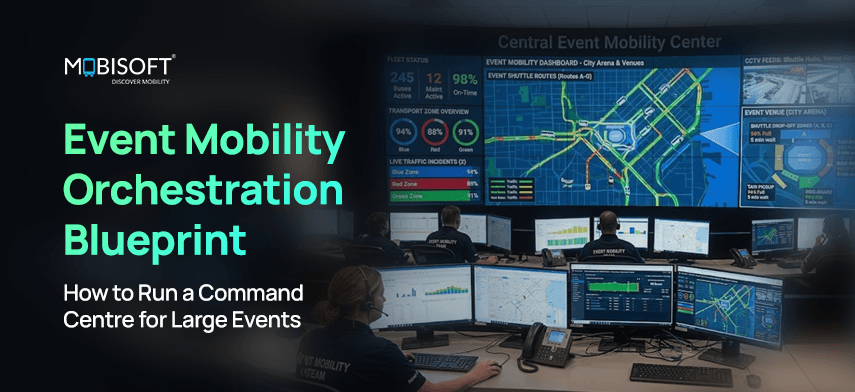
A true event mobility command center gives the operations team real-time visibility and decision-making control over every vehicle, route, driver, and passenger zone across the entire event footprint.
A command centre combines three things:
Live data
The team can manage every mode of transport, including shuttles, executive cars, airport transfers, and dedicated guest vehicles. Crew logistics management provides accurate location, status, and ETA for each vehicle without needing a phone call.
Structured communication
Every instruction between dispatchers, drivers, zone supervisors, and client liaisons runs through defined channels with defined protocols. Not group chats or personal phones.
Clear decision authority
Every person in the room knows exactly what they can decide independently and what requires escalation. When a vehicle breaks down, no one asks who should handle it. The protocol already answered that.
Without all three working together, you have no command.
What It Is Not
- A dispatcher is watching a consumer mapping app on a personal device
- A group WhatsApp thread that drivers use to self-organize
- A spreadsheet is updated manually when someone remembers to update it
- A supervisor walking the floor with a radio and good instincts
These approaches can hold together at small, low-complexity events. At large events with multiple routes, concurrent sessions, and thousands of attendees moving in unpredictable patterns, they fail. Not occasionally, but reliably.
The Three Capabilities That Define It
Live Fleet Visibility
Every active vehicle on a single dashboard with real-time GPS, current status, and ETA at the next stop. The dispatcher is not calling drivers to ask where they are.
Structured Communication
Every instruction and escalation move through a system that logs them with a timestamp. Drivers receive updates through an app, highlighting the importance of shuttle service app development for real-time coordination.
Documented Escalation Path
Every foreseeable problem has a pre-assigned response owner and a response time target. The command centre team is not improvising protocols under pressure on event day.
Why Most Operations Teams Do Not Have This?
Building a proper command centre has historically required investment in technology, staffing, and pre-event planning time. Many ops teams default to lighter coordination methods because they worked well enough in the past, or because the client budget did not seem to justify it.
That calculation changes when you factor in the cost of a single major transport failure. It also changes when purpose-built event transportation software platforms now make command centre capability accessible without building anything from scratch. The barrier is lower than most teams realize.
The Five Operational Layers of Event Mobility
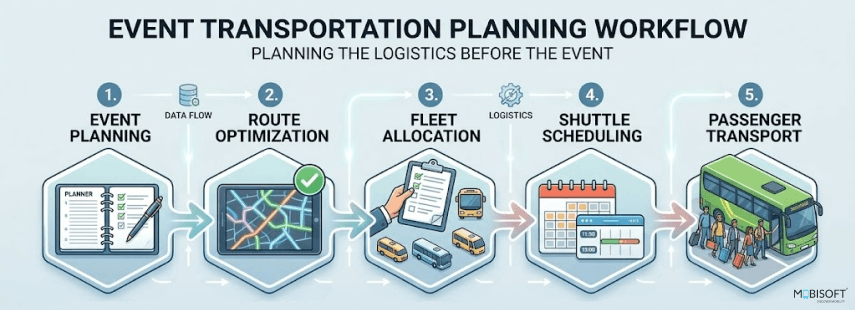
A command centre operates within a structure that connects pre-event planning to real-time operations and post-event review. Most event transport operations handle some of these layers reasonably well, but only a few handle all five as part of a structured event mobility management approach.
Layer 1: Pre-Event Intelligence
Everything on event day reflects how well this layer was executed beforehand.
Start with demand forecasting. A 10,000-person conference is not 10,000 identical transport requests. Guests need dedicated executive cars with pre-confirmed arrival windows. Out-of-town delegates require airport transfers timed to flight schedules, both on arrival and departure. Accessibility riders need dedicated accessible vans with priority loading zones booked in advance. Staff moves on shared vehicles tied to shift schedules. General attendees arrive in waves, concentrated around session times. A bus fleet management software manages this through shuttle buses on fixed high-frequency routes.
Each segment requires a different vehicle type, a different booking flow, and a different dispatch protocol. Treating them as one group is how staging zones get overwhelmed and how guest pickups get missed during event transportation planning.
Route mapping follows. Primary routes cover expected flow. Secondary routes are pre-approved alternatives dispatchers can activate without seeking approval. Emergency ingress and egress paths are mapped and shared with venue security in advance.
Staging plans define where vehicles queue, where they idle without blocking flow, and how handoffs between arriving and departing vehicles are managed at each zone.
Driver briefings close out this layer. Every driver enters event day knowing their assigned zone, communication protocol, and escalation contact.
Layer 2: Fleet Assignment and Dispatch
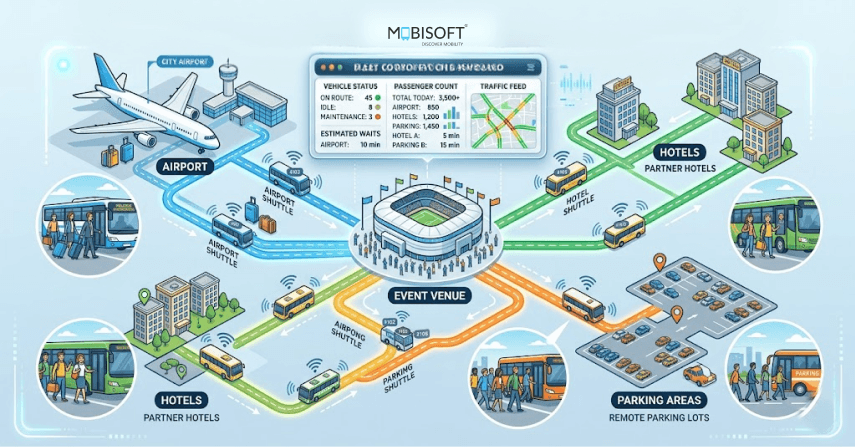
Fleet assignment matches vehicle type to passenger segment across every mode of transport the event requires.
Shuttle buses handle general attendee movement on fixed, high-frequency routes. Executive and dedicated cars cover guest arrivals, departures, and speaker transfers with assigned drivers and pre-confirmed schedules. The airline crew management system manages delegate arrivals and departures with flight-linked timing, separate from the on-venue transport schedule. Shared vehicles serve staff pools running on shift-based schedules. Accessible vans cover mobility-impaired guests with pre-confirmed bookings and priority loading zones. On-call vehicles handle unscheduled guest requests and last-minute changes that fall outside the pre-event plan.
Each mode operates on its own logic. A shuttle runs a fixed loop. A dedicated guest vehicle waits on assignment. An airport transfer is tied to a flight time. Managing all of them from the same dispatch interface, with full visibility across every mode, is what separates an advanced airport shuttle management software from a basic coordination setup in event transportation management.
Layer 3: Live Monitoring and Situational Awareness
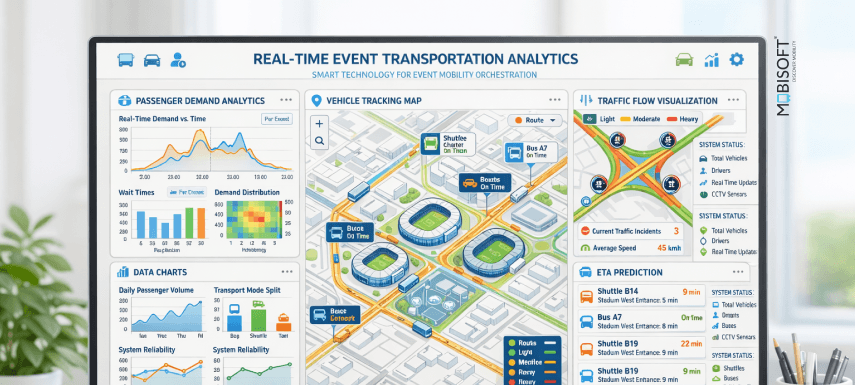
The command centre dashboard should display GPS position and status of every active vehicle, ETA at each scheduled stop, driver communication logs, zone-level crowd status from field supervisors, and active incident flags.
Telematics adds operational intelligence beyond basic GPS. Speed alerts flag drivers moving too fast through pedestrian zones. Idle time data identifies vehicles stationary beyond their scheduled window. Geofence triggers notify the dispatcher automatically when a vehicle enters or exits a defined zone.
When integrated correctly, gate scan data showing a session at 90 percent capacity gives the command centre 30 to 45 minutes of lead time to pre-position vehicles before the crowd reaches the pickup zone, supported by real-time fleet tracking capabilities.
Layer 4: Incident Response
Every large event will face incidents. What separates a well-run command centre is how fast and cleanly they get resolved.
Vehicle breakdowns require immediate replacement deployment, a passenger holding communication at the affected zone, and ops lead notification.
Target: replacement vehicle dispatched within 5 minutes of the incident flag.
Reroutes require pre-approved alternative routes ready to activate without a new approval chain. Every minute spent seeking authorization is a minute of growing delay.
Crowd surges require vehicle redeployment from lower-demand zones combined with real-time passenger communication. Sending more vehicles without updating wait time expectations creates confusion, not relief and puts additional pressure on event traffic management teams.
Escalations require a defined matrix that notifies the trigger points, who it goes to, and what the response time target is. This matrix is written before the event day.
Layer 5: Post-Event Debrief and Data Capture
Within 24 hours of the event's closing, pull the full KPI report from the platform. This includes on-time pickup rates, average wait times, fleet utilization, and the complete incident log with resolution times.
This data serves two purposes.
- Client reporting: A post-event transport report delivered within 48 hours demonstrates operational accountability. Most transport operators do not provide this.
- Continuous improvement: Every event generates data that makes the next plan more accurate. Demand forecasting, staging plans, and driver briefings all improve when they are built on actual event data rather than assumptions.
The post-event debrief is the starting point for the next event's pre-event intelligence layer. Events that rely heavily on shuttle routes often benefit from structured coordination using event shuttle management software.
Staffing the Command Centre
A well-equipped command centre is run by a team, not the technology. So the most common reason it underperforms on event day is not a platform failure. It is unclear roles, poor staffing ratios, and communication discipline that break down under pressure during event command center operations.
The Core Roles
Transport Operations Lead
Owns the full mobility plan, makes final calls on fleet redeployment, and handles escalations beyond the dispatcher's authority. This person maintains a high-level view of the entire event transportation management operation. In a large event, this role should not be shared with any other responsibility. Split attention is how small problems become large ones.
Lead Dispatcher
The operational core of the command centre within large-scale event command center operations. Manages all driver communications, monitors vehicle status across every active zone, and coordinates real-time fleet adjustments. One experienced dispatcher can manage up to 20 active vehicles when the platform is configured correctly. Beyond 25 vehicles or multiple non-adjacent zones, a second dispatcher is required because the workload compounds.
Zone Supervisors
Positioned at each major pickup and drop-off point. Their job is to report real-time crowd conditions, manage passenger flow, and support effective event traffic management, while flagging developing problems before they become incidents. A supervisor who reports a building crowd 10 minutes early gives the dispatcher time to pre-position a vehicle. One who waits too long gives the dispatcher a crisis instead.
Structured field reports create intelligence. Unstructured ones create noise.
Client or Agency Liaison
Handles VIP requests, last-minute schedule changes, and client queries without pulling the dispatcher away from fleet management. A dispatcher fielding client calls while managing 25 active vehicles is not fully doing either job.
Technology Operator
Manages the platform dashboard, monitors automated alerts, and keeps GPS and telematics data feeds running cleanly to support accurate event mobility management. At smaller events, the dispatcher can absorb this. At larger events with multiple concurrent routes and real-time integrations, a dedicated operator is worth the staffing cost.
Staffing Ratios
- One dispatcher per 15 to 20 active vehicles
- One zone supervisor per major pickup or drop-off point
- Two supervisors at zones handling more than one passenger segment
- One operations lead per dispatcher on large events, with no shared responsibilities
Communication Discipline
Three things need to be decided before event transportation planning begins on event day.
Channel Assignments
Driver communication should run through the platform app, and client liaison through a separate line. Zone supervisors should check in through a dedicated radio channel or in-app reporting. Personal phones are only for emergencies.
Check-in Cadence
Zone supervisors report every 15 minutes during peak periods and every 30 minutes during low-demand windows. The dispatcher does not wait for problems to surface.
Briefing Structure
Full team briefs at T-minus 2 hours, a short alignment check at T-minus 30 minutes, and a mid-event check-in at the halfway point. Each briefing has a defined agenda and a time limit.
These formalities are what keep a command centre functioning as a unit rather than as individuals making independent decisions during complex event mobility orchestration.
Technology Requirements for a Functioning Command Centre
Evaluating technology for a command centre is not about counting features. It helps identify which capabilities are non-negotiable, which ones add value at scale. It decides which platform covers the full operational lifecycle without forcing the team to bridge gaps manually in large event logistics management environments.
The right platform does not add complexity to the event day, but removes it.
The Non-Negotiables
These are the capabilities that a command centre cannot function without. If a platform does not cover these, it is not a command centre platform. It is a scheduling tool.
Real-Time Fleet Management Dashboard
The dashboard is the operational centre for the entire command centre team. All the important details for the dispatcher, operations lead, and technology operator need to be visible in a single interface. This removes the friction of toggling between screens or making phone calls to confirm important information.
At a minimum, the dashboard needs to display:
- Live GPS position of every active vehicle
- Current status of each vehicle (en route, loading, idle, or offline)
- ETA at the next scheduled stop with automatic alerts when a vehicle falls behind the threshold
- Fleet utilization rate is visible across the operation as a whole
The alert logic matters as much as the data. A dashboard that shows information but does not flag anomalies puts the entire monitoring burden on the dispatcher.
A well-configured platform:
- Flags a vehicle that has been idle beyond its scheduled window
- Alerts the dispatcher when an ETA exceeds the acceptable delay threshold
- Notifies the operations lead when an incident has been open longer than its target resolution time
That is the difference between a display tool and an operational tool supporting event transport coordination.
Booking and Dispatch Management
Pre-event booking covers the full range of transport modes the event requires as part of structured event transportation planning. VIP and speaker arrivals are pre-assigned to dedicated vehicles with named drivers. Airport transfers are linked to flight schedules with buffer time built in for delays. Staff transport is organized by shift with shared vehicle allocations confirmed in advance. General attendee shuttle pre-registration sets baseline demand forecasts for each route within broader event logistics management workflows. The Shuttle Service Booking System should show every confirmed booking, regardless of transport mode. It needs to be assigned to a specific vehicle and driver, with passenger details accessible through the driver app.
On event day, the platform needs to manage scheduled and dynamic dispatch across all active modes simultaneously. A shuttle running its fixed loop, a dedicated guest car waiting on standby, and an airport transfer vehicle en route to the terminal are three different operational states requiring three different dispatcher responses. A platform that handles only one mode cleanly is not built for multi-modal event transportation management.
Employee transportation management software is also essential for large corporate events for last-minute bookings. A delegate who was not on the pre-event list needs a vehicle. A sponsor representative arrives earlier than scheduled. These situations happen at every event. The platform needs to handle them without requiring the dispatcher to rebuild a route or manually reassign a driver mid-operation.
Driver Communication App
The driver app is the command centre's direct line to every vehicle in the fleet and supports efficient event transport coordination across zones. It needs to work reliably, be simple enough that drivers do not need training beyond a 15-minute briefing, and carry all the information a driver needs without requiring them to use a separate navigation tool or receive phone calls while driving.
Core requirements for the driver app:
- In-app messaging tied to a specific trip or zone rather than a general group feed
- Turn-by-turn navigation with live traffic data and event-specific route overlays that account for road closures and venue access restrictions
- One-button SOS and incident reporting that immediately alerts the command centre without the driver needing to type a message or make a call
- Trip and zone assignment updates delivered in real time without dispatcher phone calls
The SOS function deserves specific attention. A button that sends an instant alert with the vehicle's GPS position is an operational requirement. When a driver breaks down, is in an unsafe situation, or encounters a blocked route, the speed of the command centre's response depends entirely on how fast the alert reaches the dispatcher.
Passenger-Facing Communication
Passengers standing at a pickup zone with no information about their shuttle are frustrated. It results in poor crowd management and weak event mobility management. On the other hand, guests knowing their shuttle is eight minutes away stay organized. People who have no idea how long they will be waiting start moving, asking questions, and creating pressure in the zone.
Passenger communication capabilities the platform needs to support:
- Real-time shuttle ETAs accessible via QR code at the pickup zone or delivered via SMS link, with no app download required
- Automatic ETA updates that pull directly from live fleet data as the vehicle moves
- Push notifications for route changes, delays, or zone reassignments delivered to passengers in real time
- Individual tracking for accessibility riders with pre-confirmed bookings and direct driver-to-passenger communication capability
Reporting and Analytics
The reporting capability of a fleet optimization software is often evaluated last, and should be taken into account from the beginning. This event data is the foundation of every post-event client report, internal debrief, and improvement later made to the next event's transport plan, supporting better transportation planning for events.
At a minimum, the platform should capture and report:
- On-time pickup rate per zone and per vehicle
- Average passenger wait time by zone and by event phase
- Fleet utilization rate across the event day
- Complete incident log with timestamps, assigned owners, and resolution times
Each one of these connects directly to a decision the ops team or the client needs to make. On-time pickup rate by zone identifies which zones are consistently underperforming and need a staging adjustment. Fleet utilization rate tells the team whether they are over or under-provisioned for the event size. The incident log tells them where their protocols are held and where they need to be rewritten.
Capabilities That Add Meaningful Value at Scale
Beyond the non-negotiables, a set of capabilities becomes increasingly valuable as event size and complexity grow in modern event mobility orchestration environments:
- GPS and telematics integration that moves fleet data beyond basic location tracking, covering speed monitoring, idle time alerts, and engine status feeds
- RFID gate scan integration that feeds crowd flow data directly into the transport dashboard, allowing the platform to pre-position vehicles at egress zones before crowds reach them
- API connections to event management platforms that allow attendee data, session schedules, and the guest lists to flow directly into the transport system without manual data entry.
The growing role of predictive technologies in mobility operations is explored further in AI in Event Transportation: Future of Mobility Solutions.
What Agencies and Operators Need Specifically?
An ops team running transport for a single recurring venue has different platform requirements than an agency managing event transport for multiple clients across different venues and event types.
Agencies and operators specifically need:
- White label capability so the platform can be deployed under their own brand for each client engagement, positioning the technology as part of their service offering
- A pre-event transport plan covering all active modes, with documented route maps, vehicle allocation by segment, airport transfer schedules, dedicated car assignments, staging layouts, and contingency protocols within a structured event transportation management framework
- Day-of live reporting access for the client, showing real-time status across every transport mode and zone without exposing the full dispatch backend
- A post-event transport debrief delivered within 48 hours, with on-time rates, wait time averages, incident logs, and improvement recommendations across all modes
An agency that can manage shuttles, dedicated guest vehicles, airport transfers, shared staff transport, and on-call cars from a single platform and report on all of them after the event, is offering something most transport operators cannot match. These capabilities become the basis of a premium service conversation.
A Note on Platform Selection
The event transport technology market has matured considerably. Purpose-built platforms now exist that cover the full command centre stack, from pre-event booking and driver management through live fleet monitoring, passenger communication, and post-event reporting, within a single integrated system designed for event transportation solutions.
The operational advantage of an integrated platform over a collection of separate tools is significant. When fleet data, dispatch records, driver communications, and passenger notifications all live in the same system, the command centre team works from a single source of truth. When they live in separate tools, information gaps open up between them, resulting in poor management.
For ops teams evaluating platforms, the question is:
Which platform covers the full operational lifecycle of an event transport operation without requiring the team to bridge gaps manually?
Building the Day-Of Decision Framework
Every ops team that has managed large event transport has faced the same situation. Something changes on event day, and the team knows a response is needed. What slows them down is not the absence of capability. It is the absence of a pre-defined answer to the question: who decides what, and how fast?
A Day-Of Decision Framework answers that question before event day arrives and strengthens operational control within event command center operations.
This repeatable decision loop in the automated vehicle dispatch system runs continuously through out the event to support real-time transport decisions during live events.
The Decision Loop
The loop has four stages and runs from the moment the command centre opens to the moment the last vehicle clears the venue.
Observe
The dispatcher monitors the live dashboard. Zone supervisors submit scheduled crowd reports. The technology operator watches platform alerts. The operations lead maintains a broad view across all active zones. Observation runs on a structured cadence. The command centre is not waiting for problems to surface. It is actively scanning for early indicators.
Assess
Not every deviation requires a response. The assessment stage applies a simple filter: is this within normal variance, or has a threshold been crossed that requires action?
This filter only works if thresholds are defined in advance. A dispatcher working from a pre-agreed threshold is faster and more consistent than one making judgment calls under pressure. Pre-defined thresholds remove opinion from time-sensitive decisions.
Act
The action stage executes the pre-defined response for the threshold crossed. The dispatcher does not design the response in the moment. They execute the one already agreed upon.
This compresses the time between observing a problem and responding to it. It also ensures consistency across the event day, regardless of which dispatcher is on duty or how far into a long event the team is.
Log
Every action is logged in real time with a timestamp, the name of the person who initiated it, and the outcome. The log keeps the team aligned, feeds the post-event debrief, and provides documentation if a client raises a question about how a situation was handled.
Pre-Defined Response Thresholds
These thresholds should be documented, reviewed during the pre-event briefing, and accessible on the dashboard during the event as part of structured event transportation management operations.
Shuttle Delays
- Under 5 minutes: Monitor and note. No active response needed.
- 5 to 10 minutes: Dispatcher contacts driver, confirms ETA, updates passenger display, notifies zone supervisor.
- 10 to 20 minutes: Reserve vehicle deployed, passenger notification pushed, incident logged, operations lead informed.
- Over 20 minutes: Operations lead takes direct ownership. Client liaison is notified if a guest or client-visible service is affected within the broader event mobility management framework.
Vehicle Breakdown
The dispatcher flags the incident immediately. Nearest reserve vehicle is dispatched. Passenger holding communication is pushed within 2 minutes, and the operations lead is notified simultaneously.
Target: replacement vehicle en route within 5 minutes of the incident flag to maintain reliable event transport coordination.
Crowd Surge at Pickup Zone
The zone supervisor reports a surge to the command centre. The dispatcher reassigns the nearest available vehicle from a low-demand zone through the platform. Passenger notification is pushed with the updated wait time. If a surge affects multiple zones simultaneously, for instance, a rental fleet management software allows reserve deployment protocol to stabilize event traffic management.
Reroute Required
The dispatcher activates the pre-approved alternative route through the platform. All affected drivers receive updated navigation through the app simultaneously. Passenger-facing communication is updated for any zone or timing changes.
Target: reroute instruction delivered to all affected drivers within 3 minutes of the trigger event, supporting real-time event mobility orchestration.
VIP Request Outside Schedule
Client liaison confirms vehicle availability with the dispatcher before making any commitment to the client. The dispatcher identifies the nearest available vehicle without creating a coverage gap. Assignment is confirmed in the platform within 2 minutes. Client liaison communicates confirmation only after the platform shows the assignment is active.
Escalation Matrix
Keep this simple enough to recall under pressure within high-intensity event command center operations.
- Dispatcher handles independently: Delays under 20 minutes, standard reroutes using pre-approved alternatives, dynamic vehicle reassignments within reserve parameters, and routine passenger communication updates.
- Operations lead is involved: Delays exceeding 20 minutes, breakdowns requiring reserve fleet activation, surges affecting more than one zone, any client-visible service failure for delegates, and any incident open beyond its target resolution time.
The venue director or agency principal is contacted: situations requiring venue-level intervention, security involvement, or any client-facing failure that will require a formal response.
Keeping the Framework Functional Under Pressure
A framework that exists only in a briefing document is just a good intention.
The pre-event briefing at T-minus 2 hours needs to have a verbal walkthrough of key thresholds. It is to confirm that every person in the room knows their role in the loop.
Building the framework takes a few hours of pre-event work. Not having it can cost the entire event.
KPIs That Define Command Centre Performance
Running a command centre without measuring its performance is operating on an assumption in modern event transportation management operations. The right KPIs tell the ops team how the operation performed and give the agency something concrete to present to the client after the event.
"It went well" is not a post-event report. Numbers are.
On-Time Pickup Rate
The percentage of pickups completed within plus or minus 3 minutes of the scheduled time.
This is the headline metric. It reflects the quality of pre-event planning, staging, and real-time dispatch combined with effective event transportation planning.
Target benchmark: 92 percent or above.
When this falls short, the cause is usually one of three things: poor zone staging, insufficient vehicle frequency on high-demand routes, or no real-time visibility to deploy vehicles proactively.
Average Passenger Wait Time
The time between a passenger arriving at a pickup zone and boarding a vehicle.
This metric sits closest to the attendee experience. It is also the number most likely to show up in post-event feedback surveys, whether the ops team tracks it or not.
Target benchmark: under 8 minutes for shuttle services at large events and complex event mobility management environments.
Fleet Utilization Rate
The percentage of event time that vehicles are actively in use versus sitting idle during large-scale event logistics management operations.
Target range: 70 to 80 percent.
Below 60 percent means the operation is over-provisioned. Above 85 percent means reserve capacity is too thin to absorb demand spikes without service failures.
Incident Resolution Time
The time from incident flag to confirmed resolution.
Target: under 10 minutes for operational incidents such as delays and reroutes. Under 5 minutes for escalations to the operations lead.
When resolution times consistently exceed these targets, the problem is usually in the escalation matrix, not the response capability.
Client and Attendee Satisfaction Score
Measured via post-event surveys with transport-specific questions covering wait time experience, driver professionalism, communication clarity, and ease of access across the full event mobility orchestration experience.
This is a lagging indicator because by the time a problem surfaces, the event is over. The four metrics above are the leading indicators that determine what this score will look like before the survey is sent.
Using KPIs Beyond the Post-Event Report
These numbers are most valuable when they are tracked across multiple events at the same venue or for the same client. A single data point is informative, while a trend is actionable.
An agency that presents a client with 12 months of transport performance data, showing consistent on-time rates, improving wait times, and declining incident frequency, is not just reporting on past events. They are making the case for every future event and strengthening long-term transportation planning for events.
That is what separates a transport operator from a transport partner.
Many event transport teams rely on a transportation fleet management platform to monitor vehicle activity, balance utilization, and maintain service availability during high-demand periods.
How Agencies and Operators Use This Blueprint to Win More Business
Most event transport operators compete on two things: price and vehicle availability. That is a commodity conversation, and it leads to commodity margins.
The operators who build command centre capability compete on outcome and accountability within professional event command center operations. That is a different conversation entirely.
The Differentiation Opportunity
Agencies need to show certainty. The most successful ones have a documented transport plan with an efficient live-event dashboard. The clients should be able to monitor real-time activity. They offer post-event performance reports with metrics that help them in the future, proving credibility.
Clients who have experienced that level of operational transparency tend to renew contracts. They refer other clients and stop asking for price comparisons.
What a Command Centre-Ready Agency Can Offer
- A pre-event transport plan with documented route maps, vehicle allocation, staging layouts, and contingency protocols that support structured event transport coordination
- Day-of live reporting access for the client, showing vehicle status and zone performance without exposing the full dispatch backend
- A post-event transport debrief delivered within 48 hours, with on-time rates, wait time averages, incident logs, and improvement recommendations
None of these requires the agency to build proprietary technology. They require a platform that supports them and an ops team that knows how to use it.
The White Label Advantage
Agencies and operators that deploy a white-label event transportation platform present the technology as their own capability. The client sees the agency's brand instead of a third-party tool, which matters commercially.
A platform that appears proprietary strengthens the client's perception of the agency as a technology-enabled operation rather than a vehicle provider with a software subscription. That perception directly affects contract value and retention.
The Commercial Implication
Clients who have seen command centre-level event transport do not downgrade willingly. Once operational transparency, real-time visibility, and data-backed reporting become part of the service standard, removing them becomes a reason to switch providers.
Building command centre capability is, therefore, an important client retention strategy within competitive event transportation solutions.
Implementation Roadmap for First-Time Command Centre Operators
Setting up a command centre for the first time does not require rebuilding the entire transport operation. It requires adding structure, technology, and defined roles to what most ops teams are already doing in a less organized way in modern event transportation management environments.
This roadmap covers the four phases that take an operation from basic coordination to command centre-ready.
Phase 1: Pre-Event Setup (4 to 6 Weeks Before)
- Define transport demand by attendee segment: general attendees, VIPs, accessibility riders, and staff as part of event transportation planning
- Map all primary, secondary, and emergency routes with venue and local traffic authority sign-off
- Select and configure the event transportation platform, including dashboard setup, driver app onboarding, and passenger communication tools
- Assign all command centre roles and confirm staffing for event day
- Document the Day-Of Decision Framework, including response thresholds and escalation matrix
- Build the staging plan for all pickup and drop-off zones to support event transport coordination
Phase 2: Dry Run (1 Week Before)
- Run a simulated command centre session with the full ops team using the actual platform
- Test all communication channels: driver app, zone supervisor check-ins, and client liaison line
- Walk through the escalation matrix verbally with every team member
- Brief all drivers on app usage, assigned zones, and incident reporting protocols
- Identify and resolve any platform configuration gaps before event day for reliable event mobility management
Phase 3: Day-Of Activation
- Open the command centre at T-minus 3 hours
- Confirm all vehicles, drivers, and zone supervisors are in position and connected to the platform
- Run the first decision loop check at T-minus 1 hour
- Activate passenger-facing communication tools at venue open as part of coordinated event mobility orchestration
- Run scheduled briefings at T-minus 2 hours, T-minus 30 minutes, and mid-event
Phase 4: Post-Event Debrief
- Pull a full KPI report from the platform within 24 hours of event close
- Complete incident log review with the full command centre team
- Deliver the client transport report within 48 hours
- Document lessons learned and update the transport plan template for the next event, used for future transportation planning for events
The first time through this roadmap will take more effort than subsequent events. By the third event with the same structure, most of Phase 1 becomes a refinement exercise rather than building from scratch.
The Difference Between Coordination and Command
Coordination is reactive. You find out something went wrong when a passenger complains, when a driver calls to report a problem, or when a zone supervisor radios in a crowd that has already built beyond manageable levels. You respond, you resolve, and you move on.
Command is different. The command centre sees the delay forming before the passenger notices it. It sees the crowd building before it reaches the zone. It has a reserve vehicle moving before the dispatcher has to make a judgment call in professional event command center operations.
That difference, between reacting to events and anticipating them, is what this blueprint is built around. The five operational layers, the staffing structure, the decision framework, and the KPIs all exist to give the ops team the visibility and the tools to act before problems reach the guest experience level.
For agencies and operators, the stakes are higher than a single event. Every transport operation they run is either building or undermining their reputation with that client. A command centre-ready operation builds it consistently.
The technology to run what this paper describes exists, and it does not require enterprise-level budgets or months of implementation. Purpose-built technology event transportation solutions cover the full stack, from pre-event booking and fleet management through live dispatch, passenger communication, and post-event reporting.
The blueprint is here, and the platform exists. The next step is putting both to work at your next event.
Ready to Book a Demo?
If your team is ready to move from basic coordination to command centre operations, Mobisoft's white-label event transportation platform gives you the tools to do exactly that.
- Real-time fleet visibility
- Integrated dispatch and booking management
- Passenger-facing communication
- Post-event reporting.
All within a single platform, your team can deploy under your own brand.


Nitin Lahoti
Read more
Nitin Lahoti is the Co-Founder and Director at Mobisoft Infotech. He has 15 years of experience in Design, Business Development and Startups. His expertise is in Product Ideation, UX/UI design, Startup consulting and mentoring. He prefers business readings and loves traveling.
 Nitin Lahoti
 March 11, 2026