Executive Summary
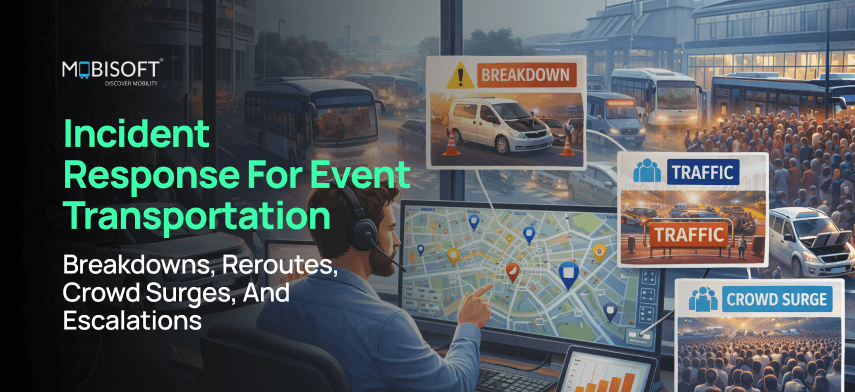
At large events, event transportation management incidents are not a matter of if. They are a matter of when. A vehicle breaks down mid-route during peak egress. A road closure makes a planned route unusable with five vehicles already on it. A session ends early, and thousands of people converge on two pickup zones at once. A situation escalates beyond the dispatcher's authority, and no one is sure who should take it from there.
These scenarios play out across special event transportation environments at every scale, every season. The operations teams that manage them well are not the ones with the most experienced staff. They are the ones who built a response system before the event opened.
Incident management in event transportation fails for one consistent reason. Not because teams lack capability, but because they lack structure.
- No pre-defined classification system
- Lack of documented response protocols
- No real-time fleet visibility
- No escalation matrix that tells the team who owns which decision and within what time frame
This playbook addresses all four major incident categories in technical detail, covering how to handle transport disruptions during events, including vehicle breakdowns, route disruptions, crowd surges, and escalations that exceed dispatcher authority. For each, it presents the specific operational problem, the best-practice solution, and the technology capabilities that enable execution under event-day pressure.
By the end of this playbook, any ops team, dispatcher, or venue manager should be able to build complete event transportation planning and management system before their next event.
Learn how purpose-built event transportation software gives ops teams the tools to execute every protocol in this playbook.
Why Incident Response Fails at Large Events?
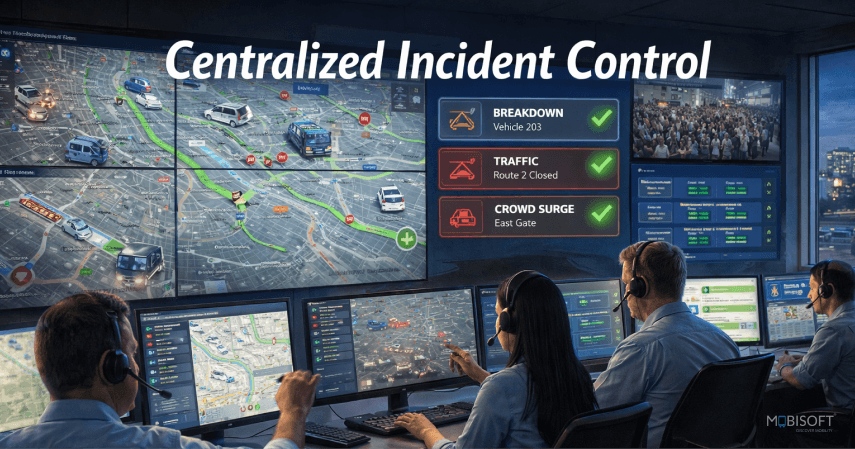
The most common assumption about event transport services is that they are unpredictable. However, most of them are not. Vehicle breakdowns, crowd surges, and route disruptions are foreseeable categories of operational failure. The reason they cause disproportionate damage when they occur is not their unpredictability. It is the absence of efficient event transport solutions designed to handle them before they arrive.
These are the event transportation challenges and solutions that every ops team must confront. Four structural gaps account for the majority of incident response failures at large events.
Absence of Incident Classification System
When every problem is treated as a unique situation, the dispatcher is making judgment calls under pressure with no consistent framework. There is no standard response to fall back on. Two dispatchers facing the same incident type will make different decisions. The same dispatcher will make different calls depending on how far into a long event day they are.
Undocumented Response Protocols
A dispatcher who knows an incident has occurred but has no defined response to execute is improvising. And improvisation under pressure produces inconsistent outcomes and slower resolution times than a pre-defined protocol, even an imperfect one.
Limited Real-Time Operational Visibility
A command centre that learns about a breakdown from a driver phone call, a crowd surge from a zone supervisor radio message, or a route closure from a passenger complaint is always responding to conditions that developed minutes ago. By the time the response reaches the affected zone, the situation has already escalated further.
Undefined Escalation Matrix
When an incident exceeds the dispatcher's authority and there is no defined handoff path, the command centre stalls. The dispatcher either holds the incident too long, trying to resolve it independently, or escalates too early and pulls senior team members away from situations that genuinely require their involvement.
Incident response does not fail because the team lacks capability. It fails because the system lacks structure. See how these structural gaps translate into real operational and financial damage in our breakdown of event transportation challenges.
Incident Classification Framework
Before any response protocol can be built, the operations team needs a classification system that tells the dispatcher what they are dealing with within the first 10 seconds of an incident being flagged. Classification determines who owns the response, what the resolution target is, and whether the incident stays at the dispatcher level or moves up the escalation path.
This is the backbone for building best transportation management systems for large events effectively. Without one, every incident starts with an assessment that takes time the dispatcher does not have. With one, every incident starts with an answer.
The Two-Axis Classification Model
The classification model works on two axes. The first axis is severity, and the second is incident type. Together, they produce a specific classification for every foreseeable event transportation incident.
Axis 1: Severity Levels
Level 1 incidents are minor operational variances that fall within normal management parameters.
- A shuttle running 4 minutes behind schedule
- A minor staging adjustment is needed at a low-demand zone
These represent a Level 1 condition with no active passenger impact. The dispatcher monitors and notes without initiating an active response.
Level 2 incidents require active dispatcher intervention and carry a limited but visible passenger impact.
- A shuttle delay exceeding the response threshold
- A zone supervisor reporting a building queue
- A driver reporting a route obstruction
All of the above fall into the level 2 category. The dispatcher acts independently within defined protocols without escalating.
Level 3 incidents require ops lead involvement and carry a visible passenger impact at one or more zones.
- A vehicle breakdown during a peak window
- A crowd surge affecting multiple zones simultaneously
- A reroute affecting more than one active route
These are Level 3 conditions. The ops lead is notified and on standby or takes direct ownership depending on the specific situation.
Level 4 incidents have event-level impact and require venue director or agency principal involvement.
- A multi-vehicle failure during peak egress
- A security-triggered route closure affecting all active transport
- A VIP transport failure with client visibility
- Any situation carrying media exposure risk
All of these qualify as Level 4 conditions. Escalation is immediate.
Axis 2: Incident Types
Four incident types account for the vast majority of what command centres deal with during transportation logistics for events:
- Vehicle and fleet incidents: Breakdowns, mechanical failures, driver no-shows, and accidents
- Route and traffic incidents: Road closures, traffic incidents, security restrictions, and weather-related access changes
- Crowd and zone incidents: Pickup zone surges, loading bay blockages, and pedestrian flow disruptions
- Communication and system incidents: Driver app connectivity failures, GPS feed interruptions, and passenger notification system outages
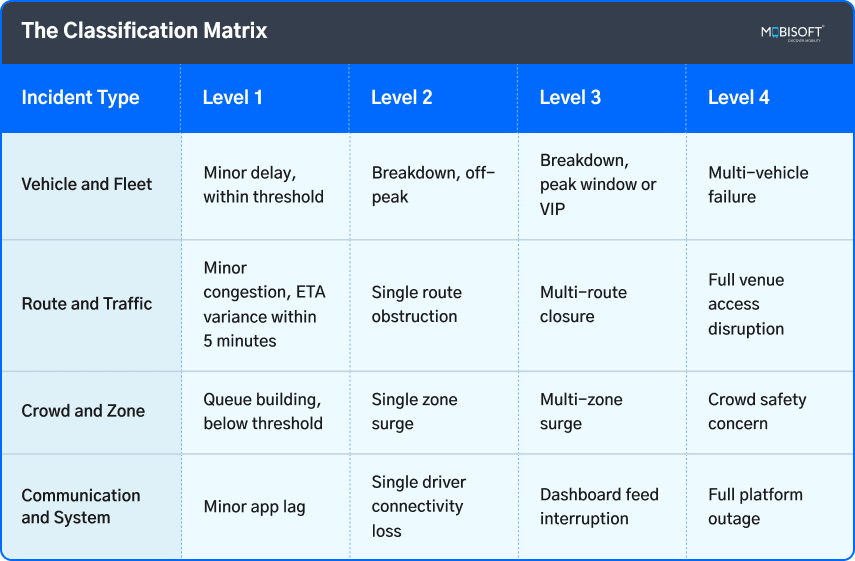
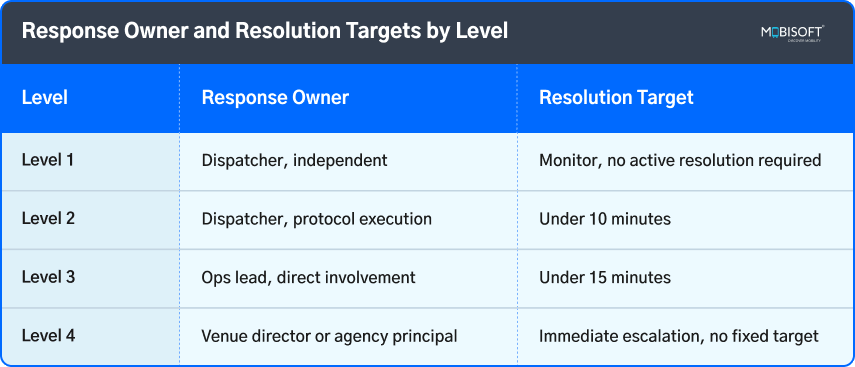
The classification matrix is not a theoretical framework. It is a working document that lives on the dispatch dashboard during the event, reviewed at the pre-event briefing and accessible to every member of the command centre team throughout the event day. For a deeper look at building the operational foundation behind this framework, read our guide on event transportation planning.
Vehicle Breakdown Response
The Problem
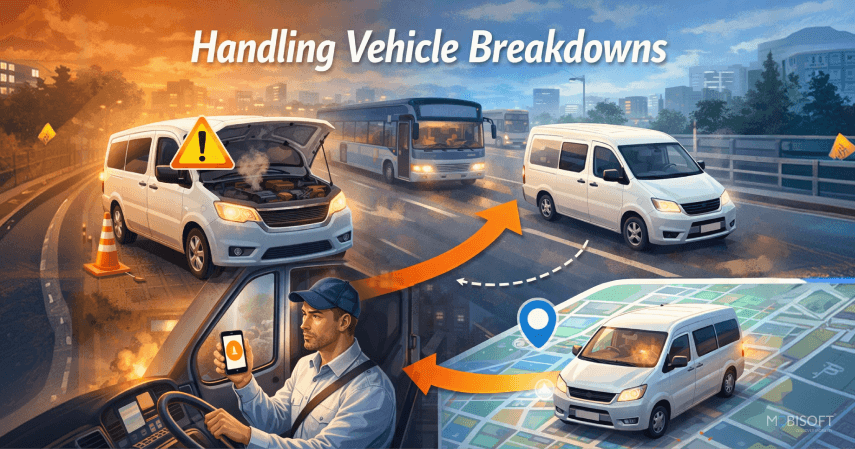
A vehicle breaks down mid-route during the post-keynote egress window, leaving the driver stranded with passengers on board. The dispatcher's first notification is a phone call from the driver, received 4 minutes after the breakdown occurred because the driver spent the first few minutes trying to restart the vehicle.
From that moment, the dispatcher is managing three simultaneous problems.
- The stranded vehicle and its passengers
- The gap created in the route schedule is already causing a queue to build at the next scheduled stop
- The communication chain that needs to reach the affected passengers, the zone supervisor, the reserve vehicle driver, and potentially the ops lead, all at once.
Without a defined protocol, each of these gets handled sequentially. The dispatcher calls the reserve vehicle driver, then calls the zone supervisor, then tries to push a passenger notification through whatever communication channel is available. The total elapsed time from breakdown to reserve vehicle dispatch stretches to 10 or 12 minutes, and the passenger impact is visible and growing throughout.
The Solution
A breakdown response protocol that activates from the driver's end the moment the incident occurs. It should trigger a pre-defined response chain without requiring the dispatcher to make sequential decisions under pressure.
The protocol has five components that execute in parallel rather than in sequence.
Instant SOS Activation From the Driver App
A single button press captures the vehicle's GPS position. It flags the incident in the dispatch management platform and simultaneously alerts the dispatcher and the ops lead if the severity threshold is met, while activating the incident log with a timestamp. The driver does not need to make a phone call because the alert reaches the command centre in under 10 seconds.
Automated Reserve Vehicle Dispatch
The platform identifies the nearest available reserve vehicle based on live GPS data and current utilization status. The dispatcher confirms the reassignment through the platform. The reserve vehicle driver receives the updated route instruction through the app without a phone call or manual position assessment.
Passenger Holding Communication
Within 2 minutes of the incident flag, a notification is pushed to the affected pickup zone. It will inform the passengers of the delay and provide an updated ETA for the replacement vehicle. Informed passengers calmly stay at the zone. Whereas, passengers with no information start moving and create secondary crowd management problems.
Route Gap Assessment
The dispatch dashboard automatically identifies which stops on the affected route are impacted by the breakdown and calculates revised ETAs based on the replacement vehicle's current position. It gives the dispatcher a full picture of downstream impact without manually working through the schedule.
The Escalation Trigger
Breakdowns occurring during peak demand windows or involving vehicles carrying Tier 1 or Tier 2 VIP guests automatically escalate to Level 3 and trigger ops lead notification through the platform. The same escalation applies when no reserve vehicle is available within the target response time.
Target Resolution Timeline
- T+0: Driver activates SOS through the platform app
- T+10 seconds: Incident flagged on the dispatch dashboard, incident log opened automatically
- T+2 minutes: Passenger holding communication pushed to the affected zone
- T+3 minutes: Nearest reserve vehicle dispatched, driver receives updated route through app
- T+5 minutes: Ops lead notified if peak window, VIP involvement, or no reserve available
- T+8 minutes: Replacement vehicle en route, updated ETAs pushed to all affected stops
How the Platform Enables This
The breakdown response protocol requires four specific platform capabilities working together in real time.
One-button SOS in the driver app with automatic GPS position capture and simultaneous multi-party alert delivery is what starts the chain. Without this, the protocol begins with a phone call that loses 3 to 5 minutes before the dispatcher has the information needed to act.
shuttle transportation software for events also links automated passenger notification directly to fleet data. It ensures that ETA updates reflect actual vehicle positions rather than manually entered estimates. Without this, passenger communication requires dispatcher attention at the exact moment the dispatcher is managing the vehicle response.
Automatic incident logging that opens a timestamped record on SOS activation and captures every response action in sequence means the post-event review is built on complete data rather than memory and reconstructed timelines.
Reroute Response
The Problem
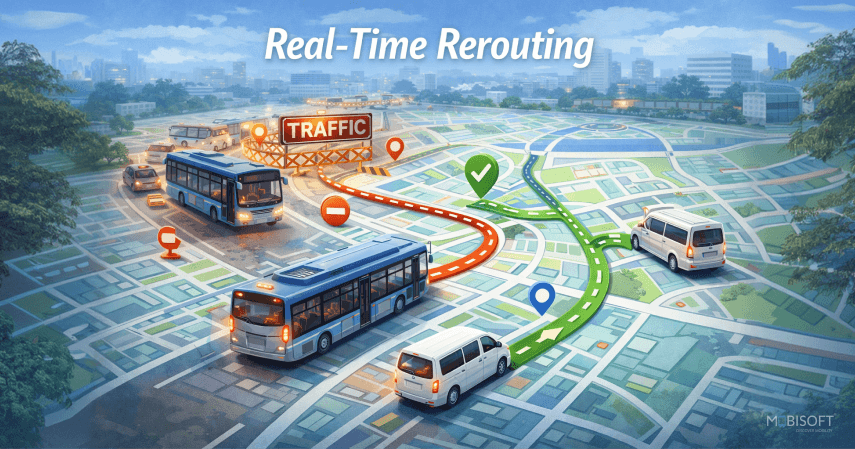
Fifteen minutes into peak egress, a road closure blocks the primary route serving the main event shuttle transportation corridor. Three vehicles are currently on that route, and two more are staged and about to depart. The dispatcher needs to reroute all five vehicles simultaneously, update passenger-facing ETAs across four affected pickup zones, and assess the timing impact on the full schedule, all within a window of under 3 minutes before the delay becomes visible to passengers at the first affected stop.
Without pre-approved alternative routes and a platform that pushes updated navigation to multiple drivers simultaneously, the dispatcher is making individual phone calls. Each call takes 60 to 90 seconds. Five calls take 7 to 8 minutes minimum, assuming every driver answers immediately and understands the instruction correctly the first time. By the time all five vehicles are on the alternative route, the delay is already a passenger experience problem at two or three zones.
The manual reroute also creates a communication gap with passengers. While the dispatcher is on phone calls with drivers, no one is updating the passenger-facing ETA displays, so passengers at the affected zones see ETAs that are no longer accurate, wait longer than the display indicates, and zone supervisors start fielding questions they cannot answer.
The Solution
A reroute protocol built on three pre-event decisions and one platform capability. The three pre-event decisions are:
- Alternative routes are mapped and loaded into the route optimization software before event day
- A reroute trigger threshold that activates the alternative without requiring real-time authorization
- A clear definition of which team member identifies and confirms the trigger
The one platform capability is simultaneous navigation update delivery to all affected drivers through the driver app, executed with a single dispatcher action.
The protocol has four components that together compress the full reroute execution into the 3-minute target window.
The first is trigger identification. Reroute triggers come from three sources:
- Live traffic monitoring alerts generated by the platform's traffic integration
- Zone supervisor or driver reports of route obstruction
- Security or venue team notifications of access restriction changes
Each source has a defined reporting channel and a defined response owner, so the trigger reaches the dispatcher through the right channel without delay.
The second is alternative route activation:
- The dispatcher selects the pre-loaded alternative route in the platform and confirms the activation
- All drivers currently on the affected route receive updated navigation simultaneously through the driver app
The activation takes one dispatcher action and approximately 15 seconds, regardless of how many vehicles are on the affected route.
The third is a passenger communication update:
- Within 60 seconds of route activation, the platform recalculates ETAs based on the alternative route
- It updates passenger-facing displays at all affected zones automatically, requiring no manual ETA entry from the dispatcher.
The fourth is the schedule impact assessment:
- The cloud based TMS dispatch dashboard displays the revised arrival times across all affected zones based on the alternative route
- It allows the dispatcher to identify any stops where the delay will exceed the response threshold and require additional action.
Target Resolution Timeline
- T+0: Reroute trigger identified
- T+1 minute: Alternative route activated through the platform, all affected drivers receive updated navigation simultaneously
- T+2 minutes: Passenger-facing ETAs updated automatically across all affected zones
- T+3 minutes: Schedule impact assessment complete on dashboard, any secondary response actions initiated
- T+3 minutes: Ops lead notified if reroute affects VIP movements or multiple concurrent routes
How the Platform Enables This
Pre-loaded alternative routes are stored in the platform and ready to activate with a single dispatcher action. This eliminates the live route planning decision that would otherwise add 3 to 5 minutes to the response time before any driver receives an instruction.
Simultaneous navigation push to multiple drivers through the driver app removes the phone call chain entirely. This eliminates the communication lag, miscommunication risk, and dispatcher attention cost that individual calls carry during a high-pressure reroute window.
Live traffic integration monitors primary routes in real time and flags developing obstructions before vehicles encounter them. This moves the reroute trigger from reactive to proactive, with the platform identifying the obstruction before the driver reaches the affected area.
Automatic ETA recalculation on route change ensures passenger-facing displays reflect the alternative route timing without requiring the dispatcher to manually update them while simultaneously managing the vehicle response. Driver confirmation receipts for navigation updates give the dispatcher certainty that every affected driver has received and acknowledged the reroute instruction without follow-up calls.
For operations running across multiple venues, see how event transportation logistics adds another layer of complexity to reroute management.
Crowd Surge Response
The Problem
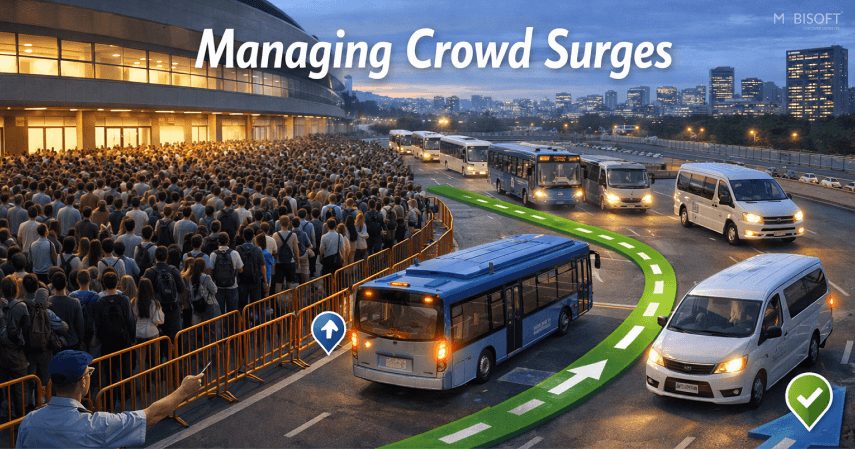
A keynote session ends 18 minutes early in a hall that holds 4,000 attendees. The primary pickup zone for that hall has two vehicles scheduled to arrive in the next 12 minutes according to the standard headway. But the zone supervisor is already reporting 300 passengers at the zone, with the crowd still building.
The dispatcher needs to identify available vehicles, assess which routes can sustain a temporary vehicle reduction, issue reassignment instructions, and push a passenger communication update to the affected zone. All of this needs to happen before the queue at Zone A becomes a crowd control transportation logistics problem rather than a transport scheduling one.
Without live vehicle utilization data, the dispatcher cannot identify which vehicles are available for reassignment without risking a secondary queue problem at another zone. Without a pre-defined surge threshold, the dispatcher has no clear trigger point for transitioning from monitoring to acting. Without a bus fleet management software linked to live fleet data, updating the ETA display at Zone A requires manual entry at the exact moment the dispatcher is managing vehicle reassignments.
The result is a response that takes 10 to 15 minutes to execute fully. The queue reaches 500 passengers, the zone supervisor can no longer manage the crowd flow, and secondary problems develop at adjacent zones as passengers start walking toward alternative pickup points.
The Solution
A surge response protocol built on pre-defined density thresholds, live zone visibility, and dynamic vehicle redeployment capability that compresses the time between surge identification and vehicle arrival at the affected zone.
The protocol has five components designed to run in parallel under dispatcher management.
The first is the surge threshold definition:
Before event day, the ops team defines the passenger count or wait time at any zone that triggers an active surge response, and a workable starting threshold for most large events is 40 passengers waiting with no vehicle arrival in the next 5 minutes. The threshold is configured in the platform as an automatic alert. Therefore, the dispatcher does not need to monitor zone supervisor reports continuously to identify the trigger condition.
The second is live zone status visibility. The dispatch dashboard displays the current status of every active zone, fed by scheduled zone supervisor check-ins and, where the venue supports it, RFID gate scan data that provides continuous crowd flow information without requiring manual reporting. When a zone crosses the surge threshold, the dashboard flags it automatically.
The third is dynamic vehicle redeployment. The fleet management software displays live utilization data for every active vehicle, showing which routes have headroom for a temporary vehicle reduction without creating a secondary queue problem. The dispatcher identifies the nearest available vehicle on a low-utilization route, issues the reassignment through the platform app, and the driver receives the updated instruction within 60 seconds without a phone call or manual position assessment.
The fourth is passenger communication. At the moment of reassignment, an updated wait time notification is pushed to the affected zone, because passengers who know a vehicle is 6 minutes away stay organized at the zone, while passengers with no update start moving and create crowd pressure that slows loading when the vehicle eventually arrives.
The fifth is a split routing assessment. If the redeployment of a single vehicle is insufficient to resolve the surge within the target window, the dispatcher splits the affected route into two shorter loops for the duration of the surge, doubling service frequency at the congested zone without adding a vehicle to the fleet.
Target Resolution Timeline
- T+0: Zone surge threshold crossed, dashboard alert fires, or zone supervisor reports
- T+1 minute: Dispatcher identifies nearest available vehicle through live utilization data
- T+2 minutes: Vehicle reassignment issued through the platform, driver confirms receipt
- T+2 minutes: Updated wait time pushed to passengers at the affected zone
- T+5 minutes: Replacement vehicle arrives at the affected zone
- T+8 minutes: Zone supervisor confirms queue normalizing, split routing activated if required
How the Platform Enables This
Configurable zone density alerts that fire automatically when a surge threshold is crossed remove the dependency on zone supervisor reports as the sole trigger for surge response. This ensures that surge identification is proactive rather than reactive and the response window is as wide as possible.
Live vehicle utilization data makes redeployment candidate identification a 30-second task rather than a manual assessment requiring calls to multiple drivers. This gives the dispatcher confidence that a reassignment will not create a secondary problem at the route being reduced.
One-action vehicle reassignment through the event transportation management platform with driver confirmation receipt removes the phone call from the redeployment process entirely, along with the lag and miscommunication risk that comes with verbal instructions during a surge window.
RFID gate scan integration is the highest-value capability in the entire surge protocol. When the platform knows that a session hall just reached capacity, it can pre-position vehicles at the adjacent egress zone before the crowd reaches the pickup point, moving surge response from reactive to fully proactive. Automated passenger notification triggered by the reassignment action ensures that the zone communication happens simultaneously with the vehicle response rather than after it.
Teams managing employee or attendee movement at scale also benefit from purpose-built carpooling software to reduce vehicle demand during high-density windows.
Escalation Management
The Problem
A vehicle breakdown during peak egress creates a queue of 400 passengers at Zone C. The dispatcher deploys a reserve vehicle, but it will take 12 minutes to arrive. Two other zones are reporting building queues, and a VIP guest is waiting at a private departure point without the ops lead having been notified. The dispatcher is managing four concurrent situations and does not have a clear answer to the question that matters most: which of these do I own and which do I hand off?
Without an escalation matrix, the dispatcher makes that assessment under pressure with incomplete information. Sometimes they hold incidents too long, trying to resolve situations that exceed their authority, and sometimes they escalate routine decisions that pull senior team members away from incidents that genuinely require their involvement. Either way, the absence of a defined escalation structure slows the overall response and creates coverage gaps at the dispatcher level that compound as the event day progresses.
The Solution
A pre-built escalation matrix that maps every foreseeable incident type and severity level to a specific response owner, escalation trigger, and resolution time target. Built before event day, briefed the full team, and made it accessible on the event transportation management dashboard throughout the event.
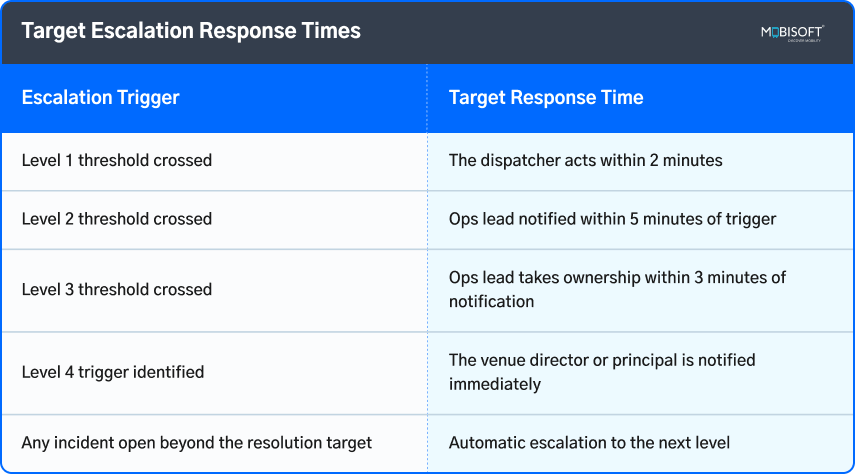
The Four Escalation Levels
- Level 1 situations stay with the dispatcher. This covers shuttle delays under the 20-minute threshold, standard reroutes using pre-approved alternatives, dynamic vehicle reassignments within normal reserve parameters, and routine passenger communication updates. The dispatcher acts independently, logs the action, and monitors for resolution without involving anyone else in the command centre.
- Level 2 situations require the ops lead to be informed and on standby. This covers delays exceeding 20 minutes, breakdowns during peak demand windows, surges affecting more than one zone simultaneously, and any incident involving a Tier 1 or Tier 2 VIP guest. The dispatcher notifies the ops lead through the platform and continues managing the response. The incident log stays open until resolution is confirmed.
- Level 3 situations require the ops lead to take direct ownership. This covers incidents open beyond their target resolution time, multiple concurrent Level 2 incidents that exceed the dispatcher's management capacity, and any situation where the initial response has not resolved the problem within the target window. The ops lead takes the incident while the dispatcher continues managing other active situations. The incident log reflects the ownership transfer with a timestamp.
- Level 4 situations require venue director or agency principal involvement. This covers situations requiring venue-level security intervention, client-facing corporate event transportation failures that need a formal response, incidents with media exposure risk, and any event-level transport disruption affecting the programme schedule. Level 4 escalation is immediate with no fixed resolution target. At this level, the priority is stakeholder notification and coordinated response rather than speed of resolution.
How the Platform Enables This
Configurable alert thresholds automatically flag incidents approaching escalation triggers before a threshold is breached. This gives the dispatcher warning rather than a reactive notification, which is the difference between a managed escalation and a missed one.
Role-based dashboard access gives the ops lead real-time visibility into all active Level 2 incidents without requiring a briefing call. By the time the escalation notification arrives, the ops lead is already informed about the developing situation.
Automated escalation notifications are pushed to the relevant team member the moment a threshold is crossed. This removes the dependency on the dispatcher remembering to notify the right person at the right moment while simultaneously managing multiple active incidents.
The complete incident log displays timestamps, response actions, ownership transfers, and resolution status to all escalation levels simultaneously. This keeps the full event logistics management team aligned without verbal updates that pull attention from active management tasks. Incident resolution timers track how long each incident has been open against its target and flag any that are approaching or exceeding it automatically, so the dispatcher does not have to manually track resolution times across concurrent incidents.
Operators managing driver coordination at this scale can also explore how ride sharing app development technology underpins real-time dispatch and escalation workflows.
Building the Incident Response Playbook Before Event Day
The four protocols in Sections 3 through 6 are only operational if the preparation work that supports them is complete before the command centre opens. A breakdown response protocol without a pre-staged reserve vehicle is a procedure without a resource. A reroute protocol without pre-loaded alternative routes is a workflow without a destination. The preparation work is what makes the protocols executable under event-day pressure rather than aspirational documents that the team cannot act on when the situation requires it.
What to Build
The incident classification matrix needs to be completed and loaded onto the dispatch dashboard before event day. Every cell should be filled with a specific response owner and a specific resolution target, not general guidance. The team should be able to look at any incident and find its classification in under 10 seconds. That level of speed only works if the matrix has been built with that level of specificity.
Pre-approved alternative routes need to be mapped, reviewed, and loaded into the route optimization software for every primary transport route. Each alternative should be tested for feasibility under event-day access conditions rather than just mapped on a general traffic application. A route that works on a normal weekday may not be accessible during a large event due to road closures, venue access restrictions, or local traffic management measures specific to the event.
Reserve vehicle staging positions need to be confirmed within the venue footprint before event day, a practice aligned with rental fleet management software workflows. Each position should be accessible to all active pickup zones within the target response time. The staging plan should specify which reserve vehicle responds to which zone type based on proximity, rather than issuing a general instruction to deploy the nearest available vehicle.
Passenger communication templates need to be pre-loaded in the platform for each incident scenario, covering breakdown holding communication, reroute notification, and surge delay updates. Pre-loaded templates mean the dispatcher activates and sends rather than drafts and sends. That difference saves 60 to 90 seconds per notification during an active incident, and those seconds matter more than most teams realize.
What to Brief
The full command centre team needs a verbal walkthrough of the classification matrix at T-minus 2 hours. This is not a document review. It is a verbal confirmation that every person in the room knows their role in the response chain for each incident level.
Drivers need a specific briefing on the SOS protocol before event day. This covers exactly how to activate it, what information it sends automatically, and what to do in the minutes between activation and response confirmation from the command centre.
Zone supervisors need a briefing on surge reporting thresholds and the specific language to use when reporting a developing condition. They also need clarity on the check-in cadence that applies during peak windows versus low-demand periods.
What to Test
The SOS alert function on every driver app device needs to be confirmed active before the first vehicle departs staging, not assumed active based on app installation alone.
The reserve vehicle dispatch flow from incident flag to driver confirmation needs to be run as a timed drill to confirm the target response time is achievable with the current staging configuration and platform setup.
Passenger notification delivery from the platform to QR code displays at pickup zones needs to be confirmed across all active zones before the venue opens. Escalation notification delivery to the ops lead, and venue director contacts also need to be confirmed before event day, tested on the actual devices and channels that will be used during the event.
Post-Incident Review and Data Capture
Every incident that occurs during an event generates data that makes the next event's response plan more accurate, more efficient, and easier to execute. The post-incident review converts that data into actionable improvements. The review should happen within 24 hours, while operational detail is fresh and the platform data is complete.
What to Pull from the Platform
- Complete incident log with classification, response owner, actions taken, and resolution time for every incident during the event
- Response time performance against targets for each incident type, showing where protocols were held and where they were not
- Redeployment log with vehicle utilization data at the time of each reassignment, showing whether decisions were made at the right threshold
- Communication log showing delivery times for every passenger notification, driver instruction, and escalation alert
- Any incidents that required improvisation rather than protocol execution were flagged for protocol gap review
Three Questions the Review Must Answer
Were classification decisions accurate?
If incidents were consistently escalated to a higher level than their actual impact warranted, the severity definitions need recalibration downward. If incidents that should have escalated were held at the dispatcher level too long, the escalation triggers need to come down.
Were response times within target?
If resolution times consistently exceed targets for a specific incident type, the protocol for that type needs revision, and the gap is usually in one of three places: the trigger identification is too late, the resource response is too slow, or the communication chain has a step that creates unnecessary delay.
Which protocol gaps created the most operational friction?
Any incident that required the dispatcher to make a decision not covered by the existing protocol points to a specific gap in the pre-event preparation, and each gap identified in the review becomes a specific addition to the protocol before the next event.
The post-incident review is not a debrief about what went wrong. It is a systematic process for converting event-day experience into a more robust protocol set. An ops team that runs this review after every event will find that each successive event requires fewer reactive decisions because more situations are already covered by a tested protocol.
Incidents Are Inevitable. Poor Response Is Not.
Every large event transportation operation will face breakdowns, reroutes, crowd surges, and escalations. That is not a failure of planning. It is the nature of moving thousands of people across a complex event footprint with dozens of variables that no pre-event plan can fully control.
What is within the ops team's control is how prepared the system is when those incidents occur. A pre-built classification matrix that tells the dispatcher what they are dealing with in 10 seconds, response protocols that execute a pre-defined chain of actions rather than requiring fresh decisions under pressure, a platform that delivers SOS alerts, simultaneous navigation updates, passenger notifications, and escalation triggers without phone calls or manual steps, and a post-event review process that makes each successive event more resilient than the last.
The difference between an operation that absorbs incidents invisibly and one that lets them cascade into visible service failures is not talent or experience alone. It is structure, preparation, and the technology that make executing that structure possible when the event day does not go according to plan.
Purpose-built event transport services now provide the full incident response stack within a single integrated system, covering driver SOS with automatic alert delivery, live fleet visibility for reserve vehicle identification and redeployment, simultaneous navigation push for multi-vehicle reroutes, configurable zone density alerts for crowd surge identification, automated escalation notifications with role-based dashboard access, and complete incident logging that feeds directly into the post-event review.
For agencies and operators, all of this deploys under their own brand through a white-label platform that presents the technology as a core part of their service capability rather than a third-party tool the client could source independently.
The protocols are here. The platform exists. The next event is where both get put to work.
Your Next Event Will Have Incidents. Here Is How to Be Ready for All of Them.
Mobisoft's white-label event transportation management platform gives ops teams, dispatchers, and venue managers the real-time visibility, automated alert thresholds, dynamic redeployment tools, and escalation management capabilities to execute every protocol in this playbook.
- One-button driver SOS with automatic GPS capture and multi-party alert delivery
- Complete visibility with real-time fleet tracking for instant redeployment decisions
- Pre-loaded alternative routes are activated with a single dispatcher action
- Simultaneous navigation push to multiple drivers through the driver app
- Configurable zone density alerts linked to automated passenger notifications
- Role-based dashboard access for ops lead and venue director escalation visibility
- Complete incident logging with timestamps, ownership records, and resolution tracking
- Deployment under your own brand for every client engagement
Book a Platform Demo


Nitin Lahoti
Read more
Nitin Lahoti is the Co-Founder and Director at Mobisoft Infotech. He has 15 years of experience in Design, Business Development and Startups. His expertise is in Product Ideation, UX/UI design, Startup consulting and mentoring. He prefers business readings and loves traveling.
 Nitin Lahoti
 March 24, 2026