What This Guide Covers
1. What is a Yard Management System (YMS)?
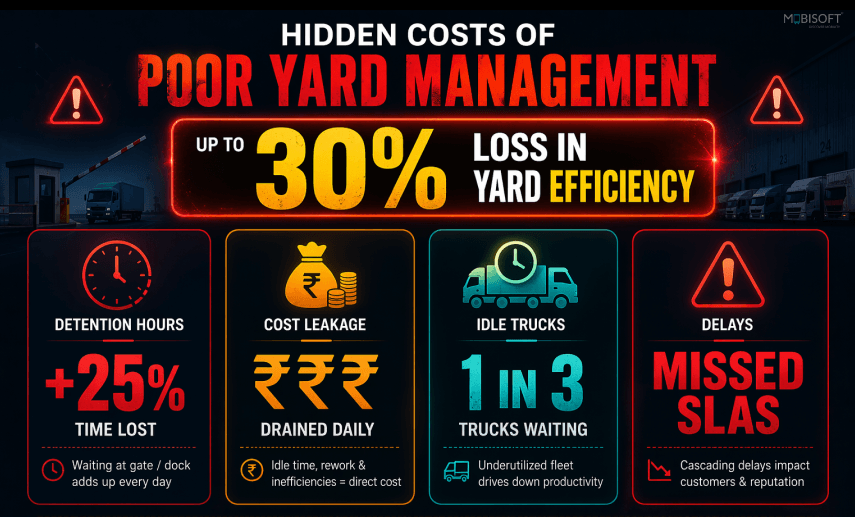
2. The Cost of an Unmanaged Yard: the business case for YMS
3. How a YMS Works: The Gate-to-Dock Flow
4. Core YMS Features: Complete breakdown
5. YMS vs. WMS vs. TMS: What each system owns
6. Key Benefits and ROI: Data-backed results
7. Industry Use Cases: Retail, Manufacturing, 3PL, Food & Beverage, Automotive, Pharma
8. AI and the Next Generation of Yard Management
9. How to Choose the Right YMS: 8-factor evaluation framework
10. Implementation: What to Expect
11. Frequently Asked Questions
12. Book a Demo with Mobisoft
What Is a Yard Management System (YMS)?
A Yard Management System, or YMS, is specialised logistics software. It monitors, coordinates, and optimises the movement of logistics inside a facility. This includes trucks, trailers, containers, and other yard equipment. Its responsibilities start when a vehicle arrives at the gate and stay active until that vehicle leaves after loading or unloading.
This system manages everything between your facility's outer boundary and the dock doors. In a busy distribution centre or manufacturing plant, the yard stays in constant motion. Dozens of vehicles move at once. Dock doors get allocated in real time. One bottleneck can quickly lead to missed shipments, detention charges, and throughput failures.
That is exactly where yard management software earns its place, offering order and visibility. Manual yard checks, phone-based coordination, and whiteboard scheduling are replaced by automated workflows, real-time tracking, and data-driven decisions. The yard stops being a guessing game and starts running like a system.
A Yard Management System is software that manages operations between the gate and the dock, enabling freight to flow without bottlenecks. It keeps track of every trailer, schedules every door, and coordinates every yard move in real time.
If you are evaluating platforms, see how YardOS approaches yard management system software for facilities of every size.
What a YMS Does: The Core Functions
Gate management
Automates vehicle check-in and check-out at the facility gate, such as driver ID, load confirmation, dock assignment, and access authorization
Dock scheduling
Assigns inbound and outbound shipments to specific dock doors based on load priority, equipment type, warehouse readiness, and carrier appointment
Trailer tracking
Provides real-time visibility of location, contents, dwell time, and status (empty, loaded, staged, in-use) of every trailer in the yard.
Yard move management
Assigns and tracks the work of yard drivers (spotters) moving trailers between parking slots and dock doors
Appointment management
Allows carriers to self-schedule delivery and collection appointments, reducing unplanned arrivals and gate congestion.
Integration hub
Connects with WMS, TMS, and ERP systems to share real-time data across the supply chain execution stack
Why It Matters More Than Most Operations Leaders Realise?
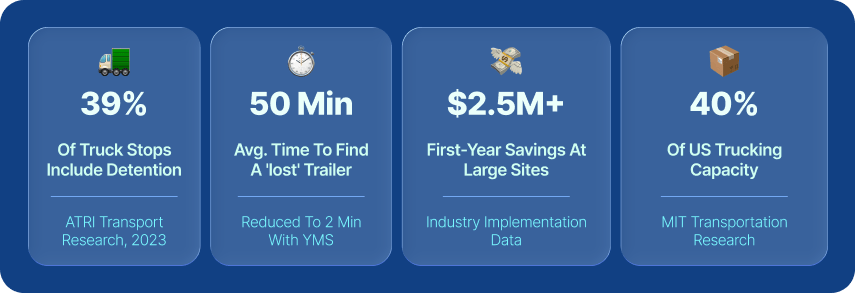
The yard is often described as the 'black hole' of the supply chain. This is because in the zone, visibility disappears, trailers sit idle, and decisions get made on guesswork. Research consistently shows that manual yard management in logistics is one of the most significant sources of operational waste:
The Cost of an Unmanaged Yard
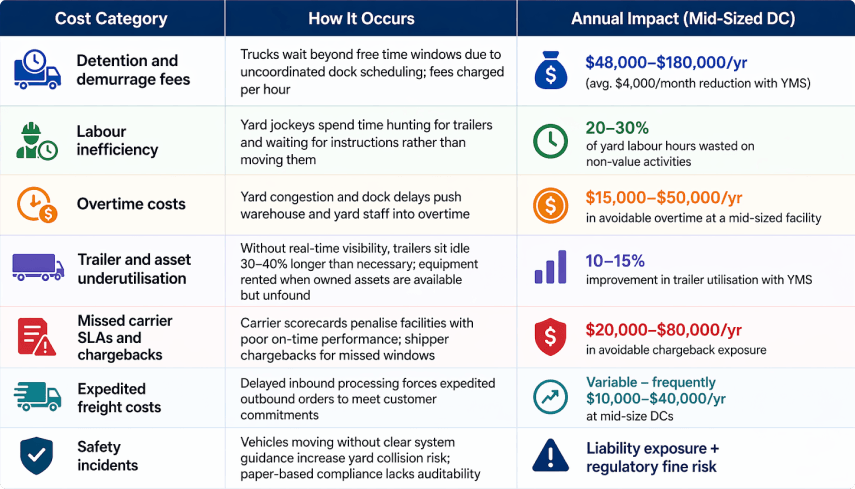
Before evaluating any YMS, it is worth quantifying what poor yard management is actually costing your operation today. Most facilities dramatically underestimate this figure because the costs are distributed across multiple budget lines rather than appearing as a single line item. This includes detention invoices, overtime labour, missed SLA penalties, carrier dissatisfaction, and reduced warehouse throughput.
The ROI Question to Ask First
Before evaluating YMS software platforms, complete this calculation for your facility:
Annual detention fees + Estimated overtime from yard delays + Annual trailer rental (for assets you probably own but can't find) + 10% of inbound processing hours (representing coordination waste)
For most mid-sized distribution centres, the yard management system ROI target figure lands between $150,000 and $500,000 per year. Most implementations recover that figure within 6 to 18 months.
How a YMS Works: The Gate-to-Dock Flow
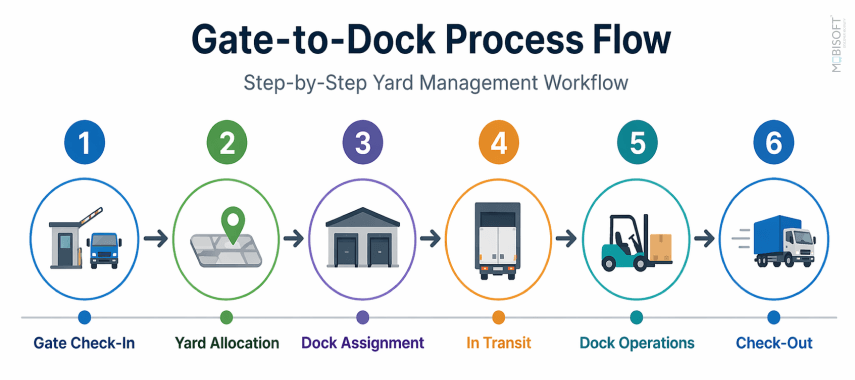
Understanding how a YMS orchestrates yard operations requires following the journey of a single shipment from the moment a truck approaches your facility until it leaves. Here is that journey, and exactly what a YMS does at each stage.
Appointment Booking
Before the truck ever arrives, the carrier self-schedules a delivery or collection appointment through the YMS carrier portal. The system checks dock door availability, warehouse labour schedules, and existing appointments to confirm a specific time window.
Gate Check-In
When the driver arrives, the gate check-in process is automated. The YMS validates against the appointment record and confirms DOT/permit compliance to generate a dock assignment. This typically takes under 2 minutes vs. 10–15 minutes for manual paper-based check-in.
Yard Placement
The YMS assigns each trailer to a specific parking slot based on load type, dock proximity, and staging rules. Yard drivers, sometimes called spotters, receive that assignment on a mobile device. They move the trailer to the designated spot. Every move gets tracked and timestamped, which creates a complete audit trail.
Dock Door Assignment
When the warehouse is ready to process a shipment, the YMS picks the best dock door for that load. The decision considers load type, door equipment like levellers or seals, proximity to the right warehouse zone, and current occupancy. The system sends this assignment to both the yard driver and the warehouse team at the same time. This replaces the radio calls and whiteboard updates that eat up management time in manual operations.
Live Monitoring
Throughout the dwell period, the YMS tracks the trailer's status. It knows when loading starts, when it finishes, and when the door is released. Real-time dashboards show managers which trailers are nearing their free time window, meaning detention risk. They also see idle dock doors and pending yard moves. The system fires automatic alerts when dwell times exceed your thresholds.
Gate Check-Out
When loading or unloading finishes, the driver checks out at the gate. The YMS records the departure time, confirms the seal number and load integrity, and generates or validates documentation like the BOL or electronic proof of delivery. It also updates your TMS to mark the shipment as departed and your WMS to confirm receipt or dispatch, all at the same time.
Data and Reporting
Every event in the gate-to-dock flow generates timestamped data. The YMS aggregates this into KPI dashboards covering average dwell time, dock utilisation rate, carrier on time performance, gate throughput, and labour productivity. This data supports continuous improvement, carrier scorecarding, SLA compliance reporting, and capacity planning.
For a deeper look at how this flow is architected in practice, read our breakdown of the yard management system for gate-to-dock operations.
Core YMS Features: Complete Breakdown
Modern yard management systems have evolved well beyond simple trailer tracking. Here is a comprehensive breakdown of the features based on operational domains.
Gate Management & Automation
Automated driver check-in/check-out via kiosk, mobile, or RFID gate reader. ID verification, appointment validation, dock assignment, and access control. Gate transaction times reduced by up to 85%, without manual intervention
Dock Door Scheduling
The system assigns dock doors to inbound and outbound appointments using rule-based logic and AI assistance. It weighs factors like load priority, equipment needs such as reefer doors or leveller capacity, carrier SLA windows, and how close the door sits to the relevant warehouse zone. Carriers can also book their own appointments through a self-service portal.
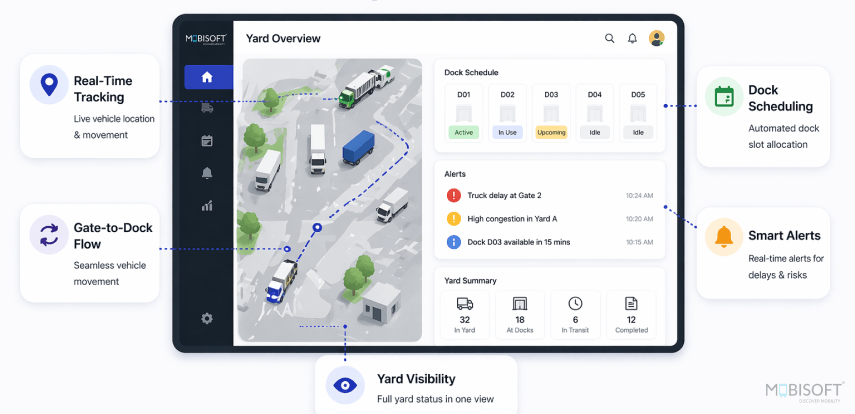
Real-Time Yard Map & Trailer Visibility
A live visual map shows every trailer's exact location, current status, and dwell time across the entire yard. Colour-coded alerts flag trailers that are getting close to detention thresholds. You can manually reassign trailers using a simple drag-and-drop interface. The map works on desktop, tablet, or mobile devices.
Trailer & Asset Tracking
The system tracks all yard assets in real time, including trailers, containers, tankers, and chassis. It relies on GPS pings, RFID tags, IoT sensors, or manual scan updates. The YMS also records what is inside each asset, the seal status, temperature for reefers, and overall equipment condition. This eliminates the problem of lost trailers.
Yard Move & Spotter Management
Assigns, dispatches, and tracks yard driver (spotter) tasks via mobile device. Prioritises moves based on dock urgency and load schedule. Replaces radio-based task assignment with a structured, auditable digital workflow that reduces spotter idle time by 20–25%.
Carrier & Driver Self-Service Portal
Carriers use a web-based portal to view available appointment slots and book their own times. They can also check facility status, receive dock assignments, and track check-in progress. This dramatically cuts down on phone calls to your gate. It also improves carrier satisfaction scores and your performance metrics with them.
Intelligent Alerts & Notifications
A configurable alert engine watches for several conditions, including detention risk when a trailer nears its free time limit, missed appointments, dock door idle time, unplanned arrivals, and compliance exceptions. The system delivers alerts through dashboards, email, SMS, or push notifications, depending on the role receiving them.
KPI Dashboards & Analytics
Role-appropriate dashboards for gate supervisors, yard managers, warehouse directors, and executives. Key metrics: average dwell time, dock utilisation %, gate throughput, carrier on-time rate, yard capacity by zone, and spotter productivity. Multi-site aggregation for enterprise operations.
WMS / TMS / ERP Integration
Bi-directional API integration with warehouse, transportation, and ERP systems. YMS pushes gate arrival and docking events to WMS to trigger labour allocation; pulls appointment data from TMS; shares detention and compliance data with ERP. Eliminates data silos across the supply chain visibility stack.
Cold Chain & Compliance Monitoring
The YMS integrates temperature monitoring for reefer trailers, both at the dock and while parked in yard slots. Automated compliance checks run at the gate for food safety, pharmaceutical cold chain requirements, and hazmat regulations. Results get documented directly in the load record. This feature is critical for food, pharma, and chemical operations.
Mobile-First Yard Operations
Native mobile apps for yard drivers, gate staff, and supervisors. Works on standard tablets and smartphones without proprietary hardware required in most implementations. Offline capability for connectivity-constrained yard environments. Real-time sync when the network is restored.
To understand how asset tracking connects with broader logistics operations, explore our work on fleet and trailer tracking systems in logistics.
YMS vs. WMS vs. TMS: What Each System Actually Owns
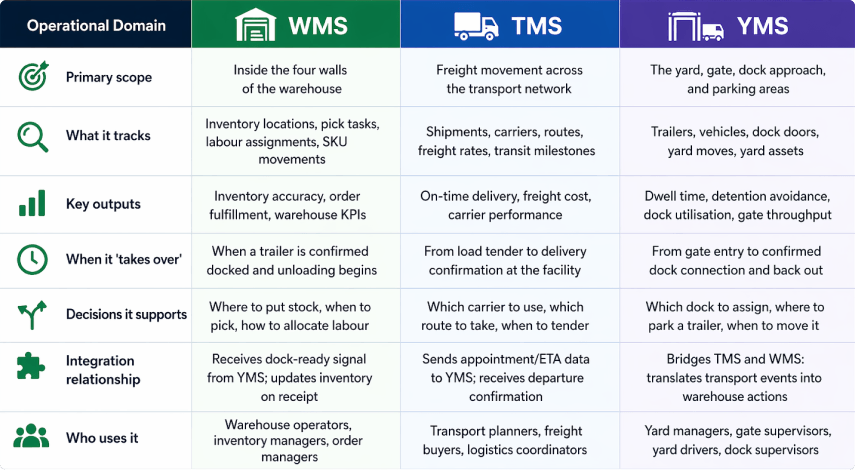
Supply chain technology decisions get confusing fast, mostly because YMS, WMS, and TMS all sound like they cover similar ground. All three touch freight, vehicles, and logistics in some way. But each system owns a distinctly different operational domain. Mixing them up either leads to buying the wrong tool or expecting one platform to handle work it was never built for. Getting clear on the boundaries before you evaluate any vendor saves a lot of time and money.
The cleanest way to think about it:
- WMS manages the inside of the warehouse, from inventory pick-and-pack, labour, to put-away.
- TMS handles movement across the transport network from origin to destination. This includes routing, carrier selection, freight rates, and shipment tracking.
- Yard management software manages the transition zone, the yard, the gate, and the dock between the transport network and the warehouse.
In many operations, the yard is where TMS visibility ends, and WMS visibility begins, creating a 'black hole' where trailers, drivers, and freight disappear from any system of record. The YMS closes that gap.
The Integration Payoff
When YMS, WMS, and TMS share data in real time:
- Warehouse teams know a truck has arrived and can pre-position labour before the trailer docks
- Transport planners know a trailer has departed and can update customer ETAs immediately
- Finance teams have accurate dwell timestamps to dispute incorrect detention invoices
- Executives have end-to-end supply chain visibility from a single data layer
Still unclear on where one system ends and another begins? Our detailed comparison covers the difference between YMS, WMS, and TMS with operational examples.
Key Benefits and ROI: The Data
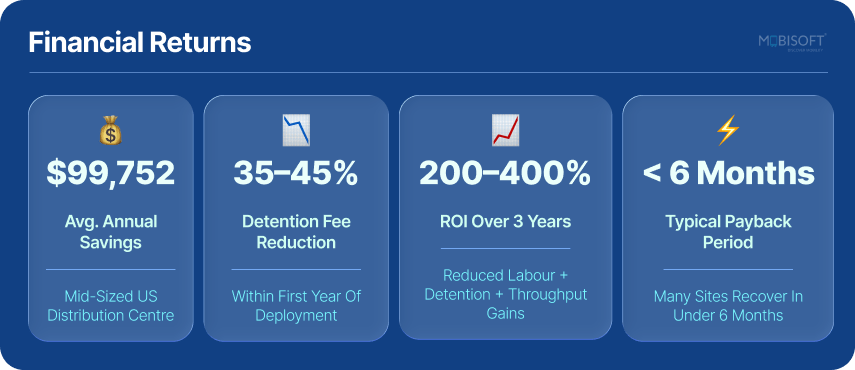
The business case for a yard management system is one of the clearest in supply chain technology. It addresses inefficiencies to generate measurable, auditable costs that appear directly on the P&L. Here is the evidence base. There are several operational efficiency gains:
Labour Productivity
A YMS replaces 4–5 full-time equivalent roles of manual yard coordination work. It automates appointment scheduling, yard checks, manual dock assignment, and status calls, freeing staff to focus on value-adding activities.
Trailer Location Time
In manual yards, locating a specific trailer takes an average of 50 minutes. It involves physical yard walks, phone calls to gate staff, and cross-referencing paper logs. With YMS, the same search takes 2 minutes via a map query.
Dock Utilisation Improvement
Intelligent dock scheduling software and real-time assignment reduce dock idle time by 20–30%. Facilities report a 12.5% improvement in warehouse throughput directly attributable to better dock management.
Faster Gate Processing
Automated check-in reduces gate processing time from 10–15 minutes (manual) to under 2 minutes. At a facility processing 200 trucks per day, this recovers 26+ hours of gate throughput capacity daily.
Beyond Cost: The Carrier and Customer Relationship Benefits
ROI calculations typically focus on hard cost savings. But yard management solutions also deliver significant relationship benefits that are harder to quantify but commercially significant:
- Carrier experience improvement: Carriers and drivers rate facilities with fast gate processing, confirmed dock assignments, and predictable appointment windows significantly higher. Better carrier relationships translate to priority capacity allocation during tight markets.
- Customer satisfaction: YMS data enables more accurate outbound ETAs, faster exception reporting, and higher on-time delivery rates. Customer satisfaction scores improve by up to 15% with well-implemented yard management.
- Carrier scorecarding: YMS data provides objective, timestamped evidence for carrier performance reviews on on-time arrival, dwell behaviour, and appointment compliance. This helps with commercial negotiations based on facts rather than anecdotes.
YMS by Industry: Use Cases and Specific Benefits
Yard management challenges are not identical across industries. The type of freight, the regulatory environment, the flow patterns, and the performance metrics that matter most vary significantly. Here is how YMS applies across the major verticals.
Retail and Consumer Goods Distribution
Key Challenges Solved:
- Managing high-volume inbound flows from multiple suppliers with uncoordinated arrival times
- Vendor compliance requirements for delivery windows that generate chargebacks on non-compliance
- Seasonal peak periods (holiday, back-to-school) that overwhelm manual yard scheduling
- Cross-dock operations where inbound and outbound loads must be matched and timed precisely
Typical YMS Results:
- 30–40% reduction in unplanned arrivals via carrier self-scheduling portal
- 90%+ vendor compliance rate through appointment-linked dock assignment
- Peak season throughput increases of 15–25% without additional headcount
- Cross-dock efficiency: YMS sequences inbound arrivals to align with outbound departure windows
Manufacturing and Industrial
Key Challenges Solved:
- Just-in-time (JIT) production schedules require inbound raw materials at exact times. A delayed trailer stops the production line
- Multiple inbound freight streams (raw materials, components, packaging), each with different dock requirements
- Outbound finished goods scheduling coordinated with carrier pick-up windows
- Large yards with complex layouts requiring structured move task management
Typical YMS Results:
- YMS dock scheduling aligned to production timetables eliminates JIT disruptions
- Equipment-specific dock rules (flatbed doors, crane bays, tanker connections) are automated in dock assignment logic
- First-year YMS implementations at automotive and electronics plants report zero production stoppages from yard delays
- Yard move task management reduces spotter costs by 20–30%
Third-Party Logistics (3PL)
Key Challenges Solved:
- Managing multiple client programmes from a single facility, each with different dock rules, compliance requirements, and SLAs
- Proving performance to clients through data to support contract renewals. This covers detention records, dwell time, and on-time rates
- Handling diverse equipment types (dry van, reefer, flatbed, LTL, parcel) across shared yard infrastructure
- Labour allocation across multiple shifts serving different client priorities simultaneously
Typical YMS Results:
- Multi-client rule sets in YMS dock assignment, with one platform managing all client programmes simultaneously
- Automated KPI reporting per client programme for contract performance reviews
- Yard management system for logistics companies of this scale generates up to $2.5M in first-year savings at large multi-client 3PL sites
- Equipment-type routing in dock assignment supports a diverse inbound fleet mix without manual coordination
Food and Beverage
Key Challenges Solved:
- FSMA (or equivalent national food safety regulation) compliance requires documented temperature control from gate to dock
- HACCP process requirements mandate documented vehicle inspection and condition checks at entry
- Cold chain integrity is maintained because reefer trailers must maintain temperature throughout dwell time in the yard
- High inbound supplier volume with perishable items that cannot wait for uncoordinated dock scheduling
Typical YMS Results:
- Automated gate inspection checks and digital vehicle condition records for FSMA/HACCP compliance
- Temperature sensor integration for reefer trailers to send alerts if the temperature exceeds the threshold during yard dwell
- YMS appointment scheduling prioritises perishable loads (first-in, first-docked) with automatic queue-jumping rules
- Complete digital audit trail of gate-to-dock events supports regulatory audit preparation.
Automotive and Heavy Industry
Key Challenges Solved:
- Multi-tier supplier networks delivering components on precise schedules to support production sequences
- Specialised equipment requirements (flatbed, lowboy, oversized) that require specific dock infrastructure
- Inbound quality inspection requirements create variable dwell times that must be accounted for in dock scheduling
- JIT and JIS (just-in-sequence) delivery models, where delivery timing is measured in minutes, not hours
Typical YMS Results:
- Production-sequenced dock scheduling: YMS aligns trailer arrivals with production line sequence and batch schedule
- Equipment-type dock rules prevent standard trailers from occupying specialist dock infrastructure
- Buffer yard logistics management: YMS holds trailers in sequenced staging zones until the production line calls for them
- Tier-1 automotive plants report zero production line stoppages attributable to yard management after YMS deployment
Pharmaceutical and Life Sciences
Key Challenges Solved:
- GDP (Good Distribution Practice) compliance requires a documented chain of custody from vehicle entry to warehouse receipt
- Controlled substance handling requires access restrictions and an audit trail at every stage of the yard process
- Cold chain integrity for temperature-sensitive products, like biologics, vaccines, and clinical trial materials
- Serialisation and track-and-trace requirements extending from the warehouse into the yard and gate processes
Typical YMS Results:
- Full digital audit trail of gate-to-dock events meeting EU GDP and equivalent national standards
- Role-based access control restricts sensitive dock areas. YMS enforces these rules without manual supervision
- Continuous temperature monitoring with automated compliance alerts for GDP-regulated products
- Integration with serialisation platforms, so the YMS gate events trigger chain-of-custody updates in track-and-trace systems
3PLs managing multi-client operations at this scale typically require tightly integrated platforms. Learn how to support these complex 3PL environments with logistics system integration for real-time visibility.
AI and the Next Generation of Yard Management
The YMS software market is undergoing a significant technology transition. The first generation of YMS platforms was digital record systems. It replaced paper and whiteboards with structured databases. The current generation is moving toward autonomous orchestration. It uses AI to not just record yard events but to predict, prevent, and optimise them in real time. The following are the AI capabilities now available in production YMS platforms:
Digital Twin Yard Visualisation
Real-time digital twin of the physical yard, every trailer, vehicle, and asset represented accurately on a live map updated continuously from sensor data, camera feeds, and mobile scans. Enables remote yard operations management and supports autonomous spotter dispatch.
Autonomous Dock Optimisation
AI dock assignment engines consider several factors while assigning trailers to the optimal dock door and time window. It continuously re-optimises with real-time dock occupancy, incoming trailer queue, warehouse labour availability, load priority, and outbound departure schedules.
Predictive Dwell and Detention Analytics
ML models analyse historical dwell patterns, carrier behaviour, dock throughput, and warehouse staffing. This helps predict which loads are at detention risk before the free-time clock expires. Operations teams receive alerts with enough lead time to act, rather than receiving a detention invoice after the fact.
Computer Vision Gate Automation
Camera-based systems identify vehicles, read licence plates, scan trailer numbers, and assess vehicle condition at the gate without manual data entry. AI models achieve much higher accuracy and process each vehicle in seconds. Now deployable as a software layer on existing CCTV infrastructure in many cases.
Where YMS Is Heading (2027–2030)
- Autonomous yard vehicles: Self-driving yard trucks receiving move instructions directly from YMS without a human driver. It is already in pilot at several major distribution centres
- Predictive capacity management: YMS forecasting inbound volume 24–72 hours ahead based on carrier GPS data and TMS shipment records. It enables proactive staffing and dock preparation
- Carbon footprint tracking: YMS that measures idle engine time, gate-to-dock movement efficiency, and reefer runtime. It provides sustainability data for Scope 3 emissions reporting
- Voice and natural language interfaces: Yard managers querying YMS via voice ('How many trailers have been waiting more than 2 hours?') rather than navigating dashboard menus
Building these capabilities requires deep logistics engineering expertise. Learn more about our logistics software development services that power platforms like YardOS
How to Choose the Right YMS: 8-Factor Evaluation Framework
Dozens of yard management system providers are available today. From lightweight dock scheduling tools to full enterprise yard operating systems, choosing the right one requires a structured evaluation. Here is an eight-factor framework for assessing YMS vendors against your specific operational requirements.
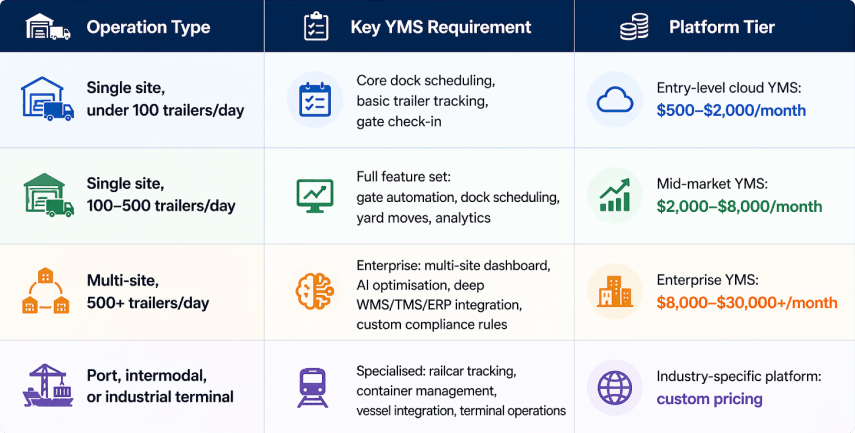
Factor 1: Operational Scope Match
Be clear about what you actually need the platform to manage. A facility running 40 trailers per day on a single site has very different requirements from a multi-site enterprise managing 500 moves per day with cross-site trailer pooling.
Factor 2: Integration Architecture
A YMS that cannot share data with your WMS, TMS, and ERP in real time is just a standalone tracking tool. You need to evaluate integration depth, not just whether integration exists.
- Pre-built connectors: Ask the vendor if they have native connectors for your specific systems. That includes SAP, Oracle, Blue Yonder, Manhattan, JDA, McLeod, or Oracle TMS.
- API standard: Does the platform offer a documented REST API for custom integrations? What are the rate limits? How good is the data model documentation?
- Real-time vs. batch: Confirm that integrations work on real-time events. For example, a gate arrival should trigger a WMS labour alert immediately. You do not want batch syncs running every 30 minutes.
- Data ownership: Who actually owns the data in integration scenarios? Can you export complete historical data in standard formats at any time?
Factor 3: Hardware Requirements
Some yard management system software platforms require proprietary hardware like RFID readers, specialised gate kiosks, or IoT beacons. This adds high upfront costs and creates vendor lock-in. Other platforms work with commodity hardware or even bring-your-own-device deployments.
- Software first platforms: These work with standard tablets, smartphones, and web browsers. You get low upfront hardware costs and faster deployment.
- Hardware-dependent platforms: These need RFID tags on every trailer, proprietary readers at dock doors and gate lanes, plus IoT sensors. They offer higher accuracy, but the upfront investment is significant, and deployment takes a long time.
- Vision native platforms: These use your existing CCTV cameras with an AI software overlay. They eliminate RFID infrastructure while achieving comparable or even better accuracy.
Factor 4: Ease of Use (The Yard Staff Reality Test)
Even the most sophisticated YMS will fail if yard drivers, gate staff, and dock supervisors refuse to use it. You must evaluate usability with the people who touch it every day, not just with IT and management.
- Gate staff interface: Can a gate guard process a check-in on a tablet in under 60 seconds? Is the screen readable in bright sunlight? Can they use it while wearing gloves?
- Yard driver mobile app: Is the move task interface simple enough for drivers who are not tech-savvy? Does the app work offline when network signals are poor in the yard?
- Manager dashboard: Can a yard supervisor find the answer to "where is Trailer 47832?" in under 10 seconds without any training?
Factor 5: Configurability vs. Customisation
Configuration is about adjusting the platform's behaviour through settings and rules without touching code. Customisation, which requires vendor development work. A well-architected YMS should handle 90% of your workflow requirements through configuration. While customisation should be reserved for genuinely unique requirements.
- Can you define custom dock assignment rules (e.g., 'food-grade trailers only to Doors 1–10', 'hazmat trailers require 2-hour pre-notification') through the settings interface?
- Can you add custom data fields to gate records, load records, and trailer profiles without vendor involvement?
- Can you configure alert thresholds (detention timers, temperature limits, dwell warnings) per dock zone, client programme, or cargo type?
Factor 6: Scalability
Your yard operations will grow. The best yard management software for your operation today should handle twice your current volume without requiring a platform migration. Key scalability questions:
- Multi-site support: Can the platform manage multiple facilities under a single account with consolidated reporting and trailer visibility across sites?
- Load testing evidence: What is the highest transaction volume this platform has handled in a single production environment? Get a reference client at that scale.
- Cloud infrastructure: Ensure auto-scaling for cloud platforms. The system should handle peak days (Black Friday, quarter-end shipping surges) without performance degradation.
Factor 7: Vendor Track Record and Support Model
A warehouse yard management system is operational-critical infrastructure. When the system has a production issue at 2 AM during a peak inbound shift, your support model matters enormously.
- Implementation references: Request two references from production deployments at facilities of comparable size and complexity to yours. Ask specifically about the implementation experience, not just the steady-state product.
- Support SLA: What is the guaranteed response time for production-critical incidents? Business-hours support is inadequate for 24/7 yard operations.
- Uptime commitment: What SLA does the vendor offer for platform availability? What is the compensation model for SLA breaches?
- Implementation timeline: What is a realistic timeline for go-live, based on actual customer deployments?
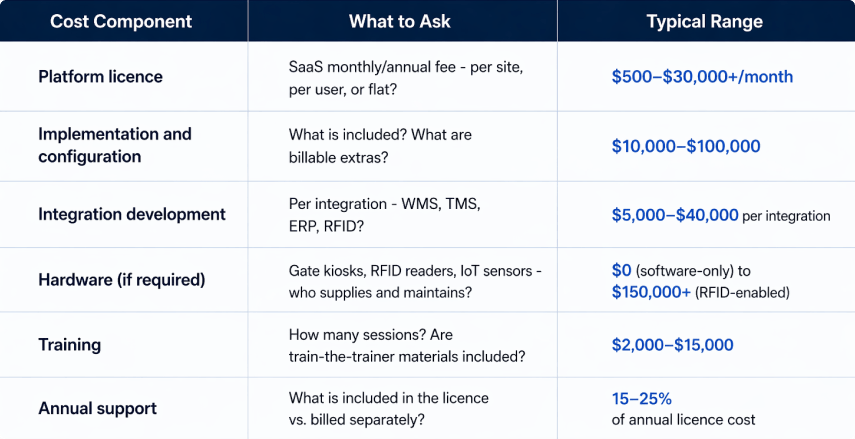
Factor 8: Total Cost of Ownership
Get clarity on the full yard management system cost before signing. YMS pricing is frequently quoted as a platform licence without clearly separating implementation, integration, hardware, and ongoing support costs.
YMS Implementation: What to Expect
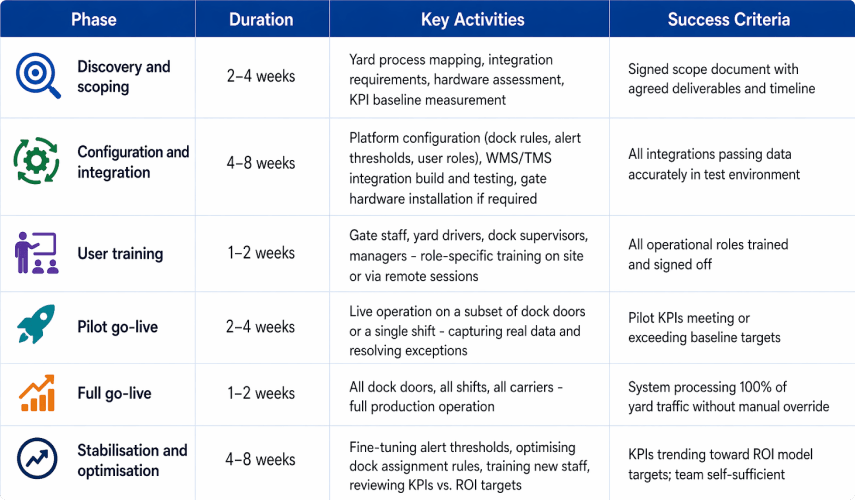
Yard management system implementation is not a plug-and-play deployment. Even cloud-based platforms require structured configuration, integration work, and change management to deliver their promised ROI. Here is a realistic implementation roadmap.
The Three Most Common Implementation Failures
- Integration underinvestment: The platform was configured and live, but the WMS integration was never completed. It left the yard team to manually manage all dock events, while the YMS tracked trailers. Integration must be part of the go-live scope, not a Phase 2 plan.
- Skipping change management: Yard staff reverts to familiar manual processes ('just radio me') because nobody made the case for why the new system matters and what happens when they bypass it. Operational adoption requires active management.
- Measuring the wrong KPIs: The YMS was evaluated on 'system uptime' and 'on-time implementation' rather than on 'detention fee reduction' and 'dock utilisation improvement'. Define your ROI metrics before go-live and track them monthly from Day one.
Ready to Transform Your Yard Operations?
YardOS by Mobisoft is a cloud-native yard management platform. It serves distribution centres, 3PLs, manufacturers, and logistics operators. Gate management, dock scheduling, trailer visibility, yard move coordination, WMS and TMS integration, and AI-powered analytics all sit within one configurable platform. It is built to fit your facility's specific needs, without stitching together multiple tools to get there.
What Makes YardOS Different
- White label architecture: YardOS deploys under your own brand and domain. This matters most for 3PLs. They want a carrier and shipper-facing experience that reflects their identity, not someone else's.
- Market configurable compliance: You can configure gate compliance rules, vehicle inspection checklists, and documentation requirements per country, per client, or per cargo type. No code changes needed.
- Mobile-first design: Every workflow works seamlessly on smartphones and tablets first. That includes gate check-in, yard move tasks, dock assignments, and ePOD capture. The system also works offline when connectivity is poor.
- Pre-built integrations: YardOS comes with native connectors for major WMS platforms like SAP EWM, Oracle WMS, Blue Yonder, and Manhattan. It also connects to TMS systems. For anything else, there is a REST API.
- AI readiness: The event logging architecture and data schema are built for predictive analytics. You can activate machine learning models later, once your facility has generated enough training data.
- Proven deployment track record: YardOS runs in production across distribution centres, manufacturing facilities, and 3PL operations. These deployments span North America, Europe, the Middle East, and the Asia Pacific.
Organisations going through digital transformation at the supply chain level often find that YMS implementation is one piece of a larger initiative. Our supply chain visibility software practice helps connect the dots across systems.
About Mobisoft Infotech
Mobisoft Infotech is based in Pune, India. The company has 10+ years of experience building supply chain, logistics, and on-demand platform solutions. Its clients operate across North America, Europe, the Middle East, South Asia, and the Asia Pacific. YardOS is Mobisoft's cloud-native yard management system built for distribution centres, manufacturers, and 3PLs that run complex, high-volume yard operations anywhere in the world.

Frequently Asked Questions
What size facility needs a YMS?
Any facility processing more than 20 truck arrivals per day benefits from a YMS. Below 20 movements per day, a structured dock scheduling spreadsheet or a basic appointment booking tool may be sufficient. Above 20 daily movements, the coordination complexity exceeds what manual processes can handle efficiently, especially with multiple carriers, multiple dock doors, and time-sensitive outbound shipments. Cloud-based yard management software now serves facilities of all sizes, with pricing starting as low as a few hundred dollars per month for basic functionality.
Does a YMS require RFID hardware?
Not necessarily. Many modern YMS platforms run fine without any RFID infrastructure. They use GPS pings, mobile app scans, barcode readers, or manual entry to track trailers. RFID and IoT hardware do improve accuracy, no question. But they are not a requirement to get started. You can begin with a learner setup and add hardware down the line if needed. Computer vision-based gate systems are increasingly replacing RFID entirely for gate automation in new deployments.
How does YMS reduce detention fees specifically?
Detention fees build up when a carrier's truck stays beyond the agreed free-time window, typically two hours. A yard management system tackles this problem from three angles. Appointment scheduling spreads arrivals through the day, cutting gate queues and wait times. Dock assignment gets trailers to the right doors faster after they arrive. And real-time dwell alerts warn your team before a trailer hits its free-time limit. Facilities using a YMS report a 35 to 45 percent drop in detention fees within the first year.
Can a YMS integrate with my existing WMS and TMS?
Yes, in most cases. Your YMS vendor needs a documented API or a native connector for your WMS and TMS platforms. Before committing, ask for the vendor's integration catalogue and verify your systems are listed. Running a less common platform? Confirm a custom REST API integration is feasible. Get a separate cost and timeline estimate for that work. Do not assume it falls under the platform licence.
What is the difference between a YMS and dock scheduling software?
Dock scheduling software manages inbound and outbound appointment bookings for dock doors. This is a subset of what a YMS does. A full yard management system includes dock scheduling plus trailer tracking, gate management, yard move task management, real-time yard visibility, asset management, and analytics. Dock scheduling software is a good entry point for facilities whose primary problem is appointment bottlenecks. A full YMS is appropriate when the facility also has visibility gaps, trailer tracking needs, carrier compliance requirements, and complex move task management.
What ROI should I realistically expect from a YMS?
Most published benchmarks show yard management system benefits and ROI of 200-400% over three years, with payback periods of 6-18 months depending on facility size, current detention exposure, and labour efficiency gains. A mid-sized distribution centre typically recovers its YMS investment through detention fee reductions alone within the first year.

Nitin Lahoti
Read more
Nitin Lahoti is the Co-Founder and Director at Mobisoft Infotech. He has 15 years of experience in Design, Business Development and Startups. His expertise is in Product Ideation, UX/UI design, Startup consulting and mentoring. He prefers business readings and loves traveling.
 Nitin Lahoti
 April 23, 2026