Every event has a detailed, line-itemed, and carefully negotiated budget. Each category, including the venue, catering, AV, content, and marketing, gets its allocation, its vendor, and its approval chain. And then there's transport. Usually added late, usually priced on the lowest workable quote, and almost always treated as part of the event that simply needs to get people there through effective event transportation management.
That framing is costing event organizations far more than they realize, especially when the event logistics cost is underestimated.
When transport goes wrong, it doesn't stay contained to a dispatch schedule or a fleet report. It bleeds into session attendance figures, sponsor activation windows, exhibitor lead volumes, and post-event satisfaction scores. It surfaces in refund requests filed 48 hours after the event closes, impacting refund management in events. It appears in a sponsor who doesn't renew, and does not explain, "We're reviewing our events strategy."
The financial damage from a transport failure rarely appears where the failure actually occurred. That's precisely what makes it so persistently expensive and so consistently ignored, often contributing to hidden costs in logistics and gaps in operational risk management.
What follows is a financial argument, not a logistics checklist. One that ops leaders, planners, and founders need to work through before the planning cycle begins, because the organizations getting event economics right have recognized something the rest of the industry hasn't formally priced: transport is revenue infrastructure, and most events are leaving it entirely unprotected within their event logistics management approach.
Preventing these cascading disruptions depends on implementing a data-driven event transportation management software.
Why the Event Industry Misprices Transport Risk?
There's a structural problem in how most event organizations think about transport, especially in event transport planning. It has to do with how teams are built, how performance is measured, and how accountability is distributed across an event organization. In most setups, the people making transport decisions are not the same people who feel the consequences of those decisions. And that gap, seemingly administrative, is where the mispricing begins.
Transport budgets are typically owned by operations or logistics teams, often under broader transportation logistics management, with a straightforward mandate:
- Get the fleet sourced,
- Get the routes planned,
- Keep costs within the allocated line.
Success, for such teams, looks like vehicles dispatched on time and spending kept under budget. What it does not look like, because nobody has formally connected these outcomes, is attendee satisfaction scores, sponsor renewal rates, or forward ticket velocity. Those metrics live in marketing, in partnerships, in commercial. Transport never appears in their reporting either. So the financial consequences of a transport failure scatter across departments that had no hand in the transport decision, and the ops team that made the call never sees the full bill, increasing the cost of logistics operations.
This is, in organizational theory terms, a classic accountability gap. The cost is real and measurable. It simply falls outside the boundary of the team generating it.
The procurement dimension compounds this further. Most event transport is sourced the same way venue catering is sourced: on a unit price. Cost per vehicle, cost per route, cost per hour. It is a costly way to buy a service whose failure can compromise the financial outcomes of every other investment made in the event. Risk-adjusted procurement, the kind that factors in supply chain transportation cost and broader transportation cost optimization, is almost absent from how transport vendors are evaluated and contracted.
The most revealing is what the data says, or rather, what it doesn't. Consider what most post-event reporting actually captures within event management logistics:
- Session attendance rates
- Sponsor activation metrics and lead scan volumes
- F&B revenue per attendee
- Overall NPS and satisfaction scores
- Ticket rebooking and renewal intent
Transport performance appears in none of these categories as a discrete variable. There is no standard line in any major event ROI framework that attributes NPS movement, sponsor underdelivery, or session attendance shortfall to transport quality. Which means that even when transport failure is the primary driver of a poor outcome, the post-event report will log the symptom, a drop in satisfaction scores, and an exhibitor flagging low foot traffic, without ever naming the cause.
The result is:
- A planning cycle that corrects for the wrong things.
- Next year's content gets upgraded because this year's NPS dipped.
- Next year's catering budget increases because F&B feedback was poor.
- And transport stays roughly the same, since reports never flagged it, limiting operational efficiency in logistics.
For founders and strategists building event programs with serious revenue ambitions, this is crucial. You cannot manage the financial risk of a function you are not measuring. And right now, most organizations are not measuring transport at all within their event transportation management systems. Closing this visibility gap requires a connected transportation management system that links transport decisions directly to business outcomes
How Transport Delays Generate Compounding Operational Losses
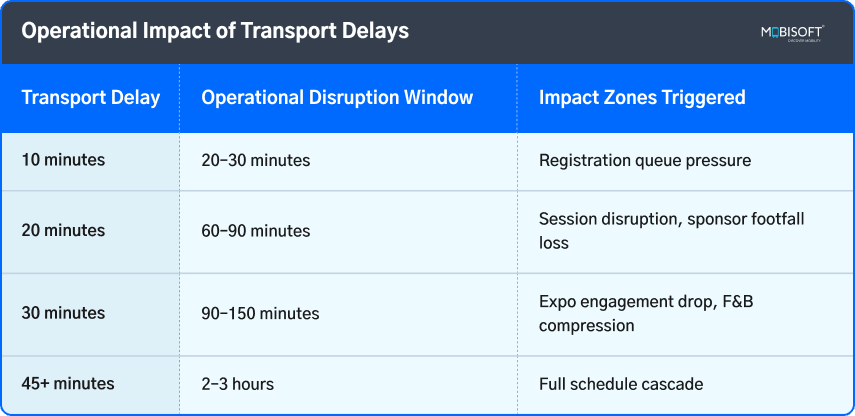
Most post-event transport reviews ask one question: Did the vehicles arrive on time? It's a reasonable question, but also an incomplete one. Because the financial consequence of a transport delay is rarely proportional to the delay itself. A 20-minute disruption at the right pressure point doesn't produce 20 minutes of operational friction. It produces a cascade that runs through the entire event timeline, directly increasing the cost of transportation delays and touching revenue-generating zones that have no connection to a shuttle schedule.
Understanding why requires looking at how attendee arrival actually works in practice. Events don't receive guests in a single, orderly wave. They receive them in overlapping cohorts, each with its own transport origin, check-in dependency, and session priority. When the first cohort is delayed, the system absorbs it. When the second cohort arrives on schedule into an unresolved backlog from the first, the system compounds, highlighting gaps in scheduling efficiency.
Mapping the Cascade Chain
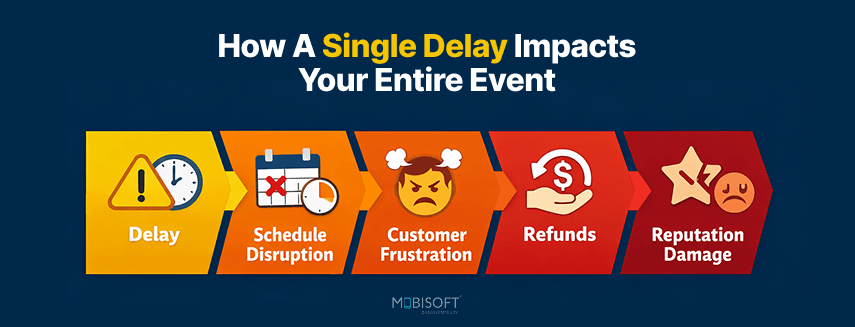
The mechanics of this are worth tracing carefully, because planners who haven't mapped them tend to underestimate how quickly a contained transport delay becomes a floor-wide operational problem.
Wave one arrives late. Registration queues build, and wave two arrives on time, colliding with wave one's unresolved backlog. The queue doubles, and by the time wave three arrives, the bottleneck has migrated. It's no longer just at registration. It's at session entrances, where late arrivals are disrupting seated audiences. It's on the expo floor, where the morning activation window is running with a fraction of the contracted footfall. It's at the coffee station, where the networking transition that sponsors paid to be adjacent to has been compressed into a fraction of its planned duration.
- Each of these zones has a financial owner.
- Sponsors paid for dwell time and activation windows.
- Sessions were priced and sold on confirmed attendance projections.
- F&B revenue depends entirely on footfall during transition periods.
A single transport failure at the arrival window doesn't affect transport. It taxes all of them simultaneously, and none of that taxation appears on the transport budget line, contributing to hidden costs in logistics.
There's a rough but useful working ratio here: 20 minutes of transport friction at a peak arrival window tends to produce somewhere between 60 and 90 minutes of compounded operational disruption across the event floor. The multiplier varies by event scale and venue layout, but the directional logic holds consistently. Small delay, outsized consequence, reinforcing the importance of event transport planning.
The true cost of poor event transportation is much higher than founders usually expect. Read our blog and find out how hidden inefficiencies translate into measurable financial loss.
Why Departure Windows Carry Equal Financial Risk?
Arrival failures get most of the attention. Departure failures, we'd argue, deserve considerably more, especially within event transportation management.
There's a well-established principle in behavioural economics called the peak-end rule. People don't judge an experience by averaging every moment of it. They judge it by how it felt at its most intense point, and by how it ended. For most event attendees, the ending is the journey home. The queue at the shuttle bay. The wait for a cab that doesn't materialise. The 55 minutes standing outside a venue after a long day, with no clear information about when the transport will arrive.
That experience doesn't just produce frustration in the moment. It produces the memory that travels home with the attendee, sits with them while they fill out the post-event survey, and affects brand image through word-of-mouth. Post-event refund requests and social media complaints follow a consistent pattern: they peak in the 48-hour window following events with poor departure transport, increasing event cancellation cost and impacting refund management in events, not during the event itself.
For recurring event programs, this timing matters enormously. By the time the complaints surface, the event team has already disbanded, and the debrief is done. The departure failure gets logged as an anomaly rather than examined as a systemic risk within event logistics management. So the next planning cycle begins without it ever being properly priced. Ensuring smoother departures at scale relies on a well-coordinated fleet management system
The Org Structure That Keeps Transport Costs Hidden
Ask any event ops leader where transport sits in their org chart, and the answer is usually some version of "logistics" or "operations," often disconnected from event logistics management strategy. Ask them where NPS accountability sits, and they'll point to marketing. Ask about sponsor renewal ownership; it is either commercial or partnerships. Ticket rebooking intent? Also commercial. The picture that emerges is one in which transport generates consequences across four or five teams and is formally owned by none of them in any revenue sense, contributing to hidden costs in logistics.
This isn't an indictment of how event teams are built. It's a description of a structural reality that has measurable financial consequences.
The incentive gap is perhaps the most important dimension of this. Operations teams managing transport are, quite reasonably, measured on what they control:
- Fleet sourced within budget
- Vehicles dispatched on schedule
- Routes planned and communicated
- On-site coordination staffed appropriately
These are legitimate performance indicators, but the problem is what they leave out. NPS movement, sponsor activation delivery, exhibitor lead volumes, and ticket renewal intent are all outcomes that transport quality directly influences, and none of them appear in an ops team's performance framework. The team bearing the consequence of poor transport and the team making transport decisions are, in most organizations, entirely different groups with entirely different scorecards, limiting operational efficiency in logistics.
Annual planning cycles reinforce this further. When transport budgets are reviewed, they're benchmarked against last year's transport spend. Not against last year's NPS delta. Not against sponsor non-renewal rates or the refund volume that followed a departure failure. The budget conversation happens inside a silo, using silo-specific data, and produces a silo-specific outcome. This is usually a transport allocation that looks roughly similar to the previous year's, independent of actual cost drivers or service outcomes, weakening event budget planning.
What does this mean for Founders Building Event Programs?
For those constructing event operations from scratch, efficient logistics and transportation solutions are readily available. Whether transport reports into revenue-oriented leadership or into facilities and logistics determines, in a very practical sense, whether transport is ever managed as a financial variable or purely as a scheduling one within event transport planning.
Organizations that have moved transport accountability closer to revenue functions, even informally, tend to make meaningfully different decisions. They ask different questions during vendor selection. They build different clauses into transport contracts. They measure different things after the event closes. The org chart, in this case, is the mechanism through which transport either gets priced correctly or doesn't.
The most telling indicator of this structural gap is what's absent from most event post-mortems. Session feedback gets reviewed. Catering scores get discussed. AV failures get documented and assigned to next year's vendor brief. Transport, unless something visibly catastrophic occurred, rarely gets a line in the debrief at all. And so the planning cycle begins again, carrying the same unexamined assumptions, the same procurement logic, and the same unpriced risk into the next event.
Quantifying the Full Cost of Event Transport Failure
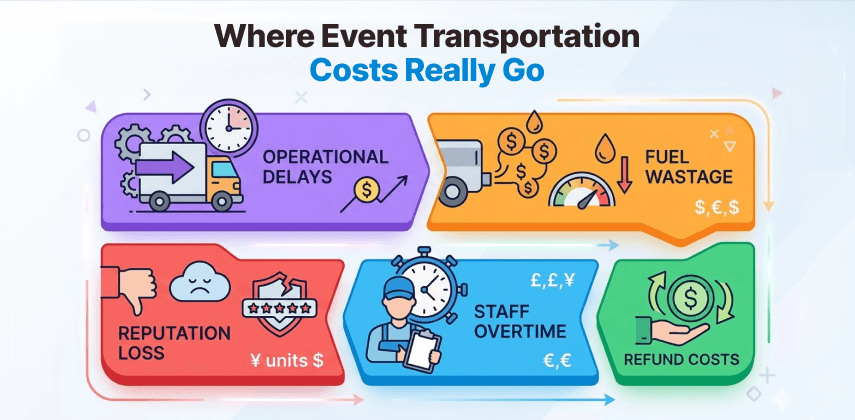
When a transport failure occurs, the immediate financial conversation tends to be narrow. An emergency vehicle was hired, for instance, staff ran overtime, or a venue penalty clause was triggered. These costs are high and relatively straightforward to reconcile. They also represent, in most cases, the smallest portion of what the failure actually costs within overall event logistics cost structures.
The more consequential damage sits in a category that most post-event reconciliations don't have a line for. Indirect costs, which scatter across sponsor outcomes, attendee behaviour, and revenue-generating zones, consistently outpace direct costs by a ratio of 3:1 to 5:1 in large-scale events. That ratio gets little attention, since indirect costs are hard to attribute, and the teams that could do so don't review the transport budget.
Direct Costs: Visible but Relatively Small
These are the costs that surface immediately and get captured without much difficulty:
- Emergency vehicle hire when planned fleet capacity proves insufficient
- Staff overtime for extended loading zone management and on-site coordination
- Venue penalty clauses triggered by operational overrun
- Last-minute passenger communication costs, additional signage, and on-site staff redeployment
Painful at the moment. Manageable in the ledger. And, critically, not where the real financial exposure lives.
Indirect Costs: Where the Real Damage Sits
This is the category that most event financial models simply aren't built to capture, which is precisely why it keeps accumulating unnoticed across planning cycles.
- Sponsor activation loss: When attendees are still in transit during a contracted activation window, the sponsor has received less than what was sold. Whether or not this is formally claimed, it registers in the sponsor's internal ROI review. This directs the renewal conversation months later.
- Lead scan erosion: Attendees arriving late don't browse. They rush to their seats, check their phones, and navigate the quickest path to wherever they need to be. Exhibitor booth engagement drops in direct proportion to arrival window disruption, and sponsors track lead scan volumes carefully.
- F&B revenue compression: Food and beverage revenue peaks during session transitions, those 15 to 20 minute windows between programme items. Delayed arrivals compress or eliminate those windows, reducing per-attendee spend so it never gets attributed to transport, creating hidden costs in logistics across revenue streams.
- Session engagement deflation: A session logged at 90% capacity may have had a significant portion of that audience arriving mid-session, distracted, or still coordinating their journey. Attendance figures look acceptable, while the actual engagement quality tells a different story.
For strategists and founders building the financial case for transport investment, the ratio insight is the most useful starting point. Budgeting only for direct transport costs is the equivalent of insuring a building for the cost of the fire extinguisher. The visible expense is covered, but the actual exposure isn't. For a deeper breakdown of financial impact, explore how to measure event transportation ROI.
Why Transport Delays Are the Primary Driver of Refund Risk?
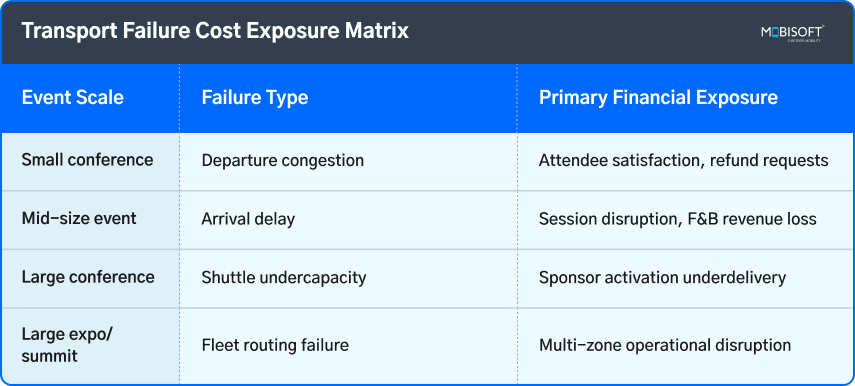
Refund pressure is one of those unpredictable post-event conversations. An attendee files a request, the customer service team handles it, the number gets logged, and the planning team moves on. A structured analysis of what triggered the request is rarely done. As a result, transport failure surfaces at the top of the trigger hierarchy with striking consistency, making the cost of event delays more visible in hindsight.
The reason goes deeper than inconvenience. Attendees don't experience an event as a collection of independent components. They experience it as a single, continuous arc. And that arc begins well before the first session opens. It begins in transit, navigating to the venue, trying to locate a shuttle, or waiting in a queue that wasn't supposed to be there. Research on consumer experience consistently tells us that people form value judgments about a purchase within the first 30 minutes of using it. For event attendees, those 30 minutes are almost entirely a transport and arrival experience.
Once that initial judgment tips negative, every subsequent friction point, a slow check-in queue, a warm room, a session that started late, gets attributed to the event brand rather than to circumstance. The transport failure doesn't just cost the arrival experience. It reframes everything that follows it.
The Three Refund Trigger Points to Model in Advance
Most refund risk conversations happen reactively, after requests have already been filed. The more useful exercise is mapping the specific trigger points before the event opens, because each one carries a distinct financial profile and a distinct prevention logic that should be factored into event transport planning decisions early.
- The missed-session trigger: When a transport delay causes an attendee to miss the session that was their primary reason for purchasing, refund pressure escalates immediately. This is particularly acute in premium ticket tiers where a specific keynote or workshop was the explicit value proposition. The attendee's argument is straightforward: they paid for something specific, and transport failure made it inaccessible.
- The departure failure trigger: Poor outbound transport produces the final memory of the event. Given what we know about the peak-end rule, that final memory carries disproportionate weight in how attendees assess the overall experience. Refund requests and social media complaints follow a consistent pattern. It peaks in the 48-hour window after events with disorganized departure transport.
- The corporate tier trigger: Group bookings involve an internal stakeholder, a travel manager, a CFO, and a procurement lead. They review the transport experience against the ticket cost and the organizational investment. Individual attendees file refund requests. Corporate buyers make non-renewal decisions at the contract level. This category has a more expensive outcome, and it still goes missing in the post-event review.
What makes these trigger points particularly worth modeling is that they're not random. They correlate to ticket tier composition, session dependency patterns, and venue geography in ways that are entirely predictable with the right data. Refund risk, framed this way, becomes less of a customer service problem and considerably more of a planning variable.
Transport Failure and Its Impact on Sponsor ROI
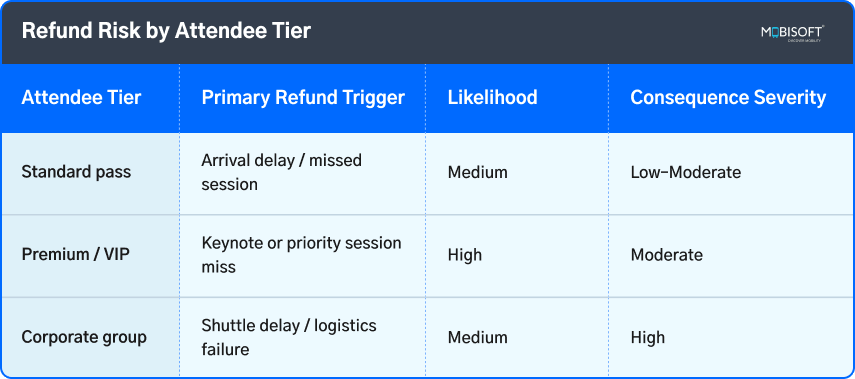
Sponsors purchase event presence based on contracted outcomes. Footfall during activation windows, dwell time at exhibition booths, lead scan volumes, brand visibility during high-attendance transitions, etc. Each of these sponsorship proposals has an estimated value. What most sponsorship contracts don't account for, and what most event organizations don't adequately protect against, is the possibility that transport failure within broader event transportation logistics will underdeliver every single one of those commitments simultaneously, resulting in lowered outcomes.
This is the dimension of transport risk that event commercial teams underestimate most severely. A transport failure isn't a single-point problem for sponsors, but a portfolio problem.
- Delayed arrivals reduce activation window footfall.
- Rushed, late-arriving attendees don't engage with exhibition booths.
- Compressed transitions remove the dwell time behind premium placement fees.
- Lead scan volumes drop, and brand visibility during high-traffic moments shrinks.
The sponsor's entire contracted ROI package gets discounted due to a failure unrelated to activation quality or investment level. The financial exposure here takes two forms, and they operate on very different timelines.
Immediate Exposure: Contractual Underdelivery
The first form is contractual. When transport failure demonstrably reduces footfall during a paid activation window, the sponsor has received less than what was sold. Most sponsorship contracts don't include transport-performance clauses, which means this underdelivery is rarely formally claimed. But the absence of a formal claim doesn't mean the sponsor hasn't noticed. Their internal ROI review captures lead scan numbers. It captures booth traffic data and the activation engagement metrics. All of that data feeds directly into the renewal conversation, whether or not transport is explicitly named as the cause, despite being rooted in event mobility execution gaps.
Consider what this looks like from the sponsor's side:
- Contracted footfall during activation window: 2,000 attendees
- Actual footfall during the window due to delayed arrivals: 1,100
- Lead scans projected: 400
- Lead scans recorded: 190
- Internal ROI assessment: underperformed against benchmark
The sponsorship team presents this data to their marketing or commercial director. The event team never sees it. The renewal conversation begins from a deficit that the event organization didn't know existed, and the sponsor's stated reason for not renewing will almost certainly not reference transport at all.
Long-Term Exposure: Relationship and Revenue Erosion
The second form operates over a longer timeline and is considerably harder to recover from. Sponsorship revenue in recurring event programs is largely relationship-dependent. Trust, built across multiple event cycles, is what justifies increasing investment and expanding activation packages. The commercial team spends multiple events building a long-term trust trajectory with the sponsor. But an underdelivered outcome due to transport failure resets it, bringing it to square one, exposing weaknesses in transport planning for large-scale events that were previously overlooked.
The Corporate Buyer Compounding Effect
Corporate group buyers add another layer of complexity that individual ticket holders don't introduce. These buyers have internal stakeholders reviewing the event investment against organizational objectives:
- Travel managers assessing logistics quality against company travel policy standards
- CFOs evaluating cost-per-outcome against competing investment options
- Procurement leads reviewing vendor performance ahead of contract renewal periods
- Team leads are assessing whether the event delivered professional development value proportionate to the spend
A single poor transport experience at a corporate tier level doesn't produce one refund request. It produces a multi-stakeholder internal review that can eliminate a relationship representing tens of thousands in annual event revenue. And it happens entirely outside the event organization's visibility, in an internal meeting that the commercial team will never be invited to.
It is crucial to understand that the ROI decline from transport failure goes unnoticed throughout the process. The failure occurs during the event, and the internal review happens after it. The non-renewal decision is made weeks later. By the time the commercial team registers the loss, the causal chain connecting it back to a shuttle delay three months prior has been entirely obscured.
Reputation Decay and Its Delayed Financial Impact
Reputation decay neither appears in post-event reconciliations nor surfaces in debrief conversations. It accumulates instead across the 12 to 18 months following an event, showing up gradually in slower early-bird ticket sales, softer sponsor pricing conversations, and a forward pipeline that eventually gets thinner without an explanation. Transport failure, however, is one of its most reliable accelerants, particularly in environments where event transportation systems are not data-driven.
The lag is what makes it so consistently underestimated. Event organizations are structured around cycles. Post-event reviews happen, actions get assigned, and attention moves to the next edition. By the time the reputation consequences of a transport failure become financially visible, its organizational memory largely fades. The link is missed because consequences surface well after the planning cycle in which the cause occurred.
The Lag Problem in Recurring Event Programs
For organizations running annual or recurring events, reputation operates as a compounding variable across cycles rather than a single-event metric. A measurable NPS dip in Year 1 produces a specific set of downstream consequences:
- Early-bird ticket velocity slows as previous attendees delay commitment
- Sponsor pricing conversations begin from a lower baseline of perceived value
- Speaker and partner interest weakens, particularly among those who track attendee satisfaction data
- Peer recommendation, which drives a significant portion of B2B event registration, becomes cautious or conditional
Trust in an event brand accumulates slowly, across multiple well-executed cycles. A single year of poor transport experience can interrupt that accumulation in ways that take two or three subsequent editions to recover from. The asymmetry between how long trust takes to build and how quickly a poor journey experience can undermine it proves underappreciated risks in event program development.
Why Word-of-Mouth Amplifies Transport Failure Disproportionately?
B2B event registration is heavily peer-influenced. Attendees recommend events to colleagues, mention them in professional networks, and reference them in internal budget justifications. For most event programs, this recommendation layer is a more powerful acquisition channel than any paid marketing activity. It's also the channel most directly affected by transport experience, particularly when event transportation performance shapes first and last impressions.
The dynamic worth understanding here is asymmetric. Attendees rarely recommend an event because a panel exceeded expectations. Positive experiences tend to generate moderate advocacy. Poor journey experiences, by contrast, generate active discouragement, the kind that travels through professional networks quickly and specifically. A colleague asking "Is it worth going?" receives a very different answer from someone who waited 55 minutes for an outbound shuttle than from someone who simply found the afternoon sessions unremarkable.
This asymmetry has a direct revenue consequence:
- Negative transport experiences generate stronger and more specific word-of-mouth than positive content experiences
- Professional networks amplify event friction faster than they amplify event quality
- Discouragement in B2B peer networks tends to be credible and acted upon, particularly when it comes from a trusted professional contact
- Recovery requires not just fixing the transport problem but visibly demonstrating the fix, which demands deliberate communication investment in subsequent cycles
Worth noting is that in almost every case, reputation decay from transport failure is entirely preventable. It doesn't require exceptional execution. It requires consistent, reliable execution of a function that the industry has historically treated as secondary. The financial cost of that secondary treatment doesn't appear immediately. But it appears.
Transport KPIs Every Event Operations Leader Must Track
Most event operations dashboards are reasonably sophisticated. Session attendance is tracked in real time. F&B revenue is reconciled by period. Sponsor activation metrics are captured, reported, and fed into renewal conversations. And then there's transport, which in most organizations has no formal measurement structure whatsoever, leaving event transport data visibility largely unaddressed. No KPIs, no benchmarks, no post-event data trail that could inform the next planning cycle.
That absence is a fundamental visibility problem. A function that directly influences NPS, sponsor ROI, refund volumes, and forward revenue is being managed entirely on instinct and retrospective complaint data. Which means that when transport fails, the organization can identify that something went wrong, but they cannot:
- Quantify what it costs
- Attribute which specific failure point caused it
- Or demonstrate to stakeholders what needs to change.
Building transport into your ops measurement framework isn't a heavy investment. It requires intentional design, a decision to treat transport performance as a discrete variable with its own data structure, its own benchmarks, and its own place in the post-event review. These are the five metrics worth formalizing:
Arrival Window Dispersion Rate
- This measures the percentage of attendees arriving outside the planned pre-session window, segmented by transport mode. It's the foundational transport metric because it directly correlates to cascade risk.
- A high dispersion rate at a peak arrival window is an early indicator that queue pressure, session disruption, and sponsor activation underdelivery are likely to follow.
- Tracking this across event cycles also builds a predictive baseline. It informs fleet deployment decisions for future editions before planning begins rather than after problems occur, strengthening event transportation planning accuracy.
Peak Queue Pressure Index
- Average queue length at shuttle loading zones and transport interchange points during the 45-minute pre-event and post-event windows.
- Queue pressure is the most immediate operational signal of transport capacity misalignment. This transport metric can be measured in real time and acted upon during the event itself.
- Organizations that track this systematically develop a much more accurate understanding of where capacity gaps consistently occur and can address them structurally rather than reactively.
Transport-Attributed NPS Delta
- This is arguably the most financially significant transport metric available, and it requires nothing more than a single additional question in the post-event survey.
- By separating NPS scores between attendees who cited transport issues and those who didn't, organizations can isolate the overall satisfaction gap in the transport-driven segment.
- Most event teams, when they run this analysis for the first time, find the delta considerably larger than expected.
- It also makes the internal business case for transport investment most compelling, because it connects transport quality directly to the satisfaction number that leadership already tracks.
Departure Dwell Time
- Departure dwell time is the average time between session close and attendee departure from the venue site. It functions as a proxy for outbound transport efficiency.
- It measures how long attendees are effectively stranded at the venue after the event ended, and captures the experience window associated with post-event refund requests and negative word-of-mouth.
- An event where departure dwell time consistently runs high is an event whose final impression is consistently poor, regardless of what happened on stage.
Sponsor Activation Overlap Rate
- It's the percentage of contracted sponsor activation windows during which a measurable proportion of transport-delayed attendees were still in transit rather than on the event floor.
- This metric directly connects transport performance to sponsor contractual delivery, making it the most commercially persuasive data point available to event commercial teams.
- When this number is tracked and shared proactively with sponsors, it demonstrates operational transparency. If not, the same underdelivery gets discovered by the sponsor's own data.
Collectively, these five metrics do something that most transport management approaches currently don't: they create a data trail connecting transport performance to business outcomes.
That trail serves multiple functions across the event lifecycle:
- It informs pre-event fleet deployment and route planning decisions
- It provides evidence for post-event sponsor conversations when underdelivery occurred
- It builds the internal business case for transport infrastructure investment
- It creates accountability for transport performance at an organizational level by connecting ops decisions to revenue consequences.
Measurement, in this context, is the mechanism through which transport stops being an unpriced risk and starts being a managed one.
The Strategic Case for Predictive Transport Management
The dominant model of transport management in the events industry is reactive.
- A vehicle runs late, a coordinator responds.
- A queue builds at a loading zone, and staff are redeployed.
- A route underperforms, and an adjustment is made.
The system responds to failure as it occurs, and the quality of that response determines how much damage gets contained. It's a model that functions adequately when conditions are stable and fails miserably when they aren't.
The more important observation about reactive transport management, though, isn't that it responds slowly. It's that it makes decisions too late in the timeline to meaningfully influence outcomes. By the time a queue has built to the point where intervention is warranted, the cascade has already begun. By the time an underperforming route is adjusted, the arrival window it was serving has already closed. Reactive management doesn't prevent transport failure. It manages the damage done, which is considerably different financially.
Predictive transport management operates on a fundamentally different logic. It actively models demand, pressure points, and capacity requirements weeks in advance, using available operational signals to improve transport demand forecasting for events. It uses data that most event organizations already have access to, but rarely apply to transport planning.
What Predictive Transport Infrastructure Actually Changes
The practical difference between reactive and predictive transport management becomes clearest when examined across specific planning and operational dimensions.
Registration data, for instance, contains significant transport-relevant information that goes largely unused in conventional planning:
- Attendee location distribution and ticket tier composition inform where demand will be heaviest
- Session priority patterns reveal which arrival windows carry the highest cascade risk
- Corporate group concentrations identify the attendee segments where transport failure carries the greatest financial consequence
Session schedules carry similar predictive value. The gap between two high-attendance sessions creates a predictable surge in outbound transport demand at a specific time. A keynote ending at 12:15 is followed by a networking lunch. This creates a different pressure profile than a workshop stream ending in staggered 20-minute intervals. Predictive planning maps these profiles in advance and deploys capacity accordingly, making it more efficient.
Real-time operational data adds a further layer during the event itself. When vehicle occupancy, route performance, and queue length are visible in a centralized dashboard, the decision to redeploy a vehicle or open an additional loading zone happens before it becomes a problem. The decision-making latency that turns a manageable 10-minute delay into a 45-minute floor-wide disruption is, in a well-instrumented operation, largely eliminable.
Where Smart Mobility Solutions Change the Math
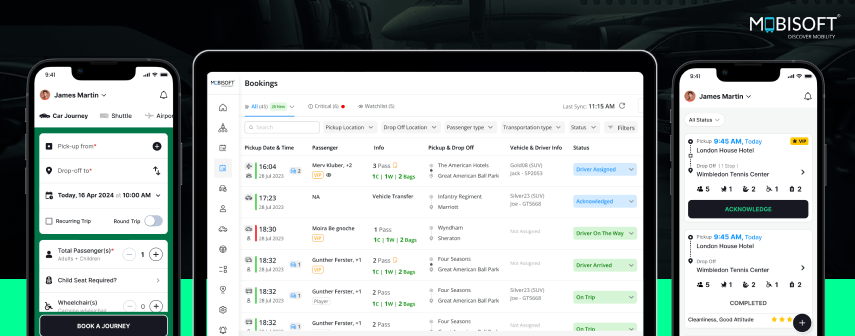
Smart mobility platforms are the operational infrastructure that enables predictive transport management to be executed at scale. The capabilities they provide, route optimization, dynamic dispatch, real-time fleet visibility, demand forecasting, and passenger communication, are individually useful. Their collective value is greater: they shift transport from a scheduling function to a data-driven risk-management function aligned with smart mobility solutions for events.
Consider what this means across the event financial model:
- Fleet deployment decisions are made on attendance data. This reduces both overcapacity waste and undercapacity risk.
- Dynamic dispatch responds to real-time demand signals, distributing load across routes and vehicles before pressure points become queues
- Centralized operational visibility compresses the response window to contain the risk at its earliest stage.
- Post-event transport data becomes a planning and commercial asset. It feeds directly into sponsor conversations, post-event reconciliations, and the following year's demand forecasting baseline.
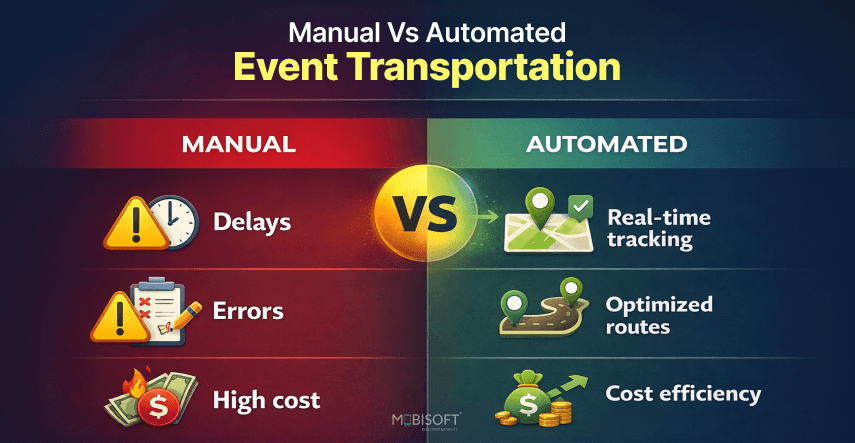
For ops leaders building the internal investment case, the ROI framing is relatively straightforward. Smart mobility infrastructure carries a cost, which should be evaluated against the combined financial exposure of a single major transport failure. This includes refund liability, sponsor under delivery, NPS impact, and reputation recovery. Framed that way, the investment calculus looks considerably different from what it does when transport is treated purely as a procurement line. Understand these differences further in our analysis of manual vs automated event transportation approaches.
We'd also add that the data infrastructure smart mobility generates has value beyond individual events. Organizations that build a transport performance data trail across multiple event cycles develop a planning advantage that compounds over time. Demand forecasting becomes more accurate. Capacity decisions become more precise. And the post-event conversations with sponsors and stakeholders become grounded in evidence rather than estimates.
Building Transport Risk Into Your Event Financial Strategy
Transport risk has a peculiar status in most event financial models. It's acknowledged informally, managed operationally, and then largely absent from the documents that actually govern how an event is planned, budgeted, and evaluated, leaving gaps in event transportation strategy alignment.
As a result, event cycles run without a formal transport risk framework with the same unpriced liabilities carried forward. The structural vulnerabilities go unaddressed, and the post-event review treats the predictable outcomes of an unmanaged risk category like anomalies.
Building transport risk into your event financial strategy isn't a complex undertaking. It requires three things: a clear failure scenario framework, a vendor contract structure that reflects actual risk exposure, and a budget model that prices contingency correctly.
Mapping Transport Failure Scenarios Before Planning Begins
The starting point is scenario mapping, a structured exercise that most event organizations apply to venue failure, speaker cancellation, and weather disruption, but almost never apply to transport within event transport planning frameworks. The exercise is straightforward in principle:
- Identify the highest-probability transport failure points specific to your event format, venue geography, and attendee profile
- Estimate the financial exposure of each failure scenario across direct costs, indirect costs, sponsor underdelivery, and refund liability
- Assign a probability weight to each scenario based on historical data, venue constraints, and fleet reliability
- Calculate a risk-adjusted transport cost that reflects total exposure, not just planned spend
The output of this exercise changes the budget conversation immediately. Transport allocation becomes a risk-weighted investment, with a clearly articulated downside case that justifies both contingency funding and infrastructure investment.
For a large-scale B2B conference, the highest-probability failure scenarios typically cluster around three points:
- Peak arrival window capacity shortfall when registration data hasn't been applied to fleet deployment
- Departure surge mismanagement following the closing keynote, particularly when venue geography concentrates outbound demand at a single exit point
- Corporate shuttle no-show or significant delay affecting a high-value attendee tier whose experience carries disproportionate renewal consequences
Each of these scenarios has a quantifiable financial profile. Building that profile into the planning model is what separates transport risk management from transport risk assumption.
Renegotiate Vendor Contracts Around Performance
Most transport vendor contracts in the events industry are structured around inputs: vehicles committed, routes planned, hours covered. What they rarely include are output-linked clauses that reflect what the vendor's performance actually affects within broader event mobility operations.
A transport vendor contract that reflects real risk exposure looks meaningfully different:
- Service level agreements specifying maximum permissible arrival window deviation, with financial remedies for breach
- Capacity guarantee clauses requiring the vendor to maintain a defined reserve fleet percentage available for deployment during peak windows
- Communication standards mandating real-time operational updates to the event ops team during active transport windows
- Performance data requirements obligating the vendor to provide post-event metrics. This includes on-time performance rates, queue dwell times, and vehicle occupancy data by route and window
The absence of these clauses in standard transport contracts reflects the procurement logic discussed earlier in this piece. Transport should not be sourced on unit price, but on a risk-adjusted total cost. Introducing performance-linked contract structures changes accountability to where it belongs and creates a vendor relationship oriented around outcomes.
Building Contingency Into the Transport Budget Correctly
Contingency budgeting for transport is, in most event organizations, either absent or structured incorrectly. The typical approach is a flat percentage added to the transport line as a general buffer. But it doesn't reflect how transport failure costs actually distribute across event transportation cost planning.
A more accurate contingency model prices specific risk scenarios:
- Capacity contingency: budget allocated for reserve fleet deployment during peak windows, sized against the arrival window dispersion risk identified in scenario mapping
- Delay remediation fund: pre-allocated budget for on-site communication, staff redeployment, and attendee management during active transport failures
- Sponsor underdelivery reserve: a fund specifically designated for managing sponsor conversations following activation window underdelivery, whether that takes the form of partial credits, additional placements, or relationship investment
- Refund liability provision: a budgeted provision sized against the refund trigger scenarios identified for your specific ticket tier composition
Structuring contingency this way produces two benefits beyond financial preparedness. It forces the planning team to confront specific failure scenarios, which improves scenario awareness across the organization. And it creates a documented financial acknowledgment that transport failure is a priced risk, which is precisely the organizational posture that makes transport investment decisions easier to justify.
The ROI Argument for Smart Mobility Investment
For ops leaders and founders building the internal business case for intelligent transport infrastructure, the most persuasive argument is a direct financial comparison rather than a capabilities conversation.
The exercise is straightforward:
- Take one realistic transport failure scenario from your scenario mapping exercise
- Quantify its financial exposure across direct costs, indirect costs, sponsor underdelivery, refund liability, and NPS remediation
- Compare that total against the annual cost of a smart mobility platform that would materially reduce the probability of that scenario occurring
In most cases, the comparison is not close. A single major transport failure at a high-stakes event, fully costed across all exposure categories, typically represents a multiple of the annual investment required for predictive transport infrastructure. The business case, built this way, doesn't require advocacy. It requires arithmetic.
Beyond risk reduction, smart mobility investment also provides the data infrastructure that makes every subsequent transport decision more defensible. Vendor negotiations become evidence-based. Sponsor conversations become proactive. Budget requests become grounded in quantified risk rather than historical spend patterns. The infrastructure, in other words, pays forward across every planning cycle that follows the initial investment.
Integrating Transport Risk Into Your Event Revenue Strategy
Every financial risk that event organizations formally manage, venue failure, speaker cancellation, weather disruption, shares one characteristic: it has a named owner, a priced contingency, and a documented response protocol. Transport failure has none of these things in most event organizations, despite generating financial consequences that are comparable in scale and considerably more frequent in occurrence, particularly across event transport operations impacting revenue.
The operational and commercial evidence is consistent across event formats and scales. Transport failure surfaces later and costs more, heavily affecting the revenue-generating functions than any single team currently has visibility over. The organizations that have recognized this operate with a more accurate understanding, making investment decisions accordingly.
Predictive transport management, underpinned by smart mobility infrastructure, is the mechanism through which that understanding becomes operational.
- It moves consequential decisions earlier in the planning timeline
- Creates the data trail that connects transport performance to business outcomes
- And replaces assumption-based contingency with evidence-based risk management.
The entry point doesn't need to be a full infrastructure overhaul. It starts with measurement, assigning transport a formal KPI structure, connecting it to the revenue metrics it already influences, and building one realistic failure scenario into the next planning cycle's financial model. That alone changes the quality of every transport decision that follows.
Transport is the first and last experience of every event. Treating it as revenue infrastructure is not an operational refinement, but a financial imperative for long-term trust and success.
Smart Mobility Infrastructure Built for Event-Scale Transport Operations
Mobisoft Infotech builds predictive transport management solutions designed specifically for the operational complexity of large-scale events. Our smart mobility platform integrates real-time fleet visibility, dynamic dispatch, demand forecasting, and attendee-facing communication into a single operational layer, giving event ops teams the data infrastructure to manage transport as a financial variable rather than a scheduling function. The platform generates the post-event performance data trail that feeds directly into sponsor conversations, refund defenses, and future planning cycles.
If the cost framework, risk scenarios, and KPI structure outlined in this piece reflect gaps in your current event transport operations, the starting point is a technical conversation about where those gaps are largest and what closing them requires.
Build your predictive transport model with Mobisoft Infotech at:


Nitin Lahoti
Read more
Nitin Lahoti is the Co-Founder and Director at Mobisoft Infotech. He has 15 years of experience in Design, Business Development and Startups. His expertise is in Product Ideation, UX/UI design, Startup consulting and mentoring. He prefers business readings and loves traveling.
 Nitin Lahoti
 March 18, 2026