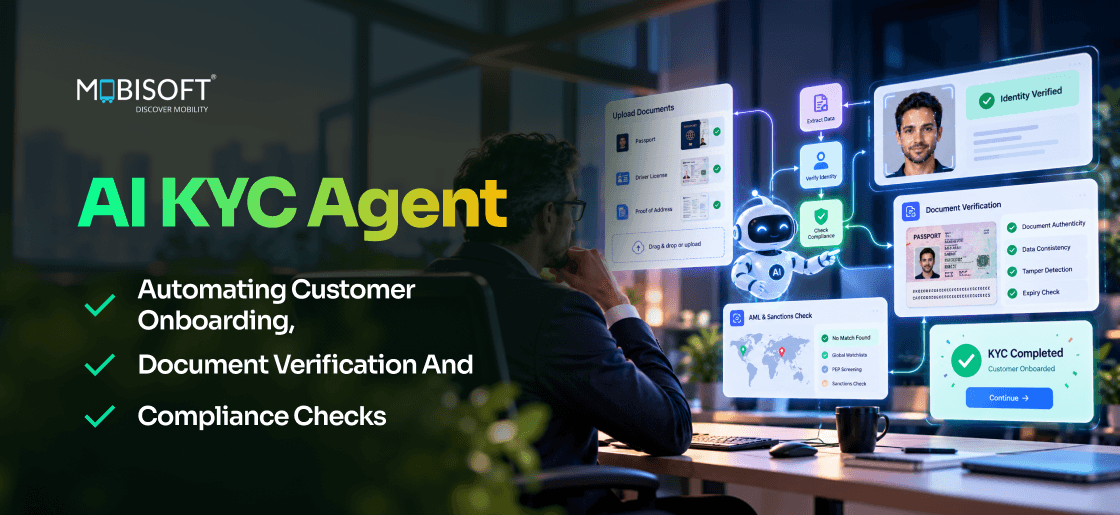
From 10 July 2027, the EU's AMLR sets fixed refresh cycles for customer data. Firms must update higher-risk customers at least yearly. Every overdue refresh is a regulatory exposure. A manual process makes that expensive. AI KYC automation runs the routine checks by software and leaves exceptions to people. It also shortens onboarding. Fenergo's 2024 survey found 67 percent of banks lost clients to slow onboarding.
Not every KYC stage needs automation first. Mobisoft's AI agent implementation services begin with a free 60-minute review of your current KYC process. That review shows where delay and alert volume cost you most. It also names your top regulatory exposure areas. Then you can choose between document checks and alert screening as your first project.
You will finish this guide knowing which stage to automate first.
What Is an AI KYC Agent
An AI KYC agent runs the Know Your Customer checks that regulators require. It verifies identity and screens names against watchlists. It also keeps watching after the account opens.
The Five Jobs an AI KYC Agent Takes On
One agent covers the whole customer relationship. That is what separates automated KYC verification from a simple document scanner. For example, a scanner doesn't go beyond reading the ID. An agent carries on to screening and monitoring.
An AI agent:
- Reads each ID and checks it for forgery.
- Matches a live selfie to the document photo.
- Screens each name against sanctions and politically exposed person lists.
- Scans the news for adverse media.
- Assigns a risk tier and records why.
- Keeps monitoring after onboarding.
Who Uses It Today
KYC is performed by banks and insurance companies for each new client. The same requirement is placed on payment service providers, crypto exchanges, and gaming companies. AI-powered KYC can be used by all of them. Regulations vary by jurisdiction. However, the process remains the same in every case. We suggest that you map your process first.
The Cost of Slow Onboarding
Fenergo surveyed more than 450 senior banking executives in 2024. Of those, 67 percent said their bank had lost clients to slow KYC and onboarding. That's up 19 percent from 2023. For example, a fintech that takes four days to approve an account gives applicants time to go elsewhere. How long does your own flow take?
Why Manual Compliance Is Expensive and Inaccurate
Compliance analysts review documents and check names. They also write case notes. That worked when a branch opened a few accounts a week. It doesn't hold up when a digital firm onboards thousands a day. KYC automation exists for that volume.
Where Manual KYC Breaks
The table shows four failure points. Each one gets worse as volume grows.
| Failure point | What goes wrong | What changes with AI |
| Document review | Queues grow. Tired analysts miss details. | Every file gets the same checks in seconds |
| AML alerts | Most alerts are false positives. Analysts can clear noise. | Context aware matching surfaces real risk |
| Due diligence | Decisions vary between analysts | One rule set applies and records its reasons |
| Ongoing monitoring | Annual reviews leave long gaps | Re screening runs when lists or customers change |
Industry commentary often puts false positives near 95 percent of AML alerts. That is for older tools based on rules. Retail Banker International repeated the figure in 2025 without naming its origin. Treat it as a rough guide. Check your own alert data first. KYC compliance automation targets that noise.
What Weak Execution Costs
Penalties do not usually follow from missing policies. They follow from policies applied unevenly at scale. The UK FCA fined Commerzbank London branch 37.8 million pounds in 2020. It cited weak assessment of politically exposed person risk. It also found more than two thousand clients overdue for KYC refreshes. Its monitoring tool wasn't fit for purpose.
Bigger cases followed. Binance agreed in 2023 to pay about 4.3 billion dollars. TD Bank settled for more than 3 billion dollars in 2024. Both involved gaps in how customers were checked and how accounts were monitored. A sensible default is to read each regulator's own notice before you quote a case.
Finding the Right Place to Start
Not every KYC step needs AI on day one. A short AI use case identification exercise ranks each step by cost and risk. For example, document review may cause most of the drop off. Alert handling may cause most of the cost. Start with whichever step hurts most. Which one is it for you?

Document Verification With AI Authentication of Identity Documents
Document verification is the base of every KYC flow. Analysts check the format of each document and security features by eye. Software runs those checks the same way every time.
Which Documents It Verifies
Different documents prove different things. The table lists the main types.
| Document | Why it's collected | What the system checks |
| National ID card | Primary identity proof | Format Security features Barcode or chip data Expiry |
| Passport | International identity proof | Machine readable zone Data consistency Chip data where NFC works |
| Driver licence | Identity, sometimes address | Issuer format Barcode data Address Expiry |
| Utility bill or bank statement | Proof of address | Name match with the ID Address Issue date |
| Company documents | Business verification | Registration number Address Registry cross-check |
Intelligent document processing handles extraction. It turns a messy phone photo into clean fields. Newer document types like payslips vary more in layout. Do not expect the same accuracy there. Ask vendors for independent test results. A sensible default is to test on 500 of your own documents.
How the Authentication Layers Work
Strong systems stack several independent checks in automated document verification. A forgery that passes one layer often won't pass the next.
- Template matching compares each document with genuine formats from many countries.
- Security checks look for holograms and microprint.
- Machine readable zone checks validate checksums against the printed data.
- Manipulation checks look for editing traces and cloned regions.
- Consistency checks compare fonts and photo placement.
- Cross document checks compare names and addresses across files.
For example, an edited date of birth may match the printed zone. It will still break the checksum in the machine readable zone.
Guided Capture Cuts Avoidable Rejections
Poor images send many files to manual review. Blur and glare are common causes along with cropped edges. Live feedback helps customers fix problems before they submit. For example, a frame guide shows customers where to place the card. A short message asks them to tilt the card. That cuts glare. Build the capture screen with the verification engine. AI application development services can cover both.
Biometric Matching and Liveness Detection for Identity Proofing
A genuine document proves nothing if someone else presents it. Matching the person to the document closes that gap. It's the second layer of any KYC flow.
Why Documents Alone Are Not Enough
Fraudsters buy or steal real passports. They then try to onboard as the owner. The document check passes as the document is real. Does a selfie match catch this? It does. We'd recommend one for every remote onboarding, which is where AI identity verification starts.
Liveness Detection and Facial Matching
Liveness detection confirms that a real person is in front of the camera. Passive checks work from a single frame. They study depth and skin texture. Active checks ask for a small action like a head turn. Facial matching then compares the selfie with the document photo.
For example, a printed photo cannot pass a depth check. A replayed video won't pass a texture check. A device check adds more signals like VPN use or emulators. These steps make up automated identity verification.
Ask vendors whether their liveness tests follow ISO/IEC 30107-3. That is the standard for presentation attack detection. NIST now runs FRTE for face matching and FATE for attack detection. Both replaced the older FRVT name.
Matching Liveness Strength to Risk
Passive liveness suits products with low risk and adds no extra steps for the customer. Active checks and video KYC suit higher risk cases. For example, a savings account may use passive checks. A large corporate account may add a video call on top of that. Choose the method per risk tier.
Balancing False Accepts and False Rejects
A false accept lets the wrong person through. A false reject blocks a genuine customer. Lowering one raises the other. A digital financial services platform often sells products at several risk levels. One threshold does not fit them all.
For example, a mortgage product may accept more false rejects to keep fraud low. Rejected applicants then go to a video call. An eWallet may favour completion instead. Set thresholds per risk tier. Does your vendor publish test results across age groups and skin tones?
Checking Results Across Demographic Groups
Face matching can perform unevenly across age groups and skin tones. NIST's FRTE program reports demographic effects for tested algorithms. Ask every AI-powered KYC vendor for that breakdown. A system that fails some groups frequently sends them to manual review more often. That is a fairness problem and a cost problem.
AML and Sanctions Screening With AI Powered Financial Crime Prevention
AML screening checks whether a customer is sanctioned or politically exposed. It also looks for links to financial crime. That is where manual teams struggle with false alerts, and intelligent KYC and AML tooling targets that noise.
What the Screening Covers
The table lists the main data sources. Each one changes at its own pace. A sanctions update can arrive overnight. A sensible default is to re screen the full customer base after every list change.
| Source | What it holds | Update need |
| Sanctions lists | OFAC, EU, UN, and UK lists of sanctioned people and entities | Re-screen every customer after each update |
| PEP lists | Current and former officials, plus relatives and close associates | Regular, because roles change |
| Adverse media | News on fraud, corruption, or crime in many languages | Continuous |
| Ownership data | Company registers and beneficial owners | Depends on each register |
Why False Positives Pile Up
Tools that rely on rules do not consider anything other than names. The name John Smith alone will trigger a number of sanction listings. Different spellings increase the number even further. There are numerous legitimate spellings for an Arabic name in Latin. Old PEP listings will not be of any assistance.
A past local administrator will give out the same warning as a current minister. For instance, one name with three spellings will generate three different warnings. Count how many alerts each customer creates before you scope AI KYC automation.
How AI Cuts the Noise
AI weighs context. It checks date of birth and nationality against each hit. It matches name variants across scripts. That is how it tells similar names apart. It scores PEP matches by seniority and recency. It reads the full article and judges whether the person is a suspect or a bystander for adverse media.
A customer named in a fraud story as a witness shouldn't raise the same alert as a defendant. Scope AI agent development around your case tools first. Then measure false positives before and after the pilot.
AI Risk Classification and Decision Architecture
Customer due diligence ties every earlier check together. It combines document results with screening hits and product details. The output is one documented decision. An unrecorded judgement call isn't a defence in an enforcement action. A consistent rule set is.
Four Risk Tiers
Most programmes sort customers into four tiers. The table shows typical triggers and what follows.
| Tier | Typical triggers | What follows |
| Low | Individual Low-risk country Simple product Clean screening | Standard checks and annual re screening |
| Medium | Complex employment Old adverse media | Extra document checks and tighter monitoring |
| High | PEP High risk country Serious adverse media Opaque ownership | Enhanced due diligence and senior approval |
| Unacceptable | Confirmed sanctions match or confirmed identity fraud | Decline and report where the law requires |
This is determined by your appetite for risk. The AI customer onboarding will then apply these principles to each individual document. It would be best if the compliance team documented the policy in clear language before attempting to design it. For instance, how do you determine high-risk countries?
Where AI Helps With Enhanced Due Diligence
Enhanced due diligence takes the most analyst time. AI can pre fill much of it. It extracts figures from payslips. It looks up company registers for directors and shareholders. It maps ownership layers up to the 25 percent threshold common in EU rules. It flags circular ownership, which often appears in shell structures. AI agents for financial services run this lookup work in seconds.
For example, Company A may own Company B while B owns A. A graph check catches that loop in seconds. Manual reviewers often don't spot it.
What Stays With Human Officers
People keep the final call on enhanced cases. They interview the riskiest customers and decide on suspicious activity reports. The AI supplies a case file with a recommended decision and the reasons behind it. The officer accepts or overrides it. Every override is logged. That's the record a regulator asks for.
For example, a recommended approval with an unusual funding source can still go to senior review. You should study agentic AI development from use case to production first.
Continuous Compliance Across the Customer Lifecycle
KYC does not end at onboarding. Regulators expect firms to know their customers for the whole relationship. Doing that by hand does not scale. Software takes over the routine checks.
Why Periodic Reviews Leave Gaps
A customer who looked low risk in 2022 may become a PEP in 2024. Adverse media may appear a year later. An annual or two year review can miss each change for months. AI KYC automation can reduce the backlog without extra analysts.
For example, a new ministerial adviser can stay unflagged for months. We'd recommend event-based reviews alongside the calendar.
What Continuous Monitoring Covers
AI turns each review trigger into an automatic check. The system re-screens every customer within minutes. These checks run in the background.
- Sanctions re screening covers the full customer base whenever a list changes.
- PEP checks run daily. New appointment triggers enhanced due diligence.
- Adverse media tracking reads new articles and confirms the person is your customer.
- Transaction monitoring compares activity with each customer's normal pattern.
- Change signals such as a new country of residence, prompt a fresh risk rating.
- Periodic reviews arrive as pre-built case files, so officers only make the decision.
Review Cycles by Risk Tier
A sensible default is a yearly review for high risk customers. Medium risk customers can move to every two years. Low risk customers can wait three years. KYC compliance automation assembles each case file before the review date.
How Transaction Monitoring Learns a Baseline
A new customer has no history. The system watches activity for the first few months and builds a baseline. After that, it flags large departures from that baseline. Structuring is one example. A customer who splits one large transfer into many small ones stands out against their own history. A human review queue is essential for every flag.
What Happens After an Alert
An alert is not a decision. A sensible default is to restrict the account after a sanctions hit. An officer reviews it before anything else happens. Serious adverse media should reach compliance the same day. Suspicious transaction alerts go to a human queue where officers decide on a report.
The AI Powered Customer Onboarding Journey
A good journey feels short to the customer. AI customer onboarding links every check above into one flow. Each step hands its result to the next. Customers don't re enter data.
The Seven Steps From First Tap to Open Account
- The customer starts on any channel and sees which documents they'll need.
- The agent collects personal details and pre-fills fields from the ID once it's scanned.
- Guided capture checks the document and returns a clear result with next steps.
- A selfie and liveness check confirm the person matches the document.
- Screening and device checks run at the same time.
- The agent assigns a risk tier and approves low-risk customers automatically.
- The account opens, and the monitoring profile starts building.
For example, two failed selfies send a customer to human review. They aren't rejected outright. We'd recommend capping automated retries at three.
What Each Risk Tier Experiences
Medium risk customers get approval with a monitoring flag. High risk customers wait for a person to review the file and decide. Declines are documented and they're reported where the law requires it. Tipping off rules apply. Customers learn only what the law allows. Automated KYC verification approves the low tier without a person.
Write the high risk message in plain words before launch. For example, tell applicants a specialist will review their file. Add a realistic timeframe. Does your current flow tell them anything at all?
Channel Coverage Needs a Fallback
Each channel has its own strengths.
- Mobile apps give the best biometric quality. They can also read passport chips over NFC.
- Mobile web needs no install. But it cannot read chips.
- Desktop webcams suit business accounts, though camera quality varies.
- Kiosks offer controlled lighting and staff help for customers who need it.
- Video calls handle enhanced due diligence and customers who fail the automated flow.
AI agents for financial services work best when every channel feeds one case file. We would suggest a fallback channel for every failed automated flow.
Global KYC Requirements by Jurisdiction
Rules differ by market. But the core steps stay the same. FATF sets the global standards. National laws apply them.
Requirements by Market
The table covers eight markets and names the main law in each. Treat it as a starting point for counsel.
| Market | Main legislation | Regulator | What matters for AI KYC |
| United States | Bank Secrecy Act and USA PATRIOT Act | FinCEN and federal banking agencies | Customer due diligence at account opening, plus suspicious activity reporting |
| United Kingdom | Money Laundering Regulations 2017 | FCA and HM Treasury | Risk-based CDD and EDD, PEP rules, and reports to the NCA |
| European Union | Regulation (EU) 2024/1624 (AMLR), applying from 10 July 2027 | National authorities and AMLA | One rulebook with fixed refresh cycles for customer data |
| UAE | Federal Decree-Law No. 10 of 2025 | CBUAE, DFSA, and FSRA | Identification, EDD for high-risk customers, and sanctions compliance |
| India | Prevention of Money Laundering Act 2002 and RBI KYC Master Direction | RBI, SEBI, and IRDAI | Aadhaar e-KYC, video KYC, and the CKYC registry |
| Singapore | MAS Notice 626 for banks | MAS | Risk-based CDD, plus Singpass and MyInfo integration |
| Australia | AML/CTF Act 2006, with reforms phasing in during 2026 | AUSTRAC | Customer identification and ongoing due diligence |
| Canada | PCMLTFA | FINTRAC | Approved ID methods, beneficial ownership, and PEP checks |
What Changed in 2026 and What Comes Next
Two updates affect any cross border programme. Check both with counsel.
- FinCEN's final rule of 11 August 2026 ended beneficial ownership reporting for US companies and persons. The 2016 customer due diligence rule for financial institutions still applies. FinCEN says it intends to modify it.
- The EU's AMLR applies from 10 July 2027. AMLA, based in Frankfurt, will directly supervise up to 40 high-risk institutions from 2028.
The AMLR also sets refresh cycles. Firms must refresh customer data yearly for higher risk customers and every five years otherwise. The beneficial ownership threshold is 25 percent. For example, a bank can map its review dates to those cycles now.
Managing Regulatory Change
KYC automation works across markets only when rules sit in configuration. A sensible default is to keep rules out of the code. Four processes support that.
- Monitoring tracks regulatory publications in every market you serve.
- Rule updates turn each change into configured rules within an agreed time.
- The audit log records which rule version informed each decision.
- Retrospective review re-checks past customers when a change applies to them.
Ask every vendor who watches for rule changes. Also ask how fast they ship updates.
Technology Architecture Behind AI KYC Agent
An AI KYC agent is a set of connected services. Each service does one job. That's why a rules engine ties them together.
The Core Components
Most builds include the same eight parts. You can buy some and build others.
- The document verification engine reads each ID and runs the authentication layers.
- The biometric service handles face matching and liveness detection.
- The screening database supplies sanctions, PEP, and adverse media data.
- The rules engine applies CDD and EDD logic and records every rule it used.
- The case management system holds review queues and enhanced due diligence files.
- The communication layer sends status updates and document requests.
- The core banking link opens, restricts, or closes accounts based on KYC results.
- The reporting layer gives compliance teams audit trails and performance metrics.
A rules engine that compliance staff can edit without developers can help. Compliance staff then own the rules behind KYC automation. A compliance lead can change a risk threshold without waiting for a code release.
Integration With Core Banking
Account opening triggers the moment KYC passes. A monitoring hit restricts the account just as fast. An overnight sync is not fast enough. Teams don't re-key KYC data into core systems. Event-based triggers can help in matching account status to the compliance record.
Data Residency and Cloud Architecture
Biometric data is the most sensitive KYC data. That is why GDPR treats facial images and templates as special category data under Article 9. Some markets also require local storage. India expects payment system data to stay in the country.
Three deployment models cover most needs.
- Single region deployment is simpler and fits firms that serve one market.
- Multi region deployment stores data in each customer's home region.
- Sovereign cloud or on premise hosting gives full control at higher cost.
A sensible default for a single market firm is one region. An AI-powered KYC build needs that choice made early. You will add regions only when a rule or a customer contract requires them.
Retention Versus Deletion
AML records are usually kept for years after a relationship ends. Privacy law also gives customers deletion rights. The two collide on biometric data. There is not a single global answer.
A practical approach keeps the decision record and the audit trail. It deletes the biometric template once verification ends and each market needs its own legal review.
The Business Case for AI KYC Automation
A business case for AI KYC automation starts with your own data. Averages from other firms do not match your volumes.
Four Inputs To Collect First
You will need four numbers before any model makes sense.
- Applications per year and the share that finish onboarding.
- Manual cost per KYC check that includes analyst time.
- Monthly AML alerts and the cost to clear each one.
- Average time from application to approval.
Pull last quarter's figures from your case management system. Do that before you speak to any vendor.
A Worked Example With Illustrative Numbers
These numbers are assumptions and are not benchmarks. Assume 8000 AML alerts a month. Assume 90 percent are false and each costs 60 dollars to clear. False alerts then cost 432K dollars a month.
Now assume AI cuts false alerts by half. The savings are 216K dollars a month.
Onboarding adds a second gain as faster automated identity verification can reduce drop off. Assume 100000 applicants a year and 50 percent finish. Lifting completion by five points adds 5000 customers. At an assumed first year margin of $100 each, that's $500K. Together, the two gains reach about $3.1 million a year before costs.
Mobisoft's stated range is $120,000 to $350,000 to build. Running costs are $8,000 to $20,000 a month. Compare both with your own gains.
What To Leave Out of the Base Case
Regulatory fine avoidance is the weakest input. It needs a probability and a fine size. Both are guesses. Leave it out of the base case and treating it as upside. For example, a finance lead can add it later as a separate line.
A 16 Week Implementation Roadmap
Mobisoft plans 16 to 22 weeks from discovery to production. The table covers the first 16 weeks. AI customer onboarding goes live in stages.
The Six Phases
Each phase ends with a named output. We'd recommend agreeing those outputs before work starts.
| Phase | Weeks | Main work | Output |
| 1. Assessment and design | 1 to 3 | Map the current KYC process and regulatory needs along wth data flows | Requirements matrix Target architecture Risk appetite framework |
| 2. Document verification build | 4 to 7 | Configure the engine, build guided capture, and calibrate forgery detection | Tested engine and a 500 document accuracy report |
| 3. Biometric and screening integration | 8 to 11 | Connect face matching and screening, then set thresholds per risk tier | A 1000 match accuracy report and a false positive baseline |
| 4. CDD logic and case management | 12 to 14 | Configure risk tier rules, EDD triggers, and review workflows | Rules engine Case system Compliance dashboard |
| 5. Integration testing and UAT | 15 | Run end-to-end tests, security tests, and a privacy impact assessment | Penetration test report DPIA Compliance sign-off |
| 6. Phased launch | 16 onward | Soft launch, threshold tuning, and exception checks | Production baseline and a quarterly optimisation plan |
Test Sizes That Mean Something
The plan sets a 500 document test in phase two. It sets a 1000-match test in phase three. Small samples don't expose weak spots. For example, ten passports from one country say little about forty document types. We'd recommend testing on your own customers' documents.
Launching in Stages
Phase six starts with a soft launch on 10 to 20 percent of onboarding traffic. The team watches thresholds and exception handling. Full launch follows confirmed performance. A sensible default is a quarterly threshold review afterwards. What result would make you pause the rollout?
Selecting Your AI KYC Development Partner
Vendor claims are easy to make. Evidence is not easy to supply. Four questions separate the two and KYC automation projects go better when you ask them early.
Regulatory Depth and Change Management
Ask which markets the vendor has built for. Ask for the regulatory framework they implement for yours. A strong answer names deployments and describes a change process. A weak answer offers a general compliance claim. Ask who owns regulatory updates and how fast they ship.
Accuracy Evidence for Documents and Faces
Ask for independent test results. Self reported figures don't count. For faces, ask for NIST data broken down by demographic group. Ask about ISO/IEC 30107-3 for liveness. For intelligent document processing, ask how many document types the library covers. Ask how it's maintained. For example, request results on your own customers' documents before you sign.
False Positive Proof From Production
Ask for production false positive rates. Because test data won't predict your alerts. Ask how name matching handles transliteration. Ask whether adverse media uses entity resolution or keyword matching. A sensible default is a pilot on your own historic alerts. What baseline will you compare against?
Security, Privacy and Audit Trails
Ask how the vendor treats biometric data under GDPR Article 9. Ask about data residency by customer market and a documented deletion workflow. Then ask what the audit trail records. Compliance staff shouldn't need help from IT to open it. Ask for a sample examination-ready report. Has a regulator ever reviewed it in a live examination?
Building AI KYC Systems for Regulated Businesses With Mobisoft
Mobisoft Infotech builds custom AI-powered KYC and compliance systems for regulated firms. Digital banks and fintech firms are core buyers. Insurers and crypto platforms with similar needs also fit.
What the System Covers
Each module maps to a section of this guide. Together they form one AI KYC agent. You'll likely start with one and add the rest later.
- Document verification includes guided capture and machine readable zone checks.
- NFC chip reading supports ePassports and eID documents.
- Biometric proofing covers face matching and liveness checks. A video KYC channel handles exceptions.
- AML screening checks sanctions lists and PEP status. It also reads adverse media.
- A CDD and EDD engine assigns risk tiers and keeps a full audit trail.
- Ongoing monitoring re-screens the portfolio on database updates.
Regulatory coverage spans the eight markets in the table above. Regulatory change management is included. For example, a firm with customers in two markets starts with those two rule sets. Add markets one at a time.
Delivery Timeline and Cost
Mobisoft plans 16 to 22 weeks from discovery to production. The build investment is $120K to $350K depending on scope. Integration complexity moves the final figure. Jurisdiction count and channel mix matter too.
Monthly operations cost $8K to $20K. That covers the screening database and API usage, plus support. The range isn't a quote. A sensible default is to budget for both lines from day one of any AI KYC automation project.
Free Assessment
Mobisoft offers a free 60 minute KYC Compliance Assessment. It maps your current KYC process and names your top three regulatory exposure areas. It also puts a cost on your current false positive rate. There's no commitment. Just bring last quarter's alert data.
Start With Your Own Alert Data
Begin with your data. Gather your AML alerts from last quarter and tally up how many did not result in any action. List your four risk categories in layman’s terms before even a demonstration by the vendor. If you work with EU customers, assign a date for annual review of the files at high risk level prior to 2027.
These four actions allow you to make a business case which a finance lead will be able to verify. This also allows you to identify at what stage the damage is the greatest. The AI KYC automation solution will do wonders at this stage. Choose one KPI for this stage, such as the number of alerts or approval time.

Frequently Asked Questions
How do we defend against deepfake video in our onboarding?
Liveness tests catch a printed photo or a replayed clip held to the lens. Injection attacks don’t touch the camera. Software feeds fake video straight into the app. Defences include a trusted capture SDK and device integrity checks, so add AI identity verification that scores the whole session.
Can Mobisoft Infotech connect this to our older core banking?
Usually yes. If the old core has no API, we’d add a middleware layer between the KYC service and the core. For example, a core that accepts only nightly batch files gets a queue of approvals. Customers still see a clear status during AI customer onboarding.
Can we run it beside our manual process first?
Yes, and it’s a safe way to build trust. A parallel run sends every application through both routes for a few weeks. When the AI approves and an analyst declines, that file goes on a review list. Those differences show where thresholds need tuning before KYC compliance automation takes live traffic.
How do we prepare our compliance officers for AI case files?
Train officers to read the AI’s reasons before its recommendation. Each case file lists the checks that ran and the rule that fired. Run a short workshop on ten closed cases from last quarter. Officers who can challenge a recommendation won’t approve it by habit.
How does Mobisoft Infotech keep accuracy steady after launch?
Accuracy slips when issuers release new ID designs. We track the override rate every month, since a rising rate means a threshold or model needs review. If officers override one document type twice a week, retest that type first. Quarterly retests on fresh samples keep your AI KYC agent current.
This content is for informational purposes only and may include AI-assisted research or content generation. While we strive for accuracy, information may evolve over time. Readers are advised to independently verify critical information before making decisions.

Nitin Lahoti
Read more
Nitin Lahoti is the Co-Founder and Director at Mobisoft Infotech. He has 15 years of experience in Design, Business Development and Startups. His expertise is in Product Ideation, UX/UI design, Startup consulting and mentoring. He prefers business readings and loves traveling.
 Nitin Lahoti
 October 23, 2026