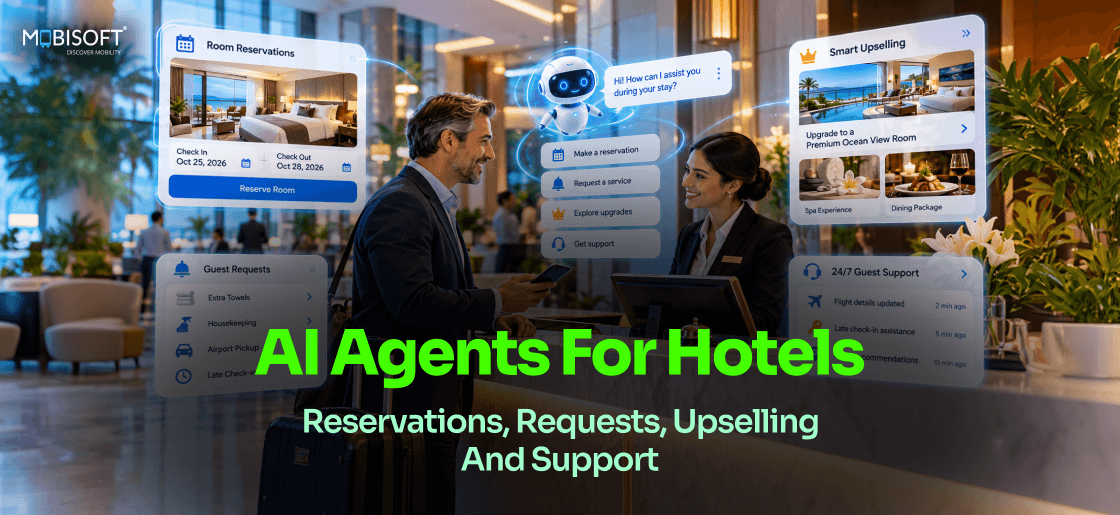
A hotel AI agent can write a warm, flawless reply and still make the stay worse. Say it tells a guest their towels will arrive in ten minutes. If housekeeping needs forty, good manners become a broken promise. The same happens when it quotes a rate that changed an hour ago.
So the hard part of AI agents for hotels sits behind the conversation. At Mobisoft, our AI automation agents read availability live from the PMS and send each request into the housekeeping queue. They confirm a time only once that queue says it's realistic. Language models already write well. Integrations decide whether guests can trust what they write.
The sections ahead follow that thread through reservations, in-stay requests, upselling and compliance. You'll come away knowing which conversations to hand over first and which systems need two-way links. You'll also have a method for testing the return against your own numbers.
What AI Agents for Hotels Actually Do
An AI guest services agent for hotels sits between guest messages and the systems your team already runs. It reads a message, then checks the PMS or hotel documents. After that, it takes whatever action it's allowed to take. Anything beyond that goes to a person, with the thread attached.
Three Kinds of Work It Takes On
The work falls into three types. Each one leans on a different part of your setup. Which type matters most at your property? Separating them early shows you which integrations come first.
Answering From Hotel Documents
Pool hours and parking charges don't need a person. The agent answers those questions from documents your team maintains, so replies match the room compendium. There's a catch, though. If a document goes stale, the agent repeats the old fact confidently.
Acting Inside Hotel Systems
Some requests only count as handled once a record changes. For a booking, that's a new reservation in the PMS. Spa treatments need a hold in the spa diary, and even a pillow request becomes a housekeeping task. Since the agent writes each record itself, your night manager sees what the guest saw. That's the core of hotel guest request automation.
Passing the Conversation to Staff
Certain conversations belong with people from the very first message. Refund requests and safety concerns are two clear examples. Here the agent collects the facts and names the role who'll reply. It also tells the guest roughly when to expect that reply.
What a Typical First Scope Covers
We'd suggest a first scope close to this one. It's narrow enough to launch within a quarter, yet owners still see results within weeks.
- Direct bookings from website chat or WhatsApp, priced from live booking engine rates.
- Pre-arrival messages that confirm arrival time before rooms are assigned.
- In-stay requests, each logged as a task with a named owner.
- Upgrade and late-checkout offers, priced from rules your revenue team sets.
- Feedback requests that reach a manager before any public review does.
Where It Stops, and Your Staff Take Over
A good hotel AI assistant has firm limits, and your team sets them. We'd write the handoff rules before anyone drafts a prompt. Prompts written first tend to promise more than operations can deliver. Rules written first keep those promises honest.
Decisions to Settle Early
- Which request types the agent may close without a staff check.
- The largest gesture it can offer alone, such as a drink voucher.
- Who receives escalations at 2 am, when one manager covers the whole building.
- What the agent tells a guest when everyone on duty is busy.
Would your front office manager accept an agent who issued refunds alone? Most wouldn't, and they'd be right to refuse.
Channels Guests Already Use
Would you download an app just to ask for towels? Most guests won't bother, so a hotel AI assistant works inside messaging apps and website chat instead. One conversation history then follows each guest across every channel.
That shared history pays off at check-in. Before a guest reaches the counter, the receptionist can already see the cot request. Teams with an existing website bot can often extend it. Our AI-powered chatbot development work starts from those channels. From there, we connect them to your booking and service systems.
Where the Guest Journey Leaks Today
A single stay produces many small conversations. They rarely reach the same person. Pre-booking queries go to the reservation office. In-stay inquiries are addressed to whoever is answering the calls at the moment. Feedback, if any, comes through the generic email software tool. All three are spots where answers can be delayed or lost altogether. How many people will handle a simple towel inquiry in your hotel?
Below is how each stage works in practice, along with suggestions to improve the process. In the right-hand column lies the main value.
| Journey Stage | Common Guest Messages | Typical Handling Today | What an AI Agent Changes |
| Pre-booking | Availability, rates, facilities, group enquiries | Email replies the next working day; phone during office hours | Replies at any hour, with live rates and a direct booking link |
| Booking to arrival | Early check-in, transfers, room preferences, occasions | A confirmation email, then manual follow-up if staff have time | A timed pre-arrival sequence that captures preferences and presents offers |
| Check-in | Room assignment, key collection, dining reservations | Front desk queue with a rushed upsell attempt | Digital pre-check-in, so the desk visit takes minutes |
| In-stay | Towels, room service, taxis, repairs, complaints | Calls to the front desk, passed on by phone or radio | Requests logged and dispatched, with an ETA sent to the guest |
| Checkout | Late checkout, bill questions, luggage storage | Manual decisions at the desk | Late-checkout answers based on the next day's arrivals |
| Post-stay | Reviews, loyalty points, return visits | One generic review email | Private feedback first, then a review invite and a relevant offer |
After-Hours Enquiries Go to Whoever Answers First
If your reservations team works office hours, late enquiries wait. Guests don't plan trips around your rota. A couple comparing three seaside hotels at 11:40 pm wants a price and a link. Whoever replies first has the edge. Meanwhile your enquiry sits unread, and an OTA may take the booking.
AI hotel guest services cover that overnight gap without a night reservations agent. How many enquiries arrive after your team logs off? Pull last month's email and chat logs and count them. That figure often decides the business case alone.
The Front Desk Is a Poor Place to Sell
Check-in upselling happens when guests least want to browse. They've often travelled for hours, and all they want is a key. At that point, an upgrade pitch feels like a delay. Even perfect phrasing can't fix bad timing.
Oaky, an upselling platform, published a case report on two Radisson Blu resorts in Gran Canaria. Their revenue manager found that tired guests rarely wanted offers on arrival. Pre-arrival offers did better because guests had time to look. That's the logic behind hotel guest experience automation for upselling. The offer moves to a calmer moment, and saying yes takes one tap.
Small Requests Fail at the Handoff
Request failures rarely start with careless staff. They start when a task moves between people without a record. Nobody can chase something that was never written down.
Where Handoffs Typically Break
- A receptionist writes the request on a pad, then a coach group arrives.
- A phone message to housekeeping reaches a supervisor who's on another floor.
- An engineer fixes the air conditioning, yet the guest never hears it's done.
- A verbal late-checkout approval never reaches the PMS.
We'd audit one busy weekend before buying any hospitality AI solutions. Log each in-stay request with two times, asked and done. The gaps show you which workflow to connect first. As an artificial intelligence solutions provider, we'd start a hotel project from that log.
How an AI Agent for Hotel Reservations Works
Reservation enquiries range widely. One guest wants the cheapest room next weekend. A conference organiser needs 12 rooms and a meeting space. An AI agent for hotel reservations can close the first enquiry alone. For the second, it qualifies the request and books time with sales.
A Late-Night Enquiry, Step by Step
Here's a worked example with illustrative details. At 11:43 pm, a guest opens website chat. They want a sea-view room for three nights from the 22nd. What happens next depends on which systems the agent can reach.
What Happens Behind the Reply
- Availability comes live from the PMS, so a room sold an hour ago won't appear.
- Two sea-view room types are offered at rates the revenue system approved.
- A light question about the occasion follows, since it'll guide later offers.
- The guest gets a booking link with dates and room type filled in.
- Payment triggers the confirmation, and the pre-arrival schedule begins.
Notice what's missing from that list. Nothing comes from a cached rate sheet, and no discount appears that revenue hasn't approved. We'd also keep questions to two at this stage, since five start to feel like a form. Dietary needs can wait for the pre-arrival message.
Recovering Bookings That Stall
Plenty of guests open the booking engine and never finish. Some get distracted. Others want to check dates with a partner first. Without a follow-up, those enquiries simply fade.
An AI hotel booking assistant can send one polite reminder two hours later. If the guest opted in to WhatsApp, it goes there. Otherwise, email carries the same pre-filled link. A second nudge the next morning is usually enough. Would you keep reading messages from a hotel that wrote five times?
Groups, Corporate Accounts and Special Occasions
Complex bookings rarely close inside a chat window, however capable the assistant. The agent's real value here is a complete brief. Your sales team then starts the call with every detail in hand.
Group Bookings
Group size and dates come first. The agent then records the room mix and any meeting space. Catering needs and a budget range complete the brief. Once the group needs a custom quote, a sales manager takes over.
Corporate Accounts
How often do your corporate bookers get the wrong rate today? A company email domain can trigger the contracted rate automatically. The agent also captures a cost code. Anything outside the contract goes to the account manager.
Weddings and Celebrations
Wedding enquiries often arrive at weekends, when sales offices close. An AI agent for hotel reservations keeps them from waiting until Monday. The agent gathers the date and guest numbers first. It then shares indicative room-block availability. The call with sales is booked before the weekend ends.
These flows depend on clean booking engine and CRM integrations. Our software engineering services team builds that layer. With it in place, staff and agents work from the same records.
Accessible Rooms Need Exact Answers
Accessibility questions leave no room for approximate replies. A typical message reads, "Does the accessible room have a roll-in shower?" That answer comes from room-level data in the PMS. A generic marketing description won't do. If it's wrong, a wheelchair user may arrive to a bath they can't use.
Requests involving medical equipment go to a person. We'd also have the agent confirm the hotel's commitment in writing. That record protects the guest and the receptionist on duty at arrival.
The AI Hotel Concierge for Guest Requests
In-stay requests are where guests judge service most directly. Each one used to mean a phone call and a short hold. An AI hotel concierge for guest requests turns that call into a tracked task. The real difference shows up after the first reply.
Housekeeping and Amenity Requests
Late in the evening, room 314 sends "can we get two more towels please" on WhatsApp. Within seconds, a task sits in the housekeeping queue. The guest gets a time estimate that's based on how busy that queue is right now.
Follow-up is what most phone-based setups miss. Ten minutes later, the agent checks whether the runner closed the task. A closed task triggers a quick check with the guest. When it's still open, the supervisor sees an alert before the guest has to ask again.
Hotel guest request automation only works when tasks close properly. We'd connect the agent to your task tool before launch. HotSOS and Nuvola are common choices, and some PMS platforms include a module.
Room Service and Restaurant Bookings
Room service by chat removes the menu card and the phone call. Your allergen matrix sits behind each dish. That lets the agent flag nuts or gluten before anyone orders. The total posts to the room folio through the POS, so card details never enter the chat.
Restaurant bookings follow a similar path into your table system. A vegetarian partner or a birthday gets noted on the booking itself. That way, kitchen staff know before anyone sits down.
Concierge and Local Bookings
Taxis and dinner tips make up much of a concierge's day. An AI hotel concierge can book an airport transfer through your transport partner. It then confirms the pickup time with the guest. Local suggestions come from a guide your own team curates.
We'd give that guide one named owner and a quarterly review. Recommending a restaurant that closed last month undoes a lot of goodwill. Guests don't forget that kind of slip.
Maintenance Issues
A broken air conditioner at midnight needs a fast acknowledgement. A work order gets logged with the room number and the fault, ready for the engineer on call. The guest then gets a visit time taken from the engineering queue. Once engineering closes the job, the guest hears about it.
When a repair overruns, the agent can offer a small gesture from an approved list, such as a complimentary drink. A room move still needs the duty manager.
Complaints Need Three Levels of Response
Complaint handling decides whether an unhappy guest returns. Good AI guest communication automation fixes simple slips itself. Everything else reaches a person fast, with the thread attached.
Level One, Operational Slips
Late deliveries and wrong items belong here. They're the easiest problems to fix. The agent apologises without excuses and marks the task urgent. It then gives a firm new time. "I'm sorry the pillows haven't arrived. I've marked it urgent, and they'll reach you within eight minutes."
Level Two, Service Quality Problems
Noise and cleanliness complaints sit at this level. So do concerns about staff behaviour. The duty manager gets an alert with the full thread. If nobody responds within ten minutes, the agent escalates again.
Level Three, Serious Complaints
Safety concerns and billing disputes go straight to senior staff. The guest receives a holding reply. At this level, the agent never offers money or refunds.
Arguing with a guest is off the table at every level. Our guide to AI-powered customer support automation covers the same escalation logic. Hotels just add room numbers and duty rosters to it. Who's on your 2 am escalation list today?
AI-Powered Hotel Upselling Guests Actually Accept
Upselling works when an offer feels chosen for the guest. A script read at the desk feels like the opposite. AI-powered hotel upselling improves two things at once. The offer arrives at a better moment. It also reflects what the guest has already told you.
Timing Decides Most of the Result
A week before arrival, guests are still planning. They've got time to browse. At check-in, they mostly want their key, which is why pre-arrival offers tend to do better.
Oaky's 2025 case study on Mercure Hotel MOA Berlin put pre-arrival email conversion at 10.04 percent. Your own rate will depend on guest mix and offer quality. Even so, it's a fair reference point. Would your current check-in upsell rate come close?
| Moment | Offer Types | Why It Works Here |
| Seven days before arrival | Room upgrades, packages, early check-in, parking, airport transfer | The guest is planning and has time to compare options |
| 48 hours before arrival | Last upgrade offer, spa slots, dinner reservations, activities | Anticipation is high, and the stay feels close |
| Digital pre-check-in | Upgrade confirmation, welcome amenity, breakfast preferences | The guest is already filling in a form for the hotel |
| First evening of the stay | Next-day breakfast, spa, dinner or tours | Plans for tomorrow come up naturally |
| Day before checkout | Late checkout, luggage storage, transfers, a return-visit offer | Departure logistics are on the guest's mind |
We'd test one moment at a time, starting with the 48-hour message. Guests open it for practical reasons, since it holds their check-in time and parking details. An upgrade line at the end reaches someone who's already reading.
Signals That Make an Offer Personal
Why do most upgrade emails get ignored? A generic upgrade banner reads like spam. AI agents for hotels do better because they read the booking first. Each signal below comes from data most hotels already hold.
Signals From the Booking
- An anniversary in the booking notes points to a suite upgrade.
- A five-night stay in a standard room makes extra space worth paying for.
- Two children on the reservation make connecting rooms a sensible offer.
Signals From Past Stays and Context
- Previous spa bookings suggest holding a treatment slot for this visit.
- A vegan preference noted last year makes the plant-based menu relevant.
- Arriving during a city festival opens the door to event tickets.
Many of these signals come from one pre-arrival question a hotel AI assistant asks about the trip's purpose. We'd use only details that make an offer relevant, since quoting facts guests never knowingly shared feels intrusive.
Guardrails for Upgrade Offers
- Offer only room types your revenue team forecasts will stay unsold.
- Pull upgrade prices from the RMS, so no rate rule gets undercut.
- Stop offers for any guest with an open complaint.
A Worked Example With Illustrative Numbers
The figures below are assumptions for a 100-room hotel at 75 percent occupancy. That's 2,250 room nights a month. At 2.4 nights per stay, it means about 940 arrivals. None of these rates are benchmarks.
| Offer | Guests Offered | Accepting | Value Each | Monthly Revenue |
| Room upgrade | 600 | 60 | $40 a night over 2.4 nights | $5,760 |
| Late checkout | 900 | 180 | $25 | $4,500 |
| Spa treatment | 650 | 39 | $90 | $3,510 |
This translates to a bit under $13,800 per month excluding food & transfers. Annually, that's around $165,000 worth of deals. An overloaded concierge department cannot forward all these offers to their guests in due time, but your personal agent can. Yet the sum is less important than the leverage you can use. Up-selling hotels with the help of AI allows you to change one offer and see the effect in weeks.
Meeting Guests on Their Channel and in Their Language
Guests bring their own messaging habits and their own languages. An English-only bot on the website reaches only part of them. Good hospitality AI solutions cover both gaps. Channels usually come first.
Which Channels Earn a Place
Travellers lean towards familiar apps. Eviivo surveyed 430 travellers in August and September 2025. Of those, 58 percent preferred quick channels like WhatsApp. Only 4 percent wanted to download a property's own app.
That doesn't make your app pointless. Loyalty members often use it. An AI hotel concierge inside the app suits in-stay offers. It simply works poorly as the only channel. Asking guests to install an app for towels is a hard sell.
| Channel | Best Use | What to Plan For |
| WhatsApp Business | Pre-booking questions, in-stay requests, offers and feedback | The official Business Platform, opt-in records and approved templates for outbound messages |
| SMS | Time-sensitive reminders for guests without WhatsApp | Two-way messaging, plus consent rules such as TCPA in the US and PECR in the UK |
| Website chat | Pre-booking enquiries and direct booking conversion | Mobile layout, language detection on first load and cookie consent |
| Confirmations, longer pre-arrival guides and invoices | Personalised content, unsubscribe handling and deliverability | |
| Hotel app | Loyalty guests and repeat visitors | SDK integration and in-app offers |
| Voice | Reservation calls outside desk hours | Speech recognition quality and warm transfer to staff |
Where should you start? We'd launch with two channels. Choose whichever carries most in-stay traffic today. Then add website chat for bookings. The rest can follow once both run smoothly.
Duve, a guest messaging vendor, has reported one useful pattern. Many OTA guests move to WhatsApp once they contact the hotel directly. Your own logs will show whether that holds for your property.
Languages Guests Can Trust
A guest who can't explain a problem feels unwelcome, however good the room is. An AI guest services agent for hotels eases that by working in the guest's language. Which languages do your bookings actually come from?
How Language Handling Works
- The guest's first message sets the language, and replies follow it.
- That choice stays fixed, so replies don't switch midway.
- Staff can read an English version before they step in.
Translated Content Versus Live Translation
General communication can use the model's multilingual abilities. Safety-related communication cannot. Guests asking "¿Este plato lleva frutos secos?" should receive an answer verified using the list of ingredients provided by the kitchen. Information about allergies and emergency procedures also requires professionally translated source texts.
We'd translate the knowledge base for your top source markets first. Live translation can cover rarer languages. Each of those threads gets a staff follow-up flag.
Tone Across Cultures
Suppose a guest writes in polite Japanese to ask about a late checkout. A reply in casual phrasing would land badly, even if the checkout time it gave were correct. Japanese service writing usually follows keigo, the honorific register staff uses with guests. We'd have a native speaker approve those templates before launch. Arabic replies, in the same way, are usually expected to open with a greeting before the answer. AI hotel guest services that skip these conventions come across as blunt to the person reading them.
Pre-Arrival and Post-Stay Messages That Build Loyalty
Take a couple who book a three-night stay six weeks out. Between the confirmation email and arrival day, they may hear nothing from the hotel. After checkout, they usually get one generic review request. An agent can fill both gaps without adding work for the front desk.
A Pre-Arrival Sequence Guests Don't Ignore
We'd plan each message around one job only. Mix parking details with a spa offer and a survey link, and guests skim the lot. Guests choose WhatsApp or email at booking. The sequence then follows that choice.
A Sample Timeline for a Three-Night Leisure Stay
- Fourteen days out, the agent asks whether the trip marks an occasion. That answer guides later offers.
- A week before arrival, an eligible guest sees one upgrade, priced per night.
- Five days out, a couple celebrating an anniversary gets a dinner suggestion.
- At 48 hours, the message carries check-in time and parking, with the upgrade at the bottom.
- The day before, a pre-check-in link collects arrival time so housekeeping can prioritise that room.
- Two hours before arrival, a short note confirms the room is nearly ready.
A one-night business guest needs only check-in time, parking and the pre-check-in link. AI guest communication automation works best when the sequence follows the booking. A short stay gets a short sequence.
Catching Problems Before They Become Reviews
Imagine a guest whose room faced a noisy service yard. They didn't complain at the desk, but they left annoyed. A private feedback request a few hours after checkout lets them say so. Ideally, that happens before they open a review site.
What Happens to Each Score
- A low score reaches the front office manager the same day, with the room number attached.
- The agent drafts a reply naming the problem, and the manager edits it before sending.
- A happy guest gets thanks and a review link mentioning their anniversary dinner.
That last detail matters more than it looks. A review request that mentions the actual stay reads like a person was paying attention. Would yours pass that test today?
Winback and Loyalty Messages
A loyalty update the day after checkout lands while the stay is still fresh. If it shows the guest is two stays from a free night, booking direct starts to make sense. Months later, the CRM can flag guests who haven't come back. A family that stayed in the August holidays might hear about school-break rates the following spring.
Birthday messages can work too. We'd limit them to one or two a year per guest. Tied to something the guest did or said, hotel guest experience automation feels like attentive service.
The Technology Behind AI Agents for Hotels
Guests only see a chat window. Behind it, a language model works with your documents and several system links. A weak layer anywhere shows up as a wrong answer.
The Model and Its Instructions
When a guest writes "my wife has a nut allergy, can we still have the set menu," the model has to read two things. One is a dinner request, and the other is a safety question. Most teams call a current model from a major provider through an API. Instructions written for the property sit around it. Those instructions set the hotel's voice and tell the model when to hand over.
Tone needs testing just as much as facts do. A beachfront resort and a city business hotel would answer the same late-checkout request differently. Before launch, we'd run twenty real guest messages from last month through your AI hotel concierge. Your front office manager then marks which replies sound like the hotel.
A Knowledge Base Your Team Keeps Current
The agent's facts come from your own documents, fetched at the moment a guest asks. This approach is called retrieval-augmented generation, or RAG. It keeps the model from inventing pool hours or spa prices.
Keeping those documents current is the harder job. The restaurant swaps its menu in October. A lift goes out of service for a week. Who updates the knowledge base when that happens? We'd name one owner per department before launch and give each a simple edit screen.
Two-Way Links to Your PMS
Your property management system holds availability, rates, profiles, and folios. AI agents for hotels need a real-time link to it that works in both directions. A read-only link can quote a room. It can't book one or post a spa charge.
Each PMS exposes data differently. Oracle offers its Hospitality Integration Platform for OPERA Cloud. Mews and Apaleo publish open APIs. Cloudbeds runs its own marketplace. We'd ask any vendor which of these they've connected in production. Ask which write actions they support too.
The channel manager matters too. A hotel AI assistant quoting an unknown rate creates parity trouble with OTAs.
Task Systems, Payments and Revenue Data
Each extra integration decides what the agent can safely promise. Leave one out, and that request type stays manual. Without a link to housekeeping's task tool, a towel request still ends with someone phoning the floor.
- HotSOS or a similar tool receives each request and signals when the runner closes it.
- Room service and spa charges post straight to the folio, or go through a tokenised payment link.
- A revenue system like IDeaS sets the upgrade price, so Saturday's suite isn't sold at Tuesday's rate.
- Stay history from the CRM tells the agent a guest booked the spa last time.
- The POS and table booking system take orders and reservations without staff re-keying them.
None of this helps hotel guest request automation unless data flows both ways. A dispatch without a completion signal leaves the agent guessing. It can't tell the guest whether towels arrived, so the guest calls the desk anyway.
Analytics and Revenue Attribution
Attribution is easy to postpone, and that's a mistake. Without it, nobody can tell which offers earn money. Nor can anyone prove to the owner that the agent pays for itself.
We'd start with a plain weekly report covering four numbers. First, reply time shows whether guests wait less than before launch. Completion time by request type shows where housekeeping or engineering runs slow. The escalation rate shows how often staff steps in. Offer revenue, split by timing, tells you whether the 48-hour message or the first evening sells better. Good hospitality AI solutions put that report in front of the general manager every Monday.
Privacy, Payments and AI Disclosure
A typical guest profile may hold a passport scan from check-in. The restaurant may have added an allergy note, and someone logged a wedding anniversary. A hotel AI assistant reading those profiles needs clear limits on what it can see. We'd bring your legal adviser in during the first week, before any data mapping.
Guest Data Laws by Market
Europe and the UK
Say a guest from Munich books direct through your website. GDPR applies to that booking. The UK GDPR would cover a guest from Manchester the same way. The reservation itself can usually rest on the booking contract. A later message offering 15 percent off a return visit is marketing, though. That typically needs consent first.
India
India notified its Digital Personal Data Protection Rules in November 2025. Obligations phase in over 18 months, with full effect due in May 2027. Hotels operating in India have only months left to adjust. We'd start with the booking form and the WhatsApp opt-in. Do they record consent for marketing separately from consent for the stay itself?
Other Markets
The UAE, Singapore, and Australia each have their own data protection laws. We'd map your top three or four source markets first, then let legal match each data flow to the rules.
Card Data Stays Out of the Chat
Payments are where AI hotel guest services carry the most risk. Some guests will happily type a full card number into WhatsApp to pay for a massage. The agent should decline that politely and send a secure payment link in its place. The number then never sits in a chat log that staff or vendors can read.
PCI DSS sets the rules for card data. The cleanest approach keeps card numbers away from the agent entirely. A room service charge posts to the folio, or to a card token stored at booking. A new card goes through your payment provider's hosted page. Before signing with any vendor, we'd ask to see their PCI compliance documentation.
Telling Guests They're Talking to AI
Article 50 of the EU AI Act has applied since 2 August 2026. People must know when they're dealing with an AI system, unless that's obvious from context. Breaching these rules can cost up to EUR 15 million or 3 percent of worldwide turnover.
For a hotel, the simplest answer sits in the first message. Well-built AI agents for hotels introduce themselves as the hotel's AI assistant. The same line offers a team member whenever the guest wants one. Voice calls may need a spoken version at the start of each call. That's worth checking with your legal team.
Allergy and Dietary Information
Under GDPR, an allergy note can count as health data. That usually means stricter handling and explicit consent. We'd treat the exact requirements as a question for legal review in each market, since practice varies.
The safety rule doesn't need a lawyer. An AI guest services agent for hotels never guesses whether a dish is safe. It answers from the allergen matrix the kitchen has signed off. A severe allergy goes straight to the F&B manager. If a dish has no allergen entry, the agent says so and checks with the kitchen.
A 14-Week Rollout Plan for AI Agents for Hotels
A single-property rollout of AI agents for hotels takes about fourteen weeks on a modern cloud PMS. An older on-premises system usually adds time. The plan below assumes one hotel and two channels at launch. We'd hold a short review at the end of each phase. The next one starts only when it passes.
Weeks One to Four, Discovery and Knowledge
The first fortnight is about evidence. Count guest messages by channel for a typical month. List the fifty questions guests ask most. Then map every request type to the team that fulfils it. That map becomes the hotel AI assistant's routing table.
Weeks three and four build the knowledge base. Menus and policies go in first, then accessibility details and the local guide. Each document gets a named owner and a review date before it's loaded.
Before Moving On
- Every request type has an owner and a target time, whether it's extra pillows or a broken safe.
- Each department head has confirmed their documents are current.
Weeks Five to Nine, Design and Build
The first two weeks of this phase go on writing. That covers the voice guide, the escalation rules, and an offer template for each guest type. Duty managers should read those escalation rules closely. They're the people who'll get the 2 am alerts.
The technical build takes about three weeks. PMS and task dispatch links come first, because most other features depend on them. Payment posting follows. Messaging channels and offer timing come last.
Weeks Ten and Eleven: Testing and Training
We'd ask your own staff to write the test scenarios, since they know how real guests behave. One tester books a room and then changes the dates. Later, the same tester complains about noise. We'd check every booking and folio charge against the PMS by hand. Your longest-serving receptionist is a good person to try breaking it. They know the odd cases automated tests miss.
Training runs in parallel, in sessions of about an hour per team. A hotel guest request automation demo with live tasks beats any slide deck.
Weeks Twelve to Fourteen, Pilot and Full Launch
The pilot opens to part of your guest base, for example, only those who opted in to WhatsApp. Someone reads every conversation daily for the first two weeks. Within days, you'll find questions the knowledge base can't answer. Does the gym have towels? What time does the bar stop serving food?
Signs the Pilot Is Ready to Widen
- A full week passes with no booking errors and no wrong charges on a folio.
- A noise complaint at 11 pm reaches the duty manager within the agreed ten minutes.
- The daily list of unanswered questions shrinks as the gaps are filled.
When those hold, the agent goes live for all guests. Offer testing begins at that point. The dashboard also goes live, and the daily reading becomes a monthly review.
Three Conversations With Your Team
We'd ask the general manager to introduce the agent personally, one department at a time. Each team gains something different, so each conversation covers different ground.
The Front Desk
With AI guest communication automation in place, receptionists get back the hours spent on repeat questions. They keep the moments that need judgement, like an upset guest or a VIP arrival. Show them how to read a guest's chat history before arrival. They'll also need to take over a thread when it turns tricky.
F&B and Spa Teams
These teams receive bookings and orders the agent creates. They'll want to know where those appear and how fast to respond. They also need to update their own prices.
Management
Owners and general managers will judge the project on a handful of figures. We'd settle what each one means before launch. Leave "escalation" undefined, and the first monthly meeting argues about the word instead of the result.
Measuring ROI Without Inflated Numbers
A finance director who sees "300 percent ROI" on a vendor slide will ask where the figure came from. The answer needs to be your hotel's own numbers. A credible case for hospitality AI solutions also separates gains you can count from ones you only observe.
Set a Baseline Before Launch
Any claim about improvement needs a starting point. We'd record the month before go-live, then measure every later month the same way. Changing the method halfway makes the comparison worthless.
- Count the enquiries that arrived after the reservations office closed, using email and chat logs.
- Note the average time to first reply, separately for WhatsApp, email, and website chat.
- Track how long in-stay requests took to complete, with towels and repairs kept apart.
- Take ancillary revenue per stay straight from the PMS, so nobody can dispute the source.
Seasonality can flatter a launch or hide its gains. A spring launch compared with a quiet winter month will look better than it is. That's why we'd also compare against the same month a year earlier.
Four Places the Return Comes From
Direct Bookings Recovered From OTAs
Imagine your logs show around 60 enquiries a month arriving after 7 pm. An AI hotel booking assistant answers those at once. Say the agent turns fifteen into direct bookings at $370 each. The hotel then avoids the OTA commission on each one. At 18 percent, that's about $1,000 a month in this illustrative case. Your real commission rates and booking values will change the result.
Upsell Revenue
The worked example in the upselling section is a starting template. Replace its rates with your own room mix, then track actual conversion each month after launch. We'd count only offers the agent sent and the guest accepted. If a guest asks for an upgrade at the desk, that sale belongs to the desk team.
Staff Time
Count the messages and calls your AI hotel concierge now handles. Multiply that by the minutes each one used to take. The result shows up as shorter queues more than as cash. Would your owners count that as value? We'd ask them before building the case around it.
Costs to Put on the Other Side
The first cost is the build. Most of it goes on PMS and task integrations, plus writing the conversations. After that comes a monthly running cost for as long as the agent is live. For an AI agent for hotel reservations and concierge, that running cost usually includes a few separate lines.
- Model usage, which climbs in August if that's your peak month and falls back in winter.
- Hosting and monitoring, so someone notices when the PMS link drops at night.
- WhatsApp messaging fees, since Meta charges for many outbound template messages.
- Ongoing work on the knowledge base and on testing new offers.
We'd ask every vendor to price the system at a specific volume, such as 20,000 messages a month. A vendor who can answer that clearly has thought about how costs grow. One who can't may leave you with a surprise bill in your busiest season.
A Simple Payback View
Take a conservative monthly benefit from your hospitality AI solutions, then subtract running costs. Divide the build cost by what's left. That gives a payback period in months, the figure owners tend to ask for first. Six months after launch, we'd set the original forecast beside the dashboard. The next year's plan then follows what actually happened.
Common Mistakes That Stall Hotel AI Projects
Projects with AI agents for hotels rarely stall because of the model. They stall when a practical decision is left until after launch. Each of the five below can be settled during planning, while changes are still cheap.
Launching on Every Channel at Once
Six channels at launch means six sets of templates, opt-in rules, and bugs. The pilot then turns into firefighting, and nobody learns much. We'd launch on one messaging channel plus website chat. After a few clean weeks on both, adding SMS or voice is far less risky.
Treating the Knowledge Base as a One-Off Task
Picture the agent confirming Monday spa hours from last season's document. The guest walks down in a robe and finds the spa closed. After that, weeks of good replies count for little. A hotel AI assistant is only as current as its documents. Each one needs a named owner and a review date. In the weekly operations meeting, we'd add one standing question for each department head. Has anything changed this week that the agent should know about?
Sending Offers Without Limits
More offers don't produce more revenue. Three upsell messages in one day quickly teach guests to ignore everything you send. Some will opt out entirely and lose useful updates too. How many offers does a typical guest receive from you now?
Caps We'd Start With
- One offer per pre-arrival message, placed below the check-in and parking details.
- At most one in-stay offer on any single day of the stay.
- No offers at all for a guest with an open complaint, even if a suite is free.
AI upselling for hotels works best inside those limits. A few weeks of data will show where your guests' ceiling actually sits. You can then loosen a cap with evidence behind the change.
Hiding the Human Route
A guest who types "can I talk to someone, please" twice and gets two more menus will remember it. That request should go to a person straight away. If the desk is busy, the agent can promise a reply within ten minutes. It then has to make sure one arrives. It also shouldn't loop a guest through the same options. After one failed attempt, a person takes over.
Skipping Staff Input
Front desk teams know which questions confuse guests. Housekeeping knows how long a cot takes to reach the fourth floor on a busy evening. Without their input, the agent promises times the hotel can't meet. Hotel guest request automation only builds trust when its estimates are honest.
We'd run a one-hour workshop with each team before conversation design begins. The answers you collect there are usually better than any audit report.
Buying a Platform or Building a Custom Agent
A 60-room boutique hotel on Mews faces a different choice from a twelve-property group on three systems. Packaged platforms launch fast and cover standard needs well. A custom build suits hotels with unusual systems or strict brand rules. Groups with several properties to connect usually fall into that second camp.
When a Platform Is Enough
A single property on a popular cloud PMS can often start with a packaged AI hotel concierge. Before signing, we'd confirm it supports your exact PMS version. It should also write bookings and charges back, as well as read them. Your revenue team should be able to change offer timing themselves. Moving an upgrade message earlier shouldn't need a support ticket.
When a Custom Build Makes Sense
Hotel groups often run several PMS versions, or want one agent covering hotels and serviced apartments. That's where packaged platforms tend to struggle, and where a custom build earns its cost.
What to Check With Any Partner
You can cover these five points in a single meeting, ideally before anyone shows you a demo.
- A two-way PMS integration running in production today, at a hotel you can call.
- How offers get personalised, and how a new offer is tested against the old one.
- Who reviews translated content in each language, and how often they do it.
- A written approach to card data and to privacy law in your guest markets.
- Who updates the knowledge base after launch, and how quickly a change goes live.
"The AI will learn over time" describes a hope. You'd want to hear who reviews conversations each week, and what they change as a result.
How Mobisoft Builds an AI Guest Services Agent for Hotels
We build custom agents for independent hotels, resorts, and groups. If you're scoping an AI guest services agent for hotels, our work covers four areas. Prefer to start with one property? We'll design for a later rollout from day one.
Reservations
- Our reservation agents answer booking enquiries at any hour, including on the phone.
- They connect in real time to PMS platforms such as OPERA and Mews.
- Group and corporate enquiries are qualified first, then routed to your sales team.
In-Stay Service
- Guest requests are dispatched to task tools like HotSOS or Nuvola.
- We track each request against its SLA and follow up with the guest automatically.
- Complaint escalation follows a protocol built around your own duty roster.
Upselling
- Our offer engines draw on your CRM and revenue management data.
- Every offer can be A/B tested, and a dashboard attributes revenue to each one.
Before and After the Stay
- Pre-arrival sequences link straight into digital pre-check-in.
- After checkout, the agent handles feedback requests, loyalty updates, and winback messages.
Where to Start This Month
It's worth knowing which promises your property can keep on time today, before choosing a vendor. Start with one busy weekend of in-stay requests. Log when each one arrived and when someone marked it done. Then pick the request type with the widest gap. We'd connect that workflow to your AI agents for hotels first, because guests notice within days.
At the same time, ask your PMS provider exactly what its API lets a third party write. Reading availability is common. Posting charges or changing room status can need extra approval, and that affects the whole project plan.
If you'd like a second view of that request log, Mobisoft can turn it into an agent design. We'll map reservations, request dispatch, and upselling onto your own PMS, and outline what the first property's rollout would involve.
Frequently Asked Questions
Can the agent work with our older on-premise PMS?
Usually yes, though it varies. Say your PMS is on-premise with no public API. Many vendors still sell an interface module, so ask yours first. The answer decides whether an AI agent for hotel reservations can book a room or only quote one.
How do we stop the agent quoting an outdated rate?
The agent reads the rate from the PMS when asked. Revenue changes Saturday's price at 5 pm, and a guest asks at 6 pm. An AI hotel booking assistant quotes the new figure. We'd also test channel manager sync.
How would Mobisoft Infotech handle our PMS going offline?
When the PMS drops at 2 am, the agent tells a guest it can't confirm yet. It logs the request, such as a 7 am wake-up call. The night auditor sees the queue first. Once the link returns, we'd replay the logged items in order.
Who owns our guest chat data after launch?
You do, and the contract should say so. A guest from Munich books direct through your website. Under GDPR, you'd normally act as the controller, with the vendor processing data for you. Ask for retention limits and a written deletion process before signing.
What affects the cost of our hotel agent from Mobisoft Infotech?
Integration usually costs more than the language model itself. A single property on a cloud PMS is a small job for hospitality AI solutions. A group running three PMS versions isn't. WhatsApp fees count too, since Meta charges for outbound templates.
This content is for informational purposes only and may include AI-assisted research or content generation. While we strive for accuracy, information may evolve over time. Readers are advised to independently verify critical information before making decisions.

Nitin Lahoti
Read more
Nitin Lahoti is the Co-Founder and Director at Mobisoft Infotech. He has 15 years of experience in Design, Business Development and Startups. His expertise is in Product Ideation, UX/UI design, Startup consulting and mentoring. He prefers business readings and loves traveling.
 Nitin Lahoti
 October 28, 2026