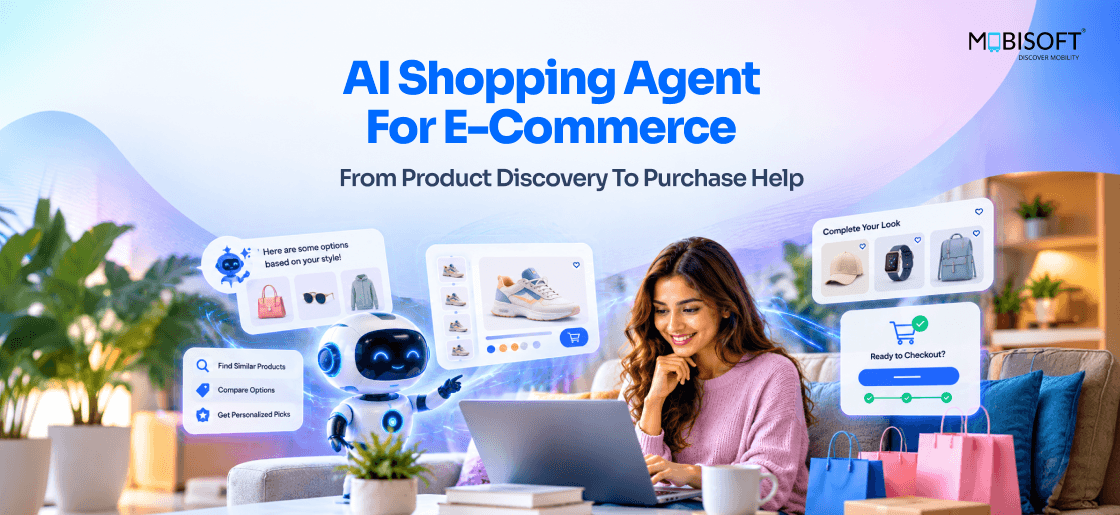
Every product page answers the average buyer's questions. Your next customer isn't average. "Does this boot fit wide feet?" "Will it arrive by Friday?" An AI shopping agent answers these on the spot. It uses your catalog, live stock, and policies. That makes your product data the real limit on its quality.
Our AI agent development services begin with discovery and specification. We'd recommend auditing the catalog and the support log first. An AI agent for e-commerce answers only from its data. Both sources show where shoppers get stuck and where answers are missing. Each gap you find there becomes a question the agent can't answer yet. Model choice comes second.
Below, you'll see how discovery and personalization work. Cart recovery and chat channels follow. Learn how to measure the return. By the end, you will know what to build first and what to test next.
What Is an AI Shopping Agent
An AI shopping agent acts as an intermediary between your product catalog and the shopper. There are three basic questions that describe almost everything it does.
What Is an AI Shopping Agent
An AI shopping agent interacts with your store. It helps the shopper make the right order. It understands natural language and verifies live inventory. It also answers any follow-up questions about its recommendations.
What an Agent Does at Each Stage
The agent works across the whole purchase. Each stage has its own task.
- The agent finds products that match a vague request.
- Questions about materials and sizing get a clear answer.
- Shoppers see the right size and honest reviews.
- Cart and payment questions get help on the spot.
- Orders are tracked and returns start with one message.
Say a buyer wants to know if they can return the product if it doesn’t fit. The agent shares the policy at the moment of doubt.
How Does an AI Shopping Agent Work?
Four steps repeat in every chat.
- The agent turns the request into a structured need.
- It searches the catalog by meaning instead of exact words.
- It ranks matches using the shopper's history and current stock.
- It replies and calls tools for prices or delivery dates. If intent is vague, it asks one clarifying question.
Take a buyer who writes "cant do thurs, fri?" about a delivery. The agent reads the date window and checks carrier cut offs. It doesn't guess at facts. It calls tools for live data. Then it writes the answer from the results. Without that step, a language model makes confident mistakes.
Speed matters too. Set up replies under two seconds as slow answers break a conversation.
What Is the Difference Between an AI Shopping Agent and an E-commerce Chatbot?
A scripted bot follows a decision tree. It's fine with "Where is my order?" It fails on "Something warm for a Scottish autumn walk". A chatbot shopping assistant on a language model won't stumble there. A full agent goes further. It builds a cart or starts a return.
Memory is another gap. A script forgets the shopper when the window closes. With consent, an agent keeps a profile. It picks up where the last visit ended. Our article on e-commerce chatbot support covers the service side of that line.
| Capability | Scripted chatbot | AI shopping agent |
| Understands intent | Matches keywords | Reads occasion, budget and style |
| Uses live catalog data | Rarely | Yes, through APIs |
| Takes actions | Links to pages | Builds carts and starts returns |
| Remembers the shopper | Session only | Across visits and channels |
Why Shoppers Leave Before They Buy
Baymard Institute puts average cart abandonment at 70.22%. That figure comes from 50 studies and a September 2025 update. Many of those exits aren't lost sales at all. Others come from causes an online shopping assistant can address.
Why Browsing Is Not Always a Lost Sale
Among US shoppers who abandoned, 42% said they were just browsing. We'd recommend not chasing every exit. A pop-up that shouts "Wait, don't go!" annoys a researcher. A simple offer to answer one question works better. It helps the buyer who's undecided and ignores the one who's done.
Search Boxes Cannot Read Intent
Keyword search matches words. But shoppers usually describe situations. "Something for a summer wedding, nothing too formal, around $150" holds an occasion and a budget. A keyword engine sees unrelated terms. A modern shopping AI doesn't miss either signal.
Your digital commerce platform holds the data behind those answers. Weak data there limits the agent.
Too Many Results and Too Few Answers
A runner searching for shoes can face thousands of results. Who reads them all? Product pages answer the average question. The buyer with wide feet doesn't get help. "Does this boot come in wide?" ends a sale when it goes unanswered.
Fit Doubts, Price Doubts and Plain Distraction
Baymard lists extra costs as the top reason, at 40%. An unsatisfactory returns policy follows at 13 percent. A virtual shopping assistant can explain shipping and return terms early. Here's how each doubt shows up.
| What the shopper thinks | What it signals | What the agent does |
| "Will it fit me?" | Size or compatibility doubt | Suggests a size from measurements and reviews |
| "Is it worth this price?" | Value doubt | Compares options and explains differences |
| "I'll come back later." | Distraction | Saves the cart and follows up with a relevant message |

How Can AI Agents Improve Product Discovery?
Discovery improves when the system understands intent before it ranks anything. A shopping agent with four layers does that work. Each layer fixes a different failure.
Four Layers Behind Better Discovery
Take the request "Something warm but not too heavy for a Scottish autumn walk". Each layer handles one piece of it.
| Layer | What it does | Typical technique |
| Query understanding | Turns language into categories, attributes, and limits | Language model with entity extraction |
| Semantic matching | Finds products by meaning, even with different wording | Vector embeddings and nearest-neighbor search |
| Contextual re-ranking | Reorders matches for this shopper, stock, and margin | Hybrid recommendation model plus business rules |
| Clarifying questions | Asks one useful question when intent is vague | Prompted question generation |
The jacket request ends as a midweight, waterproof, packable coat. No keyword in the query says any of that.
Asking One Good Clarifying Question
When intent is vague, a good virtual shopping assistant asks first. It doesn't list 200 results. "Is this for hiking or city walks?" cuts the set in half. Each answer also teaches the model about the shopper. We'd recommend one question per turn. Two questions feel like a form.
Seven Intent Signals the Agent Reads
Every shopping message carries clues. A good agent sorts them before it searches.
- Category, stated as "running shoes" or implied by "something for the gym".
- Occasion, such as "for a job interview" or "a toddler's birthday".
- Constraints such as budget or allergies, as in "fragrance-free, under $40".
- Style, for example "minimalist" or "muted tones".
- Gift context, such as "Secret Santa, $20 limit".
- Timing, as in "I need it by Friday".
- Negative limits like "nothing flashy" or "not a perfume" narrow results fastest.
Visual Search and Image Inputs
Some shoppers can't describe what they want, but they can show it. A buyer uploads a screenshot with the note "Find me this lamp". The agent reads its color and material. Then it searches the catalog for close matches.
Room photos work the same way. An AI shopping app can suggest furniture that fits the palette and the space. We'd recommend adding image search after text search is stable. It needs clean product photos. Teams without in-house machine learning staff often bring in Artificial Intelligence development services here.
How Do AI Shopping Agents Personalize Product Recommendations?
Personalization works only if the agent understands who it serves. There is no such thing as an average customer. A good recommendation should be based on good data. After that come clear guidelines for working with that data.
What Goes Into the Shopper Model
A buyer may say they wear a medium but find a brand runs small. That one detail is worth more than a month of guessing. An AI personal shopper follows what people say they want. It gives less weight to preferences it only infers.
| Data source | How the agent uses it | Consent note |
| Purchase history | Price range, sizes, brand affinity, repurchase timing | Personal data, so set a retention policy |
| Browsing behavior | Early interest signals before any purchase | Cookie consent applies in the EU and UK |
| Stated preferences | The strongest signal in the model | Captured in chat and covered by your terms |
| Saved profile | Sizes, brands and delivery details that persist | User controlled at any time |
| Session signals | Adjusts picks within the current visit | Short retention |
Real Time Signals Change the Picks
Say a visitor opens five linen shirts in a row. The agent weights linen for the rest of that visit. It doesn't wait for a purchase. Time of day and device add small hints. None of them beats what the shopper types.
Where Each Recommendation Type Fits
Collaborative filtering shows what other people bought. An agent also hears what this shopper just said. Each placement needs a different amount of data.
- Homepage picks show items that match the visitor, not a generic bestseller row.
- Chat results reflect the question and the shopper’s past orders.
- Cross-sell ideas appear on product and cart pages, such as a scarf that goes with a jacket.
- Upsell ideas offer one better option that still fits the stated need.
- Repurchase prompts arrive just before a consumable runs out.
- Cart reminders name the product and answer the most likely doubt.
Our article on AI-powered product recommendations explains the ranking models behind these placements. Which of the six does your store use today?
Personalization Without History: The Cold Start Problem
Every shopper is new once. The agent still has to help on that first visit. AI e-commerce personalization handles it in four steps.
Four Steps for a First-Time Visitor
Start with context. A visitor from a summer dress ad probably wants warm-weather clothing. Region (with consent) and season add clues. The first query then adds detail. "Show me cotton summer dresses under $60" tells the agent the category, fabric, and budget at once.
- Offer a short onboarding with three to five questions about style and budget. It works best when you frame it as a benefit.
- Learn within the session. If a visitor opens three minimalist items, the agent adjusts its picks.
- Watch price behavior. If a shopper browses above $80 but adds items under $60, that's a budget signal.
Carrying Data Forward
Registered users keep their profile, so they don't start over. Guests can be linked after an email capture, such as at cart recovery. We'd recommend a clear consent banner before any of that starts. Say a guest returns a week later and types "same style as last time". A digital shopping assistant that forgot them can't answer.
Our fashion retailer case study on AI-powered e-commerce personalization covers a project for a global audience.
Purchase Assistance at the Moment of Decision
Discovery gets a buyer to the product page. Then the harder part starts. Most visitors leave without buying. Their doubts cluster around a few questions an agent can answer.
Answering Product Questions in Real Time
An AI shopping tool earns the sale. It answers the question that would end the visit. It pulls from three sources. Specs come first because they're facts. Reviews add lived detail, such as "runs small". General knowledge fills gaps and gets flagged as a guess.
- Will this charger work with my MacBook Pro?
- Can I put this in the dishwasher?
Each question type has a different risk. A wrong care instruction damages the product. A wrong compatibility answer causes a return. Style questions are subjective, so the agent shouldn't give one verdict. We'd recommend a hard fallback for the rest. If the data can't settle a question, the agent says so. It links the spec sheet.
Our retail chain case study shows an AI-powered digital commerce platform in a multi-store setting.
Can an AI Shopping Agent Compare Products and Prices?
Yes. The agent can easily compare size and price. A shopping helper reads live prices from the product API. It won't quote a stale number. Comparing against rival stores is a separate matter. It needs licensed data, and scraping brings legal risk.
Social Proof That Stays Honest
An AI shopping system can read 800 reviews and summarize them. We'd recommend showing the negatives too. Personalized review surfacing helps too. It shows reviews from buyers with the same size or use. "Most buyers love the weight, and some find the sizing generous" builds more trust than praise alone. "Only 3 left in your size" is fine when live inventory proves it.
Fewer Returns Through Size, Fit, and Compatibility Help
Returns cost money twice, once to ship them back and once to restock. Better guidance before the order prevents many. That's why fit help is a practical first job for commerce AI.
What the Agent Checks in Each Category
Each category fails in its own way. A sofa buyer needs dimensions. She doesn't need style tips.
| Category | What the agent checks | Example question |
| Apparel | Measurements Brand size chart Fit comments in reviews | "32-inch waist, 34 leg, with a bit of room?" |
| Footwear | Width Half sizes Activity type | "Is the toe box narrow?" |
| Furniture | Room size Door Stair clearance | "Will this sofa fit through a standard door?" |
| Electronics | Device compatibility matrix | "Does this case fit the Pro Max?" |
A Worked Example for Apparel
Say a shopper gives a 32 inch waist. The brand runs slim, and several reviews call the cut small. The agent suggests one size up and explains why. If the shopper returned this brand for sizing before, it factors that in. Color needs the same care. "The screen may show this shade darker, so order a free swatch" is an honest answer.
Large catalogs with many variants often need enterprise ecommerce development on product data first. Clean variants make retail and AI projects much easier.
Recovering Abandoned Carts With the Right Message
A generic reminder ignores why the buyer left. A shopping assistant can work out the reason and address the real concern. Which message would you open?
Matching the Message to the Reason
Say a buyer opens the size guide three times and then leaves. The best follow-up suggests a size and states the return terms. A generic reminder skips both. Reason-based reminders are AI-powered product recommendations applied to the cart. Baymard found that 40% of those who abandoned cited extra costs, so clear pricing matters too.
| Signal in the session | Likely reason | Message approach |
| Size guide viewed several times | Size doubt | Suggest a size and state the return terms |
| Left at the shipping cost line | Cost objection | State the cost clearly or note a free-shipping threshold |
| Item added, removed, added again | Price hesitation | Explain the value and show payment options |
| Left at the payment screen | Payment friction | List accepted methods and offer human help |
| One visit, no checkout | Comparison shopping | Send a soft reminder with no pressure |
Why Timing and Channel Matter
Payment problems need a fast response. A message 15 minutes after a failed payment can still save the order. Comparison shoppers need room. A note the next day, with no pressure, fits them better. Channel matters as well. WhatsApp leads in many markets, and SMS leads in others. Email carries richer content such as images and review summaries. A shopping assistant that picks the channel for each market wastes fewer messages.
What Each Touch Says
Each message does one job. The in-session offer asks if the buyer wants a size check before leaving. The WhatsApp note confirms the size is in stock and returns are free. The email adds a review summary. The last note stays short and polite.
A Five-Touch Sequence to Start With
We'd recommend a short sequence across channels.
- In session, offer to answer one question before the buyer exits.
- After 30 minutes, send a WhatsApp or SMS message with one link. Opted-in shoppers only.
- After two hours, email the product image and a review summary.
- After 24 hours, send a softer follow-up built on social proof.
- After 72 hours, send a last note such as "Still interested? Reply with a question, or I'll stop reminding you."
Suppression rules matter as much as timing. Stop every message once the buyer purchases or opts out. Don't send more than five touches. Don't mention a viewed product unless your consent covers browsing data.
After Sale Support
Many stores go silent after the confirmation email. The weeks after delivery set the tone for the next purchase. AI online shopping doesn't end at checkout. A good AI shopping assistant stays useful afterward.
Messages That Follow the Order
The schedule below is a starting point. A check-in such as "How is your jacket working out?" costs little and catches problems early.
| Moment | What the agent sends | Goal |
| Order placed | Confirmation with delivery date and tracking link | Fewer "where is my order" contacts |
| Delivery day | Arrival window plus setup or care tips | Smoother first use |
| Two days after delivery | A short check-in message | Catch problems early |
| One week after delivery | A personal review request | More useful reviews |
| Consumable running low | A one-click reorder link | Repeat purchase at the right time |
| Two to four weeks later | A pick from a category the buyer hasn't tried | Wider customer value |
Asking for Reviews at the Right Time
Wait a week after delivery before asking for a review. The buyer has used the product by then. Those reviews feed back into the social proof the agent shows other shoppers.
Turning Returns Into Exchanges
Say a buyer starts a return because the jacket runs small. The agent offers the next size and handles the label. Offer free shipping on that swap. The store keeps the sale.
Other cases need different handling. For a defect on a cheap item, send a replacement and skip the return. If the buyer changed their mind, accept it politely and note why. Pause promotions for a month. Friction in returns hurts repeat business.
Loyalty Messages That Feel Earned
A note that shows how close the buyer is to the next reward gives a reason to come back. The agent tracks points and sends milestone messages. They arrive in the same thread as support. Keep them rare. A reward message every week turns into noise. A retail agent inside the brand app can time them better. It sees the full order history.
Conversational Commerce Beyond the Website
Conversational commerce means selling through chat instead of a landing page. In some markets, messaging apps are the main way brands reach shoppers. The website still matters. Chat adds a second surface for buyers who've got a specific question.
Which Channels Matter
A buyer who asks about the product color on Instagram expects an answer within minutes. A buyer on SMS expects a short reply. Each channel sets its own tone. SMS adds a consent duty. The US applies TCPA rules, and the UK applies PECR. Instagram adds a speed duty, since social buyers expect near-instant answers.
| Channel | Where it's strong | What the agent needs |
| WhatsApp Business API | India Brazil Indonesia The UAE Parts of Europe | Template approvals, product cards, payment links, human handoff |
| Instagram DMs | Fashion Beauty Home decor | Catalog links and fast replies |
| SMS | US Canada Australia UK | Two-way replies and opt-in tracking |
| In-app chat | Repeat customers and loyalty members | App SDK and full customer context |
| Voice assistants | Reorders of known items | A limited list of exact products |
One Thread From Question to Delivery
A gift buyer might message a brand on WhatsApp and ask for ideas for her mother, who loves gardening. She shares a budget of $50. The agent sends three options with prices. She picks one and adds gift wrap. A secure payment link follows. Tracking updates arrive in the same thread.
That flow works only if the agent knows she’s the same shopper. Unified conversation state is the hard part of AI powered commerce. If a virtual shop assistant loses the cart between channels, buyers get frustrated fast.
A WhatsApp Policy to Know
Meta bars general purpose AI chatbots from the WhatsApp Business Platform. The rule reached new users on October 15, 2025. Existing users followed on January 15, 2026. Assistants for support, orders, and sales are still allowed. Tie your agent to your catalog and orders. Confirm the current wording in Meta policy before launch.
How Can an AI Shopping Agent Integrate With an Ecommerce Platform?
Integration is mostly plumbing. The agent reads catalog, stock, and customer data through APIs. It then writes back carts and orders. Seven pieces make up a working AI shopping system.
Components to Connect
Say a buyer asks if the blue one is in stock in a medium. Four of these pieces answer it. The model reads the question. The inventory API checks stock. The vector store finds the product, and the cart API holds it.
| Component | Its job | Typical options |
| Language model | Handles the conversation | Chosen by speed and cost |
| Product vector store | Searches by meaning | Pinecone, Weaviate, or Qdrant |
| Inventory API | Shows price and stock | Shopify, Magento or WooCommerce |
| Personalization engine | Ranks products per shopper | Customer data platform and a ranking model |
| Cart and checkout | Holds carts and sends payment links | Your cart API and a payment provider |
| Messaging layer | Sends chat, SMS, and email | A messaging provider or direct APIs |
| Reviews and analytics | Adds social proof and tracks results | Your review platform and a BI tool |
We’d recommend replies under two seconds and a daily refresh of changed products. Stale stock data creates orders you can’t fill. Wrong prices bring legal trouble you don’t want.
Keeping Product Data Fresh
A shopper who notices an old price has found a sync gap. Three habits close most gaps. Push price and stock changes to the agent as they happen. Re-embed any product whose description changes. Review the review feed at least daily so summaries stay current. The shopping agent is only as accurate as its newest data.
Payment Links Inside Chat
Say a buyer shows interest in purchasing the product on WhatsApp. We'd recommend sending a hosted payment link. Card details then never enter the chat. Providers such as Stripe and Adyen offer this. Your PCI DSS scope stays smaller. The buyer still finishes quickly.
Build, Buy or Hybrid?
A packaged tool is quickest for a standard catalog. It's shallow on your product data. A custom build suits complex catalogs, and you own the result. Hybrid sits between them. A sensible default for mid-market stores is a platform core with a custom personalization layer. That keeps speed and protects what makes you different.
Working with a development partner is a fourth route. It suits teams without in-house AI staff. The partner choice then matters more than the build itself.
Where Google's Shopping Tools Fit
Google announced the Universal Commerce Protocol on January 11, 2026. It’s an open standard that covers the whole purchase path. Retailers such as Target and Wayfair back it. Shopify is also on the list. Checkout now runs inside AI Mode through Google Pay. Google also offers a Business Agent in Search. It answers product questions in chat.
These Google Shopping tools don’t replace your own agent. They put your products in front of more people. Your agent owns the relationship after the click. We’d treat Google commerce readiness as a data task. Complete product details and accurate prices matter most.
Test two language models on 100 real queries from your logs. No single model wins on every store.
How Do Businesses Measure the ROI of AI Shopping Agents?
Measure the AI shopping system like any revenue program. Compare agent sessions with a control group. Then subtract the running cost.
Metrics Worth Tracking
A dashboard that only shows better conversion in agent sessions proves little. Shoppers who chat are often the ones already close to buying. Track these against a matched control group.
- Conversion rate in agent sessions.
- Average order value, with and without a recommendation.
- Cart recovery rate for each channel.
- Return rate in categories that have fit help.
- Repeat purchases within 90 days.
- Support contacts per 100 orders.
Reading the Funnel
Track each step of the chat leading up to the order. If many chats end after the first product list, discovery needs work. If they end at the cart, suspect price or shipping cost. The funnel tells you which layer to fix next.
Prove the Lift With a Holdout
Say a store routes 10 percent of traffic to a version without the AI shopping assistant. After eight weeks, it compares conversion and order value. That test settles arguments fast, and it's cheap to run. We'd recommend a monthly review, since attribution across channels gets messy.
A Worked Example With Illustrative Numbers
Say a store sees 20000 abandoned carts a month. The average order is 80 dollars. Recovery rises from 6 to 9 percent. That adds 600 orders. That is 48K dollars more revenue a month. Revenue is not profit. Subtract margin and channel costs. Then subtract the run cost of the AI shopping agent.
Where the Numbers Get Shaky
Your gain may not reach 3 points. Consent rates for WhatsApp and SMS aren't the same everywhere. Some recovered carts would've come back anyway. A holdout group catches that last problem. What would your numbers say?
Privacy, Consent, and Fair Trading Rules
Rules differ by market. Treat each point below as a question for legal review. A few patterns hold almost everywhere.
Personal Data and Consent
Any AI personal shopper uses purchase history and chat preferences. In the EU and UK, that needs a lawful basis under GDPR. Tracking cookies don't get a pass. They need consent. A shopper who wants to delete their data expects it gone from every store feeding the model. California, India, and other markets add their own rules. Create a privacy notice that names AI personalization in plain words.
Telling Shoppers They're Talking to AI
Article 50 of the EU AI Act has applied since August 2, 2026. It reaches any digital shopping assistant that talks to people directly. Chat providers have to tell people they're talking to an AI. The exception is when that's obvious. Take a buyer who types "Am I talking to a person?" The agent answers honestly and offers a human handoff.
Honest Urgency, Prices and Reviews
Consumer protection law treats false stock counts as unfair. That holds in the UK, EU, and US. Hiding bad reviews raises the same concern, and so does an invented countdown. Personalized pricing is a legal question to settle market by market. Proactive WhatsApp or SMS marketing needs opt-in, but order updates usually don't. Can a shopper opt out of every message in one tap?
Messaging Consent by Channel
Capture opt-in at checkout with a clear checkbox for order updates and offers on WhatsApp. Order updates usually need no marketing consent. The buyer just has to expect them. Every proactive message needs a visible way to opt out. TCPA in the US and PECR in the UK add channel-specific duties.
Five Lines Your Agent Shouldn't Cross
Say a product manager wants to show a low-stock warning to push sales. The answer is no unless it is true. These five rules keep any AI shopping tool honest.
You should never:
- Show a stock level or urgency signal that live data doesn’t support.
- Summarize only the positive reviews.
- Change prices for one shopper without disclosure and legal advice.
- Send proactive WhatsApp or SMS messages without prior opt-in.
- Let the agent pose as a human when a shopper asks.
How to Choose an AI Shopping Agent Development Partner
Ask for proof as slides don’t count. Ask each vendor to run your 50 hardest search queries live. A partner who promises to tune things later hasn’t built it before. The table covers the main checks.
| Ask about | Good sign | Warning sign |
| Retail experience | Named integrations and real results | Generic chatbot work |
| Shopper model | Clear data plan and A/B tests | Vague claims that the AI learns alone |
| Catalog size | Handles thousands of products and variants | Basic keyword search |
| Cart recovery | Reasons for leaving and stop rules | One reminder email |
| Compliance | Consent tools and data deletion | Leaves compliance to you |
| After launch | Monthly reviews and test plans | Bug fixes only |
Don't skim the after-launch row. A shopping agent improves through monthly tuning. The support model matters as much as the build. Ask for two references too, and ask each what changed after month three.
What a Build With Mobisoft Covers
Mobisoft builds custom shopping agents for e-commerce brands and marketplaces. Scope varies. A typical build includes these parts.
- A discovery engine with natural language and visual search.
- A personalization engine with an A/B testing framework.
- Cart recovery that infers the abandonment reason and sequences WhatsApp, email and SMS.
- Purchase assistance with product Q&A and size guidance.
- Post-purchase support with repurchase prompts.
- Chat selling on WhatsApp, Instagram DMs, SMS and in-app chat.
- Consent management and PCI DSS payment handling for chat payment links.
Delivery runs 14 to 20 weeks. It includes discovery and launch. The phases below show how a retail agent build usually unfolds. Investment ranges from 75K to 250K dollars depending on catalog complexity and channel mix. Monthly operations cost 3K to 8K dollars.
| Phase | Typical length |
| Discovery and specification | 2 to 3 weeks |
| Catalog vectorization and semantic search | 3 to 4 weeks |
| Personalization engine and data integration | 3 to 4 weeks |
| Conversational AI and channel integrations | 4 to 5 weeks |
| Cart recovery sequences | 2 to 3 weeks |
| QA, compliance review and pilot | 2 to 3 weeks |
| Launch and first optimization | 1 to 2 weeks |
What to Do This Month
Your AI shopping agent will only be as good as the questions you feed it. Start there.
First, export last quarter's site searches that returned nothing or ended in an exit. Rank them by the revenue at stake. That list shows where discovery fails today. Pull the 20 most common pre-purchase questions from support tickets. Check whether your product data can answer each one. Last, agree in writing which messages need opt-in and who approves them. Without that rule, a well-meant promotion can break a consent promise. Both lists take an afternoon and neither needs a vendor. They also give any partner a real brief.
Bring that search list to Mobisoft's free 45-minute E-commerce AI Revenue Assessment. We'll analyze your conversion rate, cart abandonment, order value, return rate, and repeat purchase rate. Then we'll quantify the opportunity for your platform.

Frequently Asked Questions
Can the agent chat in the languages of our shoppers?
Yes, it can. You will have to test each language. Say a shopper in Mumbai mixes Hindi and English in one message. Your product data may exist in one language so a conversational commerce flow can stall. Translate key attributes first and check the top three.
How does Mobisoft Infotech run a pilot for our store?
Mobisoft's plan includes a two to three week pilot after QA and compliance review. Pick one category and channel, like running shoes online. Compare that AI shopping agent with a holdout group. Don't expand until the numbers hold.
How does the agent cope with traffic spikes in our sales?
Picture a flash sale starting at 8 pm. When replies slow down, search takes over from the chat. We'd cache answers to common questions, like delivery times. Before the sale, run a load test using last year's peak traffic.
When does the agent hand our chats to a person?
Say a buyer writes "my third order is late." That goes to a person, like failed payments. Buyers don't repeat themselves when an online shopping assistant passes the transcript along. Set these triggers before launch.
Can Mobisoft Infotech reuse our existing chatbot?
Yes, you can keep your channel links and approved answers. Say your bot already runs on WhatsApp. That link stays, and your returns policy carries over. A chatbot shopping assistant then replaces the decision tree with live catalog access.
This content is for informational purposes only and may include AI-assisted research or content generation. While we strive for accuracy, information may evolve over time. Readers are advised to independently verify critical information before making decisions.

Nitin Lahoti
Read more
Nitin Lahoti is the Co-Founder and Director at Mobisoft Infotech. He has 15 years of experience in Design, Business Development and Startups. His expertise is in Product Ideation, UX/UI design, Startup consulting and mentoring. He prefers business readings and loves traveling.
 Nitin Lahoti
 October 28, 2026