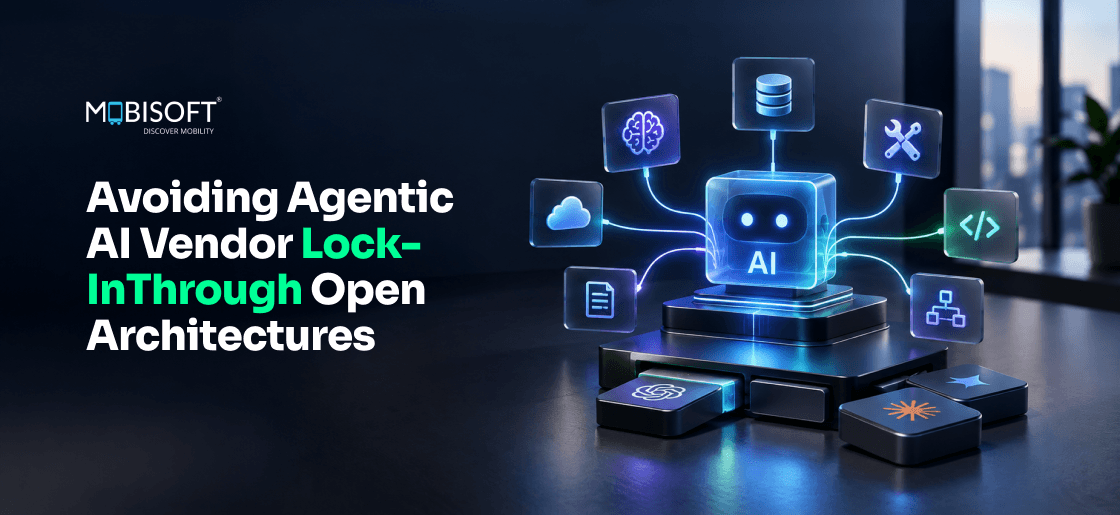
Every enterprise adopting AI agents eventually asks one question. What happens when you need to switch providers? Agentic AI vendor lock-in rarely announces itself early. It builds through SDK imports, proprietary agent frameworks, and platform-specific data storage. Switching costs climb before anyone notices the pattern forming. Traditional software lock-in took years to form through contracts and integrations. AI lock-in forms in months, hidden inside application code nobody flagged as a dependency. By the time a team notices the problem, the fix looks expensive.
Most teams do not choose lock-in on purpose. They pick the fastest SDK and the most polished agent framework. Each choice feels harmless in isolation. Two years in, those choices add up to a system nobody can move easily. That is the uncomfortable part. AI vendor lock-in rarely comes from one bad call. It comes from good short-term decisions stacked without an exit plan. The fix is not paranoia about every vendor relationship. It is a handful of deliberate choices made early. Those choices keep the door open later, on your terms. This guide covers exactly where those choices matter most.
The Anatomy Of AI Vendor Lock-In Inside An Enterprise Stack
AI vendor lock-in is the buildup of dependencies that make switching slow or costly. It rarely requires one bad decision. It usually results from dozens of convenient choices, made without any portability plan.
An AI system entangles vendor dependency with business logic itself. The model determines how prompts get written. The agent framework determines how workflows execute. The data pipeline determines where enterprise knowledge actually lives. Pull one thread and the whole system can unravel quickly.
Working with dedicated AI agent developers early helps prevent this tangle. An experienced team designs the system boundaries before code gets written. That upfront structure keeps each layer independent later on.
Why This Topic Matters More Now Than Before
Enterprise adoption of AI agents has accelerated sharply through 2025 and into 2026. More companies now run production agents handling real customer workflows daily.
That growth means more production code, more integrations, and more accumulated dependency. Every month spent building on a single vendor's assumptions adds cost. That cost only shows up later, at the switching bill. Enterprises that never plan for an exit often discover the plan was needed anyway.
Who Should Care About This Problem First
Not every team faces equal exposure to AI agent vendor lock-in risk. Some roles sit closer to the decisions that create lock-in.
- Technology leaders approving which frameworks and vendors get adopted.
- Engineering teams writing the integration code that touches vendor SDKs.
- Procurement teams negotiating contract terms with AI vendors directly.
- Architecture teams responsible for long-term system design decisions.
Each group influences a different lock-in vector described later in this guide. Coordinating across these roles produces a far stronger outcome than any team working alone.
How This Differs From Traditional Software Lock-In
Enterprises have handled ERP and CRM lock-in for decades now. They understand that playbook well. AI changes both the timeline and the visibility of the problem.
Consider these differences in how AI vendor lock-in behaves compared to older software:
- Formation speed drops from years to months, sometimes weeks.
- Lock-in often stays invisible until an exit attempt begins.
- Skills built around one model rarely transfer cleanly to another.
- Capability gaps between vendors can open within a single quarter.
A Salesforce administrator can usually learn HubSpot within a few weeks. An engineering team fluent in one model's prompt patterns faces a steeper climb. Model behavior varies enough that switching providers means relearning core assumptions.
Why Discovery Always Happens At The Worst Moment
Lock-in tends to surface during a contract renewal. It also surfaces after a competitor's capability leap or a vendor incident. In every case, the enterprise wants leverage and finds none available.
A pricing increase of 40 to 70 percent at renewal is common. This happens once a vendor senses that switching would be expensive. By then, negotiating from strength stops being realistic. The fix is not a sharper negotiator. It is an architecture built for departure from the very first day.
The Real Cost Of Discovering Lock-In Late
Enterprises that discover lock-in during a crisis pay a steep premium. Emergency migrations happen under pressure, without proper evaluation time. Decisions made this way tend to compound the original problem.
A security incident at a primary vendor illustrates this well. The enterprise wants to switch immediately as a risk measure. Engineering then discovers the switch requires months of rework. That gap between intent and capability defines the cost of lock-in.
Four Moments When AI Vendor Lock-in Becomes Impossible To Ignore
Certain events reliably force the lock-in question into the open. Recognizing them ahead of time helps teams prepare rather than react.
Contract renewal is the most common trigger by far. A vendor raises pricing once switching looks expensive enough to discourage action. A competitor's model release is the second common trigger. A rival model clearly outperforms yours on a key task. Staying put then becomes a real competitive disadvantage. A vendor security or reliability incident is the third trigger. Trust erodes fast in these moments. The desire to leave often outpaces the ability to actually leave. A vendor acquisition or strategic pivot is the fourth. Product roadmaps can diverge from enterprise needs overnight, with no warning given in advance.
Why Waiting For One Of These Moments Is Risky
Each of these four triggers arrives without much advance notice. Waiting until one happens can lead to reacting under pressure rather than planning calmly.
An enterprise that builds portability before any trigger fires controls its own timeline. It can switch on favorable terms, during a quiet period, at reduced cost. That single difference in timing often separates a manageable transition from an expensive one.
Five Vectors Behind Every AI Agent Vendor Lock-In Case
AI agent vendor lock-in does not arrive as a single decision made once. It accumulates across five distinct layers of any AI system. Each layer carries its own warning signs and its own fix.
Vector One: Direct Model API Coupling
This is the most common and most preventable vector by far. Application code imports a provider's SDK directly into production. Vendor-specific formats then get embedded into core business logic.
Every file importing a provider SDK becomes a file requiring change later. Request formats, error types, and model version strings all get hardcoded. Multiply that pattern across ten thousand lines of code. A two-week switch can silently become a five-month rebuild.
Vector Two: Proprietary Agent Frameworks
Agents built on a single vendor's orchestration platform inherit specific assumptions. Those assumptions cover memory handling, tool access, and deployment targets alike.
Closed agent builders often bundle model access with proprietary tool definitions. They also tie deployment to one specific cloud environment. Moving such an agent means rebuilding it entirely, not migrating it. This is where AI agent vendor lock-in becomes structural rather than incidental.
Evaluating this risk before committing to any single framework saves real cost later. Flagging proprietary dependencies early usually costs far less than a later migration.
Vector Three: Platform Data Gravity
Every interaction with an AI system generates data with real value. Feedback, corrections, and fine-tuning examples all carry future improvement potential.
When that data lives only on a vendor's platform, a problem forms. Leaving the platform means leaving the signal that made the system useful. Fine-tuned weights built on closed models often cannot be exported at all.
Vector Four: Ecosystem Integration Lock-In
Platform-native AI features feel convenient the moment you first deploy them. A Copilot integration here, a Workspace AI feature there, adds up fast.
Within twelve to eighteen months, dependencies compound across the organization. An enterprise can end up managing three or four separate AI ecosystems. Each one requires its own tooling knowledge and its own migration plan.
Vector Five: Skills And Tooling Monoculture
An engineering team fluent only in one provider's quirks faces real friction. Even full technical portability cannot prevent a genuine productivity drop during migration.
Prompt patterns tuned for one model rarely transfer cleanly to another. Tool-calling formats differ across providers. Reasoning styles differ too. The mental model needs rebuilding, and that rebuild takes real calendar time.
Tech companies offering generative AI software development often see this skills gap firsthand. Engineers who build exclusively on one vendor's tools tend to underestimate the relearning curve. A deliberate rotation across providers keeps that curve much shorter.
Comparing The Five Vectors At A Glance
The table below summarizes where each vector shows up and how to address it.
| Lock-In Vector | Where It Shows Up | Primary Fix |
| Model API coupling | Direct SDK imports in application code | Abstraction layer between app and provider |
| Proprietary agent frameworks | Vendor-specific orchestration platforms | Open-source frameworks or direct protocol use |
| Platform data gravity | Training data, embeddings, feedback loops | Enterprise-controlled storage from day one |
| Ecosystem integration | Platform-native connectors and features | Protocol-based tool access, not native plugins |
| Skills monoculture | Team expertise concentrated on one vendor | Deliberate multi-provider benchmarking practice |
Notice how each fix targets the layer where the risk actually lives. A generic policy rarely solves a vector-specific problem well.
Why These Vectors Rarely Appear Alone
In practice, these five vectors rarely show up in isolation. Most enterprises carry some exposure across three or four vectors at once.
A team locked into one model's SDK often also runs a proprietary agent framework. That combination compounds switching cost rather than adding it linearly. Recognizing this overlap matters when planning a remediation budget. Fixing one vector while ignoring the others delivers limited real protection.
A Realistic Scenario Of Compound Lock-In
Picture a mid-size enterprise running customer support through a single AI vendor. The team imported that vendor's SDK directly into production code early on.
Agents were built using that same vendor's proprietary orchestration tools. Conversation history and fine-tuning data both live inside that platform. Two years later, a competitor's model shows a measurable quality advantage. Engineering estimates the switch will take four to five months. That estimate reflects the combined weight of multiple lock-in vectors, not one.
Where Outside Expertise Changes The Architecture Conversation
Some enterprises try to solve every vector internally without outside input. Others find that early guidance changes the entire trajectory of the build.
Bringing in AI consulting and strategy expertise early prevents costly rework later. This should happen before writing production code. A structured assessment can identify which vectors carry the highest risk. That clarity guides decisions about frameworks, protocols, and data storage.
What Does A Portability-Focused Assessment Cover
A proper assessment looks beyond just the model choice itself. It examines every layer where dependency might silently accumulate over time.
- Current SDK usage patterns across the application codebase.
- Agent framework choices and their deployment flexibility today.
- Data storage locations for training sets and user feedback.
- Contract terms already in place with existing AI vendors.
This kind of review typically takes two to three weeks. The output is a prioritized list rather than a generic checklist.
What Enterprises Commonly Learn From This Process
Assessments tend to surface a consistent pattern across different organizations. Most teams underestimate how much lock-in already exists in production.
A common finding is heavier dependency on tool integrations than expected. Proprietary connectors accumulate faster than anyone tracks deliberately over time. Another common finding involves fine-tuning data scattered across multiple vendor platforms. Consolidating that data into enterprise storage often becomes the first recommended action.
MCP And A2A As The Real Insurance Against Agentic AI Vendor Lock-In
Contracts help, but contracts only govern what happens between two parties. Open standards remove the need for that negotiation entirely. Both sides speak the same protocol regardless of who owns it.
Open architecture for AI agents means building tool access on shared specifications. Agent coordination and observability follow the same principle. Any vendor can implement the same interface without special permission. When the interface belongs to nobody, switching implementations stops being a rebuild.
The Model Context Protocol And Tool Access
The Model Context Protocol is an open standard for connecting AI to tools. Because it is model-agnostic, it works the same way across providers.
Building on this MCP open standard means connectors get built exactly once. Switching model providers never touches that connector at all. The protocol sits between the agent and the tool. It does not sit between the agent and a vendor's plugin format.
Tool access is usually the fastest place to remove lock-in. Organizations exploring MCP server consulting typically start with this exact layer.
The A2A Protocol And Agent Coordination
Where MCP handles tool access, the A2A protocol solves a different problem. It defines how independent agents discover each other's capabilities. Coordination happens regardless of the framework or model behind each agent.
A2A and MCP interoperability matters most in multi-agent AI architecture. Specialist agents built by different teams often run on different models. They still need to hand off tasks reliably between one another. Swapping one specialist agent for a better one becomes simple. It turns into a configuration change rather than a rebuild project.
Why MCP And A2A Work Better Together Than Alone
Treating MCP and A2A as separate concerns keeps the overall architecture cleaner. It also makes the whole system easier to reason about later.
Here is how the two protocols complement each other in practice:
- MCP standardizes how a single agent reaches tools and data.
- A2A standardizes how multiple agents reach each other directly.
- Neither protocol depends on any specific model provider at all.
- Together they let every layer be replaced independently over time.
An enterprise running enterprise AI agents across departments benefits most here. Different teams often prefer different models for different tasks. The coordination layer needs to function regardless of that internal choice.
Building MCP for AI agents once, at the tool layer, means flexibility comes free. Nobody has to rebuild the connector every time a team switches models.
What Adoption Looks Like In Practice Today
Enterprise teams building agentic AI architecture in 2026 increasingly treat MCP as default infrastructure. Major cloud providers and AI vendors now publish their own MCP servers.
This change matters because it signals a genuine industry direction. Tool access is becoming a shared layer rather than a proprietary one. A2A adoption sits earlier on its curve but heads the same direction. Enterprises building now benefit from getting ahead of that curve.
Blueprint For A Vendor-Neutral AI Architecture
Building for portability costs something upfront in engineering time. That cost is far smaller than retrofitting portability after lock-in sets in.
A vendor-neutral AI architecture treats every layer as a swappable component. Model access, tool access, and observability all qualify under this principle. That discipline turns portable AI agents from an aspiration into a working reality.
The LLM Abstraction Layer As The First Investment
An abstraction layer sits between application code and the model provider. It presents one interface regardless of which vendor answers the request.
Application code sends a provider-independent request through this layer. The layer translates the request, handles routing, and normalizes the response. Switching providers becomes a configuration change instead of a rewrite. Open-source options such as LiteLLM support well over a hundred providers. This is typically the fastest-payback investment toward avoiding AI vendor lock-in.
What A Production-Ready Abstraction Layer Actually Provides
A well-built abstraction layer does more than route basic requests. It handles several operational concerns that matter at enterprise scale.
- Automatic fallback to a secondary provider during outages or errors.
- Provider-independent error types instead of vendor-specific exception classes.
- Cost tracking normalized across providers with different pricing models.
- Caching that reduces spend regardless of which provider serves a request.
Each of these features reduces operational risk beyond simple model switching. Together they make the abstraction layer worth building correctly the first time.
Where Custom Build Work Fits In
Some enterprises need an abstraction layer tailored to specific compliance requirements. Off-the-shelf options do not always meet strict regulatory or security needs.
A custom build costs more upfront than adopting an open-source library. It pays off when compliance, latency, or security requirements are unusually strict. Internal teams sometimes lack bandwidth for this kind of specialized build work.
Choosing Open-Source Agent Frameworks
Frameworks like LangGraph and CrewAI build agents without vendor ties. Neither one locks the resulting agent to a specific model or cloud.
LangGraph suits complex, stateful workflows with conditional branching logic. CrewAI suits simpler, role-based agent teams with defined responsibilities. Both frameworks connect to any model through an abstraction layer. Neither requires a direct SDK import from any single provider. Both deploy on any cloud or on-premises environment without modification.
When To Bring In Outside Framework Expertise
Choosing between frameworks gets harder as agent count grows across teams. Internal teams often lack bandwidth to evaluate every option properly.
An experienced team can benchmark frameworks against your actual workload. That evaluation often saves months of rework down the line. Framework choice affects every agent built afterward, so getting it right matters early.
Building The Full Open Standards Stack
A complete architecture layers these choices together rather than relying on just one fix. The table below shows how the layers connect.
| Architecture Layer | Open Choice | What It Prevents |
| Model access | Abstraction layer (LiteLLM or custom) | Rewriting code to switch models |
| Tool integration | MCP servers per business system | Rebuilding connectors per vendor |
| Agent coordination | A2A specification | Rearchitecting orchestration logic |
| Observability | OpenTelemetry | Re-instrumenting every service |
| Data storage | Enterprise-controlled storage | Losing training data on exit |
Where Open-Source Models Fit As A Backstop
For regulated workloads, open-source models such as Llama and Mistral offer something distinct. They allow running entirely inside enterprise infrastructure with zero external dependency.
This is not a wholesale replacement for closed frontier models. It works as a deliberate backstop for specific, sensitive use cases. Data residency rules or cost at scale often make external calls impractical there.
Observability As The Overlooked Portability Layer
Observability rarely gets the same attention as models or frameworks. Yet vendor-specific monitoring tools create a quiet dependency of their own.
OpenTelemetry, the open standard maintained by the Cloud Native Computing Foundation, solves this cleanly. It works with any backend, including Grafana, Datadog, or a self-hosted option. Instrumentation code written once produces traces any compatible tool can read. Switching observability platforms later never requires touching the instrumentation itself.
How Observability Ties Back To Multi-Agent Systems
In multi-agent AI architecture, tracing a single workflow across agents gets complicated fast. A request might touch five agents before returning a final answer.
OpenTelemetry trace identifiers can follow that request across every agent boundary. The result is one coherent trace even when different agents run on different models. That visibility matters as much for debugging as it does for cost tracking.
Scoring Your Enterprise AI Architecture For Lock-In Exposure
Before remediating anything, an honest assessment matters more than good intentions alone. Score your current setup across dimensions that actually predict switching cost. This process forms the foundation of any mature enterprise AI architecture effort.
Rate each area from one to five on a simple scale. One means heavy lock-in exists. Five means genuine independence has been achieved. Model API coupling, framework portability, and data location all factor into this score. Tool integration standards, embedding storage, observability, team skills, and contract terms matter too.
Reading Your Score And What It Means
A combined score above 32 out of 40 suggests strong existing independence. Your open architecture is likely already in reasonably good condition.
A score between 24 and 31 signals moderate risk worth addressing soon. Plan remediation into your next architecture review cycle deliberately. A score below 24 warrants immediate attention starting now. Begin with the abstraction layer, since it delivers the fastest return.
What To Prioritize First When Remediating
Not every fix carries equal weight in a remediation plan. Sequencing matters more than most teams initially expect it to.
Follow this rough order when addressing existing lock-in risk:
- Stop new lock-in from accumulating before fixing existing dependency.
- Introduce the abstraction layer for all new development immediately.
- Repatriate training data to enterprise-controlled storage next in sequence.
- Migrate tool integrations to MCP servers one system at a time.
- Save agent framework migration for last, since it takes the longest.
This order protects business continuity while progressively reducing exposure. Rushing the sequence tends to create new operational risk instead.
Contracts And Team Skills That Back Up AI Agent Interoperability
Architecture alone cannot protect an enterprise if the contract undermines it. Both layers need real attention, since either alone leaves a gap.
Provisions Worth Negotiating Directly
Certain clauses matter more than others when a vendor relationship ends. This holds true whether the end comes by choice or necessity.
Data portability rights matter most, ideally with a thirty-day export window. This protects the enterprise's own accumulated knowledge and history. Transition assistance obligations covering six to twelve months help too. They turn a rushed exit into a properly planned one instead. API stability commitments, with genuine deprecation notice, prevent forced migrations. A vendor should never dictate your migration timeline unilaterally.
Building A Credible Multi-Vendor Negotiating Position
The strongest commercial protection is not contractual but structural in nature. Maintaining active relationships with more than one vendor creates real leverage.
An enterprise running one use case with a secondary provider gains something valuable. It gains a credible threat during renewal negotiations with the primary vendor. Regular benchmarking across providers reinforces this position further. Sharing benchmark results at renewal time demonstrates genuine informed choice.
What Vendors Typically Push Back On
Not every requested provision gets accepted without friction during negotiation. Vendors have predictable objections to certain clauses more than others.
Model weight portability for proprietary base models is almost always refused outright. Vendors argue the weights themselves represent core intellectual property. Data portability claims sometimes meet resistance too, often framed as a limitation. Pushing for documented formats and a fixed export window usually resolves this. Transition assistance is the easiest provision to win. Most vendors already offer it informally in practice.
Reading The Fine Print On Training Data Use
One clause deserves particular attention beyond the obvious portability terms. Enterprises should confirm exactly how their data trains future vendor models.
Without an explicit restriction, enterprise data may improve models available to direct competitors. Most major AI vendors now offer opt-out language for enterprise contracts. Verify this in writing rather than assuming it applies by default. An audit right attached to this clause adds a meaningful layer of protection.
Building Skills That Do Not Depend On One Vendor
Technical portability solves half the equation here. The other half lives in what your engineers actually know how to do.
Require engineers to work across at least two model providers yearly. This single practice keeps skills genuinely transferable across the team. Maintain prompt libraries tested against multiple providers rather than just one. This pays off the moment a switch becomes genuinely necessary. This is where AI agent interoperability becomes a team capability. It stops being just an architectural property described on paper.
Scaling Multi-Agent AI Architecture Without Multiplying Risk
Enterprises are moving from single-purpose chatbots toward coordinated agent networks. The stakes around open AI architecture grow accordingly with that change.
A single locked-in chatbot is a manageable inconvenience at worst. A locked-in network of a dozen coordinated agents is different entirely. Each agent might handle a distinct business function across the organization. That combination represents a genuine operational risk worth taking seriously.
Standards Are Still Maturing, But Direction Is Clear
Open standards for AI agents are still evolving as an ecosystem. Adoption patterns will keep changing through 2026 and beyond that point.
Enterprises building on protocols like MCP and A2A now gain something durable. They position themselves to adopt whatever comes next without a ground-up rebuild. The interfaces they depend on belong to no single vendor. That independence is the entire point of building this way.
A Practical Timeline For Building Open Architecture
Enterprises often ask how long a genuine transition to open architecture takes. The answer depends heavily on existing lock-in depth. For a team starting fresh, introducing an abstraction layer takes four to eight weeks. Migrating tool integrations to MCP typically runs two to six weeks per system. Agent framework migration takes the longest, often eight to twenty weeks per type. A full remediation program, covering every layer, generally spans three to six months.
How To Sequence Work Without Disrupting Production
Sequencing determines whether this work disrupts existing operations or runs smoothly alongside them. Rushing every layer at once tends to create instability.
Start with net-new development, applying open standards to anything not yet built. Existing systems can migrate gradually, one integration or one agent at a time. Running old and new approaches in parallel for a short period reduces risk considerably. This staged approach costs more calendar time but protects continuity throughout the transition.
Where Context Engineering Fits Into Portability Planning
Teams building context engineering for LLMs into their workflows notice significant overlap here. Portability planning and context design share a common discipline.
Both require careful thinking about what information lives where. Both require clarity on why that placement was chosen originally. An enterprise that gets context engineering right often finds portability easier too. The two disciplines reinforce each other more than most teams expect.
Three Objections Enterprises Raise About Open AI Architecture
A few questions come up repeatedly when enterprises start this conversation. Answering them directly helps clarify what open architecture actually requires.
Does Open Architecture Mean Avoiding Closed Models Entirely
No, open architecture does not require avoiding closed models altogether. It requires building the surrounding system so switching stays possible. A closed frontier model can sit behind an abstraction layer just like any other. The point is never being permanently tied to one specific provider. Choosing a closed model for capability reasons remains a valid, deliberate decision.
Is Open Architecture Slower To Build Initially
Building with portability in mind does add some upfront engineering time. Most estimates put that premium around fifteen to twenty percent higher initially. That premium buys real optionality down the line. Enterprises that skip it often pay three to five times more later. Viewed over a two or three year horizon, that early premium looks small.
Can Small Teams Realistically Adopt This Approach
Smaller teams sometimes assume open architecture only suits large enterprises with big budgets. That assumption does not hold up in practice. Open-source tools like LiteLLM and LangGraph carry no licensing cost at all. A small team can adopt an abstraction layer within a few focused days. The discipline scales down just as well as it scales up.
How Mobisoft Builds Enterprise AI Agents On Open Standards
Every engagement starts with an honest look at existing lock-in risk. Explicit decisions follow about where open standards genuinely apply best.
Production systems get built on abstraction layers by default across projects. MCP handles tool access wherever a business system needs a connection. Open-source frameworks handle orchestration wherever the use case reasonably allows it. That discipline treats portability as a genuine requirement rather than an afterthought.
Where To Start If You Are Assessing Your Own Exposure
For enterprises earlier in this process, sequencing the right conversation matters. Clarity on priorities should come before any code gets written.
Reviewing available frameworks is a useful early step too. The guide on top AI agent SDKs and frameworks for automation covers current options. It explains tradeoffs between them clearly.
Understanding What A Dedicated Build Involves
Understanding what a dedicated build looks like also helps frame expectations. Scope, timeline, and team structure all vary by project size.
The overview of AI agent development services walks through that process end to end. It covers everything from initial scoping to production deployment.
Portable AI Agents Five Years Into An Open Build
It helps to picture what a genuinely portable system looks like years later. The picture is less dramatic than most teams expect.
A model provider gets swapped over a weekend with no customer-facing disruption. A new agent framework gets adopted for one team without touching another. A tool integration gets rebuilt for a replaced business system. No model changes are required in that process at all. None of these events require an executive escalation or an emergency budget request.
The Compounding Value Of Getting This Right Early
Each additional year on an open architecture compounds its own value further. New capabilities get adopted faster because the foundation already supports them.
Teams stop treating vendor evaluation as a high-stakes, rare event. It becomes a routine part of how the organization operates. The posture moves from anxious dependency toward confident choice. That confident choice is the actual goal here.
The Real Payoff Of Avoiding AI Vendor Lock-In
Avoiding AI vendor lock-in is not about distrust of any single provider. It is about preserving the choice to move when needed. A better option might appear, or pricing might become unreasonable. A vendor's priorities might drift away from your own over time. The five vectors covered here all compound if left unaddressed. Model coupling, proprietary frameworks, data gravity, and ecosystem integration each play a part. Skills monoculture rounds out that list as the fifth factor.
The fix is not complicated, even though it takes real discipline. An abstraction layer for models keeps switching simple and fast. Model Context Protocol for tools keeps connectors permanent across model changes. An open specification for agent coordination keeps orchestration logic stable too. Enterprise-controlled data storage keeps your own knowledge exactly where it belongs. Together these choices turn a switch into routine configuration work. Enterprises that treat portability as a design requirement pay a small premium early. They avoid a much larger one later, often at the worst possible moment. Start with the abstraction layer, since everything else builds from there.
Frequently Asked Questions
Will Mobisoft help us fix AI vendor lock-in we already have?
Yes, we start with a structured assessment of your current setup before recommending any changes. We identify where AI vendor lock-in is deepest and build a remediation plan around your actual codebase. You get a prioritized roadmap, not a generic checklist.
Can you build our agents so we stay flexible on model choice?
We design every agent system around AI agent portability from the first architecture decision. You get an abstraction layer that lets you route to any provider without rewriting application code. Switching models later becomes a configuration change, not a rebuild.
Do you only work with one AI vendor or platform?
We work across providers and deliberately avoid single-vendor dependency in the systems we build. Our approach centers on open standards for AI agents, so your architecture never depends on our specific choices either. You keep full control of your own vendor relationships.
How does Mobisoft handle tool integrations for AI agents?
We build tool access through MCP for AI agents, connecting your business systems once regardless of which model sits behind the agent. You get a connector that survives a model switch untouched. This keeps integration work permanent rather than disposable.
What happens if we want multiple agents working together later?
We architect for multi-agent AI architecture from the start, even when you begin with a single agent. This helps with a coordination layer that scales as you add specialist agents over time. Nothing needs rearchitecting when your agent count grows.
This content is for informational purposes only and may include AI-assisted research or content generation. While we strive for accuracy, information may evolve over time. Readers are advised to independently verify critical information before making decisions.

Nitin Lahoti
Read more
Nitin Lahoti is the Co-Founder and Director at Mobisoft Infotech. He has 15 years of experience in Design, Business Development and Startups. His expertise is in Product Ideation, UX/UI design, Startup consulting and mentoring. He prefers business readings and loves traveling.
 Nitin Lahoti
 September 18, 2026