Sales productivity is one of those terms that gets used constantly but is measured poorly. Most organizations default to tracking activity, calls made, meetings booked, CRM entries logged, and treat volume as a proxy for performance. It's a reasonable instinct, but it creates a blind spot.
Because when you measure what actually matters, revenue generated per hour of selling time, the picture looks different. Across FMCG, B2B distribution, SaaS, pharma, and enterprise sales, organizations deploying AI-powered sales tools and AI sales automation tools are reporting 20 to 35 percent productivity gains. This redesigning of how work actually flows matters more than most leaders initially realize and reflects the growing impact of AI in sales productivity.
To understand how organizations implement these systems at scale, explore our artificial intelligence services designed to support advanced AI-driven business operations.
The Hidden Productivity Drain in Sales Teams
Research across sales organizations consistently shows that reps spend 30 to 40 percent of their time on administrative work, another 15 to 20 percent searching for customer information, and upward of 10 to 15 percent simply updating CRM records. When you add internal coordination into that, actual selling time often falls below 40 percent of the working day.
Most organizations have quietly accepted this as the cost of running a sales team. But that acceptance is expensive. Automation addressed some of the repetition, yet the deeper friction, deciding who to call, what to recommend, and when to follow up, remained largely manual. This is precisely where AI for sales reps creates meaningful leverage, by making its decisions faster and more grounded.

Where AI Creates 30% Productivity Gains
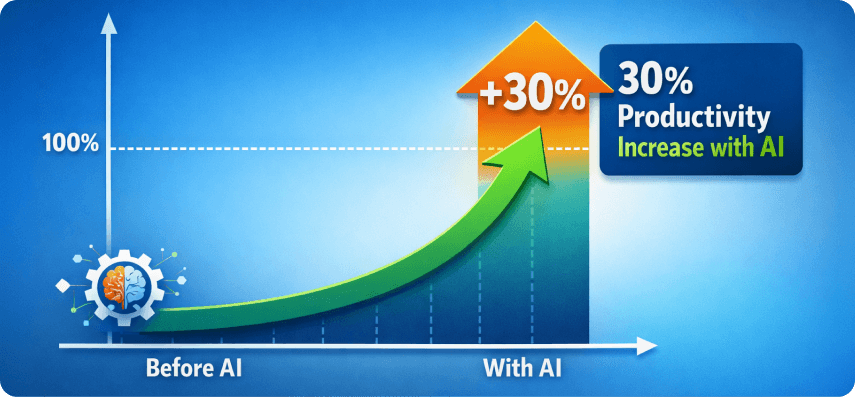
Across sales organizations, AI delivers measurable returns in five areas. But the more interesting story is what each one means at a leadership level, because the operational gains are just the surface and highlight several sales automation benefits.
AI-Powered Lead & Opportunity Scoring
When scoring is driven by data rather than instinct, something organizationally significant happens: territory and resource allocation decisions become defensible. Leaders can justify why certain accounts receive more attention, which reduces internal friction and makes performance reviews considerably more objective using AI lead scoring and prioritization, and predictive analytics for sales teams.
Smart Product & SKU Recommendations
Revenue mix is a strategic concern, not just a sales one. When AI consistently surfaces the right products at the right outlets, it gives category managers and supply chain teams more reliable demand signals, tightening the feedback loop between what's being sold and what gets produced or stocked.
AI-Assisted Call Preparation & Meeting Intelligence
Prepared reps close more, but the broader implication is customer relationship consistency. When institutional knowledge lives in a system rather than individual heads, rep turnover stops being a relationship risk, which matters considerably in enterprise and key account contexts. Many organizations now rely on AI sales enablement software to support this preparation.
Automated CRM Updates & Admin Elimination
Clean, real-time CRM data changes what's possible above the rep level. Forecasting becomes more honest, coaching becomes more specific, and territory planning becomes less dependent on senior intuition and more grounded in actual behavioral patterns.
Predictive Sales Forecasting
Perhaps the most underappreciated benefit here is political. When forecasts are model-driven, pipeline reviews become diagnostic conversations rather than negotiation exercises between reps and managers. This is where predictive analytics for sales teams plays a key role in improving forecasting accuracy.
Many modern copilots and sales assistants are powered by generative models, which is why companies are increasingly investing in AI implementation for sales teams to enhance sales workflows.
AI-Powered Lead & Opportunity Scoring
The Problem
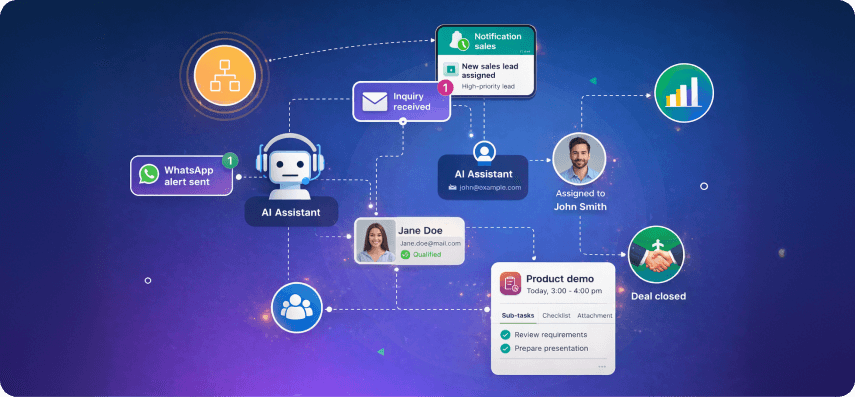
Most sales teams don't have a motivation problem. They have a prioritization problem. Reps pursue leads based on familiarity, recent interactions, or simply whoever called last, and high-value opportunities quietly age in the pipeline. The cost is the result of the compounded effect of misallocated time across an entire team over an entire quarter.
The AI Shift
- Models analyze conversion history, engagement depth, deal size patterns, and buying stage signals simultaneously using predictive analytics for sales teams
- Scores update dynamically as deal behavior changes, not just at pipeline review
- Removes subjective bias from prioritization, making focus a system output rather than a personal judgment call through AI lead scoring and prioritization
Use Case: B2B SaaS
- 28% increase in win rates after AI scoring implementation at a B2B SaaS company
- 22% shorter sales cycles attributed to reps concentrating their effort on sales-ready prospects
- Revenue per rep rose 18%, without any increase in headcount or target adjustment
Smart Product & SKU Recommendations (Field Sales & FMCG)
The Problem
In high-SKU environments, the rep's product knowledge becomes both an asset and a constraint. Most reps naturally gravitate toward familiar, fast-moving items, which means newer products, seasonal opportunities, and complementary SKUs rarely get the shelf presence they deserve. The business pays for that gap in average order value, category performance, and ultimately, distributor relationships that never quite reach their potential.
The AI Shift
- Recommendation engines analyze outlet-level purchase history, regional demand trends, and basket patterns from comparable customers
- Suggestions are contextual and timing-aware, accounting for seasonality and local consumption behavior
- Moves product discovery from rep memory to system intelligence through AI sales enablement software, making coverage consistent across the entire field force
Use Case: FMCG Distributor
- 12% increase in SKUs per bill following AI recommendation deployment across 1,200 outlets
- Average order value grew 9%, driven largely by relevant cross-sell suggestions at the point of sale
- Rep efficiency, measured by revenue per hour, improved 31%
AI-Assisted Call Preparation & Meeting Intelligence
The Problem
Between managing large territories, frequent account rotations, and the sheer volume of interactions logged across different tools, critical information gets scattered. A rep might remember the last order but miss an open support ticket, or recall a conversation but forget the pricing concern raised three months ago. That gap in continuity costs more than individual deals; it gradually dampens trust at the account level.
The AI Shift
- Copilots aggregate CRM notes, email history, past orders, support tickets, and buying patterns into a single pre-meeting briefing using AI sales automation tools
- Surfaces upsell opportunities and outstanding issues that the rep may not have consciously connected
- Ensures institutional account knowledge travels with the role, not with the individual rep
Use Case: Enterprise IT Sales
- 40% reduction in meeting preparation time after AI briefing tools were deployed at an enterprise technology firm
- Upsell rate improved 17%, attributed to reps entering conversations with clearer visibility into account needs
- Follow-up turnaround improved by 25%, as AI-generated summaries eliminated post-meeting note reconstruction entirely
Automated CRM Updates & Admin Elimination
The Problem
Manual CRM entry is one of those tasks everyone agrees is necessary, yet goes unnoticed. Reps delay it, rush it, or skip it entirely, and the data suffers as a result. Every decision built on top of that data, forecasts, coaching conversations, and territory reviews is also affected by it.
The AI Shift
- Automatically transcribes calls and extracts key action items, eliminating post-call manual entry through AI sales automation tools
- Updates opportunity stages, logs meeting notes, and drafts follow-up emails without rep intervention
- Creates a compounding data quality benefit; the longer it runs, the more reliable the CRM becomes as a planning tool
- Frees rep attention for relationship-building rather than administrative reconciliation at day's end, improving AI in sales productivity
Use Case: Mid-Market Sales Team
- Admin time reduced by 35% following AI-driven CRM automation at a mid-market sales team
- CRM data accuracy improved by 50%, strengthening forecast reliability and performance visibility at the leadership level
- Rep engagement increased measurably, with teams reporting higher motivation once routine data entry was removed from their daily workflow
- Cleaner pipeline data also reduced the time spent in weekly review meetings, as managers spent less time questioning data integrity
Predictive Sales Forecasting
The Problem
Most pipeline reviews are essentially negotiation sessions, reps defend their numbers, managers apply judgment-based discounts, and the resulting forecast still misses. The underlying issue is that human forecasting is built on recency bias and relationship dynamics rather than observable deal behavior, which makes it structurally unreliable regardless of how experienced the team is.
The AI Shift
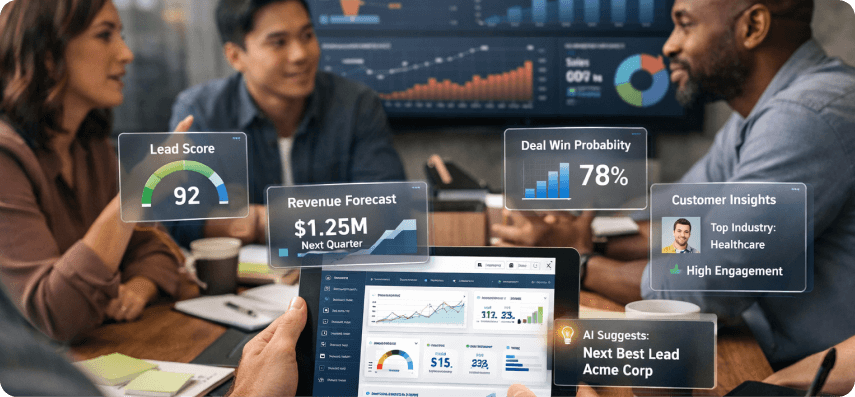
- Analyzes historical closure rates, deal velocity, and engagement patterns to generate probability scores grounded in actual behavioral data using predictive analytics for sales teams
- Detects stalled deals early, flagging risk before it becomes a missed quarter rather than after
- Removes the negotiation dynamic from pipeline reviews, making them diagnostic rather than political
- Continuously recalibrates as deal conditions change, rather than locking in assumptions made at the start of the quarter
Use Case: Manufacturing Distribution
- Regional distributor reported 18% reduction in excess inventory after adopting AI-driven demand forecasting
- Stock availability improved by 14%, directly reducing revenue lost to out-of-stock situations at the outlet level
- Sales grew 11% as a downstream effect of better inventory alignment with actual demand patterns
- Forecast accuracy improvements also gave leadership more confidence in hiring, production, and capital allocation decisions across the business
AI-Powered Route Optimization (Field Teams)
The Problem
In field sales, time spent travelling is time not spent selling. Most route planning still happens manually, with reps deciding visit sequences based on geography, habit, or wherever the day takes them. The result is uneven outlet coverage, missed high-priority visits, and a significant portion of the working day absorbed by avoidable travel inefficiency.
The AI Shift
- Optimizes visit sequencing based on outlet priority, traffic patterns, and historical purchase behavior, simultaneously using AI for sales reps
- Flags missed or overdue visits in real time, ensuring high-value outlets don't fall through the cracks between cycles
- Dynamically adjusts routes as conditions change throughout the day, rather than locking reps into a static plan
- Gives managers visibility into field activity patterns, making territory planning more evidence-based over time
Use Case
- A beverage company implementing AI route optimization reported 22% more outlet visits per rep within the same working hours
- Travel time reduced by 15%, reclaiming hours that were redirected toward actual selling activity
- Revenue uplift of 10% followed, driven by improved outlet coverage and more consistent rep presence at key accounts
- Secondary benefit emerged at the operational level, as visit data fed back into demand forecasting and distribution planning decisions
AI Coaching & Performance Analytics
The Problem
Most sales coaching happens retrospectively, after a deal is lost or a quarter underperforms. By that point, the feedback is accurate but poorly timed. Reps can't connect general observations to the specific moments where different decisions would have changed the outcome.
The AI Shift
- Analyzes call transcripts and pitch patterns to identify where conversations stall or objections go unaddressed
- Generates personalized coaching recommendations based on individual behavior, not generic frameworks
- Benchmark reps against top performers within the same team, surfacing specific gaps rather than broad skill categories
- Gives managers an evidence-based foundation for coaching conversations, reducing subjectivity on both sides
Use Case
- New rep ramp-up times improved significantly, with performance gaps identified and addressed within weeks rather than quarters
- Managers spent less time preparing for reviews as AI-generated behavioral summaries replaced manual observation
- Win rates improved as reps received timely feedback on objection handling patterns, enabling mid-cycle correction rather than post-mortem reflection
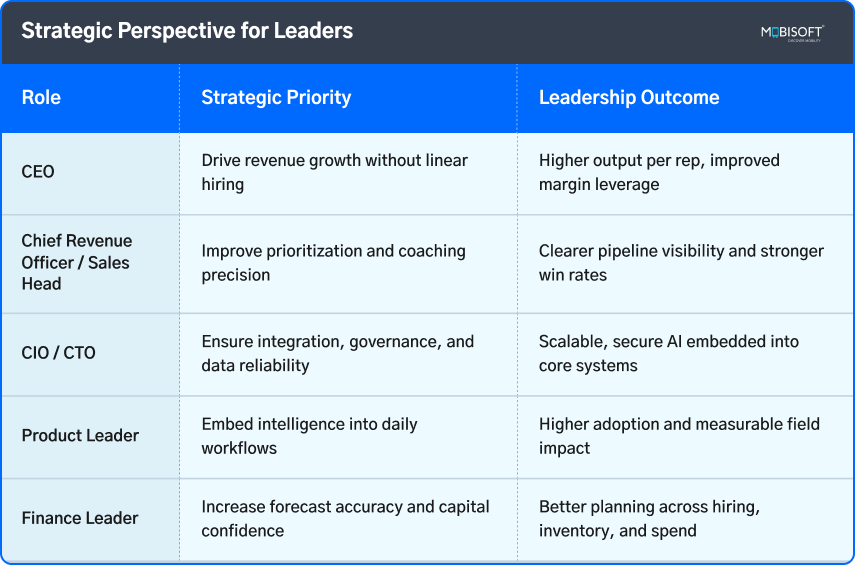
Organizations exploring advanced automation in enterprise operations are increasingly adopting Voice AI for enterprise workflows to streamline communication, documentation, and productivity across teams.
The Technical Architecture Behind AI Sales Productivity
The technology alone doesn't produce 30 percent productivity gains. The infrastructure underneath it does, especially when organizations implement systems designed for AI in sales productivity.
External Persistent Memory
- Data Aggregation: Most organizations discover their data lives in more places than anyone realized, and the aggregation process itself surfaces gaps in how customer interactions have been recorded historically.
- Data Normalization: Inconsistent formats don't just create technical problems; they introduce systematic bias into model outputs that's difficult to diagnose once the system is running.
- Feature Engineering: Choosing the wrong predictive variables is more dangerous than having no model, because it produces confident but misleading recommendations.
- Model Training: A model trained on last year's conditions needs regular retraining. Sales environments change faster than most teams account for during initial deployment planning.
- Real-Time Inference: Batch processing recommendations overnight defeats the purpose entirely in field sales contexts where decisions happen in the moment.
- Workflow Integration: Recommendations embedded inside familiar tools used by AI for sales reps get used. Standalone dashboards get ignored.
- Continuous Feedback Loop: Without closing the loop between recommendation and outcome, the model gradually optimizes for the wrong signals.
Building these systems often requires scalable platforms and integrations supported through Custom AI software development tailored to enterprise environments.
Why 30% Is Realistic - But Not Automatic?
Getting AI to work inside a sales organization is an organizational readiness problem. The companies reporting 30 percent productivity implement clean data pipelines, reps who trust the system, and leadership willing to measure outcomes differently while deploying modern AI sales automation tools.
Data quality is where most implementations struggle. Models trained on incomplete or inconsistent CRM records don't produce bad recommendations; obviously, they produce subtly wrong ones, which are harder to catch and correct. Rep adoption is equally consequential. AI recommendations that sit outside daily workflow get ignored, and ignored recommendations generate no feedback data, which means the model stops improving precisely where it needs to most.
There's also a less discussed dynamic worth acknowledging. AI tends to surface uncomfortable truths about pipeline health, territory coverage, and rep performance that manual processes allowed to stay hidden. Organizations that respond to that visibility with curiosity tend to improve. Those who respond defensively rarely see the returns they expected.
Organizations planning structured AI adoption can benefit from a defined approach through AI strategy consulting that aligns AI initiatives with measurable business outcomes.
Risks & Misconception
AI Replacing Sales Reps
The more productive question for leadership is how quickly the performance gap widens between AI-assisted teams and those still operating manually. Organizations delaying adoption aren't protecting jobs; they're ceding competitive ground one quarter at a time. This shift highlights how AI in sales productivity is reshaping competitive advantage.
Over-Automation Reducing Human Touch
Automating administrative work genuinely frees rep capacity for relationships. Automating the relationships themselves is where organizations lose accounts. The distinction sounds obvious until you see teams deploy AI-generated outreach at scale and wonder why engagement rates are falling.
Bias in Predictive Scoring
Models learn from historical data, which means they also inherit historical blind spots. Accounts that were underserved or deprioritized in the past will score poorly in the future unless someone deliberately examines what the training data is actually rewarding, particularly when using AI lead scoring and prioritization systems.
Poor Data Quality
Deploying AI on inconsistent CRM data doesn't produce obviously wrong recommendations; it produces confidently wrong ones, which are considerably harder to catch and correct mid-cycle.
Lack of Transparency
Reps who don't understand why a recommendation was made either follow it without judgment or dismiss it without consideration. Neither behavior extracts real value from the system, and both are largely avoidable with better implementation design.
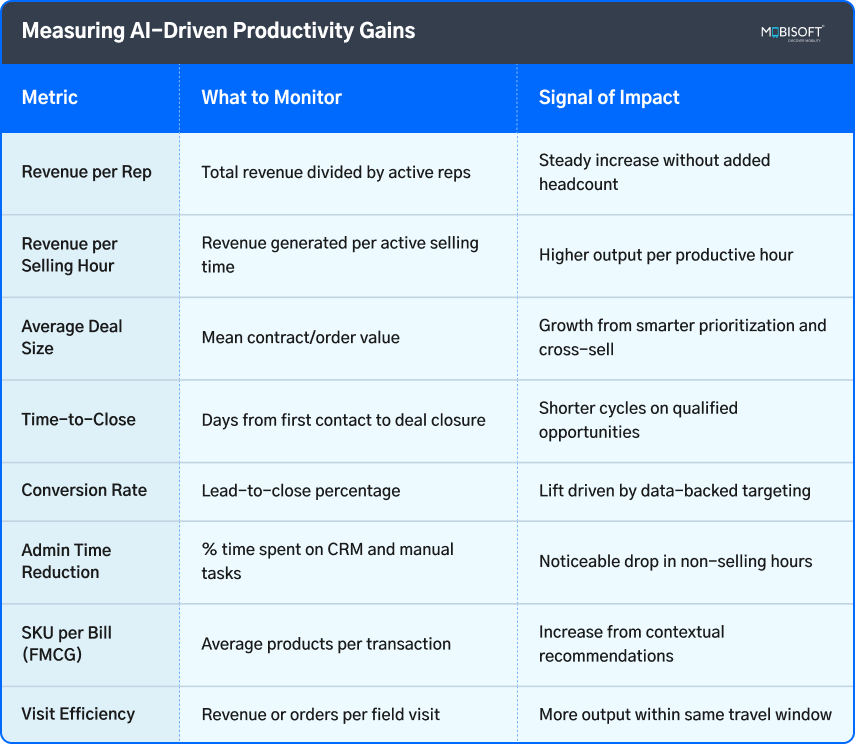
If AI is working, revenue/hour increases measurably, reflecting the broader artificial intelligence sales productivity boost organizations aim to achieve. Understanding how modern AI systems are architected for real-world deployment can provide deeper insight into scaling productivity initiatives, as explained in this guide on Claude AI architecture for productivity.
Building a Sales Organization That Learns
The organizations pulling ahead in sales productivity aren't necessarily hiring better reps or running harder. They're operating with better information, earlier in the process, consistently across the team. AI makes that possible at a scale that training programs and sales methodologies never quite achieved through modern AI sales enablement software.
What's worth internalizing is the compounding nature of it. Better data quality today produces sharper model outputs next quarter. More accurate forecasting this year informs smarter territory and hiring decisions next year. The organizations that move early don't just gain a productivity advantage; they build a structural one that widens over time.
For leadership, the decision is less about whether AI belongs in sales and more about how much ground is acceptable to concede while deliberating. The teams already using it aren't waiting for the perfect implementation. They're learning, iterating, and pulling further ahead with every cycle. The rise of autonomous tools is also accelerating automation in sales operations, which is why many teams are exploring AI agent SDKs for automation.
Key Takeaways
- Less than 40% of a rep's day is spent selling, and that's the number AI in sales productivity directly improves.
- Lead scoring removes prioritization bias, not just inefficiency, through AI lead scoring and prioritization.
- SKU recommendation engines expand what reps consider worth offering, not just what they remember to offer.
- CRM automation compounds over time; cleaner data today means sharper model outputs next quarter.
- Forecast accuracy improvements reduce political tension in pipeline reviews as much as they reduce inventory misalignment.
- Route optimization reclaims field hours that translate directly into outlet coverage and revenue.
- AI coaching identifies behavioral gaps at the rep level, making performance conversations evidence-based rather than opinion-based.
- Poor data quality produces confidently wrong recommendations, which are harder to catch than obviously wrong ones.
- Organizations building AI into workflows now are accumulating a structural advantage that widens every quarter.
- Adoption fails at the interface level more often than at the technology level.

Frequently Asked Questions
Should smaller sales teams bother with AI, or is this primarily an enterprise investment?
Smaller teams arguably benefit more, since every hour recovered from admin work represents a larger percentage of total capacity. The key consideration is data volume. Teams with fewer than 12 to 18 months of clean CRM history may need to build that foundation before AI recommendations become reliably useful.
Does AI performance vary significantly across industries?
Considerably. High-SKU, high-frequency environments like FMCG and distribution see faster returns because transaction volume gives models more to learn from. Complex B2B sales with longer cycles require more patience, but the forecasting and coaching applications tend to deliver disproportionate value once the model is properly trained.
What happens to AI effectiveness when sales teams experience high rep turnover?
Interestingly, it improves resilience rather than suffering from it. Institutional account knowledge that previously walked out the door with departing reps gets retained in the system. Onboarding new reps also accelerates because AI-generated briefings and scoring provide immediate context that would otherwise take months to develop organically.
Can AI recommendations create unhealthy dependencies where reps stop developing independent judgment?
It's a legitimate concern worth managing deliberately. Organizations that use AI outputs as conversation starters rather than directives tend to develop stronger reps over time. Those who treat every recommendation as instruction risk narrowing rep judgment precisely when situations arise that fall outside what the model has encountered before.
How should sales leaders handle rep resistance during initial AI deployment?
Resistance usually stems from two sources: fear of performance visibility and skepticism about recommendation quality. Addressing the first requires cultural groundwork around how data will be used in reviews. The second resolves itself faster than most leaders expect, once reps experience a well-timed recommendation, closing a deal they might have otherwise missed.

Nitin Lahoti
Read more
Nitin Lahoti is the Co-Founder and Director at Mobisoft Infotech. He has 15 years of experience in Design, Business Development and Startups. His expertise is in Product Ideation, UX/UI design, Startup consulting and mentoring. He prefers business readings and loves traveling.
 Nitin Lahoti
 March 6, 2026