During peak egress at a large-scale event, a manual dispatcher manages approximately 30-50 active decisions per hour. Vehicle positions, driver confirmations, zone congestion, route changes, attendee surges, etc., are handled by one person, one radio under Manual transportation management. This mental map loses accuracy over time under increasing pressure.
Most ops teams have built reliable systems around experienced dispatchers. For years, that's been enough. But fleet size grows, events get more complex, and the tolerance for transport failure at the VIP and sponsor tier gets thinner. At some point, the system that worked stops working, and the gap rarely announces itself clearly.
That's the operational reality this blog addresses. It answers whether your specific setup, fleet size, event frequency, and risk exposure have moved past what manual coordination can reliably handle, or require Event transportation software.
The two tools here are:
- A decision framework built on three operational axes
- And a migration checklist structured around four deployment phases.
Both are designed for dispatch coordinators and ops leads who need to make this call with clear criteria, not instinct alone. If you're already assessing whether manual coordination is reaching its limits, exploring a purpose-built event transportation software can clarify what operational control actually looks like at scale.
Why Manual Dispatch Still Exists at Scale?
Calling the manual dispatch outdated would be inaccurate. For a large portion of event ops teams, it has delivered consistent results across hundreds of events. But the reasons manual dispatch persists at scale are operational.
Experienced dispatchers carry a specific kind of knowledge that's difficult to document. They know which zones back up first at a particular venue. They know which drivers handle high-pressure surges well and which ones need clearer instructions. They've built working relationships with venue security, parking coordinators, and ground crews over multiple event cycles. That accumulated knowledge has real operational value, and no platform replaces it on day one.
Beyond individual expertise, the tools of manual dispatch, radio, walkie-talkie, and direct phone coordination became deeply embedded in event ops culture for a practical reason. They work in low-connectivity environments without the need to onboard. And when something goes wrong, the dispatcher can escalate immediately without navigating through transportation management systems software.
There are also legitimate financial considerations that keep teams on manual systems:
- Mid-tier event operations often run on tight margins, and the upfront cost of Event transportation software is hard to justify without a clear ROI timeline
- Procurement cycles at larger organisations can delay platform decisions by 12 to 18 months, even when the operational case is clear
- The fear of a system failure on a live event day carries real weight, particularly for teams without an internal tech function to manage troubleshooting
Perhaps the most persistent reason is the "if it isn't broken" logic. For operations running fewer than 20 vehicles across two or three events a year, that logic often holds. Manual dispatch at that scale is genuinely manageable, especially in smaller setups where employee transport software is not yet required.
The problem is that event operations rarely stay that size because fleets grow, and attendee numbers increase. Stakeholder expectations at the VIP and sponsor tiers become more demanding. So the manual system that worked reliably at one scale starts accumulating small failures at the next, missed pickups absorbed into general confusion, scheduling conflicts traced back to a miscommunication nobody logged, delays that get blamed on traffic rather than dispatch sequencing.
That's where the audit needs to start, often leading teams toward Event transport solutions.
Where Manual Dispatch Breaks Under Event Conditions
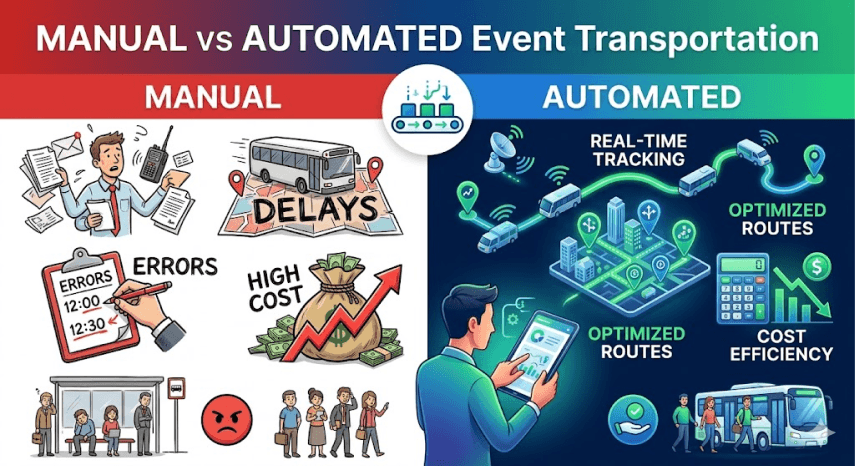
Manual dispatch was designed for manageable complexity, reasonable time windows, and a communication chain that could absorb a few delays without spiraling. Large-scale events offer none of those conditions. The failure modes below aren't edge cases. Dispatch coordinators who've run high-attendance events will recognise most of them.
The Departure Surge Problem
When a session ends early or runs 20 minutes over schedule, the attendee flow to pickup zones changes immediately. Manual dispatch cannot resequence 40-plus vehicles in real time based on that change. The dispatcher is working from a pre-set staging plan, and adjusting it mid-event means pulling drivers off the radio, recalculating zone priorities mentally, and hoping the updated instructions land before the queue builds.
In practice, they rarely do. The surge hits before the resequencing completes, and the queue dwell time climbs while the dispatcher works through the backlog of calls. It exposes the limits of Manual transportation management compared to Automated transportation management.
Communication Lag at Critical Moments
Road closures, filled lots, and blocked entry points don't wait for a convenient moment. When conditions change on the ground, the information has to travel from the driver to the dispatcher by radio or phone, get processed, and then travel back out to other drivers as updated instructions. That chain takes time, and in a compressed egress window, even a two-minute lag has downstream consequences across multiple zones simultaneously, especially without Transportation planning software.
The Single Point of Failure
One experienced dispatcher, one radio, one whiteboard. If that dispatcher is managing a driver escalation in Zone 3, Zone 6 doesn't get updated. If they're unavailable for any reason, whether that's a medical issue, a radio failure, or simply being pulled into a venue coordination issue, the entire dispatch operation loses its nerve centre with no documented fallback, unlike Automated transportation management.
Most manual operations don't have a deputy dispatcher with equivalent tacit knowledge standing by. That's not a staffing criticism, but a structural vulnerability.
Scheduling Conflicts and Cross-Referencing Errors
Manual dispatch requires coordinators to cross-reference driver availability, vehicle capacity, and zone assignments in real time, often across spreadsheets, printed schedules, and radio communication simultaneously. The error rate under those conditions is higher than most teams acknowledge. Misassignments happen, and vehicles get double-staged. A driver confirmed for a VIP run turns out to have been reassigned 40 minutes earlier, and nobody updated the board. These are failures in system design for Manual transportation management.
No Data Capture During the Event
The most consequential gap in manual dispatch is decision points, route changes, timing deviations, and driver communications. None of these gets logged in a retrievable format during a live event. Post-event debriefs become reconstructions based on memory and impression rather than structured data review, which is where Event transportation software becomes relevant.
This means the same sequencing errors, the same zone bottlenecks, the same communication gaps, can repeat across multiple events without ever being formally identified as systemic. Teams improve slowly because the raw material for improvement simply doesn't exist.
The Invisibility of Manual Errors
Related to data capture, but worth addressing separately: manual errors rarely produce a clear paper trail. A missed pickup gets absorbed into general transport confusion. A wrong drop-off zone gets corrected informally by a driver who figures it out on the ground. A scheduling conflict that caused a 15-minute delay gets attributed to traffic in the post-event notes.
Research using the NASA Task Load Index methodology confirms what experienced dispatchers already know intuitively. Dispatcher decision accuracy degrades meaningfully under sustained high-load conditions. Cognitive overload during peak egress is a documented performance characteristic of high-demand coordination roles. The issue isn't the dispatcher. The issue is asking a manual system to absorb a volume and velocity of decisions it was never configured to handle.
That's the operational case for taking automation seriously. The next question is whether your specific operation actually needs it.
The Decision Framework: When to Automate
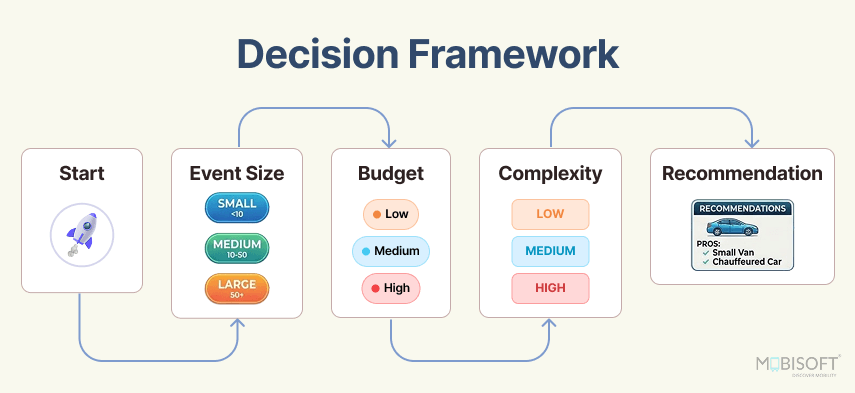
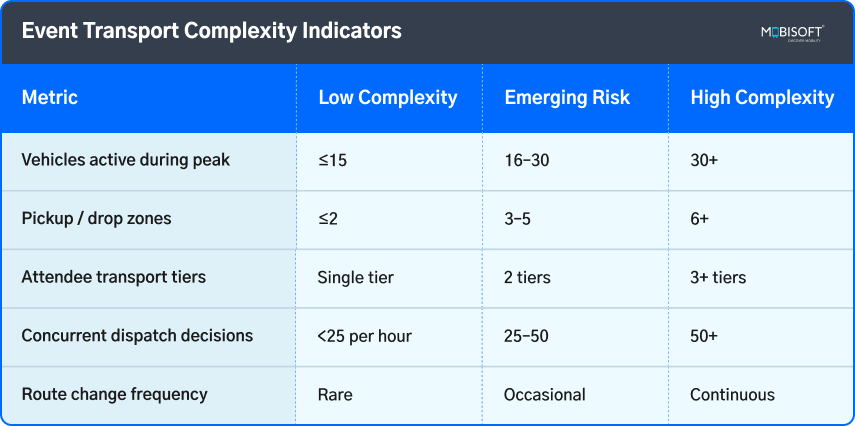
Not every operation needs full automation, and not every team is ready for it. This framework provides dispatch coordinators and ops leads with a structured way to assess their readiness across three operational axes, particularly when evaluating Event transport solutions. Score each axis honestly, and the combination tells you where your operation actually stands.
Axis 1: Operational Complexity
Fleet size is the most reliable starting indicator. Dispatch literature consistently points to 20 vehicles as the threshold where manual coordination starts accumulating meaningful risk. Beyond that, the number of simultaneous decisions per hour exceeds what a single dispatcher can reliably manage without Transportation planning software, making software for fleet management critical at scale.
Ask yourself:
- How many vehicles are you running at peak?
- How many simultaneous pickup and drop-off zones are active during egress?
- Do you segment attendee tiers, VIP lanes, general shuttles, and staff vehicles, each with different routing logic?
- How frequently do routes need adjustment during a typical event day?
The higher the complexity across these four points, the less margin manual dispatch actually has.
Attendee tier segmentation deserves particular attention here. When a single dispatcher is simultaneously managing VIP vehicle assignments, general shuttle sequencing, and staff transport routing, the cognitive load isn't additive. Each tier operates on different timing logic, different communication protocols, and different consequence levels when something goes wrong. A general shuttle running eight minutes late is an inconvenience. The same delay in a keynote speaker transfer is an incident. Manual dispatch treats both with the same tool set, which means the higher-stakes tier is always operating with less protection than it actually requires.
Axis 2: Event Frequency and Planning Cycle
A one-off event and a recurring event calendar carry very different operational costs. Teams running six or more events per year absorb the inefficiencies of manual dispatch repeatedly, and those inefficiencies compound. Every event where route data, capacity logs, and timing records aren't stored is an event that contributes nothing to the next one.
Consider:
- Are you running a recurring calendar or isolated events?
- Does your transport data carry forward between events, or does planning reset each time?
- How many hours does your team spend rebuilding dispatch plans from scratch per event cycle?
Organisations with recurring calendars have the most to gain from automation, because the planning efficiency compounds in the same way the manual inefficiency currently does, similar to an employee transport management solution.often through Event logistics automation.
There's also a planning hours calculation worth running. Research on event fleet coordination suggests that automated systems reduce per-event planning time by 30 to 40 percent when historical route and capacity data are stored and reusable. For a team running ten events annually, that's a meaningful recovery of coordinator time, time that currently goes into rebuilding what should already be documented. The first event in an automated system requires the most configuration effort. By the third or fourth event on the same platform, the setup time drops considerably, and the decisions being made are refinements rather than reconstructions.
Axis 3: Risk Tolerance and Consequence Tier
This axis is about what a single transport failure actually costs at your event. General shuttle delays are recoverable. A missed VIP pickup, a late keynote speaker transfer, or a broadcast crew that doesn't reach the production zone on time carries consequences that extend well beyond the event day itself. Many organizations use chauffeur booking software to coordinate executive and VIP transportation with greater visibility and control.
Evaluate your exposure:
- Does your event carry contractual transport obligations for specific attendee tiers?
- What is the reputational and financial cost of one high-visibility transport failure?
- Do you have a documented fallback if your lead dispatcher is unavailable on event day?
The higher your consequence tier, the lower your actual tolerance for the variability that manual dispatch carries.
Corporate and sponsored events add another layer to this calculation. When transport is part of a formal attendee experience package, or when sponsors have visibility into how their guests are being handled, a single coordination failure becomes a relationship issue, not just a logistics issue. Ops teams at this tier are often managing transport against a standard their manual systems weren't originally configured to meet. That gap tends to stay invisible until an event where it suddenly isn't.
For teams formalizing their evaluation process, a detailed transportation management system guide can help align operational needs with the right level of automation.
Reading Your Score
Assess each axis as low, medium, or high based on the criteria above. The table below maps the combinations to a recommended operational approach.
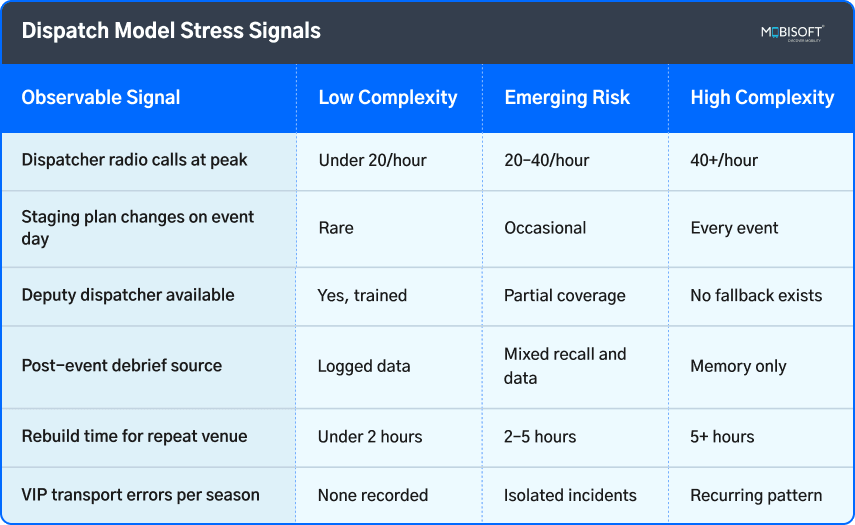
Three broad outcomes emerge from this assessment:
- Manual is viable: Low complexity, low frequency, low consequence tier. Manual dispatch with process documentation is a reasonable position.
- Hybrid is recommended: Any medium score on two or more axes. Automation handles scheduling, tracking, and resequencing while dispatchers manage exceptions and escalations using Transportation scheduling tools.
- Full automation is overdue: High scores across two or more axes, particularly where the consequence tier is high. The operational risk of staying manual is measurable and recurring, making Automated transportation management a necessary shift.
Most teams reading this framework will land in the hybrid category. That's where the next section focuses.
Hybrid Operations: The Middle Path
For most event ops teams, the choice between full manual and full automation is a false binary. Full manual becomes increasingly unreliable as operational complexity grows. Full automation, deployed without adequate preparation time or dispatcher buy-in, carries its own failure risk. The hybrid model is where most teams should realistically start, often supported by Event transportation software.
A functional hybrid divides responsibility along a clear boundary. Automated Event transportation software handles the high-volume, time-sensitive tasks that benefit most from real-time data processing. Dispatchers retain ownership of the judgment-dependent tasks that software can't fully resolve.
In practice, that division looks like this:
Automation handles:
- Vehicle assignment and zone sequencing based on live attendee flow data
- Real-time ETA tracking across all active routes
- Attendance surge alerts when pickup zone demand exceeds staged capacity, where Booking Software for Shuttle Operators helps manage demand efficiently.
- Route optimisation as ground conditions change during the event
Dispatchers own:
- Exception management when automated assignments need human override
- Driver escalations that require context the system doesn't have
- VIP and sponsor transport coordination, where relationships and discretion matter
- Last-mile judgment calls that fall outside pre-configured parameters
This division isn't just operationally sensible. It's also the fastest way to build dispatcher confidence in the system. When coordinators see automation absorbing the high-volume scheduling load accurately, their willingness to trust the platform on more complex decisions grows incrementally.
You can check out our extensive blog on essential factors to consider when choosing an event transportation solution. It will give an accurate idea of the customised hybrid approach right for your business.
Defining the Human-Machine Boundary
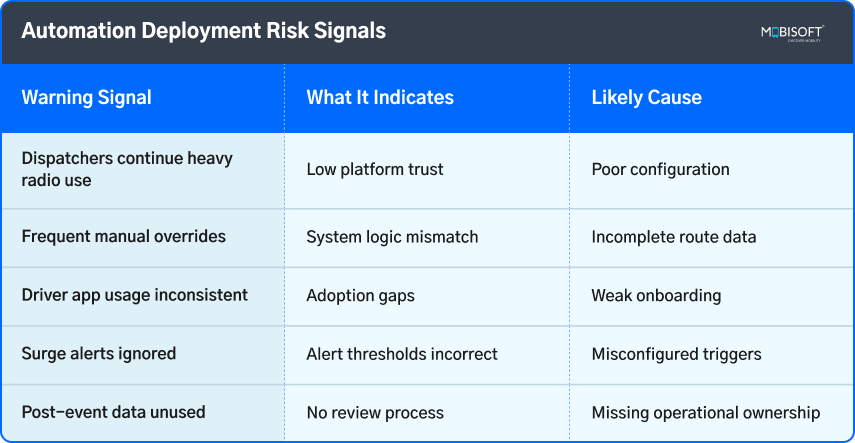
The most common reason hybrid operations underdeliver is a poorly defined boundary between what the system decides and what the dispatcher decides. If that boundary is not defined before go-live, dispatchers fall back to parallel manual processes alongside the system, duplicating work and nullifying the automation.
Before any hybrid deployment, ops leads need to answer three questions clearly:
- At what point does the system escalate to the dispatcher, and through what mechanism?
- Which vehicle categories and attendee tiers remain under direct dispatcher control?
- What's the override protocol when a dispatcher disagrees with an automated assignment?
These aren't edge case scenarios. They're the operational conditions that will occur at every event, and having documented answers before the event starts is what separates a functional hybrid from a chaotic one.
The Dispatcher Role After Automation
Without system visibility, dispatch decisions are made sequentially rather than systemically. Coordinators respond to individual vehicle events one at a time, so operations are always slightly behind the ground reality. This delay increases with fleet size, because every new vehicle adds another decision stream that must be monitored manually.
In a hybrid model, the same coordinator monitors a live dashboard with full zone visibility and escalates exceptions rather than routine assignments. It logs decisions in real time rather than reconstructing them from memory post-event. The cognitive load during peak periods drops considerably, and the decisions that do require human judgment get more attention. This is because they're not competing with 40 routine tasks simultaneously.
When driver communication moves through into structured app channels of the Shuttle Management Software, dispatch coordination becomes asynchronous rather than interrupt-driven. Drivers receive instructions without waiting for radio clearance, and dispatchers can prioritize true operational anomalies instead of responding to routine status confirmations, similar to an Employee Shuttle Management Solution.
The hybrid model doesn't reduce the dispatcher's importance. It redirects it toward the work that actually requires human judgment.
Automation Capabilities That Matter for Events
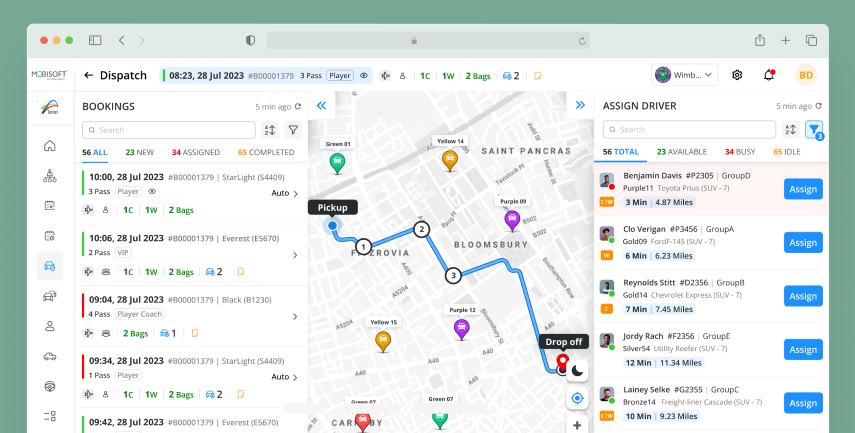
Generic fleet management software and event-specific dispatch automation are not in the same category of tools. A platform built for logistics routing or delivery fleet management carries assumptions about time windows, predictability, and volume distribution that don't apply to event conditions. When ops leads evaluate an event transportation software, the capability set needs to be assessed against event-specific operational demands, not general fleet benchmarks.
These are the capabilities that actually move the needle.
Real-Time GPS With Zone-Level Precision
City-level tracking tells a dispatcher that a vehicle is somewhere in the general vicinity of a venue. That's operationally useless during a peak egress window. Zone-level GPS precision, knowing exactly which pickup zone a vehicle is staged in, whether it's moving toward or away from a congestion point, and what its realistic ETA is given current ground conditions, is the baseline capability any event dispatch platform needs to offer.
Without it, the dispatcher is still making positional decisions based on radio confirmations, which reintroduces exactly the communication lag that automation is supposed to eliminate, limiting Transportation workflow optimization.
Dynamic Resequencing Mid-Event
Static route plans don't survive contact with a live event. Sessions run over, lots fill unexpectedly, and road access changes. Vehicles should be reassigned mid-route based on updated conditions, and the drivers should instantly be updated through the on demand transportation management system. This separates useful automation from a sophisticated scheduling tool that becomes irrelevant as the conditions deviate from the plan, even when using standard Transportation scheduling tools.
Dynamic resequencing also reduces the burden on dispatchers to manually recalculate zone priorities during surges, which is precisely when their attention is already stretched across multiple pressure points simultaneously.
Attendee Volume Integration
The most capable event dispatch platforms connect transport assignment logic directly to live attendance data or session schedules. When a session ends early, the system registers the attendee flow change. It adjusts vehicle staging before the queue builds. When registration data indicates a higher VIP attendance than planned, the platform flags the capacity gap in advance rather than surfacing it as a problem on event day.
This kind of integration requires clean data pipelines between the event management system and the dispatch platform, which is worth confirming during vendor evaluation, particularly for Event logistics automation, not after deployment.
Multi-Zone Dashboard Visibility
Dispatchers managing large-scale events need simultaneous visibility across parking zones, shuttle routes, and VIP lanes from a single interface. Toggling between separate views or cross-referencing multiple screens during peak egress adds cognitive load at exactly the wrong moment. event shuttle management platform features a multi-zone dashboard that gives the right information at the right time, with alert logic that escalates anomalies rather than requiring the dispatcher to actively scan for them, which is critical for Event shuttle management.
In-App Driver Communication
Replacing radio and phone coordination with structured in-app messaging reduces dispatcher call volume by 40 to 60 percent during high-load windows. This is based on dispatch research across large-scale event operations. Beyond the volume reduction, in-app communication creates a logged record of driver instructions and confirmations that radio simply doesn't produce. That record becomes valuable during post-event debrief and even more so when in the next event with the same routes, supporting Fleet management for events.
Post-Event Data Export and Offline Capability
Clean, structured post-event data export is what makes each event operationally useful to the next one. Timing logs, route deviations, zone dwell times, and driver response rates make post-event debrief an effective planning tool.
Equally important, particularly for venues with inconsistent connectivity, is whether the driver app functions offline. A platform that loses functionality in a low-signal environment introduces a new single point of failure in exactly the conditions where reliability matters most, reinforcing the need for reliable Event transport solutions.
As these capabilities expand across larger fleets and multi-zone operations, adopting robust fleet management software becomes critical to maintain real-time visibility and coordination.
The Migration Checklist
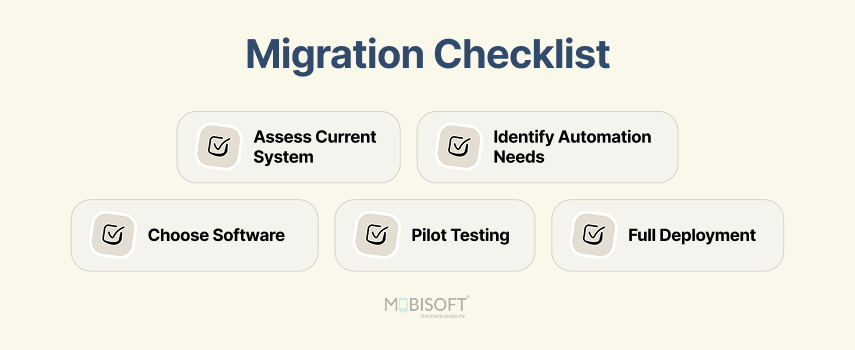
Moving from manual to automated event transport isn't a single decision. It's a sequenced operational process, and the teams that get it wrong almost always do so because they skipped a phase or compressed the timeline under event pressure. The checklist below is structured around four deployment phases. Each phase has a specific purpose, and the order matters when shifting toward automated transportation management.
Phase 1: Assess Your Current State
Before configuring any platform, the current dispatch operation needs to be documented with precision, especially if you're transitioning from manual transportation management. Without a documented baseline, there's no reliable way to measure what the platform is actually improving. You need to structurally identify configuration adjustments after the first live deployment.
Work through the following:
- Map every decision point in your current dispatch process. How many active decisions is your lead dispatcher making per hour during peak egress? What triggers each decision, and what information are they using to make it?
- Audit your fleet, including vehicle types, seating capacity, current zone assignments, typical routing patterns, and which vehicles are allocated to which attendee tiers.
- Identify which parts of your current operation collapse if one person is unavailable, one radio fails, or one lot closes unexpectedly?
- Capture dispatcher experience before system migration. Which zones back up first at which venues, which routes have recurring access issues, and which driver and venue relationships require particular handling?
- Establish baseline KPIs. On-time departure rate, average queue dwell time, driver contact frequency per hour, and post-event debrief quality.
Phase 2: Configure Before You Commit
Platform configuration is where most migrations either build a solid foundation or create problems that surface later at the worst possible moment. A generic out-of-the-box configuration is rarely adequate for event-specific transport topology, which is why choosing the right event transportation software is critical. Which is why every venue, every event format, and every attendee tier structure requires specialised TMS implementation services.
The configuration checklist:
- Map your event's full transport topology into the platform. Every zone, every route, every pickup and drop-off point. The precision here will determine the system's reliability on event day.
- Set up zone hierarchies, vehicle categories, and attendee tier logic. VIP assignments, general shuttle sequencing, and staff vehicle routing need separate configuration with clear priority logic when the same resource is allocated.
- Configure alert thresholds. At what queue depth does the system escalate to the dispatcher? What triggers a surge alert? These thresholds need to reflect your specific event conditions.
- Run a full simulation using historical event data or modelled attendee flows. It will surface configuration gaps before they become live event problems.
- Assign dispatcher roles within the system explicitly. Who owns exception management? Who monitors VIP transport? Who has override authority? This prevents the ambiguity that creates parallel manual processes in live events.
Phase 3: Trial on a Lower-Stakes Event
No matter how thorough the configuration process, the first live deployment will surface gaps that simulation didn't catch. Running that first deployment at a smaller or mid-scale event is an important risk management decision when implementing event transport solutions.
For the trial event:
- Run manual and automated in parallel for the first half of the event. It's the most reliable way to identify where the system's decisions diverge from what an experienced dispatcher does, and why.
- Log every instance where the dispatcher overrides or supplements the system. Some will reflect configuration gaps, and others will reflect dispatcher habits that need recalibration. Both data points are worth understanding.
- Identify what the system missed that dispatchers caught. Zone-specific conditions, driver behaviour patterns, venue access quirks. These are the inputs that need to be fed back into the configuration before the next event.
- Debrief with the full dispatch team within 48 hours. A structured review while the event is recent produces far more actionable reconfiguration notes than one conducted a week later.
Phase 4: Full Deployment Readiness
Full deployment readiness is a confirmed operational state across several interdependent variables. Moving to full deployment before these are confirmed introduces avoidable risk.
Before going live at a flagship event:
- Confirm driver app adoption rate. Any driver arriving without the app active becomes a manual coordination point that reintroduces communication lag. Target full activation before event day.
- Establish the exception escalation protocol for the dispatcher. How does the system flag exceptions? What's the expected response time? Who is the secondary escalation contact if the primary dispatcher is managing another issue?
- Confirm connectivity across all venue zones. Test every zone in advance, and confirm offline app functionality for the zones where connectivity is unreliable.
- Assign a dedicated system monitor role, separate from the primary dispatcher. The dispatcher manages event-day transport operations. The system monitor watches platform performance, flags technical anomalies, and handles escalations that are platform-related rather than operationally-related.
For companies, especially, set post-event data review as a standing agenda item to continuously optimize events with the employee transportation software.
What Dispatchers Gain, Not Just What They Hand Over
Automation in dispatch operations is framed as a reduction. With fewer responsibilities, decisions, and less control. That framing misses what happens to the dispatcher role when a well-configured system absorbs the high-volume coordination load through event logistics automation. It starts operating at a higher level.
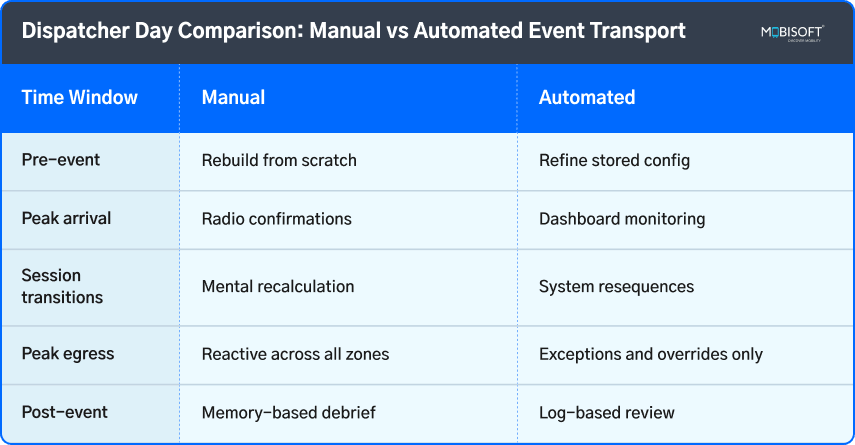
The difference is visible in how a dispatcher spends their attention during peak egress. In a manual operation, that window is almost entirely reactive:
- Individual radio calls consume attention continuously
- Vehicle positions are tracked mentally, with accuracy degrading as volume increases
- Issues surfacing without warning, requiring immediate response with limited zone visibility
- Cognitive load builds steadily from the moment doors open
In an automated operation, the same dispatcher is monitoring a live dashboard with full zone visibility. The routine assignment decisions are handled, and surge alerts surface before queues build. So the only requirement from the dispatcher is judgment:
- Exception management when automated assignments need a human override
- Driver escalations that carry context the system doesn't have
- VIP coordination, where discretion and relationship matter
- Situational calls that fall outside pre-configured parameters
That's a meaningful change in how the role operates day to day.
The Cognitive Load Difference
Dispatch preparation in manual systems resets with each event. Routing assumptions, vehicle staging plans, and zone capacities must be rebuilt because prior decisions were never captured as structured data. Over time, this produces a planning cycle where experience accumulates, but operational knowledge does not.
When historical route data, capacity logs, and zone configurations are stored in the platform, the rebuild time drops substantially. Pre-event focus moves from reconstruction to refinement.
Review what worked at the last comparable event, adjusting for venue-specific variables, and anticipating exception scenarios based on the attendee profile and session schedule. That reallocation of planning time produces better-prepared dispatchers, having thought through contingencies on the event day.
Credibility Through Data
There's a professional dimension worth addressing directly. Dispatchers who operate within automated systems build a documented record of their decisions and the outcomes those decisions produced. When a coordinator makes a manual override call during a live event, that decision is logged with context. When a VIP transfer runs on schedule despite a last-minute route change, the data reflects it.
Over time, that record becomes a credibility asset. Performance reviews, budget conversations, and post-event stakeholder reports all become more straightforward when the evidence is structured and retrievable rather than anecdotal.
The dispatcher who understands automation as a capability upgrade rather than a replacement threat is also the one most likely to configure it well, advocate for it internally, and get the most out of it operationally.
Common Migration Mistakes to Avoid
Most event transport migrations that underdeliver fail because the implementation process skipped some crucial steps. These are the mistakes ops teams make repeatedly when adopting event transport solutions, and they're worth addressing before you encounter them.
Deploying Without Dispatcher Buy-In
A platform that dispatchers don't trust gets bypassed. Coordinators run parallel manual processes alongside the automated system, even after introducing event logistics automation. They cross-check every assignment, making radio calls that the platform was supposed to handle. The automation is technically live, but operationally irrelevant.
Buy-in isn't achieved through a single briefing session. It comes from involving dispatch coordinators in the configuration process, running the trial event with their active input. You need to treat their override decisions as diagnostic data rather than resistance.
Migrating Without a Documented Baseline
Without a recorded picture of how the current operation performs, there's no reliable way to measure what the platform is actually improving. On-time rates, queue dwell times, and dispatcher call volume need to be captured before migration, not estimated afterward. Teams that skip this step often find themselves six months into an automated operation, unable to demonstrate meaningful improvement from their automated transportation management investment.
Skipping the Trial Event
Going live at a flagship event without a lower-stakes trial run is the single highest-risk decision in the migration process. Configuration gaps that the simulation didn't catch will surface under live conditions. The question is whether they surface at an event where the consequences are manageable or not, especially when deploying new event transportation software.
Configuring Generic Routes
Event transport topology is specific. A platform configured with approximate zones, estimated route times, and generic vehicle categories will produce assignments that experienced dispatchers can immediately flag. This gap between system recommendations and coordinator knowledge is one of the most common reasons event transport solutions fail to gain trust.
Every zone boundary, every route, every attendee tier assignment needs to reflect the actual operational reality of your events, not a reasonable approximation of it.
Treating Migration as a One-Time Project
The most consequential mistake ops teams make is closing the migration project once the platform is live. Dispatch automation performs best when the configuration evolves alongside the event format. As attendee movement patterns change between conferences, festivals, or corporate activations, routing logic and zone priorities must be recalibrated using insights generated through transportation workflow optimization.
Teams that build post-event data review into their standard operating rhythm get progressively better results from the same platform. Do not treat configuration as a completed task, as it often results in stagnant platform performance as events develop around a static setup.
Building the ROI Case for Your Finance Team
Dispatch coordinators and ops leads rarely control the budget decision. It is the finance teams who need a structured cost recovery approach. The numbers below give you the language to make that case precisely when investing in event transportation software.
Start with dispatcher time. Teams frequently spend entire planning cycles validating assumptions about route timing, staging capacity, and driver availability because those variables were never recorded during previous events. On a ten-event annual calendar, that's up to 120 hours of coordinator time spent on administrative reconstruction. At a senior ops coordinator rate, that's a recoverable cost that most finance teams respond to immediately.
Routing inefficiency carries its own line item. Manual dispatch produces suboptimal vehicle staging and sequencing. This means excess fuel consumption and driver overtime. Tighter automated routing, enabled through automated transportation management, typically reduces fuel waste by 15 to 20 percent per event, and driver overtime by a comparable margin when scheduling is data-driven.
Then consider the consequence tier calculation:
- A single missed VIP pickup at a corporate event can cost more in relationship damage and contractual penalties than an annual platform licence
- Broadcast crew transport failures at televised events carry production delay costs that dwarf any software investment
- Sponsor-facing transport errors at tier-one events affect renewal conversations, not just the event itself
The framing that tends to land with finance teams is staffing efficiency rather than technology investment. Automated dispatch doesn't require additional headcount to scale. A manual operation running 20 vehicles often needs a second dispatcher for 40 vehicles. An automated operation running 40 vehicles can remain a single-coordinator operation with the right platform configuration. That headcount differential, priced against the platform cost, often closes the ROI case on its own.
One further consideration worth including in any finance presentation: platform costs are fixed and predictable. The costs of manual dispatch errors, missed pickups, overtime, fuel waste, and stakeholder fallout are variable and recurring. Finance teams understand the value of replacing variable risk exposure with a fixed operational cost. Especially when the variable costs have been occurring across multiple event cycles without being formally attributed to dispatch.
To support internal buy-in, explore the measurable Benefits of fleet management systems and strengthen your financial case for automation.
Make Dispatch Measurable and Controlled
The move to automated event transport should be evaluated using operational criteria, especially when adopting event transportation software. The three-axis framework in this blog gives dispatch teams a structured way to assess their operations. The migration checklist gives them a sequenced path to act on that assessment without compressing timelines.
Two things separate event ops teams that get consistent transport performance from those that don't. First, they treat post-event data as a planning input, not an administrative record. Second, they make configuration decisions based on documented operational reality, not approximations—an essential approach to effective event logistics automation.
A poorly configured platform running on top of an undocumented manual operation produces faster versions of the same errors. Most efficient dispatch automation teams work on the baseline, document their current state, and involve their dispatchers while improving transportation workflow optimization. They treat the first live deployment as a diagnostic exercise rather than a finished product.
Platform configuration is not one-time work. It requires ongoing calibration with every event cycle. The most reliable operations a year from now will come from teams that start refining their event transport solutions today. As operations scale across events and geographies, investing in enterprise mobility solutions ensures long-term flexibility, integration, and performance consistency.
Automate Your Event Transport With Mobisoft
Mobisoft Infotech builds dispatch and fleet management software for large-scale event operations. The platform delivers zone-level GPS tracking, dynamic vehicle resequencing, multi-zone dashboard visibility, and structured post-event data export capabilities expected from modern event transportation software.
Event ops teams using Mobisoft have reduced peak-window dispatcher call volume, eliminated planning rebuild cycles between recurring events, and built post-event data records that make each subsequent event operationally sharper. If your operation has crossed the threshold where manual coordination is accumulating risk, the next step is a direct conversation.
Schedule a platform walkthrough and assess your automation readiness with Mobisoft Infotech.


Nitin Lahoti
Read more
Nitin Lahoti is the Co-Founder and Director at Mobisoft Infotech. He has 15 years of experience in Design, Business Development and Startups. His expertise is in Product Ideation, UX/UI design, Startup consulting and mentoring. He prefers business readings and loves traveling.
 Nitin Lahoti
 March 18, 2026