Golf carts perform a critical double duty. They are both a utility and a vulnerability. You rely on them completely for the daily flow of people and tasks, yet their real-time status is often a mystery without proper golf cart management practices. This leads to a familiar cycle. Staff waste time searching for vehicles. Breakdowns happen at the worst possible moment. You lack the data to know if your fleet is too large or too small.
They are expensive symptoms of managing a vital asset with guesswork. While you track other resources with precision using modern fleet management software, this mobility layer often operates in the shadows. The good news is that this blind spot can be eliminated. Modern smart golf cart technology brings these vehicles into the light. It provides clear visibility and turns raw usage into actionable insight. The goal is to make this part of your operations as reliable, efficient, and strategically sound as everything else you oversee.
To gain centralized visibility and control over moving assets, many organizations adopt fleet management software for smart operations that bring real-time tracking, insights, and automation together.
Why Golf Cart Management Matters Today?
These vehicles do much more now than carry golf bags. They have become essential tools for daily operations in many different industries. This new importance creates a common problem. The way we manage them hasn't really changed to keep up.
Guest Movement Across Resorts
A guest's wait time for a ride shapes their entire impression. Slow or missing carts don’t just inconvenience people. They actively diminish the premium experience you work so hard to create, especially when fleets aren’t supported by structured golf cart fleet management.
Patient Transfers In Hospitals
Here, a cart is part of patient care logistics. Its failure disrupts carefully timed schedules. This isn’t about minor delays. It can affect how smoothly critical behind-the-scenes operations run, where real-time visibility similar to GPS fleet tracking becomes essential.
Mobility Inside Airport
Efficient cart use manages terminal distance for those who need help. Poor management leads to visible congestion and passenger frustration during already stressful travel times.
Campus Transportation
Carts determine how effective your teams can be across large areas. Without them, security and maintenance coverage shrinks, reducing your operational reach and response speed.
Security Patrols in Gated Communities
A reliable cart is necessary for consistent safety patrols. If the fleet is poorly managed, it creates gaps in coverage. This directly impacts the security promise made to residents and highlights the need for a dependable golf cart security system.
Equipment Movement in Industrial Parks
These carts keep internal logistics moving. When they are disorganized or broken, it slows down the flow of people and parts. This delay creates a ripple effect, hindering overall productivity.
Shuttle Services in Parks and Stadiums
The public event relies on hidden support. Carts move staff and supplies out of sight. If this internal system fails, the external visitor experience can suffer.
This shift mirrors the broader adoption of smart asset tracking and IoT technologies that bring visibility and intelligence to every moving asset.
The Biggest Headaches With Cart Fleets
Location Uncertainty in Golf Cart Fleet Management
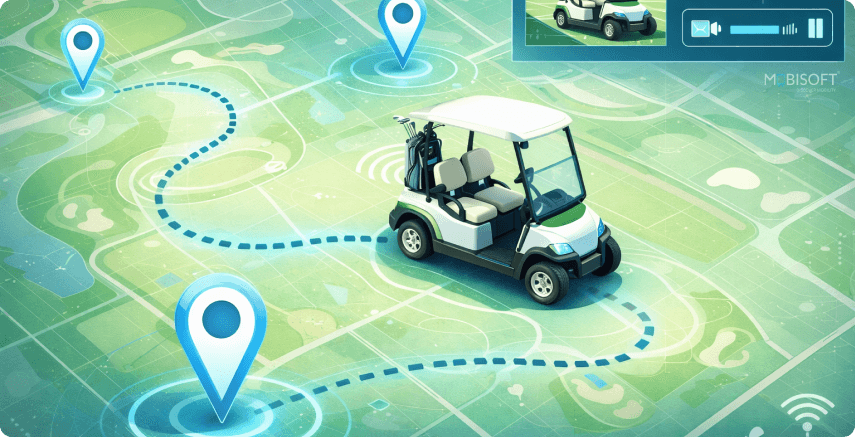
Owning multiple carts requires you to know their location and availability at all times. The answer, however, is often a guess. This uncertainty creates a false shortage, prompting over-purchasing and stockpiling. Teams waste precious time on scavenger hunts instead of being productive. The asset you paid for is thus not fully yielding its value.
Battery Failures During Daily Operations
Batteries are a major capital expense managed by ritual, not science. You replace them on a rigid schedule or when they fail catastrophically. Both are wasteful. Without understanding the state of charge and health trends through a proper golf cart monitoring system, you cannot predict failure. A dead cart during operations isn’t bad luck. It is a predictable event you chose not to see coming.
Reactive Maintenance in Golf Cart Fleets
Maintenance becomes urgent, not planned. Without data from a centralized golf cart management system, you fix what breaks, not what is about to break. This guarantees downtime will strike at peak demand, incurring premium repair costs and frustrating staff. It is the most expensive way to care for your assets.
Unauthorized or After-Hours Golf Cart Usage
A shared key or clipboard log creates ambiguity. When misuse or damage occurs, tracing it becomes a futile, morale-draining investigation. This gap erodes care standards. People treat shared assets less responsibly when their use is anonymous, increasing the need for a dependable golf cart security system. The fleet’s condition slowly degrades, and the cost is borne by everyone and no one.
Lack of Visibility into Golf Cart Usage Patterns
This is a strategic failure. You cannot say if your fleet is too large or too small. You know peak demand accounts, but not true utilization patterns without golf cart usage tracking. This leads to capital tied up in underused assets, or to operational gridlock. You are managing a significant budget line with intuition, not insight.
Where Technology Comes In
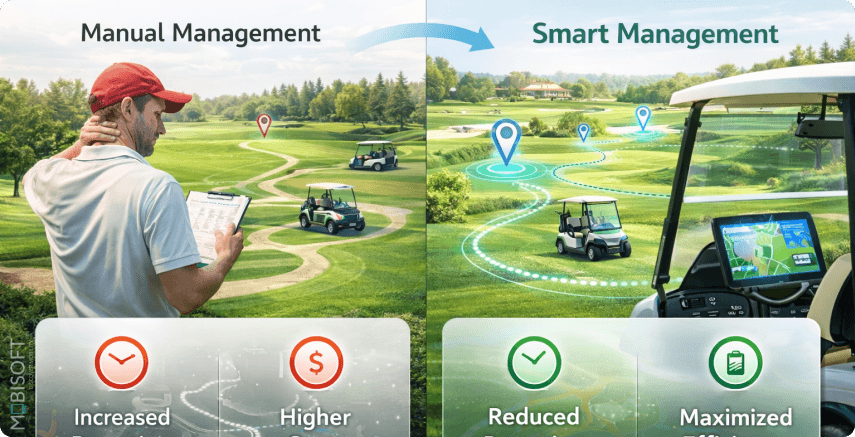
Modern golf cart management has quietly become an IoT + software + automation success story. Here’s what’s reshaping the industry:
Real-Time Location Tracking
- This is the most immediate change. A small telematics device enables golf cart GPS tracking, ending the daily search, with a dashboard to check on a live map.
- You know its location, its movement, even its idle status. Geofencing creates virtual boundaries. If a cart crosses one, you receive an alert.
- This eliminates unauthorized trips off the property. It also streamlines operations, making dispatch efficient across golf course fleet management environments.
Smart Battery Monitoring
- Sensors monitor voltage, temperature, and charge cycles in real time. The system does not just show a battery level, but analyzes health trends as well using golf cart telematics.
- It can warn you that a specific battery is likely to fail next week. This allows you to schedule a swap during downtime. You stop losing a cart in the middle of a busy afternoon.
- Most importantly, you learn how usage patterns affect longevity. You can adjust charging routines to extend life.
- This turns a major capital expense from a surprise into a planned, manageable event.
Keyless Access & Digitalisation
- Conventional keys represent shared access and zero accountability. Digital access control changes that. A staff member uses a phone app, or the guest scans a QR code through modern golf cart rental management software.
- The system logs who unlocked which cart and when. It creates a clear, unbreakable chain of custody. This simple change elevates responsibility.
- People treat assets differently when their name is attached to the usage. Misuse drops sharply. Lost keys become a non-issue.
- The process feels modern, which subtly improves the perception of your entire operation.
Predictive Maintenance Using AI
- The system learns the normal performance of each cart, including its motor performance, typical battery draw, and even vibration patterns.
- It establishes a baseline to watch for anomalies. A subtle change in controller temperature can signal a coming failure.
- The system flags it weeks before a breakdown. Your maintenance goes from reactive to predictive, allowing you to schedule service at your convenience.
- You manage parts inventory proactively. This reliability becomes a silent competitive advantage for your daily workflow.
Driver Behavior & Safety Insights
- Telematics data shows harsh acceleration, abrupt stops, and sharp turns. You might discover specific zones where speeding is common.
- This type of coaching enhances safety and reduces liability. You can use this objective data to refine training programs.
- You can also identify and correct risky habits before they cause an incident. This protects your people, your guests, and your organization.
- It turns safety from a generic talking point into a documented, improvable metric.
Fleet Optimization Through Data
- All this information flows into a central analytics platform supported by smart fleet management principles. It tells you everything, including utilization rates for each cart by hour, day, or season.
- You discover that you only need sixty carts for a peak event, not eighty. You see which models are most reliable under your specific conditions.
- This data informs critical decisions, guiding the right-sizing of your fleet for capital budgets. It justifies maintenance spending with clear ROI.
- It turns the cart fleet from a cost center into a strategically tuned asset. You stop guessing and start deciding.
This transformation is powered by connected systems built through IoT development services for smart fleet management, enabling real-time data flow between vehicles, sensors, and dashboards.
Different Use Cases, One Core Golf Cart Management Challenge
The vehicles might serve different people in different settings, where their needs seem unique. Yet the operational burden on management is strikingly similar. Here is how those universal pains manifest across sectors relying on effective golf cart fleet management.
- A luxury resort focuses on guest delight, but a misplaced cart or a dead battery means a delayed arrival. That moment of friction subtly tarnishes the experience you worked so hard to create without proper golf cart management visibility.
- A hospital coordinates patient movement where timing and reliability are non-negotiable. An unaccounted-for vehicle or an unexpected breakdown isn't an inconvenience. It disrupts critical care logistics.
- An airport uses carts for last-mile passenger assistance, often for elderly or mobility-impaired travelers. When a cart is not where it should be, it creates visible congestion and stresses your staff during already peak times.
- A university campus relies on these vehicles for security patrols, facility maintenance, and staff transport across acres of ground. Inefficient management here directly slows response times and stretches manpower without structured golf cart usage tracking.
- An industrial park needs predictable mobility for personnel and equipment between warehouses or docks. The hidden cost of reactive maintenance and poor utilization here translates into slowed throughput and missed timelines, often due to limited smart fleet management practices.
- A golf course manages the delicate flow of play. Cart availability and routing are central to pace and revenue. Without insight, you are making crucial decisions blindly, potentially affecting guest satisfaction and daily turnover.
- A theme park or stadium uses carts for internal operations, vendor support, and guest assistance. Optimal flow is everything. A mismanaged fleet creates internal bottlenecks that can, eventually, impact the public experience without a reliable golf cart tracking system.
The common thread is not the user. It is the foundational need for readiness, accountability, and data. Each operation requires vehicles to be available, functional, and used properly. Each suffers when they are not. The core problem is always a gap between reliance and control. Technology bridges that gap not by changing the cart's purpose, but by guaranteeing its reliable service.
What a Modern Golf Cart Management System Looks Like
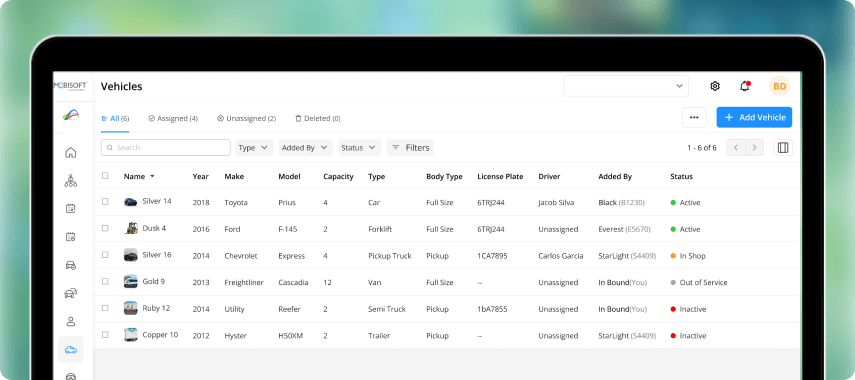
A complete digital solution typically includes:
IoT Tracking Devices for Golf Cart Telematics
These are the silent sentinels on each vehicle. We are not just talking about a simple GPS tag here. A modern device is a sophisticated sensor suite supporting golf cart GPS tracking. It captures location, yes, but also monitors the cart's vital signs. It tracks battery voltage and health in real time. It can sense motion and even diagnose potential faults in the motor or controller. This constant stream of raw data is the foundation for golf cart telematics. Without these accurate, reliable sensors, any system would be built on sand. They provide the truth about what is happening out on the property.
Cloud-Based Dashboard for Golf Cart Monitoring
This is your mission control. The data from all those sensors flows here, into a centralized platform that functions as a golf cart monitoring system. The magic is in the presentation. A good dashboard turns raw data into intuitive visuals. You see a live map, color-coded status alerts, and clean charts showing utilization. It allows you to set custom geofences with a few clicks. You configure alerts for low battery or unauthorized movement. The value is instant clarity. At a glance, you understand the entire fleet's status. This becomes your primary tool for daily decision-making, replacing radio calls and guesswork.
Mobile Apps for Golf Cart Operations and Rentals
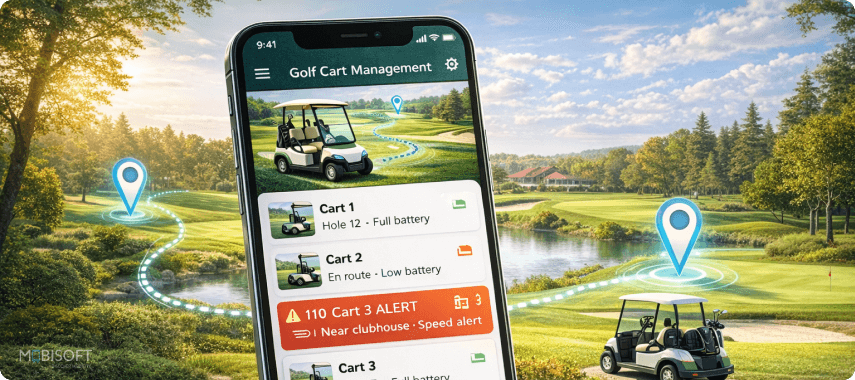
Operations are mobile, so management must be as well. Staff apps allow for quick digital checkout of a cart using a phone, often integrated with golf cart rental management software. Maintenance techs can receive fault alerts and update work order status from the field. In some implementations, guests might use a simple app to unlock a cart for rental. The goal is to bring the system's functionality directly to the point of action. This removes paper processes and reduces walk-time. It embeds the new management protocol directly into the existing workflow, making adoption natural and simple.
Digital Access Control and Golf Cart Security
This component physically enforces your policy. It replaces the traditional key with a digital key set commonly used in a golf cart security system. Access can be granted via QR codes, RFID badges, or smartphone taps. The system can be programmed with permissions. Perhaps only maintenance staff can access certain utility vehicles. Every unlock event is logged with a user ID and timestamp, strengthening accountability. This eliminates key control headaches and builds an automatic audit trail for every single use. It is the tangible point where policy meets practice.
Maintenance Module for Proactive Cart Management
This is the organized memory for your fleet's health. It goes beyond a simple spreadsheet of past repairs and supports structured golf cart maintenance management. The module automatically logs fault codes from the IoT devices. It tracks service history for each cart and generates upcoming maintenance schedules based on actual usage hours. It can even hold digital records of work orders and parts used. This creates a proactive, predictable maintenance rhythm. Your team transitions from firefighters to planners. The entire cost of care becomes visible and manageable.
Analytics and Reporting for Fleet-Level Insights
Here is where intelligence becomes insight. The system does not just store data; it analyzes it over time. It can show you utilization trends by season, by day of the week, or by hour. You can see energy consumption patterns or compare the performance of different cart models. This allows for strategic reporting. You can generate a report to justify fleet right-sizing for the finance committee. You can prove the ROI of your new maintenance schedule. This module turns operational data into executive-level business intelligence.
System Integrations for End-to-End Fleet Management
A system living in isolation is limited. Its true power is unlocked when it connects to the other software you already use. Smooth integrations with your Property Management System, your ERP software, or your guest portals are key. This allows cart reservations to flow automatically from a booking. It enables maintenance costs to be logged directly to a financial ledger. It creates a seamless experience where the cart management system is not another silo, but a connected part of your broader operational infrastructure.
It’s everything you need to move from reactive to proactive, from “organizing carts” to strategically managing a mobility fleet. Purpose-built mobile apps for golf cart tracking make fleet access, monitoring, and updates seamless for staff on the move.
The ROI: Why Decision-Makers Are Leaning In
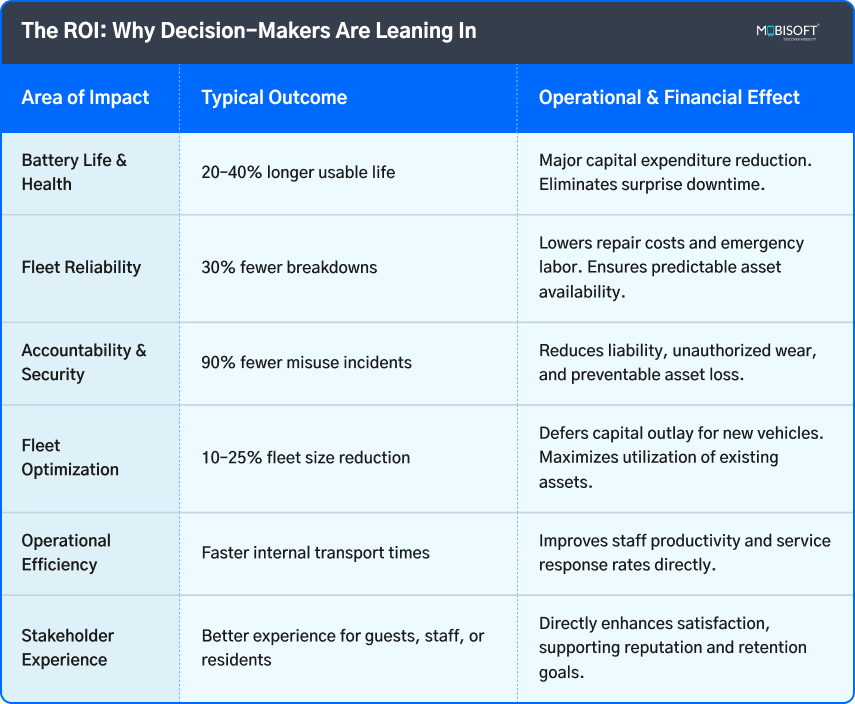
This proactive approach aligns closely with smart maintenance strategies for efficient fleet operations driven by AI and real-world usage data.
The High-Tech Future of Smart and Autonomous Golf Cart Management
The next wave focuses on autonomy and deeper integration. The humble utility vehicle is poised to become an intelligent, connected node in a larger operational system.
- Autonomous Navigation: Carts will begin navigating predefined routes on campuses or within industrial sites independently, freeing staff for more complex tasks.
- Predictive AI Routing: Systems will analyze real-time pedestrian and vehicle flow to dynamically suggest or assign the most efficient routes, reducing congestion.
- Smart Charging Infrastructure: Chargers will communicate with fleet software to schedule charging during low-rate periods and prioritize carts based on next-day usage forecasts.
- Voice-Assisted Operations: Maintenance and dispatch teams will use natural voice commands to access fleet data or control assets, streamlining hands-busy work.
- Advanced Safety Systems: Integrated sensors and cameras will enable features like collision avoidance, pedestrian detection, and automatic speed reduction in designated zones.
- Digital Twin Integration: Fleet data will feed into a live, virtual model of your entire property, allowing you to simulate and optimize mobility's impact on overall operations.
This evolution moves management from oversight to orchestration. The focus becomes a seamless, intelligent movement integrated directly into the property's strategic blueprint. This reflects the growing shift toward fleet management via mobile applications that keep teams connected beyond fixed dashboards.
The Bottom Line
The essence of modern golf cart management is in changing your perspective. It moves from seeing these vehicles as simple tools to understanding them as a connected, data-generating fleet supported by a comprehensive golf cart monitoring system. This new perspective changes everything. You are no longer just organizing equipment. You are overseeing a vital component of daily operational flow with precision and foresight.
The outcome is a more resilient, efficient, and professionally managed property. The investment in smart technology delivers a clear return, not just in financial terms, but in operational calm and strategic control. For leadership, that is perhaps the most valuable result. You gain a reliable, predictable system that works quietly in the background, enabling everything else to move forward smoothly. That is the quiet advantage of modern management.
For organizations with complex workflows, tailored fleet management system development ensures the platform fits operational realities rather than forcing process changes.
Key Takeaways
- View your carts as the central nervous system for property-wide movement, not isolated vehicles. Their performance directly dictates operational rhythm within golf course fleet management and similar environments.
- Manual management is essentially navigation without a map. You are making critical decisions blindfolded, which invites avoidable expense and disruption without golf cart GPS tracking.
- Modern systems act as an operational transparency layer. They convert physical assets into a stream of actionable, real-time data on a single screen using a centralized golf cart management system.
- The real value lies in transitioning from a firefighting posture to one of graceful foresight. You solve problems before they ever reach the staff or guests through consistent golf cart usage tracking.
- Financial justification comes from the convergence of multiple savings streams. Extended asset life, reduced labor waste, and optimized fleet size together accelerate ROI across golf cart fleet management operations.
- This process unlocks latent value within an existing line item. Your fleet evolves from a simple budget entry into a source of strategic business intelligence.
- Forward integration is the next logical step. These connected vehicles will soon communicate directly with other building and guest systems autonomously through advanced golf cart telematics.
- Adoption ultimately signals a leadership philosophy. It represents a choice to empower teams with clarity and to replace operational uncertainty with confident command.

FAQs
Can the data from this system help us with broader facility planning?
Quite possibly. Granular data on movement patterns and high traffic zones provides unexpected insight. This can inform decisions on pathway maintenance, new facility placement, or even staffing logistics. It turns fleet data from a golf cart tracking system into a planning tool for the entire property's flow.
How does this approach impact our sustainability or ESG reporting metrics?
It offers concrete data points. Extending battery life reduces waste. Optimizing routes and fleet size lowers energy consumption. You can report a reduced carbon footprint from a smaller, efficiently managed fleet supported by smart golf cart technology.
We have seasonal demand spikes. Can the system help manage that volatility?
It is particularly valuable here. Historical utilization data predicts seasonal needs with accuracy. This allows for proactive scheduling of rentals or reallocations, ensuring readiness without permanently overinvesting in fleet size. You manage volatility with data, not guesswork.
What happens if our property has poor cellular or Wi-Fi coverage in some areas?
Modern systems often use multiple network devices that cache data when offline. They transmit stored information once back in coverage. A quality provider will conduct a site survey to ensure the network solution matches your geography, guaranteeing consistent data flow.
How does this affect our insurance and liability posture?
The improved safety and theft prevention features are significant. Providers can often supply loss prevention reports generated through golf cart security system logs. This documented operational diligence can lead to more favorable insurance discussions.
Is there a risk of data overload for our managers?
A well-designed dashboard focuses on exceptions, not noise. It highlights alerts for maintenance, geofence breaches, or low batteries. The goal is to present only what requires action, allowing for calm oversight rather than constant monitoring.

Nitin Lahoti
Read more
Nitin Lahoti is the Co-Founder and Director at Mobisoft Infotech. He has 15 years of experience in Design, Business Development and Startups. His expertise is in Product Ideation, UX/UI design, Startup consulting and mentoring. He prefers business readings and loves traveling.
 Nitin Lahoti
 December 18, 2025